Tryptic Protein Digestion Kits Market
Tryptic Protein Digestion Kits Market Size and Share Forecast Outlook 2026 to 2036
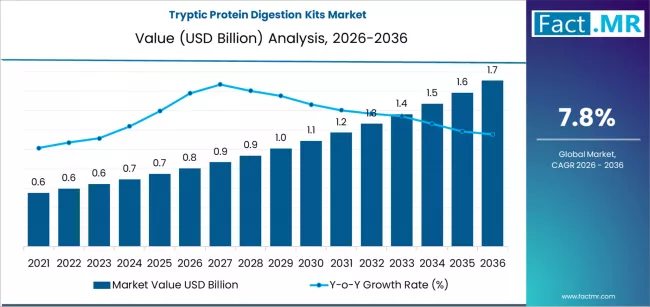
Tryptic protein digestion kits market is projected to grow from USD 0.8 billion in 2026 to USD 1.7 billion by 2036, at a CAGR of 7.8%. Sequencing-grade trypsin reagents will dominate with a 20.9% market share, while discovery proteomics will lead the application segment with a 28.5% share.
Tryptic Protein Digestion Kits Market Forecast and Outlook 2026 to 2036
The global tryptic protein digestion kits market is projected to total USD 0.81 billion in 2026, advancing to USD 1.71 billion by 2036, progressing at a 7.8% CAGR. This growth is rooted in the critical role of trypsin as the gold-standard protease for bottom-up proteomics, a field experiencing sustained expansion. Sequencing-grade trypsin reagents constitute the foundational kit segment, enabling reproducible peptide generation for mass spectrometry analysis.
Key Takeaways from the Tryptic Protein Digestion Kits Market
- Market Value for 2026: USD 0.81 Billion
- Market Value for 2036: USD 1.71 Billion
- Forecast CAGR 2026 to 2036: 7.8%
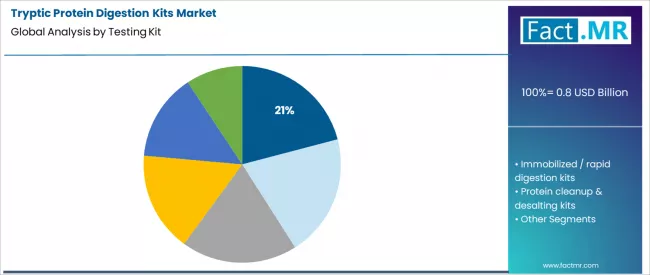
- Leading Testing Kit Segment (2026): Sequencing-Grade Trypsin Reagents (20.9%)
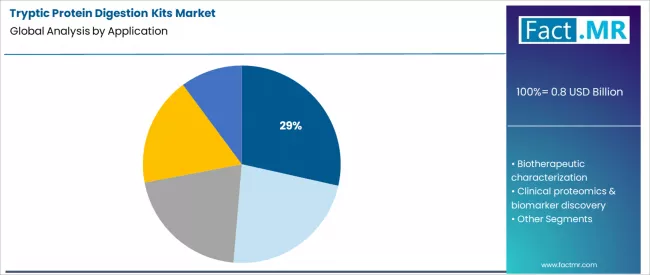
- Leading Application Segment (2026): Discovery Proteomics (28.5%)
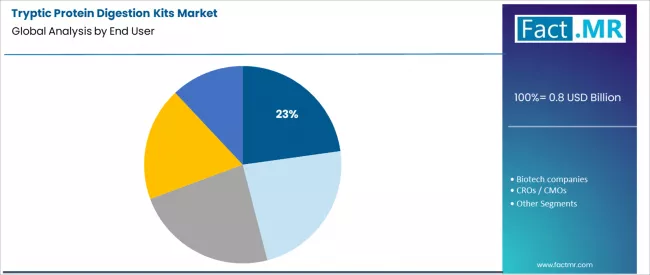
- Leading End User Segment (2026): Biopharma Manufacturers (22.8%)
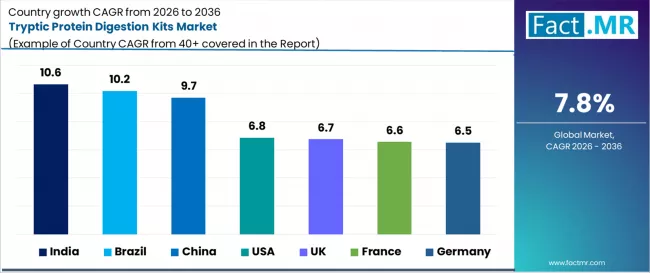
- Key Growth Countries: India (10.6% CAGR), Brazil (10.2% CAGR), China (9.7% CAGR), USA (6.8% CAGR), UK (6.7% CAGR), France (6.6% CAGR), Germany (6.5% CAGR)
- Key Players: Thermo Fisher Scientific Inc., Promega Corporation, Merck & Co. Inc., Waters Corporation, Agilent Technologies Inc.

Discovery proteomics drives the predominant application demand, fueled by the need to map complex proteomes in basic research and disease biology. Biopharma manufacturers represent the leading end-user segment, utilizing these kits for the precise characterization of therapeutic proteins.
Accelerated growth in India, Brazil, and China reflects increasing investments in life science research infrastructure and the local biopharmaceutical sector. The market's progression is further shaped by innovations aimed at improving digestion speed, completeness, and compatibility with automated high-throughput workflows.
Tryptic Protein Digestion Kits Market
| Metric | Value |
|---|---|
| Market Value (2026) | USD 0.81 Billion |
| Market Forecast Value (2036) | USD 1.71 Billion |
| Forecast CAGR 2026 to 2036 | 7.8% |
Category
| Category | Segments |
|---|---|
| Testing Kit | Sequencing-Grade Trypsin Reagents, Immobilized/Rapid Digestion Kits, Protein Cleanup & Desalting Kits, Automation-Compatible Digestion Kits, QC Standards & Reference Peptides, Enzyme Blends & Specialty Proteases |
| Application | Discovery Proteomics, Biotherapeutic Characterization, Clinical Proteomics & Biomarker Discovery, PTM Mapping Workflows, QC/Release Testing |
| End User | Biopharma Manufacturers, Biotech Companies, CROs/CMOs, Academic & Research Institutes, Proteomics Core Facilities |
| Region | North America, Latin America, Western Europe, Eastern Europe, East Asia, South Asia & Pacific, Middle East & Africa |
How are Technological and Industrial Shifts Redefining Sample Preparation in Proteomics?
Increasing throughput of modern mass spectrometers creates a parallel demand for faster, and automated sample preparation workflows. This drives the adoption of immobilized trypsin kits and automation-compatible formats that minimize manual handling and variability.
Rising complexity of biotherapeutics, including antibody-drug conjugates and fusion proteins, necessitates highly reproducible digestion for comprehensive characterization and lot-release testing, elevating kit requirements beyond basic research.
The translation of proteomics into clinical biomarker discovery mandates stringent standardization and the inclusion of QC peptides to ensure data integrity across multicenter studies. Finally, the growth of contract research and manufacturing organizations amplifies demand for reliable, off-the-shelf digestion solutions that ensure consistent results across client projects.
Segmental Analysis
By Testing Kit, Which Product Ensures Reproducibility in High-Sensitivity Analyses?

Sequencing-grade trypsin reagents command a leading 20.9% share. This segment’s prominence is anchored in its role as the essential enzyme for generating peptides suitable for high-resolution mass spectrometry.
The critical requirement for minimal autolysis, high purity, and consistent activity to ensure reproducible peptide maps and quantitation makes this a non-negotiable, recurring purchase for virtually all proteomics laboratories. Its status as the foundational component in the sample preparation workflow secures its substantial and consistent market volume.
By Application, Where does the Broadest Research Demand Originate?

Discovery proteomics constitutes the primary application segment at 28.5%. This field encompasses the large-scale identification and quantification of proteins in complex biological samples, forming the basis for much of modern biological research.
The expansive and growing number of research projects in academia and industry aimed at understanding disease mechanisms, signaling pathways, and cellular responses generates sustained, high-volume consumption of reliable digestion kits, establishing this as the largest application driver.
By End User, Which Sector Combines High-Volume Use with Stringent Quality Requirements?

Biopharma manufacturers hold a leading 22.8% share. This segment utilizes tryptic digestion kits extensively for the detailed characterization of protein-based therapeutics, a regulatory requirement for product development and quality control. T
he need for validated, robust, and scalable digestion protocols to ensure product consistency and safety translates into significant procurement of high-grade kits and supporting desalting or cleanup products, making biopharma a critical, quality-focused customer base.
What are the Drivers, Restraints, Opportunities, and Trends Impacting the Market for Tryptic Protein Digestion Kits?
| Attribute | Impact |
|---|---|
| Driver | Exponential growth in proteomics research and the expanding pipeline of complex biopharmaceuticals requiring detailed structural analysis. |
| Restraint | Incomplete digestion or digestion-induced artifacts (e.g., deamidation, oxidation) that can compromise downstream mass spectrometry data quality and reproducibility. |
| Opportunity | Development of novel enzyme blends and specialty proteases that offer complementary cleavage profiles for deeper proteome coverage and analysis of "undigestible" regions. |
| Trend | Integration of protein cleanup, reduction, alkylation, and digestion into single, streamlined spin-column or plate-based kits to minimize sample loss and hands-on time. |
Analysis of the Tryptic Protein Digestion Kits Market by Key Countries

| Country | CAGR 2026 to 2036 |
|---|---|
| USA | 6.8% |
| Germany | 6.5% |
| China | 9.7% |
| India | 10.6% |
| Brazil | 10.2% |
| France | 6.6% |
| UK | 6.7% |
What Characteristics define the USA's Mature yet Innovative Research Ecosystem?
A 6.8% CAGR is supported by a dense concentration of leading academic research institutions, large biopharmaceutical corporations, and core proteomics facilities. Demand is driven by the adoption of cutting-edge, high-throughput workflows and the stringent characterization needs of the advanced biologics pipeline, favoring high-purity, automation-friendly kit formats and specialized enzymes for challenging applications.
How does Germany's Focus on Precision and Process Reliability Shape Demand?
Germany's 6.5% CAGR reflects the country's emphasis on high-precision analytical methods in both academic and industrial research. The market values kits that deliver exceptional reproducibility and are supported by detailed technical data, aligning with the rigorous standards of German engineering and pharmaceutical manufacturing. Demand is consistent from university core facilities and industrial R&D departments.
Which Dynamics Underpin China's Rapid Expansion in Life Sciences Research?
China's 9.7% CAGR is fueled by massive, sustained government and private investment in life sciences, leading to the establishment of new research institutes and the growth of domestic biotech.
This expansion equips laboratories with modern mass spectrometers, creating a corresponding surge in demand for the essential sample preparation consumables, including trypsin kits, to support the country's ambitious research output goals.
Why is India's Growth Trajectory Linked to Biopharma and Academic Investment?
India's leading 10.6% CAGR is propelled by the dual expansion of its generic and biosimilar pharmaceutical industry and a significant increase in publicly funded academic research. The need for reliable, cost-effective proteomics tools for drug characterization and discovery is rising sharply, driving adoption across both industrial and university laboratories and creating a high-growth environment for kit suppliers.
How is Brazil's Developing Research Infrastructure Influencing Market Entry?
Brazil's 10.2% CAGR is connected to the gradual strengthening of its scientific infrastructure and a growing focus on local biotechnology development. New research grants and partnerships are equipping laboratories, creating an entry-point market for reliable, mid-tier digestion kits. Growth is focused on establishing foundational proteomics capabilities in key research centers and universities.
What Role does France's Network of Core Facilities Play in Market Dynamics?
France's 6.6% CAGR benefits from a well-organized network of regional proteomics core facilities that provide centralized services to multiple research groups. This model drives consolidated, volume-based purchasing of standardized, high-quality digestion kits to ensure service consistency. The market is characterized by demand for kits that balance performance with cost-efficiency for shared resource environments.
How does the UK's Research Grant and Biotech Landscape Guide Procurement?
A competitive research grant environment and a vibrant biotech startup sector influence the UK’s 6.7% CAGR. Procurement is often project-based, favoring kits that offer speed and reliability to accelerate research timelines. The presence of world-leading proteomics research groups also drives early adoption of innovative kit technologies, such as those enabling rapid or low-input digestion.
Competitive Landscape of the Tryptic Protein Digestion Kits Market
The competitive landscape features a mix of large, broad-based life science suppliers and specialized proteomics companies. Leaders like Thermo Fisher Scientific and Merck compete through extensive distribution networks and bundled offerings that include mass spectrometers, columns, and consumables.
Specialized firms like Promega compete based on enzyme engineering, offering high-activity, modified trypsins and optimized buffer systems. Success hinges on demonstrating superior digestion efficiency, reproducibility, and support for challenging samples, as well as providing robust technical data and application notes that integrate kits into complete proteomics workflows.
Key Players in the Tryptic Protein Digestion Kits Market
- Thermo Fisher Scientific Inc.
- Promega Corporation
- Merck & Co. Inc.
- Waters Corporation
- Agilent Technologies Inc.
- Others
Scope of Report
| Items | Metrics |
|---|---|
| Quantitative Units | USD Billion |
| Testing Kit | Sequencing-Grade Trypsin, Immobilized/Rapid Kits, Cleanup Kits, Automation Kits, QC Standards, Enzyme Blends |
| Application | Discovery Proteomics, Biotherapeutic Characterization, Clinical Proteomics, PTM Mapping, QC Testing |
| End User | Biopharma Manufacturers, Biotech Companies, CROs/CMOs, Academic Institutes, Core Facilities |
| Key Countries | India, Brazil, China, USA, UK, France, Germany |
| Key Companies | Thermo Fisher Scientific Inc., Promega Corporation, Merck & Co. Inc., Waters Corporation, Agilent Technologies Inc. |
| Additional Analysis | Comparative analysis of digestion efficiency and peptide yield across kit types; impact of protease alternatives (e.g., Lys-C) on sequence coverage; review of automation integration capabilities; cost-per-sample analysis for high-throughput applications. |
Market by Segments
-
Testing Kit :
- Sequencing-Grade Trypsin Reagents
- Immobilized/Rapid Digestion Kits
- Protein Cleanup & Desalting Kits
- Automation-Compatible Digestion Kits
- QC Standards & Reference Peptides
- Enzyme Blends & Specialty Proteases
-
Application :
- Discovery Proteomics
- Biotherapeutic Characterization
- Clinical Proteomics & Biomarker Discovery
- PTM Mapping Workflows
- QC/Release Testing
-
End User :
- Biopharma Manufacturers
- Biotech Companies
- CROs/CMOs
- Academic & Research Institutes
- Proteomics Core Facilities
-
Region :
- North America
- USA
- Canada
- Latin America
- Brazil
- Mexico
- Argentina
- Rest of Latin America
- Western Europe
- Germany
- France
- UK
- Italy
- Spain
- BENELUX
- Rest of Western Europe
- Eastern Europe
- Poland
- Russia
- Czech Republic
- Rest of Eastern Europe
- East Asia
- China
- Japan
- South Korea
- Rest of East Asia
- South Asia & Pacific
- India
- ASEAN
- Australia & New Zealand
- Rest of South Asia & Pacific
- MEA
- GCC Countries
- South Africa
- Turkiye
- Rest of MEA
- North America
References
- Aebersold, R., & Mann, M. (2023). Mass-spectrometric exploration of proteome structure and function. Nature.
- Bantscheff, M., & Drewes, G. (2024). Mass spectrometry-based proteomics in drug discovery. Current Opinion in Chemical Biology.
- Cottrell, J. S., & London, U. (2025). Protein identification using MS/MS data: The role of database searching and digestion protocols. Journal of Proteome Research.
- Picotti, P., & Aebersold, R. (2024). Selected reaction monitoring-based proteomics: Workflows, potential, pitfalls and future directions. Nature Methods.
- Society for Laboratory Automation and Screening. (2025). Automation in Sample Preparation for Proteomics. SLAS Technology.
- U.S. Pharmacopeia. (2024). General Chapter <1055> Biotechnology-Derived Articles-Peptide Mapping.
Table of Content
- Executive Summary
- Global Market Outlook
- Demand to side Trends
- Supply to side Trends
- Technology Roadmap Analysis
- Analysis and Recommendations
- Market Overview
- Market Coverage / Taxonomy
- Market Definition / Scope / Limitations
- Market Background
- Market Dynamics
- Drivers
- Restraints
- Opportunity
- Trends
- Scenario Forecast
- Demand in Optimistic Scenario
- Demand in Likely Scenario
- Demand in Conservative Scenario
- Opportunity Map Analysis
- Product Life Cycle Analysis
- Supply Chain Analysis
- Investment Feasibility Matrix
- Value Chain Analysis
- PESTLE and Porter’s Analysis
- Regulatory Landscape
- Regional Parent Market Outlook
- Production and Consumption Statistics
- Import and Export Statistics
- Market Dynamics
- Global Market Analysis 2021 to 2025 and Forecast, 2026 to 2036
- Historical Market Size Value (USD Million) Analysis, 2021 to 2025
- Current and Future Market Size Value (USD Million) Projections, 2026 to 2036
- Y to o to Y Growth Trend Analysis
- Absolute $ Opportunity Analysis
- Global Market Pricing Analysis 2021 to 2025 and Forecast 2026 to 2036
- Global Market Analysis 2021 to 2025 and Forecast 2026 to 2036, By Testing Kit
- Introduction / Key Findings
- Historical Market Size Value (USD Million) Analysis By Testing Kit, 2021 to 2025
- Current and Future Market Size Value (USD Million) Analysis and Forecast By Testing Kit, 2026 to 2036
- Sequencing-grade trypsin reagents
- Immobilized / rapid digestion kits
- Protein cleanup & desalting kits
- Automation-compatible digestion kits
- QC standards & reference peptides
- Enzyme blends & specialty proteases
- Sequencing-grade trypsin reagents
- Y to o to Y Growth Trend Analysis By Testing Kit, 2021 to 2025
- Absolute $ Opportunity Analysis By Testing Kit, 2026 to 2036
- Global Market Analysis 2021 to 2025 and Forecast 2026 to 2036, By Application
- Introduction / Key Findings
- Historical Market Size Value (USD Million) Analysis By Application, 2021 to 2025
- Current and Future Market Size Value (USD Million) Analysis and Forecast By Application, 2026 to 2036
- Discovery proteomics
- Biotherapeutic characterization
- Clinical proteomics & biomarker discovery
- PTM mapping workflows
- QC / release testing
- Discovery proteomics
- Y to o to Y Growth Trend Analysis By Application, 2021 to 2025
- Absolute $ Opportunity Analysis By Application, 2026 to 2036
- Global Market Analysis 2021 to 2025 and Forecast 2026 to 2036, By End User
- Introduction / Key Findings
- Historical Market Size Value (USD Million) Analysis By End User, 2021 to 2025
- Current and Future Market Size Value (USD Million) Analysis and Forecast By End User, 2026 to 2036
- Biopharma manufacturers
- Biotech companies
- CROs / CMOs
- Academic & research institutes
- Proteomics core facilities
- Biopharma manufacturers
- Y to o to Y Growth Trend Analysis By End User, 2021 to 2025
- Absolute $ Opportunity Analysis By End User, 2026 to 2036
- Global Market Analysis 2021 to 2025 and Forecast 2026 to 2036, By Region
- Introduction
- Historical Market Size Value (USD Million) Analysis By Region, 2021 to 2025
- Current Market Size Value (USD Million) Analysis and Forecast By Region, 2026 to 2036
- North America
- Latin America
- Western Europe
- Eastern Europe
- East Asia
- South Asia and Pacific
- Middle East & Africa
- Market Attractiveness Analysis By Region
- North America Market Analysis 2021 to 2025 and Forecast 2026 to 2036, By Country
- Historical Market Size Value (USD Million) Trend Analysis By Market Taxonomy, 2021 to 2025
- Market Size Value (USD Million) Forecast By Market Taxonomy, 2026 to 2036
- By Country
- USA
- Canada
- Mexico
- By Testing Kit
- By Application
- By End User
- By Country
- Market Attractiveness Analysis
- By Country
- By Testing Kit
- By Application
- By End User
- Key Takeaways
- Latin America Market Analysis 2021 to 2025 and Forecast 2026 to 2036, By Country
- Historical Market Size Value (USD Million) Trend Analysis By Market Taxonomy, 2021 to 2025
- Market Size Value (USD Million) Forecast By Market Taxonomy, 2026 to 2036
- By Country
- Brazil
- Chile
- Rest of Latin America
- By Testing Kit
- By Application
- By End User
- By Country
- Market Attractiveness Analysis
- By Country
- By Testing Kit
- By Application
- By End User
- Key Takeaways
- Western Europe Market Analysis 2021 to 2025 and Forecast 2026 to 2036, By Country
- Historical Market Size Value (USD Million) Trend Analysis By Market Taxonomy, 2021 to 2025
- Market Size Value (USD Million) Forecast By Market Taxonomy, 2026 to 2036
- By Country
- Germany
- UK
- Italy
- Spain
- France
- Nordic
- BENELUX
- Rest of Western Europe
- By Testing Kit
- By Application
- By End User
- By Country
- Market Attractiveness Analysis
- By Country
- By Testing Kit
- By Application
- By End User
- Key Takeaways
- Eastern Europe Market Analysis 2021 to 2025 and Forecast 2026 to 2036, By Country
- Historical Market Size Value (USD Million) Trend Analysis By Market Taxonomy, 2021 to 2025
- Market Size Value (USD Million) Forecast By Market Taxonomy, 2026 to 2036
- By Country
- Russia
- Poland
- Hungary
- Balkan & Baltic
- Rest of Eastern Europe
- By Testing Kit
- By Application
- By End User
- By Country
- Market Attractiveness Analysis
- By Country
- By Testing Kit
- By Application
- By End User
- Key Takeaways
- East Asia Market Analysis 2021 to 2025 and Forecast 2026 to 2036, By Country
- Historical Market Size Value (USD Million) Trend Analysis By Market Taxonomy, 2021 to 2025
- Market Size Value (USD Million) Forecast By Market Taxonomy, 2026 to 2036
- By Country
- China
- Japan
- South Korea
- By Testing Kit
- By Application
- By End User
- By Country
- Market Attractiveness Analysis
- By Country
- By Testing Kit
- By Application
- By End User
- Key Takeaways
- South Asia and Pacific Market Analysis 2021 to 2025 and Forecast 2026 to 2036, By Country
- Historical Market Size Value (USD Million) Trend Analysis By Market Taxonomy, 2021 to 2025
- Market Size Value (USD Million) Forecast By Market Taxonomy, 2026 to 2036
- By Country
- India
- ASEAN
- Australia & New Zealand
- Rest of South Asia and Pacific
- By Testing Kit
- By Application
- By End User
- By Country
- Market Attractiveness Analysis
- By Country
- By Testing Kit
- By Application
- By End User
- Key Takeaways
- Middle East & Africa Market Analysis 2021 to 2025 and Forecast 2026 to 2036, By Country
- Historical Market Size Value (USD Million) Trend Analysis By Market Taxonomy, 2021 to 2025
- Market Size Value (USD Million) Forecast By Market Taxonomy, 2026 to 2036
- By Country
- Kingdom of Saudi Arabia
- Other GCC Countries
- Turkiye
- South Africa
- Other African Union
- Rest of Middle East & Africa
- By Testing Kit
- By Application
- By End User
- By Country
- Market Attractiveness Analysis
- By Country
- By Testing Kit
- By Application
- By End User
- Key Takeaways
- Key Countries Market Analysis
- USA
- Pricing Analysis
- Market Share Analysis, 2025
- By Testing Kit
- By Application
- By End User
- Canada
- Pricing Analysis
- Market Share Analysis, 2025
- By Testing Kit
- By Application
- By End User
- Mexico
- Pricing Analysis
- Market Share Analysis, 2025
- By Testing Kit
- By Application
- By End User
- Brazil
- Pricing Analysis
- Market Share Analysis, 2025
- By Testing Kit
- By Application
- By End User
- Chile
- Pricing Analysis
- Market Share Analysis, 2025
- By Testing Kit
- By Application
- By End User
- Germany
- Pricing Analysis
- Market Share Analysis, 2025
- By Testing Kit
- By Application
- By End User
- UK
- Pricing Analysis
- Market Share Analysis, 2025
- By Testing Kit
- By Application
- By End User
- Italy
- Pricing Analysis
- Market Share Analysis, 2025
- By Testing Kit
- By Application
- By End User
- Spain
- Pricing Analysis
- Market Share Analysis, 2025
- By Testing Kit
- By Application
- By End User
- France
- Pricing Analysis
- Market Share Analysis, 2025
- By Testing Kit
- By Application
- By End User
- India
- Pricing Analysis
- Market Share Analysis, 2025
- By Testing Kit
- By Application
- By End User
- ASEAN
- Pricing Analysis
- Market Share Analysis, 2025
- By Testing Kit
- By Application
- By End User
- Australia & New Zealand
- Pricing Analysis
- Market Share Analysis, 2025
- By Testing Kit
- By Application
- By End User
- China
- Pricing Analysis
- Market Share Analysis, 2025
- By Testing Kit
- By Application
- By End User
- Japan
- Pricing Analysis
- Market Share Analysis, 2025
- By Testing Kit
- By Application
- By End User
- South Korea
- Pricing Analysis
- Market Share Analysis, 2025
- By Testing Kit
- By Application
- By End User
- Russia
- Pricing Analysis
- Market Share Analysis, 2025
- By Testing Kit
- By Application
- By End User
- Poland
- Pricing Analysis
- Market Share Analysis, 2025
- By Testing Kit
- By Application
- By End User
- Hungary
- Pricing Analysis
- Market Share Analysis, 2025
- By Testing Kit
- By Application
- By End User
- Kingdom of Saudi Arabia
- Pricing Analysis
- Market Share Analysis, 2025
- By Testing Kit
- By Application
- By End User
- Turkiye
- Pricing Analysis
- Market Share Analysis, 2025
- By Testing Kit
- By Application
- By End User
- South Africa
- Pricing Analysis
- Market Share Analysis, 2025
- By Testing Kit
- By Application
- By End User
- USA
- Market Structure Analysis
- Competition Dashboard
- Competition Benchmarking
- Market Share Analysis of Top Players
- By Regional
- By Testing Kit
- By Application
- By End User
- Competition Analysis
- Competition Deep Dive
- Thermo Fisher Scientific Inc.
- Overview
- Product Portfolio
- Profitability by Market Segments (Product/Age /Sales Channel/Region)
- Sales Footprint
- Strategy Overview
- Marketing Strategy
- Product Strategy
- Channel Strategy
- Promega Corporation
- Merck & Co. Inc.
- Waters Corporation
- Agilent Technologies Inc.
- Others
- Thermo Fisher Scientific Inc.
- Competition Deep Dive
- Assumptions & Acronyms Used
- Research Methodology
List Of Table
- Table 1: Global Market Value (USD Million) Forecast by Region, 2021 to 2036
- Table 2: Global Market Value (USD Million) Forecast by Testing Kit, 2021 to 2036
- Table 3: Global Market Value (USD Million) Forecast by Application, 2021 to 2036
- Table 4: Global Market Value (USD Million) Forecast by End User, 2021 to 2036
- Table 5: North America Market Value (USD Million) Forecast by Country, 2021 to 2036
- Table 6: North America Market Value (USD Million) Forecast by Testing Kit, 2021 to 2036
- Table 7: North America Market Value (USD Million) Forecast by Application, 2021 to 2036
- Table 8: North America Market Value (USD Million) Forecast by End User, 2021 to 2036
- Table 9: Latin America Market Value (USD Million) Forecast by Country, 2021 to 2036
- Table 10: Latin America Market Value (USD Million) Forecast by Testing Kit, 2021 to 2036
- Table 11: Latin America Market Value (USD Million) Forecast by Application, 2021 to 2036
- Table 12: Latin America Market Value (USD Million) Forecast by End User, 2021 to 2036
- Table 13: Western Europe Market Value (USD Million) Forecast by Country, 2021 to 2036
- Table 14: Western Europe Market Value (USD Million) Forecast by Testing Kit, 2021 to 2036
- Table 15: Western Europe Market Value (USD Million) Forecast by Application, 2021 to 2036
- Table 16: Western Europe Market Value (USD Million) Forecast by End User, 2021 to 2036
- Table 17: Eastern Europe Market Value (USD Million) Forecast by Country, 2021 to 2036
- Table 18: Eastern Europe Market Value (USD Million) Forecast by Testing Kit, 2021 to 2036
- Table 19: Eastern Europe Market Value (USD Million) Forecast by Application, 2021 to 2036
- Table 20: Eastern Europe Market Value (USD Million) Forecast by End User, 2021 to 2036
- Table 21: East Asia Market Value (USD Million) Forecast by Country, 2021 to 2036
- Table 22: East Asia Market Value (USD Million) Forecast by Testing Kit, 2021 to 2036
- Table 23: East Asia Market Value (USD Million) Forecast by Application, 2021 to 2036
- Table 24: East Asia Market Value (USD Million) Forecast by End User, 2021 to 2036
- Table 25: South Asia and Pacific Market Value (USD Million) Forecast by Country, 2021 to 2036
- Table 26: South Asia and Pacific Market Value (USD Million) Forecast by Testing Kit, 2021 to 2036
- Table 27: South Asia and Pacific Market Value (USD Million) Forecast by Application, 2021 to 2036
- Table 28: South Asia and Pacific Market Value (USD Million) Forecast by End User, 2021 to 2036
- Table 29: Middle East & Africa Market Value (USD Million) Forecast by Country, 2021 to 2036
- Table 30: Middle East & Africa Market Value (USD Million) Forecast by Testing Kit, 2021 to 2036
- Table 31: Middle East & Africa Market Value (USD Million) Forecast by Application, 2021 to 2036
- Table 32: Middle East & Africa Market Value (USD Million) Forecast by End User, 2021 to 2036
List Of Figures
- Figure 1: Global Market Pricing Analysis
- Figure 2: Global Market Value (USD Million) Forecast 2021 to 2036
- Figure 3: Global Market Value Share and BPS Analysis by Testing Kit, 2026 and 2036
- Figure 4: Global Market Y to o to Y Growth Comparison by Testing Kit, 2026 to 2036
- Figure 5: Global Market Attractiveness Analysis by Testing Kit
- Figure 6: Global Market Value Share and BPS Analysis by Application, 2026 and 2036
- Figure 7: Global Market Y to o to Y Growth Comparison by Application, 2026 to 2036
- Figure 8: Global Market Attractiveness Analysis by Application
- Figure 9: Global Market Value Share and BPS Analysis by End User, 2026 and 2036
- Figure 10: Global Market Y to o to Y Growth Comparison by End User, 2026 to 2036
- Figure 11: Global Market Attractiveness Analysis by End User
- Figure 12: Global Market Value (USD Million) Share and BPS Analysis by Region, 2026 and 2036
- Figure 13: Global Market Y to o to Y Growth Comparison by Region, 2026 to 2036
- Figure 14: Global Market Attractiveness Analysis by Region
- Figure 15: North America Market Incremental Dollar Opportunity, 2026 to 2036
- Figure 16: Latin America Market Incremental Dollar Opportunity, 2026 to 2036
- Figure 17: Western Europe Market Incremental Dollar Opportunity, 2026 to 2036
- Figure 18: Eastern Europe Market Incremental Dollar Opportunity, 2026 to 2036
- Figure 19: East Asia Market Incremental Dollar Opportunity, 2026 to 2036
- Figure 20: South Asia and Pacific Market Incremental Dollar Opportunity, 2026 to 2036
- Figure 21: Middle East & Africa Market Incremental Dollar Opportunity, 2026 to 2036
- Figure 22: North America Market Value Share and BPS Analysis by Country, 2026 and 2036
- Figure 23: North America Market Value Share and BPS Analysis by Testing Kit, 2026 and 2036
- Figure 24: North America Market Y to o to Y Growth Comparison by Testing Kit, 2026 to 2036
- Figure 25: North America Market Attractiveness Analysis by Testing Kit
- Figure 26: North America Market Value Share and BPS Analysis by Application, 2026 and 2036
- Figure 27: North America Market Y to o to Y Growth Comparison by Application, 2026 to 2036
- Figure 28: North America Market Attractiveness Analysis by Application
- Figure 29: North America Market Value Share and BPS Analysis by End User, 2026 and 2036
- Figure 30: North America Market Y to o to Y Growth Comparison by End User, 2026 to 2036
- Figure 31: North America Market Attractiveness Analysis by End User
- Figure 32: Latin America Market Value Share and BPS Analysis by Country, 2026 and 2036
- Figure 33: Latin America Market Value Share and BPS Analysis by Testing Kit, 2026 and 2036
- Figure 34: Latin America Market Y to o to Y Growth Comparison by Testing Kit, 2026 to 2036
- Figure 35: Latin America Market Attractiveness Analysis by Testing Kit
- Figure 36: Latin America Market Value Share and BPS Analysis by Application, 2026 and 2036
- Figure 37: Latin America Market Y to o to Y Growth Comparison by Application, 2026 to 2036
- Figure 38: Latin America Market Attractiveness Analysis by Application
- Figure 39: Latin America Market Value Share and BPS Analysis by End User, 2026 and 2036
- Figure 40: Latin America Market Y to o to Y Growth Comparison by End User, 2026 to 2036
- Figure 41: Latin America Market Attractiveness Analysis by End User
- Figure 42: Western Europe Market Value Share and BPS Analysis by Country, 2026 and 2036
- Figure 43: Western Europe Market Value Share and BPS Analysis by Testing Kit, 2026 and 2036
- Figure 44: Western Europe Market Y to o to Y Growth Comparison by Testing Kit, 2026 to 2036
- Figure 45: Western Europe Market Attractiveness Analysis by Testing Kit
- Figure 46: Western Europe Market Value Share and BPS Analysis by Application, 2026 and 2036
- Figure 47: Western Europe Market Y to o to Y Growth Comparison by Application, 2026 to 2036
- Figure 48: Western Europe Market Attractiveness Analysis by Application
- Figure 49: Western Europe Market Value Share and BPS Analysis by End User, 2026 and 2036
- Figure 50: Western Europe Market Y to o to Y Growth Comparison by End User, 2026 to 2036
- Figure 51: Western Europe Market Attractiveness Analysis by End User
- Figure 52: Eastern Europe Market Value Share and BPS Analysis by Country, 2026 and 2036
- Figure 53: Eastern Europe Market Value Share and BPS Analysis by Testing Kit, 2026 and 2036
- Figure 54: Eastern Europe Market Y to o to Y Growth Comparison by Testing Kit, 2026 to 2036
- Figure 55: Eastern Europe Market Attractiveness Analysis by Testing Kit
- Figure 56: Eastern Europe Market Value Share and BPS Analysis by Application, 2026 and 2036
- Figure 57: Eastern Europe Market Y to o to Y Growth Comparison by Application, 2026 to 2036
- Figure 58: Eastern Europe Market Attractiveness Analysis by Application
- Figure 59: Eastern Europe Market Value Share and BPS Analysis by End User, 2026 and 2036
- Figure 60: Eastern Europe Market Y to o to Y Growth Comparison by End User, 2026 to 2036
- Figure 61: Eastern Europe Market Attractiveness Analysis by End User
- Figure 62: East Asia Market Value Share and BPS Analysis by Country, 2026 and 2036
- Figure 63: East Asia Market Value Share and BPS Analysis by Testing Kit, 2026 and 2036
- Figure 64: East Asia Market Y to o to Y Growth Comparison by Testing Kit, 2026 to 2036
- Figure 65: East Asia Market Attractiveness Analysis by Testing Kit
- Figure 66: East Asia Market Value Share and BPS Analysis by Application, 2026 and 2036
- Figure 67: East Asia Market Y to o to Y Growth Comparison by Application, 2026 to 2036
- Figure 68: East Asia Market Attractiveness Analysis by Application
- Figure 69: East Asia Market Value Share and BPS Analysis by End User, 2026 and 2036
- Figure 70: East Asia Market Y to o to Y Growth Comparison by End User, 2026 to 2036
- Figure 71: East Asia Market Attractiveness Analysis by End User
- Figure 72: South Asia and Pacific Market Value Share and BPS Analysis by Country, 2026 and 2036
- Figure 73: South Asia and Pacific Market Value Share and BPS Analysis by Testing Kit, 2026 and 2036
- Figure 74: South Asia and Pacific Market Y to o to Y Growth Comparison by Testing Kit, 2026 to 2036
- Figure 75: South Asia and Pacific Market Attractiveness Analysis by Testing Kit
- Figure 76: South Asia and Pacific Market Value Share and BPS Analysis by Application, 2026 and 2036
- Figure 77: South Asia and Pacific Market Y to o to Y Growth Comparison by Application, 2026 to 2036
- Figure 78: South Asia and Pacific Market Attractiveness Analysis by Application
- Figure 79: South Asia and Pacific Market Value Share and BPS Analysis by End User, 2026 and 2036
- Figure 80: South Asia and Pacific Market Y to o to Y Growth Comparison by End User, 2026 to 2036
- Figure 81: South Asia and Pacific Market Attractiveness Analysis by End User
- Figure 82: Middle East & Africa Market Value Share and BPS Analysis by Country, 2026 and 2036
- Figure 83: Middle East & Africa Market Value Share and BPS Analysis by Testing Kit, 2026 and 2036
- Figure 84: Middle East & Africa Market Y to o to Y Growth Comparison by Testing Kit, 2026 to 2036
- Figure 85: Middle East & Africa Market Attractiveness Analysis by Testing Kit
- Figure 86: Middle East & Africa Market Value Share and BPS Analysis by Application, 2026 and 2036
- Figure 87: Middle East & Africa Market Y to o to Y Growth Comparison by Application, 2026 to 2036
- Figure 88: Middle East & Africa Market Attractiveness Analysis by Application
- Figure 89: Middle East & Africa Market Value Share and BPS Analysis by End User, 2026 and 2036
- Figure 90: Middle East & Africa Market Y to o to Y Growth Comparison by End User, 2026 to 2036
- Figure 91: Middle East & Africa Market Attractiveness Analysis by End User
- Figure 92: Global Market - Tier Structure Analysis
- Figure 93: Global Market - Company Share Analysis
- FAQs -
How big is the tryptic protein digestion kits market in 2026?
The global tryptic protein digestion kits market is estimated to be valued at USD 0.8 billion in 2026.
What will be the size of tryptic protein digestion kits market in 2036?
The market size for the tryptic protein digestion kits market is projected to reach USD 1.7 billion by 2036.
How much will be the tryptic protein digestion kits market growth between 2026 and 2036?
The tryptic protein digestion kits market is expected to grow at a 7.8% CAGR between 2026 and 2036.
What are the key product types in the tryptic protein digestion kits market?
The key product types in tryptic protein digestion kits market are sequencing-grade trypsin reagents, immobilized / rapid digestion kits, protein cleanup & desalting kits, automation-compatible digestion kits, qc standards & reference peptides and enzyme blends & specialty proteases.
Which application segment to contribute significant share in the tryptic protein digestion kits market in 2026?
In terms of application, discovery proteomics segment to command 28.5% share in the tryptic protein digestion kits market in 2026.