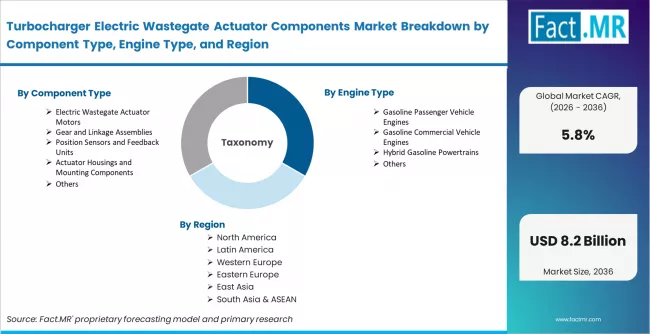
Turbocharger Electric Wastegate Actuator Components Market Size, Share, Growth and Forecast (2026 - 2036)

The Turbocharger Electric Wastegate Actuator Components Market is segmented by Component Type, Engine Type, Turbocharger Type, and Region. Forecast for 2026 to 2036.

Fact.MR analysis indicates that the turbocharger electric wastegate actuator components market is experiencing a precision-versus-emissions shift. Wastegate control is no longer treated as a simple boost-limiting function. It is increasingly judged by how precisely and quickly the actuator can manage turbine bypass flow to improve torque response, catalyst heating, fuel efficiency, and emissions control.

Turbocharger Electric Wastegate Actuator Components Market Forecast and Outlook by Fact.MR

  • In 2025, the turbocharger electric wastegate actuator components market was valued at USD 4.1 billion.
  • Based on Fact.MR analysis, demand for turbocharger electric wastegate actuator components is estimated to grow to USD 4.4 billion in 2026 and USD 7.8 billion by 2036.
  • Fact.MR projects a CAGR of 5.8% during the forecast period.
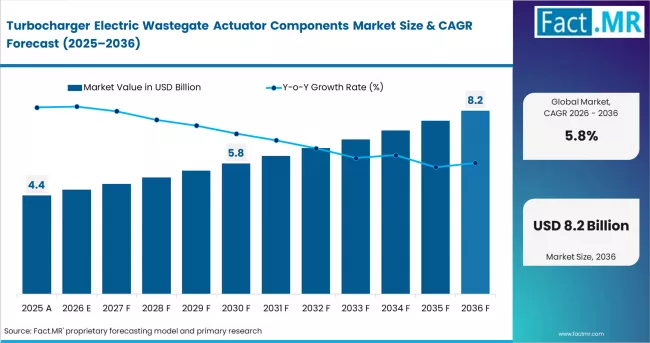
Turbocharger Electric Wastegate Actuator Components Market Value Analysis

Metric Value
Estimated Value in 2026 USD 4.4 billion
Forecast Value in 2036 USD 7.8 billion
Forecast CAGR (2026 to 2036) 5.8%

Summary of the Turbocharger Electric Wastegate Actuator Components Market

  • Market Definition
    • The turbocharger electric wastegate actuator components market includes the motors, gears, linkages, and feedback elements that electronically position the wastegate in a turbocharger system.
  • Demand Drivers
    • OEMs need more precise boost and exhaust-flow control to support emissions and drivability targets.
    • Turbocharged gasoline engines increasingly rely on electronically managed actuation rather than simpler mechanical wastegate control.
    • Hybrid gasoline powertrains still depend on efficient boosting hardware, which preserves demand for precise electric wastegate actuation.
  • Key Segments Analyzed
    • By Component Type: Electric Wastegate Actuator Motors are expected to account for 34.0% share in 2026, supported by their role as the core motion source in the actuator assembly.
    • By Engine Type: Gasoline Passenger Vehicle Engines are projected to hold 58.0% share in 2026 because electric wastegate adoption is strongest in turbocharged gasoline passenger-car applications.
    • By Turbocharger Type: Twin-Scroll Turbocharger Systems are expected to capture 31.0% share in 2026 as modern gasoline engines continue to pair advanced boost layouts with electronically managed wastegate control.
    • By Geography: China leads growth with a 6.4% CAGR through 2036.
  • Analyst Opinion at Fact.MR
    • Shambhu Nath Jha, Senior Analyst at Fact.MR, opines, “The strongest shift in this market is that the electric wastegate actuator is no longer a minor bolt-on to the turbocharger. It is becoming a precision powertrain-control component. Once catalyst heating, torque response, and boost accuracy all depend on actuator speed and position quality, the actuator component set becomes strategically important rather than purely auxiliary.”
  • Strategic Implications
    • Suppliers that combine fast actuation, durable linkage hardware, and stable feedback sensing will be better placed in next-generation turbocharger programs.
    • OEMs need actuator-component vendors that support emissions and drivability calibration, not only mechanical fitment.
    • Aftermarket participants gain more from OE-quality replacement and exact actuator compatibility than from low-cost generic substitution.
  • Methodology
    • Market sizing used turbocharged gasoline-engine production, hybrid mix, and electric wastegate penetration as baseline anchors.
    • Analysis incorporated supplier positioning around turbocharger electric wastegate systems and modular powertrain actuators.
    • Forecasts were checked against current product materials and public market references identifying electrical wastegate actuators as a continuing automotive component category.

The market is projected to create an absolute opportunity of USD 3.4 billion between 2026 and 2036. Growth remains steady because electric wastegate actuation is no longer valued only for boost regulation. It is increasingly valued for faster closed-loop response, better packaging, improved catalyst light-off behavior, and more stable control of gasoline turbocharged engines operating under tighter efficiency and emissions targets. Continental’s official turbocharger brochure states that electric wastegate actuation helps heat the catalytic converter quickly while reducing thermal load through better exhaust-gas control, and its BMW product sheet lists an electric wastegate actuator as a core feature of a modern gasoline turbocharger package. [1]

China is projected to remain the fastest-growing country, with a CAGR of 6.4% by 2036, followed by India at 6.0% and Mexico at 5.8%. Germany is expected to expand at 5.7%, the United States at 5.6%, Japan at 5.2%, and South Korea at 5.0%. Fact.MR views this spread as a reflection of differences in turbocharged gasoline-engine production, hybrid gasoline powertrain rollout, and the pace at which OEMs adopt electronically controlled boosting hardware in cost-sensitive as well as premium applications. Supplier references from Continental and Bosch support the continued relevance of electric wastegate actuation in modern downsized gasoline turbo systems.

Segmental Analysis

Turbocharger Electric Wastegate Actuator Components Market Analysis by Component Type
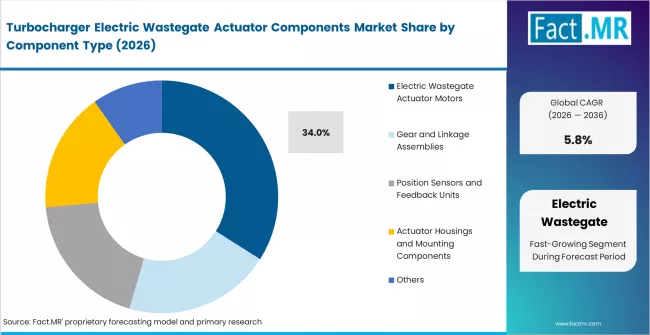
Turbocharger Electric Wastegate Actuator Components Market Analysis By Component Type

Electric wastegate actuator motors are expected to hold 34.0% share in 2026. Their lead comes from the fact that the motor is the primary motion source in the actuator assembly and determines response speed, packaging, and controllability. Bosch’s powertrain actuator materials emphasize scalable electric actuator platforms for increasingly complex powertrain tasks, and Continental’s turbocharger materials clearly identify the electric wastegate actuator as a functional hardware element within the boosting package. That makes the motor the most commercially central component type because the rest of the actuator assembly depends on its output. This segment stays ahead because OEMs can tolerate variation in brackets or housings more easily than weakness in motion precision. Wastegate control needs enough torque, repeatability, and durability to move the bypass mechanism consistently over long thermal cycles. That keeps the motor at the center of component value capture. [4]

  • Execution priority: The motor directly sets actuator responsiveness and positioning capability.
  • Packaging value: Compact electric motors help OEMs fit boosting controls into tighter engine-bay layouts.
  • Durability impact: Long-term actuator reliability depends heavily on motor performance under thermal and vibration stress.

Turbocharger Electric Wastegate Actuator Components Market Analysis by Engine Type
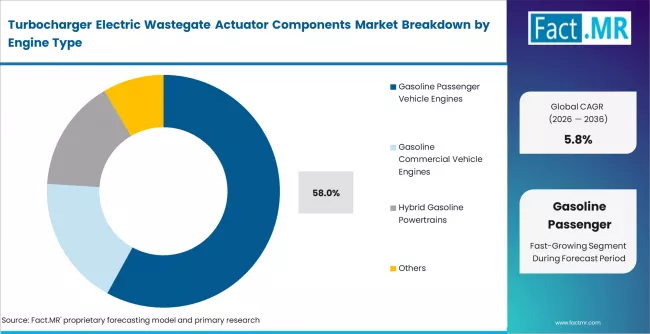
Turbocharger Electric Wastegate Actuator Components Market Analysis By Engine Type

Gasoline passenger vehicle engines are projected to hold 58.0% share in 2026 as the current public references to electric wastegate actuation are most visible in turbocharged gasoline passenger-car engines. Continental’s official BMW turbocharger product sheet explicitly lists an electric wastegate actuator on a gasoline-engine passenger-vehicle turbocharger, and its broader turbocharger brochure links electric wastegate control to catalyst heating and emissions efficiency in downsized passenger-car boosting systems. [5]

  • Commercial readiness: Passenger-car gasoline turbos show the clearest current fitment pattern for electric wastegate control.
  • Emissions pressure: Precise bypass control helps modern gasoline engines meet tighter drivability and catalyst-light-off needs.
  • Volume leverage: Passenger-vehicle scale gives suppliers the clearest path to actuator-component growth.

Turbocharger Electric Wastegate Actuator Components Market Analysis by Turbocharger Type
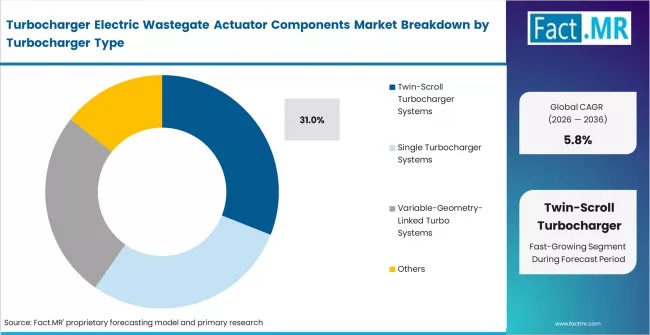
Turbocharger Electric Wastegate Actuator Components Market Analysis By Turbocharger Type

Twin-scroll turbocharger systems are expected to capture 31.0% share in 2026. Their rise comes from the fact that twin-scroll gasoline turbocharging continues to be associated with stronger low-end response, better flow separation, and greater need for accurate bypass control. BorgWarner’s broader turbo materials and Continental’s current turbocharger product positioning both support the continued relevance of advanced gasoline turbo architectures where precise wastegate response matters commercially.

  • Response sensitivity: Advanced turbo layouts gain more from accurate bypass control than simpler boosting setups.
  • Calibration leverage: Electric wastegate hardware gives OEMs more tuning freedom in modern downsized engines.
  • System integration: Twin-scroll layouts fit the broader trend toward higher-value electronically managed boosting systems.

Turbocharger Electric Wastegate Actuator Components Market Drivers, Restraints, and Opportunities
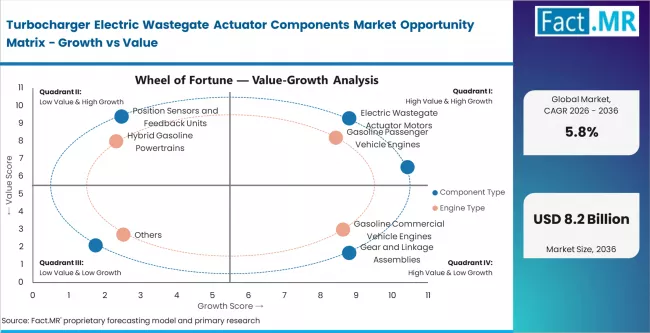
Turbocharger Electric Wastegate Actuator Components Market Opportunity Matrix Growth Vs Value

The strongest market driver is the need for tighter electronic control of turbocharger bypass flow in downsized gasoline engines. Continental’s published material directly links electric wastegate actuation to faster catalyst heating and better thermal management, while Bosch’s powertrain actuator positioning shows why OEMs want fine electric adjustment in increasingly complex combustion and hybrid powertrains. Together these signals support a market where electric wastegate actuator components are pulled by emissions, drivability, and response demands at the same time.

The main restraint is thermal and mechanical durability burden. Electric wastegate actuator components operate near the turbocharger in a high-heat, high-vibration environment where linkage wear, corrosion, and movement precision all matter. Public repair documentation for turbocharger electric wastegate linkage issues in the field highlights the practical service sensitivity of these systems. That means suppliers must deliver precision under heat and vibration without letting cost rise too sharply. [6]

Opportunities in the Turbocharger Electric Wastegate Actuator Components Market

  • Hybrid gasoline growth: Hybrid powertrains that still rely on turbocharged gasoline engines preserve long-term demand for precise electric wastegate hardware. Bosch’s powertrain actuator platform and Vitesco-related public references support this direction.
  • Aftermarket replacement expansion: Installed-vehicle parc growth creates room for OE-quality actuator and linkage replacement demand, especially where field wear becomes visible. The BMW/NHTSA bulletin supports this service pathway.

Higher-value turbo systems: Advanced gasoline turbo applications create more need for stable and fast wastegate actuation, especially where emissions and catalyst behavior are tightly calibrated. Continental’s materials support this opportunity clearly.

Regional Analysis

Based on the regional analysis, the Turbocharger Electric Wastegate Actuator Components Market is segmented into East Asia, Europe, North America, South Asia and Pacific, Latin America, and Middle East and Africa across 40 plus countries.

Top Country Growth Comparison Turbocharger Electric Wastegate Actuator Components Market Cagr (2026 2036)

Country CAGR (2026 to 2036)
China 6.4%
India 6.0%
Mexico 5.8%
Germany 5.7%
United States 5.6%

Source: Fact.MR analysis, based on proprietary forecasting model and primary research
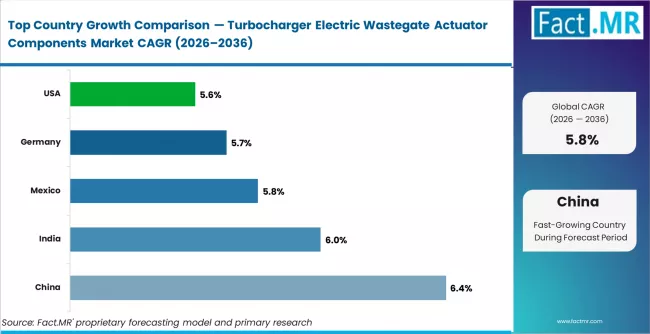
Turbocharger Electric Wastegate Actuator Components Market Cagr Analysis By Country

East Asia Turbocharger Electric Wastegate Actuator Components Market Analysis

East Asia remains the strongest production and adoption base for this market. The region combines high gasoline-engine vehicle output, large hybrid volumes, and strong component-manufacturing depth in boosting and actuation hardware. Bosch’s and Continental’s public materials, together with broader market references identifying electrical wastegate actuators as current automotive products, support the relevance of East Asia as a major base for future growth.

  • China: Turbocharger electric wastegate actuator components demand in China is projected to grow at a CAGR of 6.4% from 2026 to 2036. The market benefits from high gasoline and hybrid vehicle scale, continued turbocharged engine use, and strong component manufacturing capability.

Fact.MR’s report also covers ASEAN, Australia and New Zealand, and other South Asia and Pacific markets. These countries matter where turbocharged gasoline and hybrid vehicle production remains commercially important.

South Asia & Pacific Turbocharger Electric Wastegate Actuator Components Market Analysis

South Asia & Pacific is an emerging growth region where turbocharged gasoline engines and hybrid powertrains continue to expand. Demand is supported by stricter emission norms and increasing adoption of downsized engines.

  • India: India is expected to expand at a 6.0% CAGR through 2036, supported by rising adoption of turbocharged gasoline engines across passenger vehicles and growing hybrid powertrain programs. Emission regulations and fuel-efficiency requirements are encouraging OEMs to adopt more precise boost-control technologies. Demand is particularly strong in compact SUVs and mid-size passenger vehicles, where turbocharging is becoming more common.

Fact.MR’s report also includes ASEAN markets, where similar trends in engine downsizing and emissions compliance are gradually supporting adoption.

North America Turbocharger Electric Wastegate Actuator Components Market Analysis
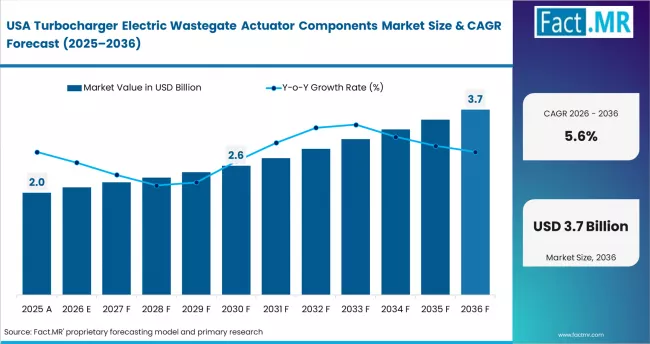
Turbocharger Electric Wastegate Actuator Components Market Country Value Analysis

North America is shaped by continued turbocharged gasoline-engine use in passenger vehicles and a growing service base for electronically controlled boosting hardware. Electric wastegate actuator components matter in this region because they influence drivability, emissions readiness, and replacement complexity in modern downsized engines. Continental’s turbocharger materials and public service references support the significance of this market logic in North American applications.

  • United States: Turbocharger electric wastegate actuator components demand in the United States is projected to rise at a CAGR of 5.6% by 2036. The market is supported by broad turbocharged gasoline-engine presence and a meaningful installed base for replacement and service.
  • Mexico: Mexico is expected to record a CAGR of 5.8% over the assessment period. Its faster growth comes mainly from manufacturing integration into North American gasoline and hybrid powertrain programs.

Fact.MR’s report also includes Canada and the broader North American turbocharged-vehicle ecosystem. Additional value comes from ongoing replacement demand and the persistence of electronically managed boost control in gasoline powertrains.

Europe Turbocharger Electric Wastegate Actuator Components Market Analysis
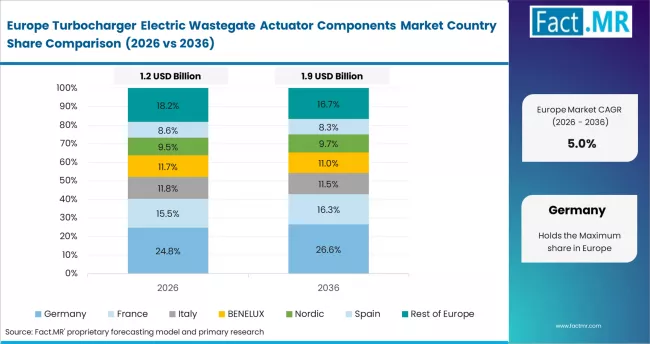
Turbocharger Electric Wastegate Actuator Components Market Europe Country Market Share Analysis, 2026 & 2036

Europe remains a high-discipline market rather than the fastest-growing one. Vehicle makers in the region put strong weight on downsized turbocharged powertrains, emissions efficiency, and precise control of exhaust-energy management. Continental’s European-centered turbocharger product materials and Bosch’s powertrain actuator portfolio reinforce the region’s importance as an engineering and application center for electric wastegate actuation.

  • Germany: Germany is projected to expand at a CAGR of 5.7% through 2036. Its importance comes from turbocharged gasoline-engine engineering depth, supplier capability, and strong demand for precision actuation in advanced powertrains.

Fact.MR’s report also covers France, Italy, the United Kingdom, Spain, and the rest of Europe. These markets add commercial depth through gasoline turbocharger applications and strong requirements around precise emissions-oriented boost control.

Competitive Aligners for Market Players
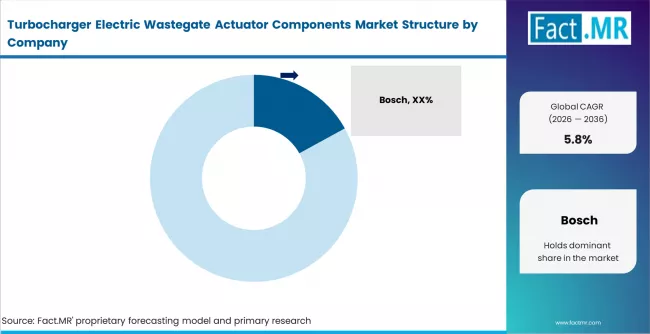
Turbocharger Electric Wastegate Actuator Components Market Analysis By Company

The turbocharger electric wastegate actuator components market is moderately consolidated. Buyers do not choose suppliers only on output force. They choose on thermal durability, position precision, packaging efficiency, linkage robustness, and the ability to support exact engine calibration. Bosch and Continental are especially visible in current public materials because they position electric actuation as an integral part of advanced turbo and powertrain control. Public market references also show continued relevance of electrical wastegate actuators as a recognized automotive component category.

Incumbents hold an advantage because electric wastegate actuation is difficult to separate from the full boosting and emissions-control package. A challenger may offer a workable motor or linkage, but replicating OEM confidence is harder when catalyst behavior, torque response, and wastegate accuracy all depend on tightly integrated actuator performance. That systems requirement keeps the market more selective than a simple small-motor component category. Buyer power still matters, though it is limited by fitment sensitivity and calibration cost. OEMs want better response and emissions behavior, but they also want low risk in components mounted near one of the harshest thermal zones in the powertrain. Through 2036, Fact.MR expects competition to remain rational, with stronger selectivity in OE-quality motors, linkages, and sensor-integrated actuator assemblies.

Key Players in Turbocharger Electric Wastegate Actuator Components Market

  • Bosch
  • Continental
  • BorgWarner
  • Garrett Motion
  • IHI turbocharger-related businesses
  • Hitachi Astemo
  • Denso-related powertrain actuation suppliers
  • Hella-related electronics suppliers
  • Various OE-linked actuator and linkage specialists.

Bibliography

  • [1] Continental Aftermarket. The new turbochargers brochure. Official brochure stating that the catalytic converter is heated very quickly by the electric wastegate actuator.
  • [2] Bosch Mobility. Actuator for powertrain applications. Official page describing modular electric actuators for increasingly complex powertrain solutions.
  • [3] BorgWarner wastegate selection guide and training references. Useful adjacent sources showing legacy mechanical wastegate control context contrasted with the electric actuator category.
  • [4] Bosch Mobility. General-purpose actuator. Official page identifying VTG turbocharger control as an application area requiring fine-tuned adjusting movements.
  • [5] Continental Aftermarket. Turbocharger for 1.5 l longitudinally installed gasoline engines of the BMW Group. Official product sheet listing an electric wastegate actuator.
  • [6] BMW / NHTSA service bulletin. Public service documentation referencing turbocharger electric wastegate linkage repair.

This Report Addresses

  • Strategic demand outlook for turbocharger electric wastegate actuator components across modern boosted gasoline and hybrid powertrains.
  • Market forecast from USD 4.4 billion in 2026 to USD 7.8 billion by 2036.
  • The growing role of electric wastegate motors, linkages, and sensor-feedback hardware in precise boost and catalyst management.
  • The effect of downsized gasoline engines and hybrid gasoline powertrains on actuator-component demand.
  • OEM versus aftermarket demand patterns in a fitment- and calibration-sensitive boosting category.
  • Regional differences in turbocharged-engine output, hybridization, and supplier capability.
  • Competitive positioning of suppliers active in turbo control, powertrain actuation, and related replacement components.
  • Segment analysis by component type, engine type, turbocharger type, sales channel, and geography.

Turbocharger Electric Wastegate Actuator Components Market Definition

The market covers the component-level hardware that electrically actuates the wastegate in a turbocharger system. This includes the motor, gear train, linkage, position-feedback elements, housings, and related mechanical-electronic subassemblies that move and supervise the wastegate flap position.

Turbocharger Electric Wastegate Actuator Components Market Inclusions

The market includes electric wastegate actuator motors, actuator gearsets, linkage pins and arms, sensor-feedback modules, housing brackets, and integrated electric actuator units supplied with or for turbocharger assemblies in gasoline and hybrid-gasoline vehicles. Bosch’s general-purpose actuator material shows electric actuation for turbocharger control functions, and Continental’s official turbocharger documents directly identify electric wastegate actuators in current production-type turbocharger applications. [2]

Turbocharger Electric Wastegate Actuator Components Market Exclusions

The market excludes pneumatic wastegate canisters without electric actuation, full turbocharger rotating assemblies where actuator value cannot be isolated, variable-geometry turbo actuators when sold purely as vane-position systems outside wastegate control, and non-automotive industrial turbo control hardware. BorgWarner’s wastegate selection guide is centered on conventional wastegate canister selection in performance applications, which is adjacent in function but outside the electric actuator component focus defined here. [3]

Turbocharger Electric Wastegate Actuator Components Market Research Methodology

  • Primary Research
    • Interviews with boosting-system engineers, engine air-management specialists, turbocharger integration teams, emissions-calibration engineers, and aftermarket turbo repair distributors.
  • Desk Research
    • Review of official turbocharger brochures, actuator product pages, OEM replacement sheets, and powertrain actuator materials from Continental and Bosch, supplemented by public product and market references identifying electrical wastegate actuators as a current automotive product category.
  • Market-Sizing and Forecasting
    • Fact.MR used a blended model based on turbocharged gasoline-engine production, hybrid gasoline powertrain penetration, electric wastegate adoption, actuator content per turbocharger, and replacement demand in the installed vehicle parc.
  • Data Validation and Update Cycle
    • Forecasts were cross-checked through supplier product positioning, public replacement references, and the increasing use of electronically managed turbo control in modern downsized engines.

Scope of the Report

Turbocharger Electric Wastegate Actuator Components Market Breakdown By Component Type, Engine Type, And Region

Attribute Details
Quantitative Units USD 4.4 billion in 2026 to USD 7.8 billion in 2036, at a CAGR of 5.8%
Market Definition Turbocharger electric wastegate actuator components that electronically position and supervise the wastegate in modern turbocharging systems.
Component Type Segmentation Electric Wastegate Actuator Motors, Gear and Linkage Assemblies, Position Sensors and Feedback Units, Actuator Housings and Mounting Components, Others
Engine Type Segmentation Gasoline Passenger Vehicle Engines, Gasoline Commercial Vehicle Engines, Hybrid Gasoline Powertrains, Others
Turbocharger Type Segmentation Single Turbocharger Systems, Twin-Scroll Turbocharger Systems, Variable-Geometry-Linked Turbo Systems, Others
Sales Channel Segmentation OEM, Aftermarket
Regions Covered East Asia, Europe, North America, South Asia and Pacific, Latin America, Middle East and Africa
Countries Covered China, India, Mexico, Germany, United States, Japan, South Korea, and 40+ countries
Key Companies Profiled Bosch, Continental, BorgWarner, Schaeffler/Vitesco-related businesses, Garrett, IHI, MHI-related businesses, Hitachi Astemo and others
Forecast Period 2026 to 2036
Approach Fact.MR combined primary interviews with turbocharger and powertrain stakeholders, desk research across official supplier materials, and a forecast model anchored in turbocharged-engine production, hybrid mix, and electric wastegate penetration.

Turbocharger Electric Wastegate Actuator Components Market by Segments

  • By Component Type:

    • Electric Wastegate Actuator Motors
    • Gear and Linkage Assemblies
    • Position Sensors and Feedback Units
    • Actuator Housings and Mounting Components
    • Others
  • By Engine Type:

    • Gasoline Passenger Vehicle Engines
    • Gasoline Commercial Vehicle Engines
    • Hybrid Gasoline Powertrains
    • Others
  • By Turbocharger Type:

    • Single Turbocharger Systems
    • Twin-Scroll Turbocharger Systems
    • Variable-Geometry-Linked Turbo Systems
    • Others
  • By Region:

    • North America
      • United States
      • Canada
      • Mexico
    • Latin America
      • Brazil
      • Argentina
      • Rest of Latin America
    • Europe
      • Germany
      • France
      • United Kingdom
      • Italy
      • Spain
      • Rest of Europe
    • East Asia
      • China
      • Japan
      • South Korea
    • South Asia and Pacific
      • India
      • ASEAN
      • Australia and New Zealand
      • Rest of South Asia and Pacific
    • Middle East and Africa
      • GCC Countries
      • South Africa
      • Turkey
      • Rest of Middle East and Africa

- Frequently Asked Questions -

What is the estimated size of the turbocharger electric wastegate actuator components market in 2026?

The market is estimated at USD 4.4 billion in 2026.

How large is the market expected to become by 2036?

Fact.MR estimates the market will reach USD 7.8 billion by 2036.

What is the forecast CAGR for 2026 to 2036?

The market is projected to expand at a CAGR of 5.8% during the forecast period.

Which component type leads the market?

Electric wastegate actuator motors lead the market with an expected 34.0% share in 2026.

Which engine type dominates demand?

Gasoline passenger vehicle engines lead with a projected 58.0% share in 2026, supported by current official fitment visibility in passenger-car turbocharger applications.

Why does the OEM channel dominate?

OEM dominates because electric wastegate actuator behavior is tightly tied to turbocharger packaging, engine calibration, catalyst management, and drivability tuning.

Why are electric wastegate actuator components important here?

They let the engine control bypass flow more precisely than simpler mechanical systems, which supports boost accuracy, catalyst heating, and drivability. Continental’s published materials point directly to these benefits.

What is the strongest demand driver?

The strongest driver is the need for tighter electronically managed boost control in downsized gasoline and hybrid powertrains.

What is the key restraint?

The main restraint is the durability burden created by high heat, vibration, and linkage wear near the turbocharger. Public repair documentation supports the practical importance of this issue.

Which country is growing fastest?

China is the fastest-growing country, with a projected CAGR of 6.4% through 2036.

How do hybrid gasoline powertrains affect this market?

They preserve demand for precise turbocharger control because many hybrid architectures still rely on boosted gasoline engines that need accurate actuator-managed wastegate behavior.

Is this a fragmented supplier market?

No. It is moderately consolidated because buyers value precision actuation, fitment accuracy, and calibration support, not just basic motor hardware.

What do OEM buyers prioritize?

They prioritize response speed, thermal durability, precise feedback, packaging efficiency, and compatibility with the turbocharger and engine-control system.

Why does the aftermarket matter in this segment?

Because wastegate actuator and linkage failures create a clear replacement market tied to exact OE-quality service parts. The BMW/NHTSA repair bulletin is direct evidence of that service reality.

Which companies are most visible in this market?

Bosch and Continental are the clearest currently supported names in official source material used here, with additional public market references pointing to broader supplier participation including Vitesco-related businesses.

Table of Content

  1. Executive Summary
    • Global Market Outlook
    • Demand to side Trends
    • Supply to side Trends
    • Technology Roadmap Analysis
    • Analysis and Recommendations
  2. Market Overview
    • Market Coverage / Taxonomy
    • Market Definition / Scope / Limitations
  3. Research Methodology
    • Chapter Orientation
    • Analytical Lens and Working Hypotheses
      • Market Structure, Signals, and Trend Drivers
      • Benchmarking and Cross-market Comparability
      • Market Sizing, Forecasting, and Opportunity Mapping
    • Research Design and Evidence Framework
      • Desk Research Programme (Secondary Evidence)
        • Company Annual and Sustainability Reports
        • Peer-reviewed Journals and Academic Literature
        • Corporate Websites, Product Literature, and Technical Notes
        • Earnings Decks and Investor Briefings
        • Statutory Filings and Regulatory Disclosures
        • Technical White Papers and Standards Notes
        • Trade Journals, Industry Magazines, and Analyst Briefs
        • Conference Proceedings, Webinars, and Seminar Materials
        • Government Statistics Portals and Public Data Releases
        • Press Releases and Reputable Media Coverage
        • Specialist Newsletters and Curated Briefings
        • Sector Databases and Reference Repositories
        • Fact.MR Internal Proprietary Databases and Historical Market Datasets
        • Subscription Datasets and Paid Sources
        • Social Channels, Communities, and Digital Listening Inputs
        • Additional Desk Sources
      • Expert Input and Fieldwork (Primary Evidence)
        • Primary Modes
          • Qualitative Interviews and Expert Elicitation
          • Quantitative Surveys and Structured Data Capture
          • Blended Approach
        • Why Primary Evidence is Used
        • Field Techniques
          • Interviews
          • Surveys
          • Focus Groups
          • Observational and In-context Research
          • Social and Community Interactions
        • Stakeholder Universe Engaged
          • C-suite Leaders
          • Board Members
          • Presidents and Vice Presidents
          • R&D and Innovation Heads
          • Technical Specialists
          • Domain Subject-matter Experts
          • Scientists
          • Physicians and Other Healthcare Professionals
        • Governance, Ethics, and Data Stewardship
          • Research Ethics
          • Data Integrity and Handling
      • Tooling, Models, and Reference Databases
    • Data Engineering and Model Build
      • Data Acquisition and Ingestion
      • Cleaning, Normalisation, and Verification
      • Synthesis, Triangulation, and Analysis
    • Quality Assurance and Audit Trail
  4. Market Background
    • Market Dynamics
      • Drivers
      • Restraints
      • Opportunity
      • Trends
    • Scenario Forecast
      • Demand in Optimistic Scenario
      • Demand in Likely Scenario
      • Demand in Conservative Scenario
    • Opportunity Map Analysis
    • Product Life Cycle Analysis
    • Supply Chain Analysis
    • Investment Feasibility Matrix
    • Value Chain Analysis
    • PESTLE and Porter’s Analysis
    • Regulatory Landscape
    • Regional Parent Market Outlook
    • Production and Consumption Statistics
    • Import and Export Statistics
  5. Global Market Analysis 2021 to 2025 and Forecast, 2026 to 2036
    • Historical Market Size Value (USD Million) Analysis, 2021 to 2025
    • Current and Future Market Size Value (USD Million) Projections, 2026 to 2036
      • Y to o to Y Growth Trend Analysis
      • Absolute $ Opportunity Analysis
  6. Global Market Pricing Analysis 2021 to 2025 and Forecast 2026 to 2036
  7. Global Market Analysis 2021 to 2025 and Forecast 2026 to 2036, By Component Type
    • Introduction / Key Findings
    • Historical Market Size Value (USD Million) Analysis By Component Type , 2021 to 2025
    • Current and Future Market Size Value (USD Million) Analysis and Forecast By Component Type , 2026 to 2036
      • Electric Wastegate Actuator Motors
      • Gear and Linkage Assemblies
      • Position Sensors and Feedback Value (USD Million)s
      • Actuator Housings and Mounting Components
      • Others
    • Y to o to Y Growth Trend Analysis By Component Type , 2021 to 2025
    • Absolute $ Opportunity Analysis By Component Type , 2026 to 2036
  8. Global Market Analysis 2021 to 2025 and Forecast 2026 to 2036, By Engine Type
    • Introduction / Key Findings
    • Historical Market Size Value (USD Million) Analysis By Engine Type, 2021 to 2025
    • Current and Future Market Size Value (USD Million) Analysis and Forecast By Engine Type, 2026 to 2036
      • Gasoline Passenger Vehicle Engines
      • Gasoline Commercial Vehicle Engines
      • Hybrid Gasoline Powertrains
      • Others
    • Y to o to Y Growth Trend Analysis By Engine Type, 2021 to 2025
    • Absolute $ Opportunity Analysis By Engine Type, 2026 to 2036
  9. Global Market Analysis 2021 to 2025 and Forecast 2026 to 2036, By Turbocharger Type
    • Introduction / Key Findings
    • Historical Market Size Value (USD Million) Analysis By Turbocharger Type, 2021 to 2025
    • Current and Future Market Size Value (USD Million) Analysis and Forecast By Turbocharger Type, 2026 to 2036
      • Twin-Scroll Turbocharger Systems
      • Single Turbocharger Systems
      • Variable-Geometry-Linked Turbo Systems
      • Others
    • Y to o to Y Growth Trend Analysis By Turbocharger Type, 2021 to 2025
    • Absolute $ Opportunity Analysis By Turbocharger Type, 2026 to 2036
  10. Global Market Analysis 2021 to 2025 and Forecast 2026 to 2036, By Region
    • Introduction
    • Historical Market Size Value (USD Million) Analysis By Region, 2021 to 2025
    • Current Market Size Value (USD Million) Analysis and Forecast By Region, 2026 to 2036
      • North America
      • Latin America
      • Western Europe
      • Eastern Europe
      • East Asia
      • South Asia and Pacific
      • Middle East & Africa
    • Market Attractiveness Analysis By Region
  11. North America Market Analysis 2021 to 2025 and Forecast 2026 to 2036, By Country
    • Historical Market Size Value (USD Million) Trend Analysis By Market Taxonomy, 2021 to 2025
    • Market Size Value (USD Million) Forecast By Market Taxonomy, 2026 to 2036
      • By Country
        • USA
        • Canada
        • Mexico
      • By Component Type
      • By Engine Type
      • By Turbocharger Type
    • Market Attractiveness Analysis
      • By Country
      • By Component Type
      • By Engine Type
      • By Turbocharger Type
    • Key Takeaways
  12. Latin America Market Analysis 2021 to 2025 and Forecast 2026 to 2036, By Country
    • Historical Market Size Value (USD Million) Trend Analysis By Market Taxonomy, 2021 to 2025
    • Market Size Value (USD Million) Forecast By Market Taxonomy, 2026 to 2036
      • By Country
        • Brazil
        • Chile
        • Rest of Latin America
      • By Component Type
      • By Engine Type
      • By Turbocharger Type
    • Market Attractiveness Analysis
      • By Country
      • By Component Type
      • By Engine Type
      • By Turbocharger Type
    • Key Takeaways
  13. Western Europe Market Analysis 2021 to 2025 and Forecast 2026 to 2036, By Country
    • Historical Market Size Value (USD Million) Trend Analysis By Market Taxonomy, 2021 to 2025
    • Market Size Value (USD Million) Forecast By Market Taxonomy, 2026 to 2036
      • By Country
        • Germany
        • UK
        • Italy
        • Spain
        • France
        • Nordic
        • BENELUX
        • Rest of Western Europe
      • By Component Type
      • By Engine Type
      • By Turbocharger Type
    • Market Attractiveness Analysis
      • By Country
      • By Component Type
      • By Engine Type
      • By Turbocharger Type
    • Key Takeaways
  14. Eastern Europe Market Analysis 2021 to 2025 and Forecast 2026 to 2036, By Country
    • Historical Market Size Value (USD Million) Trend Analysis By Market Taxonomy, 2021 to 2025
    • Market Size Value (USD Million) Forecast By Market Taxonomy, 2026 to 2036
      • By Country
        • Russia
        • Poland
        • Hungary
        • Balkan & Baltic
        • Rest of Eastern Europe
      • By Component Type
      • By Engine Type
      • By Turbocharger Type
    • Market Attractiveness Analysis
      • By Country
      • By Component Type
      • By Engine Type
      • By Turbocharger Type
    • Key Takeaways
  15. East Asia Market Analysis 2021 to 2025 and Forecast 2026 to 2036, By Country
    • Historical Market Size Value (USD Million) Trend Analysis By Market Taxonomy, 2021 to 2025
    • Market Size Value (USD Million) Forecast By Market Taxonomy, 2026 to 2036
      • By Country
        • China
        • Japan
        • South Korea
      • By Component Type
      • By Engine Type
      • By Turbocharger Type
    • Market Attractiveness Analysis
      • By Country
      • By Component Type
      • By Engine Type
      • By Turbocharger Type
    • Key Takeaways
  16. South Asia and Pacific Market Analysis 2021 to 2025 and Forecast 2026 to 2036, By Country
    • Historical Market Size Value (USD Million) Trend Analysis By Market Taxonomy, 2021 to 2025
    • Market Size Value (USD Million) Forecast By Market Taxonomy, 2026 to 2036
      • By Country
        • India
        • ASEAN
        • Australia & New Zealand
        • Rest of South Asia and Pacific
      • By Component Type
      • By Engine Type
      • By Turbocharger Type
    • Market Attractiveness Analysis
      • By Country
      • By Component Type
      • By Engine Type
      • By Turbocharger Type
    • Key Takeaways
  17. Middle East & Africa Market Analysis 2021 to 2025 and Forecast 2026 to 2036, By Country
    • Historical Market Size Value (USD Million) Trend Analysis By Market Taxonomy, 2021 to 2025
    • Market Size Value (USD Million) Forecast By Market Taxonomy, 2026 to 2036
      • By Country
        • Kingdom of Saudi Arabia
        • Other GCC Countries
        • Turkiye
        • South Africa
        • Other African Union
        • Rest of Middle East & Africa
      • By Component Type
      • By Engine Type
      • By Turbocharger Type
    • Market Attractiveness Analysis
      • By Country
      • By Component Type
      • By Engine Type
      • By Turbocharger Type
    • Key Takeaways
  18. Key Countries Market Analysis
    • USA
      • Pricing Analysis
      • Market Share Analysis, 2025
        • By Component Type
        • By Engine Type
        • By Turbocharger Type
    • Canada
      • Pricing Analysis
      • Market Share Analysis, 2025
        • By Component Type
        • By Engine Type
        • By Turbocharger Type
    • Mexico
      • Pricing Analysis
      • Market Share Analysis, 2025
        • By Component Type
        • By Engine Type
        • By Turbocharger Type
    • Brazil
      • Pricing Analysis
      • Market Share Analysis, 2025
        • By Component Type
        • By Engine Type
        • By Turbocharger Type
    • Chile
      • Pricing Analysis
      • Market Share Analysis, 2025
        • By Component Type
        • By Engine Type
        • By Turbocharger Type
    • Germany
      • Pricing Analysis
      • Market Share Analysis, 2025
        • By Component Type
        • By Engine Type
        • By Turbocharger Type
    • UK
      • Pricing Analysis
      • Market Share Analysis, 2025
        • By Component Type
        • By Engine Type
        • By Turbocharger Type
    • Italy
      • Pricing Analysis
      • Market Share Analysis, 2025
        • By Component Type
        • By Engine Type
        • By Turbocharger Type
    • Spain
      • Pricing Analysis
      • Market Share Analysis, 2025
        • By Component Type
        • By Engine Type
        • By Turbocharger Type
    • France
      • Pricing Analysis
      • Market Share Analysis, 2025
        • By Component Type
        • By Engine Type
        • By Turbocharger Type
    • India
      • Pricing Analysis
      • Market Share Analysis, 2025
        • By Component Type
        • By Engine Type
        • By Turbocharger Type
    • ASEAN
      • Pricing Analysis
      • Market Share Analysis, 2025
        • By Component Type
        • By Engine Type
        • By Turbocharger Type
    • Australia & New Zealand
      • Pricing Analysis
      • Market Share Analysis, 2025
        • By Component Type
        • By Engine Type
        • By Turbocharger Type
    • China
      • Pricing Analysis
      • Market Share Analysis, 2025
        • By Component Type
        • By Engine Type
        • By Turbocharger Type
    • Japan
      • Pricing Analysis
      • Market Share Analysis, 2025
        • By Component Type
        • By Engine Type
        • By Turbocharger Type
    • South Korea
      • Pricing Analysis
      • Market Share Analysis, 2025
        • By Component Type
        • By Engine Type
        • By Turbocharger Type
    • Russia
      • Pricing Analysis
      • Market Share Analysis, 2025
        • By Component Type
        • By Engine Type
        • By Turbocharger Type
    • Poland
      • Pricing Analysis
      • Market Share Analysis, 2025
        • By Component Type
        • By Engine Type
        • By Turbocharger Type
    • Hungary
      • Pricing Analysis
      • Market Share Analysis, 2025
        • By Component Type
        • By Engine Type
        • By Turbocharger Type
    • Kingdom of Saudi Arabia
      • Pricing Analysis
      • Market Share Analysis, 2025
        • By Component Type
        • By Engine Type
        • By Turbocharger Type
    • Turkiye
      • Pricing Analysis
      • Market Share Analysis, 2025
        • By Component Type
        • By Engine Type
        • By Turbocharger Type
    • South Africa
      • Pricing Analysis
      • Market Share Analysis, 2025
        • By Component Type
        • By Engine Type
        • By Turbocharger Type
  19. Market Structure Analysis
    • Competition Dashboard
    • Competition Benchmarking
    • Market Share Analysis of Top Players
      • By Regional
      • By Component Type
      • By Engine Type
      • By Turbocharger Type
  20. Competition Analysis
    • Competition Deep Dive
      • Bosch
        • Overview
        • Product Portfolio
        • Profitability by Market Segments (Product/Age /Sales Channel/Region)
        • Sales Footprint
        • Strategy Overview
          • Marketing Strategy
          • Product Strategy
          • Channel Strategy
      • Continental
      • BorgWarner
      • Garrett Motion
      • IHI turbocharger-related businesses
      • Hitachi Astemo
      • Denso-related powertrain actuation suppliers
      • Hella-related electronics suppliers
      • Various OE-linked actuator and linkage specialists
  21. Assumptions & Acronyms Used

List Of Table

  • Table 1: Global Market Value (USD Million) Forecast by Region, 2021 to 2036
  • Table 2: Global Market Value (USD Million) Forecast by Component Type , 2021 to 2036
  • Table 3: Global Market Value (USD Million) Forecast by Engine Type, 2021 to 2036
  • Table 4: Global Market Value (USD Million) Forecast by Turbocharger Type, 2021 to 2036
  • Table 5: North America Market Value (USD Million) Forecast by Country, 2021 to 2036
  • Table 6: North America Market Value (USD Million) Forecast by Component Type , 2021 to 2036
  • Table 7: North America Market Value (USD Million) Forecast by Engine Type, 2021 to 2036
  • Table 8: North America Market Value (USD Million) Forecast by Turbocharger Type, 2021 to 2036
  • Table 9: Latin America Market Value (USD Million) Forecast by Country, 2021 to 2036
  • Table 10: Latin America Market Value (USD Million) Forecast by Component Type , 2021 to 2036
  • Table 11: Latin America Market Value (USD Million) Forecast by Engine Type, 2021 to 2036
  • Table 12: Latin America Market Value (USD Million) Forecast by Turbocharger Type, 2021 to 2036
  • Table 13: Western Europe Market Value (USD Million) Forecast by Country, 2021 to 2036
  • Table 14: Western Europe Market Value (USD Million) Forecast by Component Type , 2021 to 2036
  • Table 15: Western Europe Market Value (USD Million) Forecast by Engine Type, 2021 to 2036
  • Table 16: Western Europe Market Value (USD Million) Forecast by Turbocharger Type, 2021 to 2036
  • Table 17: Eastern Europe Market Value (USD Million) Forecast by Country, 2021 to 2036
  • Table 18: Eastern Europe Market Value (USD Million) Forecast by Component Type , 2021 to 2036
  • Table 19: Eastern Europe Market Value (USD Million) Forecast by Engine Type, 2021 to 2036
  • Table 20: Eastern Europe Market Value (USD Million) Forecast by Turbocharger Type, 2021 to 2036
  • Table 21: East Asia Market Value (USD Million) Forecast by Country, 2021 to 2036
  • Table 22: East Asia Market Value (USD Million) Forecast by Component Type , 2021 to 2036
  • Table 23: East Asia Market Value (USD Million) Forecast by Engine Type, 2021 to 2036
  • Table 24: East Asia Market Value (USD Million) Forecast by Turbocharger Type, 2021 to 2036
  • Table 25: South Asia and Pacific Market Value (USD Million) Forecast by Country, 2021 to 2036
  • Table 26: South Asia and Pacific Market Value (USD Million) Forecast by Component Type , 2021 to 2036
  • Table 27: South Asia and Pacific Market Value (USD Million) Forecast by Engine Type, 2021 to 2036
  • Table 28: South Asia and Pacific Market Value (USD Million) Forecast by Turbocharger Type, 2021 to 2036
  • Table 29: Middle East & Africa Market Value (USD Million) Forecast by Country, 2021 to 2036
  • Table 30: Middle East & Africa Market Value (USD Million) Forecast by Component Type , 2021 to 2036
  • Table 31: Middle East & Africa Market Value (USD Million) Forecast by Engine Type, 2021 to 2036
  • Table 32: Middle East & Africa Market Value (USD Million) Forecast by Turbocharger Type, 2021 to 2036

List Of Figures

  • Figure 1: Global Market Pricing Analysis
  • Figure 2: Global Market Value (USD Million) Forecast 2021-2036
  • Figure 3: Global Market Value Share and BPS Analysis by Component Type, 2026 and 2036
  • Figure 4: Global Market Y-o-Y Growth Comparison by Component Type, 2026 to 2036
  • Figure 5: Global Market Attractiveness Analysis by Component Type
  • Figure 6: Global Market Value Share and BPS Analysis by Engine Type, 2026 and 2036
  • Figure 7: Global Market Y-o-Y Growth Comparison by Engine Type, 2026 to 2036
  • Figure 8: Global Market Attractiveness Analysis by Engine Type
  • Figure 9: Global Market Value Share and BPS Analysis by Turbocharger Type, 2026 and 2036
  • Figure 10: Global Market Y-o-Y Growth Comparison by Turbocharger Type, 2026 to 2036
  • Figure 11: Global Market Attractiveness Analysis by Turbocharger Type
  • Figure 12: Global Market Value (USD Million) Share and BPS Analysis by Region, 2026 and 2036
  • Figure 13: Global Market Y-o-Y Growth Comparison by Region, 2026 to 2036
  • Figure 14: Global Market Attractiveness Analysis by Region
  • Figure 15: North America Market Incremental Dollar Opportunity, 2026 to 2036
  • Figure 16: Latin America Market Incremental Dollar Opportunity, 2026 to 2036
  • Figure 17: Western Europe Market Incremental Dollar Opportunity, 2026 to 2036
  • Figure 18: Eastern Europe Market Incremental Dollar Opportunity, 2026 to 2036
  • Figure 19: East Asia Market Incremental Dollar Opportunity, 2026 to 2036
  • Figure 20: South Asia and Pacific Market Incremental Dollar Opportunity, 2026 to 2036
  • Figure 21: Middle East & Africa Market Incremental Dollar Opportunity, 2026 to 2036
  • Figure 22: North America Market Value Share and BPS Analysis by Country, 2026 and 2036
  • Figure 23: North America Market Value Share and BPS Analysis by Component Type, 2026 and 2036
  • Figure 24: North America Market Y-o-Y Growth Comparison by Component Type, 2026 to 2036
  • Figure 25: North America Market Attractiveness Analysis by Component Type
  • Figure 26: North America Market Value Share and BPS Analysis by Engine Type, 2026 and 2036
  • Figure 27: North America Market Y-o-Y Growth Comparison by Engine Type, 2026 to 2036
  • Figure 28: North America Market Attractiveness Analysis by Engine Type
  • Figure 29: North America Market Value Share and BPS Analysis by Turbocharger Type, 2026 and 2036
  • Figure 30: North America Market Y-o-Y Growth Comparison by Turbocharger Type, 2026 to 2036
  • Figure 31: North America Market Attractiveness Analysis by Turbocharger Type
  • Figure 32: Latin America Market Value Share and BPS Analysis by Country, 2026 and 2036
  • Figure 33: Latin America Market Value Share and BPS Analysis by Component Type, 2026 and 2036
  • Figure 34: Latin America Market Y-o-Y Growth Comparison by Component Type, 2026 to 2036
  • Figure 35: Latin America Market Attractiveness Analysis by Component Type
  • Figure 36: Latin America Market Value Share and BPS Analysis by Engine Type, 2026 and 2036
  • Figure 37: Latin America Market Y-o-Y Growth Comparison by Engine Type, 2026 to 2036
  • Figure 38: Latin America Market Attractiveness Analysis by Engine Type
  • Figure 39: Latin America Market Value Share and BPS Analysis by Turbocharger Type, 2026 and 2036
  • Figure 40: Latin America Market Y-o-Y Growth Comparison by Turbocharger Type, 2026 to 2036
  • Figure 41: Latin America Market Attractiveness Analysis by Turbocharger Type
  • Figure 42: Western Europe Market Value Share and BPS Analysis by Country, 2026 and 2036
  • Figure 43: Western Europe Market Value Share and BPS Analysis by Component Type, 2026 and 2036
  • Figure 44: Western Europe Market Y-o-Y Growth Comparison by Component Type, 2026 to 2036
  • Figure 45: Western Europe Market Attractiveness Analysis by Component Type
  • Figure 46: Western Europe Market Value Share and BPS Analysis by Engine Type, 2026 and 2036
  • Figure 47: Western Europe Market Y-o-Y Growth Comparison by Engine Type, 2026 to 2036
  • Figure 48: Western Europe Market Attractiveness Analysis by Engine Type
  • Figure 49: Western Europe Market Value Share and BPS Analysis by Turbocharger Type, 2026 and 2036
  • Figure 50: Western Europe Market Y-o-Y Growth Comparison by Turbocharger Type, 2026 to 2036
  • Figure 51: Western Europe Market Attractiveness Analysis by Turbocharger Type
  • Figure 52: Eastern Europe Market Value Share and BPS Analysis by Country, 2026 and 2036
  • Figure 53: Eastern Europe Market Value Share and BPS Analysis by Component Type, 2026 and 2036
  • Figure 54: Eastern Europe Market Y-o-Y Growth Comparison by Component Type, 2026 to 2036
  • Figure 55: Eastern Europe Market Attractiveness Analysis by Component Type
  • Figure 56: Eastern Europe Market Value Share and BPS Analysis by Engine Type, 2026 and 2036
  • Figure 57: Eastern Europe Market Y-o-Y Growth Comparison by Engine Type, 2026 to 2036
  • Figure 58: Eastern Europe Market Attractiveness Analysis by Engine Type
  • Figure 59: Eastern Europe Market Value Share and BPS Analysis by Turbocharger Type, 2026 and 2036
  • Figure 60: Eastern Europe Market Y-o-Y Growth Comparison by Turbocharger Type, 2026 to 2036
  • Figure 61: Eastern Europe Market Attractiveness Analysis by Turbocharger Type
  • Figure 62: East Asia Market Value Share and BPS Analysis by Country, 2026 and 2036
  • Figure 63: East Asia Market Value Share and BPS Analysis by Component Type, 2026 and 2036
  • Figure 64: East Asia Market Y-o-Y Growth Comparison by Component Type, 2026 to 2036
  • Figure 65: East Asia Market Attractiveness Analysis by Component Type
  • Figure 66: East Asia Market Value Share and BPS Analysis by Engine Type, 2026 and 2036
  • Figure 67: East Asia Market Y-o-Y Growth Comparison by Engine Type, 2026 to 2036
  • Figure 68: East Asia Market Attractiveness Analysis by Engine Type
  • Figure 69: East Asia Market Value Share and BPS Analysis by Turbocharger Type, 2026 and 2036
  • Figure 70: East Asia Market Y-o-Y Growth Comparison by Turbocharger Type, 2026 to 2036
  • Figure 71: East Asia Market Attractiveness Analysis by Turbocharger Type
  • Figure 72: South Asia and Pacific Market Value Share and BPS Analysis by Country, 2026 and 2036
  • Figure 73: South Asia and Pacific Market Value Share and BPS Analysis by Component Type, 2026 and 2036
  • Figure 74: South Asia and Pacific Market Y-o-Y Growth Comparison by Component Type, 2026 to 2036
  • Figure 75: South Asia and Pacific Market Attractiveness Analysis by Component Type
  • Figure 76: South Asia and Pacific Market Value Share and BPS Analysis by Engine Type, 2026 and 2036
  • Figure 77: South Asia and Pacific Market Y-o-Y Growth Comparison by Engine Type, 2026 to 2036
  • Figure 78: South Asia and Pacific Market Attractiveness Analysis by Engine Type
  • Figure 79: South Asia and Pacific Market Value Share and BPS Analysis by Turbocharger Type, 2026 and 2036
  • Figure 80: South Asia and Pacific Market Y-o-Y Growth Comparison by Turbocharger Type, 2026 to 2036
  • Figure 81: South Asia and Pacific Market Attractiveness Analysis by Turbocharger Type
  • Figure 82: Middle East & Africa Market Value Share and BPS Analysis by Country, 2026 and 2036
  • Figure 83: Middle East & Africa Market Value Share and BPS Analysis by Component Type, 2026 and 2036
  • Figure 84: Middle East & Africa Market Y-o-Y Growth Comparison by Component Type, 2026 to 2036
  • Figure 85: Middle East & Africa Market Attractiveness Analysis by Component Type
  • Figure 86: Middle East & Africa Market Value Share and BPS Analysis by Engine Type, 2026 and 2036
  • Figure 87: Middle East & Africa Market Y-o-Y Growth Comparison by Engine Type, 2026 to 2036
  • Figure 88: Middle East & Africa Market Attractiveness Analysis by Engine Type
  • Figure 89: Middle East & Africa Market Value Share and BPS Analysis by Turbocharger Type, 2026 and 2036
  • Figure 90: Middle East & Africa Market Y-o-Y Growth Comparison by Turbocharger Type, 2026 to 2036
  • Figure 91: Middle East & Africa Market Attractiveness Analysis by Turbocharger Type
  • Figure 92: Global Market - Tier Structure Analysis
  • Figure 93: Global Market - Company Share Analysis

Turbocharger Electric Wastegate Actuator Components Market