- Market Value (2025): USD 27.4 Bn
- Estimated Value (2026): USD 29.8 Bn
- Forecast Value (2036): USD 68.6 Bn
- CAGR (2026-2036): 8.7%
What is the Diabetes Monitors Market forecast to be worth by 2036?
USD 29.8 billion in 2026 to USD 68.6 billion by 2036 at an 8.7% CAGR.
- The diabetes monitors market was valued at USD 27.4 billion in 2025, with recurring purchases of sensors and testing strips providing most of the revenue.
- Revenue will expand from USD 29.8 billion in 2026 to USD 68.6 billion by 2036 as more people with Type 2 diabetes move from meters to wearable sensors.
- An 8.7% CAGR reflects longer sensor wear, over-the-counter access to CGM and wider use of connected apps that share readings with care teams.
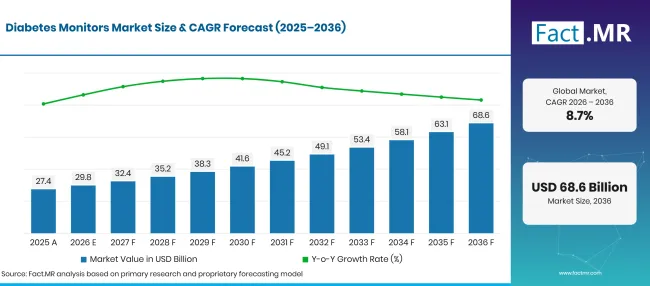
Diabetes Monitors Market Forecast Global | Source: Fact.MR
| Year | Basis | Market Value (USD billion) |
|---|---|---|
| 2025 | Actual | 27.4 |
| 2026 | Estimate | 29.8 |
| 2036 | Forecast | 68.6 |
| CAGR 2026 to 2036 | Forecast period | 8.7% |
Source: Fact.MR analysis. Updated Nov 3, 2026
What are the defining numbers behind Diabetes Monitors Market growth?
The 2026 to 2036 period adds USD 38.8 billion in new value, most of it from wearable sensors bought for home use.
- Demand Drivers in the Market
- The patient base keeps widening. The International Diabetes Federation’s April 2025 Diabetes Atlas release counts 589 million adults aged 20 to 79 living with diabetes, with 252 million of them unaware of their condition [1]. Every new diagnosis creates a long-term need for meters, strips or sensors.
- Regulators are opening CGM to people who do not use insulin. In June 2026 the U.S. Food and Drug Administration cleared Dexcom’s Stelo Glucose Biosensor System for over-the-counter use in children aged two and older, after an adult clearance in March 2024 [2]. Buyers can now purchase a sensor without a prescription, which brings non-insulin users into the market.
- Longer sensor life lowers the burden of daily use. Dexcom launched its G7 15 Day system in the United States on December 1, 2025, with 15.5 days of wear per sensor and an overall MARD of 8.0% [3]. Fewer sensor changes per month make CGM easier for older patients to keep using.
- Sensors are starting to track more than glucose. Abbott received FDA De Novo authorization in August 2026 for Libre Duo 10 Day, which monitors glucose and alerts users to rising ketone levels [4]. Insulin users and people on SGLT2 inhibitors gain an early warning for diabetic ketoacidosis from the same wearable.
- Key Segments Analyzed
- By Product Type: Continuous Glucose Monitors will hold 42.3% share in 2026, since a single wearable sensor replaces many daily fingerstick tests and shows the direction of glucose change.
- By Application: Type 2 Diabetes will account for 58.4% of 2026 value, given the size of the patient group and the growing number of non-insulin users who now qualify for sensors.
- By End User: Homecare Settings will capture 52.1% in 2026 as patients test, read alerts and share data from home between clinic visits.
- By Distribution Channel: Online Stores will represent 63.0% of 2026 revenue, owing to subscription refills of sensors and strips and direct-to-consumer sales of over-the-counter CGM.
- Analyst Opinion at Fact.MR
- Shambhu Nath Jha, Principal Consultant at Fact.MR, states, “Glucose monitoring is turning into a continuous, data-driven service, and the wearable sensor will be the entry point for most new patients through 2036. The next wave of value will come from people with Type 2 diabetes who do not use insulin, a group that over-the-counter sensors and lower monthly costs will bring into regular monitoring. Suppliers that pair accurate long-wear sensors with apps that work with insulin pumps and clinic software will gain the most ground.”
- Strategic Implications
- Manufacturers should design lower-cost sensor tiers for non-insulin Type 2 patients while keeping accuracy close to their premium systems.
- Distributors and online pharmacies should build automatic refill programmes for sensors, strips and lancets, because missed refills are a common reason patients stop monitoring.
- Clinicians and payers should agree on clear criteria for CGM coverage beyond insulin users, using time-in-range data to judge the benefit.
- Investors should watch companies that add ketone sensing, longer wear or pump integration, since these features support premium pricing in a crowded sensor field.
Germany heads the five-country comparison at 11.2%, where statutory insurers fund CGM widely and new sensor brands are lining up launches. The United States follows at 8.8%, its large insured base now joined by over-the-counter sensor buyers. The United Kingdom grows at 8.3% as NHS diabetes programmes push more patients toward technology-supported care. Brazil records 7.0%, with a rising adult diabetes rate offset by price-sensitive public purchasing. Japan closes the set at 6.2%, where an older patient pool keeps meters in wide use and CGM uptake moves more slowly.
How does the Diabetes Monitors Market break down by segment?
Continuous Glucose Monitors will lead Product Type at 42.3%; Type 2 Diabetes will head Application at 58.4%; Homecare Settings will top End User at 52.1%; Online Stores will hold Distribution Channel at 63.0% in 2026.
Which Product Type leads?
Continuous Glucose Monitors hold 42.3% of 2026 sales.
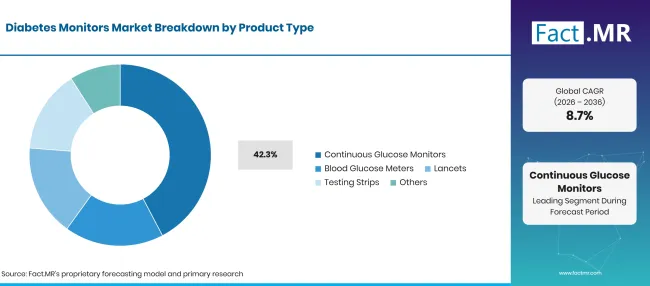
Diabetes Monitors Market Breakdown Product Type | Source: Fact.MR
| Product Type | Share (2026) |
|---|---|
| Continuous Glucose Monitors (Leading segment) | 42.3% |
| Other segments combined | 57.7%* |
| Total | 100.0% |
Source: Fact.MR analysis. Updated Nov 3, 2026
A sensor worn on the arm or abdomen sends a reading every few minutes, so patients see highs and lows that a morning fingerstick would miss. Trend arrows and alerts help users act before a low becomes dangerous. Dexcom’s 15-day G7 and Abbott’s dual glucose-ketone sensor show how suppliers now compete on wear time and added measurements [3][4]. Many sensor components overlap with the wider glucose biosensors field. Blood glucose meters remain the first device for many newly diagnosed patients and the backup when a sensor reading needs confirmation. Testing strips and lancets are bought in high volume and replaced every day, which keeps steady revenue in the conventional segment. Control solutions and lancing devices complete the range of blood glucose monitoring devices.
What supports Type 2 Diabetes within Application?
Type 2 Diabetes takes 58.4% of 2026 revenue.
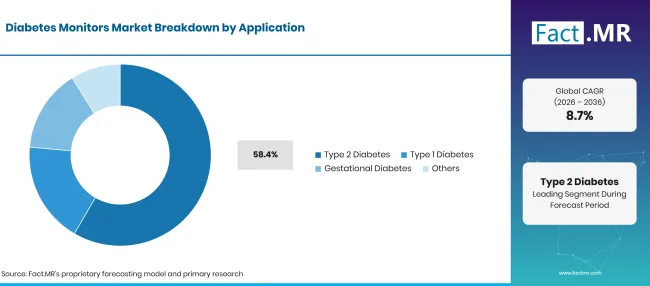
Diabetes Monitors Market Breakdown Application | Source: Fact.MR
| Application | Share (2026) |
|---|---|
| Type 2 Diabetes (Leading segment) | 58.4% |
| Other segments combined | 41.6%* |
| Total | 100.0% |
Source: Fact.MR analysis. Updated Nov 3, 2026
Most adults with diabetes have Type 2 disease, and many are diagnosed late. The IDF estimate of 252 million undiagnosed adults points to a large group that will need monitoring once identified [1]. Patients on basal insulin, sulfonylureas or SGLT2 inhibitors test often to check for lows or ketones. Those on diet or oral therapy are starting to use over-the-counter sensors to learn how meals affect glucose. Type 1 diabetes needs fewer patients but more intensive monitoring, since every insulin dose depends on current readings. Many Type 1 users pair a sensor with an automated pump drawn from the insulin pumps category. Gestational diabetes requires close checks for the length of a pregnancy, and other forms cover monogenic and secondary diabetes.
How does End User shape demand?
Homecare Settings account for 52.1% of 2026 value.
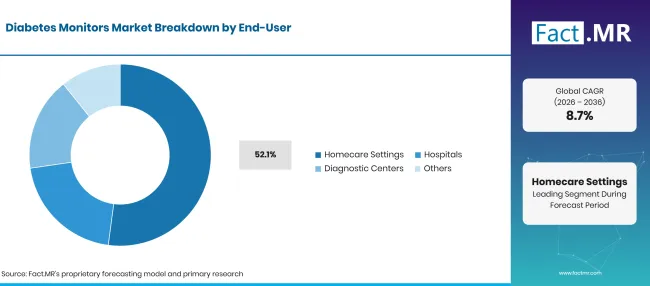
Diabetes Monitors Market Breakdown End User | Source: Fact.MR
| End User | Share (2026) |
|---|---|
| Homecare Settings (Leading segment) | 52.1% |
| Other segments combined | 47.9%* |
| Total | 100.0%\ |
Source: Fact.MR analysis. Updated Nov 3, 2026
People with diabetes make treatment choices several times a day, and nearly all of them happen at home, work or school. Smartphone apps show readings in real time and send reports to clinicians and family members. Remote review lets care teams adjust therapy without an in-person visit. Hospitals use meters and, more often now, sensors to manage glucose in admitted patients and those recovering from surgery. Diagnostic centers run screening and confirmatory tests that work alongside diabetes diagnostics such as HbA1c assays. Other end users include long-term care homes and school health services.
Which Distribution Channel gains the most ground?
Online Stores capture 63.0% of 2026 sales.
| Distribution Channel | Share (2026) |
|---|---|
| Online Stores (Leading segment) | 63.0% |
| Other segments combined | 37.0%* |
| Total | 100.0% |
Source: Fact.MR analysis. Updated Nov 3, 2026
Sensors and strips are repeat purchases, so many patients set up online subscriptions that ship supplies every month. Over-the-counter sensors such as Stelo are sold directly to consumers through company and retail websites [2]. Pharmacies remain the first stop for newly diagnosed patients who need advice on using a meter or applying a sensor. Retail stores carry meters, strips and lancets for cash buyers. Other channels include hospital supply contracts and public tenders that buy in bulk for national programmes.
What is accelerating Diabetes Monitors Market adoption, and what is holding it back?
More diagnosed diabetes, longer-wear sensors and over-the-counter access are bringing new users into continuous monitoring. Better app links with pumps and clinic software add value for patients already using a sensor. Sensor cost is the main brake, especially where insurers limit coverage to insulin users. Skin reactions and uneven access in lower-income regions also slow adoption.
Drivers Impact Analysis
| DRIVER | (~) % IMPACT ON CAGR | GEOGRAPHIC RELEVANCE | IMPACT TIMELINE |
|---|---|---|---|
| Rising diagnosed diabetes population | +1.4% | Global | Long term (>= 4 years) |
| Shift from fingerstick testing to CGM | +1.2% | North America, Western Europe | Medium term (2-4 years) |
| Home-based glucose management | +0.9% | Global | Medium term (2-4 years) |
| Connected apps and data sharing with clinicians | +0.7% | North America, East Asia | Medium term (2-4 years) |
| Over-the-counter sensor access | +0.6% | North America | Short term (<= 2 years) |
Source: Fact.MR analysis. Updated Nov 3, 2026
Opportunity Impact Analysis
| OPPORTUNITY | (~) % IMPACT ON CAGR | GEOGRAPHIC RELEVANCE | IMPACT TIMELINE |
|---|---|---|---|
| Lower-cost CGM for non-insulin Type 2 patients | +0.9% | Global | Medium term (2-4 years) |
| Longer-wear and multi-analyte sensors | +0.7% | North America, Western Europe | Medium term (2-4 years) |
| Integration with automated insulin delivery | +0.6% | Global | Long term (>= 4 years) |
| Wider reimbursement coverage | +0.5% | Western Europe, North America | Long term (>= 4 years) |
Source: Fact.MR analysis. Updated Nov 3, 2026
Restraints Impact Analysis
| RESTRAINT | (~) % IMPACT ON CAGR | GEOGRAPHIC RELEVANCE | IMPACT TIMELINE |
|---|---|---|---|
| High device and sensor costs | -0.9% | Global | Short term (<= 2 years) |
| Limited reimbursement coverage | -0.7% | Latin America, South Asia & Pacific | Medium term (2-4 years) |
| Uneven access to diabetes technology | -0.5% | East Asia, Latin America | Long term (>= 4 years) |
| Skin irritation and sensor adhesion problems | -0.4% | Global | Short term (<= 2 years) |
Source: Fact.MR analysis. Updated Nov 3, 2026
Which countries are scaling the Diabetes Monitors Market through 2036?
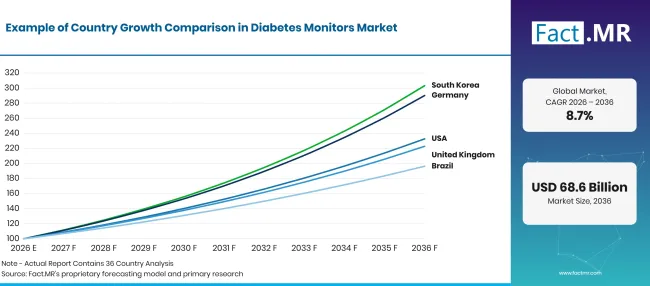
Diabetes Monitors Market Growth Index | Source: Fact.MR
| Country | CAGR (2026 to 2036) |
|---|---|
| Germany | 11.2% |
| United States | 8.8% |
| United Kingdom | 8.3% |
| Brazil | 7.0% |
| Japan | 6.2% |
Source: Fact.MR analysis. Updated Nov 3, 2026
What gives Germany the strongest growth in this market?
11.2% CAGR, driven by broad insurer funding for CGM and a large adult patient base.
Germany has one of the biggest diabetes populations in Western Europe. The Robert Koch Institute’s March 2025 surveillance report puts the number of adults with known or unknown diabetes at about 7 million when people aged 80 and over are included [5]. Statutory health insurers reimburse real-time CGM for many insulin users, and suppliers see room to grow. LifeScan plans to launch its OneTouch Vita CGM in Germany by early 2027 [6].
What is supporting United States adoption?
8.8% CAGR, backed by Medicare coverage and a new over-the-counter sensor channel.
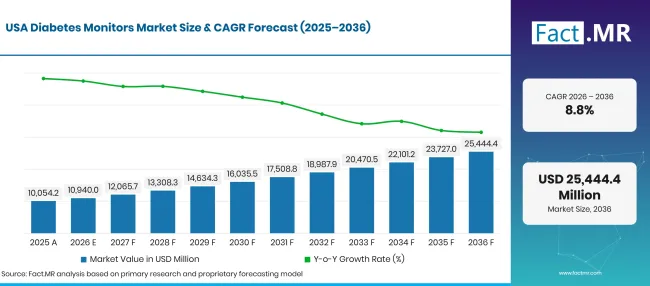
Diabetes Monitors Market Forecast Usa | Source: Fact.MR
Of the five countries, the United States has the most mature CGM market. CDC’s National Diabetes Statistics Report, updated in September 2026, counts 40.1 million people with diagnosed or undiagnosed diabetes in 2023, of whom 11.0 million adults were undiagnosed [7]. Medicare covers sensors such as Dexcom G7 15 Day [3]. Over-the-counter clearances add consumers who buy sensors without a prescription.
How is the United Kingdom developing demand?
8.3% CAGR, reflecting NHS programmes that link glucose data to better control.
NHS England tracks diabetes care closely, and the results show room for better glucose control. The April 2026 diabetes profile commentary reports that only 41.5% of people with Type 1 diabetes reached an HbA1c of 58 mmol/mol or less in the year to March 2025, against 64.7% for Type 2 and other diabetes [8]. Gaps like these strengthen the case for wider CGM and hybrid closed loop access.
How is Brazil scaling demand?
7.0% CAGR, as more adults are diagnosed and need regular glucose checks.
Diabetes is spreading quickly among Brazilian adults. The Ministry of Health reported in January 2026 that the share of adults with diabetes rose from 5.5% in 2006 to 12.9% in 2024, a 135% increase [9]. Most patients still rely on meters and strips distributed through the public health system and pharmacies. Price-sensitive buying keeps CGM uptake concentrated in private care.
What supports Japan’s adoption?
6.2% CAGR, owing to a large, ageing group that needs long-term monitoring.
Japan has a large population at metabolic risk. The Ministry of Health, Labour and Welfare’s December 2025 release on the 2024 National Health and Nutrition Survey estimates about 11 million people strongly suspected of having diabetes, a number that continues to grow [10]. Meters and strips remain common among older patients.
Who leads the Diabetes Monitors Market?
The market splits into three groups that compete on different strengths. CGM specialists Dexcom and Abbott set the pace on sensor accuracy, wear time and new measurements, with Dexcom’s 15-day G7 launch in December 2025 [3] and Abbott’s dual glucose-ketone authorization in August 2026 [4].
MiniMed competes through sensors tied to its insulin pumps, and it gained CE Mark in March 2026 for the MiniMed 780G with the 15-day Instinct sensor made by Abbott [11], then began a European rollout in June 2026 [12]. Roche, Ascensia Diabetes Care, LifeScan and AgaMatrix form the blood glucose meter group, competing on strip price, meter reliability and pharmacy reach. Roche has shown AI-based prediction that can warn of nighttime lows up to 7 hours ahead [13], and LifeScan is moving into sensors through its OneTouch Vita partnership [6]. Through 2036, competition will turn on sensor price for Type 2 users, pump integration and data platforms that clinicians trust.
Which companies are the key providers?
Key companies in the Diabetes Monitors Market include Dexcom, Inc., Abbott Laboratories, MiniMed, F. Hoffmann-La Roche Ltd, Ascensia Diabetes Care, LifeScan, Inc. and AgaMatrix, Inc.
- Dexcom, Inc.
- Abbott Laboratories
- MiniMed
- F. Hoffmann-La Roche Ltd
- Ascensia Diabetes Care
- LifeScan, Inc.
- AgaMatrix, Inc.
How is the market segmented?
-
By Product Type
- Continuous Glucose Monitors
- Blood Glucose Meters
- Lancets
- Testing Strips
- Others
-
By Application
- Type 2 Diabetes
- Type 1 Diabetes
- Gestational Diabetes
- Others
-
By End User
- Homecare Settings
- Hospitals
- Diagnostic Centers
- Others
-
By Distribution Channel
- Online Stores
- Pharmacies
- Retail Stores
- Others
-
By Region
- North America
- Latin America
- Western Europe
- Eastern Europe
- East Asia
- South Asia & Pacific
- Middle East & Africa
Bibliography
- [1] International Diabetes Federation. (2025, April 7). Over 250 million people worldwide unaware they have diabetes.
- [2] U.S. Food and Drug Administration. (2026, June 12). FDA Clears First Over-the-Counter Continuous Glucose Monitor for Children.
- [3] Dexcom, Inc. (2025, November 20). Dexcom G7 15 Day Continuous Glucose Monitoring System to Launch on Dec. 1 in the United States.
- [4] Abbott. (2026, August 25). Abbott receives FDA authorization for world’s first dual glucose-ketone sensing technology for people with diabetes.
- [5] Robert Koch Institute. (2025, March 31). Prevalence of known and unknown diabetes: Adults.
- [6] LifeScan, Inc. (2026, February 11). LifeScan Announces Transformational Partnership with i-SENS to Launch OneTouch Continuous Glucose Monitoring System.
- [7] Centers for Disease Control and Prevention. (2026, September 16). National Diabetes Statistics Report.
- [8] Office for Health Improvement and Disparities. (2026, April 8). Diabetes profile: statistical commentary, April 2026.
- [9] Ministério da Saúde, Brazil. (2026, January 28). Diabetes cresce 135% no Brasil em 18 anos, hipertensão e obesidade também avançam.
- [10] Ministry of Health, Labour and Welfare, Japan. (2025, December 2). 令和6年「国民健康・栄養調査」の結果.
- [11] MiniMed. (2026, March 10). MiniMed expands sensor portfolio in Europe with CE Mark for MiniMed 780G system with the Instinct sensor, made by Abbott.
- [12] MiniMed. (2026, June 23). MiniMed launches Instinct sensors in Europe giving people with diabetes more sensor choice with the same proven outcomes.
- [13] Roche. (2026, August 5). The power of foresight: How AI-enabled prediction can reduce the risk of nighttime lows.
This Report Answers
- How is diabetes monitor revenue split across product type, application, end user and distribution channel?
- Why are continuous glucose monitors replacing fingerstick testing, and where do meters, strips and lancets still fit?
- How large is the Type 2 opportunity once over-the-counter sensors reach non-insulin users?
- Why do Germany, the United States, the United Kingdom, Brazil and Japan grow at different rates?
- Which sensor specialists, pump makers and meter suppliers compete, and on what terms?
- How will sensor pricing, reimbursement and pump integration shape demand through 2036?
What does the Diabetes Monitors Market cover?
This study tracks devices and consumables that measure glucose in people with diabetes, from wearable sensors to fingerstick meters and the strips and lancets they use. Software sold with these devices is counted when it is needed to read or share glucose data.
Values are measured at manufacturer selling prices in USD billion. Sales through online stores, pharmacies, retail stores and institutional contracts are all counted.
What is included in the scope?
Real-time and intermittently scanned CGM sensors, transmitters and readers, including over-the-counter biosensors.
Blood glucose meters, testing strips, lancets, lancing devices and control solutions for self-monitoring.
Sensors with added measurements such as ketones, where glucose monitoring remains the main function.
CGM sensors sold for use with automated systems linked to insulin patch pumps and tubed pumps, counted at the sensor level.
What is excluded from the scope?
Insulin, GLP-1 medicines and other diabetes drugs.
Insulin pumps, pens and syringes sold without a glucose sensor, which belong to the insulin delivery devices category.
Laboratory HbA1c analyzers and hospital chemistry systems used for diagnosis.
General fitness trackers and smartwatches that do not measure glucose.
How Was the Analysis Built?
The analysis draws on 120+ sources, 35+ company portfolios, 25+ countries, and more than 20 industry interviews.
- Primary Research: Primary research includes discussions with manufacturers, service providers, technology developers, distributors, end users, and subject-matter experts. These conversations examine purchasing priorities, product adoption, operational challenges, approval requirements, competitive positioning, and the factors that influence wider market acceptance.
- Desk Research: Desk research covers government statistics, regulatory publications, company filings, trade data, technical studies, industry associations, standards, public policy, and other authoritative sources. Every source used in the analysis is documented in the bibliography.
- Market Sizing and Forecasting: Market estimates combine historical performance, demand indicators, pricing and volume trends, segment shares, company participation, country-level growth, adoption patterns, investment activity, and barriers to market expansion.
- Data Validation and Update Cycle: Findings are validated by comparing primary interviews with public data, company activity, regulatory changes, trade patterns, and industry developments. Regular updates review new product launches, capacity changes, partnerships, approvals, and shifts in commercial adoption.
Segmentation
What is the report’s scope and coverage?
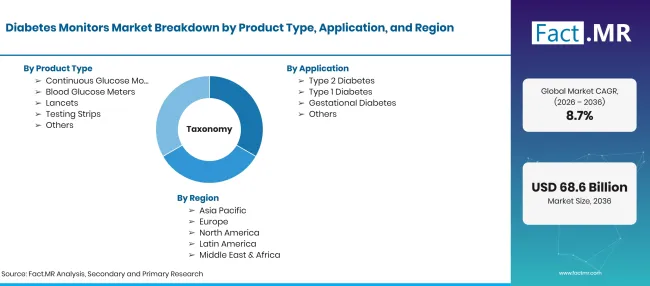
Diabetes Monitors Market Taxonomy | Source: Fact.MR
| Attribute | Details |
|---|---|
| Quantitative Units | USD billion in 2026 to USD billion by 2036 at CAGR |
| Market Definition | Devices and consumables used to measure and track glucose in people living with diabetes, covering continuous glucose monitors, blood glucose meters, lancets and testing strips. |
| Product Type | Continuous Glucose Monitors; Blood Glucose Meters; Lancets; Testing Strips; Others |
| Application | Type 2 Diabetes; Type 1 Diabetes; Gestational Diabetes; Others |
| End User | Homecare Settings; Hospitals; Diagnostic Centers; Others |
| Distribution Channel | Online Stores; Pharmacies; Retail Stores; Others |
| Regions Covered | North America; Latin America; Western Europe; Eastern Europe; East Asia; South Asia & Pacific; Middle East & Africa |
| Countries Covered | Germany; United States; United Kingdom; Brazil; Japan |
| Companies Profiled | Dexcom, Inc.; Abbott Laboratories; MiniMed; F. Hoffmann-La Roche Ltd; Ascensia Diabetes Care; LifeScan, Inc.; AgaMatrix, Inc. |
| Forecast Period | 2026 to 2036 |
| Approach | Device and consumable revenue built from patient numbers, testing frequency, sensor wear time and channel pricing, checked against reimbursement rules and company launches. |
Source: Fact.MR analysis. Updated Nov 3, 2026
Frequently Asked Questions
How large is the diabetes monitors market in 2026?
What growth rate will the diabetes monitors market record?
Which product type leads?
Which application leads?
Which end user leads?
Which distribution channel leads?
Which country will grow quickest?
Who are the main companies?
What holds the market back?
Who worked on this report


Preview the report firsthand - request a free sample
Free SampleGet the brochure for pricing and purchase details
Download PDF