- Market Value (2025): USD 83.7 Bn
- Estimated Value (2026): USD 90.6 Bn
- Forecast Value (2036): USD 201.2 Bn
- CAGR (2026-2036): 8.3%
What is the Diabetes Treatment Market forecast to be worth by 2036?
USD 90.6 billion in 2026 to USD 201.2 billion by 2036 at an 8.3% CAGR.
- Fact.MR estimates that the diabetes treatment market reached USD 83.7 billion in 2025, with oral hypoglycemic agents, insulin and non-insulin injectables forming the revenue base.
- Revenue will climb from USD 90.6 billion in 2026 to USD 201.2 billion by 2036 as newer drug classes take a larger slice of each patient’s treatment spend.
- Value will compound at 8.3% CAGR from 2026 to 2036, since a larger treated population meets steady migration toward incretin and once-weekly therapies.
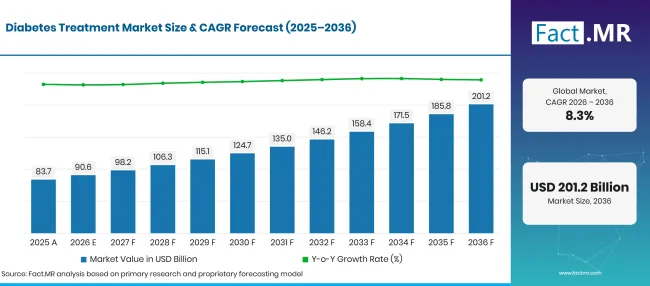
Factmr Diabetes Treatment Market Forecast Global | Source: Fact.MR
| Year | Basis | Market Value (USD billion) |
|---|---|---|
| 2025 | Actual | 83.68 |
| 2026 | Estimate | 90.6 |
| 2036 | Forecast | 201.2 |
| CAGR 2026 to 2036 | Forecast period | 8.3% |
Source: Fact.MR analysis. Updated Oct 21, 2026
What are the defining numbers behind Diabetes Treatment Market growth?
The 2026 to 2036 period adds USD 110.6 billion in new value, concentrated in oral agents and incretin injectables.
- Demand Drivers in the Market
- A large untreated population keeps the patient funnel wide. The World Health Organization reported in September 2025 that over 800 million people had diabetes in 2022 and that half of them were untreated [1]. Each person brought into care becomes a long-term prescription holder.
- Outcome-based labels are lifting the value of each prescription. In January 2025, the U.S. FDA approved Ozempic to reduce the risk of worsening kidney disease and cardiovascular death in adults with type 2 diabetes and chronic kidney disease [2]. Prescribers now pick agents for organ protection as well as glucose control.
- Lower-cost insulin options are widening access. The FDA approved Merilog, the first rapid-acting insulin biosimilar, in February 2025 for adults and children with diabetes [3]. Biosimilar competition gives payers room to cover more patients on insulin.
- Older patients need therapy for more years. Diabetes risk climbs with age, and patients diagnosed in their fifties may stay on multi-drug regimens for decades.
- Connected devices are moving daily dosing decisions into the home. Sensor readings that sync to smartphone apps help patients and clinicians adjust doses between visits, which supports adherence to prescribed drugs.
- Key Segments Analyzed
- By Product Type: Oral Hypoglycemic Agents will hold 42.8% share in 2026, as low-cost tablets remain the first step of therapy for most people with type 2 diabetes.
- By Treatment Type: Medication will account for 88.3% share in 2026, since oral and non-insulin injectable regimens cover nearly every diagnosed patient.
- By Distribution Channel: Hospital Pharmacies will capture 44.2% share in 2026 on the strength of treatment initiation, inpatient care and specialist prescribing.
- By End-User: Homecare will command 49.5% share in 2026, given that tablets, self-injection and glucose checks happen at home every day.
- Analyst Opinion at Fact.MR
- Shambhu Nath Jha, Principal Consultant at Fact.MR, states, “Prescribers now judge a diabetes drug by what it does for the heart, the kidneys and body weight, and glucose control alone no longer wins a formulary slot. Companies that pair outcome data with simple dosing and connected monitoring will keep patients for years, while generics and biosimilars carry the low-price volume. The next wave of value will come from emerging markets that extend insurance cover and from patients who step up from tablets to injectables.”
- Strategic Implications
- Drug manufacturers should put cardiovascular, renal and weight outcomes beside glycemic data in payer dossiers, because formulary committees weigh all four.
- Insulin and injectable suppliers should expand pen supply, once-weekly formats and biosimilar capacity, given that out-of-pocket cost decides whether patients start and stay on therapy.
- Pharmacy chains should build refill reminders and home delivery into chronic care services, since missed refills cut the lifetime value of each patient.
- Health systems and payers should link screening with follow-up programs so that newly diagnosed patients reach suitable therapy before complications appear.
The United States will stay in front at 10.7% CAGR, with a sizable patient pool and quick uptake of incretin therapies. Brazil follows at 9.8% as the public health system widens free access to diabetes medicines. Germany will advance at 9.5%, where statutory insurance and structured care programs keep patients in regular treatment. Japan’s 8.4% pace reflects an aging population that needs therapy for longer. The United Kingdom completes the group at 7.5% inside a mature, publicly funded care system.
How does the Diabetes Treatment Market break down by segment?
Oral Hypoglycemic Agents will lead Product Type at 42.8%; Medication will head Treatment Type at 88.3%; Hospital Pharmacies will take first place in Distribution Channel at 44.2%; Homecare will top End-User at 49.5%.
Which Product Type dominates?
Oral Hypoglycemic Agents take 42.8% of 2026 sales.
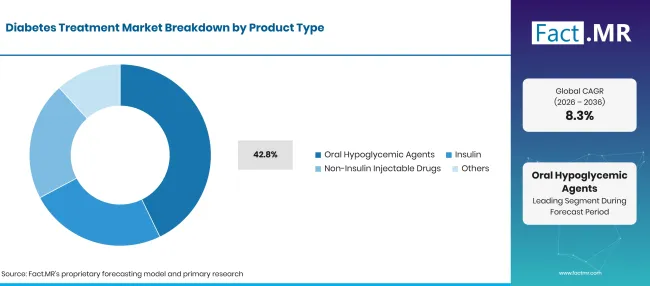
Factmr Diabetes Treatment Market Breakdown Product Type | Source: Fact.MR
| Product Type | Share (2026) |
|---|---|
| Oral Hypoglycemic Agents (Leading segment) | 42.8% |
| Other segments combined | 57.2%* |
| Total | 100.0% |
Source: Fact.MR analysis. Updated Oct 21, 2026
Most people with type 2 diabetes begin on tablets, and many stay on them for years. Metformin, sulfonylureas, DPP-4 inhibitors and SGLT2 inhibitors are often combined in fixed-dose products that cut pill burden. Generic versions keep access broad in price-sensitive markets. Insulin stays essential in type 1 and advanced type 2 care, and injection pens make dosing simpler and more accurate. Non-insulin injectables, led by GLP-1 receptor agonists, are gaining ground on combined weight and glucose benefits. In November 2025, the European Commission authorised Kyinsu, a once-weekly combination of insulin icodec and semaglutide for adults with type 2 diabetes insufficiently controlled on basal insulin or a GLP-1 receptor agonist [4].
What supports Medication within Treatment Type?
Medication makes up 88.3% of 2026 demand.
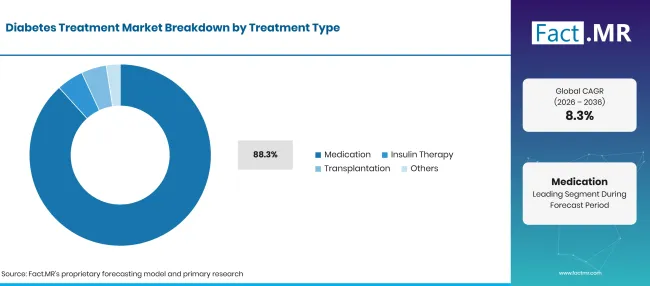
Factmr Diabetes Treatment Market Breakdown Treatment Type | Source: Fact.MR
| Treatment Type | Share (2026) |
|---|---|
| Medication (Leading segment) | 88.3% |
| Other segments combined | 11.7%* |
| Total | 100.0% |
Source: Fact.MR analysis. Updated Oct 21, 2026
Lifelong glucose control depends on daily or weekly drug regimens, from oral agents to non-insulin injectables with heart and kidney protection. Physicians add or switch classes as the disease progresses, so a single patient often uses several products over a decade. Insulin Therapy forms a separate route for type 1 patients and those with advanced type 2 disease. Transplantation, covering pancreas and islet cell procedures, serves a small group with severe disease and is limited by donor supply and cost. Lifestyle programs and emerging cell-based approaches make up the remaining options.
What leads the Distribution Channel segment?
Hospital Pharmacies account for 44.2% of 2026 revenue.
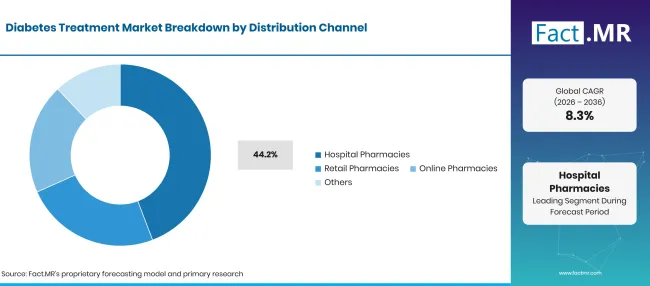
Factmr Diabetes Treatment Market Breakdown Distribution Channel | Source: Fact.MR
| Distribution Channel | Share (2026) |
|---|---|
| Hospital Pharmacies (Leading segment) | 44.2% |
| Other segments combined | 55.8%* |
| Total | 100.0% |
Source: Fact.MR analysis. Updated Oct 21, 2026
Specialist consultations and hospital admissions are where many patients receive their first prescription for an injectable or insulin. Inpatient stays for complications add steady volume, and hospital formularies influence which brands patients carry home. Retail pharmacies handle most repeat prescriptions for tablets and insulin, along with advice on injection technique and storage. Online pharmacies are gaining users through home delivery of chronic therapy. Mail-order programs and clinic dispensing complete the channel mix.
How does End-User shape demand?
Homecare represents 30.3% of 2026 sales.
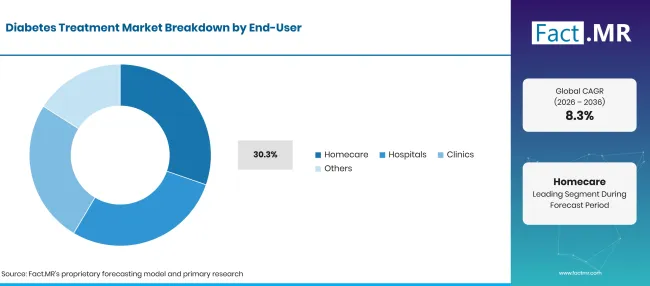
Factmr Diabetes Treatment Market Breakdown End User | Source: Fact.MR
| End-User | Share (2026) |
|---|---|
| Homecare (Leading segment) | 49.5% |
| Other segments combined | 50.5%* |
| Total | 100.0% |
Source: Fact.MR analysis. Updated Oct 21, 2026
Patients carry out most daily care themselves through tablets, self-injection and glucose checks. Pens, insulin pumps and connected sensors reduce the effort and cut the number of clinic visits needed. Hospitals step in for acute episodes and for starting complex regimens. Clinics handle screening, follow-up and prescription renewals. Growth in home healthcare services is also bringing nurse-supported injection and monitoring to older patients who live alone.
What is accelerating Diabetes Treatment Market adoption, and what is holding it back?
Wider screening and reimbursement will keep moving patients toward newer therapies. Patent expiries, price controls and thin access in low-income markets will keep value growth below the pace of patient growth.
Drivers Impact Analysis
| DRIVER | (~) % IMPACT ON CAGR | GEOGRAPHIC RELEVANCE | IMPACT TIMELINE |
|---|---|---|---|
| Rising type 2 diabetes and obesity burden | +2.3% | Global | Short term (<= 2 years) |
| Prescriber shift toward SGLT2 inhibitors and GLP-1 therapies | +1.8% | Global | Short term (<= 2 years) |
| Older patients needing sustained glucose control | +1.4% | East Asia, Western Europe, North America | Long term (>= 4 years) |
| Broader screening and reimbursement coverage | +0.9% | Latin America, South Asia & Pacific, Western Europe | Medium term (2-4 years) |
| Home-based care supported by connected monitoring | +0.5% | North America, Western Europe, East Asia | Medium term (2-4 years) |
Source: Fact.MR analysis. Updated Oct 21, 2026
Opportunity Impact Analysis
| OPPORTUNITY | (~) % IMPACT ON CAGR | GEOGRAPHIC RELEVANCE | IMPACT TIMELINE |
|---|---|---|---|
| Biosimilar insulins and low-cost generics in emerging markets | +1.1% | Global | Medium term (2-4 years) |
| Once-weekly and oral GLP-1 formulations | +0.9% | Global | Short term (<= 2 years) |
| Automated insulin delivery linked to continuous glucose monitoring | +0.6% | North America, Western Europe, East Asia | Long term (>= 4 years) |
Source: Fact.MR analysis. Updated Oct 21, 2026
Restraints Impact Analysis
| RESTRAINT | (~) % IMPACT ON CAGR | GEOGRAPHIC RELEVANCE | IMPACT TIMELINE |
|---|---|---|---|
| Patent expiries and pricing pressure on branded drugs | -0.6% | Global | Short term (<= 2 years) |
| High therapy costs restricting access in low-income markets | -0.4% | Latin America, South Asia & Pacific, Middle East & Africa | Medium term (2-4 years) |
| Side effects, supply gaps and weak patient adherence | -0.2% | Global | Long term (>= 4 years) |
Source: Fact.MR analysis. Updated Oct 21, 2026
Which countries are scaling the Diabetes Treatment Market through 2036?
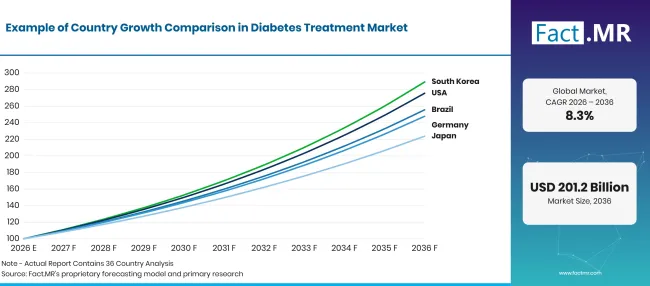
Factmr Diabetes Treatment Market Growth Index | Source: Fact.MR
| Country | CAGR (2026 to 2036) |
|---|---|
| United States | 10.7% |
| Brazil | 9.8% |
| Germany | 9.5% |
| Japan | 8.4% |
| United Kingdom | 7.5% |
Source: Fact.MR analysis. Updated Oct 21, 2026
What supports United States adoption?
10.7% CAGR, driven by a large patient base and fast uptake of newer drug classes.
The Centers for Disease Control and Prevention reports that 40.1 million people, or 12.0% of the U.S. population, had diabetes in 2023 [5]. Medicare negotiated prices for Januvia, Jardiance and Farxiga took effect in 2026, and prices for Ozempic, Rybelsus, Janumet and Tradjenta follow in 2027 [6]. Lower out-of-pocket costs for older patients will support refill volumes through retail and home-delivery pharmacies.
How does Brazil perform?
9.8% CAGR, backed by wider public access to diabetes drugs.
Brazil’s Ministry of Health reported in its Vigitel 2025 results that adults with a medical diagnosis of diabetes rose from 5.5% in 2006 to 12.9% in 2024 [7]. The unified public health system, SUS, is the main source of care.
What supports Germany’s growth?
9.5% CAGR, on the back of broad insurance cover and structured care programs.
The Robert Koch Institute estimated in September 2025 that 6.05 million people in Germany had diagnosed type 2 diabetes in 2022, a prevalence of 8.6% [8]. Its projection puts the figure at 11.01 million by 2050 if incidence and excess mortality stay unchanged [8]. Statutory health insurance covers most therapies, and benefit assessments favor drugs with proven heart and kidney outcomes.
How is Japan scaling demand?
8.4% CAGR, reflecting an aging population that needs long-term therapy.
The Statistics Bureau of Japan reported that people aged 65 and over made up 29.4% of the population in September 2025, a record share [9]. The Ministry of Health, Labour and Welfare estimated in December 2025 that about 11 million people are strongly suspected of having diabetes, a number that continues to rise [10]. Universal insurance and regular price revisions keep growth steady, while older patients favor once-weekly and simpler oral regimens.
How is the United Kingdom developing demand?
7.5% CAGR, as a mature and publicly funded system manages most care.
In England, only 58.2% of people with type 2 and other diabetes received all eight recommended care processes in the year to March 2025, according to the Office for Health Improvement and Disparities [11]. The same commentary shows 45.2% met all three treatment targets [11]. The NHS delivers most therapy through general practice and community pharmacies, and national guidance favors cost-effective generics.
Who leads the Diabetes Treatment Market?
Competition runs along three lines. Incretin and insulin specialists compete on outcome evidence and weekly dosing. Novo Nordisk offers Ozempic, Rybelsus and Tresiba, and in January 2025 it gained a U.S. kidney-protection indication for Ozempic [2].
Eli Lilly pairs Mounjaro and Trulicity with Humalog and Basaglar, while Sanofi supplies Lantus and Toujeo and received FDA approval for the biosimilar Merilog in February 2025 [3]. Oral and cardiometabolic drug makers compete on heart and kidney labels and price. Merck markets Januvia and Janumet, AstraZeneca offers Farxiga, and Boehringer Ingelheim sells Jardiance and Tradjenta. Device suppliers support dosing at home. Abbott provides FreeStyle Libre sensors, Roche offers Accu-Chek meters and the mySugr app, and MiniMed launched its app-controlled MiniMed Flex pump in the United States in June 2026 [12]. Over the forecast period, the companies that join outcome data, affordable access and connected dosing tools will gain the most ground.
Which companies are the key providers?
Key companies include Novo Nordisk; Eli Lilly; Sanofi; Merck; AstraZeneca; Boehringer Ingelheim; Abbott; Roche; and MiniMed.
- Novo Nordisk
- Eli Lilly
- Sanofi
- Merck
- AstraZeneca
- Boehringer Ingelheim
- Abbott
- Roche
- MiniMed
Bibliography
- [1] [1] World Health Organization. (2025, September 5). WHO updates list of essential medicines to include key cancer, diabetes treatments.
- [1] [2] Novo Nordisk. (2025, January 28). FDA approves Ozempic (semaglutide) as the only GLP-1 RA to reduce the risk of worsening kidney disease and cardiovascular death in adults with type 2 diabetes and chronic kidney disease.
- [1] [3] U.S. Food and Drug Administration. (2025, February 14). FDA Approves First Rapid-Acting Insulin Biosimilar Product for Treatment of Diabetes.
- [4] European Medicines Agency. (2025, November). Kyinsu: EPAR.
- [5] Centers for Disease Control and Prevention. (2026, September 16). National Diabetes Statistics Report.
- [6] Centers for Medicare & Medicaid Services. (2026, September 22). Selected Drugs and Negotiated Prices.
- [7] Ministério da Saúde, Brazil. (2026). Para o povo brasileiro viver mais e viver melhor: Resultados Vigitel 2025 [For Brazilians to live longer and better: Vigitel 2025 results].
- [8] Robert Koch Institute. (2025, September 17). Trends in prevalence and number of cases of diagnosed type 2 diabetes in Germany: Projections until 2050.
- [9] Statistics Bureau of Japan. (2025, September 14).[Statistics Topics No. 146: Elderly people in Japan as seen in statistics].
- [10] Ministry of Health, Labour and Welfare, Japan. (2025, December 2).[Results of the 2024 National Health and Nutrition Survey].
- [11] Office for Health Improvement and Disparities. (2026, April 8). Diabetes profile: statistical commentary, April 2026.
- [12] MiniMed. (2026, June 17). MiniMed’s Smallest App-Controlled Insulin Pump is Now Available in the U.S..
This Report Answers
- Sizing for 2026 and 2036 is split by product type, treatment type, distribution channel, end-user and region.
- Each segment shows which subsegment heads it in 2026 and the patient and prescriber needs behind that position.
- Patient numbers, reimbursement and access to newer therapies frame the comparison of the five listed countries.
- Company profiles group incretin and insulin makers, oral cardiometabolic drug makers, and device suppliers.
- Readers can trace how patent expiries, biosimilars and new drug classes reshape treatment choice and pricing.
What does the Diabetes Treatment Market cover?
This assessment tracks the drugs, insulin products and related therapies that people use to control blood glucose and limit complications of type 1 and type 2 diabetes. It spans oral agents, insulin and non-insulin injectables, and the supporting treatment categories sold through pharmacies and care providers.
Revenue is counted at the first sale of each product, whether through a hospital, retail or online pharmacy. Treatment Type shares refer to the main care route used by the patient, while the other splits cover all treatment sales.
What is included in the scope?
Prescription oral drugs, insulin products and non-insulin injectables are in scope, including branded drugs, generics and biosimilars. Fixed-dose combinations, pens and insulin delivery devices used with each dose also count here.
Treatment used in hospitals, clinics and homecare falls within the end-user splits. Suppliers of glucose monitoring and insulin delivery systems are profiled because their products guide dosing decisions and support adherence.
What is excluded from the scope?
Over-the-counter supplements and wellness products sold for blood sugar support are left out. Diagnostic tests used only for screening are excluded, as are treatments for other conditions prescribed to people with diabetes.
Software and digital services sold on their own, without a drug or delivery system, are not counted. Research funding and clinical trial services also fall outside market revenue.
How Was the Analysis Built?
The analysis draws on 120+ sources, 35+ company portfolios, 25+ countries, and more than 20 industry interviews.
- Primary Research: Primary research includes discussions with manufacturers, service providers, technology developers, distributors, end users, and subject-matter experts. These conversations examine purchasing priorities, product adoption, operational challenges, approval requirements, competitive positioning, and the factors that influence wider market acceptance.
- Desk Research: Desk research covers government statistics, regulatory publications, company filings, trade data, technical studies, industry associations, standards, public policy, and other authoritative sources. Every source used in the analysis is documented in the bibliography.
- Market Sizing and Forecasting: Market estimates combine historical performance, demand indicators, pricing and volume trends, segment shares, company participation, country-level growth, adoption patterns, investment activity, and barriers to market expansion.
- Data Validation and Update Cycle: Findings are validated by comparing primary interviews with public data, company activity, regulatory changes, trade patterns, and industry developments. Regular updates review new product launches, capacity changes, partnerships, approvals, and shifts in commercial adoption.
Segmentation
What is the report’s scope and coverage?
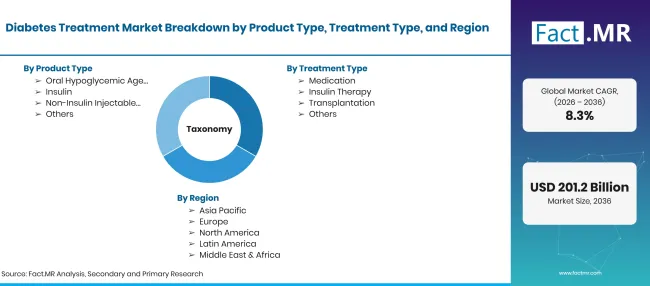
Factmr Diabetes Treatment Market Taxonomy | Source: Fact.MR
| Attribute | Details |
|---|---|
| Quantitative Units | USD billion in 2026 to USD billion by 2036 at CAGR |
| Market Definition | Drugs, insulin products and related therapies used to manage type 1 and type 2 diabetes, sold through hospital, retail and online pharmacies. Coverage spans oral and injectable treatments and insulin delivery for hospital, clinic and homecare use. |
| Product Type | Oral Hypoglycemic Agents; Insulin; Non-Insulin Injectable Drugs; Others |
| Treatment Type | Medication; Insulin Therapy; Transplantation; Others |
| Distribution Channel | Hospital Pharmacies; Retail Pharmacies; Online Pharmacies; Others |
| End-User | Homecare; Hospitals; Clinics; Others |
| Regions Covered | North America; Latin America; Western Europe; Eastern Europe; East Asia; South Asia & Pacific; Middle East & Africa |
| Countries Covered | United States; Brazil; Germany; Japan; United Kingdom |
| Companies Profiled | Novo Nordisk; Eli Lilly; Sanofi; Merck; AstraZeneca; Boehringer Ingelheim; Abbott; Roche; MiniMed |
| Forecast Period | 2026 to 2036 |
| Approach | Hybrid top-down and bottom-up approach using diagnosed and treated patient numbers; therapy prices by drug class; pharmacy channel sell-through; and company portfolio review. |
Source: Fact.MR analysis. Updated Oct 21, 2026
How is the market segmented?
-
By Product Type
- Oral Hypoglycemic Agents
- Insulin
- Non-Insulin Injectable Drugs
- Others
-
By Treatment Type
- Medication
- Insulin Therapy
- Transplantation
- Others
-
By Distribution Channel
- Hospital Pharmacies
- Retail Pharmacies
- Online Pharmacies
- Others
-
By End-User
- Homecare
- Hospitals
- Clinics
- Others
-
By Region
- North America
- Latin America
- Western Europe
- Eastern Europe
- East Asia
- South Asia & Pacific
- Middle East & Africa
Frequently Asked Questions
How big is the diabetes treatment market in 2026?
What is the CAGR of the diabetes treatment market from 2026 to 2036?
Which product type leads the diabetes treatment market?
Which treatment type leads the diabetes treatment market?
Which distribution channel leads the diabetes treatment market?
Which end-user leads the diabetes treatment market?
Which country will grow the most in the diabetes treatment market?
Who are the main companies in the diabetes treatment market?
Who worked on this report


Preview the report firsthand - request a free sample
Free SampleGet the brochure for pricing and purchase details
Download PDF