- Market Value (2025): USD 647.8 Mn
- Estimated Value (2026): USD 710.0 Mn
- Forecast Value (2036): USD 1775.7 Mn
- CAGR (2026-2036): 9.6%
What is the Ultra-Matte UV Dispersants Market forecast to be worth by 2036?
USD 710.0 million in 2026 to USD 1,775.7 million by 2036 at a 9.6% CAGR.
- The Ultra-Matte UV Dispersants Market reached USD 647.8 million in 2025.
- Demand is projected to increase from USD 710.0 million in 2026 to USD 1,775.7 million by 2036.
- The market is forecast to record 9.6% CAGR from 2026 to 2036 as formulators shift toward stable low-gloss UV finishes.
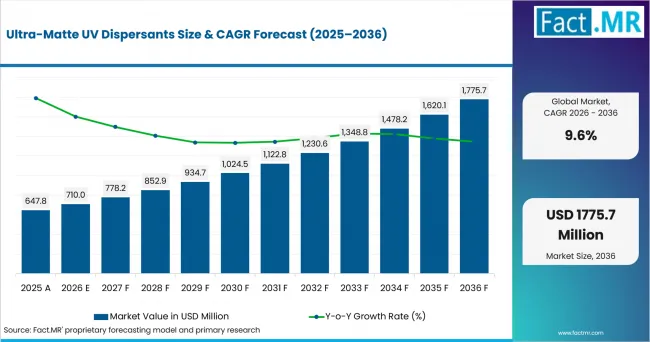
Ultra Matte Uv Dispersants Value Analysis | Source: Fact.MR
What are the defining numbers behind Ultra-Matte UV Dispersants Market growth?
An absolute opportunity of USD 1,065.7 million is expected between 2026 and 2036.
- Demand Drivers in the Market
- Formulators need ultra-matte UV dispersants that hold silica and wax particles steady during fast curing. Low-gloss clear coats link wetting behavior with viscosity control.
- Industrial finish producers need predictable viscosity as matting-solid loading rises. Stable dispersants keep spray and flow-coat behavior close to approved settings.
- Ink manufacturers need matte packages that work at thin film weights. Office for National Statistics series JQ6W records UK home-market turnover for industry 20.3, covering manufacture of paints, varnishes and similar coatings, printing ink and mastics, at GBP 742.6 million in Q2 2025.
- Wood coating producers need matte finishes that hide fingerprints without reducing scratch resistance. Furniture and flooring lines therefore screen dispersants against gloss and surface-feel targets.
- Automotive interior teams need low-glare coatings that keep surface feel consistent. UV systems shorten handling time while retaining repeatable matte appearance.
- Key Segments Analyzed
- By Dispersant Chemistry: Polymeric hyperdispersants are expected to account for 39.0% share in 2026, supported by pigment wetting and particle stability.
- By Matting Solid: Silica is projected to hold 44.0% share in 2026, attributable to low-gloss efficiency in radiation-curing finishes.
- By UV System: 100% solids UV is anticipated to represent 47.0% share in 2026, owing to solvent-free coating programs.
- By End-use: Wood coatings are estimated to capture 30.0% share in 2026, reinforced by matte furniture and flooring finishes.
- Analyst Opinion at Fact.MR
- Shambhu Nath Jha, Principal Consultant at Fact.MR, states, “Ultra-matte UV formulation is a dispersion problem before it is a styling problem. The market is expected to reward suppliers that keep silica stable while preserving low viscosity. Formulators want proof on gloss and storage behavior.”
- Strategic Implications
- Dispersant suppliers should package gloss, viscosity and storage data in the same trial sheet so formulators can compare recipes quickly.
- Matting-agent producers should work with additive partners to improve clear-coat haze control and surface smoothness in 100% solids UV systems.
- Coating manufacturers should screen alternate dispersants early where VOC rules and customer gloss targets shape recipe approval.
- Regional distributors should keep technical samples ready for smaller coating labs. BYK specifies DISPERBYK-2158 for solvent-free UV-curing coatings to disperse and stabilize treated and untreated silica-based matting agents, with viscosity reduction and improved matting properties.
The UK is projected to record 11.3% CAGR through 2036, supported by ink exports and low-VOC conversion. Italy is expected to post 10.5% CAGR through furniture finishing. The USA is anticipated to advance at 10.1% CAGR through construction-linked coatings. Japan is forecast to reach 9.8% CAGR through housing starts. Germany is estimated to record 9.5% CAGR through building-permit recovery.
How does the Ultra-Matte UV Dispersants Market break down by segment?
Polymeric hyperdispersants account for 39.0%; silica accounts for 44.0%.
Which Dispersant Chemistry dominates?
Polymeric hyperdispersants are expected to hold 39.0% share in 2026.
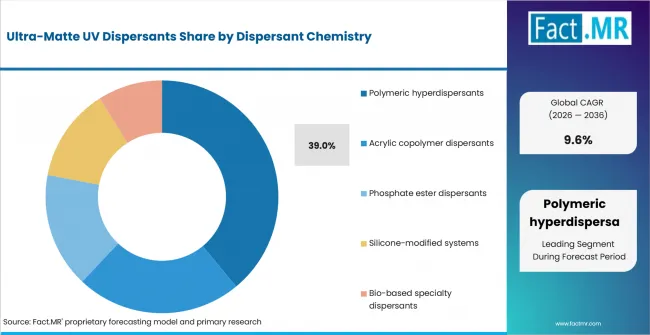
Ultra Matte Uv Dispersants Analysis By Dispersant Chemistry | Source: Fact.MR
Polymeric hyperdispersants are expected to hold the main chemistry position due to strong anchoring on pigment and matting surfaces. Acrylic copolymers serve recipes that need flow control. Phosphate ester dispersants stay useful where mineral fillers require wetting. Silicone-modified and bio-based grades serve smaller specialty routes.
What leads the Matting Solid segment?
Silica is projected to account for 44.0% share in 2026.
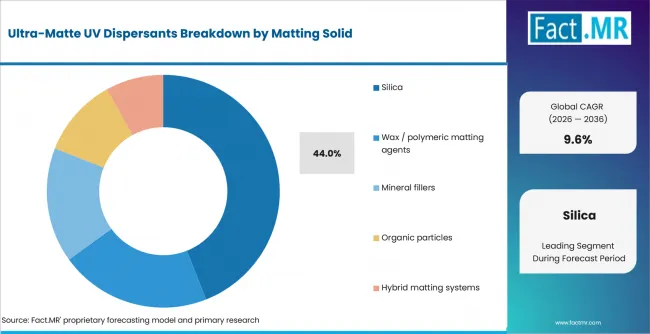
Ultra Matte Uv Dispersants Analysis By Matting Solid | Source: Fact.MR
Silica is projected to account for the main matting-solid position due to low-gloss efficiency in radiation-curing films. Wax and polymeric agents support smoother touch. Mineral fillers remain useful where cost control guides recipe work.
How does UV System shape demand?
100% solids UV is anticipated to represent 47.0% share in 2026.
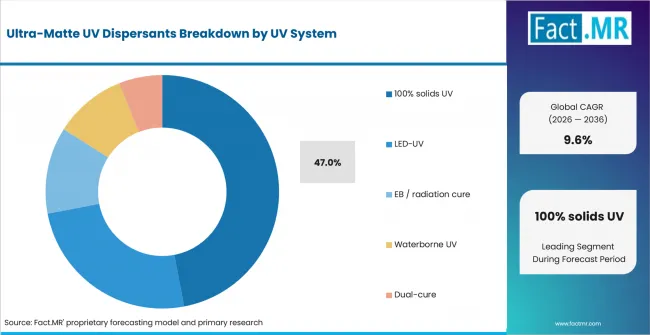
Ultra Matte Uv Dispersants Analysis By Uv System | Source: Fact.MR
100% solids UV is anticipated to represent the main system type since solvent-free lines leave little room for viscosity error. LED-UV supports heat-sensitive substrates. EB and waterborne UV serve industrial and clean-up needs.
What supports Wood coatings within End-use?
Wood coatings are estimated to capture 30.0% share in 2026.
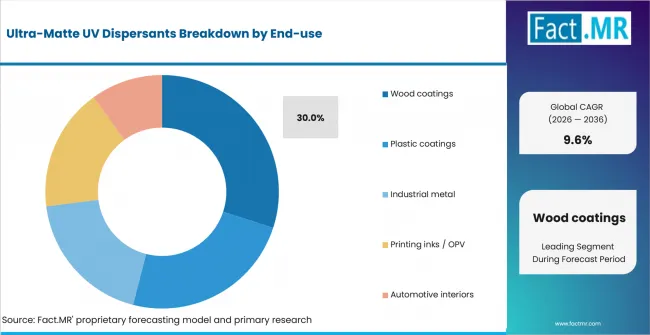
Ultra Matte Uv Dispersants Analysis By End Use | Source: Fact.MR
Wood coatings are estimated to capture the main end-use share because furniture and flooring require low gloss with smooth touch. Plastic coatings follow in interior panels. Industrial metal and ink applications use matte UV where handling speed shapes selection.
What is accelerating Ultra-Matte UV Dispersants Market adoption, and what is holding it back?
Low-gloss UV conversion drives it; viscosity control and raw-material pressure restrain it.
Drivers Impact Analysis
| DRIVER | (~) % IMPACT ON CAGR | GEOGRAPHIC RELEVANCE | IMPACT TIMELINE |
|---|---|---|---|
| Solvent-free ultra-matte coating conversion | +1.6% | North America, Europe, East Asia | Short term (<= 2 years) |
| Silica stabilization at higher matting levels | +1.3% | Global | Medium term (2-4 years) |
| Wood furniture and flooring matte finishes | +1.1% | Europe, USA, Japan | Medium term (2-4 years) |
| Printing ink and overprint varnish needs | +0.8% | UK, Germany, Japan | Long term (>= 4 years) |
- Solvent-free ultra-matte coating conversion: Solvent-free UV systems are increasing demand for dispersants that maintain low gloss without creating excessive viscosity. Formulators need stable flow and particle distribution across clear and pigmented coatings to keep application behavior consistent.
- Silica stabilization at higher matting levels: Silica remains effective for strong gloss reduction, but higher loading can make dispersion control more difficult. Polymeric hyperdispersants help keep particles separated, supporting smoother surfaces and more predictable performance in wood and plastic coatings.
- Wood furniture and flooring matte finishes: Furniture and flooring producers increasingly use matte finishes to reduce glare and fingerprints while retaining scratch resistance and surface feel. Dispersant packages that preserve smoothness and consistent gloss are therefore important in premium wood-finishing applications.
- Printing ink and overprint varnish needs: Printing inks and overprint varnishes require stable dispersions because thin films can reveal haze and uneven particle distribution quickly. Ultra-matte dispersants support uniform appearance while helping formulators maintain flow, gloss control and print-surface consistency.
Opportunity Impact Analysis
| OPPORTUNITY | (~) % IMPACT ON CAGR | GEOGRAPHIC RELEVANCE | IMPACT TIMELINE |
|---|---|---|---|
| LED-UV matte coatings for heat-sensitive substrates | +1.2% | Japan, UK, Italy | Medium term (2-4 years) |
| Bio-based specialty dispersants | +0.9% | Europe, USA | Long term (>= 4 years) |
| Hybrid silica-wax matting packages | +0.7% | Global | Short term (<= 2 years) |
- LED-UV matte coatings: LED curing supports wood and plastic applications where lower heat exposure is important. Stable matting packages can help formulators maintain low gloss, smooth surface appearance, and consistent coating performance across heat-sensitive substrates.
- Bio-based specialty dispersants: Bio-based polymeric dispersants create an opportunity for UV-cured inks and coatings seeking lower-impact formulation routes. These products can support sustainability goals while maintaining particle stabilization, flow control, and compatibility with radiation-curing systems.
- Hybrid silica-wax matting packages: Hybrid silica-wax systems can balance strong gloss reduction with smoother surface feel. Suppliers that combine dispersant selection with matting-agent guidance can help furniture and interior-plastic formulators achieve consistent appearance, touch, and application performance.
Restraints Impact Analysis
| RESTRAINT | (~) % IMPACT ON CAGR | GEOGRAPHIC RELEVANCE | IMPACT TIMELINE |
|---|---|---|---|
| Viscosity rise from high matting-solid loading | -0.7% | Global | Short term (<= 2 years) |
| Qualification delays in clear and pigmented UV films | -0.5% | Europe, North America | Medium term (2-4 years) |
| Raw-material and additive cost pressure | -0.4% | USA, UK, Germany | Short term (<= 2 years) |
- Viscosity rise from high matting-solid loading: Ultra-matte finishes require greater surface disruption, which often means higher matting-solid loading. Weak dispersion can increase viscosity and make coating application less predictable, complicating formulation approval and process control.
- Qualification delays in clear and pigmented UV films: Matte UV systems must meet gloss, scratch-resistance, cure, and appearance requirements together. Changes in dispersants or matting packages can alter coating behavior across substrates, extending validation before commercial adoption.
- Raw-material and additive cost pressure: Higher additive and coating-material costs can make formulators more cautious about switching dispersant systems. Buyers are likely to compare dosage efficiency, viscosity control, and overall formulation performance before approving higher-cost specialty additives.
Which countries are scaling the Ultra-Matte UV Dispersants Market through 2036?
- The country comparison spans 1.8 percentage points across the forecast period.
- The UK remains 0.8 percentage point above Italy through export-facing ink activity and low-VOC coating conversion.
- Italy stays 0.4 percentage point above the USA through construction coatings and matte furniture finishing.
- The USA remains 0.3 percentage point above Japan through construction-linked coating use.
- Japan stays 0.3 percentage point above Germany through housing starts and low-glare interior coating needs.
- Germany completes the displayed range through building-permit recovery and wood finishing.
Comparable CAGRs create different entry conditions due to solvent rules, coating output and furniture finishing. Full report coverage includes North America, Latin America, Western Europe, Eastern Europe, East Asia, South Asia & Pacific, Middle East & Africa.
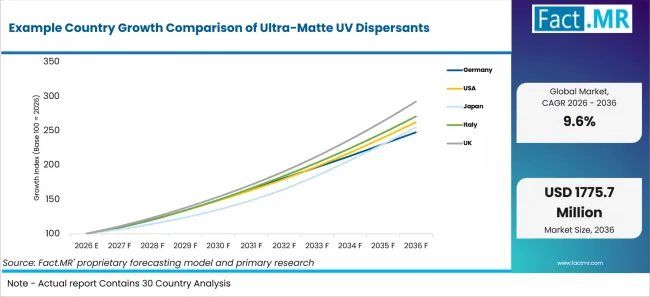
Example Country Growth Comparison Of Ultra Matte Uv Dispersants | Source: Fact.MR
| Country | CAGR |
|---|---|
| UK | 11.3% |
| Italy | 10.5% |
| USA | 10.1% |
| Japan | 9.8% |
| Germany | 9.5% |
What supports the UK outlook?
11.3% CAGR through 2036, supported by export-facing inks and low-VOC coating conversion.
UK ink and coating formulators evaluate ultra-matte UV dispersants by gloss stability and low-viscosity behavior. The UK is projected to record 11.3% CAGR through 2036. Office for National Statistics series P2Q8 records UK exports to the world of CPA 20.3 paints, varnishes and printing ink at GBP 381 million in Q3 2025. The series provides an export-facing indicator for the relevant coating and ink product category.
How is Italy scaling demand?
10.5% CAGR through 2036, driven by construction coatings and furniture finishing.
Italian furniture and building-material finishers use low-gloss UV coatings where surface touch and fast handling guide recipe approval. Italy is expected to post 10.5% CAGR through 2036. Istat stated in February 2026 that calendar-adjusted construction production rose 4.8% across 2025. Finishers are expected to support dispersants that stabilize silica and wax systems.
What supports USA adoption?
10.1% CAGR through 2036, backed by construction-linked coatings and wood finishing.
U.S. formulators apply ultra-matte UV dispersants where wood and plastic coating lines need stable matting solids. The USA is anticipated to advance at 10.1% CAGR through 2036. The U.S. Census Bureau released in February 2026 that construction value reached USD 2,164.4 billion in 2025. Building-related coatings are expected to keep wood finishes visible.
How does Japan perform?
9.8% CAGR through 2036, led by housing starts and automotive interior coating needs.
Japanese coating labs emphasize repeatable gloss and surface feel across plastic trim and wood finishes. Japan is forecast to reach 9.8% CAGR through 2036. The Ministry of Land, Infrastructure, Transport and Tourism stated in January 2026 that seasonally adjusted annualized new housing starts rose 7.3% month over month in December 2025. Formulators are expected to use matte UV recipes for tight visual standards.
What is supporting Germany’s outlook?
9.5% CAGR through 2036, supported by building permits and automotive trim finishing.
German formulators focus on documented dispersion behavior for strict gloss and touch targets. Germany is estimated to record 9.5% CAGR through 2036. Destatis reported on February 18, 2026 that 238,500 dwellings were approved in Germany in 2025, 10.8% more than in 2024. Building-permit activity provides broader context for construction-linked coating demand.
Who leads the Ultra-Matte UV Dispersants Market?
BASF, BYK, Evonik and Lubrizol document UV or radiation-curable dispersant offerings, while Elementis contributes broader coatings-dispersant portfolios.
BASF's Efka PX 4720 is designed for ultra-matte, solvent-free UV-curing coatings. BYK's DISPERBYK-2158 is designed for solvent-free UV-curing coatings to disperse and stabilize treated and untreated silica-based matting agents. Evonik's TEGO Dispers 685 is a high-polymeric wetting and dispersing additive for radiation-curing formulations and is recommended for UV printing inks.
Lubrizol's Solsperse 86000 is a polymeric dispersant for UV-cured inks and coatings. Elementis' NUOSPERSE W-30 is a wetting and dispersing agent for waterborne pigment dispersions used in paints, coatings and inks. Supplier documentation across these products highlights viscosity reduction or control, dispersion stability, and compatibility with relevant coating and ink systems.
Which companies are the key providers?
Key companies include BYK, Evonik, Lubrizol, BASF, and Elementis.
- BYK
- Evonik
- Lubrizol
- BASF
- Elementis
Bibliography
- BASF. (2026, May 13). American Coatings Show 2026: BASF debuts Efka® PX 4720 to power ultra-matte UV coatings with CFRP technology.
- Elementis. (2024). Performance specialties: Asia product overview.
- Evonik Operations GmbH. (2025, October 26). ACEMATT® 3600 [Technical data sheet].
- Evonik Operations GmbH. (2025, October 26). TEGO® Dispers 685 [Technical data sheet].
- Statistisches Bundesamt (Destatis). (2026, February 18). 10,8 % mehr Baugenehmigungen für Wohnungen im Jahr 2025.
- Istat. (2026, February 20). Production in the construction sector – December 2025.
- The Lubrizol Corporation. (2024, July 25). Solsperse™ 86000 [Product data sheet].
- Office for National Statistics. (2026, July 16). CPA 08:WW:EX:CP:BOP:NSA: 20.3. Paints, varnishes & printing ink (Series P2Q8).
- Office for National Statistics. (2026, July 16). UKProdTO: 20.3 – Manuf paint varnish & similar, printing ink & mastics HOME (Series JQ6W).
- U.S. Bureau of Labor Statistics. (2026, January 30). Producer Price Indexes – December 2025.
- U.S. Census Bureau. (2026, February 27). Monthly construction spending, December 2025.
This Report Addresses
- The report explains ultra-matte UV dispersants by chemistry and matting solid.
- Segment analysis identifies polymeric hyperdispersants, silica, 100% solids UV and wood coatings.
- Country analysis reviews Germany, USA, Japan, Italy and the UK.
- Competitive analysis reviews BYK, Evonik, Lubrizol, BASF, and Elementis.
- Application analysis assesses gloss, viscosity, surface feel and cure route.
- Source review uses official statistics, company documents and provider portfolios.
What does the Ultra-Matte UV Dispersants Market cover?
Polymeric, acrylic, phosphate ester and silicone-modified dispersants used for ultra-matte UV finishes.
The Ultra-Matte UV Dispersants Market covers additives that disperse pigments and matting solids in radiation-curing coatings. It includes chemistry used with silica and wax systems.
The assessment is narrower than general coating additives because it focuses on low-gloss UV systems. It excludes products outside dispersant use.
What is included in the scope?
Ultra-matte UV dispersant systems used in wood, plastic, metal, ink and automotive interior applications.
The scope includes dispersants used in 100% solids UV, LED-UV, EB and waterborne UV coatings. It covers wood coatings, printing ink, wetting and dispersing agents, UV cure lacquers and radiation cured products where these categories overlap coating formulation needs.
What is excluded from the scope?
Pigments, photoinitiators and stand-alone matting solids are outside the scope.
The scope excludes pigments, resin binders, photoinitiators, UV lamps and curing equipment. Adjacent paints and coatings, automotive coatings, pigments and dyes and low-foam wetting agents remain outside unless the sale centers on dispersant selection.
How Was the Analysis Built?
The analysis draws on 120+ sources, 35+ company portfolios, 25+ countries, and more than 20 industry interviews.
- Primary Research: Primary research includes discussions with manufacturers, service providers, technology developers, distributors, end users, and subject-matter experts. These conversations examine purchasing priorities, product adoption, operational challenges, approval requirements, competitive positioning, and the factors that influence wider market acceptance.
- Desk Research: Desk research covers government statistics, regulatory publications, company filings, trade data, technical studies, industry associations, standards, public policy, and other authoritative sources. Every source used in the analysis is documented in the bibliography.
- Market Sizing and Forecasting: Market estimates combine historical performance, demand indicators, pricing and volume trends, segment shares, company participation, country-level growth, adoption patterns, investment activity, and barriers to market expansion.
- Data Validation and Update Cycle: Findings are validated by comparing primary interviews with public data, company activity, regulatory changes, trade patterns, and industry developments. Regular updates review new product launches, capacity changes, partnerships, approvals, and shifts in commercial adoption.
What is the report’s scope and coverage?
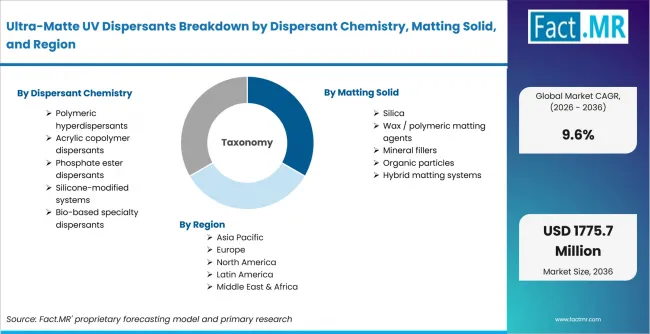
Ultra Matte Uv Dispersants Breakdown By Dispersant Chemistry, Matting Solid, And Region | Source: Fact.MR
| Attribute | Details |
|---|---|
| Units | USD million |
| Market Definition | Specialty wetting and dispersing additives used to stabilize pigments, silica, waxes and hybrid matting packages in ultra-matte UV systems. |
| Dispersant Chemistry | Polymeric hyperdispersants; Acrylic copolymer dispersants; Phosphate ester dispersants; Silicone-modified systems; Bio-based specialty dispersants |
| Matting Solid | Silica; Wax and polymeric matting agents; Mineral fillers; Organic particles; Hybrid matting systems |
| UV System | 100% solids UV; LED-UV; EB and radiation cure; Waterborne UV; Dual-cure |
| End-use | Wood coatings; Plastic coatings; Industrial metal; Printing inks and OPV; Automotive interiors |
| Regions Covered | North America; Latin America; Western Europe; Eastern Europe; East Asia; South Asia & Pacific; Middle East & Africa |
| Countries Covered | UK; Italy; USA; Japan; Germany |
| Key Companies Profiled | BYK; Evonik; Lubrizol; BASF; Elementis |
| Forecast Period | 2026 to 2036 |
| Approach | Hybrid approach using UV coating use, matting-solid selection, end-use intensity and provider portfolio review. |
How is the market segmented?
-
By Dispersant Chemistry
- Polymeric hyperdispersants
- Acrylic copolymer dispersants
- Phosphate ester dispersants
- Silicone-modified systems
- Bio-based specialty dispersants
-
By Matting Solid
- Silica
- Wax and polymeric matting agents
- Mineral fillers
- Organic particles
- Hybrid matting systems
-
By UV System
- 100% solids UV
- LED-UV
- EB and radiation cure
- Waterborne UV
- Dual-cure
-
By End-use
- Wood coatings
- Plastic coatings
- Industrial metal
- Printing inks and OPV
- Automotive interiors
-
By Region
- North America
- Latin America
- Western Europe
- Eastern Europe
- East Asia
- South Asia & Pacific
- Middle East & Africa