- Base Value(2025): 285.4 Mn
- Estimated Value(2025): 285.4 Mn
- Forecast Value (2035): 472.6 Mn
- CAGR (2025 - 2035): 5.2%
Demand for Argan Oil in USA 2025 to 2035
The argan oil industry in USA is projected to grow from USD 285.4 million in 2025 to approximately USD 472.6 million by 2035, expanding at a compound annual growth rate (CAGR) of 5.2% between 2025 and 2035. This growth is fundamentally driven by the unwavering consumer shift towards clean, multi-functional, and ethically sourced beauty and wellness ingredients.
Argan oil, often marketed as liquid gold, has successfully transcended its initial status as a niche luxury item to become a mainstream staple in skincare, haircare, and culinary applications. Its unique composition of essential fatty acids, vitamin E, and antioxidants offers a compelling narrative of efficacy that resonates with ingredient-conscious American consumers who seek proven, natural solutions for anti-aging, hydration, and overall vitality.
Quick Stats for USA Argan Oil Industry
- USA Argan Oil Sales Value (2025): USD 285.4 million
- USA Argan Oil Forecast Value (2035): USD 472.6 million
- USA Argan Oil Forecast CAGR: 5.2%
- Leading Product Type: Cosmetic Grade Argan Oil (68.5%)
- Leading Distribution Channel: E-commerce & Direct-to-Consumer (44.2%)
- Key Growth Regions: West, North, Southwest, Midwest
- Regional Leadership: The West holds a leading position in value demand
- Key Players in US Argan Oil Industry: Josie Maran Cosmetics, Moroccanoil, The Ordinary (DECIEM), SheaMoisture (Unilever), NOW Foods, ArtNaturals, Foxbrim, Aura Cacia (Frontier Co-op), Viva Naturals, 100% Pure.
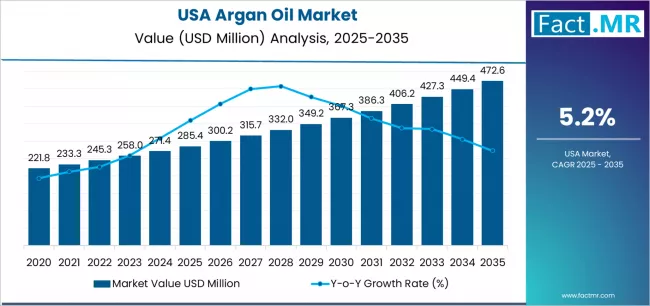
Usa Argan Oil Market Market Value Analysis | Source: Fact.MR
The market's expansion is further catalyzed by the strategic efforts of brands to diversify applications and educate consumers. Once primarily confined to hair serums and high-end facial oils, argan oil is now a featured ingredient in a vast array of product formats, including body lotions, soaps, scalp treatments, supplements, and gourmet food products. This proliferation across categories significantly amplifies its total addressable market. Furthermore, the narrative surrounding argan oil is deeply intertwined with stories of female empowerment and sustainable sourcing from Moroccan cooperatives, adding a powerful layer of ethical consumption that aligns with the values of a significant segment of US shoppers. This combination of perceived efficacy, versatility, and social impact creates a robust foundation for sustained growth, with innovation particularly concentrated in the natural and clean beauty segments prevalent in coastal urban centers.
Thecosmetic grade argan oil segmentis projected to account for 68.5% of market demand by value in 2025. This dominance is anchored in the oil's unparalleled reputation within the beauty industry as a multitasking moisturizer and reparative agent. Its efficacy in addressing concerns from frizzy hair and split ends to dry skin and fine lines has been validated both anecdotally and through a growing body of cosmetic science, securing its place as a hero ingredient in formulations ranging from mass-market drugstore lines to ultra-premium skincare brands. The segment benefits from continuous product development that seeks to blend argan oil with other potent actives, enhancing its appeal and functionality.
Thee-commerce and direct-to-consumer (DTC) channelis expected to hold 44.2% of market demand in 2025. This channel's strength is multifaceted. It serves as the primary discovery platform for new, independent brands that champion purity and ethical sourcing, allowing them to tell a detailed brand story that physical retail cannot accommodate. It facilitates the sale of pure, 100% argan oil in various sizes, which appeals to purists and DIY beauty enthusiasts. Furthermore, subscription models for replenishing hair and skincare staples containing argan oil are easily managed online, creating predictable demand and high customer lifetime value. The visual and educational nature of social media platforms like Instagram and TikTok perfectly complements this channel, driving discovery and purchase.
From 2030 to 2035, demand is forecast to grow from USD 367.8 million to USD 472.6 million, adding USD 104.8 million. This latter period will be characterized by several transformative trends. The maturation of "blue beauty" principles, focusing on water conservation and regenerative sourcing, will place argan oil's sustainable narrative under greater scrutiny, rewarding brands with verifiably transparent and impactful supply chains. The convergence of beauty and wellness will accelerate, driving growth in dietary argan oil supplements marketed for internal anti-inflammatory and nutritive benefits. Technological integration, such as QR codes on packaging linking to blockchain-verified sourcing stories, will become a standard expectation for authenticity. Finally, advanced cosmetic formulations will leverage micro-encapsulated argan oil for targeted delivery and blended "super oil" serums that combine it with other rare botanicals, driving premiumization and innovation in the high-end skincare segment.
The USA argan oil industry is navigating a pivotal phase of maturation, moving from explosive growth to sustainable, value-driven expansion. Its future trajectory hinges on the industry's collective ability to safeguard supply chain integrity against adulteration, elevate ethical sourcing from a marketing claim to a measurable impact standard, and continue to innovate in product formats that meet the evolving demands of a sophisticated and discerning consumer base. The brands that will lead the market through 2035 will be those that successfully balance scientific validation of benefits with authentic storytelling, ensuring that the story of argan oil remains as pure and potent as the oil itself.
USA Argan Oil Industry Key Takeaways
| Metric | Value |
|---|---|
| USA Argan Oil Sales Value (2025) | USD 285.4 million |
| USA Argan Oil Forecast Value (2035) | USD 472.6 million |
| USA Argan Oil Forecast CAGR (2025-2035) | 5.2% |
Source: Fact.MR analysis. Updated Dec 4, 2025
Why is the USA Argan Oil Industry Growing?
The growth of the argan oil industry in the United States of America is a compelling case study in the convergence of ingredient-led wellness, ethical consumerism, and effective marketing. The fundamental driver is a profound and lasting shift in consumer priorities towards transparency, natural efficacy, and multipurpose simplicity in personal care. Argan oil delivers on these demands by being a single-ingredient solution with a centuries-old history of use, backed by modern scientific understanding of its fatty acid and tocopherol profile. Consumers are increasingly rejecting complex chemical cocktails in favor of recognizable, potent botanicals, and argan oil sits at the pinnacle of this category due to its demonstrable benefits for skin barrier function, hair strength, and overall luminosity. This trust in its inherent properties transforms it from a mere commodity into a cherished staple within daily routines.
Beyond intrinsic efficacy, the industry's expansion is fueled by a powerful and marketable narrative of social and environmental responsibility. The story of argan oil is intrinsically linked to the female-run cooperatives in Morocco, where the traditional, labor-intensive extraction process supports rural communities and empowers women. For the American consumer, purchasing authentic, ethically sourced argan oil becomes an act of global solidarity and conscious capitalism. This narrative has been expertly leveraged by pioneering brands to build deep emotional connections with their customer base. Furthermore, the industry has adeptly expanded the USAge occasions for argan oil. It is no longer just a luxury facial oil; it is a hair treatment, a cuticle conditioner, a body moisturizer, a scalp serum, and a culinary delight. This versatility ensures it reaches a wider audience through multiple product categories, each with its own consumer base and retail channel, thereby multiplying its market touchpoints and driving compound growth.
The regulatory and retail environment in the USA has also played a facilitating role. The lack of stringent pre-market approval for cosmetics, under the FDA's framework, allows for rapid innovation and product launches featuring argan oil. Simultaneously, major retailers, from Sephora and Ulta to Target and Whole Foods, have created dedicated spaces for natural and clean beauty, providing crucial shelf space and legitimacy for argan oil-based products. The proliferation of third-party certifications, such as USDA Organic, Fair Trade, and Ecocert, provides a shorthand for quality and ethics that helps consumers navigate a crowded marketplace and justifies premium pricing. This ecosystem of consumer demand, compelling storytelling, versatile application, and supportive retail infrastructure creates a virtuous cycle that continues to propel the argan oil market forward.
Segmental Analysis
The USA argan oil market can be effectively segmented by product grade and distribution channel, a framework essential for understanding its diverse revenue streams and competitive dynamics. The product grade segmentation separates the market into two distinct worlds: cosmetic and culinary. The cosmetic grade segment is the larger and more dynamic arena, driven by beauty trends, marketing narratives, and product formulation innovation.
The culinary segment, while smaller, represents a high-growth niche fueled by gourmet food trends and nutritional awareness, operating under different regulatory considerations and purchase motivations. Analyzing these segments separately reveals how argan oil serves two different consumer mindsets—one seeking external beauty and self-care, the other seeking internal health and culinary exploration.
Parallel to product type is the critical segmentation by distribution channel, which dictates how consumers discover, evaluate, and purchase argan oil. The channel landscape is bifurcating. The e-commerce channel thrives on education, brand storytelling, and the sale of pure oils, catering to informed enthusiasts.
The brick-and-mortar channel, encompassing specialty retailers, mass merchandisers, and grocery stores, competes on immediacy, sensory experience (testers), and brand trust built through physical presence. The growth trajectory and strategy for a brand selling a USD 50 organic argan serum are fundamentally different from those of a brand selling a USD 15 argan hair oil at a drugstore, and this is dictated by their chosen channel mix. A deep dive into these segments illuminates the pathways to market and the evolving consumer journey for this prized ingredient.
Why Does Cosmetic Grade Argan Oil Dominate the Product Segment?
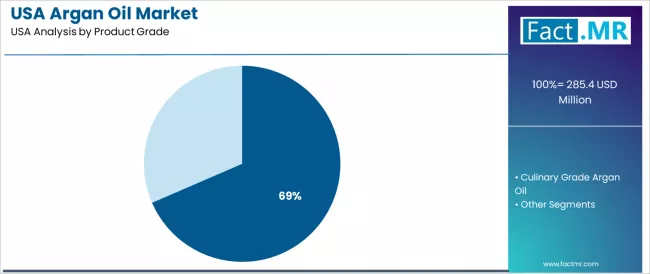
Usa Argan Oil Market Analysis By Product Grade | Source: Fact.MR
The cosmetic grade argan oil segment, commanding a 68.5% share, is the undisputed heart of the industry. Its dominance is rooted in a powerful alignment with the core tenets of the modern clean beauty movement: efficacy, purity, and multi-functionality. Argan oil’s chemical composition, rich in oleic and linoleic acids alongside vitamin E, directly addresses prevalent consumer concerns such as skin dehydration, barrier impairment, hair damage, and aging signs. This scientific backing allows brands to make credible efficacy claims, moving beyond folklore to cosmeceutical appeal. The oil serves as a versatile base or additive in formulations, allowing brands to create entire product lines—cleansers, moisturizers, hair masks, serums—under the argan oil umbrella, thereby maximizing brand equity and shelf presence within a single, powerful ingredient story.
Furthermore, the cosmetic segment benefits from exceptionally high margins and strong potential for premiumization. Consumers are willing to pay a significant premium for perceived purity, ethical sourcing, and brand prestige. This enables a wide price spectrum, from affordable pure oils at natural grocery stores to ultra-luxurious blends from prestige skincare brands. The segment is also driven by relentless innovation in delivery systems and synergistic blends. Formulators are creating water-soluble derivatives, nano-emulsions for deeper penetration, and combining argan oil with other sought-after actives like retinol, squalane, and CBD to create next-generation products. This constant innovation refreshes the category, attracts new consumers, and encourages existing users to trade up, ensuring the segment remains dynamic and far from commoditized.
The cultural resonance of cosmetic argan oil cannot be overstated. It is embedded in beauty routines through widespread professional endorsement from hairstylists, estheticians, and influencers. Its presence in both professional salon channels (for hair care) and prestige retail (for skincare) reinforces its legitimacy and desirability. Marketing campaigns successfully tie the oil to concepts of luxury, self-care ritual, and natural radiance, creating an aspirational quality that transcends its functional benefits. While the culinary segment grows, it is the deep integration of argan oil into the daily beauty and personal care rituals of millions of Americans that secures its dominant market position and provides a stable platform for continued growth and innovation.
Why is the E-commerce and DTC Channel a Critical Growth Engine?
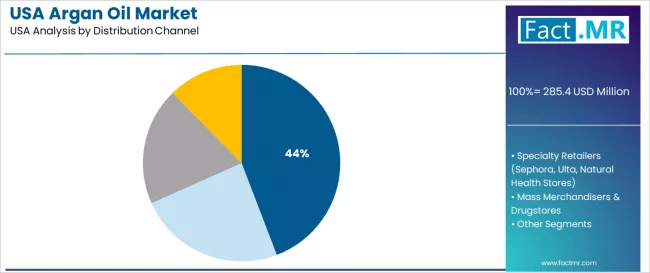
Usa Argan Oil Market Analysis By Distribution Channel | Source: Fact.MR
The e-commerce and direct-to-consumer (DTC) channel, holding 44.2% of the market, is not merely a sales outlet but the central nervous system for innovation, education, and community building in the argan oil space. This channel excels in addressing the key purchase barriers for a considered, high-quality natural product: the need for extensive information and trust in authenticity. A brand's website or dedicated Amazon storefront can host detailed content about sourcing cooperatives, extraction methods, certification details, and USAge tutorials—information impossible to convey fully on a physical product label. This depth of storytelling is crucial for justifying price points and differentiating authentic, ethical products from cheaper, adulterated alternatives that may saturate some physical retail spaces.
The DTC model provides unparalleled advantages for brand control and customer relationship management. By selling directly, brands capture valuable first-party data on customer preferences, purchasing habits, and feedback, allowing for agile product development and personalized marketing. Subscription models for replenishing staple oils or serums create predictable revenue streams and high customer lifetime value. This direct relationship also turns customers into community members and brand advocates, whose user-generated content and reviews become powerful social proof that fuels further acquisition. For many indie brands, a successful DTC operation provides the proof of concept and loyal customer base needed to later negotiate favorable terms with brick-and-mortar retailers.
The channel's growth is symbiotically linked to visual social media platforms. Instagram and Pinterest are ideal for showcasing the luxurious texture and golden hue of the oil, while TikTok and YouTube are perfect for demonstrable before-and-after tutorials and routine integrations. Influencer partnerships, often managed and measured through digital campaigns, drive targeted traffic directly to e-commerce sites. E-commerce enables the sale of a wide range of sizes and formats, from sample vials to bulk refills, catering to both new triers and dedicated power users. As consumers become more comfortable with researching and purchasing beauty and wellness products online, the e-commerce channel's share is poised to grow, solidifying its role as the primary engine for market expansion, brand launches, and consumer education in the argan oil category.
What are the Drivers, Restraints and Trends in the Argan Oil Industry in USA?
The USA argan oil industry's path is charted by a set of powerful, sustained drivers that create market expansion, countered by significant structural restraints that threaten stability and authenticity. The growth is not accidental but is fueled by macro-cultural shifts in consumer behavior towards clean beauty, holistic wellness, and ethical consumption. However, this very popularity creates its own set of challenges, including supply chain vulnerabilities, quality control issues, and intense competitive pressure that can dilute brand value. Understanding this push-and-pull dynamic is essential for stakeholders to identify genuine opportunities for differentiation and to mitigate risks that could undermine consumer trust, the industry's most valuable asset.
Beyond the immediate drivers and restraints, the market is being reshaped by emergent trends that signal its future direction. These trends point to an industry moving towards greater sophistication, transparency, and scientific integration. The conversation is evolving from simply having argan oil in a product to questioning its provenance, its environmental impact, its synergistic partners in formulation, and its mechanism of action. The following analysis delves into the specific forces propelling demand, the material constraints capping growth, and the innovative trends that will define the next wave of competition and consumer expectation in the argan oil market.
The Unabated Growth of the Clean and Natural Beauty Movement
The clean beauty movement, which prioritizes non-toxic, transparently sourced, and naturally derived ingredients, remains the single most powerful driver for argan oil demand. As consumers become increasingly ingredient-literate, often using apps to screen product compositions, simple, recognizable ingredients like argan oil gain immense trust. It is perceived as a safe, effective, and time-tested alternative to synthetic silicones, mineral oils, and parabens commonly found in conventional beauty products.
This driver is amplified by retailer curation; platforms like Sephora (with its "Clean at Sephora" seal) and Ulta (with its "Conscious Beauty" program) actively promote and segment clean brands, giving argan oil-based products prominent visibility and credibility. The movement has moved from niche to mainstream, ensuring argan oil's place not as a fleeting trend but as a cornerstone ingredient in the evolving American beauty regimen.
Consumer Demand for Multi-Functional and Minimalist Beauty Solutions
Modern consumers, particularly younger generations, seek efficiency and simplicity in their routines. Argan oil is marketed as the epitome of a multi-tasking hero product—a single item that can condition hair, moisturize skin, soften cuticles, and tame eyebrows. This aligns perfectly with desires for smaller skincare collections, capsule beauty routines, and products that deliver multiple benefits.
This driver expands the use case and frequency of application, increasing consumption rates. It also allows brands to market a single argan oil product to a wide audience, from skincare beginners to beauty enthusiasts. The narrative of simplicity and efficacy reduces decision fatigue for the consumer and positions argan oil as a versatile, cost-effective staple, driving repeat purchases and household penetration across diverse demographic groups.
Supply Chain Vulnerability and Adulteration Risks
The argan oil supply chain is geographically constrained to a specific region in Morocco, making it inherently vulnerable to climate variability, political instability, and agricultural challenges. The argan tree takes years to mature and bear fruit, and production is limited by traditional, labor-intensive methods. This finite supply, coupled with skyrocketing global demand, creates intense pressure that leads to two major issues: price volatility and widespread adulteration.
To meet volume demands and cut costs, suppliers often dilute pure argan oil with cheaper vegetable oils like sunflower or olive oil. This rampant adulteration erodes consumer trust in the category as a whole and forces legitimate brands to invest heavily in costly third-party testing and traceability systems to verify purity, costs that are ultimately passed to the consumer and can limit market growth to premium segments.
High Price Point and Consumer Education Gaps
Authentic, ethically sourced, 100% pure argan oil commands a premium price due to its limited supply and intensive production process. This high price point can be a significant barrier to entry for price-sensitive consumers, especially when compared to synthetic alternatives or diluted blends. This restraint segments the market, potentially confining the highest quality argan oil to an affluent demographic.
Compounding this is a persistent education gap. While core enthusiasts understand the value, many potential consumers remain unaware of the differences between cosmetic and culinary grades, cold-pressed versus refined oil, or pure versus blended products. This confusion can lead to disappointing experiences with low-quality products, causing consumers to dismiss the entire category rather than seek out authentic versions. Overcoming this restraint requires continuous, industry-wide investment in transparent labeling and consumer education.
The Rise of Traceability Technology and Hyper-Transparency
In response to adulteration risks and the demand for ethical proof, leading brands are investing in advanced traceability technologies. This trend moves beyond a Fair Trade certificate on a label to interactive, granular transparency. Brands are implementing blockchain technology or unique QR codes on packaging that allow consumers to trace the oil's journey from a specific cooperative in Morocco to the finished product on the shelf.
This digital passport might show photos of the harvest, data on the women's collective that produced it, and third-party lab certificates of purity. This hyper-transparency trend builds unparalleled trust, justifies premium pricing, and effectively neutralizes the threat of counterfeit or adulterated products. It transforms the ethical sourcing story from a vague marketing claim into a verifiable, immersive consumer experience, setting a new standard for accountability in the natural ingredients market.
Scientific Validation and Cosmetic Convergence
The next frontier for argan oil is moving from traditional remedy to scientifically validated cosmeceutical. The trend involves partnering with dermatologists and research institutions to conduct clinical studies on argan oil's specific efficacy for conditions like atopic dermatitis, hair tensile strength, or transepidermal water loss.
Brands are leveraging this data to make stronger, more specific claims, attracting a more discerning, science-focused consumer. Concurrently, there is a trend of cosmetic convergence, where argan oil is being chemically modified or expertly blended with other high-tech actives.
Examples include argan oil esters for non-greasy feel, phospholipid complexes for enhanced delivery, and synergistic blends with niacinamide, bakuchiol, or peptides. This trend elevates argan oil from a standalone natural oil to a sophisticated functional ingredient within advanced, hybrid formulations that bridge the gap between nature and cutting-edge cosmetic science.
Analysis of USA Argan Oil Industry by Key Regions
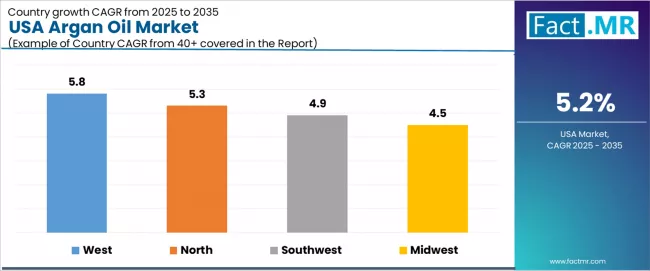
Usa Argan Oil Market Cagr Analysis By Country | Source: Fact.MR
| Region | CAGR (2025-2035) |
|---|---|
| West | 5.8% |
| Southwest | 4.9% |
| North | 5.3% |
| Midwest | 4.5% |
Source: Fact.MR analysis. Updated Dec 4, 2025
The demand for argan oil in USA is not geographically uniform; it is shaped by regional variations in culture, climate, consumer values, and retail sophistication. A national strategy fails to capture the nuances that drive purchase decisions in diverse markets. The West Coast, with its pioneering wellness culture, sets trends and demands the highest standards of purity and ethics.
The Northeast, characterized by affluent, educated consumers and harsh winters, drives demand for efficacious skincare solutions. The Sunbelt states, with their focus on active lifestyles and haircare, present unique opportunities for specific product formats. The Midwest, with its pragmatic values, prioritizes trust and recognizable brands. Understanding these regional personalities is critical for effective marketing, product assortment planning, and retail partnership strategies.
This regional analysis dissects the four key areas to provide a granular view of the USA argan oil landscape. It explores why the West leads in growth and innovation, how the North's climate and demographics shape its preferences, what drives adoption in the Southwest, and how the Midwest's steady demand forms the reliable backbone of the mass market.
For industry players, this intelligence is indispensable. It informs where to launch a new regenerative organic argan serum, how to message a hydrating hair oil in a dry climate, or which retail partners are most influential in building brand credibility in a specific region. Success in the USA market requires a federated approach that respects and responds to these powerful regional differences.
What Strategic Advantages Position the West as the Leading Growth Region?
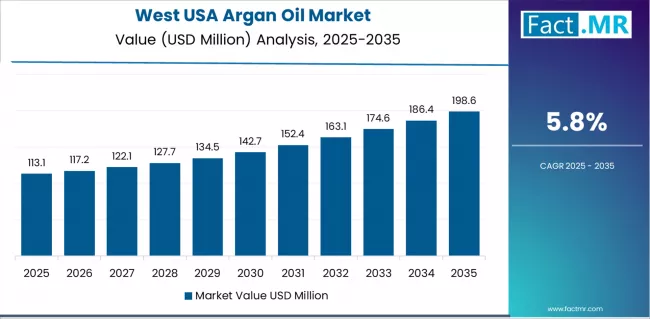
Usa Argan Oil Market Country Value Analysis | Source: Fact.MR
The West, with a leading CAGR of 5.8%, is the undisputed epicenter of the argan oil market, acting as both its largest consumer and primary trend incubator. This region's dominance is built on a deep cultural alignment with the core values of the argan oil narrative: natural wellness, environmental sustainability, and ethical consumption.
States like California, Oregon, and Washington have populations with exceptionally high ingredient awareness, a preference for clean beauty, and a willingness to invest in premium personal care products. The retail environment is uniquely favorable, hosting the headquarters and strongest store networks of key retailers like Sephora, Ulta, and Whole Foods, all of which have robust clean beauty programs that prominently feature argan oil.
Consumer demand in the West is for the most authentic, transparent, and sustainably sourced products. Brands that succeed here often lead with radical transparency, showcasing direct relationships with women's cooperatives and holding multiple certifications (Organic, Fair for Life, Leaping Bunny). The climate, ranging from the dry deserts of Southern California to the damp coastal regions, also drives versatile USAge, from intense facial hydration to frizz-control for hair.
The West is also home to a dense concentration of beauty influencers, aestheticians, and wellness practitioners whose endorsements can make or break a brand. Consequently, innovation is rapid; new product formats, blends, and sustainability initiatives are often trialed here before rolling out nationally. Marketing must be authentic, visually compelling, and deeply rooted in the story of people and planet to resonate with the discerning Western consumer.
How Does the North's Climate and Affluent Demographics Shape its Market?
The North, growing at a CAGR of 5.3%, represents a high-value, efficacy-driven market shaped by its distinct seasons and concentrated urban affluence. The harsh, dry winters in cities like New York, Boston, and Chicago create a powerful, seasonal demand for intensive moisturizing and skin barrier repair, for which argan oil is perfectly positioned. Consumers in this region are well-educated, research-driven, and value clinical validation alongside natural claims.
They are likely to seek out argan oil products that are featured in prestige dermatologist offices or recommended by beauty editors in major publications headquartered in the region. The retail landscape is a mix of iconic department stores, prestige beauty boutiques, and high-end apothecaries that cater to a luxury mindset. In the North, argan oil is often positioned as a luxury skincare elixir rather than solely a hair product. Anti-aging and reparative claims are particularly potent here.
The fast-paced urban lifestyle supports demand for multi-tasking products that streamline routines, aligning with argan oil's versatility. Successful brands in the North combine the natural story with a sleek, scientific aesthetic in packaging and messaging. They invest in partnerships with northern-based dermatologists and stylists, and ensure their products are available in the curated beauty sections of high-end grocery chains like Eataly or Dean & DeLuca, where culinary grade argan oil also finds a receptive audience among foodie consumers.
How do Lifestyle and Demographics Propel the Southwest Market?
The Southwest is forecast to grow at a CAGR of 4.9%, driven by its unique climate, active lifestyle, and significant Hispanic population. The arid, sunny environment creates consistent, year-round demand for potent moisturizers and hair products that protect against dehydration and UV-related damage. Argan oil's use as a hair treatment to combat dryness, frizz, and heat styling damage is particularly pronounced in this region. The active, outdoor lifestyle also supports sales of argan oil in body care products for post-sun skin recovery and overall hydration.
Demographically, the large and culturally connected Hispanic population is a significant driver. There is often a cultural familiarity with and appreciation for natural oil-based hair and skincare remedies, making argan oil a relatable and valued ingredient. Marketing that respectfully acknowledges this heritage and features diverse representation can resonate deeply.
The retail environment is diverse, with strong performance in both mass-market chains serving broad populations and specialty natural stores in affluent suburbs. In the Southwest, marketing that emphasizes practical results, shine, strength, hydration, along with authenticity and a touch of exotic allure performs well. Brands may also find success with larger, value-sized packaging for body and hair oils, catering to families and consistent users in the dry climate.
What Factors Underpin the Steady, Value-Conscious Market in the Midwest?
The Midwest demonstrates steady growth at a CAGR of 4.5%, forming the reliable volume backbone of the national market. Consumers here are pragmatic, brand-loyal, and value-conscious. Trust is built through familiarity and retailer endorsement rather than through influencer hype. National brands with a long-standing presence in drugstores, mass merchandisers like Target and Walmart, and club stores like Costco perform exceptionally well. Purchases are often driven by a need for a trusted solution for dry skin or damaged hair, with an emphasis on tangible results and fair pricing.
While less driven by the latest clean beauty trends than coastal regions, awareness of natural ingredients is steadily growing. Midwest consumers appreciate the straightforward benefits of argan oil but may be less concerned with the granular details of sourcing compared to Western consumers.
They are responsive to clear value propositions, such as pure argan oil at a competitive price point or a multi-purpose product that replaces several others. Marketing that highlights simplicity, effectiveness, and trust, leveraging the credibility of the retail partners where the products are sold, is key. The Midwest is less about launching the most innovative serum and more about securing dominant shelf presence for a reliable, well-priced pure oil or a popular hair care SKU in major retail channels, ensuring consistent volume and brand stability.
Competitive Landscape and Recommendations for Market Players
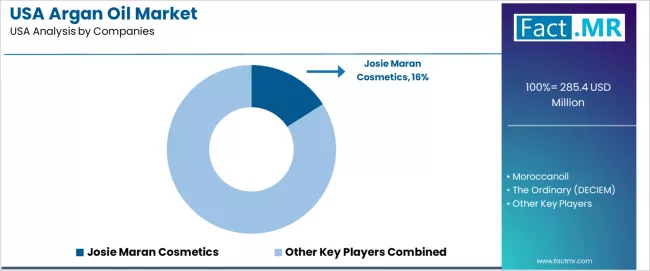
Usa Argan Oil Market Analysis By Company | Source: Fact.MR
The USA argan oil competitive landscape is a layered and dynamic field, segmented by price point, distribution channel, and brand positioning. At the pinnacle sit legacy prestige brands likeJosie Maran CosmeticsandMoroccanoil, which built the modern USA market. Josie Maran competes on authentic celebrity founder storytelling, a deep commitment to 100% pure argan oil as its hero ingredient, and a positioning at the intersection of luxury and eco-consciousness within Sephora and its own DTC channel.
Moroccanoil, while not exclusively argan oil, brilliantly branded itself around the ingredient, creating an entire olfactory and styling system that commands fierce loyalty in the professional salon channel and premium retail. These players defend their turf through brand mystique, consistent product quality, and expansive product lines that foster routine-based loyalty.
The mass-market and natural channel is intensely contested. Brands likeSheaMoisture(owned by Unilever) leverage argan oil within a broader narrative of naturally derived, culturally rooted hair care, achieving vast distribution in drugstores and mass retailers.NOW FoodsandAura Caciacompete in the pure oil space, emphasizing purity and value through health food stores and online retailers, appealing to DIY beauty consumers and those seeking affordable quality.
This segment faces constant pressure from retailer private labels (e.g., Whole Foods 365, Trader Joe's) which offer basic argan oil at aggressive price points, forcing branded players to differentiate through certification, brand story, or formulation complexity. The landscape is further crowded by countless indie DTC brands born on Instagram, each competing on a specific angle such as hyper-transparent sourcing, vegan and cruelty-free credentials, or minimalist design.
A significant and growing competitive threat comes frombrands in adjacent categories that incorporate argan oil as a secondary ingredient. High-performance skincare brands, luxury haircare lines, and even mass-market lotion manufacturers list argan oil on their ingredient decks, diluting the market for pure argan-focused brands and educating a broader audience who may later trade up.
The competitive arena is also defined by the battle againstadulteration and counterfeit products, which commoditize the ingredient and erode consumer trust. Legitimate players must therefore invest not only in marketing their own brand but also in educating the market about how to identify pure argan oil, making competition partly a collaborative effort to elevate the entire category's standards. The future landscape will be shaped by which players can best leverage technology for traceability, science for validated claims, and storytelling for emotional connection in an increasingly crowded and savvy market.
Recommendations for Market Players
- Invest in Vertical Integration and Blockchain-Enabled Traceability: To combat adulteration and build unassailable trust, leading brands should move beyond third-party certifications towards vertical integration or exclusive, long-term partnerships with Moroccan cooperatives. The goal should be implementing a blockchain-based traceability system. From tree to bottle, each step (harvesting, drying, pressing, bottling) is recorded on an immutable ledger. Consumers can scan a QR code to see the journey, including photos, dates, and lab test results. This transforms the ethical claim into a transparent, interactive experience, justifying a premium price and creating a formidable barrier to entry for dishonest competitors. It turns supply chain management into a core marketing asset.
- Develop Clinically Validated, Solution-Oriented Product Lines: Move marketing beyond generic "nourishing" and "hydrating" claims. Invest in clinical studies to validate argan oil's efficacy for specific, high-concern conditions. For example, develop and market a "Skin Barrier Repair Serum" with clinical data on improving hydration and reducing irritation in sensitive skin, or a "Split-End Treatment" proven to increase hair tensile strength. Partner with dermatologists and trichologists to endorse these targeted solutions. This scientific positioning elevates the brand into the cosmeceutical space, attracts a more discerning consumer, and creates defensible product differentiation based on evidence, not just marketing.
- Master an Omnichannel Strategy with Community-Centric DTC at its Core: A winning strategy must seamlessly bridge channels. Use the DTC website and social media as the hub for deep storytelling, community building, and launching innovative products. Leverage first-party data to understand core customers. Then, use this brand strength and proven demand to enter selective retail partnerships strategically. In physical retail, tailor the assortment: offer best-selling staples at mass retailers and exclusive, premium collections at specialty stores like Sephora or Credo. Ensure brand consistency but optimize messaging and product mix for each channel's specific customer mission and expectation, using online community engagement to drive offline sales.
- Pioneer Regenerative and "Blue Beauty" Sourcing Initiatives: Anticipate the next wave of ethical consumption by moving beyond Fair Trade to regenerative agricultural practices. Partner with cooperatives to implement and fund programs that improve soil health, water retention, and biodiversity in the argan forest. Calculate and market a water savings metric, aligning with "Blue Beauty" principles. This forward-thinking approach future-proofs the brand against evolving sustainability standards, creates a powerful, next-generation narrative, and contributes to the long-term resilience of the argan supply chain itself. Market this not as an obligation but as a leadership choice, appealing to the most environmentally conscious consumers.
- Innovate in Sustainable Packaging and Refillable Ecosystems: Address the significant environmental footprint of beauty packaging. Lead the market by transitioning to post-consumer recycled (PCR) glass or aluminum bottles, and invest in attractive, durable refill systems. For example, sell a beautiful, permanent glass dropper bottle once, and then offer larger, pouch-based refills that use significantly less plastic. Develop a take-back program for empty containers. This comprehensive approach to circularity directly addresses a key consumer pain point, differentiates the brand in a tangible way, and builds loyalty through a convenient and ethically satisfying replenishment model. It turns packaging from waste into a component of the brand experience.
Key Players in USA Argan Oil Industry
- Josie Maran Cosmetics
- Moroccanoil
- The Ordinary (DECIEM)
- SheaMoisture (Unilever)
- NOW Foods
- ArtNaturals
- Foxbrim
- Aura Cacia (Frontier Co-op)
- Viva Naturals
- 100% Pure
- Acure Organics
- Mielle Organics
- Fable & Mane
Segmentation
Scope of the Report
| Item | Value / Coverage |
|---|---|
| Quantitative Units | Revenue in USD Million |
| Market Valuation (2025) | USD 285.4 Million |
| Market Valuation (2035) | USD 472.6 Million |
| Forecast Period | 2025 - 2035 |
| Product Grade Segmentation | Cosmetic Grade, Culinary Grade |
| Distribution Channel Segmentation | E-commerce & DTC, Specialty Retail, Mass Merchandisers, Others |
| Regions Covered | West, Southwest, North, Midwest |
| Key Companies Profiled | Josie Maran, Moroccanoil, The Ordinary, SheaMoisture, NOW Foods, ArtNaturals, Aura Cacia |
| Additional Attributes | Analysis by product grade and distribution channel; regional growth dynamics; competitive landscape; impact of clean beauty and ethical sourcing trends; supply chain and adulteration analysis. |
Source: Fact.MR analysis. Updated Dec 4, 2025
USA Argan Oil Industry by Segments
-
Product Grade :
- Cosmetic Grade Argan Oil
- Culinary Grade Argan Oil
-
Distribution Channel :
- E-commerce & Direct-to-Consumer
- Specialty Retailers (Sephora, Ulta, Natural Health Stores)
- Mass Merchandisers & Drugstores
- Others (Salons, Grocery)
-
Region :
- West
- Southwest
- North
- Midwest
Frequently Asked Questions
How big is the demand for argan oil in USA in 2025?
What will be the size of argan oil in USA in 2035?
How much will be the demand for argan oil in USA growth between 2025 and 2035?
What are the key product types in the argan oil in USA?
Which distribution channel segment is expected to contribute significant share in the argan oil in USA in 2025?
Who worked on this report


Preview the report firsthand - request a free sample
Free SampleGet the brochure for pricing and purchase details
Download PDF