- Base Value(2025): 85.0 Mn
- Estimated Value(2025): 85.0 Mn
- Forecast Value (2035): 112.0 Mn
- CAGR (2025 - 2035): 2.8%
Demand for Citronella Oil in USA 2025 to 2035
Demand for citronella oil in USA is projected to grow from USD 85.00 million in 2025 to approximately USD 112.00 million by 2035, recording an absolute increase of USD 27.00 million over the forecast period. This translates into a total growth of 31.76%, with demand forecast to expand at a compound annual growth rate (CAGR) of 2.80% between 2025 and 2035.
Quick Stats for USA Citronella Oil Sector
- USA Citronella Oil Sales Value (2025): USD 85.00 million
- USA Citronella Oil Forecast Value (2035): USD 112.00 million
- USA Citronella Oil Forecast CAGR: 2.80%
- Leading Type in USA Citronella Oil Sector: Cymbopogon nardus (Ceylon type)
- Key Growth Regions in USA Citronella Oil Sector: South, West, Northeast, Midwest
- Regional Leadership: South holds the leading position in demand
- Key Contributors in USA Citronella Oil Sector: doTERRA International, Young Living Essential Oils, Citroli Ltd., Greenleaf Extracts Pvt. Ltd., Aromatic Herbals Inc., Biolandes, India Essential Oils, The Lebermuth Company, Essential Oils of New Zealand, H. Reynaud & Fils (HRF)
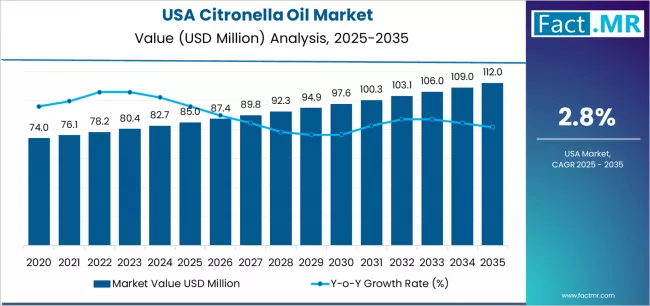
Usa Citronella Oil Market Market Value Analysis | Source: Fact.MR
The overall demand size is expected to grow significantly during this period, supported by increasing consumer preference for natural insect repellent solutions, expanding applications in aromatherapy and personal fragrances, rising investment in bio-based and organic ingredient development, and growing utilization in household and outdoor product formulations throughout USA.
The Cymbopogon nardus (Ceylon type) segment is projected to account for a dominant share of citronella oil demand in 2025. Ceylon-type citronella oil applications are widely recognized in the USA for personal insect repellent formulations, aromatic product development, and natural cleaning applications where its characteristic scent profile, established efficacy against insects, and natural origin remain essential for product development and consumer acceptance.
The personal insect repellent segment is expected to represent the largest share of citronella oil demand in 2025. Personal repellent applications are fundamental to the citronella oil sector because they provide the natural efficacy, consumer safety profile, and brand alignment required for large-scale consumer product development and formulation applications meeting demand for plant-based solutions.
Between 2020 and 2025, citronella oil demand in the USA experienced steady expansion, driven by increasing awareness of synthetic chemical alternatives and growing recognition of plant-derived ingredient benefits for personal safety and environmental compatibility.
The sector developed as brands and formulation developers, especially in major consumer centers, recognized the need for reliable natural active ingredients and effective botanical solutions to achieve product differentiation while meeting safety standards and performance expectations. Personal care companies and household product manufacturers began emphasizing natural ingredient integration and consumer transparency to maintain brand relevance and commercial viability.
Between 2025 and 2030, demand for citronella oil in the USA is projected to expand from USD 85.00 million to USD 97.50 million, resulting in a value increase of USD 12.50 million. This phase of growth will be shaped by accelerating development of natural lifestyle product campaigns, rising investment in extraction and purification technology, and growing ingredient requirements for advanced botanical formulations across USA regions, particularly in areas where consumer demand for wellness and sustainability initiatives are accelerating citronella oil adoption.
Increasing integration of certified organic sourcing in personal care applications and growing adoption of synergistic botanical blends continue to drive demand. Consumer brands and product development companies are expanding their natural ingredient capabilities to address the growing complexity of modern consumer preferences and regulatory standards, with USA operations leading investments in sustainable sourcing methods and quality optimization systems.
From 2030 to 2035, demand is forecast to grow from USD 97.50 million to USD 112.00 million, adding another USD 14.50 million. This period is expected to be characterized by expansion of premium aromatherapy applications, development of enhanced delivery systems for repellency, and implementation of comprehensive supply chain sustainability programs across different consumer and industrial sectors. The growing adoption of advanced encapsulation technologies and enhanced product stability platforms, particularly in major consumer centers and manufacturing operations, will drive demand for more sophisticated natural solutions and validated ingredient systems.
USA Citronella Oil Sector Key Takeaways
| Metric | Value |
|---|---|
| USA Citronella Oil Sales Value (2025) | USD 85.00 million |
| USA Citronella Oil Forecast Value (2035) | USD 112.00 million |
| USA Citronella Oil Forecast CAGR (2025-2035) | 2.80% |
Source: Fact.MR analysis. Updated Dec 10, 2025
Why is the USA Citronella Oil Sector Growing?
The USA citronella oil sector is experiencing consistent growth, primarily fueled by a parallel expansion in the broader natural products and wellness infrastructure. A significant surge in demand for both effective plant-based insect repellent solutions and advanced botanical formulation technologies has created a larger base of brands, product developers, and sourcing professionals requiring reliable citronella oil ingredients. Furthermore, changing consumer preference patterns mandate the use of efficacious natural solutions for personal protection and home care. This preference-driven demand establishes a consistent, values-based foundation. As new brands enter the natural living segment and existing formulation practices evolve, the need for high-quality and sustainably sourced citronella oil forms a stable foundation for the sector's expansion, ensuring a continuous stream of demand driven by ingredient necessity and brand compliance.
Innovation in extraction and application serves as a powerful secondary engine for this growth. Modern citronella oil systems are no longer just basic essential oils; they are advanced botanical ingredients. The rapid adoption of specialized encapsulation technologies for prolonged efficacy has become a major product development point, significantly improving user experience and enhancing consumer satisfaction. Beyond traditional topical applications, manufacturers are integrating advanced delivery systems for seamless incorporation into diffusers, candles, and treated textiles, enhancing compatibility with various lifestyle requirements. These features, coupled with improvements in scent profile consistency, product stability, and purity verification, are compelling both consumer brands and industrial formulators to upgrade from basic essential oil use, driving a cycle of product enhancement and premiumization.
The sector is benefiting from evolving consumer health dynamics and a heightened focus on the natural product experience. An increasing emphasis on ingredient transparency, particularly exploration of certified organic and ethically sourced botanicals, is pushing demand for higher-quality, more traceable ingredient varieties. The segment has also expanded beyond traditional personal care channels, with growing interest from the pet care industry, outdoor living sector, and even agricultural crop protection. This diversification, combined with the rise of specialized e-commerce platforms that improve accessibility for smaller brands, ensures that suppliers can reach a wider audience than ever before. This confluence of health-conscious demand, application innovation, and supply chain accessibility creates fertile ground for continued sector expansion.
Segmental Analysis
The sector is segmented by source type, application, and region. By source type, the sector is divided into Cymbopogon nardus (Ceylon type) and Cymbopogon winterianus (Java type). In terms of application, the sector is segmented into personal insect repellent, aromatherapy & fragrances, and household & outdoor. Regionally, the sector is divided into South, West, Northeast, and Midwest.
Which Source Type Dominates the Citronella Oil Landscape?
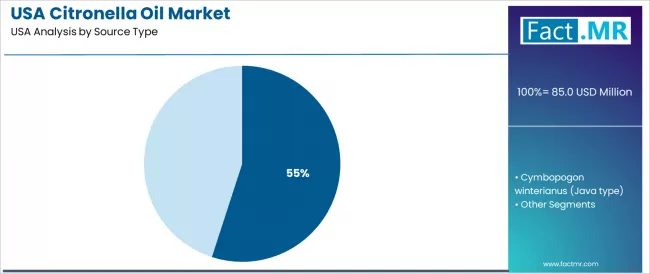
Usa Citronella Oil Market Analysis By Source Type | Source: Fact.MR
The Cymbopogon nardus segment is projected to account for 55.0% of citronella oil demand in 2025, establishing a clear majority position. This dominance is rooted in its distinct sensory and chemical profile which aligns with long-standing consumer expectations for a classic citronella aroma. Its higher perceived gentleness and historical use in premium personal care formulations have cemented its status as the benchmark for quality within the sector. This preference is particularly pronounced among brands that prioritize a traditional and recognizable scent note in their natural product lines.
In USA, formulation infrastructure for natural repellents and aromatic products has largely been calibrated to the Ceylon type's specific balance of citronellal and geraniol constituents. This creates a significant technical and consumer preference barrier for alternative sources. Its cultivation patterns, primarily in Sri Lanka, have also established more mature and reliable supply chains that major US importers and brands have depended on for decades. This reliability translates into lower procurement risk and more predictable pricing models for large-scale manufacturers.
Continuous innovations in sustainable and organic cultivation of Cymbopogon nardus are further entrenching its lead. Investments in farming practices that increase oil yield per hectare without compromising purity are directly addressing cost sensitivity concerns. Moreover, its well-documented efficacy profile against a broad spectrum of insects provides a strong foundational claim for product marketing, reducing the need for extensive new validation studies. This combination of supply chain stability, consumer familiarity, and a solid efficacy data package makes it the pragmatic and preferred choice for volume-driven applications.
What Application Drives the Core of Industry Demand?
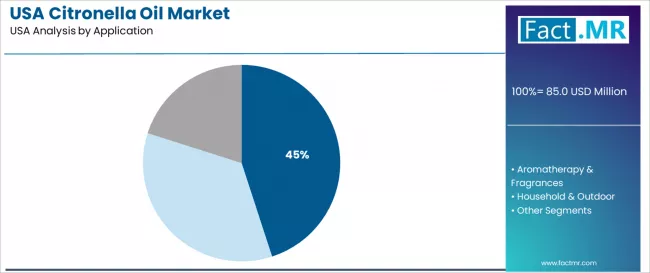
Usa Citronella Oil Market Analysis By Application | Source: Fact.MR
Personal insect repellent applications are expected to represent 45.0% of citronella oil demand in 2025, forming the single largest application segment. This central role reflects the powerful consumer shift away from synthetic actives like DEET towards plant-derived alternatives perceived as safer for frequent use, especially on children and sensitive skin. The demand is not monolithic; it spans a wide range of product formats from simple spray-on solutions and roll-ons to more sophisticated lotions, wipes, and even impregnated wristbands and patio candles designed for personal space protection.
The driving force behind this segment is the dual demand for efficacy and safety. Citronella oil provides a compelling natural active ingredient that allows brands to make credible repellency claims while aligning with clean label trends. Its integration is often part of a broader botanical blend, featuring oils like lemongrass and peppermint, which are marketed for enhanced performance and a more complex fragrance profile. Regulatory guidance from the Environmental Protection Agency, which recognizes certain citronella oil-based formulations as minimum risk pesticides, provides a clear pathway to market that further stimulates development in this category.
Growth in this application is further fueled by geographic and demographic factors. Regions with warmer climates and longer mosquito seasons, such as the South and Southeast, exhibit consistently high baseline demand. Furthermore, increasing outdoor recreational activities across all demographics, from hiking and camping to gardening and backyard socializing, expands the use occasion for personal repellents. Brand investment in educating consumers about proper reapplication techniques for natural repellents, thereby managing efficacy expectations, is also crucial for sustaining long-term category growth and preventing consumer dissatisfaction.
What are the Drivers, Restraints, and Key Trends in the USA Citronella Oil Sector?
The demand for citronella oil in the USA is advancing steadily due to increasing consumer demand for natural ingredient solutions and growing recognition of plant-derived repellent necessity for brand compliance, with the South region serving as a key driver of adoption and outdoor lifestyle consciousness.
The sector faces challenges including agricultural yield consistency, extraction efficiency complexity, and ongoing concerns regarding raw material cost considerations and regulatory classifications for repellency claims.
Growth in Natural Product Development and Botanical Ingredient Expansion Programs
The enhancement of natural formulation standards, gaining particular significance through wellness trends and ingredient education campaigns, is enabling citronella oil providers to achieve differentiation without prohibitive production costs, providing predictable demand patterns through consumer preferences and brand values.
Enhanced formulation standards offering substantial opportunities for citronella oil systems and integrated applications provide foundational dynamics while allowing providers to secure brand agreements and distribution partnerships.
Deployment of Advanced Delivery Capabilities and High-Precision Formulation Systems
Modern citronella oil providers and consumer brands are establishing advanced supply networks and centralized quality control facilities that improve sourcing efficiency through process standardization and constituent analytics.
Integration of efficacy enhancement systems, high-precision encapsulation technology, and coordinated quality management enables more efficient production operations across multiple formulation regions.
Development of Sustainable Sourcing Systems and Enhanced Botanical Targeting Methods
The expansion of certified organic systems and ingredient segmentation is driving development of specialized citronella oil systems with enhanced sustainability profiles, improved consistency characteristics, and optimized sensory attributes that address current limitations and expand applications beyond traditional uses.
These specialized systems require sophisticated agricultural capabilities and processing expertise that exceed traditional distillation requirements, creating specialized demand segments with differentiated ingredient propositions. Producers are investing in botanical targeting and supply chain optimization to serve emerging consumer applications while supporting innovation in product development.
Analysis of USA Citronella Oil Demand by Key Regions
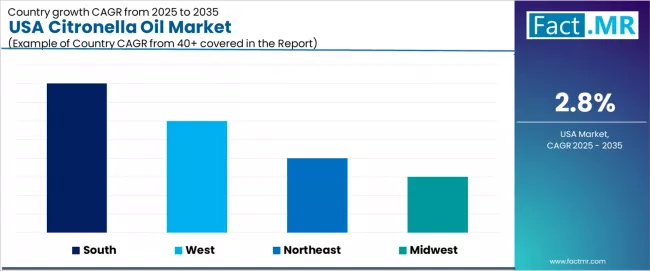
Usa Citronella Oil Market Cagr Analysis By Country | Source: Fact.MR
| Region | CAGR (2025-2035) |
|---|---|
| South | 3.10% |
| West | 2.90% |
| Northeast | 2.70% |
| Midwest | 2.60% |
Source: Fact.MR analysis. Updated Dec 10, 2025
The USA citronella oil demand is witnessing steady growth, supported by rising outdoor activity requirements, expanding natural product facility initiatives, and the deployment of advanced botanical technologies across regions. South leads the nation with a 3.10% CAGR, reflecting a strong outdoor lifestyle base, substantial consumer product development, and established distribution networks for natural ingredients.
Why does the South Region Lead in Citronella Oil Consumption?
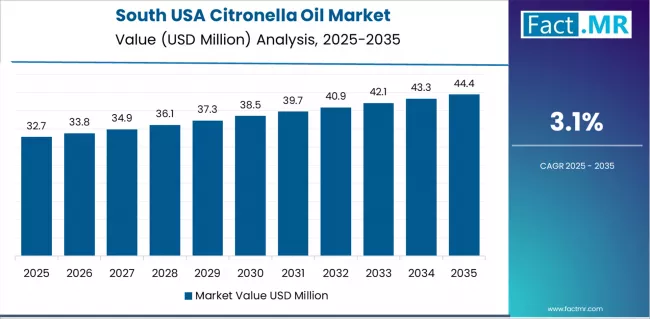
Usa Citronella Oil Market Country Value Analysis | Source: Fact.MR
Demand for citronella oil in the South is projected to exhibit the nation's strongest growth with a CAGR of 3.10% through 2035. This leadership is fundamentally tied to climatological factors that create an extended and intense mosquito season across states like Florida, Texas, Georgia, and Louisiana. The protracted warm and humid conditions effectively create a year-round market for insect repellent solutions, establishing a consistently high baseline demand that other regions cannot match. This environmental driver is compounded by a deeply ingrained outdoor lifestyle, where activities from evening social gatherings on patios to fishing, hunting, and golfing are central to the regional culture.
The commercial infrastructure within the South is uniquely adapted to serve this demand. A high concentration of distribution centers for major retailers and specialty outdoor brands ensures product availability. Furthermore, the region hosts several key manufacturing facilities for consumer insecticide and outdoor living products, creating local demand for bulk citronella oil as a raw material. The presence of major ports, such as Houston and Miami, facilitates direct and cost-effective importation of raw citronella oil, providing a logistical advantage for processors and brands operating in the region.
Consumer awareness and proactive USAge are particularly high in the South. Public health messaging regarding mosquito-borne illnesses has made repellent use a common preventive health practice. This awareness, combined with the high nuisance factor of insects, means consumers are more knowledgeable and less price-sensitive about effective repellent options, including premium natural formulations featuring citronella oil. The region also sees significant demand from the hospitality and tourism sectors, where citronella-based solutions are used in outdoor dining areas, resorts, and parks to enhance guest comfort.
What factors Underpin Steady Demand in the West Region?
Demand for citronella oil in the West is projected to grow with a CAGR of 2.90% through 2035, underpinned by a powerful consumer ethos centered on wellness, sustainability, and natural living. States like California, Oregon, and Washington are hotbeds for the organic and natural products movement, creating a receptive and educated consumer base for botanical ingredients like citronella oil. Demand here is less about combating disease-carrying mosquitoes and more about aligning with a holistic lifestyle that values non-toxic, plant-based solutions for home and personal care.
The innovation ecosystem in the West significantly influences demand patterns. Numerous pioneering brands in natural personal care, aromatherapy, and eco-friendly home products are headquartered in this region. These companies are often early adopters of sustainably sourced botanicals and drive trends in product formulation. They utilize citronella oil not only in repellents but also in aromatic blends for diffusion, natural home cleaning products, and pet care items, diversifying its application beyond the traditional scope. The focus is often on multi-functional products that offer repellency as one benefit among several, such as a hydrating body lotion with insect-repelling properties.
Despite a generally drier climate that suppresses mosquito populations in many areas, localized demand remains strong in specific microclimates like coastal zones, river valleys, and areas with significant irrigation. The West's vast outdoor recreation culture, encompassing camping, hiking, and beach activities in regions where insects are prevalent, sustains a robust market for portable and natural repellent solutions. The regulatory environment in California, often a bellwether for ingredient safety, also shapes demand by influencing which ingredients brands across the country choose to formulate with, indirectly bolstering the preference for recognized natural actives like citronella.
How is the Northeast's Market Character Defined?
Demand for citronella oil in the Northeast is forecast to advance with a CAGR of 2.70% through 2035, characterized by a concentrated urban consumer base with high disposable income and a strong inclination towards premium, branded natural products. The demand cycle in this region is highly seasonal, peaking sharply during the summer months in response to mosquito and black fly populations in recreational areas from Upstate New York to coastal New England. This seasonality requires sophisticated supply chain management from brands and retailers to capture the brief but intense sales window.
The Northeast is a major center for marketing, branding, and corporate headquarters of numerous consumer packaged goods companies. This proximity influences demand through the decisions of product developers and marketers based in cities like New York and Boston who are attuned to national trends in wellness and natural living. Demand is often driven by premium product offerings found in specialty retailers, high-end grocery stores, and boutique pharmacies. Consumers in this region demonstrate a willingness to pay a premium for products that are efficacious, well-designed, and aligned with their values regarding ingredient provenance and brand ethos.
Beyond personal use, there is significant commercial demand from the region's affluent suburban communities and exclusive vacation destinations. Professional landscaping and pest control services frequently incorporate citronella-based solutions for outdoor events and residential properties. Furthermore, the dense urban environment creates a market for citronella in formats suitable for small outdoor spaces, such as balconies and rooftops, including candles, diffusers, and patio torches. This combination of affluent, trend-conscious consumers and a strong commercial landscaping sector creates a diverse and valuable demand profile.
What drives Consistent Utilization in the Midwest Region?
Demand for citronella oil in the Midwest is expected to expand with a CAGR of 2.60 % through 2035, driven by pragmatic consumer needs, a strong manufacturing base, and significant agricultural and outdoor recreational activity. The demand profile here is value-oriented and practical, focusing on reliable performance for backyard use, gardening, and protection during outdoor activities like fishing, camping, and summer sports. Consumers in states like Illinois, Ohio, and Michigan prioritize products that are effective, readily available at major retail chains, and offer good value.
The Midwest's role as a central logistics and manufacturing hub for the nation plays a crucial part in the sector. Many companies that blend and package finished consumer goods, including insect repellents and household products, have facilities in this region. This creates substantial industrial demand for citronella oil as a raw material shipped in bulk for formulation and distribution across the country. The region's extensive agricultural sector also contributes to demand, with citronella oil finding niche applications in certain organic farming operations as a component of integrated pest management strategies.
Seasonal demand is pronounced, with a very active summer season. The region's numerous lakes, state parks, and campgrounds become focal points for consumption. Brand loyalty is often built through trusted mass-market brands that distribute widely through big-box retailers and pharmacies. While premium natural brands have a presence, the growth driver is often the expansion of citronella-based options within established, mainstream product lines. This region also shows steady demand for citronella in multi-purpose formats, such as combination sunscreen and repellent products, which appeal to families seeking convenience and efficiency for their outdoor needs.
Competitive Landscape of USA Citronella Oil Sector
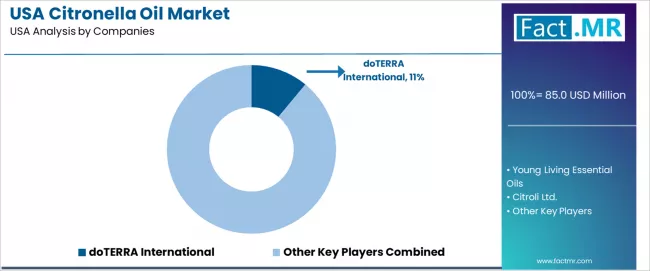
Usa Citronella Oil Market Analysis By Company | Source: Fact.MR
USA citronella oil demand is defined by competition among established multi-category essential oil corporations, specialized botanical ingredient companies, and integrated consumer brands, with major sourcing operators maintaining significant influence through supply chain resources and quality control capabilities. Companies are investing in citronella oil advancement, sourcing optimization, sustainability technologies, and comprehensive technical services to deliver effective, reliable, and traceable botanical solutions across USA consumer and manufacturing applications.
doTERRA Internationalholds a significant position, offering comprehensive wellness ingredient solutions including advanced sourcing, quality enhancement technologies, and direct-to-consumer services with a focus on purity, supply chain transparency, and Co-Impact Sourcing initiatives across USA operations. The company continues investing in sustainable farming programs, member education strategies, and product innovation while expanding its wellness presence and advanced application development.
Young Living Essential Oilsprovides specialized essential oil solutions with emphasis on Seed to Seal quality commitment and member community development.Citroli Ltd.focuses on dedicated citronella oil production and supply chain excellence for industrial and branded clients.Greenleaf Extracts Pvt. Ltd.emphasizes large-scale botanical extraction and specialized ingredient production for global distributors.Aromatic Herbals Inc.offers domestic sourcing and blending solutions with professional technical support for mid-sized brands, focusing on regional adaptability and consistent supply.
USA Citronella Oil Sector - Stakeholder Contribution Framework
The USA citronella oil sector is a critical component for national natural product development, supporting consumer brand installations, manufacturing infrastructure, and lifestyle applications. With a projected demand value driven by wellness product development, natural ingredient adoption cycles, and sustainable technology advancement, the sector's resilience depends on collaborative engagement among regulatory agencies, agricultural operators, ingredient manufacturers, and brands to modernize sourcing, enhance quality, and secure supply chains.
How Governments Could Accelerate Agricultural Modernization and Sector Competitiveness?
- Federal Agricultural Research Grants: Expand funding through the USDA for R&D into advanced cultivation techniques, yield-enhanced plant varieties, and sustainable pest management systems to enhance supply stability and farmer profitability.
- Tax Incentives for Sustainable Farming: Offer investment tax credits for operators implementing organic certification, regenerative agricultural practices, or water conservation systems that reduce environmental impact and improve long-term crop viability.
- Domestic Ingredient Production Support: Implement policies and programs for domestic botanical agriculture, ensuring a resilient supply of raw materials and mitigating import dependency and price volatility for strategic plant derivatives.
- Standardized Quality and Purity Policies: Introduce unified federal standards for citronella oil grading, constituent testing, and labeling claims to streamline regulatory approval and boost consumer confidence.
- Permitting Process Reform for Green Facilities: Expedite environmental reviews and permitting for critical distillation and extraction facility projects that enhance national ingredient processing capacity and efficiency.
How Industry Bodies & Associations Could Strengthen Sector Coordination and Technical Leadership?
- Unified Botanical and Purity Standards: Develop consensus-based benchmarks for citronella oil grades, constituent profiles, and sustainability certifications to ensure interoperability and sector-wide quality.
- Agricultural Workforce Development Programs: Create certification pathways for organic herb farmers, distillation technicians, and quality control engineers to address the skilled labor shortage and ensure quality production.
- Collaborative R&D Consortia: Establish joint programs linking farmers, processors, brands, and research institutions to drive innovation in extraction efficiency, novel delivery systems, and efficacy testing protocols.
- Sustainability Data Repositories: Build centralized industry databases for agricultural yield data, environmental impact metrics, and supply chain transparency to inform better sourcing and production standards.
- Public Outreach and Awareness: Promote the role of high-quality botanicals in natural wellness, economic opportunity for rural communities, and environmental stewardship through coordinated sector campaigns.
How Citronella Oil Producers & Technology Suppliers Could Capture Value and Drive Innovation?
- Advanced Agricultural and Extraction Manufacturing: Invest in production technologies for high-purity oil systems, yield-enhanced cultivation, and integrated distillation solutions for consistent quality output.
- Supply Chain Digitalization and Traceability: Implement digital traceability from farm sourcing to final distillation batch, using blockchain or QR codes to ensure material provenance, ethical sourcing, and quality compliance for brand partners.
- Partnership with Agricultural Research Institutions: Collaborate with agricultural colleges and national labs on next-generation cultivation, such as drought-resistant plant varieties and optimized harvest timing for maximal oil content.
- Operational Optimization: Introduce automated distillation monitoring systems, advanced filtration applications, and modular extraction unit fabrication to lower processing costs and improve throughput and consistency.
How Consumer Brands & Product Development Companies Could Optimize Operational Efficiency and Demand Expansion?
- Digital Supply Chain Integration: Create digital replicas of ingredient supply chains integrated with real-time sourcing data to optimize inventory, predict shortages, and simulate sustainability scenarios.
- Scale-up of High-Value Applications: Focus on citronella oil specifications for premium repellent developments, aromatherapy diffuser projects, and pet care product lines.
- Collaborative Supply Ecosystems: Develop long-term contracts with citronella oil producers and farming co-ops to ensure consistent quality, secure annual capacity, and support sustainable agricultural practices.
- Pilot-to-Launch Deployment Transition: Use phased testing for new citronella oil formulations, such as advanced time-release systems for lotions, before full-scale product launch.
- Lifecycle Brand Value Optimization: Invest in premium, transparently sourced citronella oil materials during product development to reduce long-term brand risk and enhance consumer trust.
Key Contributors in USA Citronella Oil Sector
- doTERRA International
- Young Living Essential Oils
- Citroli Ltd.
- Greenleaf Extracts Pvt. Ltd.
- Aromatic Herbals Inc.
- Biolandes
- India Essential Oils
- The Lebermuth Company
- Essential Oils of New Zealand
- H. Reynaud & Fils (HRF)
Scope of the Analysis
| Item | Value |
|---|---|
| Quantitative Units | USD Million |
| Source Type | Cymbopogon nardus (Ceylon type), Cymbopogon winterianus (Java type) |
| Application | Personal Insect Repellent, Aromatherapy & Fragrances, Household & Outdoor |
| Regions Covered | South, West, Northeast, Midwest |
| Key Contributors Profiled | doTERRA International, Young Living Essential Oils, Citroli Ltd., Greenleaf Extracts Pvt. Ltd., Aromatic Herbals Inc. |
| Additional Attributes | Sales by source type and application segment, regional demand trends, competitive landscape with established botanical corporations and ingredient suppliers, formulation preferences for Ceylon versus Java type, integration with natural product facilities and advanced sourcing policies. |
Source: Fact.MR analysis. Updated Dec 10, 2025
Segmentation
USA Citronella Oil Sector by Segments
-
Source Type :
- Cymbopogon nardus (Ceylon type)
- Cymbopogon winterianus (Java type)
-
Application :
- Personal Insect Repellent
- Aromatherapy & Fragrances
- Household & Outdoor
-
Region :
- South
- West
- Northeast
- Midwest
Frequently Asked Questions
How big is the demand for citronella oil in USA in 2025?
What will be the size of citronella oil in USA in 2035?
How much will be the demand for citronella oil in USA growth between 2025 and 2035?
What are the key product types in the citronella oil in USA?
Which application segment is expected to contribute significant share in the citronella oil in USA in 2025?
Who worked on this report


Preview the report firsthand - request a free sample
Free SampleGet the brochure for pricing and purchase details
Download PDF