- Base Value(2025): 41.6 Bn
- Estimated Value(2025): 41.6 Bn
- Forecast Value (2035): 54.3 Bn
- CAGR (2025 - 2035): 2.7%
Demand for Lighting Fixture in USA 2025 to 2035
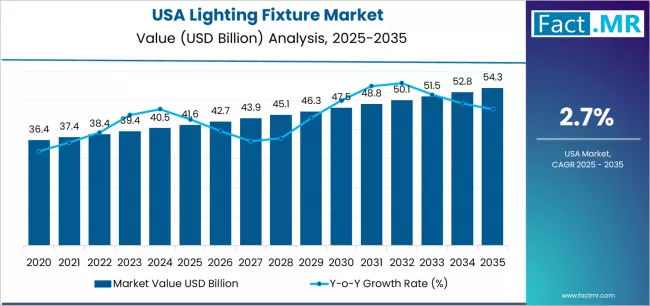
Demand for lighting fixtures in the USA is projected to grow from USD 41.60 billion in 2025 to approximately USD 54.27 billion by 2035, recording an absolute increase of USD 12.67 billion over the forecast period. This translates into a total growth of 30.4%, with demand forecast to expand at a compound annual growth rate (CAGR) of 2.7% between 2025 and 2035.
Sales of lighting fixtures in USA are expected to grow by 1.3 times during the same period, supported by increasing energy efficiency initiatives, advancing LED technology adoption, expanding smart building infrastructure, and growing renovation activities throughout the USA.
Quick Stats for USA Lighting Fixture Industry
- USA Lighting Fixture Sales Value (2025): USD 41.60 billion
- USA Lighting Fixture Forecast Value (2035): USD 54.27 billion
- USA Lighting Fixture Forecast CAGR: 2.7%
- Leading Technology in USA Lighting Fixture Industry: LED (82.30%)
- Key Growth Regions in USA Lighting Fixture Industry: West, Northeast, South, Midwest
- Regional Leadership: West holds the leading position in demand
- Key Players in USA Lighting Fixture Industry: Signify Holding, Acuity Brands Incorporated, Panasonic Holdings Corporation, Samsung Electronics Co. Limited, Zumtobel Group AG, Cree Lighting, Opple Lighting Co. Limited, NVC Lighting Technology Corporation, OSRAM GmbH, GE Current
Usa Lighting Fixture Market Market Value Analysis | Source: Fact.MR
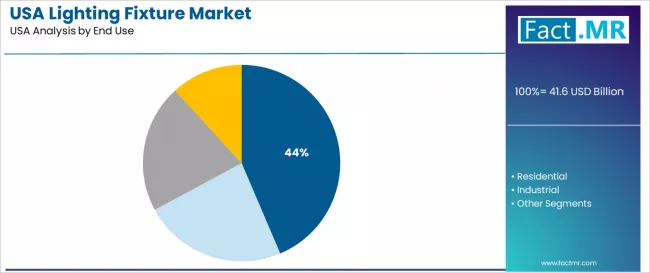
LED lighting fixtures are projected to account for 82.30% of lighting fixture demand in 2025. LED applications are widely used in the USA for commercial buildings, residential installations, and industrial facilities where energy efficiency, longevity, and superior illumination quality remain essential for modern lighting solutions and building performance optimization. The commercial segment is expected to represent 43.60% of lighting fixture demand in 2025. Commercial applications are fundamental to the industry because they provide the essential illumination requirements, energy efficiency benefits, and smart control capabilities required for office buildings, retail spaces, educational facilities, and healthcare institutions.
Between 2020 and 2025, lighting fixture demand in the USA experienced steady expansion, driven by increasing building modernization projects and growing recognition of energy-efficient lighting requirements for operational cost reduction and regulatory compliance. The sector developed as facility managers and building operators, especially in major metropolitan areas, recognized the need for advanced LED solutions and effective energy management systems to achieve cost savings while meeting building codes and energy standards. Construction companies and facility operators began emphasizing technology integration and energy efficiency to maintain competitive advantages and operational excellence.
Between 2025 and 2030, demand for lighting fixtures in the USA is projected to expand from USD 41.60 billion to USD 47.67 billion, resulting in a value increase of USD 6.07 billion, which represents 47.9% of the total forecast growth for the decade. This phase of growth will be shaped by accelerating building renovation projects, rising smart lighting system adoption, and growing energy code compliance requirements for efficient building operations across key regions, particularly in areas where construction activity and energy efficiency initiatives are accelerating fixture adoption.
Increasing integration of IoT-enabled lighting platforms and growing adoption of automated control systems continue to drive demand. Building owners and lighting suppliers are expanding their installation capabilities to address the growing complexity of modern building requirements and energy efficiency standards, with USA operations leading investments in advanced LED manufacturing processes and efficient distribution systems.
From 2030 to 2035, demand is forecast to grow from USD 47.67 billion to USD 54.27 billion, adding another USD 6.60 billion, which constitutes 52.1% of the overall ten-year expansion. This period is expected to be characterized by expansion of intelligent lighting applications, development of enhanced connectivity capabilities, and implementation of comprehensive smart building technology programs across different commercial and residential sectors. The growing adoption of circadian lighting systems and enhanced building automation platforms, particularly in major urban centers and new construction projects, will drive demand for more sophisticated fixture solutions and integrated control systems.
USA Lighting Fixture Industry Key Takeaways
| Metric | Value |
|---|---|
| USA Lighting Fixture Sales Value (2025) | USD 41.60 billion |
| USA Lighting Fixture Forecast Value (2035) | USD 54.27 billion |
| USA Lighting Fixture Forecast CAGR (2025-2035) | 2.7% |
Source: Fact.MR analysis. Updated Dec 15, 2025
Why is the USA Lighting Fixture Industry Growing?
The USA lighting fixture industry is experiencing steady growth, primarily fueled by a parallel expansion in the broader building modernization sector. A significant surge in demand for both energy-efficient lighting solutions and advanced smart building technologies has created a larger base of facility managers, building owners, and construction companies requiring reliable fixture products.
Changing energy regulations and building codes mandate the use of efficient LED systems for optimal building performance and energy cost optimization. This regulation-driven demand establishes a consistent, compliance-based foundation. As new construction projects enter the building development segment and existing facilities are modernized, the need for standard-issue and specialized fixture products forms a stable foundation for the industry's growth, ensuring a continuous stream of customers driven by efficiency necessity and regulatory compliance.
Technological innovation serves as a powerful secondary engine for this growth. Modern lighting fixture systems are no longer just basic illumination devices; they are advanced connected products. The rapid adoption of smart lighting technologies has become a major selling point, significantly reducing energy consumption and enhancing user control. Beyond traditional options, manufacturers are integrating advanced features for seamless incorporation with digitally conscious building approaches, and compatibility with various automation requirements.
These features, coupled with improvements in energy efficiency, system convenience, and illumination quality, are compelling both commercial and residential operators to upgrade from basic lighting systems, driving a cycle of replacement and premiumization within the industry. The industry is benefiting from evolving building dynamics and a heightened focus on occupant experience. An increasing emphasis on energy efficiency, particularly exploration of smart lighting technologies, is pushing demand for higher-quality, more diverse fixture varieties.
The segment has also expanded beyond traditional commercial channels, with growing interest from the residential sector, industrial applications, and even outdoor infrastructure units. This diversification, combined with the rise of integrated platforms that improve accessibility for all building types, ensures that suppliers can reach a wider audience than ever before. This confluence of efficiency, innovation, and accessibility creates a fertile ground for continued industry expansion.
Opportunity Pathways - Demand for Lighting Fixtures in the USA
The lighting fixture industry in the USA is positioned for steady and consistent expansion, growing from USD 41.60 billion in 2025 to USD 54.27 billion by 2035, reflecting a 2.8% CAGR. This growth is driven by the rising adoption of advanced, energy-efficient LED systems in commercial buildings, residential renovations, and industrial facility upgrades. Operators are seeking specialized fixture solutions that maximize energy savings, regulatory compliance, and operational efficiency amidst evolving building codes.
Demand from smart building trends, automation innovations, and connected lighting implementations strengthens opportunities for both high-performance LED products and integrated control solutions. Suppliers focusing on IoT connectivity, dimming capabilities, and installation support stand to gain from evolving energy regulations and building owner expectations for system integration, energy monitoring, and technical documentation completeness.
- Pathway A - Commercial Building Renovations. Building owners face escalating demand for energy-efficient fixtures for large-scale renovation projects across office buildings, retail spaces, and institutional facilities. Solutions targeting LED retrofits, smart controls, and automated systems can achieve strong adoption through demonstrated energy savings, improved illumination quality, and regulatory compliance capabilities. Estimated revenue opportunity: USD 8.50-11.20 billion.
- Pathway B - Residential Smart Lighting Systems. The residential sector requires increasingly sophisticated lighting solutions with automation and connectivity features. Collaborations with home builders and renovation contractors for integrated smart lighting systems can unlock long-term installation contracts and partnerships. Estimated revenue opportunity: USD 6.80-9.10 billion.
- Pathway C - Industrial and Warehouse Applications. Growth in manufacturing modernization and warehouse automation creates robust demand for high-bay LED fixtures and motion-sensing systems. Suppliers offering proven industrial-grade products with exceptional durability and energy performance can build strategic relationships with facility management companies. Estimated revenue opportunity: USD 5.20-7.30 billion.
- Pathway D - Outdoor and Infrastructure Lighting. Municipal requirements for street lighting modernization and parking facility upgrades are driving preference for long-lasting LED fixtures with smart controls. Suppliers offering products with exceptional weather resistance and connectivity can differentiate offerings and attract government organizations. Estimated revenue opportunity: USD 4.10-5.80 billion.
- Pathway E - Specialty and Architectural Applications. Critical applications in healthcare facilities, educational institutions, and hospitality venues require specialized fixture configurations with advanced dimming, color control, and circadian lighting features. Suppliers investing in custom solutions for architectural lighting can secure advantages in this demanding segment. Estimated revenue opportunity: USD 3.40-4.60 billion.
- Pathway F - Technical Support, Installation & Maintenance Services. Comprehensive support networks offering lighting design consultation, full installation services, and ongoing maintenance create recurring service opportunities. Companies building strong technical service capabilities can capture ongoing relationships and enhance customer satisfaction. Estimated revenue opportunity: USD 2.30-3.20 billion.
Segmental Analysis
The industry is segmented by technology, end use, and region. By technology, the industry is divided into LED, fluorescent, and other technologies. In terms of end use, the industry is segmented into commercial, residential, industrial, with commercial representing a key growth and innovation hub for lighting technologies. Regionally, the industry is divided into West, Northeast, South, and Midwest.
Why Does LED Account for High Share of 82.30%?

Usa Lighting Fixture Market Analysis By Technology | Source: Fact.MR
The LED segment is projected to account for 82.30% of lighting fixture demand in 2025, making it the dominant technology type across the sector. This leadership reflects the energy efficiency requirements and cost acceptance needs of fixture systems for existing building facilities and new construction applications where longevity is optimized through established performance characteristics and integrated energy-saving architecture.
In the USA, where substantial building infrastructure requires lighting upgrades without complete electrical system redesign, LED solutions provide practical pathways for facility enhancement while maintaining cost preferences. Continuous innovations are improving energy efficiency, color quality, and control parameters, enabling building operators to achieve high performance standards while maximizing cost effectiveness.
- Energy compatibility and existing system integration make LED the preferred technology type for enhancing commercial facilities and residential operations.
- Performance reliability and longevity demonstration track records are enhancing operator confidence and installation viability across large-scale adoption initiatives.
Why Does Commercial Account for High Share of 43.60%?
Usa Lighting Fixture Market Analysis By End Use | Source: Fact.MR
Commercial applications are expected to represent 43.60% of lighting fixture demand in 2025, reflecting the critical role of professional lighting systems requiring comprehensive energy solutions. Commercial operations including office projects, retail facilities, and institutional systems generate consistent demand for fixtures that support efficient building utilization and performance optimization.
Fixture systems are widely adopted for commercial building facilities due to significant energy benefits and enhanced operational capabilities. Their reliable, high-performance operation provides effective, cost-efficient illumination solutions, enhancing productivity independence for building users.
- Energy efficiency requirements and operational control needs drive substantial demand for specialized fixtures designed for commercial applications.
- Performance optimization and cost efficiency demands create consistent building illumination requirements across major metropolitan regions and commercial facilities.
What are the Drivers, Restraints, and Key Trends in the USA Lighting Fixture Industry?
The demand for lighting fixtures in the USA is advancing steadily due to increasing building efficiency requirements and growing recognition of advanced LED necessity for energy compliance, with the West region serving as a key driver of innovation and technological advancement. The sector faces challenges including energy performance consistency optimization, system integration complexity, and ongoing concerns regarding installation cost considerations and technology variations.
Growth in Building Infrastructure Development and Energy Efficiency Programs
The enhancement of energy standards, gaining particular significance through building code trends and efficiency education campaigns, is enabling fixture providers to achieve differentiation without prohibitive development costs, providing predictable demand patterns through building requirements and operator preferences. Enhanced energy standards offering substantial opportunities for fixture systems and integrated applications provide foundational dynamics while allowing providers to secure building facility agreements and distribution partnerships.
Deployment of Advanced Smart Capabilities and High-Performance Control Systems
Modern fixture providers and building operators are establishing advanced manufacturing networks and centralized distribution facilities that improve installation efficiency through process standardization and smart analytics. Integration of connectivity enhancement systems, high-performance LED technology, and coordinated control management enables more efficient lighting operations across multiple building regions.
Development of Automated Building Systems and Enhanced Control Methods
The expansion of automated building systems and lighting segmentation is driving development of specialized fixture systems with enhanced connectivity profiles, improved control characteristics, and optimized energy attributes that address current limitations and expand building applications beyond traditional fixtures. These specialized systems require sophisticated connectivity capabilities and performance expertise that exceed traditional installation requirements, creating specialized demand segments with differentiated control propositions. Producers are investing in building automation and connectivity optimization to serve emerging facility applications while supporting innovation in performance development and energy engagement.
Analysis of USA Lighting Fixture Demand by Key Regions
Usa Lighting Fixture Market Cagr Analysis By Country | Source: Fact.MR
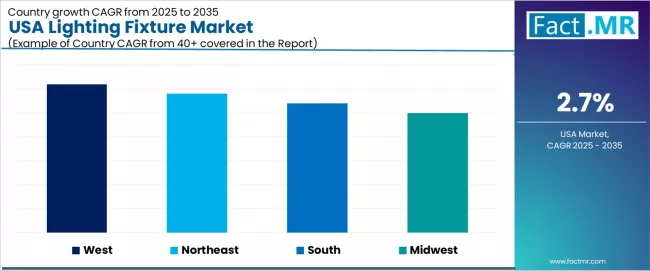
| Region | CAGR (2025-2035) |
|---|---|
| West | 3.10% |
| Northeast | 2.90% |
| South | 2.70% |
| Midwest | 2.50% |
Source: Fact.MR analysis. Updated Dec 15, 2025
The USA lighting fixture demand is witnessing steady growth, supported by rising building efficiency requirements, expanding energy code facility initiatives, and the deployment of advanced LED technologies across regions. West leads the nation with a 3.10% CAGR, reflecting a strong innovation-conscious base, substantial building development, and established energy efficiency advancement facilities.
Why Does the West Region Lead Lighting Fixture Demand?
Demand for lighting fixtures in West is projected to exhibit strong growth with a CAGR of 3.10% through 2035, driven by a strong innovation-conscious building base, substantial construction development creating premium LED opportunities, and a concentration of technology advancement across California, Oregon, Washington, Nevada, and surrounding states.
Advanced building efficiency programs and energy control initiatives are expanding fixture adoption among contractors, facility operators, and construction suppliers pursuing performance optimization, energy development, and specialized building projects throughout major urban hubs and construction corridors.
- Innovation consciousness base and building infrastructure capabilities are requiring comprehensive energy strategies and efficiency solutions, driving demand for fixture systems with demonstrated performance enhancement capabilities and permanent energy assurance throughout diverse building operations.
- Construction development and building concentration are generating substantial fixture demand across facility companies, contractors, and efficiency suppliers serving building applications and energy requirements.
Why Does the Northeast Region Demonstrate Strong Growth?
Demand for lighting fixtures in Northeast is projected to grow with a CAGR of 2.90% through 2035, supported by established building presence, comprehensive construction development, and strong facility networks across New York, Pennsylvania, Massachusetts, New Jersey, and surrounding states.
Established building presence and construction leadership are supporting fixture adoption throughout contractor facilities, building operations, and efficiency distribution centers serving performance enhancement and LED applications.
- Strong building ecosystem and construction networks are enabling fixture integration across efficiency producers, contractors, and LED suppliers pursuing advanced performance development and building programs.
- Premium construction capabilities and efficiency excellence are driving fixture demand among leading contractor corporations, building centers, and specialized efficiency firms focused on performance enhancement, LED optimization, and construction development targeting building applications and advanced facility operations.
What Factors Underpin Lighting Fixture Demand in South Region?
Usa Lighting Fixture Market Country Value Analysis | Source: Fact.MR
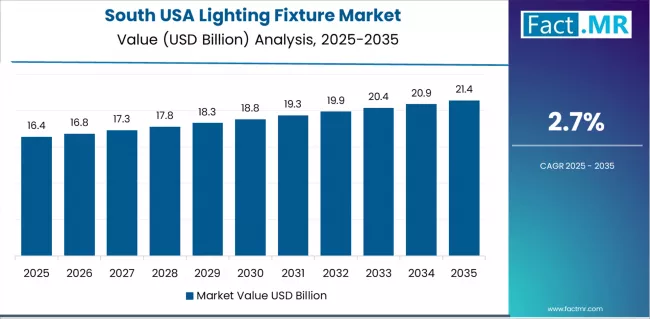
Demand for lighting fixtures in South is forecast to advance with a CAGR of 2.70% through 2035, driven by expanding building capabilities, growing LED investment, and increasing efficiency consciousness across Texas, Florida, Georgia, North Carolina, and surrounding states.
Rising construction sector development and facility partnerships are supporting fixture integration across LED producers, contractor facilities, and efficiency distributors pursuing performance enhancement, building expansion, and energy initiatives throughout expanding construction regions and urban centers.
- Growing building infrastructure and construction investment are creating opportunities for fixture adoption across emerging LED hubs, contractor facilities, and efficiency distribution centers in major metropolitan areas and building corridors.
- Performance expansion and efficiency growth are driving fixture demand among building operators seeking enhanced performance capabilities and participation in advanced LED programs.
What Boosts Consistent Demand in the Midwest Region?
Demand for lighting fixtures in Midwest is expected to expand with a CAGR of 2.50% through 2035, supported by LED manufacturing capabilities, building infrastructure development, and growing contractor efficiency presence across Illinois, Ohio, Wisconsin, Michigan, and surrounding states.
Efficiency expertise and production capabilities are driving fixture demand among LED producers, building suppliers, and construction contractors serving fixture production and performance applications.
- Growing LED development and construction investment are supporting fixture adoption across emerging production hubs, building facilities, and contractor centers pursuing performance enhancement and LED programs.
- Expanding building infrastructure and LED integration are creating opportunities for fixture utilization across efficiency suppliers, building production facilities, and contractor operations seeking performance fixture production, efficiency support, and construction capabilities throughout major building regions and emerging contractor efficiency centers.
Competitive Landscape of USA Lighting Fixture Industry
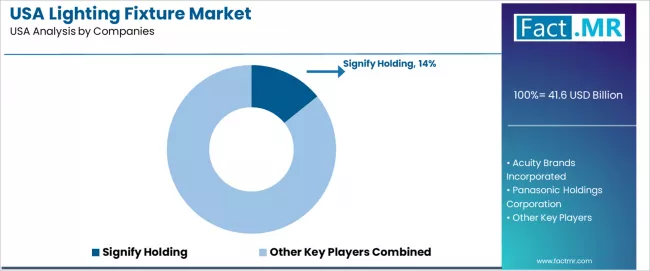
Usa Lighting Fixture Market Analysis By Company | Source: Fact.MR
USA lighting fixture demand is defined by competition among established lighting corporations, specialized LED companies, and integrated building suppliers, with major facility operators maintaining significant influence through production resources and distribution capabilities. Companies are investing in fixture advancement, LED optimization, efficiency acceptance technologies, and comprehensive performance services to deliver effective, reliable, and efficient lighting solutions across USA building and facility applications.
Signify Holding dominates with a 14.20% share, offering comprehensive LED solutions including advanced equipment, performance enhancement technologies, and distribution services with a focus on building applications, efficiency consistency, and LED optimization across USA operations. The company continues investing in LED programs, distribution strategies, and fixture innovation while expanding operational presence and advanced facility applications.
Acuity Brands Incorporated provides specialized LED solutions with emphasis on performance development and construction excellence. Panasonic Holdings Corporation focuses on premium fixture development and building applications. Samsung Electronics Co. Limited emphasizes performance development and specialized facility equipment production. Zumtobel Group AG offers LED technology solutions and professional performance support. Cree Lighting specializes in building fixture development and distribution programs.
Key Players in USA Lighting Fixture Industry
- Signify Holding
- Acuity Brands Incorporated
- Panasonic Holdings Corporation
- Samsung Electronics Co. Limited
- Zumtobel Group AG
- Cree Lighting
- Opple Lighting Co. Limited
- NVC Lighting Technology Corporation
- OSRAM GmbH
- GE Current
- Hubbell Incorporated
- Eaton Corporation
- Trilux GmbH & Co. KG
- Fagerhult Group
- Havells India Limited
Segmentation
Scope of the Report
| Item | Value |
|---|---|
| Quantitative Units | USD 54.27 billion |
| Technology | LED, Fluorescent, Others |
| End Use | Commercial, Residential, Industrial, Outdoor |
| Regions Covered | West, Northeast, South, Midwest |
| Key Companies Profiled | Signify Holding, Acuity Brands Incorporated, Panasonic Holdings Corporation, Samsung Electronics Co. Limited, Zumtobel Group AG, Cree Lighting, Opple Lighting Co. Limited, NVC Lighting Technology Corporation, OSRAM GmbH, GE Current, Hubbell Incorporated, Eaton Corporation, Trilux GmbH & Co. KG, Fagerhult Group, Havells India Limited |
| Additional Attributes | Sales by technology and end use segment, regional demand trends across West, Northeast, South, and Midwest, competitive landscape with established lighting corporations and LED suppliers, facility preferences for LED versus fluorescent equipment, integration with building facilities and advanced LED optimization policies particularly advanced in West region |
Source: Fact.MR analysis. Updated Dec 15, 2025
USA Lighting Fixture Industry by Segments
-
Technology :
- LED
- Fluorescent
- Others
-
End Use :
- Commercial
- Residential
- Industrial
- Outdoor
-
Region :
- West
- Northeast
- South
- Midwest
Frequently Asked Questions
How big is the demand for lighting fixture in USA in 2025?
What will be the size of lighting fixture in USA in 2035?
How much will be the demand for lighting fixture in USA growth between 2025 and 2035?
What are the key product types in the lighting fixture in USA?
Which end use segment is expected to contribute significant share in the lighting fixture in USA in 2025?
Who worked on this report


Preview the report firsthand - request a free sample
Free SampleGet the brochure for pricing and purchase details
Download PDF