- Market Value (2025): USD 827.2 Mn
- Estimated Value (2026): USD 924.0 Mn
- Forecast Value (2036): USD 2793.9 Mn
- CAGR (2026-2036): 11.7%
What is the Upcycled Fruit Fiber Extracts Market forecast to be worth by 2036?
USD 924.0 million in 2026 to USD 2793.9 million by 2036 at an 11.7% CAGR.
- The Upcycled Fruit Fiber Extracts Market reached USD 827.2 million in 2025.
- Demand is projected to increase from USD 924.0 million in 2026 to USD 2793.9 million by 2036.
- The market is forecast to record 11.7% CAGR from 2026 to 2036 as food formulators use fruit-derived fibers for texture and moisture control. Fiber enrichment and ingredient-list simplification provide additional formulation routes.
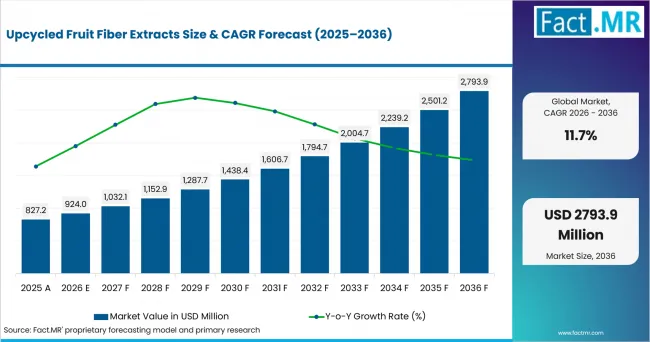
Upcycled Fruit Fiber Extracts Value Analysis | Source: Fact.MR
What are the defining numbers behind Upcycled Fruit Fiber Extracts Market growth?
An absolute opportunity of USD 1869.8 million is expected between 2026 and 2036.
- Demand Drivers in the Market
- Bakery formulators use fruit fibers for moisture retention and texture. Fiber enrichment gives the same ingredient an additional nutritional role.
- Beverage developers use soluble and pectin-rich fractions for body and suspension. Controlled particle size helps protect mouthfeel.
- Ingredient manufacturers gain a higher-value outlet when fruit side-streams become standardized food-grade fiber.
- Nutrition and supplement brands use fruit-derived fibers for fiber content and prebiotic positioning. Botanical sourcing gives formulators another way to differentiate finished products.
- Plant-based and reduced-fat food developers use water binding and bulking to manage structure. These functions can also support calorie reduction in selected formulations.
- Key Segments Analyzed
- By Fruit Source: Citrus is expected to hold 36.0% share in 2026 because citrus juicing produces peel and pulp streams that can be converted into high-functionality fiber ingredients.
- By Fiber Fraction: Insoluble fiber is projected to account for 31.0% share in 2026 as its bulk and water-management properties fit bakery, supplements, and plant-based foods.
- By Application: Bakery is anticipated to capture 29.0% share in 2026 owing to regular use of fiber for moisture retention, texture management, and nutritional reformulation.
- By Function: Water binding is estimated to represent 33.0% share in 2026 since hydrated fruit fibers can influence yield, softness, viscosity, and moisture migration.
- Analyst Opinion at Fact.MR
- Shambhu Nath Jha, Principal Consultant at Fact.MR, states, “The commercial question is whether a fruit side-stream can be converted into a consistent ingredient with measurable functionality. The market is expected to reward suppliers that document source control, particle or fiber characteristics, and repeatable performance in a defined food application. Strong portfolios combine credible upcycling logic with formulation data that lets manufacturers replace or reduce other binders, texturizers, or bulking agents.”
- Strategic Implications
- Fruit processors should separate and stabilize suitable side-streams early. Food-grade handling protects ingredient quality before drying or extraction.
- Ingredient suppliers should publish hydration and particle-size data. Composition and use-condition information should be stated separately so formulators can compare performance clearly.
- Food formulators should compare cost in use. Fiberstar stated on June 11, 2025 that Citri-Fi can provide dual functionality at a usage level below 1% compared with other ingredients, while its low use level can provide cost-in-use savings in certain food applications.
- Commercial teams should separate nutritional claims from functional claims. Clear supporting documentation helps brands evaluate each benefit on its own terms.
Japan is forecast to post 12.1% CAGR through 2036 as food manufacturers emphasize standardized fiber functionality. China is anticipated to record 11.8% CAGR as packaged-food and online channels expand. France is projected to advance at 11.7% CAGR through fruit processing and bakery use. The USA is estimated to record 11.3% CAGR as citrus side-streams support commercial supply. Germany is expected to post 11.1% CAGR as fruit processing and resource-efficiency goals encourage by-product valorization.
How does the Upcycled Fruit Fiber Extracts Market break down by segment?
Citrus leads Fruit Source at 36.0%; while Water binding leads Function at 33.0%.
Which Fruit Source leads?
Citrus is expected to hold 36.0% share in 2026.
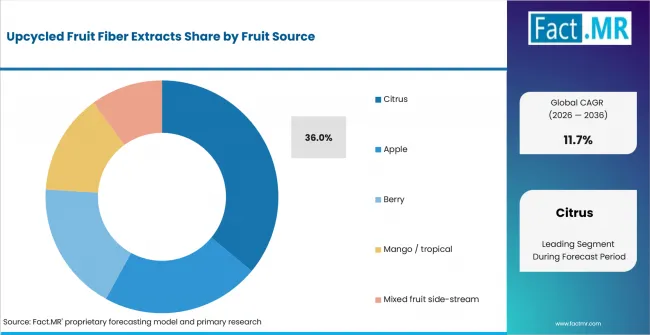
Upcycled Fruit Fiber Extracts Analysis By Fruit Source | Source: Fact.MR
Citrus leads because juice processing creates concentrated peel and pulp streams. These streams contain insoluble fiber as well as soluble fiber and native pectin. Established drying and milling routes allow suppliers to convert the material into standardized powders.
What leads the Fiber Fraction segment?
Insoluble fiber is projected to account for 31.0% share in 2026.
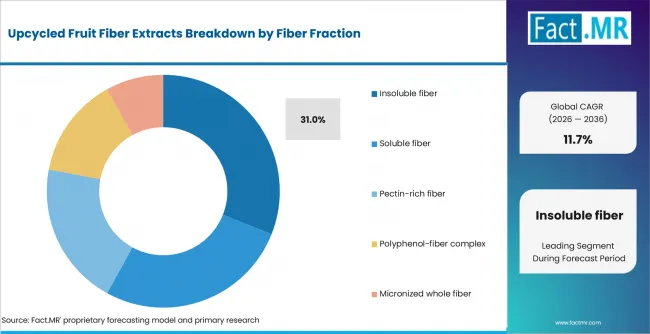
Upcycled Fruit Fiber Extracts Analysis By Fiber Fraction | Source: Fact.MR
Insoluble fractions provide bulk and water management in bakery and supplements. Plant-based foods use the same properties to support structure. Commercial performance depends on particle size and hydration as well as sensory impact.
How does Application shape demand?
Bakery is anticipated to capture 29.0% share in 2026.
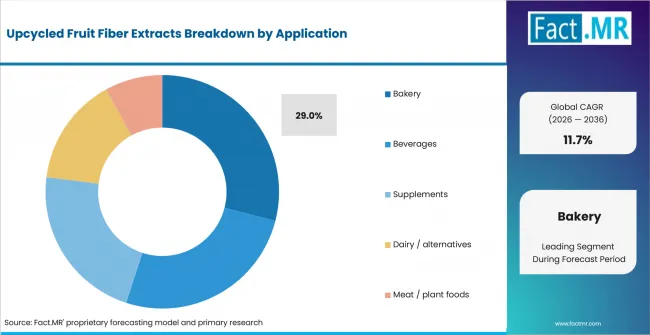
Upcycled Fruit Fiber Extracts Analysis By Application | Source: Fact.MR
Bakery provides a broad route to market because fruit fibers can support moisture retention and texture in the same formulation. Fiber enrichment adds another reason for use. Low inclusion rates can reduce reliance on other binders or texturizers.
What supports Water binding within Function?
Water binding is estimated to represent 33.0% share in 2026.
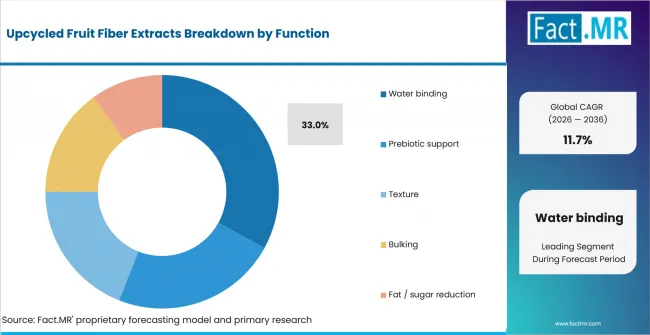
Upcycled Fruit Fiber Extracts Analysis By Function | Source: Fact.MR
Water binding affects yield and softness. It also changes viscosity and moisture migration. Fruit fibers with high surface area can help manage these properties, making hydration performance a direct purchasing criterion for formulators.
What is accelerating Upcycled Fruit Fiber Extracts Market adoption, and what is holding it back?
Demand is expected to rise through side-stream valorization, fiber-focused reformulation, and multifunctional texture needs. Adoption is constrained by raw-material variability, food-grade handling requirements, and formulation-specific performance.
Drivers Impact Analysis
| DRIVER | (~) % IMPACT ON CAGR | GEOGRAPHIC RELEVANCE | IMPACT TIMELINE |
|---|---|---|---|
| Higher-value use of fruit-processing side-streams | +1.8% | Global | Short term (<= 2 years) |
| Fiber enrichment and texture reformulation | +1.4% | North America, Europe, East Asia | Medium term (2-4 years) |
| Water-binding and bulking functionality | +1.1% | Global | Medium term (2-4 years) |
| Ingredient-list simplification | +0.8% | North America, Western Europe | Long term (>= 4 years) |
Opportunity Impact Analysis
| OPPORTUNITY | (~) % IMPACT ON CAGR | GEOGRAPHIC RELEVANCE | IMPACT TIMELINE |
|---|---|---|---|
| Standardized citrus and apple side-stream platforms | +1.3% | North America, Europe | Short term (<= 2 years) |
| Prebiotic and polyphenol-fiber combinations | +1.0% | Global | Medium term (2-4 years) |
| Bakery and plant-based formulation systems | +0.8% | North America, Europe, East Asia | Long term (>= 4 years) |
Restraints Impact Analysis
| RESTRAINT | (~) % IMPACT ON CAGR | GEOGRAPHIC RELEVANCE | IMPACT TIMELINE |
|---|---|---|---|
| Seasonal and compositional variability | -0.7% | Global | Short term (<= 2 years) |
| Food-safety and traceability requirements | -0.5% | Global | Medium term (2-4 years) |
| Sensory limits at higher inclusion levels | -0.4% | Global | Long term (>= 4 years) |
Which countries are scaling the Upcycled Fruit Fiber Extracts Market through 2036?
- Japan is forecast to record 12.1% CAGR through 2036 as food manufacturers emphasize controlled texture and standardized ingredient performance.
- China is anticipated to reach 11.8% CAGR as packaged-food demand expands and ingredient developers widen fruit-source options.
- France is projected to post 11.7% CAGR through apple processing and established bakery applications for functional fibers.
- The USA is estimated to record 11.3% CAGR as citrus processing supplies peel and pulp streams for commercial fiber production.
- Germany is expected to reach 11.1% CAGR as industrial fruit processing supports apple-fiber and citrus-fiber formulation activity.
Comparable CAGRs create different entry conditions because fruit availability and processing infrastructure vary by country. Full report coverage includes North America, Latin America, Western Europe, Eastern Europe, East Asia, South Asia & Pacific, Middle East & Africa.
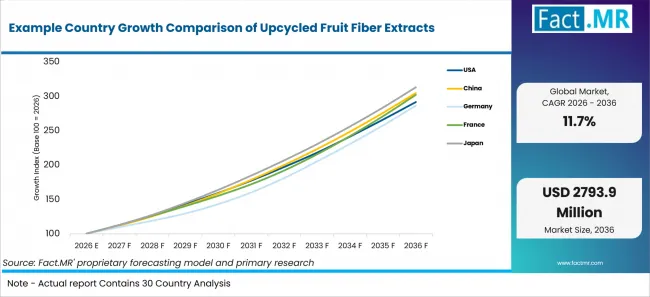
Example Country Growth Comparison Of Upcycled Fruit Fiber Extracts | Source: Fact.MR
| Country | CAGR (2026-2036) |
|---|---|
| Japan | 12.1% |
| China | 11.8% |
| France | 11.7% |
| United States | 11.3% |
| Germany | 11.1% |
What supports USA adoption?
11.3% CAGR, supported by citrus side-stream availability and a large food formulation base.
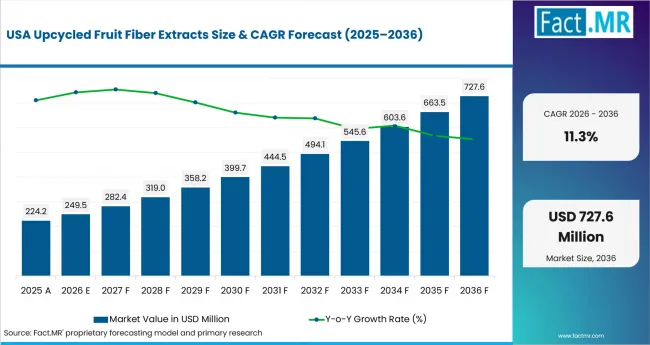
Upcycled Fruit Fiber Extracts Country Value Analysis | Source: Fact.MR
U.S. citrus processing gives ingredient manufacturers a direct source of peel and pulp for upcycled fiber. The U.S. Department of Agriculture, National Agricultural Statistics Service reported in August 2025 that utilized citrus production totaled 5.02 million tons in the 2024-25 season. Standardized drying and milling can convert suitable side-streams into food-grade fiber for bakery and beverage formulations. Commercial adoption is expected to depend on source control and repeatable water-binding performance.
How is China developing demand?
11.8% CAGR, led by packaged-food activity and broader ingredient use.
China combines a large packaged-food base with expanding retail activity that supports ingredient reformulation. The National Bureau of Statistics of China reported in February 2026 that retail sales of grain, oil and food by enterprises above the designated size rose 9.3% in 2025. Fruit-derived fibers can serve bakery and beverage developers that need texture or fiber enrichment. Suppliers are expected to gain more acceptance when color and hydration remain consistent across fruit sources.
What supports Germany adoption?
11.1% CAGR, backed by apple processing and functional-fiber formulation.
Germany has a well-developed apple-processing base that creates feedstock for fruit-fiber ingredients. Destatis reported in December 2025 that 270,000 tons of the 2025 apple harvest were intended for processing or industrial use. That stream provides a practical base for apple fiber when collection preserves food-grade quality. Formulators are expected to focus on water binding and particle-size control when comparing fruit fibers with established texturizing systems.
How does France perform?
11.7% CAGR, backed by apple supply and bakery-oriented formulation demand.
France combines sizeable apple production with food applications that already use pectin and dietary fiber. Agreste estimated in November 2025 that French table-apple production reached 1.59 million tons in 2025. Processing side-streams from fruit preparation can support apple-fiber and pectin-rich ingredients when suppliers standardize moisture and sensory characteristics. Bakery and beverage manufacturers are expected to remain important formulation targets for these ingredients.
What supports Japan adoption?
12.1% CAGR, shaped by premium formulation requirements and fruit-processing activity.
Japan's food manufacturers place close attention on texture and sensory consistency in functional foods. The Ministry of Agriculture, Forestry and Fisheries released 2025 peach statistics in January 2026 showing a harvest of 100,600 tons. Fruit-processing streams from peaches and other domestic fruit can support specialized fiber ingredients where food-grade recovery is practical. Adoption is expected to favor finely processed fractions that deliver body or fiber without coarse mouthfeel.
Who leads the Upcycled Fruit Fiber Extracts Market?
Herbafood Ingredients is directly active through HERBACEL® apple and citrus fibers for food formulation. Its portfolio includes functional apple fibers and multifunctional citrus fibers designed for texturizing, water binding, stabilization and other food applications.
Fiberstar is directly active through Citri-Fi®, an upcycled citrus fiber produced from byproduct of the citrus-juicing industry. The company documents high water-holding and oil-binding functionality, with applications across bakery, beverages and plant-based foods.
Herbafood published an August 2025 technical sheet covering HERBACEL® AQ® AFB-250 and AFB-200 as functional apple fibers with high water-binding and texturizing performance. AFB-250 is specifically positioned for color-neutral applications where a bright appearance is important, while AFB-200 supports a golden-brown color tone in applications such as baked goods and meat alternatives.
Relevant areas of differentiation across functional fruit-fiber portfolios include fruit source, water-binding and texturizing performance, particle-size options, food-grade certifications and application support. These characteristics are relevant across bakery, beverage and other formulated-food applications.
Which companies are the key providers?
Key companies include Herbafood Ingredients; Fiberstar; J. Rettenmaier & Söhne; Cargill; and Ingredion.
- Herbafood Ingredients
- Fiberstar
- J. Rettenmaier & Söhne
- Cargill
- Ingredion
Bibliography
- Eurostat. (2025, October 16). 130 kg of food wasted per person annually in the EU.
- U.S. Department of Agriculture, National Agricultural Statistics Service. (2025, August). Citrus fruits 2024 summary.
- National Bureau of Statistics of China. (2026, February 28). Statistical communiqué of the People’s Republic of China on the 2025 national economic and social development.
- Statistisches Bundesamt (Destatis). (2025, December 19). Apfelernte 2025: Mit 1 138 000 Tonnen zweithöchste Ernte der vergangenen zehn Jahre [Apple harvest 2025: At 1,138,000 tonnes, the second-highest harvest of the past ten years].
- Laurent, B., & Lousteau, M. (2025, November 14). Pomme. Une production de pommes en léger recul, des prix en baisse en début de campagne. Agreste.
- Fiberstar, Inc. (2025, June 11). Efficient food ingredient – citrus fiber.
- Herbafood Ingredients GmbH. (2025, September 15). Enhanced texturizing with functional apple fibers.
This Report Addresses
- The report explains how fruit-processing side-streams become food-grade fiber ingredients and which properties determine commercial value.
- Segment analysis identifies the source, fraction, application, and function shares for 2026.
- Country analysis compares the five listed markets using the stated CAGRs and official evidence.
- Competitive analysis reviews the profiled companies and their relevant ingredient capabilities.
- Application analysis examines how water binding, texture, bulking, and fiber enrichment affect customer trials.
What does the Upcycled Fruit Fiber Extracts Market cover?
The Upcycled Fruit Fiber Extracts Market covers food-grade ingredients recovered from fruit-processing side-streams and converted into standardized powders, fractions, or extracts. It includes citrus peel, apple pomace, berry residues, tropical fruit side-streams, and mixed fruit streams used for nutritional or functional formulation. It includes fruit-derived powders when the material is recovered from processing side-streams and sold for functional use.
The assessment covers insoluble, soluble, pectin-rich, polyphenol-associated, and micronized whole-fiber formats across bakery, beverages, supplements, dairy alternatives, and meat or plant-food applications.
What is included in the scope?
The scope includes recovered fruit material processed to a defined food-grade specification, including dried citrus pulp, citrus fiber, apple fiber, fruit-pomace fractions, and mixed fruit fibers sold as formulation inputs.
The scope includes direct ingredient sales and technical support tied to ingredient performance.
What is excluded from the scope?
The scope excludes fresh fruit, conventional juice, flavor-led concentrates, and powders without a meaningful fiber or side-stream proposition. Purified pectin without broader fruit-fiber positioning is also excluded.
Animal-feed residues, compost, bioenergy feedstocks, non-food uses, and finished consumer products are excluded.
How Was the Analysis Built?
The analysis draws on 120+ sources, 35+ company portfolios, 25+ countries, and more than 20 industry interviews.
- Primary Research: Primary research includes discussions with manufacturers, service providers, technology developers, distributors, end users, and subject-matter experts. These conversations examine purchasing priorities, product adoption, operational challenges, approval requirements, competitive positioning, and the factors that influence wider market acceptance.
- Desk Research: Desk research covers government statistics, regulatory publications, company filings, trade data, technical studies, industry associations, standards, public policy, and other authoritative sources. Every source used in the analysis is documented in the bibliography.
- Market Sizing and Forecasting: Market estimates combine historical performance, demand indicators, pricing and volume trends, segment shares, company participation, country-level growth, adoption patterns, investment activity, and barriers to market expansion.
- Data Validation and Update Cycle: Findings are validated by comparing primary interviews with public data, company activity, regulatory changes, trade patterns, and industry developments. Regular updates review new product launches, capacity changes, partnerships, approvals, and shifts in commercial adoption.
What is the report’s scope and coverage?
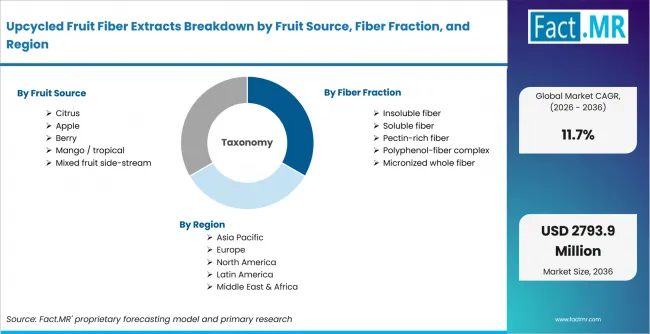
Upcycled Fruit Fiber Extracts Breakdown By Fruit Source, Fiber Fraction, And Region | Source: Fact.MR
| Attribute | Details |
|---|---|
| Quantitative Units | USD million |
| Market Definition | Food-grade fiber extracts and fiber-rich ingredients recovered from fruit-processing side-streams such as peel, pomace, pulp, and juice residues, then processed for nutritional or functional use in food and beverage formulations. |
| Fruit Source | Citrus; Apple; Berry; Mango / tropical; Mixed fruit side-stream |
| Fiber Fraction | Insoluble fiber; Soluble fiber; Pectin-rich fiber; Polyphenol-fiber complex; Micronized whole fiber |
| Application | Bakery; Beverages; Supplements; Dairy / alternatives; Meat / plant foods |
| Function | Water binding; Prebiotic support; Texture; Bulking; Fat / sugar reduction |
| Regions Covered | North America; Latin America; Western Europe; Eastern Europe; East Asia; South Asia & Pacific; Middle East & Africa |
| Countries Covered | United States; China; Germany; France; Japan |
| Key Companies Profiled | Herbafood Ingredients; Fiberstar; J. Rettenmaier & Söhne; Cargill; Ingredion |
| Forecast Period | 2026 to 2036 |
| Approach | Hybrid top-down and bottom-up approach using fruit-processing side-stream availability, food-manufacturing demand, application requirements, country evidence, supplier portfolios, and cross-checks against first-hand public data. |
How is the market segmented?
-
By Fruit Source
- Citrus
- Apple
- Berry
- Mango / tropical
- Mixed fruit side-stream
-
By Fiber Fraction
- Insoluble fiber
- Soluble fiber
- Pectin-rich fiber
- Polyphenol-fiber complex
- Micronized whole fiber
-
By Application
- Bakery
- Beverages
- Supplements
- Dairy / alternatives
- Meat / plant foods
-
By Function
- Water binding
- Prebiotic support
- Texture
- Bulking
- Fat / sugar reduction
-
By Region
- North America
- Latin America
- Western Europe
- Eastern Europe
- East Asia
- South Asia & Pacific
- Middle East & Africa