- Base Value(2024): 314.1 Mn
- Estimated Value(2026): 358.3 Mn
- Forecast Value (2036): 691.7 Mn
- CAGR (2026 - 2036): 6.8%
Upcycled Ingredients Market Outlook (2025 to 2035)
The global upcycled ingredients market is expected to reach USD 647.9 million by 2035, up from USD 314.1 million in 2024. During the forecast period (2025 to 2035), the industry is projected to grow at a CAGR of 6.8%, driven by heightened emphasis on sustainable sourcing and circular economy practices.
A key growth catalyst is the increasing incorporation of upcycled components into functional and clean-label product lines, as manufacturers seek to reduce waste, comply with evolving regulatory frameworks, and strengthen their ESG positioning in response to shifting consumer preferences.
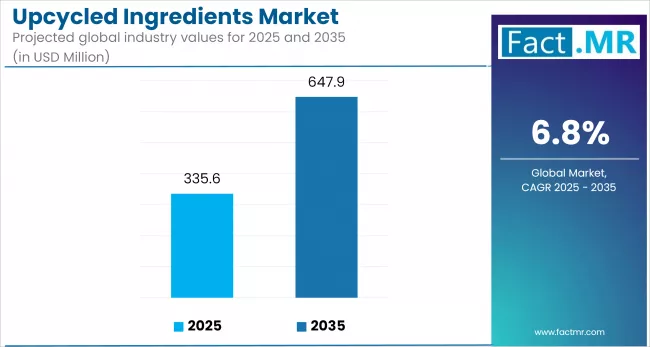
Upcycled Ingredients Market Projected Global Industry Values For 2025 And 2035 | Source: Fact.MR
What drives demand in the upcycled ingredients market amid sustainability and food waste reduction trends?
Growing emphasis on sustainability, minimizing food waste, and promoting a circular economy has been driving market growth. Firms have advanced the process of product innovation in line with consumer demands for green products. The majority of the environmental organizations and other stakeholders have promoted awareness of the importance of upcycled inputs. Through food, skincare, and wellness formulations, brands have utilized upcycled ingredients, which enhance product appeal.
Sustainable sourcing is also a priority for retailers, who allocate upcycled goods to some of the most visible shelf spaces. Governments have supported green projects, thereby further encouraging their adoption across various sectors. A convergence of these factors has created an ideal environment for growth, and market players have taken this opportunity to align sustainability with profitability.
What are the key market trends driving growth in the upcycled ingredients market today?
Market trends emerging within the industry have involved the advancement of upcycled formulations into premium-category foods, clean cosmetics, and wellness products. Agricultural and food production industries have collaborated with start-ups and other companies to collect and reuse waste streams.
Transparency, source tracking, and narration of upcycled origins have become increasingly integral to marketing strategies. The innovations have also been targeted to improve the appeal, flavor and functionality of the ingredients so as to fulfill the mainstream quality demands.
Industry associations have been established, and certifications have been created to standardize such claims and build confidence among consumers. These efforts reinforce the perception that upcycled products are evaluated as viable, desirable and need to contribute to responsible consumption behaviors.
What factors are limiting the growth of the upcycled ingredients market despite sustainability trends?
Despite its progress, the upcycled ingredients market has encountered several challenges and limiting factors. The reliability of sourcing quality byproducts has remained elusive owing to the inconsistencies in the supply chain. The ambiguities of regulations have made product approvals complex in certain regions.
The technological investments required to upcycle efficiently have posed a problem for smaller companies. Such ingredients have occasionally been perceived by consumers as lower in quality, and shifting this perception takes considerable time. Moreover, the lack of international homogeneity in labeling and certification has made market entry challenging.
One of the key issues it has posed to brands is the inability to balance cost-efficiency and sustainability objectives. These constraints have hampered its speed of adoption in some segments, and thus there is a need to have coordinated industry initiatives to make the market work effectively by overcoming these barriers.
What regions are driving growth in the upcycled ingredients market through sustainability-focused food innovations?
Demand for upcycled ingredients has surged in North America, driven by growing awareness of sustainability and the reduction of food waste. Manufacturers have utilized byproducts in the production of mass-market food and beverage products. Circular economy practices have been enhanced through government and private sector efforts, which have contributed significantly to innovation and investment in the industry.
East Asia has adopted upcycled ingredients as consumers increasingly prioritize sustainable and health-conscious consumption patterns. Ingredient recovery has been prompted by challenges related to urbanization and food security. Regional players have also developed new upcycled ingredient formulations, and government initiatives marketing waste valorization activities have enhanced industry awareness and attracted both domestic and international investment.
Stringent environmental control and high consumer interest in eco-friendly products have enabled Western Europe to emerge as a leader in the adoption of upcycled ingredients. Recovered fibers, proteins, and oils have been incorporated into functional foodstuffs. Sustainable sourcing certifications and policy frameworks have advanced the level of transparency, increased consumer trust, and expanded the market’s growth potential.
Country-wise Outlook
Health-Conscious Consumers and Functional Ingredients Boost U.S. Upcycled Ingredients Market
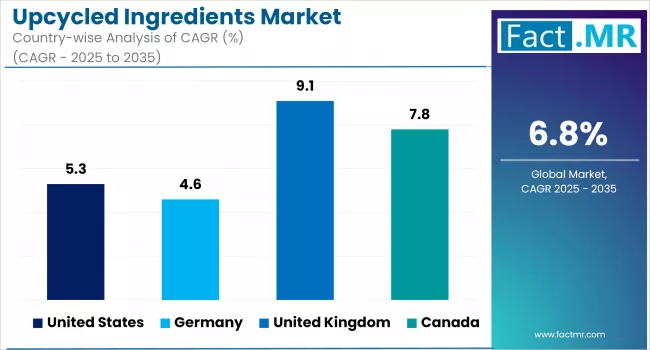
Upcycled Ingredients Market Country Wise Analysis Of CAGR | Source: Fact.MR
The U.S. upcycled ingredients market has been performing steadily, with current trends indicating that consumers are placing greater emphasis on functional and nutrient-enriched baked goods. As a result of the growing number of health-conscious individuals shifting toward clean-label ingredients, large scale bakeries started to invest in upcycled ingredients as a natural preservative. The trend of this movement has been accompanied by the shift in eating habits where the health, transparency, and intentional nutrition are gaining increased attention.
Products such as artisan and organic bread that often include upcycled ingredients are also popular as they are of high quality and contain no additives. Besides, the convenience of using frozen dough products and their popularity in the retail sector has led to the incorporation of upcycled ingredients into the products to extend shelf life without compromising the flavor and texture.
Clean-Label Compliance and Dairy Innovation Propel Germany’s Upcycled Ingredients Market
In Germany, the upcycled ingredients market has matured, driven by tight regulatory standards and expanding consumer preference for clean-label foods. To align with the Europe’s high food safety requirements and the growing demand for additive-free products, food manufacturers have adopted the use of natural food preservatives.
The incorporation of upcycled ingredients in dairy and bakery products has enabled manufacturers to reduce spoilage and maintain product integrity. As concerns grow regarding clean-label policies and the consumers demanding that their products to be reflective of their values in natural and minimally processed foods, the German food processors are increasingly using these ingredients to help sustain the production of foods and adhere to clean-label policy.
Heritage Cuisine and Gourmet Consumption Spur U.K. Upcycled Ingredients Market
Upcycled Ingredients in the U.K. have been developing steadily, and consumers have indulged in gourmet and heritage-inspired foundations of culinary choices. The growing demand for Mediterranean-style and artisanal cuisines has solidified the use of upcycled ingredients in both home and family diets, as well as in the food industry. This trend has combined with the overall movement toward clean eating, which has driven demand for lightly processed dairy products.
More specifically, halloumi has been innovative in the implementation of ready-to-eat meals and street food formats, making it relevant to the city markets and high-value product requirements. The increased use of vegan and flexitarian diets has stimulated the production of hybrid milk products that can replicate the quality and cooking capabilities of traditional cheeses, such as Halloumi.
Category-Wise Market Outlook
Fruit & Vegetable Waste Emerges as the Leading Source Amid Zero-Waste and Clean Label Movements
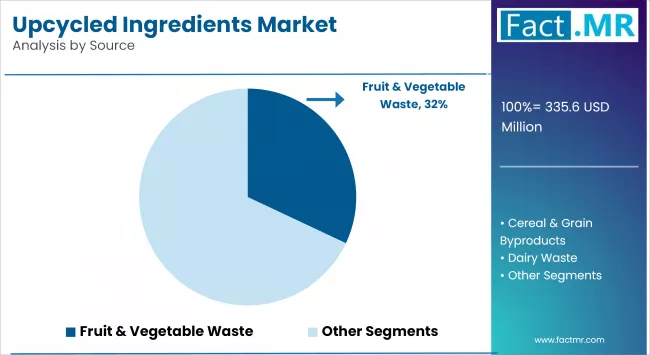
Upcycled Ingredients Market Analysis By Source | Source: Fact.MR
Fruit and vegetable waste has emerged as one of the most actively utilized sources in the upcycled ingredients market over the years. Growing interest in food waste and sustainability have strengthened the valorization process of these byproducts to obtain valuable ingredients. They are rich in micronutrients, available in large quantities, and highly versatile; hence, they can be used in food, cosmetic, and nutraceutical applications.
These sources have gained particular traction among companies seeking to project a more environmentally friendly image, as they have a clean-label reputation and align with circular economy principles. This has been facilitated by regulatory incentives on efforts to reduce food waste in the EU and North America.
Fibers Capture Growth Momentum Driven by Digestive Health and Label Transparency
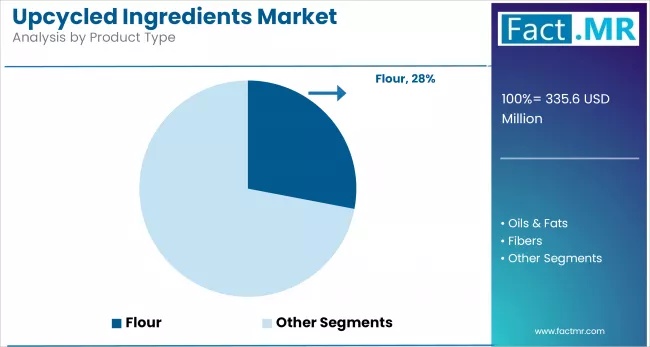
Upcycled Ingredients Market Analysis By Product Type | Source: Fact.MR
Fibers are witnessing strong growth, driven by the demand for dietary enhancement in foods, beverages, and nutritional supplements. As consumers seek natural, value-added ingredients to enhance their gut health, upcycled fibers made of fruit peels, grains, and vegetable husks are gaining popularity.
These fibers are also clean-label friendly, enabling the reformulation of the product to provide a superior texture and lower sugar levels. They find application in baked goods, meat substitutes, and nutritional bars, particularly in those markets, notably in Europe and North America, where regulatory labeling provides a premium for high-fiber statements.
Powder Format Gains Prominence for Its Versatility and Shelf-Stability
Powder is the most rapidly expanding segment, owing to its convenience of storage, transportation, and integration into a diverse range of applications, such as food, cosmetics, and pharmaceuticals. Powdered ingredients made using upcycled ingredients are more stable, have a longer shelf life and can be dosed more accurately, which is appealing to manufacturers due to these characteristics.
They are versatile, as they can be transformed into product lines such as supplements, beverages, protein blends, and personal care products, which makes them a valuable strategic selection for brands characterized by their pursuit of efficiency and innovation. The increased use of upcycled fruit peel powder and spent grains can be observed, particularly in North America and the Asia-Pacific region.
Competitive Analysis
Competitive Outlook: Upcycled Ingredients Market
The upcycled ingredients market has grown significantly, and its expansion is fueled by companies that convert food byproducts into new products and promote their commodification. Renewal Mill has been the driving force behind the trend to turn waste byproducts into usable goods, utilizing okara, a soy milk byproduct, as a raw material and developing protein-rich, high-fiber flour to drive a circular economy in food production.
ReGrained, now Upcycled Foods Inc. has created SuperGrain+, a product made of spent brewers grains, and has become a leader in B2B upcycled food economy. In developing defatted sunflower seeds, Planetarians has introduced plant-based meat alternatives intended to be widely accessible, as they are produced through upcycling. Using microbial fermentation, ÄIO has turned industrial byproducts of the agriculture and wood industry into oils and fats that are sustainable and are replacements to palm and coconut oils.
Upcycling has also extended consumer facing brands. Bake Me Healthy has launched non-allergenic, plant-based baking products with upcycled fruits, vegetables, and grains. By utilizing imperfect bananas, that would otherwise go to waste, Barnana produces snacks such as banana bites and plantain chips.
Casca Foods has developed fruit waste products for use as supplements and snacks, including apple fiber and collagen products that also offer antioxidant benefits. Green Bowl has developed ready-to-eat food items by utilizing upcycled produce, including brewer's spent grain and vegetable pulps.
An upcycling food company I Am Grounded has created coconut energy bars with upcycled coffee cherries to provide snacks. Matriark Foods has also partnered with farmers to convert excess food into nutritious, shelf-stable foods for underserved populations in schools and hospitals. Upcycle by Oisix has incorporated worldwide upcycling to Japanese tray meals, making it eco-friendly.
Pluck has developed seasoning blends produced through the upcycling of vegetable and meat waste products, reducing waste in the process while incorporating significant flavor input. Rootly has transformed upcycled nuts and seeds into a plant-based dairy alternative, contributing to a greener food system.
Key players of the upcycled ingredients industry are Renewal Mill, Upcycled Foods Inc., Planetarians, and AIO.BIO, Bake Me Healthy, Barnana, Cascara Foods, Green Bowl, I Am Grounded, Matriark, Upcycle by Oisix, Pluck, Rootly.
Recent Development:
- In September 2024, Upcycled Foods, Inc. partnered with Atoria’s Family Bakery to launch Mini Upcycled Multigrain Naan, incorporating ReGrained SuperGrain+®, a byproduct of beer brewing. This collaboration introduced the first upcycled naan to grocery and foodservice markets, aligning with consumer demand for sustainable, nutritious products.
- In April 2025, Compound Foods unveiled a platform producing sustainable, beanless coffee and cocoa ingredients through fermentation and upcycled inputs. This innovation aims to mitigate supply chain risks and environmental impacts associated with traditional coffee and cocoa production.
Fact.MR has provided detailed information about the price points of key manufacturers in the Upcycled Ingredients Market, positioned across regions, including sales growth, production capacity, and speculative technological expansion, in the recently published report.
Methodology and Industry Tracking Approach
The 2025 Global Upcycled Ingredients Market Report by Fact.MR sets a new standard in strategic market intelligence, delivering a data-rich, precision-calibrated view of the expanding role of upcycled ingredients across global foodservice, circular nutrition, and premium clean-label product ecosystems. Anchored in insights from over 7,500 stakeholders across 35 countries each contributing 300+ high-fidelity responses, the report offers unparalleled analytical depth, geographic reach, and commercial relevance.
The respondent framework was rigorously designed to ensure comprehensive, 360° market coverage, two-thirds composed of end users and executive decision-makers, including product developers, sustainability leads, innovation managers, and procurement heads from leading CPG, foodservice, and retail organizations. The remaining one-third featured domain specialists such as fermentation technologists, ingredient formulators, clean-label advocates, quality assurance officers, and supply chain strategists engaged in upcycled food innovation, waste valorization, and regenerative sourcing.
Conducted over a 12-month research cycle from July 2024 to June 2025, the study traces breakthrough shifts in the upcycled ingredients economy spanning input stream optimization (e.g., side-stream valorization, fiber-protein synergies), process advancements (e.g., enzymatic conversion, low-emission dehydration), product innovation (e.g., upcycled snacks, functional beverages, beauty actives), and evolving policy frameworks around food recovery certification, carbon labeling, and traceability compliance. Stratified sampling and weighted modeling were applied across stakeholder role, geography, and distribution tier to ensure strong, representative insights.
Built upon over 250 rigorously vetted sources spanning regulatory frameworks, sustainability benchmarks, retail intelligence audits, patent databases, and ingredient performance trials the report employs advanced statistical techniques such as cluster segmentation, predictive analytics, and regression modeling to produce actionable, forward-looking intelligence.
Backed by continuous tracking since 2018, the 2025 edition is an essential guide for ingredient manufacturers, product innovation teams, sustainability officers, regulatory strategists, and institutional investors aiming to lead in the dynamic and fast-expanding upcycled ingredients market.
Segmentation
Segmentation of Upcycled Ingredients Market Research
-
By Source :
- Fruit & Vegetable Waste
- Cereal & Grain Byproducts
- Dairy Waste
- Meat & Seafood Waste
- Brewery Spent Grains
- Others (e.g., coffee grounds)
-
By Product Type :
- Flour
- Oils & Fats
- Fibers
- Proteins
- Sweeteners
- Antioxidants
- Enzymes & Others
-
By Form :
- Solid
- Liquid
- Semi-solid
- Powder
- Gel
- Paste
- Others
-
By Application :
- Food & Beverage
- Cosmetics & Personal Care
- Animal Feed
- Nutraceuticals
- Biofuel & Biochemicals
- Pharmaceuticals
- Others
-
By End Use Industry :
- Food & Beverage
- Cosmetics
- Animal Feed
- Nutraceuticals
- Biofuel
- Pharmaceuticals
- Others
-
By Region :
- North America
- Latin America
- Western Europe
- Eastern Europe
- East Asia
- South Asia & Pacific
- Middle East & Africa
Frequently Asked Questions
What was the Global Upcycled Ingredients Market Size Reported by Fact.MR for 2024?
Who are the Major Players Operating in the Upcycled Ingredients Market?
What is the Estimated Valuation of the Upcycled Ingredients Market in 2035?
What Value CAGR did the Upcycled Ingredients Market Exhibit Over the Last Five Years?
Who worked on this report


Preview the report firsthand - request a free sample
Free SampleGet the brochure for pricing and purchase details
Download PDF