- Market Value (2025): USD 532.8 Mn
- Estimated Value (2026): USD 601.0 Mn
- Forecast Value (2036): USD 2004.3 Mn
- CAGR (2026-2036): 12.8%
What is the Upcycled Carob Prebiotics Market forecast to be worth by 2036?
USD 601.0 million in 2026 to USD 2004.3 million by 2036 at a 12.8% CAGR.
- The Upcycled Carob Prebiotics Market was valued at USD 532.8 million in 2025.
- Demand is projected to increase from USD 601.0 million in 2026 to USD 2004.3 million by 2036.
- The market is forecast to record 12.8% CAGR from 2026 to 2036, supported by fiber enrichment and digestive wellness formats.
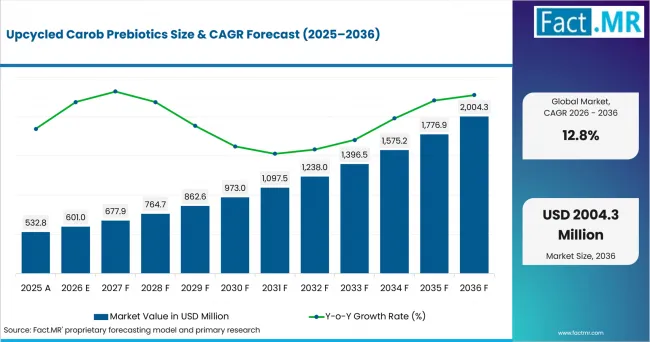
Upcycled Carob Prebiotics Value Analysis | Source: Fact.MR
What are the defining numbers behind Upcycled Carob Prebiotics Market growth?
An absolute opportunity of USD 1403.3 million is expected between 2026 and 2036.
- Demand Drivers in the Market
- Product teams need pulp fiber that adds label-visible dietary fiber while keeping texture suitable for snacks, bakery mixes and powdered formats.
- China gives reformulators a large packaged-food base. The National Bureau of Statistics reported that grain, oil and food retail sales by enterprises above designated size rose 9.3% in 2025.
- U.S. brands have a broad food-spending base for fiber-positioned products. USDA Economic Research Service reported total U.S. food spending of USD 2.51 trillion in 2025.
- Pet nutrition developers need plant fibers that fit stool-quality claims and kibble texture before carob fractions move into routine digestive-care formulas.
- Key Segments Analyzed
- By Carob Fraction: Pulp fiber is expected to hold 37.0% share in 2026 due to its upcycling story and direct fiber route.
- By Function: Prebiotic support is projected to account for 33.0% share in 2026 supported by digestive wellness claims across foods and supplements.
- By Application: Functional foods are anticipated to capture 34.0% share in 2026 owing to snack, bakery and beverage reformulation built around added fiber.
- By Processing: Dry milling is estimated to represent 31.0% share in 2026 due to simpler powder production and lower process complexity than extraction-led routes.
- Analyst Opinion at Fact.MR
- Shambhu Nath Jha, Principal Consultant at Fact.MR, states, "Carob prebiotics draw attention due to the link between a familiar Mediterranean crop and side-stream valorization. Demand is expected to shift toward suppliers that document pod origin, fraction identity and prebiotic substantiation together. Practical selection is expected to favor milling discipline, sensory support and claim-ready technical files."
- Strategic Implications
- Ingredient processors should document pod sourcing, fraction identity and contaminant controls before offering pulp fiber to supplement brands.
- Food brands should test carob fruit powder in bakery and snack systems where natural color supports the finished product.
- FDA proposed a front-of-package nutrition labeling rule in January 2025 that would classify saturated fat, sodium and added sugars as Low, Med or High based on their percentage of Daily Value.
- Distributors should separate carob pulp fiber from locust bean gum in technical material so formulators understand the use case.
China is projected to post 13.3% CAGR through 2036 supported by packaged-food reformulation and age-linked digestive wellness demand. France is anticipated to record 13.2% CAGR while nutrition data and supplement controls push brands toward better documented fibers. The USA is expected to advance at 12.8% CAGR through functional-food spending and fiber-label visibility. Germany is estimated to reach 12.6% CAGR supported by processed-food scale and formulation work. Japan is forecast to hold 11.7% CAGR while portioned wellness formats shape selective uptake.
How does the Upcycled Carob Prebiotics Market break down by segment?
Pulp fiber leads Carob Fraction at 37.0%; Functional foods lead Application at 34.0%.
Which Carob Fraction dominates?
Pulp fiber is expected to hold 37.0% share in 2026.
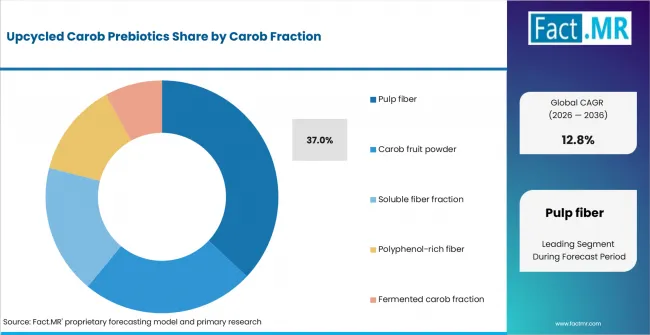
Upcycled Carob Prebiotics Analysis By Carob Fraction | Source: Fact.MR
Pulp fiber leads due to its clear upcycled identity. It uses the fibrous part of the carob pod in powders and blends where brands want dietary fiber without moving into purified extracts. Carob fruit powder supports flavor and color systems. Soluble fiber fraction fits beverages and supplement powders where smoother mouthfeel is needed.
What leads the Function segment?
Prebiotic support is projected to account for 33.0% share in 2026.
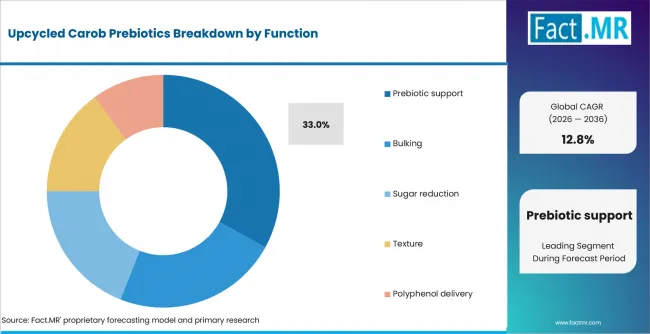
Upcycled Carob Prebiotics Analysis By Function | Source: Fact.MR
Prebiotic support leads the function mix as digestive wellness gives carob fibers a clear job inside food and supplement briefs. ANSES published the Ciqual 2025 food composition table with 3,484 foods for France. More structured nutrition data raises the value of documented fiber ingredients in formulation files.
How does Application shape demand?
Functional foods are anticipated to capture 34.0% share in 2026.
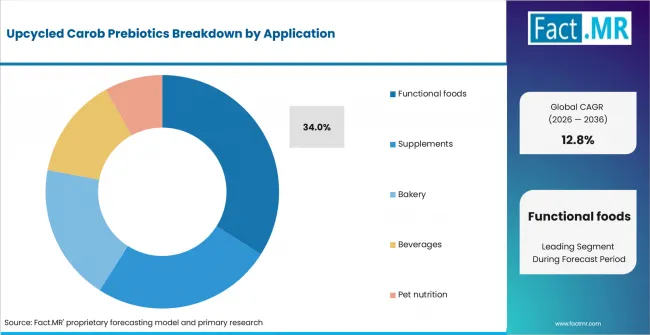
Upcycled Carob Prebiotics Analysis By Application | Source: Fact.MR
Functional foods lead due to snacks, bakery items and beverage powders that fit daily eating habits. In France, INSEE reported household spending of EUR 192.8 billion on food and non-alcoholic beverages in 2025. The spending base gives reformulated foods a broad commercial route for carob fiber positioning.
What supports Dry milling within Processing?
Dry milling is estimated to represent 31.0% share in 2026.
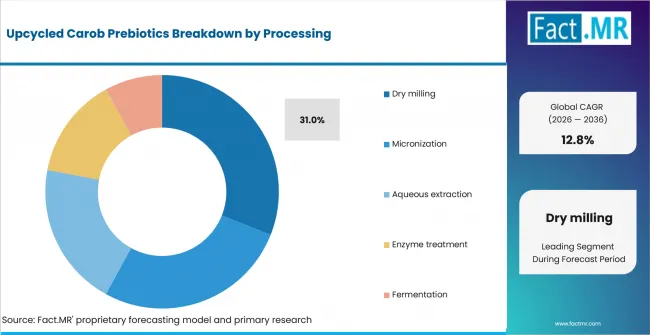
Upcycled Carob Prebiotics Analysis By Processing | Source: Fact.MR
Dry milling leads processing due to fewer steps than aqueous extraction or enzyme treatment. The method supports pulp fiber and fruit powder where cost control and simple ingredient files carry weight. Micronization improves mouthfeel for beverages. Fermentation remains a smaller route for specialty fractions.
What is accelerating Upcycled Carob Prebiotics Market adoption, and what is holding it back?
Digestive wellness and food-stream valorization drive it; claim review and sensory limits restrain it.
Drivers Impact Analysis
| DRIVER | (~) % IMPACT ON CAGR | GEOGRAPHIC RELEVANCE | IMPACT TIMELINE |
|---|---|---|---|
| Prebiotic fiber positioning in foods and supplements | +2.1% | North America, Western Europe, East Asia | Short term (<= 2 years) |
| Upcycling of carob pod side streams | +1.5% | Mediterranean supply regions, Europe | Medium term (2-4 years) |
| Sugar reduction and bulking needs | +1.2% | USA, France, Germany, Japan | Medium term (2-4 years) |
| Pet nutrition digestive-care formats | +0.8% | USA, Japan, Western Europe | Long term (>= 4 years) |
Source: Fact.MR analysis. Updated Sep 17, 2026
Opportunity Impact Analysis
| OPPORTUNITY | (~) % IMPACT ON CAGR | GEOGRAPHIC RELEVANCE | IMPACT TIMELINE |
|---|---|---|---|
| Functional bakery and snack reformulation | +1.3% | USA, France, Germany | Short term (<= 2 years) |
| Beverage powders and portioned wellness formats | +1.0% | Japan, USA, China | Medium term (2-4 years) |
| Carob-acacia and mixed botanical fiber blends | +0.7% | Europe, North America | Long term (>= 4 years) |
Source: Fact.MR analysis. Updated Sep 17, 2026
Restraints Impact Analysis
| RESTRAINT | (~) % IMPACT ON CAGR | GEOGRAPHIC RELEVANCE | IMPACT TIMELINE |
|---|---|---|---|
| Claim substantiation requirements | -0.7% | USA, Europe, Japan | Short term (<= 2 years) |
| Color and flavor limits in beverages | -0.5% | Global | Medium term (2-4 years) |
| Food-price pressure on premium ingredients | -0.4% | USA, Japan, Germany | Medium term (2-4 years) |
Source: Fact.MR analysis. Updated Sep 17, 2026
Which countries are scaling the Upcycled Carob Prebiotics Market through 2036?
- The country comparison spans 1.6 percentage points and forms a compact growth band across the forecast period.
- China remains 0.1 percentage point above France through packaged-food reformulation and rising interest in digestive wellness.
- France remains 0.4 percentage point above the USA through nutrition data and supplement control that sharpen ingredient documentation needs.
- The USA remains 0.2 percentage point above Germany through fiber-label visibility and functional-food reformulation.
- Germany remains 0.9 percentage point above Japan through processed-food scale and ingredient quality routines.
- Japan closes the displayed range through portioned wellness formats and selective routes for soluble carob fractions.
Comparable CAGRs create different entry conditions across the carob proposition. Full report coverage includes North America, Latin America, Western Europe, Eastern Europe, East Asia, South Asia & Pacific, Middle East & Africa.
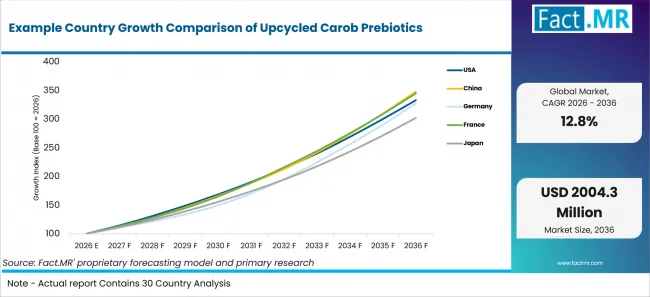
Example Country Growth Comparison Of Upcycled Carob Prebiotics | Source: Fact.MR
| Country | CAGR |
|---|---|
| China | 13.3% |
| France | 13.2% |
| USA | 12.8% |
| Germany | 12.6% |
| Japan | 11.7% |
Source: Fact.MR analysis. Updated Sep 17, 2026
What is powering China adoption?
13.3% CAGR, supported by packaged food reformulation and digestive wellness demand.
China's packaged-food base gives carob pulp fiber a large reformulation route for snacks and supplement powders. Local brands are projected to favor carob fractions when added fiber needs mild sweetness and controlled color. Batch identity and origin records are expected to shape supplier approval.
How is France scaling demand?
13.2% CAGR, driven by functional food spending and supplement documentation.
France pairs functional-food spending with closer review of nutrition and supplement claims. Product teams are expected to use documented carob fractions where fiber support needs a clearer ingredient story. Sensory fit and claim files are projected to shape repeat use in bakery and supplement formats.
What supports the USA outlook?
12.8% CAGR, backed by fiber-label visibility and reformulation needs.
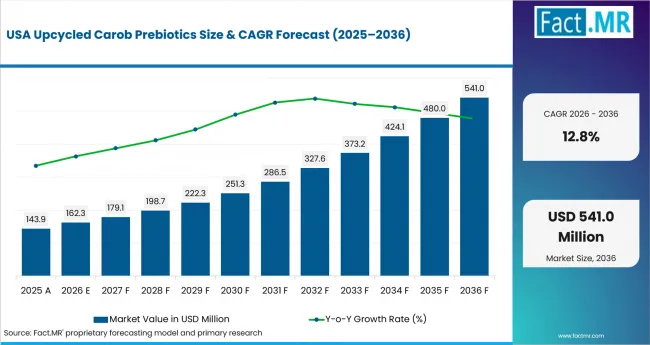
Upcycled Carob Prebiotics Country Value Analysis | Source: Fact.MR
The USA offers a broad base for fiber-positioned foods and supplement formats. Carob prebiotics are expected to fit products where added fiber and sugar reduction need texture support. Label teams are projected to favor ingredients with clear fiber identity and stable sensory behavior.
What is supporting Germany's adoption?
12.6% CAGR, supported by processed food scale and quality routines.
Germany's food economy supports steady formulation work for botanical fibers. Destatis listed EUR 250.39 billion in 2025 household consumption of food, beverages and tobacco. Dry-milled carob fractions are forecast to gain where processors need stable powder behavior and clear specifications.
How does Japan perform?
11.7% CAGR, led by portioned wellness formats and selective fiber use.
Japan's portioned nutrition formats suit soluble fibers with controlled dose and taste. The Statistics Bureau reported average monthly consumption expenditure of 314,001 yen per two-or-more-person household in 2025. Carob fractions are expected to move through powders, jelly snacks and beverage mixes where texture control is reliable.
Who leads the Upcycled Carob Prebiotics Market?
CarobWay has direct public product evidence for carob-derived prebiotic ingredients, while Nexira has expanded its carob ingredient capabilities through its July 2026 acquisition of Keragum.
CarobWay describes CarobWell™ Biome as a prebiotic powder derived from carob fruit. Nexira acquired Keragum, a Moroccan company specializing in carob-based ingredients, in July 2026. Carob S.A. supplies PALGUM® locust bean gum derived from carob seeds, providing adjacent carob-processing capability rather than direct evidence of a carob-based prebiotic product.
Which companies are the key providers?
CarobWay and Nexira are profiled for direct carob or carob-prebiotic relevance. Carob S.A. are retained as adjacent carob/LBG comparators, while IFF and Tate & Lyle represent broader prebiotic-fiber capabilities.
- CarobWay
- Nexira
- Carob S.A.
- IFF
- Tate & Lyle
Bibliography
- Du Chaffaut, L., Oseredczuk, M., & Gauvreau-Béziat, J. (2025). Table de composition nutritionnelle des aliments Ciqual 2025 [Data set]. Recherche Data Gouv.
- Institut national de la statistique et des études économiques. (2026, May 29). Consommation effective des ménages par fonction : Données annuelles 1965 et 2025.
- National Bureau of Statistics of China. (2026, February 28). Statistical communiqué of the People’s Republic of China on the 2025 national economic and social development.
- Nexira. (2026, July 9). Nexira acquires Keragum, strengthening its position of global leader in natural plant-based ingredients.
- Statistics Bureau of Japan. (2026a, January 23). Japan 2025 [Consumer Price Index].
- Statistics Bureau of Japan. (2026b, February 6). 2025 yearly average [Family Income and Expenditure Survey].
- Tate & Lyle. (2026, June 3). Tate & Lyle fibre portfolio receives NutraStrong™ Prebiotic Verified certification.
- U.S. Food and Drug Administration. (2025, January 14). FDA proposes requiring at-a-glance nutrition information on the front of packaged foods.
- Zeballos, E., & Sinclair, W. (2026, June 11). Total U.S. food spending reached $2.51 trillion in 2025. U.S. Department of Agriculture, Economic Research Service.
This Report Answers
- The report explains where upcycled carob prebiotics are used across carob fraction and function. It also covers application and processing.
- Segment analysis identifies pulp fiber and functional foods as the main data points and explains formulator priorities.
- Country analysis examines China, France, the USA, Germany and Japan through food spending, nutrition data and formulation routes.
- Competitive analysis reviews CarobWay and Nexira for direct carob or carob-prebiotic relevance, with Carob S.A., IFF and Tate & Lyle included as adjacent comparison participants.
- Application analysis assesses how fiber addition, sugar reduction and sensory fit influence decisions by food, supplement and pet nutrition brands.
- Processing analysis covers dry milling, micronization, aqueous extraction, enzyme treatment and fermentation within carob fraction development.
- Provider checks, official statistics and portfolio review support the forecast reasoning used across the assessment.
What does the Upcycled Carob Prebiotics Market cover?
Pulp fiber, fruit powder, soluble fiber fraction and polyphenol-rich carob ingredients used for prebiotic food and nutrition applications.
The Upcycled Carob Prebiotics Market covers carob-derived ingredients made from pulp, fruit powder, soluble fiber and related fractions. These ingredients are used in functional foods, supplements, bakery, beverages and pet nutrition where fiber support and digestive positioning shape formulation work.
The assessment is narrower than general prebiotic fiber ingredients because it focuses on carob-origin streams and upcycled positioning. It also sits alongside carob powder applications when roasted fruit powder is used mainly for flavor, color or cocoa-style replacement.
What is included in the scope?
Upcycled carob ingredients used in food, supplement, beverage, bakery and pet nutrition applications.
The scope includes carob pulp fiber, carob fruit powder, soluble fiber fraction, polyphenol-rich fiber and fermented carob fraction. It covers prebiotic support, bulking, sugar reduction, texture and polyphenol delivery across functional foods applications. It includes dry milling, micronization, aqueous extraction, enzyme treatment and fermentation when the output is sold as an upcycled carob prebiotic ingredient. Adjacent carob extract systems are included when the ingredient is positioned within the carob prebiotic boundary.
What is excluded from the scope?
Conventional locust bean gum and non-carob prebiotic fibers are outside the scope.
The scope excludes standard locust bean gum sold only as a thickener outside prebiotic or upcycled positioning. It excludes inulin, resistant starch, acacia fiber and polydextrose except as comparison points.
How Was the Analysis Built?
120+ sources, 35+ company portfolios, 25+ countries, and more than 20 interviews.
- Primary Research: Primary research includes discussions with ingredient processors, distributors, food brands, supplement formulators, pet nutrition developers and application specialists. These conversations examine purchase criteria, sensory limits, claim review, processing needs and factors that influence wider market acceptance.
- Desk Research: Desk research covers government statistics, food consumption data, nutrition guidance, regulator publications, company portfolios, product pages, technical material and official development announcements. Every source used in the analysis is documented in the bibliography.
- Market Sizing and Forecasting: Market estimates combine functional food reformulation, supplement demand indicators, processing economics, segment shares, country-level growth, provider participation and barriers to market expansion.
- Data Validation and Update Cycle: Findings are validated by comparing interviews with public data, company activity, portfolio mapping, regulatory checks and food-ingredient developments. Regular updates review new launches, acquisitions, certification changes and shifts in commercial adoption.
Segmentation
What is the report's scope and coverage?
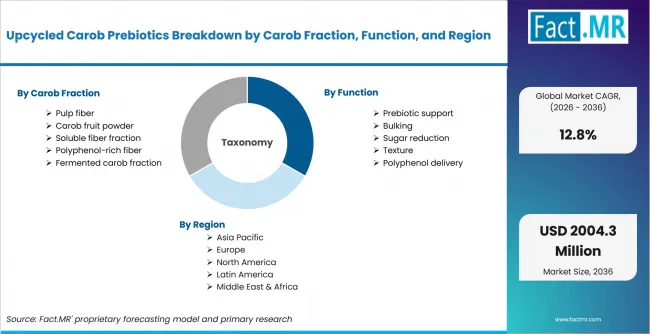
Upcycled Carob Prebiotics Breakdown By Carob Fraction, Function, And Region | Source: Fact.MR
| Attribute | Details |
|---|---|
| Quantitative Units | USD million |
| Market Definition | Carob-derived fiber ingredients positioned for prebiotic support, fiber enrichment, bulking, sugar reduction, texture and polyphenol delivery in food, supplement and pet nutrition applications. |
| Carob Fraction | Pulp fiber; Carob fruit powder; Soluble fiber fraction; Polyphenol-rich fiber; Fermented carob fraction |
| Function | Prebiotic support; Bulking; Sugar reduction; Texture; Polyphenol delivery |
| Application | Functional foods; Supplements; Bakery; Beverages; Pet nutrition |
| Processing | Dry milling; Micronization; Aqueous extraction; Enzyme treatment; Fermentation |
| Regions Covered | North America; Latin America; Western Europe; Eastern Europe; East Asia; South Asia & Pacific; Middle East & Africa |
| Countries Covered | China; France; USA; Germany; Japan |
| Key Companies Profiled | CarobWay; Nexira; Carob S.A.; IFF; Tate & Lyle |
| Forecast Period | 2026 to 2036 |
| Approach | Hybrid top-down and bottom-up approach using food spending indicators, fiber formulation needs, carob processing routes, country growth, application fit and provider portfolio review. |
Source: Fact.MR analysis. Updated Sep 17, 2026
How is the market segmented?
-
By Carob Fraction
- Pulp fiber
- Carob fruit powder
- Soluble fiber fraction
- Polyphenol-rich fiber
- Fermented carob fraction
-
By Function
- Prebiotic support
- Bulking
- Sugar reduction
- Texture
- Polyphenol delivery
-
By Application
- Functional foods
- Supplements
- Bakery
- Beverages
- Pet nutrition
-
By Processing
- Dry milling
- Micronization
- Aqueous extraction
- Enzyme treatment
- Fermentation
-
By Region
- North America
- Latin America
- Western Europe
- Eastern Europe
- East Asia
- South Asia & Pacific
- Middle East & Africa
Frequently Asked Questions
How big is the Upcycled Carob Prebiotics Market in 2026?
What is the CAGR of the Upcycled Carob Prebiotics Market from 2026 to 2036?
Which carob fraction leads the Upcycled Carob Prebiotics Market?
Which application leads the Upcycled Carob Prebiotics Market?
Who are the leading companies in the Upcycled Carob Prebiotics Market?
Who worked on this report


Preview the report firsthand - request a free sample
Free SampleGet the brochure for pricing and purchase details
Download PDF