- Base Value(2025): 342 Mn
- Estimated Value(2026): 372 Mn
- Forecast Value (2036): 865 Mn
- CAGR (2026 - 2036): 8.8%
Upcycled Coffee Fruit Extracts Market Forecast and Outlook By FACT.MR
In 2025, the upcycled coffee fruit extracts market was valued at USD 342 million. Based on Fact.MR analysis, demand for upcycled coffee fruit extracts is estimated to grow to USD 372 million in 2026 and USD 865 million by 2036. FACT.MR projects a CAGR of 8.8% during the forecast period.
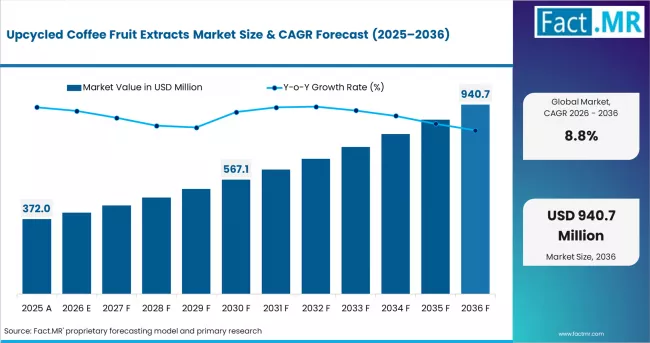
Upcycled Coffee Fruit Extracts Market Market Value Analysis | Source: Fact.MR
| Metric | Value |
|---|---|
| Estimated Value in 2026 | USD 372 million |
| Forecast Value in 2036 | USD 865 million |
| Forecast CAGR (2026 to 2036) | 8.8% |
Source: Fact.MR analysis. Updated Apr 24, 2026
Summary of the Upcycled Coffee Fruit Extracts Market
- Market Definition
- The market covers functional ingredients derived from upcycled coffee cherry fruit including extracts, concentrates, powders, and oils supplying food and beverage, nutraceutical, cosmetics, and animal feed applications globally.
- Demand Drivers
- India and Vietnam are investing in cherry processing. This converts pulp into antioxidant extracts for export.
- U.S. brands are using certified coffee fruit extract. It is used as a clean-label caffeine alternative.
- EU regulations are pushing sustainable ingredients. Coffee fruit formats are used in food and dairy products.
- Key Segments Analyzed
- By Product Type: Coffee fruit extracts lead with 42% share in 2026. Driven by higher functionality and better standardisation.
- By Application: Food and beverages lead with 48% share in 2026. Driven by demand for functional and clean-label products.
- By Distribution Channel: Supermarkets and hypermarkets lead with 36% share in 2026. Supported by retail expansion.
- By Geography: India leads with 9.4% CAGR. Growth is driven by nutraceutical demand and processing investment.
- Analyst Opinion at FACT.MR
- Shambhu Nath Jha, Principal Consultant at Fact.MR, opines, ‘CXOs will find that Upcycled Food Association certification and proven antioxidant benchmarks are key buying criteria. Traceable and origin-verified supply gives brands a strong advantage over standard extract buyers.’
- Strategic Implications
- Invest in certification and antioxidant benchmarking to qualify for clean-label procurement in the USA and Europe.
• Build direct sourcing partnerships in India, Vietnam, and Brazil to ensure traceable supply and premium positioning.
• Develop application-specific formats such as powders and concentrates for key markets like Japan and Germany.
- Invest in certification and antioxidant benchmarking to qualify for clean-label procurement in the USA and Europe.
- Methodology
- Market sizing is based on processing volumes and producer revenues. Validated with certification and procurement benchmarks.
- • Analysis includes FSSAI, USDA, EU regulations, and India nutraceutical data.
- • Forecasts consider adoption trends, antioxidant demand, and expert insights.
The market is expected to generate an absolute dollar opportunity of USD 493 million over the forecast period. Growth is transformational, driven by clean-label and upcycled ingredient mandates from food and beverage brands. Expansion is moderated by fragmented origin-side processing infrastructure, inconsistent raw material quality, and limited consumer awareness in price-sensitive markets.
Food and nutraceutical brands are increasingly specifying coffee fruit extract with documented antioxidant activity and Upcycled Food Association certification. Long-term ingredient sourcing agreements between extract producers and beverage brands are increasing in frequency. Buyers prefer verified origin documentation, standardised ORAC benchmarks, and traceable smallholder supply chains as qualification criteria.
India leads with 9.4% CAGR through 2036, driven by expanding nutraceutical demand and coffee cultivation region processing investment. Vietnam follows at 9.1%, supported by large coffee cherry output and growing ingredient processing infrastructure. Brazil records 8.8%, anchored by domestic raw material abundance and rising functional food commercialisation. Germany posts 8.3%, led by clean-label and nutraceutical channel demand in organised retail. Japan grows at 8.1%, driven by advanced functional beverage and ready-to-drink innovation. The USA records 7.9%, reflecting sustained functional beverage demand and sustainability-driven brand procurement, with qualification standards moderating new entrant volumes.
Segmental Analysis
Upcycled Coffee Fruit Extracts Market Analysis by Product Type
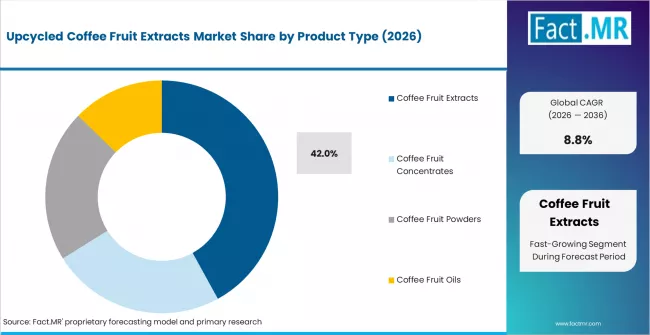
Upcycled Coffee Fruit Extracts Market Analysis By Product Type | Source: Fact.MR
Based on FACT.MR analysis, coffee fruit extracts hold 42% share in 2026. Extracts lead due to high bioactive content. They are easy to use in liquid formulations. They offer consistent antioxidant performance.
- Nestlé Cascara Programme: Nestlé expanded cascara sourcing in 2024. It supports sustainability goals. Supplier programmes are active in Colombia and Ethiopia. This builds certified extract capacity [4].
- KonaRed Powder Innovation: KonaRed launched a spray-dried powder in 2025. It contains 40% polyphenols. The product targets nutraceutical and protein markets. It is UFA certified and Non-GMO verified [5].
- Coffee Cherry Co. Growth Trend: Coffee Cherry Co. reported 35% growth in 2024. Demand came from U.S. beverage brands. Applications include energy drinks and supplements. Growth is strong in ready-to-drink formats [6].
Upcycled Coffee Fruit Extracts Market Analysis by Application
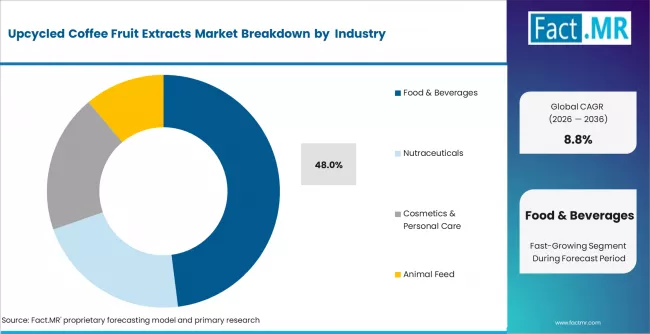
Upcycled Coffee Fruit Extracts Market Analysis By Application | Source: Fact.MR
Based on FACT.MR analysis, food and beverages hold 48% share in 2026. This segment leads due to wide formulation use. Coffee fruit extracts fit into drinks, dairy, and snacks. Clean-label demand supports adoption.
- Starbucks Beverage Launch: Starbucks launched cascara-based drinks in 2024. The focus is on sustainability. Sourcing expanded in Costa Rica and Ethiopia. This supports brand positioning [7].
- Kirin RTD Development: Kirin developed a functional beverage in 2025. It uses coffee fruit extracts. The product targets gut health. It includes chlorogenic acid and GABA [8].
- Nutraceutical Demand Trend: Supplement demand grew by 18% in 2024. Coffee fruit extract is gaining traction. Growth is driven by energy and cognitive health claims [9].
Drivers, Restraints, and Opportunities
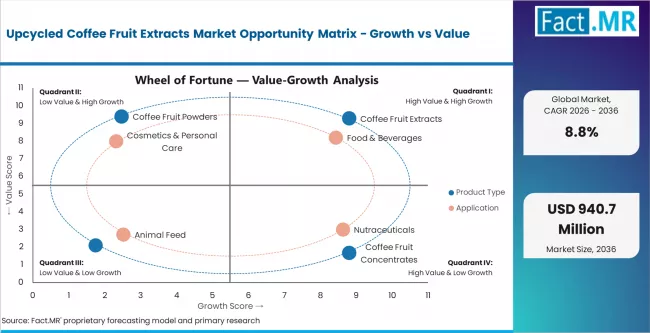
Upcycled Coffee Fruit Extracts Market Opportunity Matrix Growth Vs Value | Source: Fact.MR
FACT.MR analysts observe that the upcycled coffee fruit extracts market is still emerging. It is scaling rapidly within the upcycled ingredient space. Demand is driven by antioxidant and prebiotic claims. Beverages and supplements are key applications. Sustainability mandates and raw material availability are core drivers.
The market shows a clear split between certified and non-certified products. Certified extracts command 30–50% price premiums. Brands in the USA and Europe prefer certified inputs. Volume growth is higher in origin countries. Value growth is concentrated in developed markets.
- Upcycled Food Association Certification Driver: Over 500 products were certified in 2024. Coffee fruit ingredients are among the fastest-growing categories. U.S. brands require certification for procurement. This raises entry barriers for non-certified suppliers [1].
- India FSSAI Framework: India expanded functional ingredient approvals in 2024. This supports health claims for coffee fruit extracts. The nutraceutical market crossed USD 8 billion. Demand for certified ingredients is increasing [2].
- Vietnam Processing Expansion: Vietnam increased coffee processing capacity by 23% in 2024. Investment came from cooperative programmes. This improves raw material availability. It lowers costs for extract producers [3].
Regional Analysis
The upcycled coffee fruit extracts market is assessed across Asia Pacific, North America, Europe, Latin America, and Middle East and Africa, covering 40+ countries with distinct demand profiles shaped by coffee origin processing capacity, functional ingredient regulation maturity, nutraceutical retail infrastructure, and clean-label brand procurement activity. The full report offers market attractiveness analysis by region and country.
.webp "Top Country Growth Comparison Upcycled Coffee Fruit Extracts Market Cagr (2026 2036)")
Top Country Growth Comparison Upcycled Coffee Fruit Extracts Market Cagr (2026 2036) | Source: Fact.MR
| Country | CAGR (2026 to 2036) |
|---|---|
| India | 9.4% |
| Vietnam | 9.1% |
| Brazil | 8.8% |
| Germany | 8.3% |
| Japan | 8.1% |
| United States | 7.9% |
Source: Fact.MR analysis. Updated Apr 24, 2026
Source: Fact.MR (FACT.MR) analysis, based on proprietary forecasting model and primary research
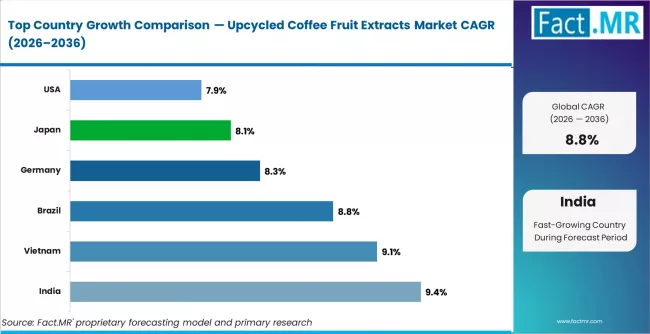
Upcycled Coffee Fruit Extracts Market Cagr Analysis By Country | Source: Fact.MR
Asia Pacific Upcycled Coffee Fruit Extracts Market Analysis
Asia Pacific serves as both the supply base and a fast-growing demand centre. Origin-side processing and regional consumption are expanding together. India and Vietnam lead production, while Japan drives premium usage.
- India: In India, growth is closely linked to rising nutraceutical demand and local processing expansion. The market is expected to grow at a CAGR of 9.4% through 2036. Regulatory updates in 2024 enabled structured health claims for antioxidant ingredients. Coffee cultivation regions are receiving investment for cherry processing. This is improving cascara extract availability. Domestic brands are increasing sourcing for supplement and wellness products.
- Vietnam: Vietnam’s market is shaped by large-scale robusta production and cooperative processing upgrades. Growth is forecast at around 9.1% CAGR through 2036. Wet processing capacity increased significantly in 2024. This expanded raw material availability for extraction. Export programmes are building traceability standards. International demand from Germany and Japan is increasing.
- Brazil: Brazil benefits from its position as the largest coffee producer globally. Growth is projected at nearly 8.8% CAGR through 2036. Regulatory updates are supporting functional ingredient approvals. Investment in processing infrastructure is expanding extraction capacity. Domestic brands are entering the coffee fruit ingredient segment. Export opportunities are also increasing.
FACT.MR covers India, Vietnam, China, Japan, ASEAN, and Australia and New Zealand. It includes processing data, regulatory frameworks, and demand trends.
North America Upcycled Coffee Fruit Extracts Market Analysis
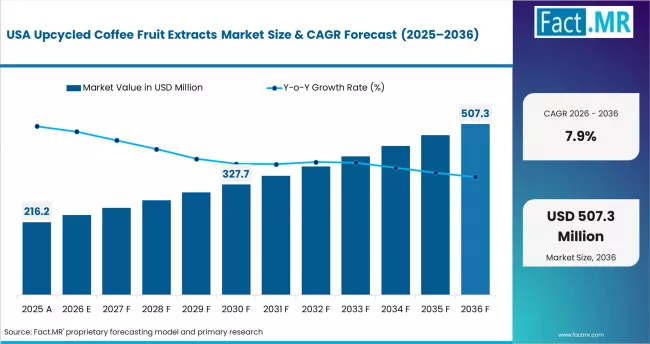
Upcycled Coffee Fruit Extracts Market Country Value Analysis | Source: Fact.MR
North America represents a high-value consumption market. Demand is driven by functional beverages and clean-label positioning. Certification and traceability play a major role in procurement.
- United States: In the United States, demand is largely driven by functional beverage innovation and sustainability positioning. The market is expected to expand at a CAGR of 7.9% through 2036. Brands are specifying certified ingredients for antioxidant and caffeine-alternative claims. Regulatory updates in 2024 increased traceability requirements. Retail and food service channels are adopting coffee fruit ingredients. Premium positioning continues to shape demand.
FACT.MR covers the USA, Canada, and Mexico. It includes certification trends and retail demand analysis.
Europe Upcycled Coffee Fruit Extracts Market Analysis
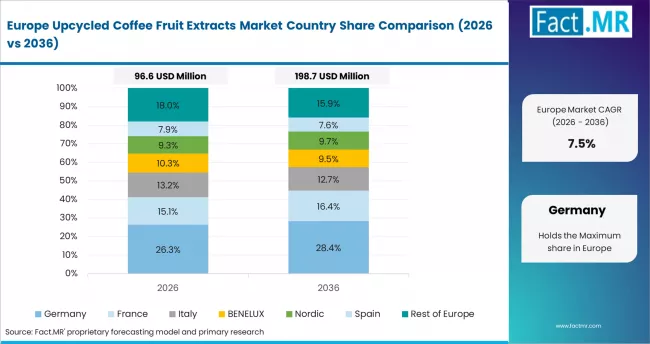
Upcycled Coffee Fruit Extracts Market Europe Country Market Share Analysis, 2026 & 2036 | Source: Fact.MR
Europe acts as a regulatory benchmark and premium demand region. Sustainability mandates and clean-label trends are shaping procurement. Nutraceutical and beverage segments are key drivers.
- Germany: Germany serves as the leading entry point for upcycled ingredients in Europe. Demand is projected to grow at around 8.3% CAGR through 2036. Strong retail networks support product visibility. Regulatory updates in 2024 improved labelling clarity. Major companies are increasing certified ingredient sourcing. The country remains central to European market expansion.
- Japan: Japan reflects a highly structured and innovation-led market environment. Growth is expected at approximately 8.1% CAGR through 2036. Functional beverage development is accelerating. Regulatory pathways support health claims. Retail networks provide strong consumer exposure. Procurement requires strict standardisation and documentation.
FACT.MR covers Germany, France, the UK, Italy, Spain, and Rest of Europe. It includes regulatory and demand insights.
Latin America Upcycled Coffee Fruit Extracts Market Analysis
Latin America is the core raw material region. The market is shifting toward value-added processing. Export demand is increasing alongside domestic consumption.
- Brazil: Brazil combines large-scale production with emerging domestic demand. Growth is supported by processing investments and export opportunities. Development bank funding in 2024 expanded extraction capacity. Regulatory updates enabled functional ingredient approvals. Domestic nutraceutical demand is also rising.
FACT.MR covers Brazil, Colombia, Honduras, and Rest of Latin America. It includes processing trends and export data.
Competitive Aligners for Market Players
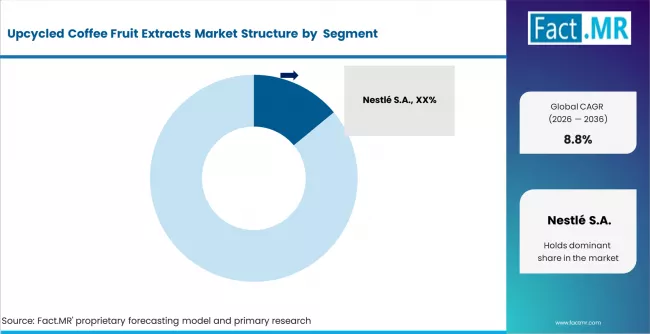
Upcycled Coffee Fruit Extracts Market Analysis By Company | Source: Fact.MR
The upcycled coffee fruit extracts market is quite fragmented. It includes origin-based producers, ingredient suppliers, and consumer-facing brands. No single company dominates globally. What really sets players apart is certification and product quality. Upcycled Food Association certification and consistent antioxidant levels are key for entering premium food and beverage supply chains, especially in the U.S. and Europe.
Large companies like Nestlé S.A. and Olam Food Ingredients have a clear edge. They control sourcing directly from farmers. They also have strong processing infrastructure in coffee-producing regions. This allows them to offer traceable and standardised extracts at scale. Smaller companies often struggle to match this level of consistency and supply reliability.
On the other hand, brands like KonaRed Corporation and Coffee Cherry Co. are well positioned in niche markets. They have built strong identities in the natural and functional food space. Their certification and direct relationships with beverage brands help them maintain premium positioning. Buyer behaviour is also changing. Food and beverage companies are now working with fewer suppliers. They prefer long-term partnerships with those who can provide clear traceability and proven functionality. This is pushing certified suppliers into a stronger position. At the same time, sellers offering basic or undocumented extracts are facing pricing pressure and shrinking margins.
Key Players
- Nestlé S.A.
- Starbucks Corporation
- Kirin Holdings Co., Ltd.
- Olam Food Ingredients
- KonaRed Corporation
- Good Land Organics
- Coffee Cherry Co.
Bibliography
- [1] Upcycled Food Association. (2024). Annual Upcycled Certified Product Report 2024: Certified Product Growth Including Coffee Fruit Extract Category Expansion and Brand Adoption Data Across North American Functional Food and Beverage Retail Channels. upcycledfood.org
- [2] Food Safety and Standards Authority of India (FSSAI). (2024). Functional Food Labelling Standards Update 2024: Novel Fruit-Derived Functional Ingredient Health Claim Registration Pathways for Category 13 Health and Supplement Products. fssai.gov.in
- [3] Vietnam Ministry of Agriculture and Rural Development. (2024). Central Highlands Coffee Processing Cooperative Modernisation Report 2024: Wet Processing Capacity Expansion and Cascara By-Product Extraction Programme Data for Smallholder Coffee Farmers in Dak Lak and Lam Dong Provinces. mard.gov.vn
- [4] Nestlé S.A. (2024). Nestlé Sustainability Report 2024: Cascara and Coffee Fruit Ingredient Upcycling Programme Including Certified Supplier Development in Colombia and Ethiopia for European Clean-Label Beverage Reformulation. nestle.com/sustainability
- [5] KonaRed Corporation. (2025). Product Launch Announcement: Spray-Dried Coffee Fruit Powder with Standardised 40% Polyphenol Content for Nutraceutical and Protein Blend Applications with Upcycled Food Association Certification and Non-GMO Project Verification. konared.com/news
- [6] Coffee Cherry Co. (2024). B2B Sales Report 2024: 35% Growth in Coffee Fruit Extract Supply to US Functional Beverage Brands Including Energy Drink and Pre-Workout Supplement Formulation Customers at Natural Food Retailers. coffeecherryco.com
- [7] Starbucks Corporation. (2024). Starbucks Global Sustainability Report 2024: Cascara Ingredient Sourcing Programme Including Costa Rica and Ethiopian Cooperative Supplier Development for Coffee Fruit Upcycling in Food Service Applications. stories.starbucks.com/sustainability
- [8] Kirin Holdings Co., Ltd. (2025). Health Science Division Product Development Announcement: Coffee Cherry Polyphenol-Enhanced Functional RTD Beverage Standardised for Chlorogenic Acid and GABA Content Targeting Gut Health Consumer Segment in Japan. kirinholdings.com/en/investor
- [9] Council for Responsible Nutrition. (2024). US Dietary Supplement Industry Report 2024: Antioxidant Ingredient Category Procurement Growth Including Coffee Fruit Extract Adoption by US Dietary Supplement Brands for Natural Energy and Cognitive Health Functional Claims. crnusa.org
This Report Addresses
- Strategic intelligence on upcycled coffee fruit extract demand across functional beverage antioxidant procurement, nutraceutical supplement ingredient sourcing, clean-label food reformulation, and cosmetics natural active ingredient adoption globally.
- Market forecast from USD 372 million in 2026 to USD 865 million by 2036, at a CAGR of 8.8%.
- Growth opportunity mapping across India FSSAI functional ingredient expansion, Vietnam coffee cherry processing scale-up, Brazil ANVISA novel ingredient framework, US UFA-certified clean-label brand demand, and Germany EU Farm to Fork sustainability compliance.
- Segment analysis by product type, application, and distribution channel. Covers coffee fruit extracts, concentrates, powders, and oils across food and beverage, nutraceutical, cosmetics, and animal feed end uses.
- Regional outlook covering Asia Pacific origin-side processing investment and nutraceutical demand growth, North America UFA certification-driven brand procurement, and Europe EU sustainability-led clean-label ingredient adoption.
- Competitive landscape of Nestlé, Starbucks, Kirin Holdings, Olam Food Ingredients, KonaRed, Good Land Organics, and Coffee Cherry Co. covering origin traceability, antioxidant standardisation, and functional ingredient channel positioning.
- Regulatory analysis covering US UFA certification requirements, FSSAI 2024 functional food labelling standards, EU Farm to Fork sustainability objectives, Japan Consumer Affairs Agency Foods with Function Claims updates, and Brazil ANVISA novel ingredient registration.
- Report delivered in PDF, Excel, and presentation formats supported by validated producer data, Upcycled Food Association certification benchmarks, and functional ingredient industry expert inputs.
Upcycled Coffee Fruit Extracts Market Definition
The upcycled coffee fruit extracts market includes functional ingredients derived from the fruit, pulp, cascara, and mucilage surrounding the coffee bean, which are typically discarded during coffee processing.
Upcycled Coffee Fruit Extracts Market Inclusions
Covers global and regional forecasts from 2026 to 2036. Segmentation includes product type, application, and distribution channel. Includes extracts, concentrates, powders, and oils. Covers use in food, nutraceutical, cosmetics, and feed. Also includes certification, traceability, and antioxidant benchmarks.
Upcycled Coffee Fruit Extracts Market Exclusions
Excludes roasted coffee products, green coffee extract, and caffeine isolates. Omits finished beverages and supplements. Excludes non-standardized coffee by-products. Focus remains on value-added upcycled ingredients.
Upcycled Coffee Fruit Extracts Market Research Methodology
- Primary Research: Includes interviews with extract producers, ingredient buyers, nutraceutical formulators, and certification experts across key markets.
- Desk Research: Uses data from Nestlé, Olam Food Ingredients, and KonaRed. Includes FSSAI, USDA, and industry trade statistics.
- Market-Sizing and Forecasting: Uses a hybrid model based on processing volumes, producer revenues, and pricing benchmarks. Covers product types and applications.
- Data Validation and Update Cycle: Validated using revenue data, certification volumes, and procurement benchmarks. Supported by expert interviews and trade data.
Segmentation
Scope of Report
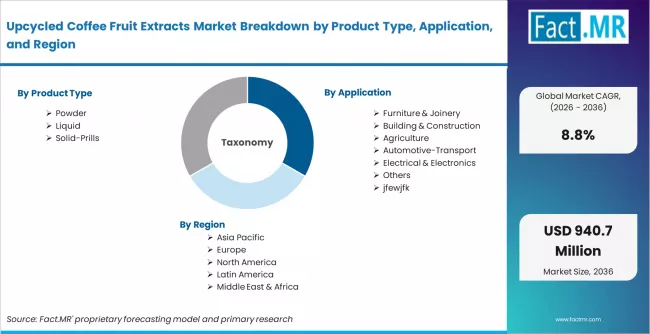
Upcycled Coffee Fruit Extracts Market Breakdown By Product Type, Application, And Region | Source: Fact.MR
| Attribute | Details |
|---|---|
| Quantitative Units | USD 372 million (2026) to USD 865 million (2036), at a CAGR of 8.8% |
| Market Definition | Functional ingredients derived from upcycled coffee cherry fruit including liquid extracts, concentrates, powders, and oils, supplied with antioxidant activity documentation and upcycled certification for food, beverage, nutraceutical, and cosmetics applications globally. |
| Product Type Segmentation | Coffee Fruit Extracts, Coffee Fruit Concentrates, Coffee Fruit Powders, Coffee Fruit Oils |
| Application Segmentation | Food & Beverages, Nutraceuticals, Cosmetics & Personal Care, Animal Feed |
| Distribution Channel Segmentation | Supermarkets/Hypermarkets, Online Retail, Specialty Stores, Others |
| Application Coverage | Functional beverage antioxidant ingredient sourcing, nutraceutical supplement antioxidant and prebiotic active supply, clean-label food reformulation, natural caffeine-alternative energy drink formulation, and cosmetics natural polyphenol active ingredient procurement. |
| Regions Covered | North America, Europe, Asia Pacific, Latin America, Middle East and Africa |
| Countries Covered | USA, Canada, Mexico, Germany, UK, France, Italy, Spain, Nordic, BENELUX, China, Japan, South Korea, India, Vietnam, ASEAN, Australia and New Zealand, Brazil, Colombia, Argentina, Saudi Arabia, GCC, Turkey, South Africa, Ethiopia, Rest of MEA |
| Key Companies Profiled | Nestlé S.A., Starbucks Corporation, Kirin Holdings Co. Ltd., Olam Food Ingredients, KonaRed Corporation, Good Land Organics, Coffee Cherry Co. |
| Forecast Period | 2026 to 2036 |
| Approach | Hybrid top-down and bottom-up model using coffee cherry processing volume data, extract producer revenues, ingredient volume estimates by product type and application, average selling prices by format and certification grade, and primary interviews with functional food ingredient buyers and nutraceutical formulators. |
Source: Fact.MR analysis. Updated Apr 24, 2026
Upcycled Coffee Fruit Extracts Market by Segments
-
By Product Type:
- Coffee Fruit Extracts
- Coffee Fruit Concentrates
- Coffee Fruit Powders
- Coffee Fruit Oils
-
By Application:
- Food & Beverages
- Nutraceuticals
- Cosmetics & Personal Care
- Animal Feed
-
By Distribution Channel:
- Supermarkets/Hypermarkets
- Online Retail
- Specialty Stores
- Others
-
By Region:
- North America
- United States
- Canada
- Mexico
- Latin America
- Brazil
- Colombia
- Honduras
- Argentina
- Rest of Latin America
- Western Europe
- Germany
- United Kingdom
- France
- Italy
- Spain
- Nordic Countries
- BENELUX
- Rest of Western Europe
- Eastern Europe
- Russia
- Poland
- Rest of Eastern Europe
- East Asia
- China
- Japan
- South Korea
- South Asia and Pacific
- India
- Vietnam
- ASEAN
- Australia and New Zealand
- Rest of South Asia and Pacific
- Middle East and Africa
- Kingdom of Saudi Arabia
- Other GCC Countries
- Turkey
- South Africa
- Ethiopia
- Rest of Middle East and Africa
- North America
Frequently Asked Questions
How large is the global upcycled coffee fruit extracts market in 2025?
What will the market size be in 2026?
What is the projected market size by 2036?
What is the expected CAGR from 2026 to 2036?
Which product type segment is poised to lead the market?
Which application segment holds the largest share?
Which country shows the fastest growth in the market?
What are upcycled coffee fruit extracts used for?
What drives demand in this market?
Who are the key players in the market?
Who worked on this report


Preview the report firsthand - request a free sample
Free SampleGet the brochure for pricing and purchase details
Download PDF