Urban Organics-to-Field Nutrient Recovery Fertilizer Market
Urban Organics-to-Field Nutrient Recovery Fertilizer Market Size and Share Forecast Outlook 2026 to 2036
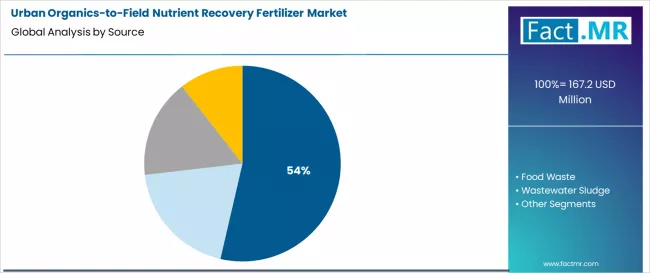
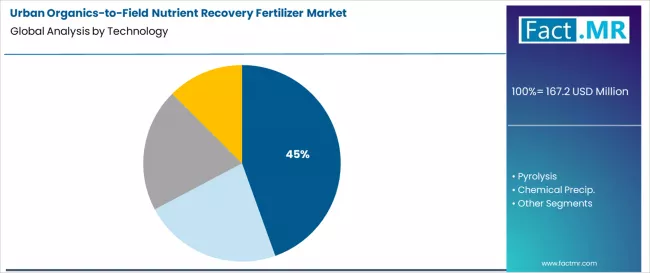
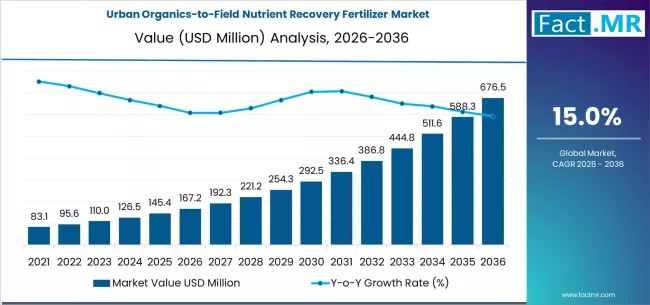
Urban organics-to-field nutrient recovery fertilizer market is projected to grow from USD 167.2 million in 2026 to USD 676.5 million by 2036, at a CAGR of 15.0%. Animal Manure will dominate with a 53.6% market share, while anaerobic digestion will lead the technology segment with a 44.5% share.
Urban Organics-to-Field Nutrient Recovery Fertilizer Market Forecast and Outlook 2026 to 2036
The global market for urban organics-to-field nutrient recovery fertilizer is positioned for exceptional growth, projected to surge from USD 167.23 million in 2026 to USD 676.54 million by 2036, advancing at a CAGR of 15.0%.
This market represents the practical implementation of the urban circular economy, transforming municipal organic waste streams into standardized, high-quality fertilizers for surrounding agricultural regions. The expansion is driven by the critical need to address dual pressures of rising cost and environmental burden of urban waste disposal, and the unsustainable linear consumption of finite mineral nutrients in farming.
Key Takeaways from the Urban Organics-to-Field Nutrient Recovery Fertilizer Market
- Market Value for 2026: USD 167.23 Million
- Market Value for 2036: USD 676.54 Million
- Forecast CAGR (2026-2036): 15.0%
- Leading Source Segment (2026): Animal Manure (54%)
- Leading Technology Segment (2026): Anaerobic Digestion (45%)
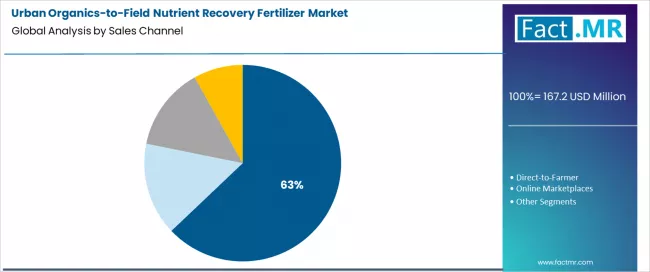
- Leading Sales Channel Segment (2026): Ag-Retailers (63%)
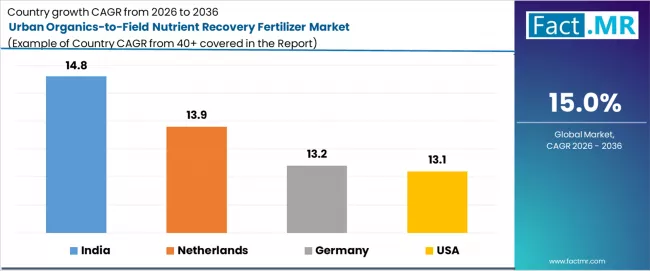
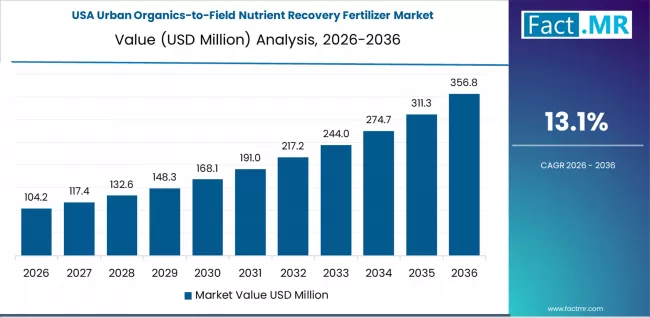
- Key Growth Countries: India (14.8% CAGR), Netherlands (13.9% CAGR), Germany (13.2% CAGR), USA (13.1% CAGR)
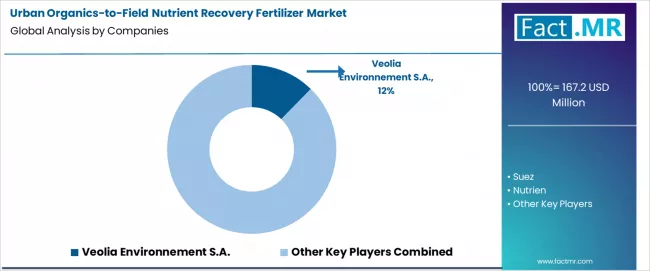
- Key Players in the Market: Veolia Environnement S.A., Suez, Nutrien, Yara International ASA, EuroChem Group A.G., OCP

This sector moves beyond traditional composting to employ advanced chemical and thermal recovery technologies that extract and refine nitrogen, phosphorus, and potassium from heterogeneous urban feedstocks. The resulting products close the nutrient loop between cities and farms, reducing landfill dependency, cutting greenhouse gas emissions from waste, and providing farmers with a locally-sourced, sustainable alternative to synthetic fertilizers. This model is gaining traction as municipalities seek cost-effective waste solutions and as agricultural regions grapple with nutrient runoff pollution and supply chain vulnerabilities.
The market's evolution focuses on technological innovation to improve recovery efficiency, product purity, and economic viability. Success hinges on creating robust partnerships between waste management authorities, technology providers, and the agricultural community to establish reliable supply chains and ensure market acceptance for these novel, but fundamentally vital, recycled nutrient products.
Metric
| Metric | Value |
|---|---|
| Market Value (2026) | USD 167.23 Million |
| Market Forecast Value (2036) | USD 676.54 Million |
| Forecast CAGR (2026-2036) | 15.0% |
Category
| Category | Segments |
|---|---|
| Source | Animal Manure, Food Waste, Wastewater Sludge, Crop Residue |
| Technology | Anaerobic Digestion, Pyrolysis, Chemical Precipitation, Composting |
| Sales Channel | Ag-Retailers, Direct-to-Farmer, Online Marketplaces, Cooperatives |
| Region | North America, Latin America, Western Europe, Eastern Europe, East Asia, South Asia & Pacific, Middle East & Africa |
Segmental Analysis
By Source, Which Urban Stream is Most Significant?

Animal manure, primarily from urban periphery livestock operations and large stables, leads with a 54% share. Its dominance is due to high nutrient concentration and relative consistency compared to mixed municipal food waste.
Managing this manure within growing urban boundaries is a major logistical and environmental challenge, making nutrient recovery and conversion into a transportable fertilizer a strategically attractive solution for municipal planners and farmers alike.
By Technology, Which Process Balances Output and Energy?

Anaerobic digestion holds a 45% share as the leading technology. It is favored for its ability to handle mixed wet waste streams while producing biogas as a valuable co-product that improves the facility's overall economics.
The resulting digestate provides a stabilized foundation for further nutrient refinement into various fertilizer forms, making AD a central, versatile platform in the urban nutrient recovery ecosystem.
By Sales Channel, How are Recovered Nutrients Integrated into Farming?

Ag-retailers are the dominant channel, capturing 63% of sales. Their central role underscores the importance of integrating recovered nutrients into existing agricultural input supply chains. Farmers trust retailers for quality assurance and agronomic advice.
For recovered nutrient products to achieve scale, they must be validated and distributed through these established networks, which provide the necessary logistical reach and technical support to end-users.
What are the Drivers, Restraints, and Key Trends of the Urban Organics-to-Field Nutrient Recovery Fertilizer Market?
The primary driver is stringent municipal legislation mandating organic waste diversion from landfills and incinerators. Coupled with rising tipping fees, this creates a powerful economic incentive to valorize waste. Heightened awareness of phosphorus scarcity and the carbon intensity of synthetic nitrogen production pushes agri-food companies and governments to seek circular nutrient sources. Consumer demand for sustainably produced food further amplifies this pull.
A key restraint is the significant upfront capital required for advanced recovery facilities. Public acceptance and regulatory frameworks for products derived from waste streams, particularly wastewater, can also be slow to develop, requiring rigorous safety certification. The variable composition of urban organic waste presents a continuous challenge for producing fertilizers with consistent nutrient content and guaranteed absence of contaminants.
Key trends include the co-location of recovery facilities with wastewater treatment plants or energy-from-waste sites to create synergistic industrial ecosystems. There is a strong push for product innovation, creating tailored fertilizers like struvite pellets or ammonium sulfate solutions that meet specific crop and soil needs. The use of digital platforms to connect urban waste sources with agricultural demand points is emerging to optimize logistics and build transparent, trusted supply chains.
Analysis of the Urban Organics-to-Field Nutrient Recovery Fertilizer Market by Key Countries

| Country | CAGR (2026-2036) |
|---|---|
| India | 14.8% |
| Netherlands | 13.9% |
| Germany | 13.2% |
| USA | 13.1% |
How is India's Urbanization and Policy Agenda Catalyzing Growth?
A rapidly urbanizing population drives India’s leading CAGR of 14.8% and ambitious national missions like the Swachh Bharat Abhiyan and sustainable agriculture programs. The sheer volume of urban organic waste generated presents both a crisis and an opportunity.
Government policies are increasingly funding and promoting decentralized and centralized resource recovery plants, creating a fertile ground for technologies that convert urban waste into fertilizers for the surrounding agricultural belt.
Why are the Netherlands a European Frontrunner?
The Netherlands' 13.9% growth stems from its world-leading circular economy ambitions and extreme nutrient management constraints. Dutch cities have advanced waste separation systems, providing high-quality feedstock.
The country’s intensive agriculture, operating under strict nitrogen quotas, actively seeks alternative, compliant nutrient sources. This creates a perfect environment where urban waste is processed to meet the precise needs of nearby farms, a model being refined and scaled nationally.
What is Germany's Role in Technological Precision and Regulation?
Germany’s 13.2% CAGR reflects its engineering rigor and strict waste hierarchy laws. German technology providers are at the forefront of advanced pyrolysis and chemical precipitation techniques for nutrient extraction.
A strong regulatory framework ensures recovered products meet stringent quality standards for pollutants, which in turn builds farmer confidence. The market is characterized by high-tech solutions that produce premium, specification-grade fertilizers from urban residues.
How is the USA's Diverse Regulatory Landscape Shaping the Market?

The USA’s 13.1% growth is uneven but accelerating. Adoption is strongest in states with landfill diversion mandates, high disposal costs, and agricultural regions concerned with water quality.
Municipalities and water utilities are often the project drivers, partnering with private technology firms. The development of consistent, national standards for recovered nutrient products is seen as a key next step to unlock broader market potential across state lines.
Competitive Landscape of the Urban Organics-to-Field Nutrient Recovery Fertilizer Market

The competitive environment features a blend of global environmental service corporations, established fertilizer giants, and specialized technology start-ups. Competition centers on proprietary recovery process efficiency, the ability to secure long-term waste supply agreements with municipalities, and success in cultivating offtake partnerships with agricultural distributors or large farming enterprises. Demonstrating a compelling economic model for municipalities and proving consistent product performance in field trials are critical barriers to entry and scales of success.
Key Players in the Urban Organics-to-Field Nutrient Recovery Fertilizer Market
- Veolia Environnement S.A.
- Suez
- Nutrien
- Yara International ASA
- EuroChem Group A.G.
- OCP
Scope of Report
| Items | Values |
|---|---|
| Quantitative Units | USD Million |
| Source | Animal Manure, Food Waste, Wastewater Sludge, Crop Residue |
| Technology | Anaerobic Digestion, Pyrolysis, Chemical Precipitation, Composting |
| Sales Channel | Ag-Retailers, Direct-to-Farmer, Online Marketplaces, Cooperatives |
| Key Countries | Netherlands, Germany, India, USA |
| Key Companies | Veolia Environnement S.A., Suez, Nutrien, Yara International ASA, EuroChem Group A.G., OCP |
| Additional Analysis | Lifecycle assessment comparing recovered vs. synthetic fertilizer footprints; analysis of contaminant (PFAS, pharmaceuticals) removal efficacy; economic models for public-private partnership facilities; review of policy instruments driving circular nutrients; market acceptance studies with farmers; technology benchmarking for nutrient recovery from mixed waste streams. |
Market by Segments
-
Source :
- Animal Manure
- Food Waste
- Wastewater Sludge
- Crop Residue
-
Technology :
- Anaerobic Digestion
- Pyrolysis
- Chemical Precipitation
- Composting
-
Sales Channel :
- Ag-Retailers
- Direct-to-Farmer
- Online Marketplaces
- Cooperatives
-
Region :
- North America
- USA
- Canada
- Latin America
- Brazil
- Mexico
- Argentina
- Rest of Latin America
- Western Europe
- Germany
- UK
- France
- Spain
- Italy
- Netherlands
- BENELUX
- Rest of Western Europe
- Eastern Europe
- Russia
- Poland
- Czech Republic
- Rest of Eastern Europe
- East Asia
- China
- Japan
- South Korea
- Rest of East Asia
- South Asia & Pacific
- India
- ASEAN
- Australia
- Rest of South Asia & Pacific
- MEA
- Saudi Arabia
- UAE
- Turkiye
- Rest of MEA
- North America
Table of Content
- Executive Summary
- Global Market Outlook
- Demand to side Trends
- Supply to side Trends
- Technology Roadmap Analysis
- Analysis and Recommendations
- Market Overview
- Market Coverage / Taxonomy
- Market Definition / Scope / Limitations
- Market Background
- Market Dynamics
- Drivers
- Restraints
- Opportunity
- Trends
- Scenario Forecast
- Demand in Optimistic Scenario
- Demand in Likely Scenario
- Demand in Conservative Scenario
- Opportunity Map Analysis
- Product Life Cycle Analysis
- Supply Chain Analysis
- Investment Feasibility Matrix
- Value Chain Analysis
- PESTLE and Porter’s Analysis
- Regulatory Landscape
- Regional Parent Market Outlook
- Production and Consumption Statistics
- Import and Export Statistics
- Market Dynamics
- Global Market Analysis 2021 to 2025 and Forecast, 2026 to 2036
- Historical Market Size Value (USD Million) Analysis, 2021 to 2025
- Current and Future Market Size Value (USD Million) Projections, 2026 to 2036
- Y to o to Y Growth Trend Analysis
- Absolute $ Opportunity Analysis
- Global Market Pricing Analysis 2021 to 2025 and Forecast 2026 to 2036
- Global Market Analysis 2021 to 2025 and Forecast 2026 to 2036, By Source
- Introduction / Key Findings
- Historical Market Size Value (USD Million) Analysis By Source, 2021 to 2025
- Current and Future Market Size Value (USD Million) Analysis and Forecast By Source, 2026 to 2036
- Animal Manure
- Food Waste
- Wastewater Sludge
- Crop Residue
- Animal Manure
- Y to o to Y Growth Trend Analysis By Source, 2021 to 2025
- Absolute $ Opportunity Analysis By Source, 2026 to 2036
- Global Market Analysis 2021 to 2025 and Forecast 2026 to 2036, By Technology
- Introduction / Key Findings
- Historical Market Size Value (USD Million) Analysis By Technology, 2021 to 2025
- Current and Future Market Size Value (USD Million) Analysis and Forecast By Technology, 2026 to 2036
- Anaerobic Digestion
- Pyrolysis
- Chemical Precip.
- Composting
- Anaerobic Digestion
- Y to o to Y Growth Trend Analysis By Technology, 2021 to 2025
- Absolute $ Opportunity Analysis By Technology, 2026 to 2036
- Global Market Analysis 2021 to 2025 and Forecast 2026 to 2036, By Sales Channel
- Introduction / Key Findings
- Historical Market Size Value (USD Million) Analysis By Sales Channel, 2021 to 2025
- Current and Future Market Size Value (USD Million) Analysis and Forecast By Sales Channel, 2026 to 2036
- Ag-Retailers
- Direct-to-Farmer
- Online Marketplaces
- Cooperatives
- Ag-Retailers
- Y to o to Y Growth Trend Analysis By Sales Channel, 2021 to 2025
- Absolute $ Opportunity Analysis By Sales Channel, 2026 to 2036
- Global Market Analysis 2021 to 2025 and Forecast 2026 to 2036, By Region
- Introduction
- Historical Market Size Value (USD Million) Analysis By Region, 2021 to 2025
- Current Market Size Value (USD Million) Analysis and Forecast By Region, 2026 to 2036
- North America
- Latin America
- Western Europe
- Eastern Europe
- East Asia
- South Asia and Pacific
- Middle East & Africa
- Market Attractiveness Analysis By Region
- North America Market Analysis 2021 to 2025 and Forecast 2026 to 2036, By Country
- Historical Market Size Value (USD Million) Trend Analysis By Market Taxonomy, 2021 to 2025
- Market Size Value (USD Million) Forecast By Market Taxonomy, 2026 to 2036
- By Country
- USA
- Canada
- Mexico
- By Source
- By Technology
- By Sales Channel
- By Country
- Market Attractiveness Analysis
- By Country
- By Source
- By Technology
- By Sales Channel
- Key Takeaways
- Latin America Market Analysis 2021 to 2025 and Forecast 2026 to 2036, By Country
- Historical Market Size Value (USD Million) Trend Analysis By Market Taxonomy, 2021 to 2025
- Market Size Value (USD Million) Forecast By Market Taxonomy, 2026 to 2036
- By Country
- Brazil
- Chile
- Rest of Latin America
- By Source
- By Technology
- By Sales Channel
- By Country
- Market Attractiveness Analysis
- By Country
- By Source
- By Technology
- By Sales Channel
- Key Takeaways
- Western Europe Market Analysis 2021 to 2025 and Forecast 2026 to 2036, By Country
- Historical Market Size Value (USD Million) Trend Analysis By Market Taxonomy, 2021 to 2025
- Market Size Value (USD Million) Forecast By Market Taxonomy, 2026 to 2036
- By Country
- Germany
- UK
- Italy
- Spain
- France
- Nordic
- BENELUX
- Rest of Western Europe
- By Source
- By Technology
- By Sales Channel
- By Country
- Market Attractiveness Analysis
- By Country
- By Source
- By Technology
- By Sales Channel
- Key Takeaways
- Eastern Europe Market Analysis 2021 to 2025 and Forecast 2026 to 2036, By Country
- Historical Market Size Value (USD Million) Trend Analysis By Market Taxonomy, 2021 to 2025
- Market Size Value (USD Million) Forecast By Market Taxonomy, 2026 to 2036
- By Country
- Russia
- Poland
- Hungary
- Balkan & Baltic
- Rest of Eastern Europe
- By Source
- By Technology
- By Sales Channel
- By Country
- Market Attractiveness Analysis
- By Country
- By Source
- By Technology
- By Sales Channel
- Key Takeaways
- East Asia Market Analysis 2021 to 2025 and Forecast 2026 to 2036, By Country
- Historical Market Size Value (USD Million) Trend Analysis By Market Taxonomy, 2021 to 2025
- Market Size Value (USD Million) Forecast By Market Taxonomy, 2026 to 2036
- By Country
- China
- Japan
- South Korea
- By Source
- By Technology
- By Sales Channel
- By Country
- Market Attractiveness Analysis
- By Country
- By Source
- By Technology
- By Sales Channel
- Key Takeaways
- South Asia and Pacific Market Analysis 2021 to 2025 and Forecast 2026 to 2036, By Country
- Historical Market Size Value (USD Million) Trend Analysis By Market Taxonomy, 2021 to 2025
- Market Size Value (USD Million) Forecast By Market Taxonomy, 2026 to 2036
- By Country
- India
- ASEAN
- Australia & New Zealand
- Rest of South Asia and Pacific
- By Source
- By Technology
- By Sales Channel
- By Country
- Market Attractiveness Analysis
- By Country
- By Source
- By Technology
- By Sales Channel
- Key Takeaways
- Middle East & Africa Market Analysis 2021 to 2025 and Forecast 2026 to 2036, By Country
- Historical Market Size Value (USD Million) Trend Analysis By Market Taxonomy, 2021 to 2025
- Market Size Value (USD Million) Forecast By Market Taxonomy, 2026 to 2036
- By Country
- Kingdom of Saudi Arabia
- Other GCC Countries
- Turkiye
- South Africa
- Other African Union
- Rest of Middle East & Africa
- By Source
- By Technology
- By Sales Channel
- By Country
- Market Attractiveness Analysis
- By Country
- By Source
- By Technology
- By Sales Channel
- Key Takeaways
- Key Countries Market Analysis
- USA
- Pricing Analysis
- Market Share Analysis, 2025
- By Source
- By Technology
- By Sales Channel
- Canada
- Pricing Analysis
- Market Share Analysis, 2025
- By Source
- By Technology
- By Sales Channel
- Mexico
- Pricing Analysis
- Market Share Analysis, 2025
- By Source
- By Technology
- By Sales Channel
- Brazil
- Pricing Analysis
- Market Share Analysis, 2025
- By Source
- By Technology
- By Sales Channel
- Chile
- Pricing Analysis
- Market Share Analysis, 2025
- By Source
- By Technology
- By Sales Channel
- Germany
- Pricing Analysis
- Market Share Analysis, 2025
- By Source
- By Technology
- By Sales Channel
- UK
- Pricing Analysis
- Market Share Analysis, 2025
- By Source
- By Technology
- By Sales Channel
- Italy
- Pricing Analysis
- Market Share Analysis, 2025
- By Source
- By Technology
- By Sales Channel
- Spain
- Pricing Analysis
- Market Share Analysis, 2025
- By Source
- By Technology
- By Sales Channel
- France
- Pricing Analysis
- Market Share Analysis, 2025
- By Source
- By Technology
- By Sales Channel
- India
- Pricing Analysis
- Market Share Analysis, 2025
- By Source
- By Technology
- By Sales Channel
- ASEAN
- Pricing Analysis
- Market Share Analysis, 2025
- By Source
- By Technology
- By Sales Channel
- Australia & New Zealand
- Pricing Analysis
- Market Share Analysis, 2025
- By Source
- By Technology
- By Sales Channel
- China
- Pricing Analysis
- Market Share Analysis, 2025
- By Source
- By Technology
- By Sales Channel
- Japan
- Pricing Analysis
- Market Share Analysis, 2025
- By Source
- By Technology
- By Sales Channel
- South Korea
- Pricing Analysis
- Market Share Analysis, 2025
- By Source
- By Technology
- By Sales Channel
- Russia
- Pricing Analysis
- Market Share Analysis, 2025
- By Source
- By Technology
- By Sales Channel
- Poland
- Pricing Analysis
- Market Share Analysis, 2025
- By Source
- By Technology
- By Sales Channel
- Hungary
- Pricing Analysis
- Market Share Analysis, 2025
- By Source
- By Technology
- By Sales Channel
- Kingdom of Saudi Arabia
- Pricing Analysis
- Market Share Analysis, 2025
- By Source
- By Technology
- By Sales Channel
- Turkiye
- Pricing Analysis
- Market Share Analysis, 2025
- By Source
- By Technology
- By Sales Channel
- South Africa
- Pricing Analysis
- Market Share Analysis, 2025
- By Source
- By Technology
- By Sales Channel
- USA
- Market Structure Analysis
- Competition Dashboard
- Competition Benchmarking
- Market Share Analysis of Top Players
- By Regional
- By Source
- By Technology
- By Sales Channel
- Competition Analysis
- Competition Deep Dive
- Veolia Environnement S.A.
- Overview
- Product Portfolio
- Profitability by Market Segments (Product/Age /Sales Channel/Region)
- Sales Footprint
- Strategy Overview
- Marketing Strategy
- Product Strategy
- Channel Strategy
- Suez
- Nutrien
- Yara International ASA
- EuroChem Group A.G.
- OCP
- Veolia Environnement S.A.
- Competition Deep Dive
- Assumptions & Acronyms Used
- Research Methodology
List Of Table
- Table 1: Global Market Value (USD Million) Forecast by Region, 2021 to 2036
- Table 2: Global Market Value (USD Million) Forecast by Source , 2021 to 2036
- Table 3: Global Market Value (USD Million) Forecast by Technology, 2021 to 2036
- Table 4: Global Market Value (USD Million) Forecast by Sales Channel, 2021 to 2036
- Table 5: North America Market Value (USD Million) Forecast by Country, 2021 to 2036
- Table 6: North America Market Value (USD Million) Forecast by Source , 2021 to 2036
- Table 7: North America Market Value (USD Million) Forecast by Technology, 2021 to 2036
- Table 8: North America Market Value (USD Million) Forecast by Sales Channel, 2021 to 2036
- Table 9: Latin America Market Value (USD Million) Forecast by Country, 2021 to 2036
- Table 10: Latin America Market Value (USD Million) Forecast by Source , 2021 to 2036
- Table 11: Latin America Market Value (USD Million) Forecast by Technology, 2021 to 2036
- Table 12: Latin America Market Value (USD Million) Forecast by Sales Channel, 2021 to 2036
- Table 13: Western Europe Market Value (USD Million) Forecast by Country, 2021 to 2036
- Table 14: Western Europe Market Value (USD Million) Forecast by Source , 2021 to 2036
- Table 15: Western Europe Market Value (USD Million) Forecast by Technology, 2021 to 2036
- Table 16: Western Europe Market Value (USD Million) Forecast by Sales Channel, 2021 to 2036
- Table 17: Eastern Europe Market Value (USD Million) Forecast by Country, 2021 to 2036
- Table 18: Eastern Europe Market Value (USD Million) Forecast by Source , 2021 to 2036
- Table 19: Eastern Europe Market Value (USD Million) Forecast by Technology, 2021 to 2036
- Table 20: Eastern Europe Market Value (USD Million) Forecast by Sales Channel, 2021 to 2036
- Table 21: East Asia Market Value (USD Million) Forecast by Country, 2021 to 2036
- Table 22: East Asia Market Value (USD Million) Forecast by Source , 2021 to 2036
- Table 23: East Asia Market Value (USD Million) Forecast by Technology, 2021 to 2036
- Table 24: East Asia Market Value (USD Million) Forecast by Sales Channel, 2021 to 2036
- Table 25: South Asia and Pacific Market Value (USD Million) Forecast by Country, 2021 to 2036
- Table 26: South Asia and Pacific Market Value (USD Million) Forecast by Source , 2021 to 2036
- Table 27: South Asia and Pacific Market Value (USD Million) Forecast by Technology, 2021 to 2036
- Table 28: South Asia and Pacific Market Value (USD Million) Forecast by Sales Channel, 2021 to 2036
- Table 29: Middle East & Africa Market Value (USD Million) Forecast by Country, 2021 to 2036
- Table 30: Middle East & Africa Market Value (USD Million) Forecast by Source , 2021 to 2036
- Table 31: Middle East & Africa Market Value (USD Million) Forecast by Technology, 2021 to 2036
- Table 32: Middle East & Africa Market Value (USD Million) Forecast by Sales Channel, 2021 to 2036
List Of Figures
- Figure 1: Global Market Pricing Analysis
- Figure 2: Global Market Value (USD Million) Forecast 2021 to 2036
- Figure 3: Global Market Value Share and BPS Analysis by Source, 2026 and 2036
- Figure 4: Global Market Y to o to Y Growth Comparison by Source, 2026 to 2036
- Figure 5: Global Market Attractiveness Analysis by Source
- Figure 6: Global Market Value Share and BPS Analysis by Technology, 2026 and 2036
- Figure 7: Global Market Y to o to Y Growth Comparison by Technology, 2026 to 2036
- Figure 8: Global Market Attractiveness Analysis by Technology
- Figure 9: Global Market Value Share and BPS Analysis by Sales Channel, 2026 and 2036
- Figure 10: Global Market Y to o to Y Growth Comparison by Sales Channel, 2026 to 2036
- Figure 11: Global Market Attractiveness Analysis by Sales Channel
- Figure 12: Global Market Value (USD Million) Share and BPS Analysis by Region, 2026 and 2036
- Figure 13: Global Market Y to o to Y Growth Comparison by Region, 2026 to 2036
- Figure 14: Global Market Attractiveness Analysis by Region
- Figure 15: North America Market Incremental Dollar Opportunity, 2026 to 2036
- Figure 16: Latin America Market Incremental Dollar Opportunity, 2026 to 2036
- Figure 17: Western Europe Market Incremental Dollar Opportunity, 2026 to 2036
- Figure 18: Eastern Europe Market Incremental Dollar Opportunity, 2026 to 2036
- Figure 19: East Asia Market Incremental Dollar Opportunity, 2026 to 2036
- Figure 20: South Asia and Pacific Market Incremental Dollar Opportunity, 2026 to 2036
- Figure 21: Middle East & Africa Market Incremental Dollar Opportunity, 2026 to 2036
- Figure 22: North America Market Value Share and BPS Analysis by Country, 2026 and 2036
- Figure 23: North America Market Value Share and BPS Analysis by Source, 2026 and 2036
- Figure 24: North America Market Y to o to Y Growth Comparison by Source, 2026 to 2036
- Figure 25: North America Market Attractiveness Analysis by Source
- Figure 26: North America Market Value Share and BPS Analysis by Technology, 2026 and 2036
- Figure 27: North America Market Y to o to Y Growth Comparison by Technology, 2026 to 2036
- Figure 28: North America Market Attractiveness Analysis by Technology
- Figure 29: North America Market Value Share and BPS Analysis by Sales Channel, 2026 and 2036
- Figure 30: North America Market Y to o to Y Growth Comparison by Sales Channel, 2026 to 2036
- Figure 31: North America Market Attractiveness Analysis by Sales Channel
- Figure 32: Latin America Market Value Share and BPS Analysis by Country, 2026 and 2036
- Figure 33: Latin America Market Value Share and BPS Analysis by Source, 2026 and 2036
- Figure 34: Latin America Market Y to o to Y Growth Comparison by Source, 2026 to 2036
- Figure 35: Latin America Market Attractiveness Analysis by Source
- Figure 36: Latin America Market Value Share and BPS Analysis by Technology, 2026 and 2036
- Figure 37: Latin America Market Y to o to Y Growth Comparison by Technology, 2026 to 2036
- Figure 38: Latin America Market Attractiveness Analysis by Technology
- Figure 39: Latin America Market Value Share and BPS Analysis by Sales Channel, 2026 and 2036
- Figure 40: Latin America Market Y to o to Y Growth Comparison by Sales Channel, 2026 to 2036
- Figure 41: Latin America Market Attractiveness Analysis by Sales Channel
- Figure 42: Western Europe Market Value Share and BPS Analysis by Country, 2026 and 2036
- Figure 43: Western Europe Market Value Share and BPS Analysis by Source, 2026 and 2036
- Figure 44: Western Europe Market Y to o to Y Growth Comparison by Source, 2026 to 2036
- Figure 45: Western Europe Market Attractiveness Analysis by Source
- Figure 46: Western Europe Market Value Share and BPS Analysis by Technology, 2026 and 2036
- Figure 47: Western Europe Market Y to o to Y Growth Comparison by Technology, 2026 to 2036
- Figure 48: Western Europe Market Attractiveness Analysis by Technology
- Figure 49: Western Europe Market Value Share and BPS Analysis by Sales Channel, 2026 and 2036
- Figure 50: Western Europe Market Y to o to Y Growth Comparison by Sales Channel, 2026 to 2036
- Figure 51: Western Europe Market Attractiveness Analysis by Sales Channel
- Figure 52: Eastern Europe Market Value Share and BPS Analysis by Country, 2026 and 2036
- Figure 53: Eastern Europe Market Value Share and BPS Analysis by Source, 2026 and 2036
- Figure 54: Eastern Europe Market Y to o to Y Growth Comparison by Source, 2026 to 2036
- Figure 55: Eastern Europe Market Attractiveness Analysis by Source
- Figure 56: Eastern Europe Market Value Share and BPS Analysis by Technology, 2026 and 2036
- Figure 57: Eastern Europe Market Y to o to Y Growth Comparison by Technology, 2026 to 2036
- Figure 58: Eastern Europe Market Attractiveness Analysis by Technology
- Figure 59: Eastern Europe Market Value Share and BPS Analysis by Sales Channel, 2026 and 2036
- Figure 60: Eastern Europe Market Y to o to Y Growth Comparison by Sales Channel, 2026 to 2036
- Figure 61: Eastern Europe Market Attractiveness Analysis by Sales Channel
- Figure 62: East Asia Market Value Share and BPS Analysis by Country, 2026 and 2036
- Figure 63: East Asia Market Value Share and BPS Analysis by Source, 2026 and 2036
- Figure 64: East Asia Market Y to o to Y Growth Comparison by Source, 2026 to 2036
- Figure 65: East Asia Market Attractiveness Analysis by Source
- Figure 66: East Asia Market Value Share and BPS Analysis by Technology, 2026 and 2036
- Figure 67: East Asia Market Y to o to Y Growth Comparison by Technology, 2026 to 2036
- Figure 68: East Asia Market Attractiveness Analysis by Technology
- Figure 69: East Asia Market Value Share and BPS Analysis by Sales Channel, 2026 and 2036
- Figure 70: East Asia Market Y to o to Y Growth Comparison by Sales Channel, 2026 to 2036
- Figure 71: East Asia Market Attractiveness Analysis by Sales Channel
- Figure 72: South Asia and Pacific Market Value Share and BPS Analysis by Country, 2026 and 2036
- Figure 73: South Asia and Pacific Market Value Share and BPS Analysis by Source, 2026 and 2036
- Figure 74: South Asia and Pacific Market Y to o to Y Growth Comparison by Source, 2026 to 2036
- Figure 75: South Asia and Pacific Market Attractiveness Analysis by Source
- Figure 76: South Asia and Pacific Market Value Share and BPS Analysis by Technology, 2026 and 2036
- Figure 77: South Asia and Pacific Market Y to o to Y Growth Comparison by Technology, 2026 to 2036
- Figure 78: South Asia and Pacific Market Attractiveness Analysis by Technology
- Figure 79: South Asia and Pacific Market Value Share and BPS Analysis by Sales Channel, 2026 and 2036
- Figure 80: South Asia and Pacific Market Y to o to Y Growth Comparison by Sales Channel, 2026 to 2036
- Figure 81: South Asia and Pacific Market Attractiveness Analysis by Sales Channel
- Figure 82: Middle East & Africa Market Value Share and BPS Analysis by Country, 2026 and 2036
- Figure 83: Middle East & Africa Market Value Share and BPS Analysis by Source, 2026 and 2036
- Figure 84: Middle East & Africa Market Y to o to Y Growth Comparison by Source, 2026 to 2036
- Figure 85: Middle East & Africa Market Attractiveness Analysis by Source
- Figure 86: Middle East & Africa Market Value Share and BPS Analysis by Technology, 2026 and 2036
- Figure 87: Middle East & Africa Market Y to o to Y Growth Comparison by Technology, 2026 to 2036
- Figure 88: Middle East & Africa Market Attractiveness Analysis by Technology
- Figure 89: Middle East & Africa Market Value Share and BPS Analysis by Sales Channel, 2026 and 2036
- Figure 90: Middle East & Africa Market Y to o to Y Growth Comparison by Sales Channel, 2026 to 2036
- Figure 91: Middle East & Africa Market Attractiveness Analysis by Sales Channel
- Figure 92: Global Market - Tier Structure Analysis
- Figure 93: Global Market - Company Share Analysis
- FAQs -
How big is the urban organics-to-field nutrient recovery fertilizer market in 2026?
The global urban organics-to-field nutrient recovery fertilizer market is estimated to be valued at USD 167.2 million in 2026.
What will be the size of urban organics-to-field nutrient recovery fertilizer market in 2036?
The market size for the urban organics-to-field nutrient recovery fertilizer market is projected to reach USD 676.5 million by 2036.
How much will be the urban organics-to-field nutrient recovery fertilizer market growth between 2026 and 2036?
The urban organics-to-field nutrient recovery fertilizer market is expected to grow at a 15.0% CAGR between 2026 and 2036.
What are the key product types in the urban organics-to-field nutrient recovery fertilizer market?
The key product types in urban organics-to-field nutrient recovery fertilizer market are animal manure, food waste, wastewater sludge and crop residue.
Which technology segment to contribute significant share in the urban organics-to-field nutrient recovery fertilizer market in 2026?
In terms of technology, anaerobic digestion segment to command 44.5% share in the urban organics-to-field nutrient recovery fertilizer market in 2026.