- Market Value (2025): USD 2.0 Bn
- Estimated Value (2026): USD 2.1 Bn
- Forecast Value (2036): USD 4.2 Bn
- CAGR (2026-2036): 6.9%
What is the Vapor Recompression Systems market forecast to be worth by 2036?
USD 2.1 billion in 2026 to USD 4.2 billion by 2036, at 6.9% CAGR.
- The Vapor Recompression Systems market crossed a valuation of USD 2.0 billion in 2025.
- Demand is projected to increase from USD 2.1 billion in 2026 to USD 4.2 billion by 2036.
- The market is forecast to record 6.9% CAGR from 2026 to 2036 as process engineers and utility managers replace live-steam evaporation with recompressed-vapor designs.
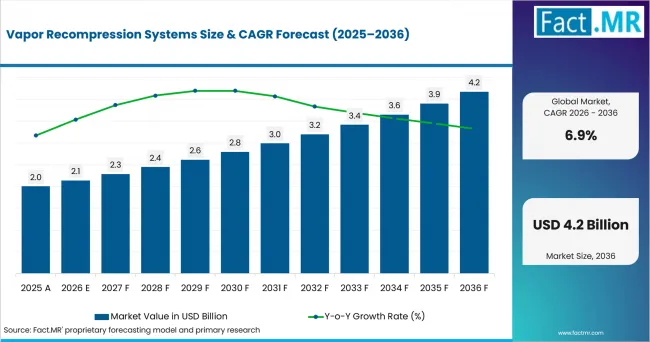
Vapor Recompression Systems Value Analysis | Source: Fact.MR
What are the defining numbers behind Vapor Recompression Systems market growth?
USD 2.0 billion absolute opportunity by 2036, led by mechanical vapor recompression, falling-film evaporators and food and dairy plants.
- Demand Drivers in the Market
- Dairy evaporator operators need lower steam intensity because milk and whey concentration expose every plant to recurring utility cost.
- Chemical process engineers need stable vapor reuse supported by solvent recovery, brine concentration and temperature-sensitive separation duties.
- Wastewater and ZLD teams need volume reduction driven by stricter discharge controls and higher reuse expectations in industrial facilities.
- Pulp and paper mills need durable recompression systems owing to black-liquor concentration and heat-recovery requirements inside continuous mills.
- Key Segments Analyzed
- By Technology: Mechanical vapor recompression is expected to hold 58.0% share in 2026 because it reuses process vapor as the main heat source.
- By Evaporator Integration: Falling-film is projected to account for 34.0% share in 2026 supported by short residence time and lower thermal stress.
- By End-use Industry: Food and dairy is anticipated to capture 25.0% share in 2026 due to recurring concentration needs in milk, whey and beverage processing.
- By Capacity Class: 5-20 t/h is estimated to represent 31.0% share in 2026 owing to fit with mid-sized process lines and retrofit projects.
- Analyst Opinion at Fact.MR
- Shambhu Nath Jha, Principal Consultant at Fact.MR, states, “Vapor recompression is becoming a heat-cost decision for plants that evaporate water every day. The market is expected to reward suppliers that connect compressors, evaporators and controls into one serviceable package. Plant teams value proof of energy savings, fouling control and dependable commissioning over broad efficiency claims.”
- Strategic Implications
- Equipment vendors should document steam savings by feed type so plant operators compare upgrades against existing evaporator baselines.
- Food and dairy processors should match residence time and clean-in-place needs before selecting falling-film or plate configurations.
- Water-technology integrators should link MVR units with crystallizers and filtration where discharge reduction depends on solids recovery.
- Engineering contractors should build service access around compressors and fans since downtime risk shapes retrofit acceptance.
The USA is projected to record 8.7% CAGR through 2036 driven by energy-intensive industry and steam-saving retrofits. Japan is anticipated to post 8.2% CAGR supported by compact factory layouts and process efficiency needs. France is expected to advance at 7.6% CAGR due to water reuse policy and food-industry concentration. Germany is estimated to hold 6.0% CAGR owing to industrial order activity and process-heat cost control. The UK is forecast to reach 5.3% CAGR shaped by food manufacturing scale and water-sector investment.
How does the Vapor Recompression Systems market break down by segment?
Mechanical vapor recompression leads Technology at 58.0%; Falling-film leads Evaporator Integration at 34.0%.
Which Technology dominates?
Mechanical vapor recompression holds 58.0% share in 2026.
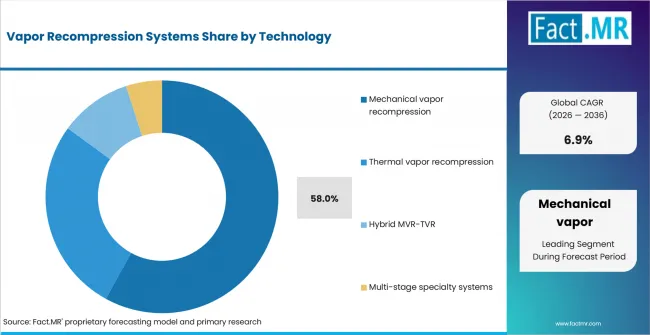
Vapor Recompression Systems Analysis By Technology | Source: Fact.MR
Mechanical vapor recompression is expected to lead because it recycles vapor from the evaporator into useful heat. The design reduces live-steam input where evaporation runs for long hours. Thermal vapor recompression remains useful when motive steam is available at steady pressure. Hybrid MVR-TVR systems serve plants that balance electric compression with steam ejectors during variable operation.
What leads the Evaporator Integration segment?
Falling-film holds 34.0% share in 2026.
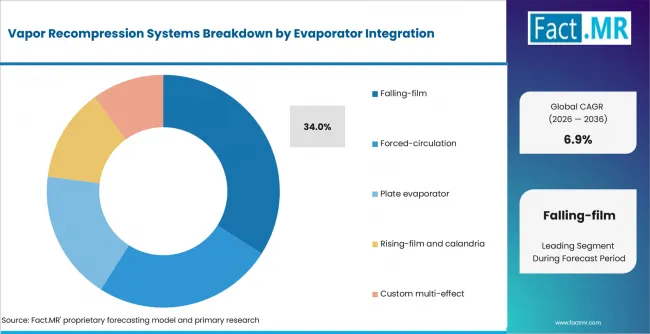
Vapor Recompression Systems Analysis By Evaporator Integration | Source: Fact.MR
Falling-film integration is projected to account for the main share supported by short product residence time and broad use in heat-sensitive liquids. Alfa Laval reported in January 2025 that Chelsea Sugar upgraded older TVR technology to an AlfaVap rising-film evaporator with MVR and achieved a 9% energy reduction. Forced-circulation units suit fouling liquids where scaling risk is higher. Plate evaporators fit compact retrofits where lower installation height improves site acceptance.
How does End-use Industry shape demand?
Food and dairy holds 25.0% share in 2026.
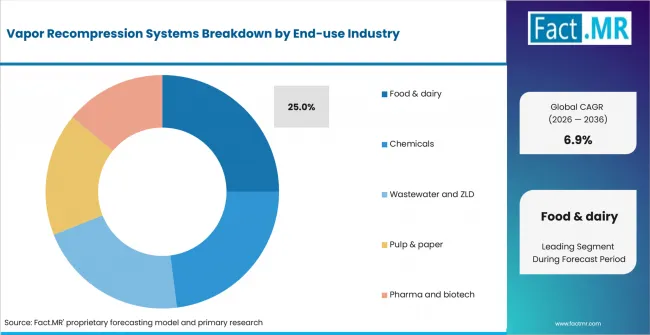
Vapor Recompression Systems Analysis By End Use Industry | Source: Fact.MR
Food and dairy is anticipated to capture the main end-use share due to routine water removal in milk, whey, juices and sweeteners. ITT Flow Technologies launched APV® Infusion UHT featuring SteamRecycle™ in October 2025 for dairy, nutritional beverage and plant-based producers. The closed-loop system recovers and reuses 100% of the steam used in the infusion UHT process, eliminating the need for fresh steam after startup. Chemicals follow through solvent recovery and brine concentration.
What supports the 5-20 t/h Capacity Class?
5-20 t/h holds 18.0% share in 2026.
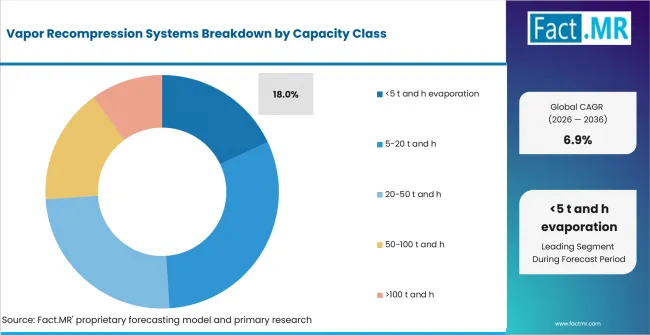
Vapor Recompression Systems Analysis By Capacity Class | Source: Fact.MR
The 5-20 t/h class is estimated to represent the central band owing to fit with mid-sized lines and retrofits. It gives plant operators enough evaporation duty to justify compressor integration while keeping installation risk manageable. Smaller units below 5 t/h suit pilots and specialty batches. Systems above 20 t/h are concentrated in large dairy, chemical and pulp plants where site utilities already support heavier equipment.
What is accelerating Vapor Recompression Systems Market adoption, and what is holding it back?
Steam-cost reduction drives it; retrofit complexity restrains it.
Drivers Impact Analysis
| DRIVER | (~) % IMPACT ON CAGR | GEOGRAPHIC RELEVANCE | IMPACT TIMELINE |
|---|---|---|---|
| Steam and fuel-cost reduction in evaporation | +1.6% | Global | Short term (<= 2 years) |
| Food and dairy concentration duties | +1.2% | North America, Europe | Medium term (2-4 years) |
| Water reuse and ZLD evaporator projects | +1.0% | Europe, North America | Medium term (2-4 years) |
| Electrified process heat planning | +0.8% | Western Europe, Japan | Long term (>= 4 years) |
- Steam and fuel-cost reduction in evaporation: MVR converts process vapor into heating duty and lowers dependence on live steam. High fuel exposure gives plants a measurable case for vapor heat reuse. Suppliers with documented energy baselines are expected to gain approval faster in continuous processing sites.
- Food and dairy concentration duties: Processors evaporate milk, whey and sweetener streams under controlled heat. Vapor recompression reduces live-steam dependence where concentration runs across long operating hours. Hygienic design and clean-in-place access shape equipment choice. Falling-film and plate systems are expected to gain attention where heat sensitivity and cleaning time affect production schedules.
- Water reuse and ZLD evaporator projects: Industrial facilities use evaporators for high-salinity wastewater after filtration and reuse steps. Evaporation helps concentrate final brines and reduce disposal volume. Demand is projected to strengthen where reuse rules and disposal costs push plants toward closed water loops.
- Electrified process heat planning: Electrically driven compression reduces direct fossil-steam use. Equipment selection is shaped by how plant teams compare compressor power against boiler fuel. Adoption is anticipated to be stronger where utility teams track both energy cost and site emissions.
Opportunity Impact Analysis
| OPPORTUNITY | (~) % IMPACT ON CAGR | GEOGRAPHIC RELEVANCE | IMPACT TIMELINE |
|---|---|---|---|
| Retrofit MVR upgrades of steam evaporators | +1.0% | USA, Western Europe | Short term (<= 2 years) |
| Packaged falling-film and plate systems | +0.8% | Japan, Germany | Medium term (2-4 years) |
| Wastewater and brine concentration packages | +0.7% | France, UK, USA | Medium term (2-4 years) |
- Retrofit MVR upgrades of steam evaporators: Existing plants often seek energy savings before adding capacity. Retrofit demand is expected to focus on brownfield sites where operators already know feed behavior. Clear payback evidence supports faster internal approval when utilities and operations teams share the same payback case.
- Packaged falling-film and plate systems: Older factories often have limited height and service space. Packaged evaporator designs reduce engineering time where plant teams need a defined footprint. Falling-film and plate configurations are projected to gain interest in food and specialty chemical plants. Suppliers that offer pilot testing are expected to convert more trials into equipment orders.
- Wastewater and brine concentration packages: ZLD and reuse projects need evaporation after filtration. Systems that combine MVR with crystallization or solids handling give operators fewer interfaces to manage. Wastewater specialists are expected to use vapor recompression where disposal volume is a direct cost. This opportunity remains tied to feed testing and site-level water balances.
Restraints Impact Analysis
| RESTRAINT | (~) % IMPACT ON CAGR | GEOGRAPHIC RELEVANCE | IMPACT TIMELINE |
|---|---|---|---|
| Retrofit installation complexity | -0.5% | Global | Short term (<= 2 years) |
| Feed fouling and scaling risk | -0.4% | Food, chemical, wastewater plants | Medium term (2-4 years) |
| Electricity tariff exposure | -0.3% | Europe, Japan | Medium term (2-4 years) |
- Retrofit installation complexity: MVR projects require compressor selection, vapor ducting and evaporator integration. Brownfield plants must schedule installation around production windows and utility tie-ins. Engineering teams are expected to stage upgrades where steam savings justify design work. Smaller plants often wait until shutdown timing and service access are clear.
- Feed fouling and scaling risk: High-viscosity liquids and salts reduce heat-transfer performance. Plant trials remain central because a compressor upgrade alone leaves scaling unresolved at heat-transfer surfaces. Forced-circulation systems are expected to retain demand where crystals or solids create higher fouling risk. Suppliers need test data that links feed behavior to cleaning intervals.
- Electricity tariff exposure: MVR shifts part of the energy burden to electricity. High electricity exposure is expected to stretch payback when boiler steam is cheap. Hybrid systems are expected to suit sites that balance steam and electric energy sources.
Which countries are scaling Vapor Recompression Systems Market through 2036?
- The USA remains 0.56 percentage point above Japan owing to industrial fuel pressure and steam-cost reduction in continuous plants.
- Japan remains 0.53 percentage point above France as compact production layouts support packaged vapor recompression systems.
- France remains 1.62 percentage points above Germany because water reuse policy supports wastewater evaporation projects.
- Germany remains 0.76 percentage point above the UK through industrial order activity and process-heat cost control.
- The UK closes the displayed range as food manufacturing and water-sector investment sustain retrofit opportunities.
Comparable CAGRs create different entry conditions due to process heat, power cost, wastewater rules and food-processing scale. Full report coverage includes North America, Latin America, Western Europe, Eastern Europe, East Asia, South Asia and Pacific, and Middle East and Africa.
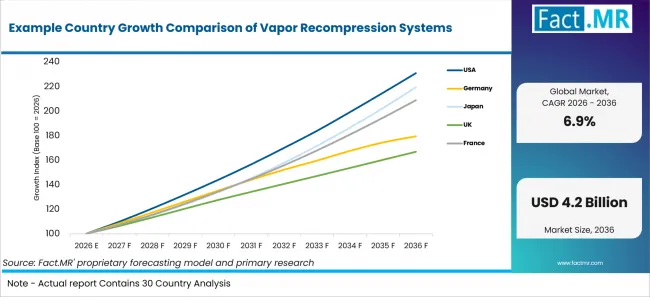
Example Country Growth Comparison Of Vapor Recompression Systems | Source: Fact.MR
| Country | CAGR |
|---|---|
| USA | 8.7% |
| Japan | 8.2% |
| France | 7.6% |
| Germany | 6.0% |
| UK | 5.3% |
What supports USA adoption?
8.7% CAGR through 2036, supported by industrial fuel pressure and steam-cost control.
U.S. plant operators are expected to favor MVR where live steam is a recurring operating expense. EIA reported in May 2026 that industrial natural gas consumption averaged a record 23.6 Bcf/d in 2025. In that operating context, MVR systems can reduce live-steam demand by recompressing process vapor and reusing it as a heating medium.
How is Japan scaling demand?
8.2% CAGR through 2036, supported by compact factories and process efficiency needs.
Japan’s processing plants are expected to use vapor recompression where factory space and utility integration shape equipment choice. The Statistics Bureau of Japan reported in August 2026 that manufacturing sales reached 475.4084 trillion yen in 2024. Packaged MVR evaporators are available in modular, compact configurations for integration into new or existing production lines.
What supports the France outlook?
7.6% CAGR through 2036, led by water reuse policy and agri-food concentration.
French demand is expected to build around wastewater reuse and process concentration. Eaufrance reported in 2026 that nearly 165 urban and industrial treatment stations used part of their treated wastewater in December 2025. Veolia Water Technologies states that evaporation and crystallization can treat membrane brine after pre-concentration in ZLD systems, supporting final concentration after upstream reuse steps.
What underpins Germany's growth?
6.0% CAGR through 2036, driven by industrial order activity and process-heat control.
German plant operators are expected to evaluate vapor recompression through energy cost and reliability. Destatis reported in August 2026 that real new manufacturing orders rose 3.1% in June 2026 from May after seasonal and calendar adjustment. The June increase was supported in part by manufacture of machinery and equipment, where new orders rose 12.7% month on month.
How does the UK perform?
5.3% CAGR through 2036, shaped by food manufacturing and water-sector investment.
UK adoption is expected to come from food manufacturing and wastewater projects. ONS reported in July 2026 that food manufacturing represented 22.9% of total UK manufacturers’ product sales in 2025. ITT Flow Technologies states that Anhydro MVR evaporators serve dairy, food and beverage applications and can operate with minimal or no live steam once operational.
Who leads the Vapor Recompression Systems market?
Key providers with direct public product evidence include GEA, Alfa Laval, ITT Flow Technologies, ANDRITZ and Veolia Water Technologies.
GEA participates through meVap and MVR-based evaporator systems for food, beverage, chemical, pharmaceutical and environmental technology plants. Alfa Laval supports rising-film AlfaVap and AlfaFlash evaporation systems that use MVR in sugar refining and algae-oil production. ITT Flow Technologies participates through APV and Anhydro process technologies, including SteamRecycle for UHT applications and Anhydro MVR evaporators.
ANDRITZ provides evaporation systems across pulp, paper, food and chemical duties, while ANDRITZ Dedert adds MVR, falling-film and forced-circulation evaporation capability. Veolia Water Technologies addresses wastewater evaporation through Evaled systems, including MVR-based Evaled RV units. Competition is expected to center on compressor reliability, feed testing, cleanability, service access and verified steam savings.
Which companies are the key providers?
Key providers include GEA, Alfa Laval, ITT Flow Technologies, ANDRITZ, and Veolia Water Technologies.
- GEA
- Alfa Laval
- ITT Flow Technologies
- ANDRITZ
- Veolia Water Technologies
Bibliography
- Alfa Laval. (2025, January 24). Chelsea Sugar reduces carbon emissions with new Alfa Laval evaporation system.
- Department for Environment, Food & Rural Affairs. (2026, July 9). Agriculture in the United Kingdom 2025. GOV.UK.
- Statistisches Bundesamt (Destatis). (2026, August 6). New orders in manufacturing in June 2026: +3.1% on the previous month.
- Eaufrance. (2026, March 24). Eaux non conventionnelles.
- GEA. (2026, May 5). Decarbonization of the thermal process industry with GEA meVap®.
- SPX FLOW, Inc. (2025, October 7). SteamRecycle™ recycles 100% of steam, offering more sustainable UHT processing.
- Office for National Statistics. (2026, July 24). UK manufacturers' sales by product: 2025.
- Statistics Bureau of Japan. (2026, August 28). News Bulletin August 28, 2026.
- U.S. Energy Information Administration. (2026, May 15). U.S. industrial natural gas consumption expected to hit records in 2026 and 2027.
- Alfa Laval. (2025, December 1). Veramaris’s algae oil revolution boosted by Alfa Laval’s evaporation technology.
- ITT Inc. (2026, March 2). ITT completes acquisition of SPX FLOW.
This Report Answers
- The report explains vapor recompression use across technology and evaporator integration.
- Segment analysis identifies mechanical vapor recompression and falling-film evaporators as the main 2026 shares.
- Country analysis covers the USA, Japan, France, Germany and the UK.
- Competitive analysis reviews GEA, Alfa Laval, ITT Flow Technologies, ANDRITZ and Veolia Water Technologies.
- Application analysis reviews steam savings, feed sensitivity and wastewater concentration.
- The scope links vapor recompression to adjacent process equipment such as industrial evaporators and heat pumps.
- Primary interviews, official statistics and provider portfolio checks support the forecast.
What does the Vapor Recompression Systems market cover?
Mechanical, thermal, hybrid and multi-stage vapor recompression systems used for evaporation and thermal separation.
The Vapor Recompression Systems Market covers equipment that recompresses process vapor and reuses it as heating medium. It covers evaporation trains where vapor recompression is sold with equipment comparable to industrial evaporators and related process-heat systems.
The assessment is narrower than the broader evaporator category. It reaches into zero liquid discharge projects only when vapor recompression is part of the final evaporation step.
What is included in the scope?
Vapor recompression systems used in industrial evaporation and concentration applications.
Included coverage spans MVR, TVR and hybrid systems used with falling-film, forced-circulation, plate, rising-film and custom multi-effect evaporators. It includes food and dairy plants, chemical sites, wastewater facilities and pulp mills. Related industrial water treatment appears where evaporation follows filtration or reuse steps.
Capacity coverage runs from small duties below 5 t/h to units above 100 t/h where vapor compression is integrated with the evaporator system. Adjacent leachate evaporators and membrane wastewater treatment are referenced when they shape wastewater concentration requirements.
What is excluded from the scope?
Conventional evaporators and standalone compressors are outside the scope.
The scope excludes live-steam evaporators, simple boiler upgrades and standalone compressors sold apart from evaporator integration. Spray drying equipment remains outside the boundary unless upstream vapor recompression evaporation is sold as part of the same package.
Building HVAC and general heating equipment are excluded unless the system is packaged for industrial thermal separation. Adjacent heat pumps are referenced only where high-temperature compression supplies process steam to an evaporation train.
How Was the Analysis Built?
The analysis draws on 120+ sources, 35+ company portfolios, 25+ countries, and more than 20 industry interviews.
- Primary Research: Primary research includes discussions with manufacturers, service providers, technology developers, distributors, end users, and subject-matter experts. These conversations examine purchasing priorities, product adoption, operational challenges, approval requirements, competitive positioning, and the factors that influence wider market acceptance.
- Desk Research: Desk research covers government statistics, regulatory publications, company filings, trade data, technical studies, industry associations, standards, public policy, and other authoritative sources. Every source used in the analysis is documented in the bibliography.
- Market Sizing and Forecasting: Market estimates combine historical performance, demand indicators, pricing and volume trends, segment shares, company participation, country-level growth, adoption patterns, investment activity, and barriers to market expansion.
- Data Validation and Update Cycle: Findings are validated by comparing primary interviews with public data, company activity, regulatory changes, trade patterns, and industry developments. Regular updates review new product launches, capacity changes, partnerships, approvals, and shifts in commercial adoption.
What is the report’s scope and coverage?
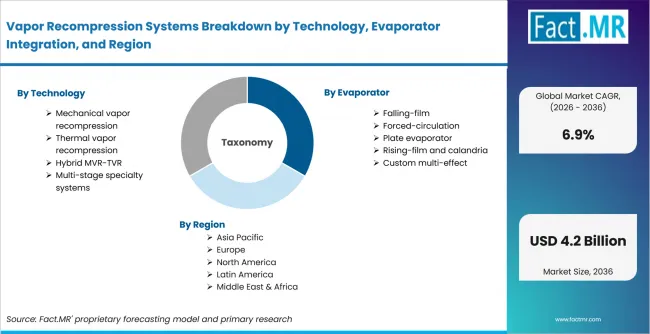
Vapor Recompression Systems Breakdown By Technology, Evaporator Integration, And Region | Source: Fact.MR
| Attribute | Details |
|---|---|
| Quantitative Units | USD billion |
| Market Definition | Systems that recompress process vapor and reuse it as heating medium in evaporation, concentration, distillation or related thermal separation duties. |
| Technology | Mechanical vapor recompression; Thermal vapor recompression; Hybrid MVR-TVR; Multi-stage specialty systems |
| Evaporator Integration | Falling-film; Forced-circulation; Plate evaporator; Rising-film and calandria; Custom multi-effect |
| End-use Industry | Food and dairy; Chemicals; Wastewater and ZLD; Pulp and paper; Pharma and biotech |
| Capacity Class | <5 t/h evaporation; 5-20 t/h; 20-50 t/h; 50-100 t/h; >100 t/h |
| Regions Covered | North America; Latin America; Western Europe; Eastern Europe; East Asia; South Asia and Pacific; Middle East and Africa |
| Countries Covered | USA; Germany; Japan; UK; France |
| Key Companies Profiled | GEA; Alfa Laval; ITT Flow Technologies; ANDRITZ; Veolia Water Technologies |
| Forecast Period | 2026 to 2036 |
| Approach | Hybrid top-down and bottom-up approach using installed evaporator base, energy-cost pressure, end-use adoption, country growth and provider portfolio review. |
How is the market segmented?
-
By Technology
- Mechanical vapor recompression
- Thermal vapor recompression
- Hybrid MVR-TVR
- Multi-stage specialty systems
-
By Evaporator Integration
- Falling-film
- Forced-circulation
- Plate evaporator
- Rising-film and calandria
- Custom multi-effect
-
By End-use Industry
- Food and dairy
- Chemicals
- Wastewater and ZLD
- Pulp and paper
- Pharma and biotech
-
By Capacity Class
- <5 t/h evaporation
- 5-20 t/h
- 20-50 t/h
- 50-100 t/h
- >100 t/h
-
By Region
- North America
- Latin America
- Western Europe
- Eastern Europe
- East Asia
- South Asia and Pacific
- Middle East and Africa