- Market Value (2025): USD 18.8 Bn
- Estimated Value (2026):USD 18.8 Bn
- Forecast Value (2036): USD 39.5 Bn
- CAGR (2026-2036): 7.7%
What is the Membrane Water and Wastewater Treatment WWT Market forecast to be worth by 2036?
USD 18.8 billion in 2026 to USD 39.5 billion by 2036, at 7.7% CAGR.
- The market enters the forecast period at USD 17.5 billion in 2025 across municipal and industrial treatment programs.
- Demand is projected to increase from USD 18.8 billion in 2026 to USD 39.5 billion by 2036.
- The market is forecast to record a 7.7% CAGR from 2026 to 2036 as utilities and industrial users add membrane stages for reuse, desalination and advanced contaminant removal.
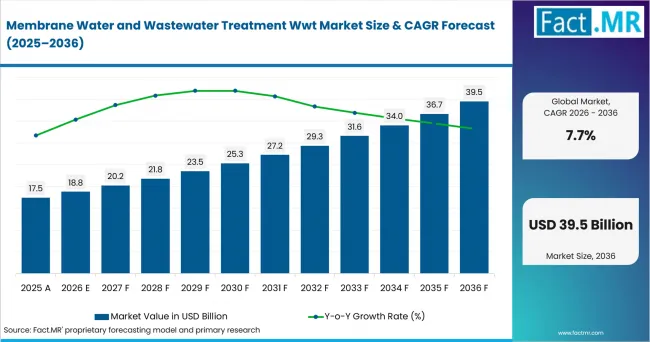
Membrane Water And Wastewater Treatment Wwt Market Value Analysis | Source: Fact.MR
What are the defining numbers behind Membrane Water and Wastewater Treatment WWT Market growth?
USD 20.7 billion absolute opportunity by 2036, led by Reverse Osmosis, Municipal Water & Wastewater Treatment and Polymeric Membranes.
- Demand Drivers in the Market
- Municipal utilities need dependable treatment barriers because drinking-water quality, wastewater discharge and reuse projects require predictable contaminant removal across changing source-water conditions.
- Coastal and water-stressed regions need reverse osmosis capacity for seawater and brackish-water desalination where conventional treatment cannot remove dissolved salts.
- Industrial facilities need water-reuse systems that reduce freshwater dependence and stabilize process-water supply without disrupting plant production schedules.
- Utilities with limited land need compact ultrafiltration and membrane bioreactor layouts when conventional clarification or tertiary expansion would require a larger site footprint.
- Key Segments Analyzed
- By Membrane Type: Reverse Osmosis (RO) is expected to hold 38% share in 2026 because it serves desalination, high-purity process water and advanced reuse applications.
- By Application: Municipal Water & Wastewater Treatment is projected to account for 42% share in 2026 owing to drinking-water, sewage treatment and tertiary-upgrade requirements.
- By Material: Polymeric Membranes are anticipated to capture 69% share in 2026 supported by broad polyamide and PVDF use across spiral-wound and hollow-fiber modules.
- By End User: Municipal Utilities are estimated to represent 40% share in 2026 attributable to recurring public investment in water and wastewater infrastructure.
- By Technology: Pressure-Driven Membrane Systems are forecast to account for 58% share in 2026 driven by established reverse osmosis and ultrafiltration process routes.
- Analyst Opinion at Fact.MR
- Shambhu Nath Jha, Principal Consultant at Fact.MR, states: “Membrane selection is no longer a single-equipment decision. Utilities and industrial buyers are comparing the complete treatment train, including pretreatment, recovery, cleaning, energy demand and concentrate handling. Suppliers that document performance under the buyer’s actual feed-water conditions and support lifecycle optimization are positioned to convert more pilot work into long-term membrane replacement business.” Fact.MR opines that membrane suppliers will be assessed on feed-water tolerance, energy management, and lifecycle performance.
- Strategic Implications
- Membrane suppliers should validate recovery, fouling behavior and cleaning intervals with representative feed water before finalizing performance guarantees.
- Municipal utilities should compare membrane replacement, energy and residuals-management costs over the full asset life instead of selecting only on initial module price.
- Industrial users should separate process-water, wastewater-reuse and zero-liquid-discharge requirements because each route places different demands on pretreatment and membrane chemistry.
- System integrators should design pretreatment and monitoring around the selected membrane because upstream variability determines whether nameplate recovery remains achievable in operation.
How does the Membrane Water and Wastewater Treatment WWT Market break down by segment?
Reverse Osmosis leads at 38%, Municipal Water & Wastewater Treatment at 42%, Polymeric Membranes at 69%, Municipal Utilities at 40% and Pressure-Driven Membrane Systems at 58%.
Why does Reverse Osmosis lead Membrane Type?
Reverse Osmosis (RO) holds 38% share in 2026.
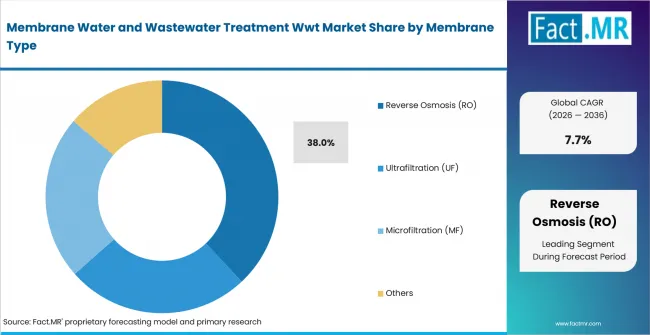
Membrane Water And Wastewater Treatment Wwt Market Analysis By Membrane Type | Source: Fact.MR
Reverse Osmosis is expected to hold 38% share in 2026 because it removes dissolved salts and supports seawater desalination, brackish-water treatment, high-purity industrial water and advanced reuse. Seawater RO requires pretreatment designed for feed-water quality and fouling control and energy management, while brackish-water RO is used where lower salinity allows different pressure and recovery settings. Ultrafiltration follows as a drinking-water barrier and as pretreatment that protects downstream RO. Microfiltration serves suspended-solids removal and selected industrial duties, while nanofiltration and membrane bioreactors address more specific separation and wastewater-treatment requirements. The U.S. Environmental Protection Agency identifies RO and nanofiltration as pressure-driven processes that use semipermeable membranes to separate contaminants from water.
Why does Municipal Water & Wastewater Treatment lead Application?
Municipal Water & Wastewater Treatment holds 42% share in 2026.
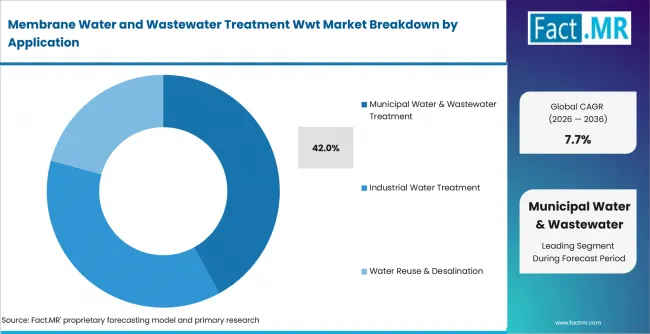
Membrane Water And Wastewater Treatment Wwt Market Analysis By Application | Source: Fact.MR
Municipal Water & Wastewater Treatment is projected to account for 42% share in 2026 because public utilities manage continuous drinking-water production, sewage treatment and regulatory compliance across large service populations. Membranes are used as primary separation barriers, tertiary polishing stages and components of water-reuse trains. Industrial Water Treatment follows where food and beverage, chemicals and petrochemicals require process-specific quality and discharge control. Water Reuse & Desalination expands where utilities and industrial parks can use treated wastewater close to the point of demand. The World Bank’s 2025 water-reuse analysis emphasizes that the business case is strongest when used water is available near municipal and industrial users.
Why do Polymeric Membranes lead Material?
Polymeric Membranes hold 69% share in 2026.
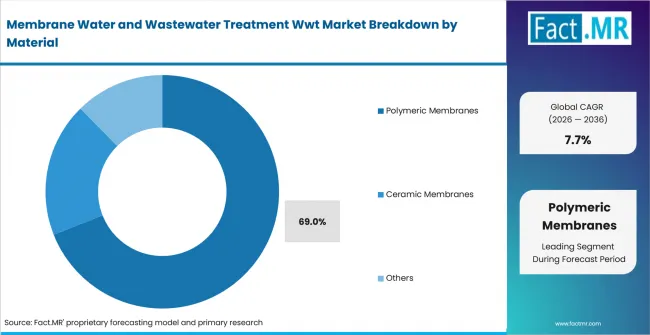
Membrane Water And Wastewater Treatment Wwt Market Analysis By Material | Source: Fact.MR
Polymeric Membranes are anticipated to capture 69% share in 2026 because polyamide and PVDF are established across high-volume spiral-wound and hollow-fiber products. Polyamide thin-film composites support RO and nanofiltration, while PVDF is widely used in ultrafiltration and microfiltration modules that need mechanical strength and chemical tolerance. Ceramic Membranes remain important for abrasive, high-temperature or chemically difficult streams where durability can justify higher capital cost. PTFE and other composite materials serve specialized duties that require particular solvent, fouling or temperature performance. DuPont’s current FilmTec technical documentation describes thin-film composite membranes in spiral-wound configurations as the standard construction for many RO and nanofiltration applications.
Why do Municipal Utilities lead End User?
Municipal Utilities hold 40% share in 2026.
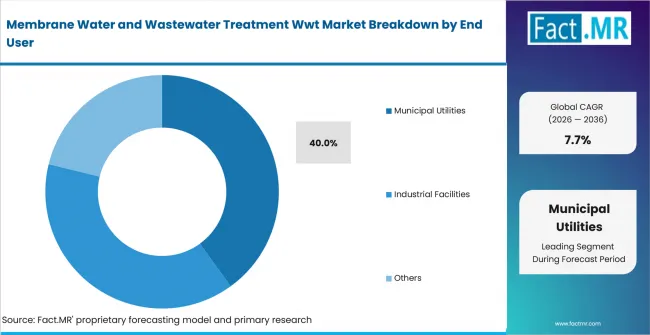
Membrane Water And Wastewater Treatment Wwt Market Analysis By End User | Source: Fact.MR
Municipal Utilities are estimated to represent 40% share in 2026 because water and wastewater assets operate continuously and replacement decisions are tied to public-health, discharge and service-reliability obligations. Water utilities purchase membrane capacity for drinking-water treatment and desalination, while wastewater utilities use ultrafiltration, microfiltration and membrane bioreactors for advanced effluent quality and reuse. Industrial Facilities make faster project decisions when water constraints affect production, but specifications vary sharply by sector. Desalination plants, mining sites and commercial facilities form a diverse buyer group where project scale and feed-water chemistry determine the treatment train.
Why do Pressure-Driven Membrane Systems lead Technology?
Pressure-Driven Membrane Systems hold 58% share in 2026.
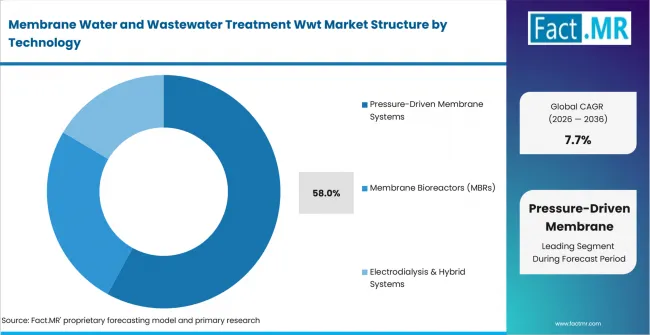
Membrane Water And Wastewater Treatment Wwt Market Analysis By Technology | Source: Fact.MR
Pressure-Driven Membrane Systems are forecast to account for 58% share in 2026 because reverse osmosis and ultrafiltration can be configured across desalination, drinking water, industrial process water and reuse. Integrated UF-RO trains use ultrafiltration to stabilize feed quality before high-rejection separation. Membrane Bioreactors combine biological treatment with membrane solids separation and are selected where high effluent quality or a smaller footprint justifies the operating complexity. Electrodialysis and hybrid systems serve ionic separation and specialized recovery duties where feed composition or recovery targets favor electrically driven or multi-stage treatment.
What is accelerating Membrane Water and Wastewater Treatment WWT Market adoption, and what is holding it back?
Water reuse, desalination and advanced treatment upgrades are expected to accelerate adoption, while fouling, energy use and concentrate management remain the main constraints.
Drivers Impact Analysis
| DRIVER | EXPECTED INFLUENCE | GEOGRAPHIC RELEVANCE | IMPACT TIMELINE |
|---|---|---|---|
| Municipal water-reuse investment | Strong positive | North America, Europe, Asia Pacific | Medium term (2-4 years) |
| Seawater and brackish-water desalination | Strong positive | Australia, USA, coastal Asia | Long term (>= 4 years) |
| Advanced wastewater-quality requirements | Positive | Europe, Canada, South Korea, Japan | Medium term (2-4 years) |
| Industrial water security and reuse | Positive | Manufacturing and power hubs | Short to medium term |
| Replacement of aging treatment assets | Positive | USA, UK, Germany, Canada | Medium term (2-4 years) |
Source: Fact.MR analysis. Updated Aug 5, 2026
- Water reuse investment: Used water becomes a dependable supply source when treatment is matched to the intended end use and the reclaimed-water customer is close enough to control conveyance cost. Municipal and industrial projects therefore create demand for staged UF, RO and disinfection systems rather than a single membrane module. The World Bank identifies policy, regulation and funding as the enabling conditions required to scale reuse.
- Advanced treatment upgrades: Utilities are under pressure to improve effluent quality, remove difficult contaminants and make existing plants more resilient. Membrane stages can raise treatment consistency, but procurement depends on how clearly suppliers demonstrate flux, rejection, cleaning and residuals performance under local feed conditions.
Opportunity Impact Analysis
| OPPORTUNITY | EXPECTED INFLUENCE | GEOGRAPHIC RELEVANCE | IMPACT TIMELINE |
|---|---|---|---|
| Integrated UF-RO trains for reuse and desalination | High | USA, Australia, South Korea, Japan | Medium term (2-4 years) |
| MBR retrofits for land-constrained plants | High | UK, Germany, Japan, urban Asia | Medium term (2-4 years) |
| Low-fouling and lower-energy membrane products | High | Global | Short to medium term |
| Digital design, monitoring and lifecycle services | Moderate | Global utility and industrial accounts | Short term (<= 2 years) |
Source: Fact.MR analysis. Updated Aug 5, 2026
- Integrated treatment trains: Suppliers can create more value when membrane selection, pretreatment, hydraulic design and operating software are developed together. DuPont expanded WAVE PRO in March 2026 to combine ultrafiltration, ion exchange, reverse osmosis and nanofiltration modeling in one design environment, illustrating the shift toward whole-system optimization.
Restraints Impact Analysis
| RESTRAINT | EXPECTED INFLUENCE | GEOGRAPHIC RELEVANCE | IMPACT TIMELINE |
|---|---|---|---|
| Membrane fouling and cleaning burden | High negative | Global | Short term (<= 2 years) |
| RO energy use and concentrate management | High negative | Desalination and high-recovery projects | Medium term (2-4 years) |
| Long municipal approval and procurement cycles | Moderate negative | North America and Europe | Medium term (2-4 years) |
| Feed-water variability and material compatibility | Moderate negative | Industrial and mixed-source systems | Short to medium term |
Source: Fact.MR analysis. Updated Aug 5, 2026
- Fouling and cleaning burden: Organic matter, scaling compounds, microorganisms and suspended solids can reduce flux or increase transmembrane pressure. Poor pretreatment shifts cost into chemicals, downtime and early membrane replacement, so buyers often require pilot evidence before approving a new module or process configuration.
- Energy and concentrate management: RO economics depend on pressure, recovery and the disposal or beneficial use of concentrate. Projects can be delayed where brine discharge is constrained or where electricity cost makes the full treatment train difficult to justify without energy-recovery and process-optimization measures.
Which countries are scaling Membrane Water and Wastewater Treatment WWT Market fastest?
South Korea 8.48%, USA 8.11%, Canada 7.76%, United Kingdom 7.50%, Australia 7.43%, Germany 7.29% and Japan 6.94% through 2036.
Regional analysis covers North America, Europe, Asia Pacific, Central & South America and the Middle East & Africa.
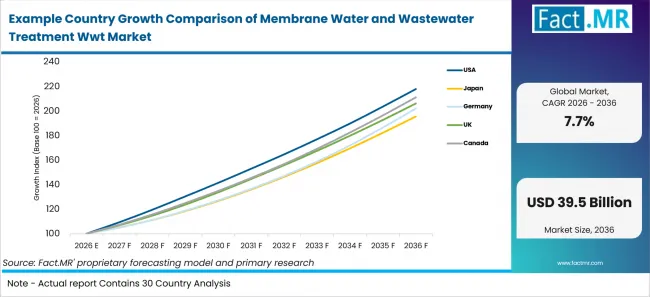
Example Country Growth Comparison Of Membrane Water And Wastewater Treatment Wwt Market | Source: Fact.MR
| COUNTRY | CAGR (2026-2036) |
|---|---|
| South Korea | 8.48% |
| USA | 8.11% |
| Canada | 7.76% |
| United Kingdom | 7.50% |
| Australia | 7.43% |
| Germany | 7.29% |
| Japan | 6.94% |
Source: Fact.MR analysis. Updated Aug 5, 2026
What is driving South Korea’s growth through 2036?
8.48% CAGR through 2036.
South Korea combines dense urban infrastructure with industrial clusters that need stable utility water and tighter wastewater control. Korea Environment Corporation reports that 1,169 million tons of treated sewage were
reused in 2024, equal to a 15.6% reuse rate. A May 2025 rule change also made it easier for public wastewater systems to provide stable-quality treated effluent to reuse facilities, including projects serving industrial complexes. The market is projected to record an 8.48% CAGR through 2036.
What supports the USA outlook?
8.11% CAGR through 2036.
The USA has a broad installed base of drinking-water and wastewater assets, so demand combines greenfield reuse projects with replacement and upgrade work. In April 2026, the U.S. Environmental Protection Agency launched Water Reuse Action Plan 2.0 to advance reuse across industry, energy and other end uses. In June 2026, EPA stated that approximately USD 11 billion in WIFIA financing was available for water infrastructure projects. The market is expected to post an 8.11% CAGR through 2036.
How is Canada scaling demand?
7.76% CAGR through 2036.
Canada’s demand profile is defined by large service distances, varied provincial systems and a need to improve treatment depth without assuming one centralized solution fits every community. Environment and Climate Change Canada reported that 94.9% to 96.4% of collected municipal wastewater received treatment between 2013 and 2023, but only 29.3% of the population was served by tertiary treatment in 2023. This leaves room for advanced polishing, compact membrane systems and targeted plant upgrades. The market is projected to expand at 7.76% CAGR through 2036.
What is driving the United Kingdom through 2036?
7.50% CAGR through 2036.
The United Kingdom enters the forecast period with a large regulated investment program and intense scrutiny of wastewater performance. Ofwat’s final determinations support GBP 104 billion of water-company spending over 2025 to 2030 and a quadrupling of new investment. Membranes will not be selected for every project, but they are relevant where utilities need compact tertiary treatment, reuse-quality effluent, difficult-contaminant removal or reliable pretreatment before advanced purification. Demand is anticipated to record a 7.50% CAGR through 2036.
How is Australia developing membrane-treatment demand?
7.43% CAGR through 2036.
Australia’s membrane-treatment market is tied closely to drought resilience, coastal desalination and recycled-water planning. An Australian federal environmental referral filed in December 2025 describes the proposed Northern Water project as a 51 GL per year seawater reverse osmosis desalination plant in South Australia. Projects of this scale pull demand through RO elements, ultrafiltration pretreatment, pressure vessels, cleaning systems and performance monitoring. The market is forecast to post a 7.43% CAGR through 2036.
What supports Germany’s growth?
7.29% CAGR through 2036.
Germany already has mature wastewater coverage, so membrane demand is concentrated in advanced treatment, industrial reuse, difficult-stream management and plant modernization rather than basic network buildout. The Federal Environment Ministry states that more than five billion cubic meters of wastewater are generated each year by households, industry and commerce, while roughly three billion cubic meters of rainwater runoff also enter treatment plants. The market is expected to record a 7.29% CAGR through 2036.
How does Japan perform?
6.94% CAGR through 2036.
Japan’s market combines highly developed water infrastructure with aging assets, disaster-resilience requirements and a strong domestic membrane manufacturing base. In February 2026, the Ministry of Land, Infrastructure, Transport and Tourism began work toward revising reclaimed-wastewater quality guidance, describing treated sewage as a stable urban resource and a potential alternative supply during droughts and emergencies. Demand is estimated to advance at 6.94% CAGR through 2036.
Who leads the Membrane Water and Wastewater Treatment WWT Market?
DuPont Water Solutions is an active provider, while Veolia Water Technologies, Toray Industries and other providers compete across membrane products, systems and lifecycle services.
DuPont Water Solutions combines FilmTec reverse osmosis and nanofiltration elements with IntegraTec and inge ultrafiltration modules, ion-exchange products and digital design tools. Its competitive position reflects a role that spans membrane supply, system specification and replacement demand across drinking water, wastewater, industrial utility water and desalination. Veolia Water Technologies competes through integrated reverse osmosis, ultrafiltration and packaged treatment systems backed by project engineering and service. Toray Industries covers RO, UF, MF and MBR technologies and continues to develop lower-fouling pretreatment products for downstream RO stability. SUEZ Water Technologies & Solutions remains relevant through industrial water, process treatment and membrane-based separation portfolios.
Koch Separation Solutions, now operating as Kovalus Separation Solutions, brings PURON MBR, RO, NF, UF and MF technologies into municipal and industrial applications. Pentair’s X-Flow portfolio covers capillary and tubular membranes for potable water, wastewater polishing, reuse and desalination pretreatment. LG Chem concentrates on thin-film nanocomposite RO elements for desalination, industrial water and reuse. Kubota competes through submerged MBR systems, while Hydranautics within Nitto Denko supplies RO products for desalination, wastewater reuse and zero-liquid-discharge systems. Asahi Kasei adds Microza hollow-fiber membranes for water purification and industrial or wastewater reuse. Competition through 2036 is expected to focus on demonstrated feed-water performance, lower energy and cleaning demand, dependable replacement supply and local technical support.
Which companies are the key providers?
DuPont Water Solutions is an active provider. Veolia Water Technologies, Toray Industries and SUEZ Water Technologies & Solutions are also profiled, followed by six additional membrane and system providers.
- DuPont Water Solutions
- Veolia Water Technologies
- Toray Industries, Inc.
- SUEZ Water Technologies & Solutions
- Koch Separation Solutions
- Pentair plc
- LG Chem Ltd.
- Kubota Corporation
- Hydranautics (Nitto Denko Corporation)
- Asahi Kasei Corporation
Bibliography
- Asahi Kasei Corporation. (2025, July 15). Asahi Kasei’s Microza hollow fiber membrane for filtration and separation receives Gold rating in EcoVadis.
- Department of Climate Change, Energy, the Environment and Water. (2025, December 11). Northern Water Desalination Plant and Water Transfer System Infrastructure Project referral.
- DuPont. (2026, March 3). DuPont Water Solutions expands data-driven WAVE PRO design tool with reverse osmosis and nanofiltration.
- Environment and Climate Change Canada. (2025, September 25). Municipal wastewater treatment.
- German Federal Ministry for the Environment. (2026, February 11). Waste water.
- Korea Environment Corporation. (2025, June 13). Water reuse policy support.
- Kovalus Separation Solutions. (2025, November 13). Kovalus Separation Solutions shares decades of know-how in new whitepaper on water efficiency for dairy plants.
- Kubota Corporation. (n.d.). Membrane solutions: Products and solutions.
- LG Chem. (2025, March 19). LG Chem’s RO membrane making waves worldwide.
- Ministry of Environment, Republic of Korea. (2025, May 22). Water reuse made easier even during heavy rainfall: Sewerage Act Enforcement Rule revised.
- Ministry of Land, Infrastructure, Transport and Tourism, Japan. (2026, February). Toward revision of the reclaimed wastewater quality standards manual.
- Hydranautics. (n.d.). Products.
- Ofwat. (2025, April 1). Our final determinations for the 2024 price review.
- Pentair. (n.d.). Products | X-Flow.
- Toray Industries, Inc. (2026, April 27). Toray to launch lower-biofouling ultrafiltration membrane for more stable reverse osmosis operation.
- UN-Water. (2024, August 25). Progress on wastewater treatment - 2024 update.
- U.S. Environmental Protection Agency. (2026, April 16). EPA launches Water Reuse Action Plan 2.0.
- U.S. Environmental Protection Agency. (2026, June 29). EPA to waive Water Infrastructure Finance and Innovation Act loan program fees for small communities.
- U.S. Environmental Protection Agency. (2026, March 23). Overview of drinking water treatment technologies.
- Veolia Water Technologies. (n.d.). Uflex.
- World Bank. (2025, May 20). Scaling water reuse: A tipping point for municipal and industrial use.
This Report Answers
- The report provides strategic intelligence on Membrane Water and Wastewater Treatment WWT across Membrane Type, Application, Material, End User and Technology choices that shape treatment-system procurement.
- Segment analysis covers Reverse Osmosis, Municipal Water & Wastewater Treatment, Polymeric Membranes, Municipal Utilities and Pressure-Driven Membrane Systems as the supplied 2026 share leaders.
- Regional outlook evaluates South Korea and the USA alongside Canada, the United Kingdom, Australia, Germany and Japan through the supplied country CAGR framework.
- Competitive analysis profiles DuPont Water Solutions as the competitive position leader and explains the market roles of nine additional membrane and system providers.
- Application assessment compares drinking water, municipal wastewater, industrial treatment, water reuse and seawater desalination through distinct process and buying requirements.
- Technology assessment distinguishes pressure-driven systems from MBR, electrodialysis and hybrid configurations based on separation target, feed-water quality and lifecycle operating demands.
What does the Membrane Water and Wastewater Treatment WWT Market cover?
RO, UF, MF, NF, MBR, electrodialysis and hybrid membrane systems used in municipal and industrial water or wastewater treatment.
The Membrane Water and Wastewater Treatment WWT Market covers membrane products and membrane-based treatment systems whose primary commercial function is separation within water purification, wastewater treatment, reuse or desalination. Coverage includes membrane elements, modules and packaged or engineered systems using reverse osmosis, ultrafiltration, microfiltration, nanofiltration, membrane bioreactors, electrodialysis and integrated membrane trains.
The market differs from the wider water-equipment industry because value is assigned to membrane separation and the directly associated system configuration. Pumps, tanks, piping, chemicals and conventional filters are considered only when supplied as part of a membrane treatment system and are not counted as independent membrane-market demand.
What is included in the scope?
Municipal and industrial membrane treatment for drinking water, wastewater, reuse, process water and desalination.
The scope includes polymeric and ceramic membranes sold into municipal utilities, industrial facilities, desalination plants, mining and commercial treatment projects. It covers new installations, capacity expansions, retrofit modules and replacement demand where the membrane performs the core separation duty. Integrated pretreatment and monitoring are considered when they are commercially tied to an included membrane system. The scope also captures water-reuse and high-recovery configurations where membrane stages convert treated effluent or difficult feed water into fit-for-purpose supply.
What is excluded from the scope?
Standalone conventional treatment equipment, non-water process membranes and finished consumer devices are outside the core boundary.
The scope excludes sand filters, activated carbon, clarifiers, disinfection systems, dosing chemicals, pumps and piping sold without an included membrane separation system. Membranes used primarily for gas separation, battery processing, pharmaceutical product purification or food concentration are excluded unless the purchased function is treatment of water or wastewater. Household point-of-use products are outside the boundary when demand is measured as a finished consumer appliance rather than as a municipal, industrial or commercial treatment system.
How Was the Analysis Built?
120+ sources, 40+ company portfolios, 25+ countries and 20+ interviews.
- Primary Research: Primary research includes interviews with membrane manufacturers, system integrators, municipal utilities, industrial water managers and engineering contractors. It also includes input from plant operators, procurement teams, consultants and distributors involved in specification, commissioning, cleaning and membrane replacement.
- Desk Research: Desk research reviews official wastewater, water-reuse, desalination and infrastructure publications. It also covers membrane technical manuals, company portfolios, public project documents, environmental approvals, regulatory material and peer-reviewed process studies.
- Market-Sizing and Forecasting: Forecasting uses installed treatment capacity, municipal and industrial project activity, membrane replacement intervals, application-specific recovery requirements, material adoption, module pricing and system attachment. Models also account for differences among RO, UF, MF, MBR, electrodialysis and hybrid configurations.
- Data Validation and Update Cycle: The analysis combines primary interviews with structured review of public company disclosures, official statistics, regulatory material, and sector publications. Forecast interpretation considers market conditions, adoption requirements, competitive positioning, and regional operating context.
Segmentation
What is the report’s scope and coverage?
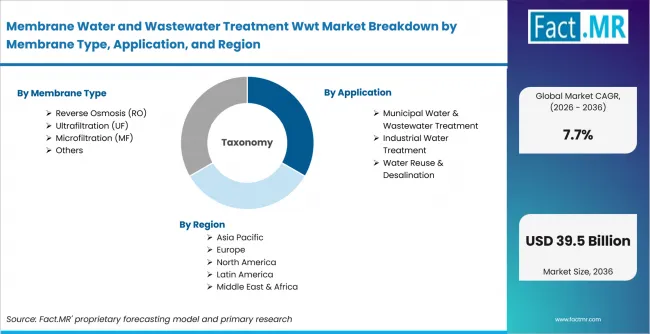
Membrane Water And Wastewater Treatment Wwt Market Breakdown By Membrane Type, Application, And Region | Source: Fact.MR
| Attribute | Details |
|---|---|
| Quantitative Units | USD Billion in 2026 to USD Billion by 2036 at CAGR |
| Market Definition | Membrane elements, modules and membrane-based treatment systems used to separate dissolved salts, suspended solids, microorganisms and selected organic or ionic contaminants from municipal and industrial water and wastewater streams |
| Membrane Type | Reverse Osmosis (RO); Ultrafiltration (UF); Microfiltration (MF); Others including Nanofiltration and Membrane Bioreactors |
| Application | Municipal Water & Wastewater Treatment; Industrial Water Treatment; Water Reuse & Desalination |
| Material | Polymeric Membranes; Ceramic Membranes; Others including PTFE and Composite Membranes |
| End User | Municipal Utilities; Industrial Facilities; Others including Desalination Plants, Mining and Commercial Facilities |
| Technology | Pressure-Driven Membrane Systems; Membrane Bioreactors; Electrodialysis & Hybrid Systems |
| Regions Covered | North America; Europe; Asia Pacific; Central and South America; Middle East and Africa |
| Countries Covered | USA; Japan; Germany; United Kingdom; Canada; Australia; South Korea |
| Key Companies Profiled | DuPont Water Solutions; Veolia Water Technologies; Toray Industries, Inc.; SUEZ Water Technologies & Solutions; Koch Separation Solutions; Pentair plc; LG Chem Ltd.; Kubota Corporation; Hydranautics; Asahi Kasei Corporation |
| Forecast Period | 2026 to 2036 |
| Approach | Hybrid top-down and bottom-up approach using installed treatment capacity, municipal and industrial project pipelines, membrane replacement cycles, desalination and reuse activity, application-specific recovery requirements, material adoption, pricing and supplier validation |
Source: Fact.MR analysis. Updated Aug 5, 2026
How is the market segmented?
-
By Membrane Type:
- Reverse Osmosis (RO)
- Seawater RO
- Brackish Water RO
- Ultrafiltration (UF)
- Hollow Fiber UF
- Pressure-Driven UF
- Microfiltration (MF)
- Ceramic MF
- Polymeric MF
- Others
- Nanofiltration (NF)
- Membrane Bioreactors (MBRs)
- Reverse Osmosis (RO)
-
By Application:
- Municipal Water & Wastewater Treatment
- Drinking Water Treatment
- Municipal Wastewater
- Industrial Water Treatment
- Food & Beverage
- Chemicals & Petrochemicals
- Water Reuse & Desalination
- Industrial Water Reuse
- Seawater Desalination
-
By Material
- Polymeric Membranes
- Polyamide
- PVDF
- Ceramic Membranes
- Alumina
- Zirconia
- Others
- PTFE
- Composite Membranes
- Polymeric Membranes
-
By End User
- Municipal Utilities
- Water Utilities
- Wastewater Utilities
- Industrial Facilities
- Power Generation
- Manufacturing
- Chemical Processing
- Others
- Desalination Plants
- Mining
- Commercial Facilities
- Municipal Utilities
- Municipal Water & Wastewater Treatment
-
By Technology
- Pressure-Driven Membrane Systems
- Reverse Osmosis
- Ultrafiltration
- Membrane Bioreactors (MBRs)
- Submerged MBR
- Side-Stream MBR
- Electrodialysis & Hybrid Systems
- Electrodialysis
- Integrated Membrane Systems
- Pressure-Driven Membrane Systems
-
By Region
- North America
- United States
- Canada
- Europe
- Germany
- United Kingdom
- France
- Italy
- Spain
- Asia Pacific
- Japan
- South Korea
- Australia
- Central & South America
- Brazil
- Argentina
- Mexico
- Chile
- Middle East & Africa
- UAE
- Saudi Arabia
- South Africa
- North America
Frequently Asked Questions
Which Membrane Type leads the Membrane Water and Wastewater Treatment WWT Market?
Which Application leads the market?
Which Material leads the market?
Which End User leads the market?
Which Technology leads the market?
Which country records the highest CAGR?
How does the USA perform?
How does Canada perform?
Who worked on this report


Preview the report firsthand - request a free sample
Free SampleGet the brochure for pricing and purchase details
Download PDF