- Market Value (2025): USD 188.7 Mn
- Estimated Value (2026): USD 205.0 Mn
- Forecast Value (2036): USD 470.0 Mn
- CAGR (2026-2036): 8.7%
What is the Leachate Evaporators Market forecast to be worth by 2036?
USD 205 million in 2026 to USD 470 million by 2036, at 8.7% CAGR.
- The leachate evaporators market reached USD 188.7 million in 2025 through installed systems and rental units used by landfill operators.
- Demand is projected to rise from USD 205.0 million in 2026 to USD 470.0 million by 2036 as sites seek tighter control over hauling and discharge exposure.
- The market is forecast to record an 8.7% CAGR from 2026 to 2036 supported by PFAS treatment planning and landfill aftercare requirements.
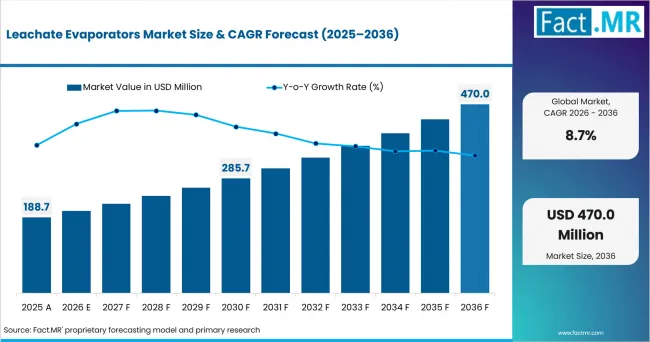
Leachate Evaporators Market Value Analysis | Source: Fact.MR
What are the defining numbers behind Leachate Evaporators Market growth?
USD 265 million absolute opportunity by 2036, led by Mechanical vapor recompression and Fixed installation within their respective segments.
- Demand Drivers in the Market
- Landfills with changing leachate volumes are expected to add treatment at the site. This can reduce their dependence on tanker schedules and outside treatment plants.
- Leachate affected by PFAS is likely to increase demand for systems that remove most of the water and leave a smaller waste stream for controlled disposal.
- Landfill gas and waste heat can lower operating costs when the energy supply is steady enough to run the evaporation system.
- Rental units mounted on skids or placed inside containers allow landfill owners to test performance before investing in a permanent plant.
- Key Segments Analyzed
- By Evaporation Technology: Mechanical vapor recompression is expected to hold 31.0% share in 2026 because energy recovery carries weight in continuous high-throughput duty.
- By Deployment: Fixed installation is projected to account for 43.0% share in 2026 as large sites integrate evaporation with permanent leachate infrastructure.
- By Heat Source: Natural gas is anticipated to capture 36.0% share in 2026 because controllable heat output supports consistent evaporation across changing feed conditions.
- By Leachate Type: Municipal landfill is estimated to represent 42.0% share in 2026 since municipal sites combine broad coverage with recurring liquid generation.
- By Customer Type: Landfill operators are forecast to hold 46.0% share in 2026 as they carry long-term compliance and disposal risk.
- Analyst Opinion at Fact.MR
- Shambhu Nath Jha, Senior Analyst at Fact.MR, states, “Landfill operators now look at more than how quickly a system removes water. They also consider how often it can run and how much the leftover waste costs to handle. Pilot units that show steady energy use and fewer buildup problems with real leachate are more likely to move into long-term use. Clear records on the final concentrate also help support investment approval.”
- Strategic Implications
- Landfill operators are better placed to set equipment size after comparing available heat with seasonal changes in leachate volume.
- Equipment makers build stronger claims when they provide records of energy use and cleaning needs under real site conditions.
- Mobile units suit waste companies serving several smaller landfills where separate fixed plants would cost too much.
- Engineering contractors benefit from planning pretreatment and vapor control before choosing the final evaporator size. Storage for the remaining waste and permit needs also belong in the same design stage.
Germany is expected to record a 9.5% CAGR by 2036 driven by energy-efficient treatment and waste-heat integration. The United States is projected to post a 9.3% CAGR as PFAS planning brings treatment choices closer to landfill sites. The United Kingdom is anticipated to advance at a 9.0% CAGR because landfill tax pressure supports on-site liquid reduction. Italy is estimated to grow at an 8.8% CAGR as municipal waste generation remains high. Spain is forecast to register an 8.6% CAGR through 2036.
How does the Leachate Evaporators Market break down by segment?
Mechanical vapor recompression leads at 31.0% by Evaporation Technology, while Fixed installation leads at 43.0% by Deployment in 2026.
Which Evaporation Technology dominates?
Mechanical Vapor Recompression holds 31.0% share in 2026.
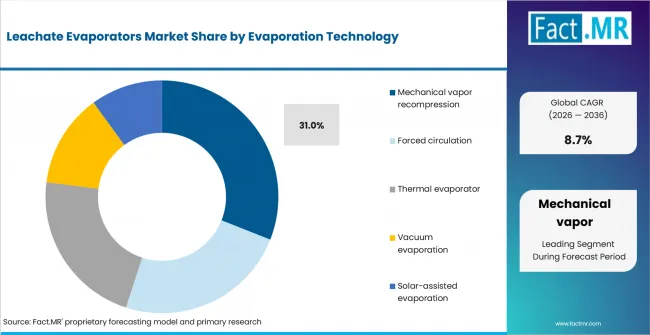
Leachate Evaporators Market Analysis By Evaporation Technology | Source: Fact.MR
Mechanical Vapor Recompression leads because the system reuses vapor energy instead of relying only on continuous external heat. This lowers energy demand during long operating cycles and makes the technology suitable for landfills handling steady leachate volumes. Its closed-loop design also supports tighter control over temperature and concentration. These operating benefits give Mechanical Vapor Recompression a clear advantage where treatment costs and daily process stability influence equipment selection.
What leads the Deployment Type segment?
Fixed Installation accounts for 43.0% share in 2026.
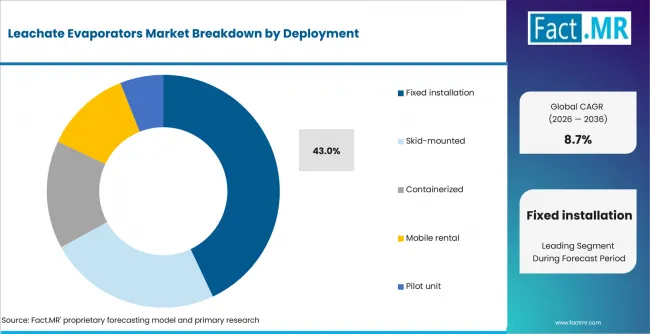
Leachate Evaporators Market Analysis By Deployment | Source: Fact.MR
Fixed installations remain the preferred choice at large landfill sites with established leachate collection systems and predictable treatment needs. Permanent equipment can be linked directly with tanks, pumps, controls, and residual handling units. This arrangement supports continuous operation and reduces repeated setup work. Landfill owners also gain more control over capacity planning and site integration, which keeps fixed systems ahead where long service life matters more than short-term mobility.
Which Heat Source dominates?
Natural Gas holds 36.0% share in 2026.
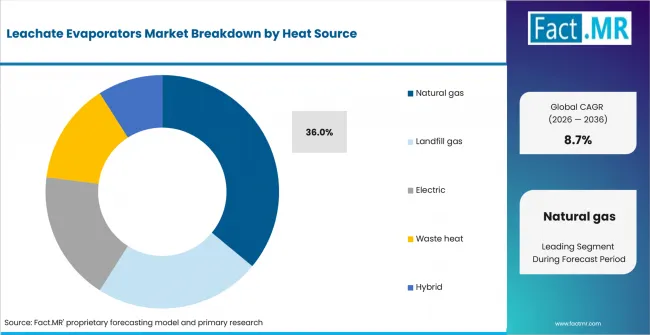
Leachate Evaporators Market Analysis By Heat Source | Source: Fact.MR
Natural gas leads because operators can adjust heat input quickly as leachate flow and concentration change. The fuel also works with familiar burners, controls, and maintenance practices already used across industrial sites. Its steady availability helps evaporation systems maintain reliable operating temperatures during extended runs. This practical balance between control, service access, and process continuity keeps natural gas ahead of less predictable heat sources in many landfill treatment projects.
What leads the Leachate Type segment?
Municipal Landfill Leachate accounts for 42.0% share in 2026.
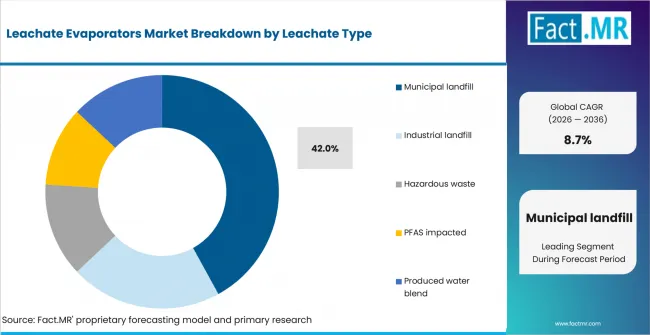
Leachate Evaporators Market Analysis By Leachate Type | Source: Fact.MR
Municipal landfill leachate creates the largest equipment requirement because active and closed sites continue producing collected liquid over long periods. Rainfall, waste age, and site design affect flow and composition, so operators need treatment systems that can handle changing feed conditions. Evaporation also reduces the volume sent for transport or further treatment. These recurring operating needs make municipal landfill sites the main source of demand for leachate evaporators.
Which End User dominates?
Landfill Operators hold 46.0% share in 2026.
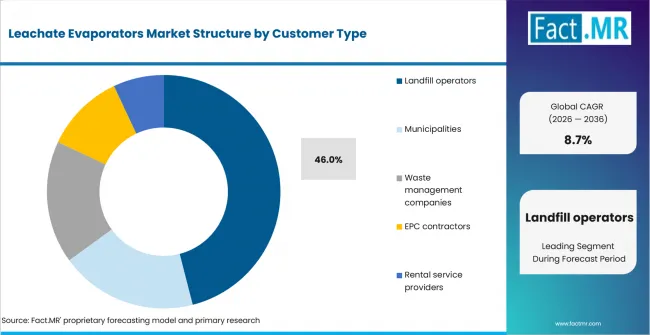
Leachate Evaporators Market Analysis By Customer Type | Source: Fact.MR
Landfill operators lead purchases because they manage leachate storage, transport, treatment, and regulatory compliance as part of daily site operations. Installing evaporation equipment gives them direct control over liquid volumes and reduces dependence on outside disposal routes. Operators can also match system capacity with actual site conditions and seasonal flow changes. This close link between equipment performance and landfill management keeps operators at the center of purchasing decisions.
What is accelerating Leachate Evaporators Market adoption, and what is holding it back?
On-site volume reduction is anticipated to drive adoption, while energy intensity and concentrate disposition restrain wider project approval.
Drivers Impact Analysis
| DRIVER | (~) % IMPACT ON CAGR |
GEOGRAPHIC RELEVANCE | IMPACT TIMELINE |
|---|---|---|---|
| On-site volume reduction | +1.3% | North America | Short term (<= 2 years) |
| PFAS treatment planning | +1.1% | United States | Medium term (2-4 years) |
| Landfill gas utilization | +1.0% | Europe and North America | Medium term (2-4 years) |
| Modular procurement | +0.8% | Asia-Pacific | Short term (<= 2 years) |
| Closed-site management | +0.6% | Global | Long term (>= 4 years) |
Source: Fact.MR analysis. Updated Jul 17, 2026
- On-site volume reduction: Hauling exposure is expected to make on-site concentration attractive at landfills with recurring liquid generation. Projects move fastest where tanks and residual handling are already in place.
- PFAS treatment planning: Regulatory attention is projected to push owners toward better feed and residual data. Evaporation performs best when the treatment train already defines the downstream concentrate route.
- Landfill gas utilization: Sites with usable landfill gas are anticipated to offset part of the thermal requirement. The opportunity depends on gas conditioning and competing uses for the same energy stream.
- Modular procurement: Skid-mounted and containerized equipment gives owners a staged route from pilot trial to higher capacity. This route is expected to suit sites with uncertain liquid volumes or permit timing.
- Closed-site management: Closed landfills still generate leachate and need aftercare systems that operate without daily waste receipts. Evaporation is forecast to gain use where owners want smaller liquid movements from legacy sites.
Opportunity Impact Analysis
| OPPORTUNITY | (~) % IMPACT ON CAGR |
GEOGRAPHIC RELEVANCE | IMPACT TIMELINE |
|---|---|---|---|
| Pilot-to-permanent programs | +0.7% | Global | Short term (<= 2 years) |
| Waste-heat integration | +0.6% | Europe | Medium term (2-4 years) |
| Mobile treatment fleets | +0.5% | North America | Medium term (2-4 years) |
| Remote performance services | +0.4% | Global | Long term (>= 4 years) |
Source: Fact.MR analysis. Updated Jul 17, 2026
- Pilot-to-permanent programs: Rental and pilot units are expected to show concentration ratio and energy use on actual leachate before capital approval. Cleaning frequency also becomes visible before larger equipment is ordered.
- Waste-heat integration: Industrial and waste sites with recoverable heat are projected to lower the marginal energy burden of evaporation. Flexible heat-exchanger design is therefore expected to influence equipment selection.
- Mobile treatment fleets: Mobile fleets are anticipated to cover seasonal peaks and emergency storage pressure across smaller properties. Utilization improves when one asset serves several sites under one operator.
- Remote performance services: Remote monitoring is expected to support smaller operating teams that cannot keep specialist staff on-site. Alarm review and cleaning guidance can reduce avoidable downtime.
Restraints Impact Analysis
| RESTRAINT | (~) % IMPACT ON CAGR |
GEOGRAPHIC RELEVANCE | IMPACT TIMELINE |
|---|---|---|---|
| Energy intensity | -0.6% | Global | Short term (<= 2 years) |
| Scaling and fouling | -0.5% | Global | Short term (<= 2 years) |
| Concentrate disposition | -0.4% | North America and Europe | Medium term (2-4 years) |
| Variable site volumes | -0.3% | Monsoon and high-rainfall regions | Long term (>= 4 years) |
Source: Fact.MR analysis. Updated Jul 17, 2026
- Energy intensity: Evaporation concentrates contaminants by applying substantial thermal or electrical energy. Approval is expected to slow when recovery or on-site fuel cannot offset operating cost.
- Scaling and fouling: Leachate chemistry changes over time and creates deposits that reduce heat transfer. Operators need realistic cleaning assumptions from representative feed testing before full approval.
- Concentrate disposition: Evaporation reduces liquid volume but keeps residual management inside the project. Disposal classification and storage plans must be resolved before the cost case is accepted.
- Variable site volumes: Rainfall and site age can shift leachate generation sharply across the year. Oversized equipment raises capital cost while undersized systems leave operators exposed during peak periods.
Which countries are scaling Leachate Evaporators Market fastest?
Germany 9.5%. United States 9.3%. United Kingdom 9.0%. Italy 8.8%. Spain 8.6%.
Regional analysis covers North America and Europe with country sections for the five fastest scaling markets. It also covers Asia Pacific, Latin America and the Middle East & Africa.
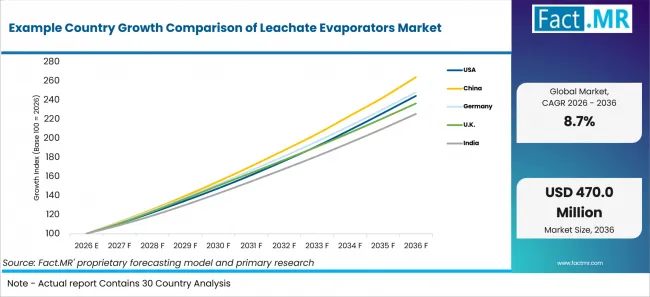
Example Country Growth Comparison Of Leachate Evaporators Market | Source: Fact.MR
| COUNTRY | CAGR |
|---|---|
| Germany | 9.5% |
| United States | 9.3% |
| United Kingdom | 9.0% |
| Italy | 8.8% |
| Spain | 8.6% |
Source: Fact.MR analysis. Updated Jul 17, 2026
What is driving Germany's growth through 2036?
9.5% CAGR, driven by energy-efficient treatment and waste-heat integration.
Germany’s market is shaped by the need to manage landfill liquids with tighter engineering control. Operators are placing greater weight on systems that reduce energy use and recover available heat from nearby processes. The market is expected to record a 9.5% CAGR through 2036 as efficient evaporation becomes more important at sites seeking lower operating costs and stable long-term treatment performance.
How is the United States scaling leachate evaporator demand?
9.3% CAGR, supported by PFAS planning and landfill wastewater oversight.
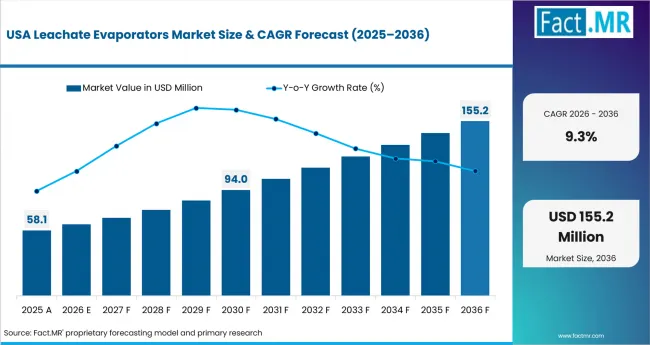
Leachate Evaporators Market Country Value Analysis | Source: Fact.MR
The United States is developing around stricter treatment records and clearer discharge control. Landfill owners need stronger evidence that leachate is handled properly, especially where PFAS affects treatment planning. The market is projected to post a 9.3% CAGR from 2026 to 2036 as operators invest in systems that reduce liquid volume and support more consistent wastewater management.
What supports the United Kingdom outlook?
9.0% CAGR, owing to landfill aftercare and pressure to reduce off-site liquid movement.
United Kingdom landfill sites often carry leachate obligations long after active disposal slows or ends. This creates a continuing need for equipment that lowers stored volumes and reduces reliance on transport to outside treatment facilities. Demand is anticipated to record a 9.0% CAGR through 2036 as operators seek better control over long-term handling costs and site aftercare requirements.
What underpins Italy’s growth?
8.8% CAGR, supported by regional treatment gaps and the need for local volume reduction.
Italy’s landfill network faces different treatment conditions across regions, including uneven access to outside processing facilities and varying transport distances. On-site evaporation becomes more useful where hauling leachate adds cost or delays treatment. The market is estimated to expand at an 8.8% CAGR from 2026 to 2036 as operators look for stable local systems that reduce stored liquid.
How is Spain developing leachate evaporator demand?
8.6% CAGR, driven by seasonal leachate changes and lower landfill dependence.
Spain’s market reflects the need to manage existing landfill sites while disposal activity declines over time. Rainfall patterns and dry periods can create sharp changes in leachate flow, which places value on flexible treatment capacity. The market is forecast to post an 8.6% CAGR through 2036 as landfill managers adopt evaporation systems that support local volume control during changing site conditions.
Who leads the Leachate Evaporators Market?
ENCON Evaporators and EVALED lead direct evaporator coverage, while Samsco and H2O GmbH strengthen wastewater evaporation and vacuum distillation capability.
ENCON Evaporators has a strong position through its range of industrial wastewater evaporators and practical support during operation. EVALED competes through Veolia Water Technologies and its vacuum evaporation systems. Samsco serves smaller industrial sites with wastewater evaporators made for lower treatment volumes.
H2O GmbH adds VACUDEST vacuum distillation systems and process-water treatment experience. Flash Rockwell Technologies focuses on harder waste streams that require more careful evaporation. Through 2036, companies are expected to compete on feed testing, cleaning needs, energy use, and clear proof of how the remaining waste is handled.
Which companies are the key providers?
ENCON Evaporators and EVALED are key providers. Samsco and H2O GmbH are also profiled, while Flash Rockwell Technologies completes the company set.
- ENCON Evaporators
- EVALED
- Samsco
- H2O GmbH
- Flash Rockwell Technologies
Bibliography
- European Environment Agency. (2025, March 1). Germany: Municipal waste management country profile.
- Istituto Superiore per la Protezione e la Ricerca Ambientale. (2025, December 11). Rifiuti urbani: Nel 2024 +2,3% di produzione rispetto al 2023. L’Italia differenzia di più, il Sud accelera.
- European Environment Agency. (2025, November 18). Diversion of waste from landfill in Europe. European Environment Agency.
- Ministerio para la Transición Ecológica y el Reto Demográfico. (2025, December 31). Plan Estatal Marco de Gestión de Residuos 2025-2035. Gobierno de España.
- U.S. Environmental Protection Agency. (2024, December 5). Method 1633A analysis of per- and polyfluoroalkyl substances. U.S. Environmental Protection Agency.
This Report Addresses
- The report provides strategic intelligence on leachate evaporators across Evaporation Technology and Deployment choices that shape landfill treatment planning.
- Segment analysis covers Mechanical vapor recompression and Fixed installation as the share within the 2026 market.
- Regional outlook evaluates Germany and the United States alongside the United Kingdom while Italy and Spain complete the growth comparison.
- Competitive analysis profiles ENCON Evaporators and EVALED alongside Samsco and H2O GmbH, followed by Flash Rockwell Technologies.
- Technology assessment covers Mechanical vapor recompression and Forced circulation alongside Thermal evaporator, Vacuum evaporation and Solar-assisted evaporation systems.
- Customer assessment covers Landfill operators and Municipalities alongside Waste management companies, EPC contractors and Rental service providers.
What does the Leachate Evaporators Market cover?
Leachate evaporation systems used to reduce landfill liquid volume and produce a smaller residual stream for controlled handling.
The Leachate Evaporators Market covers packaged evaporation equipment used to treat landfill leachate before discharge or hauling. Coverage includes Mechanical vapor recompression and Forced circulation systems. Thermal evaporator, Vacuum evaporation and Solar-assisted evaporation systems are also included.
The market differs from general wastewater treatment because commercial value comes from volume reduction and feed-specific operating support. Membrane systems and biological treatment remain outside the boundary as integrated components of an evaporator package.
What is included in the scope?
Leachate-specific evaporators and integrated components sold with the equipment across landfill treatment environments.
The scope includes Fixed installation and Skid-mounted formats. Containerized and Mobile rental formats are also included. Coverage spans Natural gas and Landfill gas heat-source configurations. Electric and Waste heat configurations are included for municipal and industrial landfill leachate. PFAS impacted and produced-water-blend streams are included when the purchased function is evaporation-based liquid reduction.
What is excluded from the scope?
Civil works and storage ponds are outside the scope. Tanker services and standalone non-evaporation treatment systems are also excluded.
The scope excludes independent power-generation assets and hauling services sold separately from the evaporator package. Standalone membrane and biological treatment systems are excluded unless their components are integrated into a leachate evaporator sale.
How Was the Analysis Built?
The analysis draws on 120+ sources, 35+ company portfolios, 25+ countries, and more than 20 industry interviews.
- Primary Research: Primary research includes discussions with manufacturers, service providers, technology developers, distributors, end users, procurement teams, and subject-matter experts. These conversations examine purchasing priorities, product adoption, operational challenges, approval requirements, competitive positioning, and the factors that influence wider market acceptance.
- Desk Research: Desk research covers government statistics, regulatory publications, company filings, trade data, technical studies, industry associations, standards, public policy, and other authoritative sources. Every source used in the analysis is documented in the bibliography.
- Market Sizing and Forecasting: Market estimates combine historical performance, demand indicators, pricing and volume trends, segment shares, company participation, country-level growth, adoption patterns, investment activity, and barriers to market expansion.
- Data Validation and Update Cycle: Findings are validated by comparing primary interviews with public data, company activity, regulatory changes, trade patterns, and industry developments. Regular updates review new product launches, capacity changes, partnerships, approvals, procurement trends, and shifts in commercial adoption.
Segmentation
What is the report’s scope and coverage?
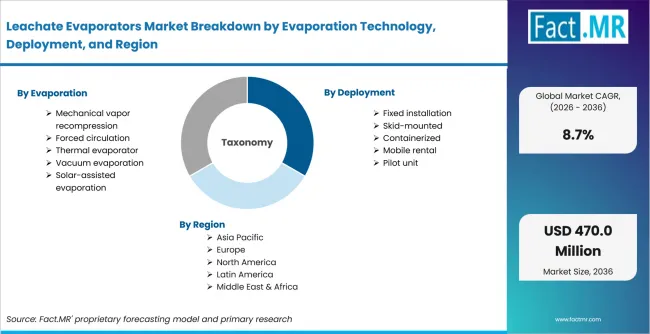
Leachate Evaporators Market Breakdown By Evaporation Technology, Deployment, And Region | Source: Fact.MR
| Attribute | Details |
|---|---|
| Quantitative Units | USD Million in 2026 to USD Million by 2036 at CAGR |
| Market Definition | Equipment and packaged systems that evaporate water from landfill leachate to reduce liquid volume and generate a concentrated residual stream. |
| Evaporation Technology | Mechanical vapor recompression; Forced circulation; Thermal evaporator; Vacuum evaporation; Solar-assisted evaporation |
| Deployment | Fixed installation; Skid-mounted; Containerized; Mobile rental; Pilot unit |
| Heat Source | Natural gas; Landfill gas; Electric; Waste heat; Hybrid |
| Leachate Type | Municipal landfill; Industrial landfill; Hazardous waste; PFAS impacted; Produced water blend |
| Customer Type | Landfill operators; Municipalities; Waste management companies; EPC contractors; Rental service providers |
| Regions Covered | North America; Europe; Asia Pacific; Central and South America; Middle East and Africa |
| Countries Covered | Germany; United States; United Kingdom; Italy; Spain |
| Key Companies Profiled | ENCON Evaporators; EVALED; Samsco; H2O GmbH; Flash Rockwell Technologies |
| Forecast Period | 2026 to 2036 |
| Approach | Hybrid top-down and bottom-up approach using landfill wastewater regulation, equipment portfolios, deployment formats, heat-source economics, customer validation, and country growth indicators. |
Source: Fact.MR analysis. Updated Jul 17, 2026
How is the market segmented?
-
By Evaporation Technology
- Mechanical vapor recompression
- Forced circulation
- Thermal evaporator
- Vacuum evaporation
- Solar-assisted evaporation
-
By Deployment
- Fixed installation
- Skid-mounted
- Containerized
- Mobile rental
- Pilot unit
-
By Heat Source
- Natural gas
- Landfill gas
- Electric
- Waste heat
- Hybrid
-
By Leachate Type
- Municipal landfill
- Industrial landfill
- Hazardous waste
- PFAS impacted
- Produced water blend
-
By Customer Type
- Landfill operators
- Municipalities
- Waste management companies
- EPC contractors
- Rental service providers
-
By Region
- North America
- United States
- Europe
- Germany
- United Kingdom
- Italy
- Spain
- Asia Pacific
- Central & South America
- Middle East & Africa
Frequently Asked Questions
Which Evaporation Technology leads the Leachate Evaporators Market?
Which Deployment format leads the Leachate Evaporators Market?
Which Heat Source leads the Leachate Evaporators Market?
Which Leachate Type leads the Leachate Evaporators Market?
Which country records the highest CAGR in the Leachate Evaporators Market?
How does the United States perform in the Leachate Evaporators Market?
How does the United Kingdom perform in the Leachate Evaporators Market?
How does Italy perform in the Leachate Evaporators Market?
What is the primary driver in the Leachate Evaporators Market?
What is the main restraint in the Leachate Evaporators Market?
Why do landfill operators dominate demand?
Who worked on this report


Preview the report firsthand - request a free sample
Free SampleGet the brochure for pricing and purchase details
Download PDF