- Base Value(2025): 534 Mn
- Forecast Value (2036): 770 Mn
- CAGR (2036): 3.4%
Vaporized Hydrogen Peroxide Sterilization System Market Forecast and Outlook 2026 to 2036
In 2025, the vaporized hydrogen peroxide sterilization system market was valued at USD 534 million. Based on Fact.MR analysis, demand for vaporized hydrogen peroxide sterilization systems is estimated to reach approximately USD 552 million in 2026 and around USD 770 million by 2036. Fact.MR projects a CAGR of 3.4% during the forecast period. Market expansion reflects continued reliance on low temperature sterilization methods across regulated manufacturing environments, supported by established validation frameworks and compatibility with sensitive equipment.
The market adds roughly USD 236 million in value over the forecast window, indicating incremental growth anchored in replacement demand and incremental facility upgrades rather than large scale capacity shifts. Early period growth is supported by pharmaceutical and biotech cleanroom expansions and routine requalification of isolators and production lines. Mid period performance aligns with broader adoption of mobile systems for modular facilities and contract manufacturing. In later years, value realization is shaped by lifecycle replacements and compliance driven upgrades, where proven process reliability sustains steady purchasing behavior.
China records the fastest growth at 4.6% CAGR, supported by expanding pharmaceutical manufacturing and biologics capacity. India follows at 4.3% driven by API and formulation plant upgrades. Germany posts 3.9% linked to stringent contamination control standards, while Brazil reaches 3.6% as regulated food and pharma facilities expand. Mature markets including the United States at 3.2%, the United Kingdom at 2.9%, and Japan at 2.6% remain replacement led, constrained by stable installed bases and long system qualification cycles.
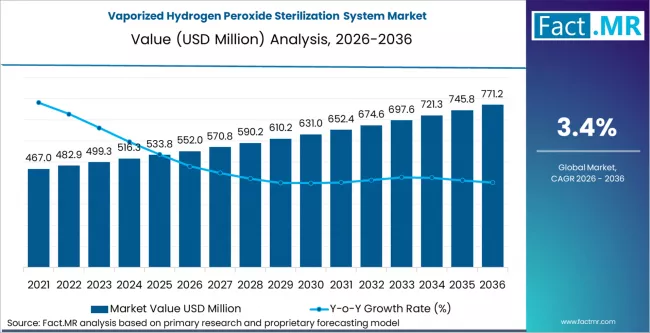
Vaporized Hydrogen Peroxide Sterilization System Market Market Value Analysis | Source: Fact.MR
Vaporized Hydrogen Peroxide Sterilization System Market Definition
The vaporized hydrogen peroxide sterilization system market covers low temperature sterilization equipment used to eliminate microorganisms on medical devices and instruments. These systems convert liquid hydrogen peroxide into vapor and distribute it within a sealed chamber to achieve sterilization without high heat. The process is suitable for heat and moisture sensitive medical equipment used in healthcare settings. System design, performance, and clinical use are regulated under medical device frameworks issued by the US Food and Drug Administration and infection control guidance published by the Centers for Disease Control and Prevention [1]. Primary users include hospitals, clinics, and diagnostic laboratories.
Vaporized Hydrogen Peroxide Sterilization System Market Inclusions
The report covers global and regional market size estimates in volume and value terms with a forecast period from 2026 to 2036. Segmentation includes system type by chamber size, application across surgical instruments and reusable medical devices, and end use covering hospitals, ambulatory surgical centers, and life science laboratories. The scope also includes regional demand patterns, pricing benchmarks, and trade flows related to regulated sterilization equipment.
Vaporized Hydrogen Peroxide Sterilization System Market Exclusions
The scope excludes steam sterilizers, ethylene oxide systems, radiation based sterilization, and chemical liquid disinfectants that use different sterilization mechanisms. Consumables such as hydrogen peroxide cartridges sold separately are not included. Sterilization validation services, maintenance contracts, and installation services are excluded. Laboratory scale research units, prototype systems without regulatory clearance, and veterinary sterilization equipment are also outside the scope.
Vaporized Hydrogen Peroxide Sterilization System Market Research Methodology
- Primary Research: Primary research involved interviews with sterilization system manufacturers, hospital sterile processing managers, clinical engineers, and infection prevention specialists.
- Desk Research: Desk research used medical device regulations, safety communications, and clearance databases issued by the US Food and Drug Administration and infection prevention guidance from the Centers for Disease Control and Prevention, along with company regulatory filings.
- Market Sizing and Forecasting: Market sizing applied a hybrid top down and bottom up model using healthcare facility counts, instrument reprocessing volumes, and system installation rates.
- Data Validation and Update Cycle: Outputs were cross checked against regulatory approval records, hospital procurement disclosures, trade statistics, and public healthcare infrastructure data, with updates applied when verified public sources issue revisions.
Summary of vaporized hydrogen peroxide sterilization system market
-
Market definition
-
The vaporized hydrogen peroxide sterilization system market covers low temperature sterilization equipment that uses hydrogen peroxide vapor to decontaminate medical devices, cleanrooms, isolators, and controlled environments within healthcare and regulated manufacturing facilities.
-
-
Demand drivers
-
Expansion of pharmaceutical and biotech cleanrooms increases routine sterilization cycles for isolators, filling lines, and transfer chambers under validated aseptic processing requirements.
-
Hospital infection prevention protocols drive continued use of low temperature sterilization compatible with heat and moisture sensitive instruments, as outlined in public infection control guidance by. [2]
-
Repeat qualification and lifecycle replacement of installed systems sustain purchasing in mature facilities where sterilization performance is tied to regulatory audits and accreditation.
-
-
Key segments analyzed
-
System type: Fixed VHP systems account for about 60% share due to permanent installation within validated rooms and integration with HVAC and isolator infrastructure.
-
Application: Pharmaceutical and biotechnology applications lead with nearly 65% share, reflecting reliance on residue-free sterilization in sterile drug and biologics manufacturing.
-
Geography: China and India show higher growth rates as new pharma capacity is commissioned, while the United States, Germany, and Japan remain replacement driven markets.
-
-
Analyst opinion at Fact.MR
-
Shambhu Nath Jha, Principal Consultant at Fact.MR, opines, ‘CXOs will find this report useful for understanding how validation requirements, facility design constraints, and repeat qualification cycles are shaping steady demand for vaporized hydrogen peroxide sterilization systems across healthcare and pharmaceutical environments.’
-
-
Strategic implications / executive takeaways
-
Align system design with fixed room and isolator integration to match dominant installation patterns in regulated facilities.
-
Strengthen validation documentation and audit readiness to support procurement under regulatory inspections.
-
Target lifecycle replacement opportunities in hospitals and pharma plants operating under frameworks. [3]
-
-
Methodology
- Market sizing based on healthcare facility counts, cleanroom installations, and sterilization cycle utilization rates.
- Validation through regulatory clearance records, hospital procurement disclosures, and public healthcare infrastructure data.
- Forecasts derived from reproducible top down and bottom up models grounded in verified regulatory and operational benchmarks.
Segmental Analysis
Vaporized Hydrogen Peroxide Sterilization System Market Analysis by System Type
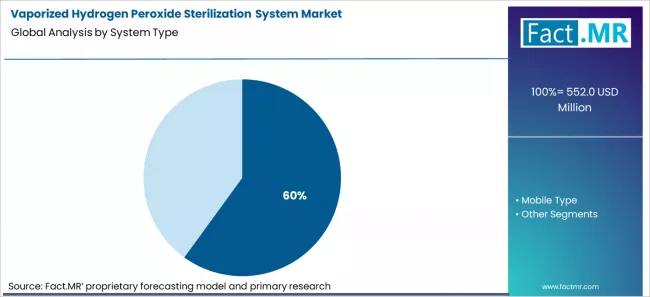
Vaporized Hydrogen Peroxide Sterilization System Market Analysis By System Type | Source: Fact.MR
Based on Fact.MR analysis, consumption of fixed type vaporized hydrogen peroxide sterilization systems is estimated to hold 60% share of the global market. Fact.MR analysts note that fixed systems lead due to permanent installation within controlled cleanroom and production environments, supporting repeat sterilization cycles with validated parameters. As per Fact.MR, this system type addresses facility requirements for consistent decontamination coverage, automated process control, and integration with HVAC and isolator systems used in regulated manufacturing settings across pharmaceutical and biotechnology operations worldwide.
- Regulatory framework: Sterilization of pharmaceutical manufacturing areas is governed by current good manufacturing practice requirements for aseptic processing.
[4] - Facility integration: Fixed systems are designed to operate within validated rooms, isolators, and filling suites.
- Process repeatability: Permanent installations support documented and reproducible sterilization cycles.
Vaporized Hydrogen Peroxide Sterilization System Market Analysis by Application
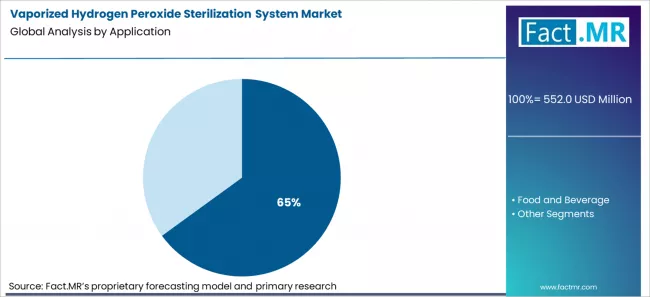
Vaporized Hydrogen Peroxide Sterilization System Market Analysis By Application | Source: Fact.MR
Based on Fact.MR analysis, consumption of vaporized hydrogen peroxide sterilization systems in pharmaceutical and biotechnology applications is estimated to hold 65% share of the global market. Fact.MR opines that this application leads due to strict contamination control requirements in sterile drug manufacturing and biologics processing. As per Fact.MR, these systems address the need for low-temperature, residue-free sterilization compatible with sensitive equipment, packaging components, and cleanroom environments used throughout drug production and quality control operations globally.
- Aseptic standards: Government health agencies mandate validated sterilization and decontamination processes in sterile pharmaceutical manufacturing.
Industry reliance: Fact.MR analysts note pharmaceutical facilities represent the largest installed base for VHP systems. - Operational scope: VHP sterilization is applied across rooms, isolators, and transfer chambers.
Vaporized Hydrogen Peroxide Sterilization System Market Drivers, Restraints, And Opportunities
Fact.MR analysis indicates that the vaporized hydrogen peroxide (VHP) sterilization system market exists as a critical sterilization technology segment within healthcare, pharmaceutical, and laboratory environments where high-level decontamination is required for equipment, isolators, and cleanrooms. As per Fact.MR assessment, VHP systems employ vaporized hydrogen peroxide to inactivate microbial contaminants on surfaces and within enclosed spaces, guided by sterilization validation protocols and biosafety standards such as those outlined by the Centers for Disease Control and Prevention (CDC) Biosafety in Microbiological and Biomedical Laboratories (BMBL) guidelines, which provide criteria for facility decontamination and sterilization practices in clinical and research settings [5]. Fact.MR analysts observe that the market’s current scale is tied to infection control priorities, pharmaceutical manufacturing quality systems, and regulatory expectations for validated sterilization in critical environments.
Fact.MR is of the opinion that current market dynamics reflect a transition toward wider adoption of VHP systems with enhanced automation, real-time monitoring, and integration with facility sterilization cycles. Based on Fact.MR assessment, conventional sterilization equipment such as autoclaves and ethylene oxide chambers remain in use due to historical adoption, but growth in VHP systems is occurring where combined efficacy, material compatibility, and turnaround time advantages are specified in operational procedures. Advanced VHP sterilization systems typically carry higher per-unit pricing because of control systems, safety interlocks, and process validation capabilities, meaning realised market value can increase even where shipment volumes grow at a measured rate. Fact.MR analysis suggests this balance between incremental adoption and premium system placement shapes near-term market progression.
- Sterilization protocol expectations: Fact.MR analysts note that decontamination and sterilization criteria within the CDC Biosafety in Microbiological and Biomedical Laboratories (BMBL) guidelines influence facility and procedural requirements for validated VHP use in laboratories and clinical environments
- Shift to automated VHP systems: Based on Fact.MR assessment, demand is rising for VHP sterilization systems with integrated automation, environmental monitoring, and process validation features that reduce operator dependency and support compliance workflows.
- Asia Pacific healthcare infrastructure growth: Fact.MR opines that expanding hospital networks, pharmaceutical manufacturing facilities, and laboratory investments in China, India, and Southeast Asia support regional uptake of VHP sterilization systems as part of infection prevention and quality systems.
Regional Analysis
Based on regional assessment, the vaporized hydrogen peroxide sterilization system sector is analyzed across North America, Europe, East Asia, South Asia, Latin America, and other major healthcare markets, spanning more than 40 countries. Regional performance varies according to hospital sterilization capacity expansion, regulatory standards for low-temperature sterilization, and adoption of advanced infection control technologies. The analysis also presents a comparative market attractiveness evaluation grounded in region-specific demand trends.
Vaporized Hydrogen Peroxide Sterilization System Market CAGR Analysis by Country (2026-2036)
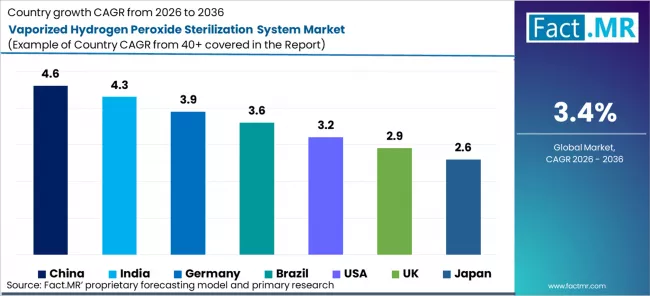
Vaporized Hydrogen Peroxide Sterilization System Market Cagr Analysis By Country | Source: Fact.MR
| Country | CAGR |
|---|---|
| China | 4.6% |
| India | 4.3% |
| Germany | 3.9% |
| Brazil | 3.6% |
| United States | 3.2% |
| United Kingdom | 2.9% |
| Japan | 2.6% |
Source: Fact.MR analysis. Updated Feb 24, 2026
Source: Fact.MR analysis, based on proprietary forecasting models and primary research.
Asia Pacific Vaporized Hydrogen Peroxide Sterilization System Market Analysis
Asia Pacific operates as a hospital and pharmaceutical compliance driven market for vaporized hydrogen peroxide sterilization systems supported by expanding healthcare infrastructure and stricter infection control protocols. Demand is shaped by national sterilization standards hospital accreditation requirements and pharmaceutical cleanroom regulations. Adoption is concentrated in tertiary hospitals medical device manufacturing units and drug production facilities. Regional growth reflects increased surgical volumes regulatory enforcement of low temperature sterilization methods and gradual replacement of legacy ethylene oxide systems across healthcare and life science facilities.
- China: Demand for vaporized hydrogen peroxide sterilization systems in China is projected to rise at 4.6% CAGR through 2036. Adoption is driven by hospital infection control requirements and pharmaceutical manufacturing compliance with national sterilization standards, as per Fact.MR.
- India: Demand for vaporized hydrogen peroxide sterilization systems in India is projected to rise at 4.3% CAGR through 2036. Usage is linked to hospital accreditation norms and expansion of pharmaceutical cleanroom facilities, according to Fact.MR.
- Japan: Demand for vaporized hydrogen peroxide sterilization systems in Japan is projected to rise at 2.6% CAGR through 2036. Adoption reflects stable hospital sterilization practices and compliance with medical device reprocessing standards, as per Fact.MR.
Fact.MR’s analysis of the Vaporized Hydrogen Peroxide Sterilization System Market in Asia Pacific consists of country-wise assessment that includes China, India, and Japan. Readers can find hospital sterilization standards, regulatory requirements, and facility-level adoption trends.
Europe Vaporized Hydrogen Peroxide Sterilization System Market Analysis
Europe functions as a regulation led sterilization technology market shaped by harmonized medical device rules and hospital hygiene standards. Demand is governed by MDR compliance national infection prevention guidelines and hospital procurement frameworks. Adoption is centered in public hospitals pharmaceutical production sites and research laboratories. Market activity reflects replacement of high temperature and chemical sterilization methods procedural volume growth and enforcement of occupational safety and environmental regulations across Western and Northern European healthcare systems supported by standardized compliance audits.
- Germany: Demand for vaporized hydrogen peroxide sterilization systems in Germany is projected to rise at 3.9% CAGR through 2036. Usage is driven by hospital hygiene regulations and MDR aligned sterilization requirements, according to Fact.MR.
- United Kingdom: Demand for vaporized hydrogen peroxide sterilization systems in the United Kingdom is projected to rise at 2.9% CAGR through 2036. Adoption follows NHS infection control standards and centralized hospital procurement processes, as per Fact.MR.
Fact.MR’s analysis of the Vaporized Hydrogen Peroxide Sterilization System Market in Europe consists of country-wise assessment that includes Germany and the United Kingdom. Readers can find regulatory compliance requirements hospital procurement models and sterilization protocol references.
North America Vaporized Hydrogen Peroxide Sterilization System Market Analysis
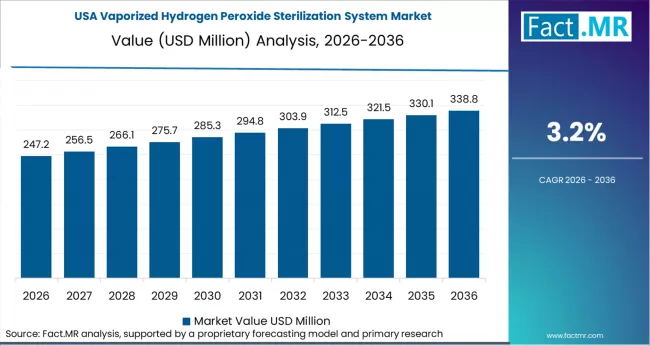
Vaporized Hydrogen Peroxide Sterilization System Market Country Value Analysis | Source: Fact.MR
North America operates as a standards and accreditation driven sterilization systems market supported by stringent infection control oversight and established hospital infrastructure. Demand is governed by regulatory approvals accreditation requirements and facility level sterilization validation protocols. Adoption is widespread across hospitals pharmaceutical plants and medical device manufacturers. Market development reflects replacement of legacy sterilization technologies increased outpatient surgical volumes and emphasis on low temperature methods compatible with complex medical instruments within regulated healthcare environments nationwide consistently.
- United States: Demand for vaporized hydrogen peroxide sterilization systems in the United States is projected to rise at 3.2% CAGR through 2036. Usage is supported by hospital accreditation requirements and adoption across medical device reprocessing facilities, as per Fact.MR.
Fact.MR’s analysis of the Vaporized Hydrogen Peroxide Sterilization System Market in North America consists of country-wise assessment that includes the United States. Readers can find accreditation standards regulatory approvals and facility adoption trends.
Latin America Vaporized Hydrogen Peroxide Sterilization System Market Analysis
Latin America functions as a developing sterilization systems market driven by hospital modernization and strengthening infection control policies. Demand is influenced by national health regulations hospital accreditation expansion and pharmaceutical manufacturing growth. Adoption is concentrated in large urban hospitals and drug production facilities. Market growth reflects gradual replacement of traditional sterilization methods increasing surgical procedures and rising compliance expectations within public and private healthcare systems across major regional economies supported by ongoing infrastructure investment.
- Brazil: Demand for vaporized hydrogen peroxide sterilization systems in Brazil is projected to rise at 3.6% CAGR through 2036. Adoption is supported by hospital infection control initiatives and pharmaceutical facility compliance requirements, as per Fact.MR.
Fact.MR’s analysis of the Vaporized Hydrogen Peroxide Sterilization System Market in Latin America consists of country-wise assessment that includes Brazil. Readers can find healthcare investment trends regulatory approvals and sterilization adoption references.
Competitive Landscape of Vaporized Hydrogen Peroxide Sterilization System Market
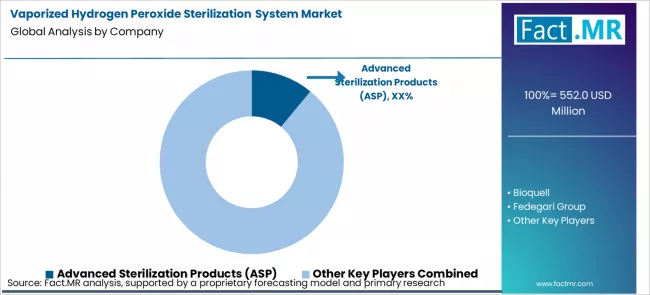
Vaporized Hydrogen Peroxide Sterilization System Market Analysis By Company | Source: Fact.MR
As per Fact.MR analysis, the 2026 vaporized hydrogen peroxide (VHP) sterilization system market is defined by validated sterilization efficacy, compliance with global safety standards, and integration with healthcare workflows, which determine competitive advantage. Advanced Sterilization Products (ASP) and Bioquell lead with high-capacity, validated VHP units that maintain consistent microbial inactivation, which strengthens adoption in hospitals, laboratories, and pharmaceutical manufacturing. Fedegari Group and Getinge focus on modular sterilizers with documented cycle reproducibility and load penetration, which reduces operational risk and enhances regulatory acceptance. Steelco S.p.A. and STERIS Life Sciences provide automated monitoring and system validation tools, which improve procedural reliability and reduce human error. Shinva and Van der Stahl Scientific offer validated VHP systems for small- to medium-scale facilities, which increases accessibility in emerging markets. STERIS AST and Stryker emphasize multi-region compliance and integration with decontamination workflows, which strengthens OEM partnerships and end-user confidence. Across the market, validated sterilization performance, regulatory adherence, and operational integration form enduring competitive moats, reducing reliance on price or isolated system claims.
Recent Industry Developments
- STERIS: V-PRO™ 3D-Printing Validation: As of early 2026, STERIS has expanded the validated material list for its V-PRO™ Low Temperature Sterilizers to include over 43 unique materials. A major recent milestone is the validation of select 3D-printed medical devices and instruments containing tungsten carbide and ceramics, making STERIS a leader in the sterilization of custom-manufactured orthopedic implants. [6]
- Bioquell (Ecolab): Rapid Biodecontamination (RB) Systems: In late 2025, Bioquell introduced an updated fixed-room VHP biodecontamination system designed for pharmaceutical cleanrooms. The new development features "Flash Evaporation" technology that reduces cycle times by 20% compared to previous models, specifically targeting the rapid turnover of vaccine production facilities and high-containment laboratories. [7]
Key Players in Vaporized Hydrogen Peroxide Sterilization System Market
- Advanced Sterilization Products (ASP)
- Bioquell
- Fedegari Group
- Getinge
- Steelco S.p.A.
- STERIS Life Sciences
- Shinva
- Van der Stahl Scientific
- STERIS AST
- Stryker
Bibliography
- [1] U.S. Food and Drug Administration. (2024). Medical devices: Sterilizers and reprocessors. Center for Devices and Radiological Health, U.S. Department of Health and Human Services.
- [2] Centers for Disease Control and Prevention. (2024). Infection control guidelines for healthcare settings. U.S. Department of Health and Human Services.
- [3] U.S. Food and Drug Administration. (2024). Overview of medical device regulatory requirements. Center for Devices and Radiological Health, U.S. Department of Health and Human Services.
- [4] U.S. Food and Drug Administration. (2024). Current good manufacturing practice (CGMP) regulations for drugs. U.S. Department of Health and Human Services.
- [5] Centers for Disease Control and Prevention. (2023). Biosafety in microbiological and biomedical laboratories (6th ed.). U.S. Department of Health and Human Services.
- [6] STERIS plc. (2026). V-PRO™ low temperature sterilization systems: Material compatibility and validation updates. STERIS Life Sciences - Product Documentation.
- [7] Bioquell (Ecolab Inc.). (2025). Rapid biodecontamination (RB) vaporized hydrogen peroxide systems for pharmaceutical cleanrooms. Bioquell Global Product Announcements.
Segmentation
Scope of the Report
| Metric | Value |
|---|---|
| Quantitative Units | USD 552 million (2026) to USD 770 million (2036), at a CAGR of 3.4% |
| Market Definition | The vaporized hydrogen peroxide (VHP) sterilization system market covers low temperature sterilization equipment used to eliminate microorganisms on medical devices, instruments, and enclosed spaces without using high heat. Systems convert liquid H₂O₂ into vapor and distribute it across sealed chambers, suitable for heat- and moisture-sensitive equipment in healthcare and life science facilities. |
| System Type Segmentation | Fixed Type, Mobile Type, Others |
| Application Segmentation | Pharmaceutical & Biotech, Food & Beverage, Others |
| Regions Covered | Asia Pacific, Europe, North America, Latin America, Middle East & Africa |
| Countries Covered | India, China, Japan, South Korea, Indonesia, Australia & New Zealand, ASEAN, Rest of Asia Pacific, Germany, Italy, France, United Kingdom, Spain, Benelux, Nordics, Central & Eastern Europe, Rest of Europe, United States, Canada, Mexico, Brazil, Argentina, Chile, Rest of Latin America, Kingdom of Saudi Arabia, United Arab Emirates, South Africa, Turkey, Rest of Middle East & Africa |
| Key Companies Profiled | Advanced Sterilization Products (ASP), Bioquell, Fedegari Group, Getinge, Steelco S.p.A., STERIS Life Sciences, Shinva, Van der Stahl Scientific, STERIS AST, Stryker |
| Forecast Period | 2026 to 2036 |
| Approach | Hybrid top-down and bottom-up modeling validated through primary interviews with sterilization system manufacturers, hospital sterile processing managers, clinical engineers, and infection prevention specialists. Market sizing supported by facility counts, instrument reprocessing volumes, system installation rates, and alignment with FDA and CDC sterilization guidance. |
Source: Fact.MR analysis. Updated Feb 24, 2026
Vaporized Hydrogen Peroxide Sterilization System Market Analysis by Segments
-
System Type :
- Fixed Type
- Mobile Type
- Others
-
Application :
- Pharmaceutical and Biotech
- Food and Beverage
- Others
-
Region :
- Asia Pacific
- India
- China
- Japan
- South Korea
- Indonesia
- Australia & New Zealand
- ASEAN
- Rest of Asia Pacific
- Europe
- Germany
- Italy
- France
- United Kingdom
- Spain
- Benelux
- Nordics
- Central & Eastern Europe
- Rest of Europe
- North America
- United States
- Canada
- Mexico
- Latin America
- Brazil
- Argentina
- Chile
- Rest of Latin America
- Middle East & Africa
- Kingdom of Saudi Arabia
- United Arab Emirates
- South Africa
- Turkey
- Rest of Middle East & Africa
- Asia Pacific
Frequently Asked Questions
What is the estimated size of the vaporized hydrogen peroxide sterilization system market in 2026?
What is the projected market value by 2036?
What CAGR is expected during the 2026–2036 forecast period?
What was the market value in 2025?
How much absolute value is expected to be added over the forecast horizon?
What are the primary factors governing demand for VHP sterilization systems?
Which system type dominates the market?
Why do fixed VHP systems hold the largest share?
Which application segment leads market demand?
What drives adoption in pharmaceutical and biotech facilities?
Which country shows the fastest growth rate?
What is driving growth in China?
How fast is the Indian market expected to grow?
What is the growth outlook for Germany?
How do mature markets such as the United States perform?
Why is growth more moderate in Japan?
What supports early-period growth in the forecast window?
What factors influence mid-period market performance?
What shapes value realization in the later years of the forecast?
What strategic focus areas are important for suppliers in this market?
Who worked on this report


Preview the report firsthand - request a free sample
Free SampleGet the brochure for pricing and purchase details
Download PDF