- Market Value (2025): USD 6.9 Bn
- Estimated Value (2026): USD 7.5 Bn
- Forecast Value (2036): USD 16.2 Bn
- CAGR (2026-2036): 8.0%
What is the Veterinary CRO CDMO Market forecast to be worth by 2036?
USD 7.5 billion in 2026 to USD 16.2 billion by 2036 at 8.0% CAGR.
- The veterinary CRO CDMO market reached USD 6.9 billion in 2025 as animal health companies outsourced more study design and formulation work.
- Demand is projected to increase from USD 7.5 billion in 2026 to USD 16.2 billion by 2036.
- The market is forecast to record 8.0% CAGR from 2026 to 2036 owing to livestock health pipelines and stricter proof before filing.
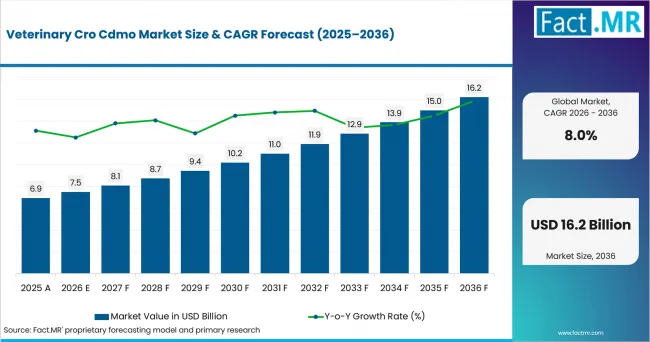
Veterinary Cro Cdmo Market Value Analysis | Source: Fact.MR
What are the defining numbers behind Veterinary CRO CDMO Market growth?
USD 8.7 billion absolute opportunity by 2036.
- Demand Drivers in the Market
- Livestock programs need partners that understand herd protocols and farm-based study execution.
- Development services gain weight when sponsors need formulation work and regulatory planning before clinical activity.
- Medicines remain the main application because veterinary drugs need clear proof for species and dose form.
- Direct Contracting is expected to appeal to sponsors that want one accountable provider from development through scale-up. This route also fits animal drug compounding work.
- Key Segments Analyzed
- By Animal Type: Livestock Animals are projected to hold 57.9% share in 2026 because cattle and swine programs need planned field work.
- By Service Type: Development is expected to account for 35.9% share in 2026 as sponsors test formulation and safety needs early.
- By Application: Medicines are anticipated to capture 40.3% share in 2026 since veterinary drugs carry the deepest filing work.
- By End Use: Pharmaceutical and Animal Health Companies are forecast to hold 29.9% share in 2026 as main product sponsors.
- By Distribution Channel: Direct Contracting is estimated to represent 30.6% share in 2026 due to accountability needs during research and scale-up.
- Analyst Opinion at Fact.MR
- Shambhu Nath Jha, Principal Consultant at Fact.MR, states, “Veterinary CRO CDMO growth is expected to depend on animal-specific trial design and dependable service execution. Sponsors are expected to prefer partners that reduce approval risk instead of partners that only offer capacity.”
- Strategic Implications
- Animal health companies should define the target species and endpoint before choosing a CRO/CDMO partner. This reduces repeat work during product development.
- Service providers are expected to connect formulation work with trial execution and manufacturing transfer. This helps veterinary infectious disease diagnostics avoid gaps between evidence and production.
- Investors should separate broad outsourcing from companion animal medicine and livestock specialist capacity. The stronger case comes from field research and regulatory knowledge.
Brazil is projected at 5.6% CAGR from 2026 to 2036. Germany is projected at 8.8%. Australia is forecast at 6.4%. USA is anticipated to record 10.4%. UK is estimated at 8.0%. Canada is projected at 7.2%. Japan is forecast at 9.6%.
How does the Veterinary CRO CDMO Market break down by segment?
Livestock Animals are expected to lead Animal Type at 57.9% share in 2026. Development is projected to lead Service Type at 35.9% share in 2026.
Which animal type dominates?
Livestock Animals are projected to account for 57.9% share in 2026.
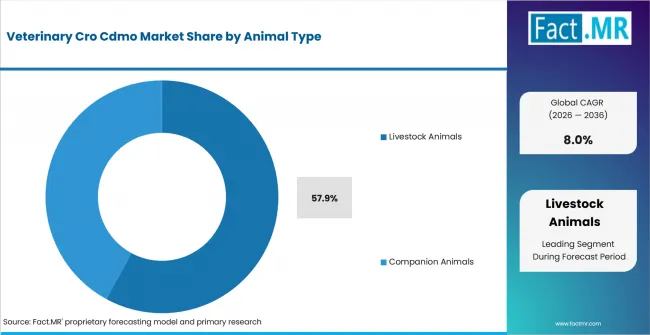
Veterinary Cro Cdmo Market Analysis By Animal Type | Source: Fact.MR
Livestock Animals lead because herd programs need planned field work. Cattle and Swine remain central to evidence work. Companion Animals support clinic-based study demand.
What leads the Service Type segment?
Development is expected to hold 35.9% share in 2026.
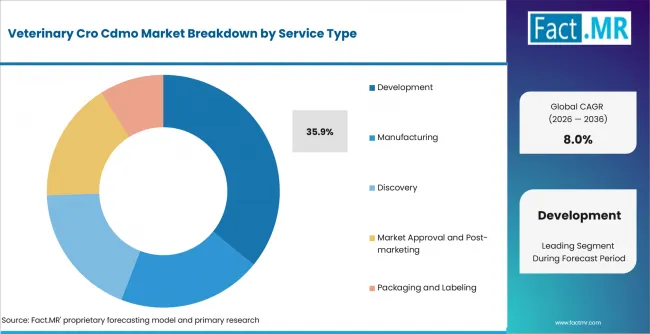
Veterinary Cro Cdmo Market Analysis By Service Type | Source: Fact.MR
Development leads because sponsors need proof before scale-up. Preclinical Development and Clinical Development remain important when safety or field evidence must be built.
How does Application shape demand?
Medicines are anticipated to lead with 40.3% share in 2026.
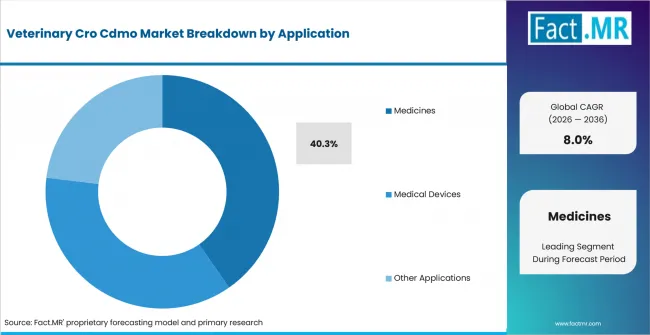
Veterinary Cro Cdmo Market Analysis By Application | Source: Fact.MR
Medicines lead because veterinary drugs and biologics need product-specific proof. Medical Devices and animal nutrition products create selective demand where documentation controls acceptance.
What supports Pharmaceutical and Animal Health Companies within End Use?
Pharmaceutical and Animal Health Companies are forecast to hold 29.9% share in 2026.
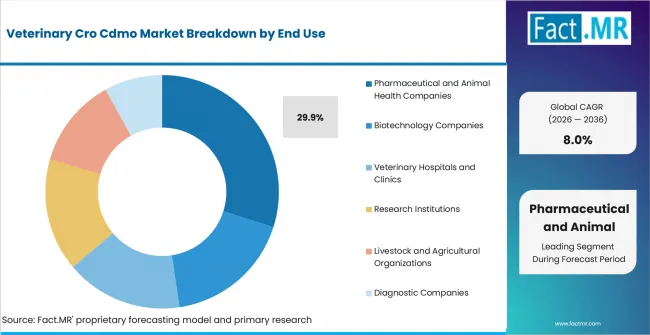
Veterinary Cro Cdmo Market Analysis By End Use | Source: Fact.MR
These companies lead because they sponsor the main product development work. Veterinary hospitals and research institutions matter when access to animals or field sites is central.
What supports Direct Contracting within Distribution Channel?
Direct Contracting is estimated to represent 30.6% share in 2026.
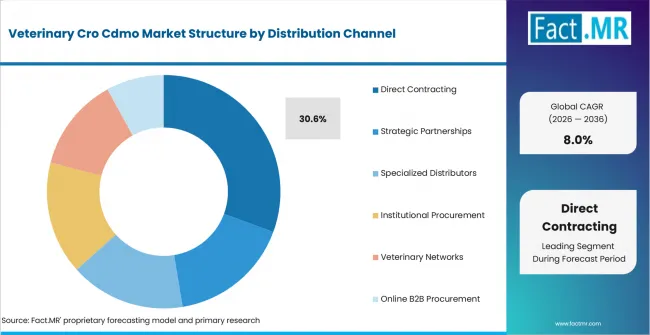
Veterinary Cro Cdmo Market Analysis By Distribution Channel | Source: Fact.MR
Direct Contracting leads because sponsors want clearer accountability during study design and scale-up. Strategic Partnerships fit repeat programs where the same technical team handles several stages.
What is accelerating Veterinary CRO CDMO Market adoption, and what is holding it back?
Demand is expected to rise through livestock product development and greater use of outside technical support. Growth may be limited by validation work and limited animal-health capacity.
Drivers Impact Analysis
| DRIVER | (~) % IMPACT ON CAGR | GEOGRAPHIC RELEVANCE | IMPACT TIMELINE |
|---|---|---|---|
| Livestock animal study volume | +1.8% | Brazil, USA, Germany | Short term (<= 2 years) |
| Development outsourcing need | +1.5% | Germany, UK, USA | Short term (<= 2 years) |
| Medicine dossier complexity | +1.2% | Brazil, Australia, Canada | Medium term (2-4 years) |
| Direct contracting preference | +0.9% | USA, UK, Germany | Medium term (2-4 years) |
| Regulatory and scale-up support | +0.6% | Japan and mature animal health markets | Long term (>= 4 years) |
Source: Fact.MR analysis. Updated Aug 3, 2026
- Livestock animal study volume: Larger cattle and swine programs are expected to increase the value of field protocols and species-specific proof. These controls matter for animal model services where study quality depends on consistent species handling.
- Development outsourcing need: Sponsors are expected to outsource formulation and regulatory planning when internal teams lack animal-health depth.
- Medicine dossier complexity: Veterinary medicines require proof around species and dose form. This makes documentation support commercially useful.
Opportunity Impact Analysis
| OPPORTUNITY | (~) % IMPACT ON CAGR | GEOGRAPHIC RELEVANCE | IMPACT TIMELINE |
|---|---|---|---|
| Integrated development packages | +0.8% | Brazil and Germany | Medium term (2-4 years) |
| Animal health biologics support | +0.7% | USA, UK, Japan | Medium term (2-4 years) |
| Field-trial network expansion | +0.6% | Brazil and Australia | Medium term (2-4 years) |
| Post-approval service programs | +0.4% | Canada and mature markets | Long term (>= 4 years) |
Source: Fact.MR analysis. Updated Aug 3, 2026
- Integrated development packages: Companies that combine formulation and regulatory writing are expected to reduce handoff risk for sponsors.
- Animal health biologics support: Biologic veterinary products are expected to create more need for specialist testing and active pharmaceutical ingredient CDMO support.
- Field-trial network expansion: CRO networks with farm and clinic access are expected to improve project timing in livestock-heavy markets.
Restraints Impact Analysis
| RESTRAINT | (~) % IMPACT ON CAGR | GEOGRAPHIC RELEVANCE | IMPACT TIMELINE |
|---|---|---|---|
| Validation burden for livestock programs | -1.0% | Brazil and Australia | Short term (<= 2 years) |
| Price sensitivity around development | -0.8% | Germany, UK, Canada | Short term (<= 2 years) |
| Limited animal-health specialist capacity | -0.6% | Japan and smaller markets | Medium term (2-4 years) |
| Manufacturing transfer risk | -0.4% | Global | Long term (>= 4 years) |
Source: Fact.MR analysis. Updated Aug 3, 2026
- Validation burden for livestock programs: Livestock studies carry operating risk because animal access and endpoint timing are hard to standardize.
- Price sensitivity around development: Smaller sponsors are expected to delay outsourcing when early work lacks a clear filing path.
- Limited animal-health specialist capacity: Project timing slows where providers lack species-specific investigators or veterinary regulatory experience.
Which countries are scaling Veterinary CRO CDMO Market fastest?
- Brazil leads through livestock-focused support and strong farm-level execution. Germany follows through technical review and early development services, while Australia benefits from dependable field coverage.
- The USA and UK hold the middle position through sponsor networks and regulatory planning. Canada grows steadily where broad service areas increase the value of reliable support.
- Japan advances more carefully as quality control and development records shape partner selection. Market entry depends on field access, provider depth and sponsor readiness.
The full report provides country-level CAGR analysis across North America and Latin America. It also covers Europe and East Asia. South Asia and Oceania complete the regional view with Middle East and Africa.
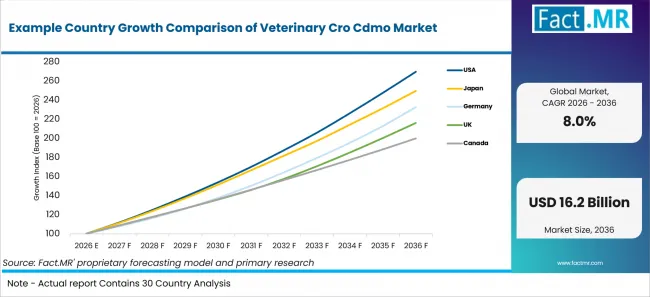
Example Country Growth Comparison Of Veterinary Cro Cdmo Market | Source: Fact.MR
| Country | CAGR (2026-2036) |
|---|---|
| Brazil | 5.6% |
| Germany | 8.8% |
| Australia | 6.4% |
| USA | 10.4% |
| UK | 8.0% |
| Canada | 7.2% |
| Japan | 9.6% |
Source: Fact.MR analysis. Updated Aug 3, 2026
What supports Brazil adoption?
5.6% CAGR, supported by livestock animal demand and stronger route-to-market execution.
Brazil’s growth reflects livestock programs that need field study access. Sponsors are expected to favor partners that understand farm protocols before medicines move into wider use.
How is Germany scaling demand?
8.8% CAGR, driven by development service needs and technical evidence review.
Germany’s growth depends on formulation and safety review. Providers gain projects when they reduce evidence gaps before clinical development.
What is driving Australia’s growth from 2026 to 2036?
6.4% CAGR, backed by service coverage and field-trial execution needs.
Australia’s growth is shaped by distance-sensitive operations. CRO/CDMO partners gain preference when they maintain study continuity across livestock sites.
How is the USA developing demand?
10.4% CAGR, supported by animal drug development and established sponsor networks.
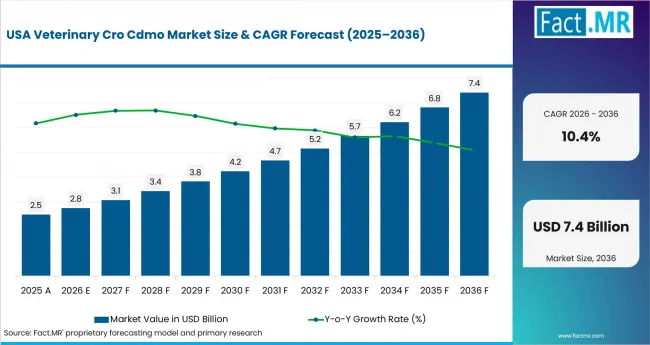
Veterinary Cro Cdmo Market Country Value Analysis | Source: Fact.MR
The USA’s growth reflects sponsor need for strong filing documentation. Direct Contracting gives clearer accountability for development tasks.
How does the UK perform?
8.0% CAGR, led by regulatory planning and partner accountability.
The UK’s growth reflects careful review of evidence and outsourcing value. Regulatory knowledge helps providers win sponsor confidence.
What supports Canada’s growth?
7.2% CAGR, backed by livestock animal work and demand for service coverage.
Canada’s growth is steady because customers need support across wide service areas. Adoption stays selective when sponsors compare field access.
What supports Japan’s growth?
9.6% CAGR, supported by quality expectations and development control.
Japan’s growth reflects high weight on quality control and documentation. CRO/CDMO partners gain work when they show careful development control.
Who leads the Veterinary CRO CDMO Market?
Charles River Laboratories and Vetio Animal Health show the clearest direct relevance, while Clinglobal and Argenta strengthen the wider veterinary research and manufacturing landscape.
Charles River Laboratories supports veterinary product development through preclinical research, safety testing and laboratory services. Vetio Animal Health contributes formulation, manufacturing and commercialization support for animal health products. Clinglobal, through Clinvet and Clinaxel, adds veterinary clinical research and field-trial capabilities. Argenta, including KLIFOVET, strengthens development, regulatory and manufacturing support. Knoell Animal Health and Triveritas extend the field through regulatory consulting and product-development services. Veterinary Research Management, VETSPIN and CEBIPHAR broaden coverage through study execution, testing and specialized veterinary research support.
Which companies are the key providers?
Key companies include Charles River Laboratories; Vetio Animal Health; Clinglobal Group (Clinvet and Clinaxel); Argenta, including KLIFOVET GmbH; Knoell Animal Health, including Triveritas; Veterinary Research Management; VETSPIN SRL; CEBIPHAR
- Charles River Laboratories
- Vetio Animal Health
- Clinglobal Group (Clinvet and Clinaxel)
- Argenta, including KLIFOVET GmbH
- Knoell Animal Health, including Triveritas
- Veterinary Research Management
- VETSPIN SRL
- CEBIPHAR
Bibliography
- Argenta. (2024, October 15). Argenta acquires Shawnee sterile fill-finish manufacturing site dedicated to animal health.
- Clinglobal. (2024, October 2). Clinglobal Welcomes OCRvet to the Team!
- U.S. Food and Drug Administration. (2025, July 29). FDA Announces FY 2026 Animal Drug User Fee Rates for ADUFA and AGDUFA.
This Report Answers
- The report provides strategic intelligence on Veterinary CRO CDMO demand across Animal Type and Service Type choices. Adjacent veterinary hematology analyzers show how evidence quality affects clinical acceptance.
- Segment analysis covers Livestock Animals and Development as the share leaders within the 2026 market structure.
- Country outlook compares Brazil and Germany with Australia. USA and UK form the middle group. Canada and Japan complete the growth comparison.
- Competitive analysis profiles Charles River Laboratories and Vetio Animal Health alongside Clinvet and KLIFOVET. Knoell Animal Health, including Triveritas and Veterinary Research Management are included. VETSPIN SRL and Inotiv complete the provider set.
- Service assessment covers Development and Direct Contracting. Manufacturing and clinical development complete the service view alongside regulatory submissions and packaging.
What does the Veterinary CRO CDMO Market cover?
Veterinary CRO CDMO services support animal health sponsors from early development to commercial readiness where study design and manufacturing transfer decide approval progress.
What does the Veterinary CRO CDMO Market cover?
Veterinary CRO CDMO services support animal health sponsors from early development to commercial readiness.
What is included in the scope?
Veterinary CRO CDMO services are used by Pharmaceutical and Animal Health Companies. Biotechnology Companies and veterinary hospitals are included when they purchase outsourced support.
The scope includes Animal Type and Service Type alongside Application and End Use. Distribution Channel and Region complete the structure. Coverage includes development and manufacturing. Market approval and packaging are included.
What is excluded from the scope?
General healthcare outsourcing without a veterinary use case remains outside the scope of this market.
The scope excludes services that do not support veterinary product research or development. Pet retail products without service demand are excluded.
How Was the Analysis Built?
The analysis draws on 120+ sources and 35+ company portfolios. It also reviews 25+ countries and more than 20 industry interviews.
- Primary Research: Primary research includes discussions with manufacturers and service providers. It also covers technology developers and end users. These conversations examine purchasing priorities and approval requirements.
- Desk Research: Desk research covers government statistics and regulatory publications. It also reviews company filings and trade data.
- Market Sizing and Forecasting: Market estimates combine historical performance and demand indicators. Pricing trends and segment shares are reviewed with company participation.
- Data Validation and Update Cycle: Findings are validated by comparing interviews with public data. Company activity and regulatory changes are reviewed during the same pass.
Segmentation
What is the report’s scope and coverage?
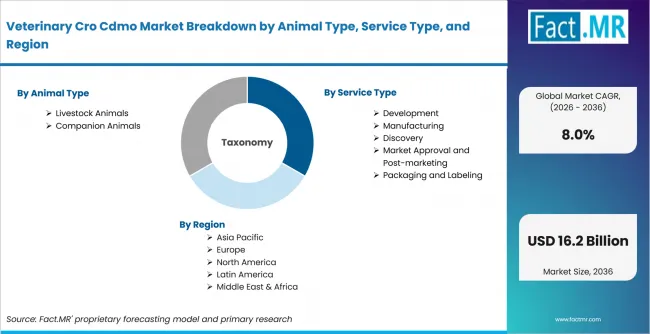
Veterinary Cro Cdmo Market Breakdown By Animal Type, Service Type, And Region | Source: Fact.MR
| Attribute | Details |
|---|---|
| Quantitative Units | USD billion in 2026 to USD billion by 2036 at CAGR |
| Market Definition | Outsourced research, development, manufacturing, regulatory, and packaging services used for veterinary medicines, biologics, devices, and animal health products |
| Animal Type | Livestock Animals; Cattle; Swine; Companion Animals; Dogs; Cats |
| Service Type | Development; Preclinical and Clinical Development; Manufacturing; Discovery; Market Approval; Post-marketing; Packaging and Labeling |
| Application | Medicines; Pharmaceuticals; Biologics; Medical Devices; Diagnostic Devices; Therapeutic Devices; Animal Nutrition; Veterinary Wellness |
| End Use | Pharmaceutical and Animal Health Companies; Biotechnology Companies; Veterinary Hospitals; Research Institutions; Livestock Organizations; Diagnostic Companies |
| Distribution Channel | Direct Contracting; Long-term Agreements; Strategic Partnerships; Specialized Distributors; Institutional Procurement; Veterinary Networks; Online B2B Procurement |
| Regions Covered | North America; Latin America; Europe; East Asia; South Asia and Oceania; Middle East and Africa |
| Countries Covered | Brazil; Germany; Australia; USA; UK; Canada; Japan |
| Key Companies Profiled | Charles River Laboratories; Vetio Animal Health; Clinglobal Group (Clinvet and Clinaxel); Argenta, including KLIFOVET GmbH; Knoell Animal Health, including Triveritas; Veterinary Research Management; VETSPIN SRL; CEBIPHAR |
| Forecast Period | 2026 to 2036 |
| Approach | Hybrid top-down and bottom-up approach using service demand; development activity; field-trial needs; manufacturing transfer; regulatory review; country adoption patterns and company portfolio review |
Source: Fact.MR analysis. Updated Aug 3, 2026
How is the market segmented?
-
By Animal Type:
- Livestock Animals
- Cattle
- Swine
- Companion Animals
- Dogs
- Cats
- Livestock Animals
-
By Service Type:
- Development
- Preclinical Development
- Clinical Development
- Manufacturing
- API Manufacturing
- Finished Dose Manufacturing
- Discovery
- Target Identification
- Lead Identification and Optimization
- Market Approval and Post-marketing
- Regulatory Submissions
- Pharmacovigilance and Post-marketing Surveillance
- Packaging and Labeling
- Primary Packaging
- Secondary Packaging and Labeling
- Development
-
By Application:
- Medicines
- Pharmaceuticals
- Biologics
- Medical Devices
- Diagnostic Devices
- Therapeutic Devices
- Other Applications
- Animal Nutrition Products
- Veterinary Health and Wellness Products
- Medicines
-
By End Use:
- Pharmaceutical and Animal Health Companies
- Branded Animal Health Companies
- Generic Veterinary Pharmaceutical Companies
- Biotechnology Companies
- Veterinary Biotech Companies
- Animal Health Biologics Developers
- Veterinary Hospitals and Clinics
- Specialty Veterinary Hospitals
- Companion Animal Clinics
- Research Institutions
- Academic Veterinary Research Centers
- Government Research Institutes
- Livestock and Agricultural Organizations
- Livestock Health Programs
- Agricultural Research Organizations
- Diagnostic Companies
- Veterinary Diagnostic Manufacturers
- Animal Disease Testing Companies
- Pharmaceutical and Animal Health Companies
-
By Distribution Channel:
- Direct Contracting
- Direct Contracts with Animal Health Companies
- Long-term CRO/CDMO Agreements
- Strategic Partnerships
- Co-development Partnerships
- Licensing and Technology Partnerships
- Specialized Distributors
- Veterinary Pharmaceutical Distributors
- Animal Health Product Distributors
- Institutional Procurement
- Government Procurement Programs
- Research Institution Procurement
- Veterinary Networks
- Veterinary Hospital Networks
- Clinic and Practice Networks
- Online B2B Procurement
- Digital Procurement Platforms
- Online Industry Marketplaces
- Direct Contracting
-
By Region:
- North America
- Latin America
- Europe
- East Asia
- South Asia and Oceania
- Middle East and Africa
Frequently Asked Questions
Which Animal Type leads the market?
Which Service Type leads the market?
Which Application leads the market?
Which End Use leads the market?
Which Distribution Channel leads the market?
Which country records the highest listed CAGR?
What is the primary driver in this market?
What is the main restraint?
Why do Pharmaceutical and Animal Health Companies lead demand?
Who worked on this report


Preview the report firsthand - request a free sample
Free SampleGet the brochure for pricing and purchase details
Download PDF