- Base Value(2026): 3.7 Bn
- Estimated Value(2026): 3.7 Bn
- Forecast Value (2036): 6.7 Bn
- CAGR (2026 - 2036): 6.1%
Veterinary Metabolic Disease Treatment Market Forecast and Outlook 2026 to 2036
The global veterinary metabolic disease treatment market is projected to grow from USD 3.73 billion in 2026 to USD 6.75 billion by 2036, progressing at a CAGR of 6.1%. This market addresses critical metabolic disorders in livestock and companion animals, directly impacting animal welfare and farm productivity.
Key Takeaways from the Veterinary Metabolic Disease Treatment Market
- Market Value for 2026: USD 3.73 Billion
- Market Value for 2036: USD 6.75 Billion
- Forecast CAGR 2026 to 2036: 6.1%
- Leading Product Segment (2026): Hormonal Therapies (32.3%)
- Leading Application Segment (2026): Ketosis (36.1%)
- Leading End-User Segment (2026): Veterinary Clinics (43.7%)
- Key Growth Countries: India (7.7% CAGR), China (7.5% CAGR), Brazil (7.2% CAGR), USA (6.2% CAGR), UK (6.0% CAGR), Germany (6.0% CAGR), France (5.9% CAGR)
- Key Players in the Market: Zoetis Inc., MSD Animal Health, Bayer AG, Elanco Animal Health, Ceva Santé Animale
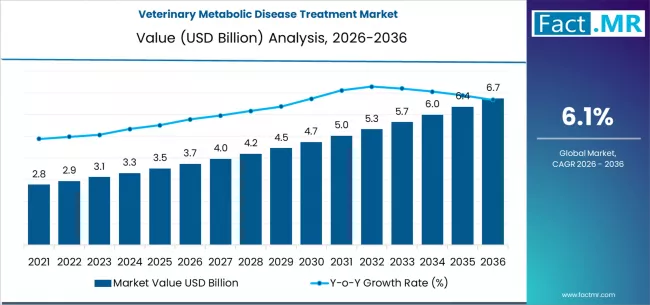
Veterinary Metabolic Disease Treatment Market Market Value Analysis | Source: Fact.MR
Growth is sustained by the intensification of global livestock production and rising health consciousness for pets. The financial impact of conditions like ketosis and milk fever on dairy operations creates a strong economic driver for treatment adoption.
Increasing prevalence of metabolic disorders in high-yield dairy cattle is a primary growth factor. Advances in targeted hormonal and nutritional therapies are improving treatment outcomes. The expansion of large-scale commercial farming in emerging economies necessitates effective herd health management.
Metric
| Metric | Value |
|---|---|
| Market Value (2026) | USD 3.73 Billion |
| Market Forecast Value (2036) | USD 6.75 Billion |
| Forecast CAGR 2026 to 2036 | 6.1% |
Source: Fact.MR analysis. Updated Jan 12, 2026
Category
| Category | Segments |
|---|---|
| Product | Hormonal Therapies, Nutritional Supplements, Injectable Therapeutics, Others |
| Application | Ketosis, Milk Fever, Fatty Liver Syndrome, Others |
| End User | Veterinary Clinics, Large Farms, Agro-Vet Distributors |
| Region | North America, Latin America, Western Europe, Eastern Europe, East Asia, South Asia & Pacific, Middle East & Africa |
Source: Fact.MR analysis. Updated Jan 12, 2026
Segmental Analysis
By Product, Which Segment Addresses Core Endocrine Dysfunctions?
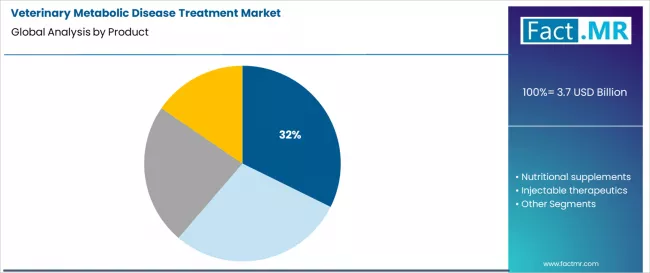
Veterinary Metabolic Disease Treatment Market Analysis By Product | Source: Fact.MR
Hormonal therapies command a leading 32.3% share. This segment is fundamental for treating metabolic diseases often rooted in endocrine imbalance, such as ketosis and milk fever in transition dairy cows.
These treatments work by directly regulating calcium metabolism, energy balance, and insulin function. Their critical role in rapidly stabilizing high-value animals during the vulnerable periparturient period solidifies their dominant market position.
By Application, Which Disorder Represents the Most Significant Production Loss?
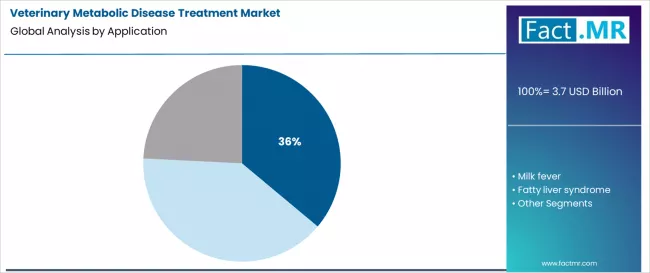
Veterinary Metabolic Disease Treatment Market Analysis By Application | Source: Fact.MR
Ketosis constitutes the primary application segment at 36.1%. This condition is a prevalent and costly metabolic disease in high-producing dairy herds worldwide. It leads to severe drops in milk yield, weight loss, and secondary health issues.
The high incidence rate and direct economic impact on farm revenue drive consistent, high-volume demand for preventative and therapeutic interventions, making it the core focus of the veterinary metabolic disease treatment market.
By End User, Which Channel is the Primary Access Point for Advanced Therapeutics?
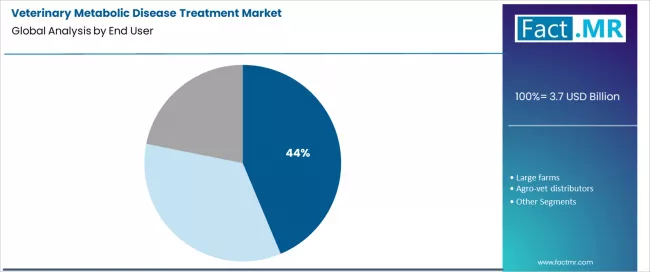
Veterinary Metabolic Disease Treatment Market Analysis By End User | Source: Fact.MR
Veterinary clinics form the leading end-user segment at 43.7%. These facilities are the primary site for diagnosis and prescription of advanced hormonal and injectable treatments for complex metabolic conditions.
Veterinarians provide crucial professional oversight for dosing and management, especially for valuable livestock. Their role ensures appropriate use of therapeutics and drives adoption of new treatment protocols.
What are the Principal Drivers, Constraints, and Evolving Dynamics of this Market?
| Factor | Market Influence |
|---|---|
| Intensification of Dairy and Livestock Production | Rising demand for animal protein pushes for higher-yielding breeds, which are more susceptible to metabolic disorders, creating a larger patient pool and greater financial incentive for treatment. |
| High Cost of Advanced Therapeutics | The development and approval of new hormonal or biologic treatments for animals is costly, limiting pipeline innovation. Price sensitivity in cost-conscious farming segments can also hinder adoption. |
| Expansion into Precision Livestock Farming and Preventive Care | Integration of metabolic treatments with digital health monitoring allows for early intervention and prophylactic care programs, moving from treatment to management. |
| Development of Combination and Sustained-Release Formulations | The trend is toward products that address multiple metabolic pathways simultaneously or provide prolonged therapeutic effect with a single administration, improving compliance and efficacy. |
Source: Fact.MR analysis. Updated Jan 12, 2026
Analysis of the Veterinary Metabolic Disease Treatment Market by Key Countries
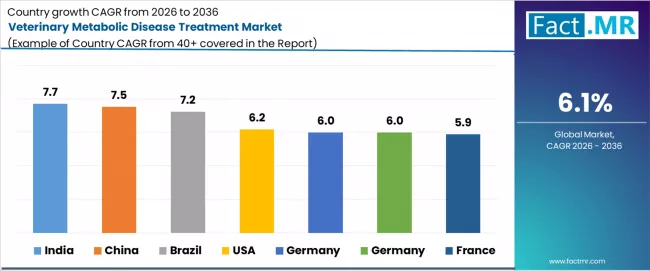
Veterinary Metabolic Disease Treatment Market CAGR Analysis By Country | Source: Fact.MR
| Country | CAGR 2026 to 2036 |
|---|---|
| India | 7.7% |
| China | 7.5% |
| Brazil | 7.2% |
| USA | 6.2% |
| UK | 6.0% |
| Germany | 6.0% |
| France | 5.9% |
Source: Fact.MR analysis. Updated Jan 12, 2026
Will the USA's Market Remain Centered on High-Yield Dairy Herd Management?
The USA’s 6.2% CAGR is deeply anchored in its large-scale, high-productivity dairy sector. The veterinary metabolic disease treatment market is driven by the economic imperative to manage transition cow disorders in herds with high genetic merit. Growth is focused on sophisticated monitoring systems paired with targeted hormonal therapies to protect substantial investment in each animal.
Does Brazil's Expansion as a Beef and Dairy Exporter Redefine Treatment Priorities?
Brazil’s 7.2% CAGR is fueled by its dual role as a major beef exporter and expanding dairy producer. Market growth uniquely addresses metabolic stresses in grass-fed beef systems and the rapid modernization of its dairy industry. Demand is for robust, cost-effective solutions suitable for extensive farming conditions, with a growing channel through large farms and agro-vet distributors.
Can China's Industrializing Livestock Sector Overcome Biosecurity-Driven Treatment Barriers?
China’s 7.5% CAGR is propelled by its shift towards consolidated, industrial-scale pig and dairy production. The veterinary metabolic disease treatment market faces the unique challenge of integrating metabolic care within strict national biosecurity and antibiotic reduction policies, driving demand for preventive nutritional supplements and licensed injectables.
Is India's Growth Catalysed by Dairy Intensification and Changing Farmer Economics?
India’s leading 7.7% CAGR is driven by the rapid transformation of its smallholder dairy sector into more intensive production models. As farmers invest in higher-yielding crossbred cattle, the incidence of metabolic disorders rises. This creates a vast, emerging market for both basic nutritional supplements and increasing use of injectable therapies, serviced by a growing network of veterinary clinics.
Will Germany's Precision Farming Ethos Shift the Market from Treatment to Prevention?
Germany’s 6.0% CAGR reflects a mature market where precision livestock farming is advanced. The focus is increasingly on using data from sensors to prevent metabolic diseases before clinical onset. This shifts the veterinary metabolic disease treatment market toward sophisticated nutritional management software and early-intervention products, rather than high-volume crisis treatment.
Does France's Leadership in Premium Dairy Genetics Fuel Demand for Specialized Therapeutics?
France’s 5.9% CAGR is closely linked to its high-value dairy sector focused on Protected Designation of Origin (PDO) cheeses. The market emphasizes specialized treatments for maintaining the health and productivity of specific breeds in traditional systems, supporting a niche for premium therapeutics and tailored veterinary services.
Is the UK's Market Evolution Tied to Welfare Standards and Antibiotic Stewardship?
Strong animal welfare regulations and strict antibiotic reduction targets influence the UK’s 6.0% CAGR. This environment drives the veterinary metabolic disease treatment market towards nutritional and hormonal interventions as first-line therapies to reduce secondary infections and maintain animal health within a regulated framework.
Competitive Landscape of the Veterinary Metabolic Disease Treatment Market
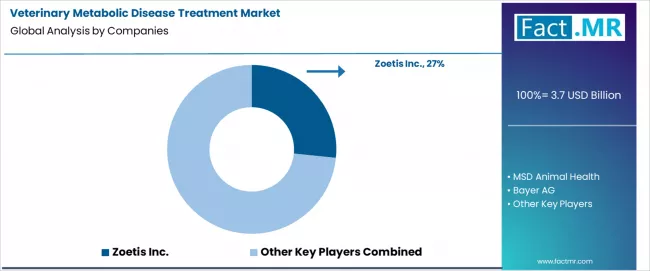
Veterinary Metabolic Disease Treatment Market Analysis By Company | Source: Fact.MR
The competitive landscape is consolidated among major global animal health corporations. These players compete through extensive R&D pipelines for patented hormonal and pharmaceutical treatments. They leverage strong relationships with large veterinary clinics and direct sales teams for key farm accounts.
Success depends on demonstrating clear return on investment through improved herd productivity and reduced cull rates. Competition is intensifying in emerging markets where local manufacturers offer generic nutritional supplements. Global players respond by forming partnerships with local distributors and developing region-specific product formulations. The ability to provide integrated solutions combining therapeutics, diagnostics, and technical herd management support is becoming a key differentiator.
Key Players in the Veterinary Metabolic Disease Treatment Market
- Zoetis Inc.
- MSD Animal Health
- Bayer AG
- Elanco Animal Health
- Ceva Santé Animale
Bibliography
- American Association of Bovine Practitioners (AABP). (2025).Clinical Guidelines for Metabolic Disease Management in Dairy Cattle.
- European Medicines Agency (EMA). (2024).Veterinary Regulatory Guidelines for Metabolic and Endocrine Therapies. EMA/CVMP.
- Food and Agriculture Organization (FAO). (2025).The Impact of Metabolic Disorders on Global Livestock Productivity. FAO Animal Production and Health Paper.
- World Organisation for Animal Health (WOAH). (2024).Terrestrial Animal Health Code: Chapter on Metabolic Diseases. WOAH.
Segmentation
Scope of Report
| Items | Metrics |
|---|---|
| Quantitative Units | USD Billion |
| Product | Hormonal Therapies, Nutritional Supplements, Injectable Therapeutics, Others |
| Application | Ketosis, Milk Fever, Fatty Liver Syndrome, Others |
| End User | Veterinary Clinics, Large Farms, Agro-Vet Distributors |
| Key Countries | India, China, Brazil, USA, Germany, France, UK |
| Key Companies | Zoetis, MSD Animal Health, Bayer, Elanco, Ceva, Others |
| Additional Analysis | Economic impact models of metabolic disease on herd profitability; analysis of residue and withdrawal periods for hormonal therapies; comparison of treatment protocols across different farming systems; study of market access and distribution challenges in emerging economies. |
Source: Fact.MR analysis. Updated Jan 12, 2026
Market by Segments
-
Product :
- Hormonal Therapies
- Nutritional Supplements
- Injectable Therapeutics
- Others
-
Application :
- Ketosis
- Milk Fever
- Fatty Liver Syndrome
- Others
-
End User :
- Veterinary Clinics
- Large Farms
- Agro-Vet Distributors
-
Region :
-
North America
- USA
- Canada
-
Latin America
- Brazil
- Mexico
- Argentina
- Rest of Latin America
-
Western Europe
- Germany
- France
- UK
- Italy
- Spain
- BENELUX
- Rest of Western Europe
-
Eastern Europe
- Russia
- Poland
- Czech Republic
- Rest of Eastern Europe
-
East Asia
- China
- Japan
- South Korea
- Rest of East Asia
-
South Asia & Pacific
- India
- ASEAN
- Australia
- Rest of South Asia & Pacific
-
MEA
- GCC Countries
- South Africa
- Turkiye
- Rest of MEA
-
Frequently Asked Questions
How big is the veterinary metabolic disease treatment market in 2026?
What will be the size of veterinary metabolic disease treatment market in 2036?
How much will be the veterinary metabolic disease treatment market growth between 2026 and 2036?
What are the key product types in the veterinary metabolic disease treatment market?
Which application segment to contribute significant share in the veterinary metabolic disease treatment market in 2026?
Who worked on this report


Preview the report firsthand - request a free sample
Free SampleGet the brochure for pricing and purchase details
Download PDF