- Market Value (2025): USD 600.0 Mn
- Estimated Value (2026): USD 600.0 Mn
- Forecast Value (2036): USD 1,100.0 Mn
- CAGR (2026-2036): 6.2%
What is the Veterinary Sterilization Container Market forecast to be worth by 2036?
USD 600.0 million in 2026 to USD 1,100.0 million by 2036, at 6.2% CAGR.
- The veterinary sterilization container market crossed USD 600.0 million in 2025 across hospitals and specialty veterinary practices.
- Demand is projected to increase from USD 600.0 million in 2026 to USD 1,100.0 million by 2036.
- The market is forecast to record a 6.2% CAGR from 2026 to 2036 as complex instrument sets require repeatable sterile barriers.
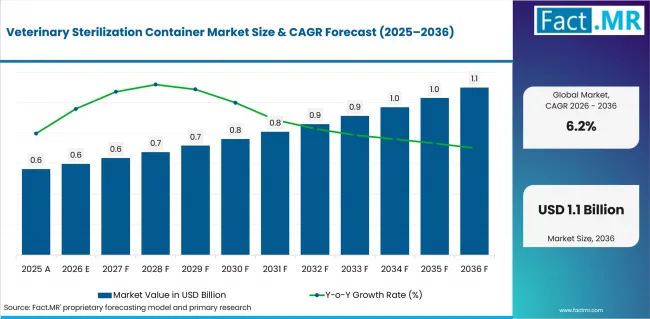
Veterinary Sterilization Container Market Value Analysis | Source: Fact.MR
What are the defining numbers behind Veterinary Sterilization Container Market growth?
USD 500.0 million absolute opportunity by 2036, led by Aluminum Containers and Surgical Instrument Sterilization alongside Veterinary Hospitals.
- Demand Drivers in the Market
- Veterinary referral hospitals need rigid enclosures that protect complete orthopedic sets during sterilization and clinical transfer.
- Specialty clinics require configurable baskets that keep delicate dental or endoscopic instruments organized throughout repeated processing cycles.
- Clinical operations teams need documented cycle compatibility since filters and load weight affect drying and aseptic presentation.
- Regional distributors need dependable spare components since damaged gaskets or missing filters disrupt scheduled veterinary procedures.
- Key Segments Analyzed
- By product: Aluminum sterilization containers are expected to account for 46.0% share in 2026, supported by reusable rigidity.
- By application: Surgical instrument sterilization is projected to represent 49.0% share in 2026, owing to recurring set processing.
- By end user: Veterinary hospitals are anticipated to capture 44.0% share in 2026, driven by multispecialty procedures.
- By distribution channel: Direct sales are estimated to hold 45.0% share in 2026, attributable to trial-load support.
- By sterilization method: Steam sterilization is forecast to garner 58.0% share in 2026, reinforced by installed autoclaves.
- Analyst Opinion at Fact.MR
- Shambhu Nath Jha, Sr. Consultant at Fact.MR, opines: “Container qualification depends on documented performance beyond basic material selection. Adoption is expected to favor manufacturers that define cycle limits and drying conditions for specific loads.”
- Strategic Implications
- Veterinary hospitals should map recurring instrument sets before approving container sizes across several clinical departments.
- Container manufacturers need to document sterilizer models and load limits before presenting cycle claims to clinical operations teams.
- Regional distributors must stock filters and seals locally so smaller clinics avoid lengthy procedure disruptions.
- Practice groups should compare wrap consumption and rework frequency across sites with different procedure volumes.
Competition is shifting toward systems that support documented instrument flow instead of functioning as passive rigid packaging. B. Braun’s AESCULAP Aicon sterile container documentation highlights synchronized container-and-basket handling and faster drying, reinforcing demand for validated reusable systems.
United States demand is expected to record 7.6% CAGR through 2036. FDA-cleared sterilization systems and direct technical support remain important for referral hospitals managing complex reusable surgical sets. Germany is projected to post 7.3% CAGR from 2026 to 2036, reinforced by reusable engineering. United Kingdom demand is anticipated to advance at 7.0% CAGR by 2036, owing to practice standards. Japan is estimated to register 6.7% CAGR over the assessment period, shaped by compact veterinary equipment workflows. Canada is forecast to expand at 6.4% CAGR across the forecast horizon, influenced by service distances.
How does the Veterinary Sterilization Container Market break down by segment?
Aluminum Sterilization Containers are projected to account for 46.0% share, Surgical Instrument Sterilization is estimated to garner 49.0% share.
Which product dominates?
Aluminum Sterilization Containers are expected to account for 46.0% share in 2026
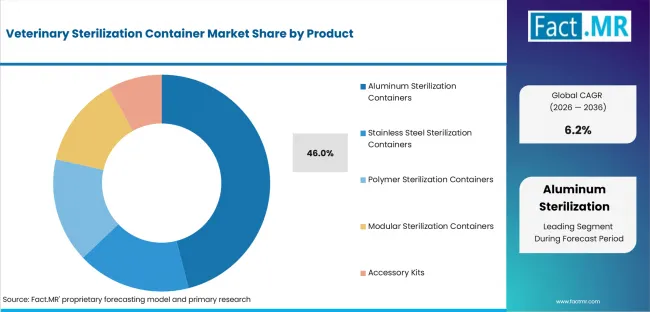
Veterinary Sterilization Container Market Analysis By Product | Source: Fact.MR
Based on product, aluminum sterilization containers are projected to account for 46.0% in 2026 due to reusable rigidity. Stainless steel serves heavy loads, while plastic composites support low-temperature sterile medical packaging and sterility indicators document release conditions.
What leads the application segment?
Surgical Instrument Sterilization is projected to represent 49.0% share in 2026
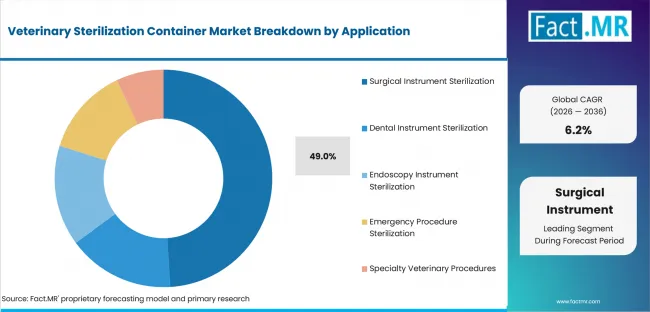
Veterinary Sterilization Container Market Analysis By Application | Source: Fact.MR
In 2026, surgical instrument sterilization is expected to lead application with 49.0% share because recurring sets require organized reprocessing. Dental cassettes support frequent procedures, while veterinary endoscopy enclosures protect sensitive components during processing and storage.
How does end user shape demand?
Veterinary Hospitals are anticipated to capture 44.0% share in 2026
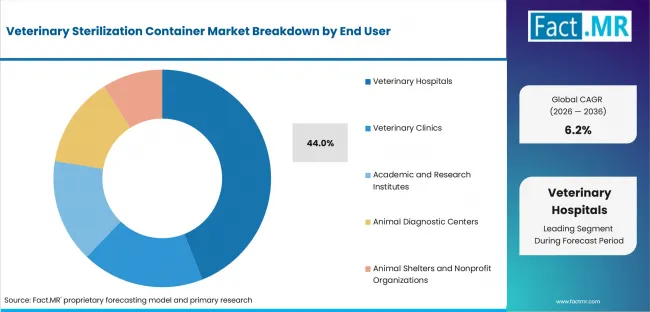
Veterinary Sterilization Container Market Analysis By End User | Source: Fact.MR
By end user, veterinary hospitals are estimated to hold 44.0% in 2026 owing to multispecialty procedure volume. Clinics favor smaller fleets, while academic centers pair veterinary imaging systems with supervised handling and reprocessing instruction.
What supports direct sales within distribution channel?
Direct Sales are estimated to hold 45.0% share in 2026
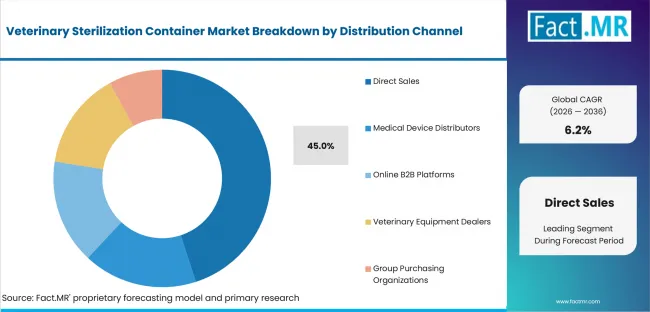
Veterinary Sterilization Container Market Analysis By Distribution Channel | Source: Fact.MR
The distribution channel is forecast to be led by direct sales at 45.0% in 2026 due to trial-load requirements. Distributors provide regional inventory, while hospital groups retain sterilization services for unusual loads beyond recurring fleets.
What drives steam sterilization within sterilization method?
Steam Sterilization is forecast to garner 58.0% share in 2026
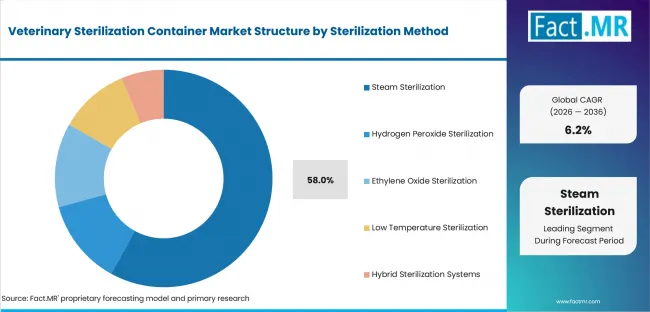
Veterinary Sterilization Container Market Analysis By Sterilization Method | Source: Fact.MR
Steam sterilization is projected to hold 58.0% share in 2026 owing to installed autoclaves and reusable instruments. Facilities use sterilization monitoring technologies, while hydrogen peroxide systems protect sensitive loads unable to tolerate steam exposure.
What is accelerating Veterinary Sterilization Container Market adoption, and what is holding it back?
Instrument-set complexity drives adoption, qualification burden restrains conversion, while clinic-scale modular fleets create the clearest commercial opening.
Drivers Impact Analysis
| DRIVER | (~) % IMPACT ON CAGR | GEOGRAPHIC RELEVANCE | IMPACT TIMELINE |
|---|---|---|---|
| Instrument-set complexity | +0.8% | North America and Europe | Medium term (2-4 years) |
| Infection-control documentation | +0.7% | Europe and North America | Medium term (2-4 years) |
| Reusable workflow economics | +0.5% | Global referral centers | Long term (>= 4 years) |
| Specialty procedure expansion | +0.4% | United States and Japan | Medium term (2-4 years) |
| Group-practice standardization | +0.3% | United States and United Kingdom | Long term (>= 4 years) |
Source: Fact.MR analysis. Updated Jul 31, 2026
- Instrument-set complexity: Referral hospitals need rigid baskets because orthopedic and emergency sets require organized movement throughout repeated sterile-processing cycles.
- Documented infection control: Written packaging and storage procedures reduce filter-placement variation across technicians working different clinical shifts.
- Reusable workflow economics: High-volume hospitals gain clearer payback when recurring wrap use and replacement costs exceed container maintenance expense.
- Specialty procedure expansion: Modular depths and dedicated holders protect dental, endoscopic, and powered instruments requiring different processing conditions.
Opportunity Impact Analysis
| OPPORTUNITY | (~) % IMPACT ON CAGR | GEOGRAPHIC RELEVANCE | IMPACT TIMELINE |
|---|---|---|---|
| Clinic-scale modular fleets | +0.5% | Europe and North America | Medium term (2-4 years) |
| Low-temperature compatibility | +0.4% | United States and Japan | Medium term (2-4 years) |
| Digital traceability | +0.4% | North America and Europe | Long term (>= 4 years) |
| Regional accessory networks | +0.3% | Canada and Australia | Short term (<= 2 years) |
Source: Fact.MR analysis. Updated Jul 31, 2026
- Clinic-scale modular fleets: Half-size containers and starter accessory kits reduce capital exposure for clinics processing smaller weekly instrument loads.
- Low-temperature compatibility: Method-specific enclosures protect powered tools and sensitive components during qualified cycles that cannot use repeated steam exposure.
- Digital traceability integration: Container labels and process indicators create audit records across recurring sterilization, storage, and instrument-transfer workflows.
Restraints Impact Analysis
| RESTRAINT | (~) % IMPACT ON CAGR | GEOGRAPHIC RELEVANCE | IMPACT TIMELINE |
|---|---|---|---|
| Qualification burden | -0.5% | Global veterinary facilities | Short term (<= 2 years) |
| Upfront capital exposure | -0.4% | Global independent clinics | Medium term (2-4 years) |
| Maintenance discipline | -0.3% | Canada and regional markets | Medium term (2-4 years) |
| Space and lifting constraints | -0.2% | Japan and urban Europe | Long term (>= 4 years) |
Source: Fact.MR analysis. Updated Jul 31, 2026
- Qualification burden: Facilities must match each container with approved sterilizers and instrument loads before updating written clinical procedures.
- Upfront capital exposure: Low procedure volume extends payback periods and weakens full-fleet conversion across smaller independent veterinary practices.
- Maintenance discipline: Damaged gaskets and incorrect filters compromise drying performance unless staff inspect components before every processing cycle.
- Space and lifting constraints: Compact clinics favor smaller containers because full-size loaded baskets increase storage and handling requirements.
Which countries are scaling Veterinary Sterilization Container Market fastest?
United States 7.6%, Germany 7.3%, United Kingdom 7.0%, Japan 6.7%, Canada 6.4%.
Regional analysis covers North America, Europe, Asia Pacific, Latin America, and the Middle East & Africa.
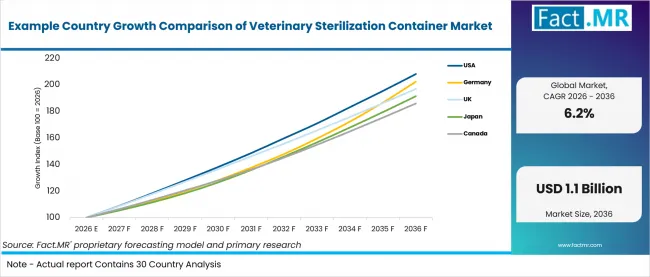
Example Country Growth Comparison Of Veterinary Sterilization Container Market | Source: Fact.MR
| COUNTRY | CAGR |
|---|---|
| United States | 7.6% |
| Germany | 7.3% |
| United Kingdom | 7.0% |
| Japan | 6.7% |
| Canada | 6.4% |
Source: Fact.MR analysis. Updated Jul 31, 2026
What is driving growth in the United States through 2036?
7.6% CAGR, driven by FDA-cleared systems and direct technical support.
United States referral hospitals require FDA-cleared systems and technical support for complex reusable surgical sets. The May 2025 ONE TRAY clearance confirms availability for defined hospital sterilization loads across national channels. Veterinary container demand in U.S. is expected to record 7.6% CAGR through 2036, although qualification and capital approval slow conversion.
How is Germany scaling veterinary sterilization container demand?
7.3% CAGR, supported by reusable engineering and organized service routes.
German veterinary facilities access domestic sterile-processing engineering and organized technical service across regional clinical networks. The June 2026 chamber update recorded 11,216 self-employed veterinarians, confirming a sizeable independent practice base. Sales in Germany are projected to expand at 7.3% CAGR through 2036, although smaller practices face payback pressure.
What supports the United Kingdom outlook?
7.0% CAGR, owing to auditable practice standards and hospital-group purchasing.
United Kingdom accreditation makes documented clinical governance visible across independent clinics and larger hospital groups. The July 2025 RCVS update covered more than 3,700 premises participating in the national standards framework. Market in UK is anticipated to advance at 7.0% CAGR by 2036, although practice scale delays conversion.
What underpins Japan’s growth?
6.7% CAGR, attributable to compact workflows and distributor-led support.
Compact Japanese clinics favor smaller containers and precise instructions supporting recurring processing cycles across limited spaces. The March 2026 agriculture ministry count recorded 17,200 animal medical facilities across the national clinical network. Sales in Japan are estimated to register 6.7% CAGR through 2036, although imported dimensions complicate adoption.
How is Canada developing veterinary sterilization container demand?
6.4% CAGR, reinforced by accredited facilities and regional inventory needs.
Canadian veterinary facilities require dependable regional inventory and replacement support across widely dispersed service territories. The March 2025 CVMA assessment counted 4,328 accredited practices, confirming a broad base of clinical accounts. Industry in Canada is forecast to post 6.4% CAGR through 2036, although remote service remains costly.
Who leads the Veterinary Sterilization Container Market?
B. Braun SE and STERIS plc lead direct container coverage, while Case Medical and Aygun strengthen method-specific validation capabilities.
Competition centers on integrated sterile-processing companies and specialists offering validated cycle claims across defined container platforms. Method compatibility, surgical instrument tracking, and replacement parts determine platform productivity throughout each service life. Specialist providers compete in compact formats, but broader systems retain an advantage during multisite standardization.
B. Braun and STERIS combine container families with technical service coverage across sterile-processing departments and clinical networks. Case Medical and Aygun offer method-specific configurations, while Stryker and HuFriedyGroup address powered tools and compact cassettes. Shinva combines containers with sterilization equipment, and competition is expected to emphasize local replacement support.
Which companies are the key providers?
Key providers include B. Braun SE and STERIS plc alongside Case Medical, Aygun, Stryker, Shinva, and HuFriedyGroup.
- B. Braun SE
- STERIS plc
- Case Medical, Inc.
- Aygun Surgical Instruments
- Stryker Corporation
- Shinva Medical Instrument Co., Ltd.
- HuFriedyGroup
Bibliography
- B. Braun. (2025, December 3).
- Bundestierärztekammer. (2026, June 1).
- Canadian Veterinary Medical Association. (2025, March 21).
- Ministry of Agriculture, Forestry and Fisheries. (2026, March 6).
- Royal College of Veterinary Surgeons. (2025, July 1).
- U.S. Food and Drug Administration. (2025, May 1).
This Report Addresses
- The report evaluates product and application choices shaping reusable sterile-barrier decisions across veterinary clinical facilities.
- Segment analysis covers aluminum containers and surgical instrument sterilization as the primary 2026 share positions.
- Regional outlook compares the United States and Germany with the United Kingdom, Japan, and Canada.
- Competitive analysis profiles seven active providers across integrated sterile-processing platforms and specialist container systems serving veterinary clinical facilities.
- Technology assessment covers aluminum, stainless steel, plastic composite, and modular systems across different processing conditions.
- Use-case assessment covers surgical, dental, endoscopic, and emergency instrument workflows across veterinary hospitals and specialty clinics.
What does the Veterinary Sterilization Container Market cover?
Aluminum and stainless steel containers alongside plastic composite and modular systems package reusable veterinary instruments during validated sterilization.
The market covers reusable rigid enclosures that organize veterinary instrument sets throughout validated processing cycles. Compatible baskets support surgical and dental workflows across hospitals and clinics managing recurring instrument procedures.
What is included in the scope?
Veterinary sterilization container systems support surgical and dental workflows alongside endoscopic, emergency, and research instrument processing.
The scope includes aluminum and stainless steel containers alongside plastic composite and modular container systems. Coverage spans surgical, dental, endoscopic, emergency, and research instrument workflows across veterinary hospitals or clinics. Direct and distributor channels remain included alongside validated steam and qualified low-temperature instrument-processing methods.
What is excluded from the scope?
Standalone sterilizers and disposable wraps or pouches remain outside the defined veterinary sterilization container market scope.
The scope excludes sterilizers sold without reusable container systems or compatible sterile-barrier components for instruments. Disposable wraps and pouches remain outside coverage unless designed specifically as reusable-container accessories for qualified processing cycles.
How was the analysis built?
The analysis draws on 120+ sources, 35+ company portfolios, 25+ countries, and more than 20 industry interviews.
- Primary Research: Primary research includes discussions with manufacturers, service providers, technology developers, distributors, end users, procurement teams, and subject-matter experts. These conversations examine purchasing priorities, product adoption, operational challenges, approval requirements, competitive positioning, and the factors that influence wider market acceptance.
- Desk Research: Desk research covers government statistics, regulatory publications, company filings, trade data, technical studies, industry associations, standards, public policy, and other authoritative sources. Every source used in the analysis is documented in the bibliography.
- Market Sizing and Forecasting: Market estimates combine historical performance, demand indicators, pricing and volume trends, segment shares, company participation, country-level growth, adoption patterns, investment activity, and barriers to market expansion.
- Data Validation and Update Cycle: Findings are validated by comparing primary interviews with public data, company activity, regulatory changes, trade patterns, and industry developments. Regular updates review new product launches, capacity changes, partnerships, approvals, procurement trends, and shifts in commercial adoption.
Segmentation
What is the report’s scope and coverage?
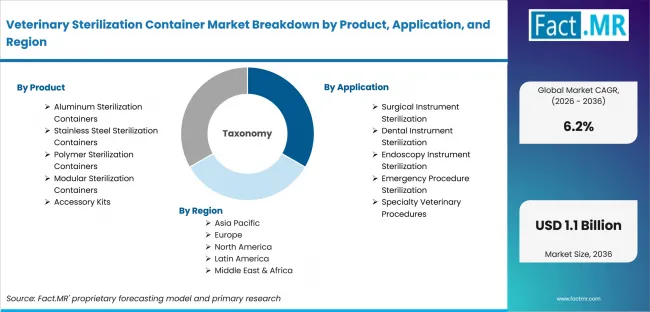
Veterinary Sterilization Container Market Breakdown By Product, Application, And Region | Source: Fact.MR
| Coverage field | Report scope |
|---|---|
| Quantitative Units | USD million |
| Market Definition | Reusable rigid containers and baskets for veterinary instrument sterilization and sterile storage |
| Product | Aluminum Sterilization Containers, Stainless Steel Containers, Plastic Composite Containers, Modular Containers, Specialty Containers |
| Application | Surgical Instrument Sterilization, Dental Instrument Sterilization, Endoscopy Equipment Sterilization, Emergency Instrument Sterilization, Research Instrument Sterilization |
| End User | Veterinary Hospitals, Veterinary Clinics, Research Institutes, Academic Centers, Mobile Veterinary Units |
| Distribution Channel | Direct Sales, Medical Device Distributors, Online Platforms, Equipment Dealers, Group Purchasing Organizations |
| Sterilization Method | Steam Sterilization, Hydrogen Peroxide Sterilization, Ethylene Oxide Sterilization, Low-temperature Sterilization, Hybrid Methods |
| Regions Covered | North America, Europe, Asia Pacific, Latin America, Middle East & Africa |
| Countries Covered | United States, Canada, Germany, United Kingdom, France, Japan, Australia, Brazil, Mexico, Saudi Arabia, South Africa |
| Key Companies Profiled | B. Braun SE, STERIS plc, Case Medical, Inc., Aygun Surgical Instruments, Stryker Corporation, Shinva Medical Instrument Co., Ltd., HuFriedyGroup |
| Forecast Period | 2026 to 2036 |
| Approach | Hybrid sizing using facility counts, instrument activity, attachment rates, replacement cycles, method compatibility |
Source: Fact.MR analysis. Updated Jul 31, 2026
How is the market segmented?
-
By Product
- Aluminum Sterilization Containers
- Stainless Steel Containers
- Plastic Composite Containers
- Modular Containers
- Accessory Kits
-
By Application
- Surgical Instrument Sterilization
- Dental Instrument Sterilization
- Endoscopy Equipment Sterilization
- Emergency Instrument Sterilization
- Specialty Veterinary Procedures
-
By End User
- Veterinary Hospitals
- Veterinary Clinics
- Academic and Research Institutes
- Animal Diagnostic Centers
- Animal Shelters and Nonprofit Organizations
-
By Distribution Channel
- Direct Sales
- Medical Device Distributors
- Online B2B Platforms
- Veterinary Equipment Dealers
- Group Purchasing Organizations
-
By Sterilization Method
- Steam Sterilization
- Hydrogen Peroxide Sterilization
- Ethylene Oxide Sterilization
- Low Temperature Sterilization
- Hybrid Sterilization Systems
-
By Region
- North America
- United States
- Canada
- Europe
- Germany
- United Kingdom
- France
- Italy
- Spain
- Asia Pacific
- India
- China
- Japan
- South Korea
- Australia
- Latin America
- Brazil
- Argentina
- Mexico
- Chile
- Middle East & Africa
- UAE
- Saudi Arabia
- South Africa
- North America
Frequently Asked Questions
What valuation is projected for this market by 2036?
Which product category carries the primary 2026 share?
What supports surgical instrument sterilization demand?
Why do veterinary hospitals represent 44.0% of demand?
Why does direct sales retain a 45.0% position?
What supports steam sterilization’s 58.0% share?
Which operating factor drives container adoption?
Which friction delays conversion from disposable wrapping?
Who worked on this report


Preview the report firsthand - request a free sample
Free SampleGet the brochure for pricing and purchase details
Download PDF