- Market Value (2025): USD 60.9 Mn
- Estimated Value (2026): USD 74 Mn
- Forecast Value (2036): USD 520 Mn
- CAGR (2026-2036): 21.5%
What is the Virtual Metrology Copilots Market forecast to be worth by 2036?
USD 74 million in 2026 to USD 520 million by 2036, at 21.5% CAGR.
- The virtual metrology copilots market was valued at USD 60.9 million in 2025.
- Demand is projected to increase from USD 74 million in 2026 to USD 520 million by 2036.
- The market is forecast to record 21.5% CAGR from 2026 to 2036 as foundries and memory makers use wafer-level predictions to shorten feedback loops.
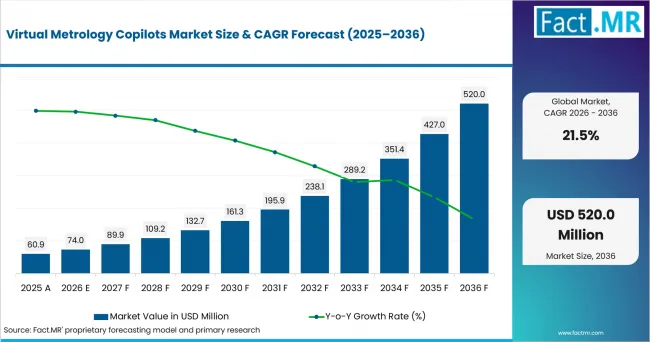
Virtual Metrology Copilots Market Value Analysis | Source: Fact.MR
What are the defining numbers behind Virtual Metrology Copilots Market growth?
USD 446 million absolute opportunity by 2036, led by film thickness prediction, gradient-boosted models and foundries.
- Demand Drivers in the Market
- Process engineers need wafer-level estimates between sampling points because physical metrology cannot measure every wafer after every step.
- Yield teams need early drift signals, so virtual metrology copilots translate chamber traces into warnings before out-of-control lots build.
- Equipment engineers need recommendations that can be traced to recipe steps, sensor windows and previous measurement results.
- Manufacturing IT teams need on-tool or fab-local deployment where process data cannot be moved into broad public environments.
- The National Institute of Standards and Technology published a 2025 comparative study of virtual metrology methods and dynamic sampling.
- Key Segments Analyzed
- By Prediction Target: Film thickness is projected to hold 33.0% share in 2026 due to deposition, planarization and dielectric control use cases.
- By Model Type: Gradient-boosted models are expected to account for 39.0% share in 2026 owing to their fit with tabular tool and metrology data.
- By Deployment: On-tool edge is anticipated to capture 45.0% share in 2026 as fabs keep low-latency prediction close to equipment signals.
- By End User: Foundries are estimated to represent 44.0% share in 2026, led by product mix complexity and recipe-transfer requirements.
- Analyst Opinion at Fact.MR
- Shambhu Nath Jha, Principal Consultant at Fact.MR, states, “Virtual metrology copilots draw attention because they convert existing equipment data into usable process guidance. Adoption is expected to rise where fabs need faster control without adding physical measurements after every process step. Well-positioned providers should combine model accuracy, fab data connectors and engineer-readable recommendations.”
- Strategic Implications
- Software vendors should document prediction accuracy by layer, tool family and recipe type so fabs can qualify copilots without broad rework.
- Equipment OEMs should expose clean trace data and recipe context because virtual metrology quality depends on stable inputs.
- Foundry teams should define when a copilot can recommend action and when physical metrology must remain the release gate.
- Procurement teams should compare model governance and change-control evidence. NIST's November 2025 workshop report addresses artificial intelligence and open/scaled data sharing in semiconductor manufacturing.
Germany is projected to post 24.3% CAGR through 2036, supported by semiconductor project funding and industrial process-control needs. The United Kingdom is forecast to record 23.2% CAGR as specialty clusters expand analytics use. Japan is anticipated to advance at 22.6% CAGR due to domestic fab investment and GPU-cloud programs. The USA is expected to hold 20.9% CAGR as new fab projects create qualification work. South Korea is estimated to record 15.6% CAGR while memory fabs scale selective adoption.
How does the Virtual Metrology Copilots Market break down by segment?
Film thickness leads at 33.0%; on-tool edge leads at 45.0%.
Which Prediction Target dominates?
Film thickness holds 33.0% share in 2026.
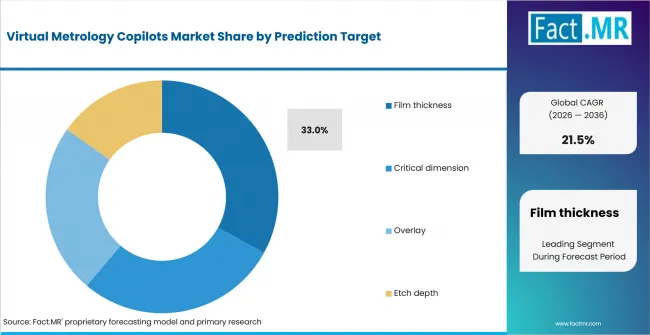
Virtual Metrology Copilots Market Analysis By Prediction Target | Source: Fact.MR
Film thickness prediction leads because deposition, oxidation and planarization steps generate repeat measurement needs. Copilots estimate thickness from process traces and sampled metrology, giving engineers a faster way to check whether the next lot should continue or be reviewed.
Critical dimension, overlay and etch depth remain relevant prediction targets. Their adoption is narrower at first because each model needs stronger recipe context and tighter alignment with qualified metrology results.
What leads the Model Type segment?
Gradient-boosted models account for 39.0% share in 2026.
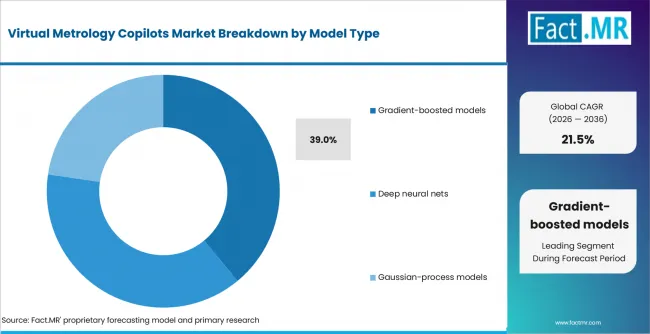
Virtual Metrology Copilots Market Analysis By Model Type | Source: Fact.MR
Gradient-boosted models lead because many fabs already organize equipment traces, recipe variables and metrology outputs as structured data. These models handle mixed inputs well and can give process engineers useful feature ranking.
Deep neural nets are used when larger trace histories and sensor sequences justify heavier modeling. Gaussian-process models remain useful for uncertainty-aware prediction where engineers want confidence intervals along with point estimates.
How does Deployment shape demand?
On-tool edge captures 45.0% share in 2026.
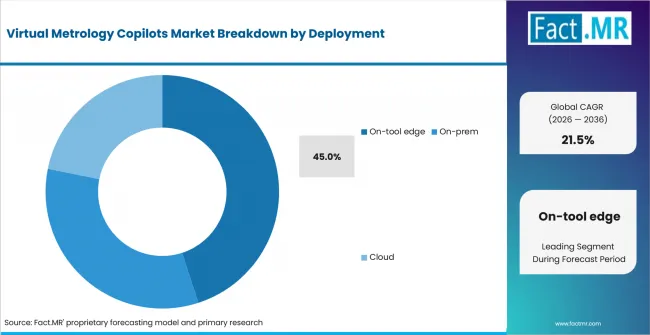
Virtual Metrology Copilots Market Analysis By Deployment | Source: Fact.MR
On-tool edge deployment leads because prediction value falls when estimates arrive too late for wafer routing or process adjustment. Keeping models close to tool data also reduces movement of sensitive process information outside the fab.
On-prem deployment supports centralized model governance across multiple tools. Cloud adoption is more selective because semiconductor process data often carries recipe, yield and customer confidentiality constraints.
What supports Foundries within End User?
Foundries represent 44.0% share in 2026.
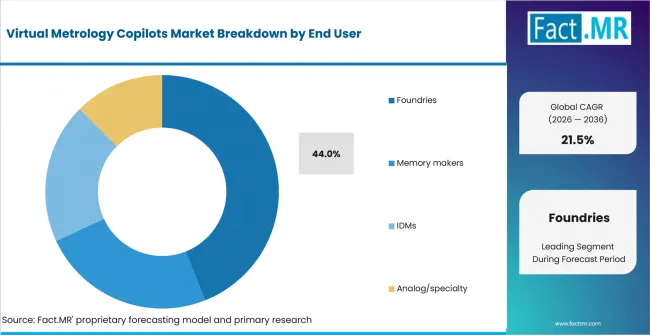
Virtual Metrology Copilots Market Analysis By End User | Source: Fact.MR
Foundries lead end-user demand because they manage changing product mixes across many customer nodes. Virtual metrology copilots compare tool behavior during recipe transfer and speed investigations when a process window starts drifting.
Memory makers adopt copilots for high-volume control where repeated process steps create strong training histories. IDMs and analog or specialty fabs use them more selectively where process runs are lower and model reuse is harder.
What is accelerating Virtual Metrology Copilots Market adoption, and what is holding it back?
Demand is expected to rise through sampling pressure and fab-local AI deployment; adoption is constrained by data access and model trust.
Drivers Impact Analysis
| DRIVER | (~) % IMPACT ON CAGR | GEOGRAPHIC RELEVANCE | IMPACT TIMELINE |
|---|---|---|---|
| Wafer-level sampling pressure in advanced fabs | +2.4% | Global | Short term (<= 2 years) |
| Tool drift and recipe-transfer needs | +1.7% | USA, Germany, Japan | Medium term (2-4 years) |
| Fab-local deployment for sensitive process data | +1.1% | East Asia, North America | Medium term (2-4 years) |
| Model-governance needs in yield engineering | +0.8% | Global | Long term (>= 4 years) |
- Wafer-level sampling pressure: Physical metrology remains essential, but fabs need faster estimates between measurement points when cycle time is tight.
- Tool drift and recipe transfer: Copilots can compare expected and actual outputs across chambers, which helps engineers identify drift before yield loss expands.
- Fab-local deployment: Edge and on-prem systems fit data-control rules because many fabs avoid moving sensitive recipe records into external environments.
Opportunity Impact Analysis
| OPPORTUNITY | (~) % IMPACT ON CAGR | GEOGRAPHIC RELEVANCE | IMPACT TIMELINE |
|---|---|---|---|
| ModelOps for fab analytics and virtual metrology | +1.5% | USA, Japan, Germany | Short term (<= 2 years) |
| Edge copilots for chamber-level control | +1.2% | East Asia, North America | Medium term (2-4 years) |
| Hybrid physics and machine-learning models | +0.8% | Global | Long term (>= 4 years) |
- ModelOps for fab analytics: Suppliers can gain adoption by making version control, retraining and rollback clear enough for production engineering teams.
- Edge copilots for chamber-level control: Tool-connected deployment creates an opening for modules that estimate wafer outputs and flag recipe drift locally.
- Hybrid models: Physics-informed features can improve confidence where sparse metrology histories make pure machine-learning models difficult to approve.
Restraints Impact Analysis
| RESTRAINT | (~) % IMPACT ON CAGR | GEOGRAPHIC RELEVANCE | IMPACT TIMELINE |
|---|---|---|---|
| Data access and tool-integration limits | -0.8% | Global | Short term (<= 2 years) |
| Model trust and release-gate risk | -0.6% | North America, East Asia | Medium term (2-4 years) |
| Limited optimization and process-data skills | -0.4% | Global | Long term (>= 4 years) |
- Data access and tool integration limits: Different tool interfaces, trace formats and historian systems can slow the first production model.
- Model trust and release-gate risk: Fabs still need physical metrology for qualification when an inaccurate prediction risks releasing a weak lot.
- Skills shortages: Copilot deployment needs process engineers and data teams to agree on features, drift rules and change-control routines.
Which countries are scaling the Virtual Metrology Copilots Market through 2036?
- The country comparison spans 8.7 percentage points across the five profiled markets.
- Germany remains 1.1 percentage points above the UK as semiconductor projects expand qualification demand.
- The UK remains 0.6 percentage point above Japan as specialty technology clusters support analytics adoption.
- Japan remains 1.7 percentage points above the USA as domestic chip programs strengthen process development.
- The USA remains 5.3 percentage points above South Korea as new fabs add model-validation work.
- South Korea closes the displayed range while memory fabs keep adoption selective and evidence-driven.
Comparable CAGRs create different entry conditions due to fab investment, metrology maturity, data-security rules and local engineering capacity. Full report coverage includes North America, Latin America, Western Europe, Eastern Europe, East Asia, South Asia & Pacific, Middle East & Africa.
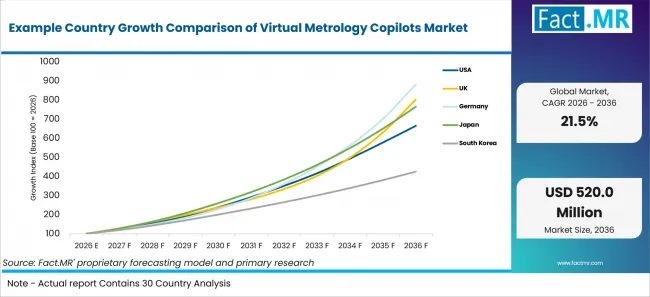
Example Country Growth Comparison Of Virtual Metrology Copilots Market | Source: Fact.MR
| Country | CAGR (2026-2036) |
|---|---|
| Germany | 24.3% |
| United Kingdom | 23.2% |
| Japan | 22.6% |
| United States | 20.9% |
| South Korea | 15.6% |
What supports Germany adoption?
24.3% CAGR through 2036, supported by semiconductor project funding and industrial process-control demand.
Germany’s growth is supported by semiconductor investment and demand for tighter process control. BMWE stated in July 2026 that 35 German projects are planned for national support under IPCEI Advanced Semiconductor Technologies, subject to State-aid approval and budget availability, while the European Commission approved EUR 623 million in German State aid for two semiconductor facilities in December 2025. NIST research shows that virtual metrology can supplement physical metrology and reduce measurement requirements in semiconductor process control. Destatis reported that German industrial producer prices were 1.8% higher year over year in June 2026.
How is the United Kingdom scaling demand?
23.2% CAGR through 2036, backed by specialty semiconductor revenue and cluster support.
The United Kingdom’s growth reflects a specialized semiconductor base and continued support for technology clusters. DSIT estimated that dedicated UK semiconductor companies generated GBP 10.6 billion in revenue in 2025, while the Scottish Government announced more than GBP 2 million in September 2025 for new clusters including semiconductors and quantum systems. Specialty fabs and pilot lines are expected to favor transparent virtual metrology models suited to mixed production histories.
What supports Japan adoption?
22.6% CAGR through 2036, reinforced by chip investment and manufacturing software spending.
Japan’s growth is supported by semiconductor investment and rising manufacturing-software expenditure. METI stated on November 21, 2025 that Japan intended to invest JPY 100 billion in Rapidus through IPA, while the Ministry of Finance Policy Research Institute projected manufacturing-sector software and plant-and-equipment investment to increase 5.0% year over year in FY2026. Virtual metrology copilots can fit established engineer-review routines and high-value process steps.
What supports USA adoption?
20.9% CAGR through 2036, supported by fab awards and electronics manufacturing investment.
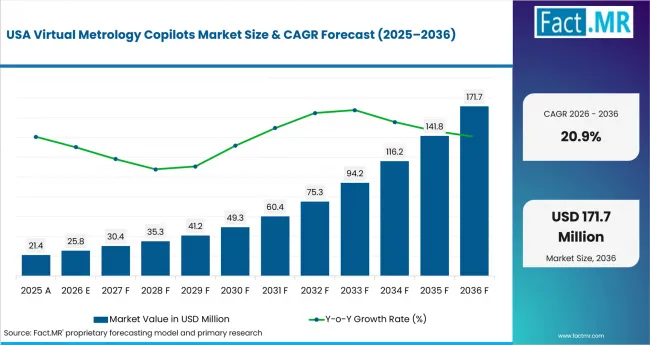
Virtual Metrology Copilots Market Country Value Analysis | Source: Fact.MR
The USA’s growth is supported by semiconductor facility awards and new electronics manufacturing investment. GAO reported in December 2025 that Commerce had issued awards to 19 companies for 40 semiconductor facility projects as of July 2025, while BEA reported USD 2.0 billion in 2025 greenfield expenditures for computers and electronic products manufacturing. Greenfield fabs can integrate tool and metrology data early, creating favorable conditions for virtual metrology copilots.
How is South Korea developing demand?
15.6% CAGR through 2036, supported by memory exports and AI-semiconductor programs.
South Korea’s growth is supported by strong semiconductor exports and government-backed AI-chip development. MOTIR reported that Korea’s semiconductor exports increased 22.2% year over year to a record USD 173.4 billion in 2025, while MSIT selected 17 consortia for the K-Cloud Technology Development Project, a six-year initiative with a total budget of KRW 403.1 billion. Memory fabs provide repeated process histories that can support virtual metrology once drift and validation rules are established.
Who leads the Virtual Metrology Copilots Market?
Applied Materials, PDF Solutions, Onto Innovation, Cohu (including Tignis), Synopsys (including relevant BISTel semiconductor assets), are reviewed for relevant metrology, fab-analytics and AI process-control capabilities.
Providers differentiate through semiconductor manufacturing data integration, metrology analytics and AI model-management capabilities. Applied Materials introduced its SEMVision H20 defect review system in February 2025 with advanced AI image recognition for nanoscale defect analysis. PDF Solutions offers Exensio analytics and announced Exensio Studio AI in October 2025 for semiconductor AI/ML model development and lifecycle management. Onto Innovation provides optical metrology supported by modeling and analysis software for semiconductor process control.
Tignis is treated through Cohu following Cohu’s January 2025 acquisition, which added AI process-control and analytics-based monitoring software. Synopsys acquired BISTel’s semiconductor and flat-panel-display solutions in September 2021, so those assets are treated through Synopsys.
Which companies are the key providers?
Key companies include Applied Materials, PDF Solutions, Synopsys, Inc. (BISTel Manufacturing Analytics), Cohu, Inc. (Tignis PAICe), Onto Innovation.
- Applied Materials
- PDF Solutions
- Synopsys, Inc. (BISTel Manufacturing Analytics)
- Cohu, Inc. (Tignis PAICe)
- Onto Innovation
Bibliography
- Applied Materials, Inc. (2025, February 19). Applied Materials accelerates chip defect review with next-gen eBeam system.
- U.S. Bureau of Economic Analysis. (2026, June 10). New foreign direct investment in the United States, 2025.
- U.S. Bureau of Labor Statistics. (2025, March 7). The employment situation—February 2025.
- Cohu, Inc. (2025, January 7). Cohu completes acquisition of Tignis.
- Department for Science, Innovation and Technology. (2026, June 8). Semiconductor Sector Study 2026.
- European Commission. (2025, December 11). Commission approves €623 million German State aid to support set-up of two first-of-a-kind chips factories in Germany.
- Federal Ministry for Economic Affairs and Energy. (2026, July 1). Germany presses ahead: First projects for the IPCEI for Europe’s next generation of semiconductor technologies submitted to European Commission.
- Federal Statistical Office (Destatis). (2026, July 20). Producer prices in June 2026: +1.8% on June 2025.
- U.S. Government Accountability Office. (2025, December 11). Semiconductors: Information on projects funded to strengthen U.S. supply chain (GAO-26-107882).
- Ministry of Economy and Finance. (2025, September 12). Current Economic Situation, September 2025.
- Ministry of Economy, Trade and Industry. (2025, November 21). Press conference by Minister Akazawa (Excerpt).
- Ministry of Science and ICT. (2025, May 8). MSIT launches KRW 400 billion K-Cloud R&D project based on domestic AI semiconductors.
- Office for National Statistics. (2026, August 19). Producer price inflation, UK: July 2026.
This Report Addresses
- The report covers virtual metrology copilots across film thickness, critical dimension, overlay and etch depth.
- Segment analysis identifies the leading subsegments and the practical reasons fabs prioritize them during process-control planning.
- Country analysis reviews the listed markets and the semiconductor investment or data-control factors shaping adoption.
- Competitive analysis reviews current providers across metrology, fab analytics, process-control software and AI monitoring tools.
- Application analysis considers how prediction latency, model governance and physical metrology evidence shape purchase decisions.
What does the Virtual Metrology Copilots Market cover?
The market covers software copilots connected to industrial metrology workflows that predict wafer outcomes from tool-state data and sampled measurements.
Virtual metrology copilots sit near semiconductor defect inspection workflows when fabs pair prediction with physical review evidence.
The scope also touches e-beam wafer inspection when predicted outputs must be compared with high-resolution inspection results. It remains separate from deep imaging metrology when image acquisition is sold as a physical measurement system instead of predictive software.
What is included in the scope?
The scope includes licensed or subscription software, fab-local AI modules and managed model environments tied to metrology systems as validation inputs.
It includes copilots connected to wafer defect VQA workflows when defect evidence improves metrology prediction or model review. Related use cases include backside power metrology and process steps where sparse physical measurement raises the value of prediction.
What is excluded from the scope?
The scope excludes pure die placement metrology tools when they do not provide predictive wafer-process copilots.
It also excludes HBM TSV qualification equipment when the sale does not include predictive metrology software. Raw remote plasma sources are excluded unless bundled with software that predicts wafer or process results.
How Was the Analysis Built?
The analysis draws on 120+ sources, 35+ company portfolios, 25+ countries, and more than 20 industry interviews.
- Primary Research: Primary research includes discussions with manufacturers, service providers, technology developers, distributors, end users, procurement teams, and subject-matter experts. These conversations examine purchasing priorities, product adoption, operational challenges, approval requirements, competitive positioning, and the factors that influence wider market acceptance.
- Desk Research: Desk research covers government statistics, regulatory publications, company filings, trade data, technical studies, industry associations, standards, public policy, and other authoritative sources. Every source used in the analysis is documented in the bibliography.
- Market Sizing and Forecasting: Market estimates combine historical performance, demand indicators, pricing and volume trends, segment shares, company participation, country-level growth, adoption patterns, investment activity, and barriers to market expansion.
- Data Validation and Update Cycle: Findings are validated by comparing primary interviews with public data, company activity, regulatory changes, trade patterns, and industry developments. Regular updates review new product launches, capacity changes, partnerships, approvals, procurement trends, and shifts in commercial adoption.
What is the report’s scope and coverage?
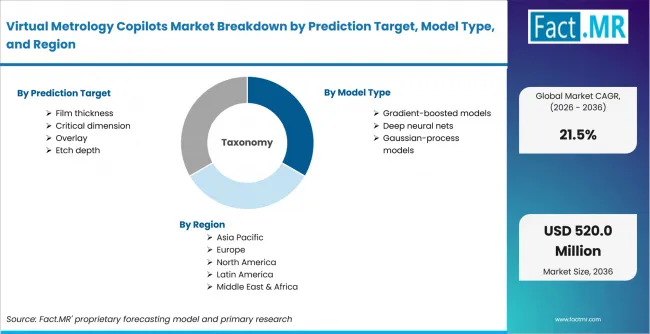
Virtual Metrology Copilots Market Breakdown By Prediction Target, Model Type, And Region | Source: Fact.MR
| Attribute | Details |
|---|---|
| Quantitative Units | USD million |
| Market Definition | Software copilots that predict wafer or process outcomes from tool data, recipe context and sampled physical metrology results. |
| Prediction Target | Film thickness; Critical dimension; Overlay; Etch depth |
| Model Type | Gradient-boosted models; Deep neural nets; Gaussian-process models |
| Deployment | On-tool edge; On-prem; Cloud |
| End User | Foundries; Memory makers; IDMs; Analog/specialty |
| Regions Covered | North America; Latin America; Western Europe; Eastern Europe; East Asia; South Asia & Pacific; Middle East & Africa |
| Countries Covered | United States; United Kingdom; Germany; Japan; South Korea |
| Key Companies Profiled | Applied Materials, PDF Solutions, Synopsys, Inc. (BISTel Manufacturing Analytics), Cohu, Inc. (Tignis PAICe), Onto Innovation |
| Forecast Period | 2026 to 2036 |
| Approach | Hybrid top-down and bottom-up approach using fab investment, process-control adoption, metrology workload, country growth and provider portfolio review. |
How is the market segmented?
-
By Prediction Target:
- Film thickness
- Critical dimension
- Overlay
- Etch depth
-
By Model Type:
- Gradient-boosted models
- Deep neural nets
- Gaussian-process models
-
By Deployment:
- On-tool edge
- On-prem
- Cloud
-
By End User:
- Foundries
- Memory makers
- IDMs
- Analog/specialty
-
By Region:
- North America
- Latin America
- Western Europe
- Eastern Europe
- East Asia
- South Asia & Pacific
- Middle East & Africa