- Market Value (2025): USD 2.8 Bn
- Estimated Value (2026): USD 3.0 Bn
- Forecast Value (2036): USD 6.0 Bn
- CAGR (2026-2036): 7.3%
What is the Water-Based Soft-Touch Coatings Market forecast to be worth by 2036?
USD 3.0 billion in 2026 to USD 6.0 billion by 2036 at a 7.3% CAGR.
- As per Fact.MR analysis, the Water-Based Soft-Touch Coatings Market was valued at USD 2.8 billion in 2025.
- Demand is projected to increase from USD 3.0 billion in 2026 to USD 6.0 billion by 2036.
- The market is forecast to record 7.3% CAGR from 2026 to 2036 as premium packaging converters balance tactile finish needs with water-based coating systems.
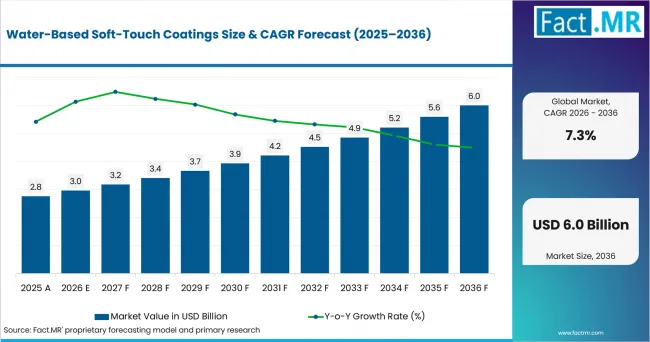
Water Based Soft Touch Coatings Value Analysis | Source: Fact.MR
What are the defining numbers behind Water-Based Soft-Touch Coatings Market growth?
An absolute opportunity of USD 3.0 billion is expected between 2026 and 2036.
- Demand Drivers in the Market
- Carton makers need soft coatings that protect printed surfaces from marks during packing and shipping. This helps premium cartons keep their appearance until they reach stores.
- Beauty and personal-care brands use soft-touch coatings to make premium packaging feel different. The coating also needs to give the same look and feel across the full production run.
- Flexible packaging companies need thin water-based coatings that dry well and move with the film during rolling and filling. This helps the soft feel stay even after the pack is shaped.
- Food and drink packaging companies need to check recycling and food-contact rules when choosing coatings. The EU Packaging and Packaging Waste Regulation entered into force on February 11, 2025, and increased the focus on recyclable packaging [2].
- Online sales increase the need for scratch protection because cartons and labels are handled several times during shipping. The packaging needs to keep its appearance until delivery.
- Key Segments Analyzed
- By Coating Chemistry: Water-based polyurethane is expected to hold a 34.0% share in 2026 because it gives packaging a soft feel and sticks well to common packaging materials.
- By Substrate: Paperboard holds 31.0% share in 2026 because it is widely used for beauty and gift cartons.
- By End-use: Luxury packaging is expected to hold a 36.0% share in 2026 because brands use soft-touch finishes to give packs a premium feel.
- By Finish: Velvet and suede leads with 29.0% share in 2026 because their soft, low-gloss feel works well on premium cartons and labels.
- Analyst Opinion at Fact.MR
- Shambhu Nath Jha, Principal Consultant at Fact.MR, states, “Soft-touch coatings are chosen for more than appearance. Packaging companies check the feel, how well the coating sticks, and recycling. Suppliers that provide clear test results on actual packaging materials can find more use in premium packaging.”
- Strategic Implications
- Coating suppliers should give clear coating amounts and drying times for each packaging material. This helps reduce repeated testing.
- Packaging companies should check if the coating rubs or sticks after drying. Soft surfaces can get marks when packs are stacked.
- Brands should check recycling and product safety when testing soft-touch coatings. This helps avoid packaging changes later.
- Material suppliers should provide polyurethane and acrylic coatings that give a soft feel with less coating. Thinner coatings can dry faster and reduce coating use.
France and the USA are expected to grow at 7.6% CAGR through 2036. China and Germany follow at 7.4%, while Japan records 6.3%. Packaging needs and recycling rules affect soft-touch coating use in each country.
How does the Water-Based Soft-Touch Coatings Market break down by segment?
Luxury packaging leads End-use at 36.0% share in 2026; while Water-based polyurethane leads Coating Chemistry at 34.0% share.
Which Coating Chemistry dominates?
Water-based polyurethane is expected to hold 34.0% share in 2026.
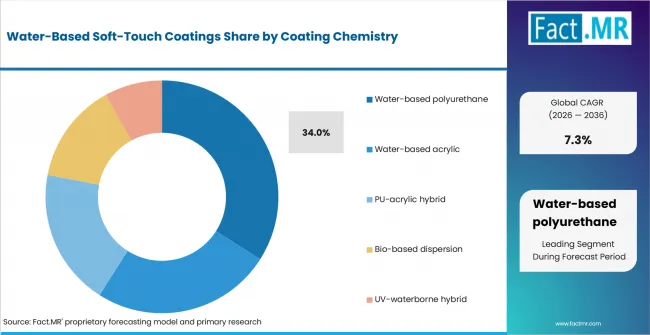
Water Based Soft Touch Coatings Analysis By Coating Chemistry | Source: Fact.MR
Water-based polyurethane is expected to lead because it gives packaging a soft feel and stays flexible. Acrylic coatings dry quickly and work well on cartons and labels. PU-acrylic coatings provide a soft feel and steady results during printing. Bio-based coatings use renewable materials, while UV-waterborne coatings dry faster and provide better protection from wear.
What leads the Substrate segment?
Paperboard is projected to account for 31.0% share in 2026.
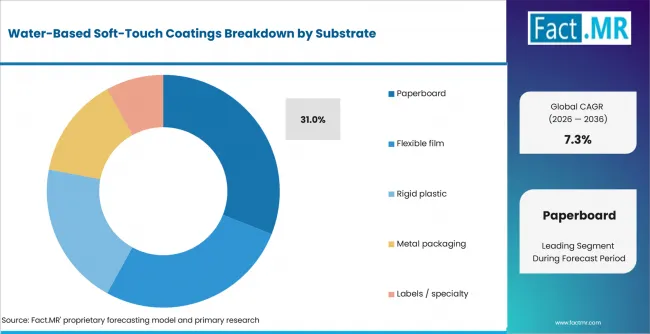
Water Based Soft Touch Coatings Analysis By Substrate | Source: Fact.MR
Paperboard is anticipated to lead because cartons have large printed areas for soft-touch coatings. Flexible film needs coatings that can stretch without sticking, while rigid plastic needs coatings that stick well. Metal packaging needs coatings that resist wear, while labels and special papers need thin coatings that work well with printing.
Eurostat reported in October 2025 that paper and cardboard made up 40.4% of the 79.7 million tonnes of packaging waste generated in the EU in 2023 [1]. This makes recycling important when soft-touch coatings are used on paperboard.
How does End-use shape demand?
Luxury packaging is anticipated to capture 36.0% share in 2026.
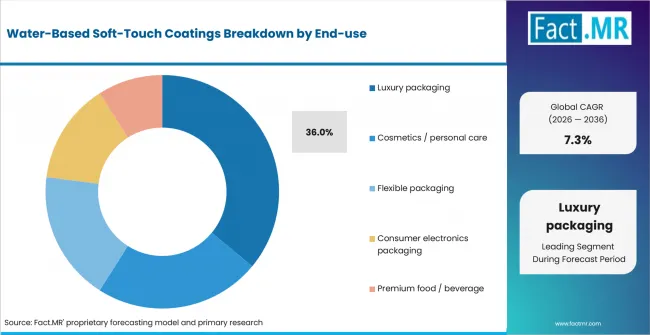
Water Based Soft Touch Coatings Analysis By End Use | Source: Fact.MR
Luxury packaging uses soft-touch finishes to improve product appearance, so brands check the feel along with print and color. Beauty packaging often uses matte or velvet finishes, while flexible packaging needs coatings that stay in place during rolling and sealing. Electronics packaging needs scratch protection, while premium food cartons also need food-safety and recycling checks.
What supports Velvet / suede within Finish?
Velvet / suede is estimated to represent 29.0% share in 2026.
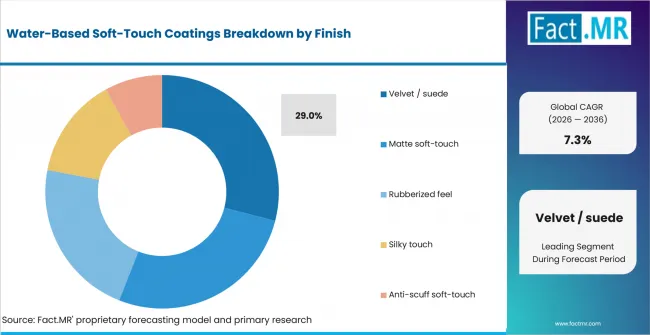
Water Based Soft Touch Coatings Analysis By Finish | Source: Fact.MR
Velvet and suede finishes give paperboard and labels a soft, low-gloss feel. Matte coatings give a smooth look, while rubberized and silky finishes change how the pack feels. Anti-scuff coatings protect the surface from marks during handling and stacking.
ACTEGA supplies packaging coatings that give packs a soft feel and protect the printed surface from marks.
What is accelerating Water-Based Soft-Touch Coatings Market adoption, and what is holding it back?
Premium packaging and recyclable aqueous finishing support demand; qualification cost and coating durability limit faster use.
Drivers Impact Analysis
| DRIVER | (~) % IMPACT ON CAGR | GEOGRAPHIC RELEVANCE | IMPACT TIMELINE |
|---|---|---|---|
| Premium carton and cosmetic packaging upgrades | +1.7% | Global | Short term (<= 2 years) |
| Shift toward water-based decorative systems | +1.3% | North America, Europe, East Asia | Medium term (2-4 years) |
| E-commerce handling and scuff-resistance needs | +1.0% | USA, China, Europe | Medium term (2-4 years) |
| Recyclability-focused packaging redesign | +0.8% | Europe, Japan | Long term (>= 4 years) |
Opportunity Impact Analysis
| OPPORTUNITY (~) % IMPACT ON CAGR | GEOGRAPHIC RELEVANCE | IMPACT TIMELINE | |
|---|---|---|---|
| Soft-touch coatings for recyclable paperboard | +1.1% | Europe, North America | Medium term (2-4 years) |
| Premium flexible packaging with low coat weight | +0.8% | East Asia, North America | Short term (<= 2 years) |
| Bio-based and hybrid waterborne dispersions | +0.6% | Europe, Japan | Long term (>= 4 years) |
Restraints Impact Analysis
| RESTRAINT | (~) % IMPACT ON CAGR | GEOGRAPHIC RELEVANCE | IMPACT TIMELINE |
|---|---|---|---|
| Blocking, rub, and scratch failure during converting | -0.6% | Global | Short term (<= 2 years) |
| Recyclability and food-contact qualification cost | -0.5% | Europe, North America | Medium term (2-4 years) |
| Substrate-specific adhesion and drying limits | -0.4% | Global | Medium term (2-4 years) |
Which countries are scaling the Water-Based Soft-Touch Coatings Market through 2036?
- The country comparison spans 1.3 percentage points across the five profiled markets.
- France and the USA share the upper growth band at 7.6% CAGR as premium packages and online retail keep tactile finishing in brand specifications.
- China remains 0.2 percentage point below the upper band at 7.4% CAGR as large online retail volumes support decorated consumer packaging.
- Germany also records 7.4% CAGR as recycling rules and premium paperboard use shape coating trials.
- Japan closes the displayed range at 6.3% CAGR as converters place greater weight on quality checks and recycling fit.
Comparable CAGRs can still create different entry conditions because packaging type, retail use, recycling rules, and plant equipment vary by country and shape coating tests in each market. Full report coverage includes North America, Latin America, Western Europe, Eastern Europe, East Asia, South Asia & Pacific, Middle East & Africa.
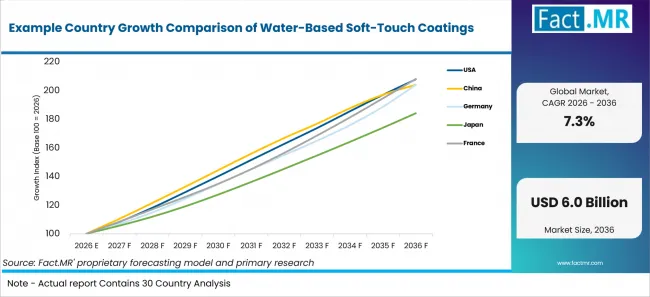
Example Country Growth Comparison Of Water Based Soft Touch Coatings | Source: Fact.MR
| Country | CAGR (2026-2036) |
|---|---|
| USA | 7.6% |
| France | 7.6% |
| China | 7.4% |
| Germany | 7.4% |
| Japan | 6.3% |
What supports USA adoption?
7.6% CAGR, supported by e-commerce packaging and premium finishing demand.
U.S. packaging companies use soft-touch coatings on cartons, labels, film, and rigid packs that need to stay protected during shipping. The U.S. Census Bureau reported in August 2025 that retail e-commerce sales reached USD 304.2 billion in the second quarter of 2025 [3]. High online sales increase the need for water-based soft-touch coatings that give packs a premium feel and protect them from marks.
How is China scaling demand?
7.4% CAGR, driven by large online retail volumes and decorated consumer packaging.
China has a large packaging industry and high online shopping, which increases the use of soft-touch coatings for beauty products and electronics. The National Bureau of Statistics reported in January 2026 that online retail sales of physical goods reached CNY 13,092.3 billion in 2025 [4].
What is supporting Germany’s adoption?
7.4% CAGR, supported by premium paperboard use and recycling-focused packaging design.
German packaging companies check how soft-touch coatings affect paper recycling during production tests. The German Environment Agency reported in March 2026 that Germany generated 17.9 million tonnes of packaging waste in 2023 and recycled 69.4% [5]. This increases the need for thin coatings that give a soft feel while keeping paper easy to recycle.
How does Japan perform?
6.3% CAGR, led by premium retail formats and careful coating qualification.
Japanese packaging companies check soft-touch coatings for smell, scratch resistance, and steady results during production. METI reported in August 2025 that Japan’s B2C e-commerce market reached JPY 26.1 trillion in 2024 [6].
What supports France growth?
7.6% CAGR, backed by online buying and strong premium-packaging use.
France has high online shopping and strong beauty and fragrance markets. Premium food and luxury packaging also increase the use of soft-touch coatings. Insee reported in October 2025 that 63% of people aged 15 or older in France bought products or services online during the previous three months in 2024 [7].
Who leads the Water-Based Soft-Touch Coatings Market?
ACTEGA supplies coatings for paper and board packaging that improve the look, feel, and surface protection.
Siegwerk provides water-based inks, coatings, and soft-touch varnishes for paper and board. Sun Chemical supplies coatings for folding cartons, labels, and flexible packaging. These products help improve the feel, printing, and surface protection of packaging.
Michelman supplies water-based coatings for paper and flexible packaging. In November 2025, it introduced Michem® Coat 9250 for recyclable paper cups. Michelman states that the coating works with ultrasonic, servo, and high-speed cup-making equipment and provides reliable heat sealing.
Which companies are the key providers?
Key companies include ACTEGA; Siegwerk; Sun Chemical; Michelman; and Flint Group.
- ACTEGA
- Siegwerk
- Sun Chemical
- Michelman
- Flint Group
Bibliography
- [1] Eurostat. (2025, October 22). Plastic packaging waste in the EU: 35.3 kg per person.
- [2] European Commission, Directorate-General for Environment. (2025, February 11). New rules enter into force for a more sustainable and competitive packaging economy.
- [3] U.S. Census Bureau. (2025, August 19). Quarterly retail e-commerce sales: 2nd quarter 2025.
- [4] National Bureau of Statistics of China. (2026, January 20). Total retail sales of consumer goods in December 2025.
- [5] Umweltbundesamt. (2026, March 5). Verpackungsabfälle [Packaging waste].
- [6] Ministry of Economy, Trade and Industry. (2025, August 26). Results of FY2024 E-Commerce Market Survey Compiled.
- [7] Insee. (2025, October 14). Achats de produits et de services en ligne.
- [8] Siegwerk. (2025, August 11). Siegwerk strengthens its coating business by acquiring chemicals producer Allinova.
- [9] Michelman. (2025, November 6). Michelman introduces Michem® Coat 9250: Next-generation recyclable cup coating for hot beverages.
This Report Answers
- The report explains where tactile water-based coatings fit across packaging structures and why converters choose different chemistries for paperboard, film, plastic, metal, and specialty labels.
- Segment analysis identifies the four leading subsegments and explains the operational reasons behind each 2026 share.
- Country analysis compares the five listed markets and explains how retail use, packaging mix, recycling rules, and converter conditions shape coating qualification.
- Competitive analysis reviews the profiled companies and their current product activity across water-based packaging coatings.
- Application analysis examines how soft feel, scuff resistance, adhesion, drying, and recycling requirements influence coating qualification.
What does the Water-Based Soft-Touch Coatings Market cover?
The Water-Based Soft-Touch Coatings Market covers water-based coatings used to give consumer and special packages a soft feel including velvet or suede as well as matte and rubberized effects. Board and film are the main packaging materials in scope while rigid plastic and metal are included when the coating forms part of the packaging surface.
The assessment covers velvet or suede finishes and matte soft-touch grades with rubberized and silky effects included in the same scope. Uses span luxury and beauty packages as well as flexible packages while electronics and premium food packages are included when a soft-touch coating forms part of the printed structure.
What is included in the scope?
The scope includes water-based soft-touch topcoats and varnishes used on printed packages with plants applying them by flexo or gravure when the process fits. Roller and anilox systems are also used when they match the coating and packaging material.
Hybrid waterborne systems are included when water is a main carrier and the end use is a tactile packaging so the review covers bond strength and rub control with gloss and blocking. Dry time plus recycling or food-contact fit are part of the same assessment.
What is excluded from the scope?
The market boundary is limited to packaging uses so architectural and car-interior coatings are treated as separate categories along with textile or leather finishes. Industrial coatings used away from packages are also separate while solvent tactile systems and stand-alone soft-feel films remain outside the defined market.
How Was the Analysis Built?
The analysis draws on 120+ sources, 35+ company portfolios, 25+ countries, and more than 20 industry interviews.
- Primary Research: Primary research includes discussions with manufacturers, service providers, technology developers, distributors, end users, and subject-matter experts. These conversations examine purchasing priorities, product adoption, operational challenges, approval requirements, competitive positioning, and the factors that influence wider market acceptance.
- Desk Research: Desk research covers government statistics, regulatory publications, company filings, trade data, technical studies, industry associations, standards, public policy, and other authoritative sources. Every source used in the analysis is documented in the bibliography.
- Market Sizing and Forecasting: Market estimates combine historical performance, demand indicators, pricing and volume trends, segment shares, company participation, country-level growth, adoption patterns, investment activity, and barriers to market expansion.
- Data Validation and Update Cycle: Findings are validated by comparing primary interviews with public data, company activity, regulatory changes, trade patterns, and industry developments. Regular updates review new product launches, capacity changes, partnerships, approvals, and shifts in commercial adoption.
What is the report’s scope and coverage?
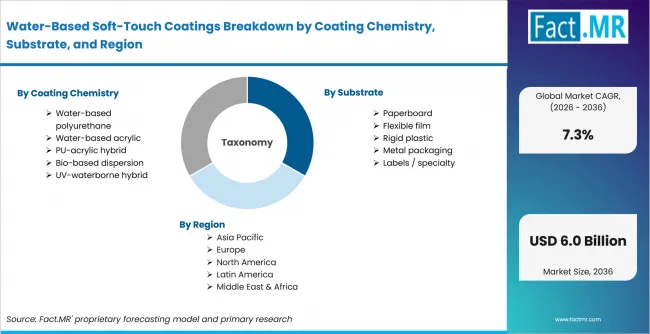
Water Based Soft Touch Coatings Breakdown By Coating Chemistry, Substrate, And Region | Source: Fact.MR
| Attribute | Details |
|---|---|
| Quantitative Units | USD billion |
| Market Definition | Water-based decorative coatings applied to packaging surfaces to create a soft tactile effect such as velvet, suede, matte, rubberized, or silky touch while maintaining print and surface performance. |
| Coating Chemistry | Water-based polyurethane; Water-based acrylic; PU-acrylic hybrid; Bio-based dispersion; UV-waterborne hybrid |
| Substrate | Paperboard; Flexible film; Rigid plastic; Metal packaging; Labels / specialty |
| End-use | Luxury packaging; Cosmetics / personal care; Flexible packaging; Consumer electronics packaging; Premium food / beverage |
| Finish | Velvet / suede; Matte soft-touch; Rubberized feel; Silky touch; Anti-scuff soft-touch |
| Regions Covered | North America; Latin America; Western Europe; Eastern Europe; East Asia; South Asia & Pacific; Middle East & Africa |
| Countries Covered | USA; China; Germany; Japan; France |
| Key Companies Profiled | ACTEGA; Siegwerk; Sun Chemical; Michelman; Flint Group |
| Forecast Period | 2026 to 2036 |
| Approach | Hybrid top-down and bottom-up approach using packaging-converter demand, coating consumption, substrate mix, end-use activity, supplier portfolios, regulation, and country indicators. |
How is the market segmented?
-
By Coating Chemistry:
- Water-based polyurethane
- Water-based acrylic
- PU-acrylic hybrid
- Bio-based dispersion
- UV-waterborne hybrid
-
By Substrate:
- Paperboard
- Flexible film
- Rigid plastic
- Metal packaging
- Labels / specialty
-
By End-use:
- Luxury packaging
- Cosmetics / personal care
- Flexible packaging
- Consumer electronics packaging
- Premium food / beverage
-
By Finish:
- Velvet / suede
- Matte soft-touch
- Rubberized feel
- Silky touch
- Anti-scuff soft-touch
-
By Region:
- North America
- Latin America
- Western Europe
- Eastern Europe
- East Asia
- South Asia & Pacific
- Middle East & Africa