- Market Value (2025): USD 234.7 Mn
- Estimated Value (2026): USD 258.7 Mn
- Forecast Value (2036): USD 683.9 Mn
- CAGR (2026-2036): 10.2%
Moisture-Blocking Edible Films Market Forecast and Outlook 2026 to 2036
The global moisture-blocking edible films market was valued at USD 234.7 million in 2025 and reached USD 258.7 million in 2026. The market is set to reach USD 683.9 million by 2036, advancing at a CAGR of 10.2% during the 2026 to 2036 assessment period.
Food exporters and retailers are turning to edible moisture barriers to reduce weight loss, wilting and texture deterioration without depending entirely on conventional plastic packaging. Manufacturers are combining plant proteins, waxes and oils to develop thin coatings that slow moisture transfer while preserving food appearance. In January 2026, Akorn Technology was named a winner of the UAE FoodTech Challenge for its vegetable-protein-based edible coating technology. Such initiatives are bringing greater attention to post-harvest preservation solutions, particularly in hot-climate and import-dependent markets.
Key Takeaways from the Moisture-Blocking Edible Films Market
- Sales of moisture-blocking edible films reached USD 234.7 million in 2025.
- Moisture-Blocking Edible Films Market Value (2026): USD 258.7 million.
- Moisture-Blocking Edible Films Market Forecast Value (2036): USD 683.9 million.
- Moisture-Blocking Edible Films Market Forecast CAGR (2026-2036): 10.2%.
- Leading Barrier Chemistry: Lipid / wax (44.3%).
- Key Market Participants: Apeel Sciences, Mori, Sufresca, Akorn Technology, Xampla and Mantrose-Haeuser.
- Key Growth Regions: China, India, Netherlands, Spain and United States.
Growers and food retailers are exploring edible moisture barriers to preserve avocados, citrus fruits and other perishable produce during storage and transportation. Greater attention is going towards coatings that can operate with existing packing lines rather than requiring substantial process changes. Akorn Technology's recognition at the UAE FoodTech Challenge in January 2026 has also brought attention to natural post-harvest coating technologies. Commercial adoption across produce-exporting regions could create opportunities for manufacturers serving North America, Europe and the Middle East.
Moisture-Blocking Edible Films Market
| Metric | Value |
|---|---|
| Estimated Value in 2025 | USD 234.7 million |
| Estimated Value in 2026 | USD 258.7 million |
| Forecast Value in 2036 | USD 683.9 million |
| Forecast CAGR (2026 to 2036) | 10.2% |
Source: Fact.MR analysis. Updated Nov 20, 2026
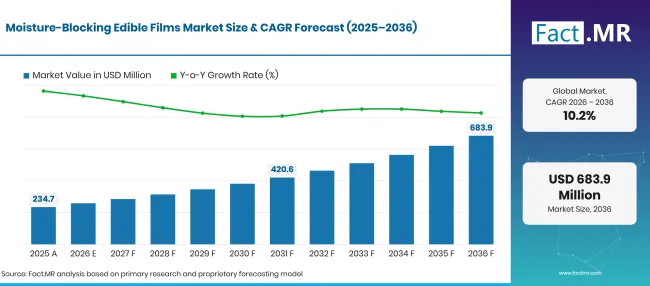
Moisture Blocking Edible Films Forecast Global | Source: Fact.MR
Category
| Category | Segments |
|---|---|
| Barrier Chemistry | Lipid / wax, Polysaccharide-lipid, Protein-lipid, Biopolymer composite, Multilayer edible |
| Food Substrate | Fresh vegetables, Fresh fruit, Meat / seafood, Bakery / confectionery, Prepared / specialty foods |
| Application Method | Casting / wrapping, Spray coating, Roller / curtain, Dip coating, In-line hybrid |
| Barrier Function | Antimicrobial, Oxygen control, Moisture control, Mechanical protection, Multi-function |
| Region | China, India, Netherlands, Spain, United States |
Source: Fact.MR analysis. Updated Nov 20, 2026
Segmental Analysis
Why does lipid and wax chemistry lead the Moisture-Blocking Edible Films Market?
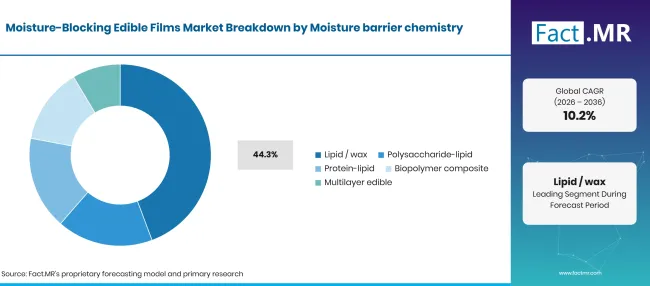
Moisture Blocking Edible Films Breakdown Moisture Barrier Chemistry | Source: Fact.MR
Lipid and wax chemistry holds a 44.3% market share in 2026, valued at approximately USD 114.6 million, because hydrophobic layers restrict water-vapour movement more effectively than most standalone protein and polysaccharide films. Carnauba, candelilla and beeswax also have established applications in fresh-produce surface treatments.
The European Commission's Regulation (EU) 2025/651 recognizes carnauba wax as a physical barrier against moisture loss and oxidation when used in fresh fruit and vegetable surface treatments. Protein-polysaccharide blends and polysaccharide-based films are also gaining traction through improvements in film strength and functionality.
How are fresh vegetables positioned as the leading food substrate in the Moisture-Blocking Edible Films Market?
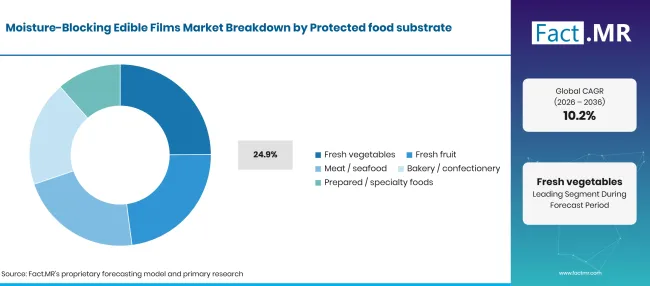
Moisture Blocking Edible Films Breakdown Protected Food Substrate | Source: Fact.MR
Fresh vegetables account for 24.9% of market revenue in 2026, equivalent to approximately USD 64.4 million, because tomatoes, cucumbers, peppers and leafy vegetables lose moisture rapidly during storage and distribution.
India's Ministry of Food Processing Industries reported in its 2025-26 Annual Report that estimated post-harvest vegetable losses ranged from 4.87% to 11.61%, based on the 2022 assessment. Fruit applications are also gaining traction because of moisture loss and surface deterioration, while bakery and confectionery products create opportunities for films that preserve texture and freshness.
Why does casting and wrapping lead application methods in the Moisture-Blocking Edible Films Market?
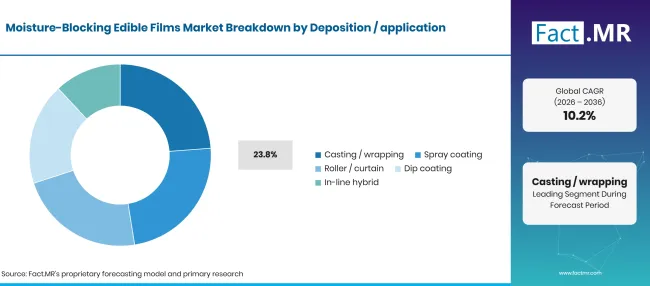
Moisture Blocking Edible Films Breakdown Deposition Application | Source: Fact.MR
Casting and wrapping captures 23.8% of market revenue in 2026, worth approximately USD 61.6 million, as pre-formed edible films offer controlled thickness, uniform barrier coverage and flexibility for individual portions, sachets and food inserts. This format also allows manufacturers to develop single-serve packaging without conventional plastic layers.
Spraying and dipping are gaining traction because they can coat irregular produce surfaces directly, while in-line hybrid methods offer opportunities for automated application. The FDA's January 2025 decision to end 35 PFAS-related food-contact authorizations for grease-proofing applications also highlights changes in conventional food-packaging materials.
How are antimicrobial functions shaping performance demand in the Moisture-Blocking Edible Films Market?
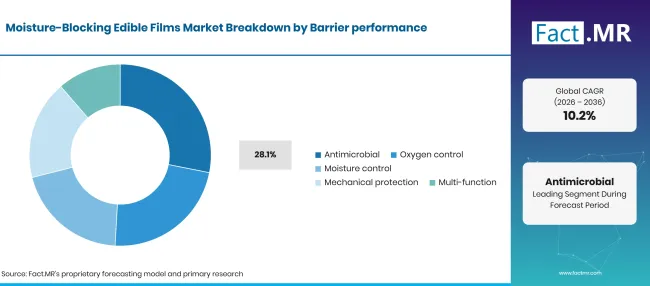
Moisture Blocking Edible Films Breakdown Barrier Performance | Source: Fact.MR
Antimicrobial functionality accounts for 28.1% of market revenue in 2026, approximately USD 72.7 million, because moisture retention alone cannot prevent microbial spoilage when food surfaces remain exposed to contamination.
Formulators are incorporating chitosan, essential oils and organic acids into edible matrices to combine moisture control with microbial protection. Food-safety frameworks, including the USDA's 2025 Harmonized GAP audit standards, reinforce the importance of hygiene and contamination control across fresh-produce handling. Antioxidant and oxygen-barrier functions are also gaining traction as complementary approaches to preserve food quality and extend shelf life.
Moisture-Blocking Edible Films Market: Drivers, Restraints and Trends
Driver:
Rising value of fresh produce exports:Longer export journeys make moisture retention a commercial priority because even minor weight loss can reduce the selling value of fresh produce. This is particularly relevant for exporters handling high-value fruits and vegetables across international markets. Spain's Ministry of Agriculture reported that fruit exports reached EUR 11.918 billion and vegetable exports reached EUR 9.352 billion in 2025. Such international trade activity creates stronger commercial interest in edible moisture barriers that preserve produce quality during transportation.
Restraint:Difficulty maintaining consistent barrier performance:
Edible films still struggle to match conventional plastic packaging across different storage conditions. Some formulations crack, become sticky or lose barrier strength under high humidity. Others alter food appearance, taste or respiration when applied too thickly. Small packers may also find crop-specific testing, food-contact approvals and application equipment expensive. These limitations make commercial adoption difficult, particularly where packaging cost and consistent shelf-life performance determine purchasing decisions.
Trend: Commercial interest in reducing food losses:
Edible moisture barriers are attracting attention as food-security initiatives shift towards practical post-harvest loss reduction. In January 2026, the UAE FoodTech Challenge selected Akorn Technology among its winners for its edible fruit and vegetable coating technology, with winners set to join the country's national agri-tech ecosystem. This creates opportunities for moisture-blocking edible film manufacturers across export-oriented supply chains and food-preservation programs. Similar trend: Public investment in post-harvest technologies is bringing greater attention to natural food-preservation materials.
Trend: Packaging regulations are encouraging material efficiency:
Packaging regulations are putting greater emphasis on product protection, material reduction and food-waste prevention. The EU Packaging and Packaging Waste Regulation (EU) 2025/40, published in January 2025, identifies humidity, moisture loss, oxidation and product deterioration among the factors considered in packaging performance. This creates an opportunity for edible film manufacturers to develop commercially viable materials that combine moisture protection with lower conventional packaging use. Similar trend: Food-contact compliance and packaging waste reduction are influencing material selection across food supply chains.
Moisture-Blocking Edible Films Market Analysis by Key Country
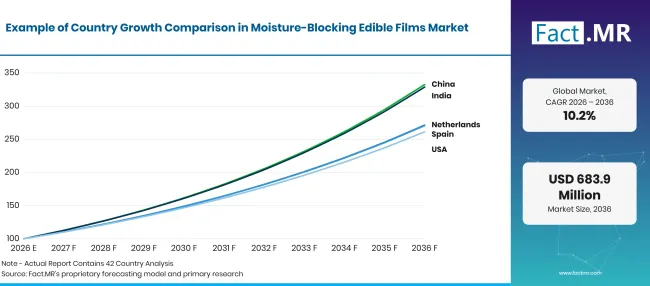
Moisture Blocking Edible Films Growth Index | Source: Fact.MR
| Country | CAGR (2026-2036) |
|---|---|
| China | 12.8% |
| India | 12.6% |
| Netherlands | 10.5% |
| Spain | 10.5% |
| United States | 10.1% |
Source: Fact.MR analysis. Updated Nov 20, 2026
What is driving moisture-blocking edible films demand in China?
China's investment in fresh-produce packaging and cold-chain infrastructure is creating room for moisture-blocking edible films, particularly across fruit and vegetable distribution networks.
The country's national standard GB/T 46685-2025, published on October 31, 2025, establishes technical guidelines for packaging fresh edible agricultural products and became effective on May 1, 2026. This regulatory attention is encouraging food processors to review packaging performance. Expanding refrigerated logistics, fresh-food distribution and the need to preserve produce quality during transportation are adding to commercial opportunities.
How is post-harvest loss reduction supporting moisture-blocking edible films sales in India?
Post-harvest losses across India's fruit and vegetable supply chains are creating a strong case for moisture-retaining edible films.
The Ministry of Food Processing Industries reported estimated losses of 6.02% to 15.05% for fruits and 4.87% to 11.61% for vegetables in its 2025-26 Annual Report, citing the 2022 assessment. Government investment in cold-chain infrastructure and food-processing capacity is adding momentum to preservation technologies. Exporters and organized retailers are also exploring better ways to maintain produce quality during storage and long-distance transportation.
Why is the Netherlands an important market for moisture-blocking edible films?
The Netherlands' position as a major agricultural export hub creates a commercial need for packaging that preserves produce quality beyond domestic markets.
Statistics Netherlands reported that fruit exports reached EUR 9.6 billion and vegetable exports EUR 9.4 billion in 2025. Wageningen University & Research also found that fruit and vegetables accounted for 27.6% of supermarket food losses by weight in 2025. These conditions are encouraging interest in edible moisture barriers among produce handlers, exporters and retailers focused on reducing spoilage.
What is shaping moisture-blocking edible films demand in Spain?
Spain's extensive fruit and vegetable export business makes moisture retention important because produce must preserve its appearance and weight throughout distribution across European markets.
The Spanish Ministry of Agriculture reported that fruit exports reached EUR 11.918 billion and vegetable exports EUR 9.352 billion in 2025. Total agri-food and fisheries exports also reached EUR 78.044 billion, representing a 2.9% increase over 2024. This large export base creates opportunities for edible moisture barriers in produce packing, storage and transportation.
How is commercialization supporting moisture-blocking edible films demand in the United States?
In the United States, retailers and fresh-food distributors are looking for ways to preserve produce quality while reducing avoidable food losses.
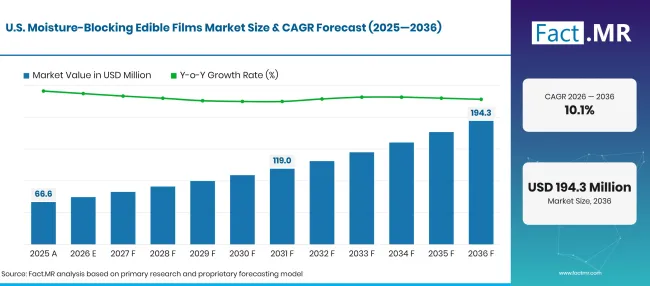
Moisture Blocking Edible Films Forecast Usa | Source: Fact.MR
USDA Economic Research Service data published in June 2025 showed that fresh vegetables accounted for 39% of total vegetable and pulse availability in 2024. This creates opportunities for edible moisture barriers across retail produce, fresh-cut vegetables and food distribution. Interest in shelf-life extension, food-waste reduction and packaging material efficiency is adding further commercial momentum.
Competitive Landscape for Moisture-Blocking Edible Films Market
The moisture-blocking edible films market brings together specialist produce-coating companies and established food-coating manufacturers, each competing through different material technologies and commercial capabilities. Apeel Sciences, Akorn Technology, Sufresca and Mori focus on fresh-produce preservation through lipid, plant-based and silk-protein formulations. Xampla works with plant-protein materials, whereas Mantrose-Haeuser has experience in wax and shellac coatings for fruit and confectionery. These companies compete through formulation performance, coating consistency, food-contact approvals and compatibility with existing packing lines.
The competitive landscape is moving beyond laboratory performance towards commercial application. In January 2026, Akorn Technology was named a UAE FoodTech Challenge winner, strengthening its access to the country's agri-tech ecosystem. Apeel has focused on integrating its coatings with existing produce-handling operations, while Notpla's brand trials have brought seaweed-based packaging into practical use. Companies with repeatable field results, regulatory clearances and reliable packhouse integration have a stronger position when competing for long-term commercial contracts.
Recent Developments
- On June 3, 2025, Apeel Sciences was recognized as a 2025 Game Changer by Food & Wine for its plant-based edible coating technology, which extends produce freshness and helps reduce food spoilage.
- On June 6, 2025, Akorn Technology launched Akorn Natural Advantage, an edible coating for English cucumbers and bell peppers. The plant-based coating creates a protective layer that maintains freshness and reduces reliance on single-use plastic wraps.
- On July 29, 2025, Xampla partnered with Bunzl UK & Ireland to introduce Huhtamaki's Taste hot-food boxes featuring its Morro plant-based coating. The products became available through Bunzl's distribution network for food-service businesses.
- On February 26, 2025, Mantrose-Haeuser introduced MantroShield, a fat-free encapsulated acid formulation for gummy coatings. The product improves sour flavour delivery, product stability and ingredient-label requirements.
- On February 25, 2026, Akorn Technology announced its expansion into the UAE after winning the UAE FoodTech Challenge. The recognition will help the company advance its natural post-harvest coating solutions.
Key Players in the Moisture-Blocking Edible Films Market
Key companies operating in the market include Apeel Sciences, Mori, Sufresca, Akorn Technology, Xampla, and Mantrose-Haeuser.
- Apeel Sciences
- Mori
- Sufresca
- Akorn Technology
- Xampla
- Mantrose-Haeuser
Bibliography
- European Commission. (2025). Commission Regulation (EU) 2025/651 of 2 April 2025 amending Annex II to Regulation (EC) No 1333/2008 as regards the use of mono- and diglycerides of fatty acids (E 471) and carnauba wax (E 903) as glazing agents on certain fresh fruit and vegetables. EUR-Lex.
- European Parliament & Council of the European Union. (2025). Regulation (EU) 2025/40 of the European Parliament and of the Council of 19 December 2024 on packaging and packaging waste. Official Journal of the European Union.
- Food and Drug Administration. (2025, January 3). FDA determines authorization for 35 food contact notifications related to PFAS are no longer effective. U.S. Department of Health and Human Services.
- Ministry of Agriculture, Fisheries and Food. (2026). Advance annual report on foreign trade in agri-food and fisheries products 2025. Government of Spain.
- Ministry of Food Processing Industries. (2026). Annual report 2025-26. Government of India.
- National Market Supervision and Administration Administration & Standardization Administration of China. (2025). GB/T 46685-2025: Technical guidelines for packaging of fresh edible agricultural products. National Public Service Platform for Standards Information.
- Statistics Netherlands. (2026). Value of agricultural exports up by over 8 percent in 2025.
- U.S. Department of Agriculture, Agricultural Marketing Service. (2025). Harmonized GAP.
- U.S. Department of Agriculture, Economic Research Service. (2025, June 26). Vegetable availability declined in 2024.
- Wageningen University & Research. (2026). Food waste in supermarkets down to 0.89%.
Segmentation
Scope of Report
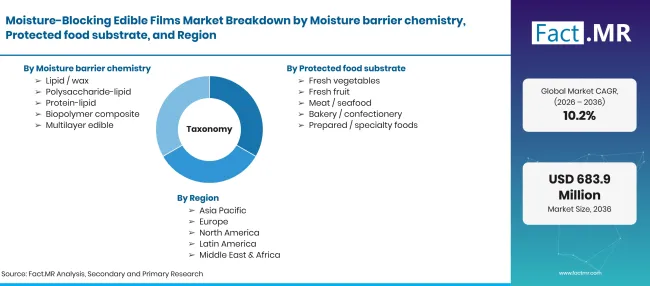
Moisture Blocking Edible Films Taxonomy | Source: Fact.MR
| Items | Values |
|---|---|
| Quantitative Units (2026) | USD 258.7 million |
| Barrier Chemistry | Lipid / wax, Polysaccharide-lipid, Protein-lipid, Biopolymer composite, Multilayer edible |
| Food Substrate | Fresh vegetables, Fresh fruit, Meat / seafood, Bakery / confectionery, Prepared / specialty foods |
| Application Method | Casting / wrapping, Spray coating, Roller / curtain, Dip coating, In-line hybrid |
| Barrier Function | Antimicrobial, Oxygen control, Moisture control, Mechanical protection, Multi-function |
| Regions Covered | North America, Latin America, Europe, East Asia, South Asia and Pacific, Middle East & Africa |
| Countries Covered | China, India, Netherlands, Spain, United States and other countries |
| Key Companies Profiled | Apeel Sciences, Mori, Sufresca, Akorn Technology, Xampla, Mantrose-Haeuser |
| Additional Attributes | Dollar revenue in the Moisture-Blocking Edible Films Market is segmented by barrier chemistry, food substrate, application method, barrier function and region. |
Source: Fact.MR analysis. Updated Nov 20, 2026
Moisture-Blocking Edible Films Market by Segments
-
Barrier Chemistry
- Lipid / wax
- Polysaccharide-lipid
- Protein-lipid
- Biopolymer composite
- Multilayer edible
-
Food Substrate
- Fresh vegetables
- Fresh fruit
- Meat / seafood
- Bakery / confectionery
- Prepared / specialty foods
-
Application Method
- Casting / wrapping
- Spray coating
- Roller / curtain
- Dip coating
- In-line hybrid
-
Barrier Function
- Antimicrobial
- Oxygen control
- Moisture control
- Mechanical protection
- Multi-function
-
Region
- North America
- United States
- Canada
- Mexico
- Europe
- Germany
- United Kingdom
- France
- Italy
- Spain
- Rest of Europe
- Asia Pacific
- China
- India
- Japan
- South Korea
- Australia
- Rest of Asia Pacific
- Latin America
- Brazil
- Mexico
- Argentina
- Rest of Latin America
- Middle East & Africa
- GCC Countries
- South Africa
- Rest of Middle East & Africa
- North America
Frequently Asked Questions
How big is the global Moisture-Blocking Edible Films Market in 2026?
What will be the size of the Moisture-Blocking Edible Films Market by 2036?
How fast will the Moisture-Blocking Edible Films Market grow during the forecast period?
Which barrier chemistry segment holds the largest share of the Moisture-Blocking Edible Films Market?
Who worked on this report


Preview the report firsthand - request a free sample
Free SampleGet the brochure for pricing and purchase details
Download PDF