- Market Value (2025): USD 433.2 Mn
- Estimated Value (2026): USD 478.2 Mn
- Forecast Value (2036): USD 1285.0 Mn
- CAGR (2026-2036): 10.4%
Moisture-Loss Prevention Coatings Market Forecast and Outlook 2026 to 2036
The global moisture-loss prevention coatings market was valued at USD 433.2 million in 2025 and reached USD 478.2 million in 2026. The market is projected to reach USD 1285.0 million by 2036, expanding at a CAGR of 10.4% during the 2026 to 2036 assessment period.
Moisture loss directly affects margins in meat, seafood, bakery and fresh produce processing, where even a small reduction in product weight can make a noticeable difference to saleable output. The seafood trade offers a clear example of this opportunity. In June 2026, India's Marine Products Export Development Authority reported that seafood exports reached a record 1.97 million tonnes, valued at USD 8.46 billion in fiscal 2025-26, with frozen shrimp leading exports. Higher volumes of frozen seafood and other protein products are creating wider opportunities for moisture-retention coatings across processing and export operations.
Key Takeaways from the Moisture-Loss Prevention Coatings Market
- Sales of moisture-loss prevention coatings stood at USD 433.2 million in 2025
- Moisture-Loss Prevention Coatings Market Value (2026): USD 478.2 million
- Moisture-Loss Prevention Coatings Market Forecast Value (2036): USD 1285.0 million
- Moisture-Loss Prevention Coatings Market Forecast CAGR (2026-2036): 10.4%
- Leading Coating Chemistry: Wax emulsion (22.6%)
- Key Market Participants: Ingredion, Cargill, Kerry Group, IFF, Tate & Lyle, Roquette
- Key Growth Regions: India, China, United States, Germany, France
China’s meat production crossed 100 million tonnes in 2025, marking a new high, according to the State Council Information Office in January 2026. Poultry output alone increased 6.7%. Higher meat volumes are putting greater focus on weight retention during chilled storage and transportation, as moisture loss directly affects processor margins. This is creating room for clean-label starch- and fiber-based coatings that help retain surface moisture without phosphates. Similar processing trends across East Asia, South Asia and the Americas are opening further opportunities for coating manufacturers.
Moisture-Loss Prevention Coatings Market
| Metric | Value |
|---|---|
| Estimated Value in (2025) | USD 433.2 million |
| Estimated Value in (2026) | USD 478.2 million |
| Forecast Value in (2036) | USD 1285.0 million |
| Forecast CAGR (2026 to 2036) | 10.4% |
Source: Fact.MR analysis. Updated Nov 20, 2026
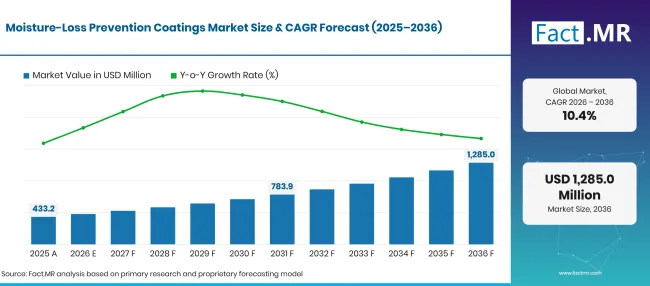
Moisture Loss Prevention Coatings Forecast Global | Source: Fact.MR
Category
| Category | Segments |
|---|---|
| Coating Chemistry | Wax emulsion, Biopolymer hydrogel, Lipid-polymer blend, Polysaccharide film, Composite coating |
| Food Substrate | Meat / seafood, Fresh vegetables, Fresh fruit, Bakery / confectionery, Prepared / specialty foods |
| Application Method | Casting / wrapping, Spray coating, Roller / curtain, Dip coating, In-line hybrid |
| Barrier Function | Multi-function, Oxygen control, Antimicrobial, Mechanical protection, Moisture control |
| Region | India; China; United States; Germany; France |
Source: Fact.MR analysis. Updated Nov 20, 2026
Segmental Analysis
Why do wax emulsions lead coating chemistry in the Moisture-Loss Prevention Coatings Market?
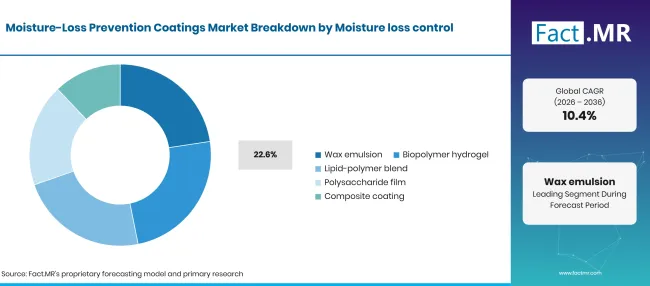
Moisture Loss Prevention Coatings Breakdown Moisture Loss Control | Source: Fact.MR
Wax emulsions hold a 22.6% market share in 2026, valued at approximately USD 108.1 million, because they create a moisture-resistant surface without adding complicated processing steps. Their use across fruit, cheese and confectionery also makes them a practical choice for processors handling different food categories. Other chemistries, particularly protein and hydrocolloid coatings, are gaining attention for their film-forming properties and suitability for specific food formulations. In a 2025 study listed on FAO AGRIS, carnauba wax-based coatings reduced mandarin weight loss to 11.71%, compared with 21.72% in untreated fruit.
How are meat and seafood positioned as the leading food substrate in the Moisture-Loss Prevention Coatings Market?
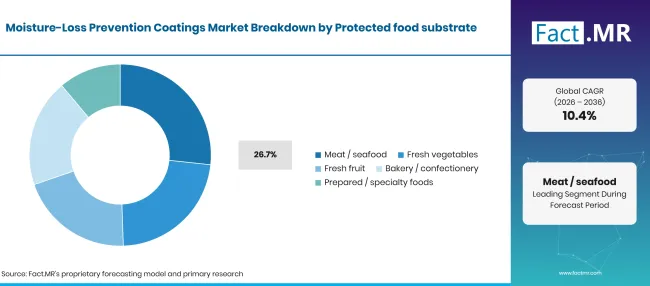
Moisture Loss Prevention Coatings Breakdown Protected Food Substrate | Source: Fact.MR
Meat and seafood account for 26.7% of market revenue in 2026, equivalent to approximately USD 127.7 million. Frozen shrimp, fish fillets and portioned meat need effective surface protection because moisture loss during freezing and thawing affects both product weight and appearance. India’s seafood exports reached a record 1.97 million tonnes, worth USD 8.46 billion, in FY 2025-26, according to MPEDA data released in June 2026. Frozen shrimp contributed 40.19% of export volume. Meanwhile, fruit, bakery and dairy applications are gaining attention as processors look to limit dehydration and preserve product quality.
Why does casting and wrapping lead application methods in the Moisture-Loss Prevention Coatings Market?
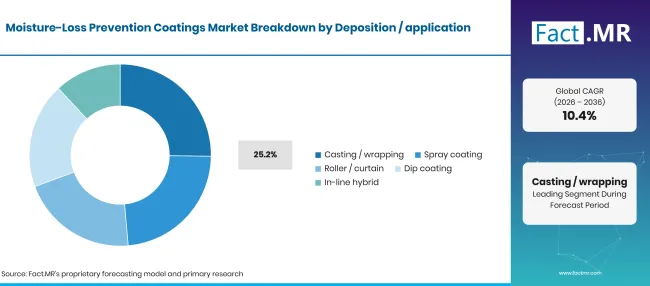
Moisture Loss Prevention Coatings Breakdown Deposition Application | Source: Fact.MR
Casting and wrapping account for 25.2% of market revenue in 2026, worth approximately USD 120.5 million. Pre-formed films and casings offer consistent coverage on sausages, cheese and portioned foods, making them suitable for automated packing operations. Spraying and dipping are also gaining ground because they allow processors to coat irregular surfaces and handle high-volume production. In May 2025, India's Bureau of Indian Standards revised its implementation guidelines for cellulose films, covering plain and coated varieties used in food packaging. This adds to the relevance of film-based barrier materials in food processing.
How are multi-function coatings shaping performance demand in the Moisture-Loss Prevention Coatings Market?
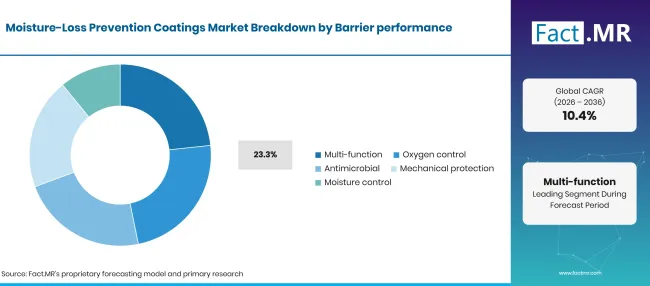
Moisture Loss Prevention Coatings Breakdown Barrier Performance | Source: Fact.MR
Processors are showing greater interest in coatings that do more than control moisture, helping multi-function formulations capture 23.3% of market revenue in 2026, or approximately USD 111.4 million. Combining moisture barriers with antioxidant and antimicrobial properties can help protect food quality without adding several separate treatment stages. Single-function moisture barriers also retain a place in applications where basic water retention is the main priority. In February 2026, the European Food Safety Authority outlined how active food-contact materials can absorb or release substances to improve food quality and extend shelf life. This wider focus on active preservation adds relevance to multi-function coating systems.
Moisture-Loss Prevention Coatings Market-Drivers, Restraints & Trends
Drivers: Rising Meat Consumption and Processing Volumes:
Higher meat consumption is creating more opportunities for moisture-loss prevention coatings because processors need to limit weight loss during chilled storage, freezing and transportation. FranceAgriMer reported in July 2026 that meat consumption in France increased 1.3% in 2025, while poultry consumption rose 3.3%. Larger volumes of processed poultry and meat are increasing the importance of moisture retention, particularly where even minor weight losses affect processing margins.
Restraints: Clean-Label and Additive Restrictions:
Clean-label reformulation creates additional hurdles because conventional moisture-binding formulations may contain phosphates or other additives that food brands want to reduce. The US MAHA Strategy, released in September 2025, called for stronger post-market reviews of food additives and greater transparency around food ingredients. Reformulating coatings can increase testing costs, complicate regulatory approvals and affect performance consistency, particularly for smaller manufacturers.
Trend: Ownership Changes in Food Ingredient Businesses:
Food ingredient businesses are attracting strategic buyers as companies reconsider which operations deserve investment. In May 2026, IFF agreed to sell its Food Ingredients business to CVC Capital Partners in a transaction valued at approximately USD 4.3 billion. Such ownership changes could create opportunities for moisture-loss prevention coatings through greater specialization, focused R&D and wider customer access. Similar portfolio restructuring across ingredient companies may reshape investment priorities in food preservation markets.
Trend: Regional Investment in Food Processing Infrastructure:
Shorter supply chains and stronger regional manufacturing networks are becoming important considerations for food ingredient companies. In June 2026, Cargill announced investments worth approximately EUR 56 million across three Belgian facilities, covering edible oils, chocolate production and food innovation capabilities. Such regional investment creates opportunities for moisture-loss prevention coatings by strengthening access to food manufacturers and ingredient networks. Similar capacity expansion across regional food processing hubs may encourage greater adoption of moisture-retention technologies.
Moisture-Loss Prevention Coatings Market by Analysis by Key Country
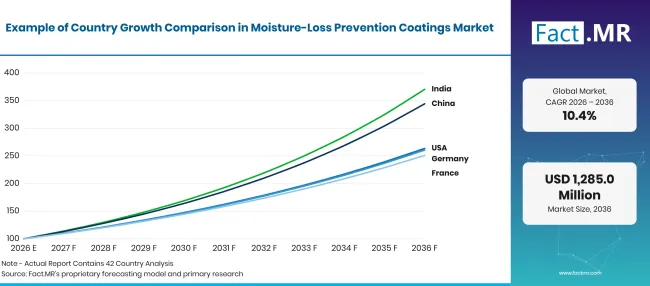
Moisture Loss Prevention Coatings Growth Index | Source: Fact.MR
| Country | CAGR (2026-2036) |
|---|---|
| India | 14.0% |
| China | 13.2% |
| United States | 10.2% |
| Germany | 10.1% |
| France | 9.6% |
Source: Fact.MR analysis. Updated Nov 20, 2026
What is driving moisture-loss prevention coatings demand in India?
India's expanding food processing and export industries are creating a strong market for moisture-loss prevention coatings, particularly across seafood, meat and packaged food operations.
In April 2026, the Ministry of Food Processing Industries reported that food preservation and processing capacity had increased by 34 lakh tonnes per annum under its production-linked incentive scheme. Rising processed food exports and investments in cold-chain infrastructure are encouraging processors to pay closer attention to moisture retention, product weight and shelf quality.
How is meat output supporting moisture-loss prevention coatings sales in China?
Large-scale meat production gives China a strong opportunity for moisture-loss prevention coatings, as processors handle substantial quantities of chilled and frozen protein products.
China's National Bureau of Statistics reported in February 2026 that pork, beef, mutton and poultry production reached 100.72 million tonnes in 2025, increasing 4.2% year over year. Poultry output alone rose 6.7%. Higher processing volumes and the need to preserve meat quality during distribution are driving interest in moisture-retention treatments.
What is shaping moisture-loss prevention coatings demand in the United States?
The United States offers a substantial market for moisture-loss prevention coatings because its meat industry handles large volumes of products across refrigerated retail, foodservice and frozen distribution channels.
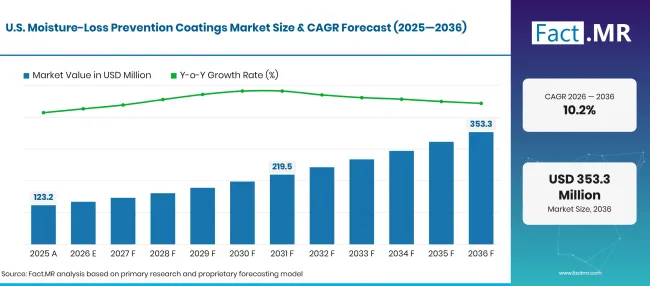
Moisture Loss Prevention Coatings Forecast Usa | Source: Fact.MR
USDA's National Agricultural Statistics Service reported in April 2026 that red meat production reached 53.8 billion pounds in 2025, despite a 2% annual decline. The scale of meat processing, combined with freezer-storage losses and strict retail quality standards, is sustaining interest in coatings that protect product weight and appearance.
Why is Germany an important market for moisture-loss prevention coatings?
Germany's extensive meat processing industry and expanding convenience-food production are creating opportunities for moisture-loss prevention coatings.
According to Destatis, the country produced meat and meat products worth EUR 45.2 billion in 2025, up 2.0% from the previous year. The production of ready meals also continued increasing during the first three quarters of 2025. These processing activities are encouraging greater attention to moisture retention, particularly in packaged meat products, chilled meals and prepared foods.
How is poultry consumption supporting moisture-loss prevention coatings demand in France?
rance's meat consumption patterns are creating steady opportunities for moisture-loss prevention coatings, particularly in poultry and prepared meat categories.
FranceAgriMer reported in July 2026 that total meat consumption increased 1.3% in 2025, while poultry consumption climbed 3.3%. Higher poultry consumption is encouraging processors to maintain product weight, texture and appearance throughout chilled distribution. Expansion of prepared meat products and frozen food retail is also creating sales opportunities for moisture-retention coatings across French food processing facilities.
Competitive Landscape for Moisture-Loss Prevention Coatings Market
Competition in the moisture-loss prevention coatings market centres on formulation expertise and the ability to reduce processing losses. Ingredion, Cargill, Tate & Lyle and Roquette bring starch, fibre and plant protein technologies, while Kerry Group and IFF focus on preservation, texture and integrated coating solutions. Buyers place greater weight on actual yield improvement, clean-label compatibility and performance across freezing, thawing and chilled storage.
Recent business moves are reshaping the competitive landscape. IFF agreed to sell its Food Ingredients business to CVC Capital Partners in May 2026, while Cargill announced EUR 56 million in investments across Belgian operations in June 2026. These changes put greater emphasis on focused portfolios, regional capacity and application support.
Recent Developments
- On July 6, 2026, Ingredion introduced its FUSERA® clean-label solutions at IFT FIRST 2026. The solutions help food and beverage manufacturers reduce sugar while maintaining flavor, color and texture in finished products.
- On March 4, 2025, Cargill showcased new food ingredients at AAHAR 2025 in India, including Gemini Plus Trans Fat-Free Vanaspati, NatureFresh Professional Elite Choice and NatureFresh Professional Lite for bakery and food-service applications.
- On September 30, 2025, Kerry Group launched Smart Taste™, a range of taste solutions that helps food and beverage manufacturers manage ingredient costs, reduce sugar and maintain product flavor while addressing changing consumer preferences.
- On June 23, 2026, IFF launched Danisco Grindsted DuoGel, a stabilizer system for plant-based gummies in Europe, the Middle East and Africa. The ingredient helps manufacturers achieve a juicy texture and chewy bite similar to traditional gummies.
- On September 4, 2025, Tate & Lyle launched its Tate & Lyle Sensation™ formulation tool in Asia-Pacific. The tool helps food and beverage manufacturers understand consumer texture preferences and develop products with improved mouthfeel, starting with yogurt applications.
Key Players in Moisture-Loss Prevention Coatings Market
Key companies operating in the market include Ingredion, Cargill, Kerry Group, IFF, Tate & Lyle, and Roquette.
- Ingredion
- Cargill
- Kerry Group
- IFF
- Tate & Lyle
- Roquette
Bibliography
- Bureau of Indian Standards. (2025, May 5). Guidelines for implementation of revised IS 5012:2024, cellulose film: Specification.
- Cargill. (2026, June 3). Cargill strengthens Belgium as strategic European food innovation and manufacturing hub.
- Devi, S., Mukherjee, A., Sharma, S., Katiyar, V., & Kumar, S. (2025). Effects of blending of neem seed oil, carvacrol, and eugenol in carnauba wax-based nanocoating on shelf-life extension of common mandarin. FAO AGRIS.
- Destatis. (2026, May 18). Nach jahrelangem Anstieg: Fleischersatz-Produktion sinkt 2025 um 1,2 % gegenüber dem Vorjahr [Meat substitute production falls 1.2% in 2025 after years of growth].
- European Food Safety Authority. (2026, February 11). Active and intelligent materials. Official website
- FranceAgriMer. (2026, July 8). La consommation de viandes en France [Meat consumption in France].
- International Flavors & Fragrances Inc. (2026, May 29). IFF enters into agreement to sell its Food Ingredients business to CVC.
- Marine Products Export Development Authority. (2026, June 1). India's seafood exports net US $8.46 billion in 2025-26.
- Press Information Bureau, Government of India. (2026, August 12). The new era of Indian agriculture and allied sectors.
- State Council Information Office. (2026, January 26). SCIO briefing on China's economic performance in 2025.
- The White House. (2025, September 9). Make our children healthy again strategy.
- U.S. Department of Agriculture, National Agricultural Statistics Service. (2026, April). Livestock slaughter 2025 summary.
Segmentation
Scope of Report
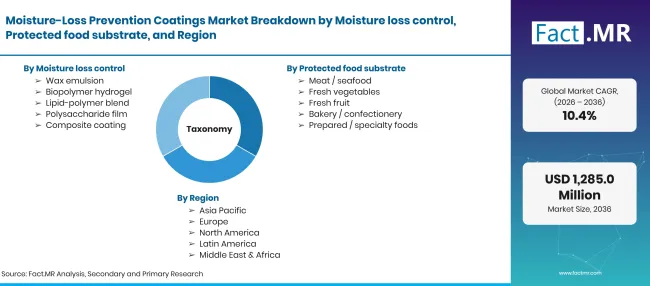
Moisture Loss Prevention Coatings Taxonomy | Source: Fact.MR
| Items | Values |
|---|---|
| Quantitative Units (2026) | USD 478.2 Million |
| Coating Chemistry | Wax emulsion, Biopolymer hydrogel, Lipid-polymer blend, Polysaccharide film, Composite coating |
| Food Substrate | Meat / seafood, Fresh vegetables, Fresh fruit, Bakery / confectionery, Prepared / specialty foods |
| Application Method | Casting / wrapping, Spray coating, Roller / curtain, Dip coating, In-line hybrid |
| Barrier Function | Multi-function, Oxygen control, Antimicrobial, Mechanical protection, Moisture control |
| Regions Covered | North America, Latin America, Europe, East Asia, South Asia and Pacific, Middle East & Africa |
| Countries Covered | India, China, United States, Germany, France, and other countries |
| Key Companies Profiled | Ingredion, Cargill, Kerry Group, IFF, Tate & Lyle, Roquette |
| Additional Attributes | Dollar revenue in the Moisture-Loss Prevention Coatings Market is segmented by coating chemistry (wax emulsion, biopolymer hydrogel, lipid-polymer blend, polysaccharide film, composite coating), food substrate, application method, barrier function and region. |
Source: Fact.MR analysis. Updated Nov 20, 2026
Moisture-Loss Prevention Coatings Market by Segments
-
Coating Chemistry
- Wax emulsion
- Biopolymer hydrogel
- Lipid-polymer blend
- Polysaccharide film
- Composite coating
-
Food Substrate
- Meat / seafood
- Fresh vegetables
- Fresh fruit
- Bakery / confectionery
- Prepared / specialty foods
-
Application Method
- Casting / wrapping
- Spray coating
- Roller / curtain
- Dip coating
- In-line hybrid
-
Barrier Function
- Multi-function
- Oxygen control
- Antimicrobial
- Mechanical protection
- Moisture control
-
Region:
- North America
- United States
- Canada
- Mexico
- Europe
- Germany
- United Kingdom
- France
- Italy
- Spain
- Rest of Europe
- Asia Pacific
- China
- India
- Japan
- South Korea
- Australia
- Rest of Asia Pacific
- Latin America
- Brazil
- Mexico
- Argentina
- Rest of Latin America
- Middle East & Africa
- GCC Countries
- South Africa
- Rest of Middle East & Africa
- North America
Frequently Asked Questions
How big is the global Moisture-Loss Prevention Coatings Market in 2026?
What will be the size of the Moisture-Loss Prevention Coatings Market by 2036?
How fast will the Moisture-Loss Prevention Coatings Market grow during the forecast period?
Which coating chemistry segment holds the largest share of the Moisture-Loss Prevention Coatings Market?
Who worked on this report


Preview the report firsthand - request a free sample
Free SampleGet the brochure for pricing and purchase details
Download PDF