- Market Value (2025): USD 162.6 Mn
- Estimated Value (2026): USD 174.0 Mn
- Forecast Value (2036): USD 342.3 Mn
- CAGR (2026-2036): 7.0%
Dry Filling Precision Machines Market Forecast and Outlook 2026 to 2036
The dry filling precision machines market was valued at approximately USD 162.6 million in 2025 and USD 174.0 million in 2026. It is set to reach USD 342.3 million by 2036, registering a 7.0% CAGR during the 2026–2036 assessment period.
Food, nutrition and pharmaceutical manufacturers are turning to precision filling machines to maintain accurate powder and granule weights across jars, pouches and capsules. Even small filling errors can lead to ingredient wastage or compliance issues, particularly for high-value products such as protein powders, infant formula and coffee. The EU Packaging and Packaging Waste Regulation, which applies from August 2026, also places limits on empty packaging space. Such regulatory changes are creating fresh opportunities for precision filling equipment through 2036.
Key Takeaways from the Dry Filling Precision Machines Market
- Sales of dry filling precision machines stood at USD 162.6 million in 2025
- Dry Filling Precision Machines Market Value (2026): USD 174.0 million
- Dry Filling Precision Machines Market Forecast Value (2036): USD 342.3 million
- Dry Filling Precision Machines Market Forecast CAGR (2026-2036): 7.0%
- Leading Dry filler dosing: Auger (27.2%)
- Key Market Participants: Syntegon, Coesia, IMA Group; All-Fill; Krones; Sidel
- Key Growth Regions: India, United States, China; Italy; Germany
At interpack 2026 in Düsseldorf, Syntegon, IMA; Coesia and other manufacturers showcased servo-driven auger and net-weigh fillers with inline checkweighing and automatic dose correction. These systems help manufacturers maintain filling accuracy by adjusting doses using real-time weight feedback. As production lines place greater emphasis on reducing product loss and manual corrections, integrated dosing and weighing systems are gaining attention. This shift toward automated filling is opening new sales opportunities worldwide.
Dry Filling Precision Machines Market
| Metric | Value |
|---|---|
| Estimated Value in (2025) | USD 162.6 million |
| Estimated Value in (2026) | USD 174.0 million |
| Forecast Value in (2036) | USD 342.3 million |
| Forecast CAGR (2026 to 2036) | 7.0% |
Source: Fact.MR analysis. Updated Nov 19, 2026
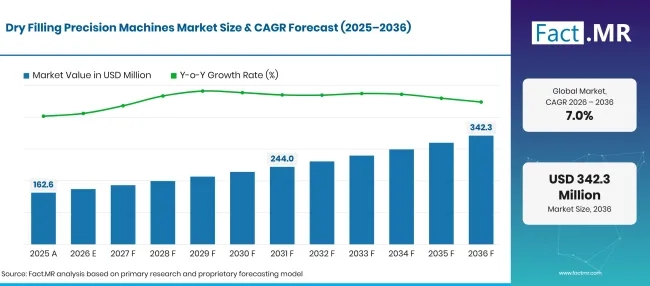
Dry Filling Precision Machines Forecast Global | Source: Fact.MR
Category
| Category | Segments |
|---|---|
| Dry filler dosing | Auger, Vibratory feeder, Net-weigh; Gross-weigh; Hybrid volumetric-gravimetric |
| Processing scale | Pilot / lab, Small commercial, Mid-scale; High-throughput; Ultra-high-throughput |
| Operating configuration | Batch, Semi-continuous, Continuous; Modular skid; Integrated line |
| Food / process application | Bakery / wafers, Confectionery / cocoa, Snacks / seasoning; Brewing / grains; Other food / industrial |
| Region | India; United States; China; Italy; Germany |
Source: Fact.MR analysis. Updated Nov 19, 2026
Segmental Analysis
Why do Auger fillers lead dosing demand in the Dry Filling Precision Machines Market?
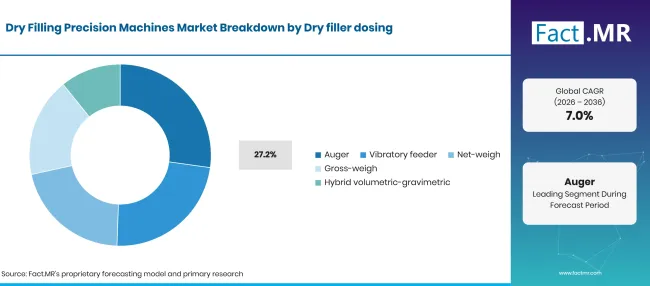
Dry Filling Precision Machines Breakdown Dry Filler Dosing | Source: Fact.MR
Auger fillers hold a 27.2% revenue share in 2026, valued at approximately USD 47.3 million. Their rotating screw mechanism handles fine powders such as flour, milk powder and spices without relying on free-flowing material movement, making them suitable for consistent dosing at moderate operating costs. Gross-weigh and vibratory fillers serve granules and other free-flowing materials. Accuracy is also becoming a stronger purchasing consideration as the 2026 edition of NIST Handbook 133 updates procedures for checking the net contents of packaged goods.
Why does the Pilot / lab segment lead scale demand in the Dry Filling Precision Machines Market?
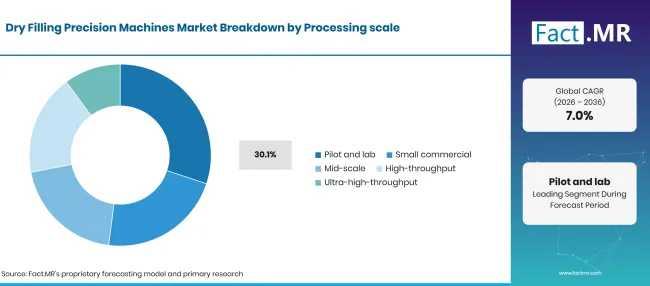
Dry Filling Precision Machines Breakdown Processing Scale | Source: Fact.MR
The Pilot / lab segment captures 30.1% of market revenue in 2026, equivalent to USD 52.4 million. Smaller filling systems suit nutrition start-ups, product developers and contract packers that need to test powder blends, adjust filling weights and handle limited production batches before investing in larger equipment. India's CFTRI inaugurated a BIRAC-BioNEST incubation centre in April 2026, with shared infrastructure for food start-ups and support for scale-up validation. Such initiatives strengthen the need for compact filling and testing equipment.
Why does Semi-continuous operation lead configuration demand in the Dry Filling Precision Machines Market?
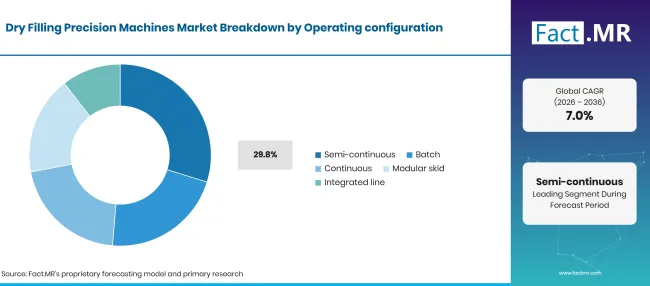
Dry Filling Precision Machines Breakdown Operating Configuration | Source: Fact.MR
Semi-continuous machines generate 29.8% of revenue in 2026, reaching approximately USD 51.9 million. Many small and mid-sized processors prefer indexed conveyors and manual container loading because these arrangements offer better control over short production runs without the expense of fully automated lines. Batch systems serve similar requirements, while larger facilities increasingly consider automation upgrades. At interpack 2026, held from May 7 to 13 in Düsseldorf, automation; robotics and connected production systems featured prominently across packaging technology discussions.
Why does Other food / industrial lead application demand in the Dry Filling Precision Machines Market?
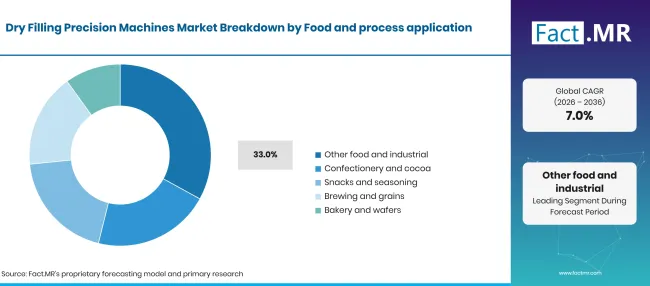
Dry Filling Precision Machines Breakdown Food And Process Application | Source: Fact.MR
Protein supplements, infant formula, pharmaceutical powders and specialty industrial materials together place the Other food / industrial category at the forefront; with 33.0% revenue in 2026; worth USD 57.4 million. These products often involve different powder densities, handling conditions and filling weights, making flexible dosing equipment useful across production settings. India's Ministry of Food Processing Industries updated its food testing laboratory scheme guidelines in November 2025 and published equipment cost norms in January 2026. This focus on testing infrastructure adds context to the need for accurate filling and quality-control systems.
Dry Filling Precision Machines Market-Drivers, Restraints & Trends
Driver
Rising Cost of High-Value Powder Wastage: Protein powders, collagen blends and infant formula leave little room for filling errors because even small weight variations can lead to expensive product losses. This is encouraging food and nutrition manufacturers to pay closer attention to filling accuracy, particularly across high-volume packaging operations. As packaged nutrition products expand into more formats, accurate powder measurement is becoming an important part of production cost control.
Restraint
Difficult Powder Handling: Fine powders do not always behave consistently during filling. Some materials absorb moisture, form lumps or stick inside hoppers, making it difficult to maintain uniform weights across batches. Dust extraction, cleaning and material-flow adjustments also add to installation and operating costs. Smaller processors may find these expenses difficult to justify, particularly when handling several powder types on the same production line.
Trend
Closed-Loop Weighing and Dosing: Packaging lines are moving towards closer coordination between filling and weight inspection. At interpack 2026, manufacturers highlighted connected weighing, automated correction and digital process control. This approach gives operators better visibility into filling variations and helps reduce product giveaway. Over time, wider adoption of connected production systems could create opportunities for dry filling precision machines across food, nutrition and pharmaceutical packaging.
Trend
Recyclable Packaging Adaptation: Packaging sustainability is changing how manufacturers approach dry product filling. The EU Packaging and Packaging Waste Regulation entered into force in February 2025 and applies from August 2026, bringing greater attention to packaging efficiency and material use. This creates an opportunity for the dry filling precision machines market as packers adapt production lines to recyclable packaging formats, lighter materials and changing pouch structures.
Dry Filling Precision Machines Market by Analysis by Key Country
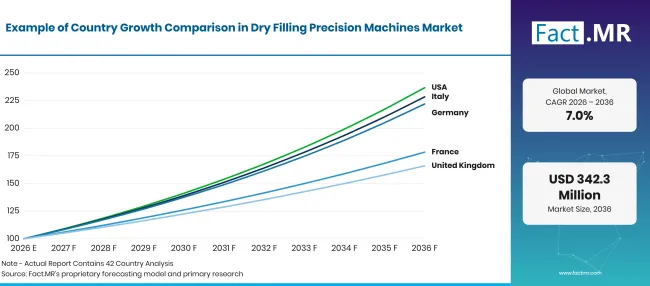
Dry Filling Precision Machines Growth Index | Source: Fact.MR
| Country | CAGR (2026-2036) |
|---|---|
| India | 9.3% |
| United States | 9.0% |
| China | 8.6% |
| Italy | 8.5% |
| Germany | 8.3% |
Source: Fact.MR analysis. Updated Nov 19, 2026
Why is India the fastest-growing market for dry filling precision machines?
India's expanding packaged food industry is creating more room for dry filling precision machines, particularly in dairy powders, nutrition blends and ready-to-cook products.
The Ministry of Food Processing Industries reported in 2026 that the PLI scheme had helped create 34 lakh tonnes of annual food processing capacity. As more processors increase output, sales of precision fillers are gaining support from the need to control powder wastage and maintain consistent pack weights. The expansion of organised food manufacturing is also creating opportunities among small and mid-sized processors moving away from manual filling methods.
What is shaping dry filling machine sales in the United States?
Powdered supplements, protein blends, coffee and baking ingredients give the United States a broad customer base for precision filling equipment.
The scale of the industry is significant: US food manufacturing shipments reached USD 1,054.3 billion in 2024, according to Census Bureau data released in 2026. Manufacturers are investing in accurate dosing to limit costly ingredient losses, making production efficiency an important factor behind equipment sales. Rising interest in packaged nutrition and specialised food formulations is also encouraging manufacturers to improve filling accuracy across different product sizes.
What is driving dry filling machine demand in China?
China's food processing industry is handling larger volumes of packaged products, creating a stronger need for consistent powder filling.
National Bureau of Statistics data showed that agricultural and sideline food processing value added increased by 5.6% in 2025. This expansion is encouraging equipment investment among food and nutrition manufacturers. Sales are also gaining momentum as factories look to reduce manual filling errors and improve output across multiple packaging formats. The wider adoption of automated manufacturing lines is adding another source of opportunity for precision filling equipment across domestic processing facilities.
What is shaping dry filling machine demand in Italy?
Italy's packaging machinery industry offers a substantial market for dry filling equipment.
UCIMA reported in July 2026 that domestic sales of Italian food and pharmaceutical packaging machinery increased by more than 15% in 2025. This activity is relevant to dry filling precision machines because manufacturers handling powders and granules need reliable dosing across different product categories. Equipment upgrades, packaging flexibility and tighter weight control are contributing to sales growth. The country's established food and pharmaceutical processing base also creates opportunities for machinery upgrades as manufacturers adapt to changing packaging specifications.
Why is dry filling machine growth slower in Germany?
Germany's strong food processing and packaging machinery base is keeping investment in filling technology active.
VDMA reported in May 2026 that German food processing and packaging machinery production reached nearly EUR 17 billion in 2025, increasing by 4.9%. For dry filling precision machine manufacturers, the opportunity comes from processors upgrading production lines to improve filling consistency, reduce material losses and handle changing packaging requirements. Demand for connected production systems and greater weight-control accuracy is also encouraging equipment investment among German food and industrial powder processors.
Competitive Landscape for Dry Filling Precision Machines Market
The competitive landscape in the dry filling precision machines market is shaped by how well manufacturers handle different powder types, maintain filling accuracy and reduce production losses. All-Fill introduced its Series 100 automatic auger filler in April 2026, with servo-driven dosing, tool-free changeovers and checkweigher feedback options. Syntegon showcased its GKF 705 Capsylon capsule filler for fine powders and granules at Pack Expo 2025, targeting nutraceutical production. IMA Group, Coesia, Krones and Sidel compete through broader packaging automation capabilities. Buyers are paying closer attention to dosing consistency, dust management, cleaning time and flexibility across packaging formats
Recent Developments
- On December 18, 2025, GEA Group AG agreed to acquire Hydract A/S; a Danish manufacturer of water-hydraulic process valves; to expand its valve technology portfolio for the food; beverage and pharmaceutical industries.
- On March 12, 2026, Syntegon Technology GmbH strengthened its partnership with LYOCONTRACT through a €50 million production expansion project in Germany. Syntegon will install a complete vial filling and freeze-drying line at the facility.
- On July 30, 2026, IMA Group announced the acquisition of Azzurra Technology Platform and the launch of IMA LIFE Quantum to expand its robotic automation capabilities for sterile pharmaceutical filling processes.
- On April 28, 2026, All-Fill Inc. introduced its Series 100 automatic inline auger filler, featuring tool-free changeovers, servo-driven filling and dust-reduction technology for powder packaging applications.
- On August 26, 2026, Spee-Dee Packaging Machinery; Inc. announced the launch of its High-Speed, Ultra-Hygienic Rotary Tray Filling System, designed to improve sanitation; production efficiency and format flexibility.
Key Players in Dry Filling Precision Machines Market
Key companies profiled include Syntegon Technology GmbH; IMA Group; All-Fill Inc.; Spee-Dee Packaging Machinery, Inc.; GEA Group AG; OPTIMA Packaging Group GmbH; PER-FIL Industries, Inc.; and AMS Filling Systems, Inc.
- Syntegon Technology GmbH
- IMA Group
- All-Fill Inc.
- Spee-Dee Packaging Machinery, Inc.
- GEA Group AG
- OPTIMA Packaging Group GmbH
- PER-FIL Industries, Inc.
- AMS Filling Systems, Inc.
Bibliography
- Central Food Technological Research Institute. (2026). FoodPro newsletter: January–March 2026. Council of Scientific and Industrial Research.
- Central Food Technological Research Institute. (n.d.). BIRAC-BioNEST: Bioincubators nurturing entrepreneurship for scaling technologies. Council of Scientific and Industrial Research.
- Destatis. (2026, January 14). Production of ready meals increased by 25.6% in volume over five years. Federal Statistical Office of Germany. https://www.destatis.de/DE/Presse/Pressemitteilungen/2026/01/PD26_N002_42
- European Parliament and Council of the European Union. (2025). Regulation (EU) 2025/40 on packaging and packaging waste. Official Journal of the European Union.
- Messe Düsseldorf. (2026). The world's largest event for the processing and packaging industry: interpack 2026 is in the starting blocks.
- Ministry of Food Processing Industries. (n.d.). Production Linked Incentive Scheme for the Food Processing Industry (PLISFPI). Government of India.
- National Bureau of Statistics of China. (2026, February 28). Statistical communiqué of the People's Republic of China on the 2025 national economic and social development.
- National Institute of Standards and Technology. (2026). NIST Handbook 133: Checking the net contents of packaged goods (2026 ed.). U.S. Department of Commerce. https://doi.org/10.6028/NIST.HB.133-2026
- Unione Costruttori Italiani Macchine Automatiche per il Confezionamento e l'Imballaggio. (2026, July 2). I costruttori macchine packaging mantengono la crescita: Fatturato 2025 a +4% che sfiora i 10,5 miliardi di euro.
- U.S. Census Bureau. (2026, September 3). Census Bureau releases new Annual Integrated Economic Survey data.
Segmentation
Scope of Report
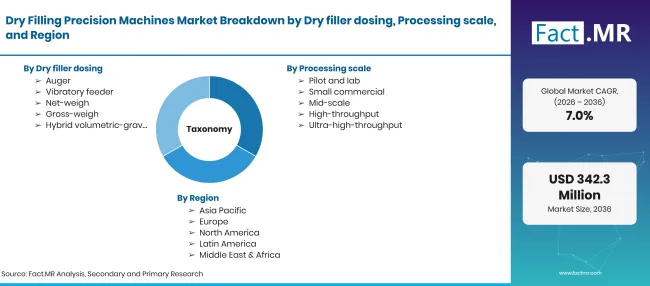
Dry Filling Precision Machines Taxonomy | Source: Fact.MR
| Items | Values |
|---|---|
| Quantitative Units (2026) | USD 174.0 Million |
| Dry filler dosing | Auger, Vibratory feeder, Net-weigh; Gross-weigh; Hybrid volumetric-gravimetric |
| Processing scale | Pilot / lab, Small commercial, Mid-scale; High-throughput; Ultra-high-throughput |
| Operating configuration | Batch, Semi-continuous, Continuous; Modular skid; Integrated line |
| Food / process application | Bakery / wafers, Confectionery / cocoa, Snacks / seasoning; Brewing / grains; Other food / industrial |
| Regions Covered | North America, Latin America, Europe; East Asia; South Asia and Pacific; Middle East & Africa |
| Countries Covered | India, United States, China; Italy; Germany; and other countries |
| Key Companies Profiled | Syntegon, Coesia, IMA Group; All-Fill; Krones; Sidel |
| Additional Attributes | Dollar revenue in the Dry Filling Precision Machines Market is segmented by dry filler dosing (auger, vibratory feeder, net-weigh; gross-weigh; hybrid volumetric-gravimetric); processing scale (pilot / lab; small commercial; mid-scale; high-throughput; ultra-high-throughput); operating configuration (batch; semi-continuous; continuous; modular skid; integrated line); food / process application (bakery / wafers; confectionery / cocoa; snacks / seasoning; brewing / grains; other food / industrial) and region. |
Source: Fact.MR analysis. Updated Nov 19, 2026
Dry Filling Precision Machines Market by Segments
-
Dry filler dosing
- Auger
- Vibratory feeder
- Net-weigh
- Gross-weigh
- Hybrid volumetric-gravimetric
-
Processing scale
- Pilot / lab
- Small commercial
- Mid-scale
- High-throughput
- Ultra-high-throughput
-
Operating configuration
- Batch
- Semi-continuous
- Continuous
- Modular skid
- Integrated line
-
Food / process application
- Bakery / wafers
- Confectionery / cocoa
- Snacks / seasoning
- Brewing / grains
- Other food / industrial
-
Region:
- North America
- United States
- Canada
- Mexico
- Europe
- Germany
- United Kingdom
- France
- Italy
- Spain
- Rest of Europe
- Asia Pacific
- China
- India
- Japan
- South Korea
- Australia
- Rest of Asia Pacific
- Latin America
- Brazil
- Mexico
- Argentina
- Rest of Latin America
- Middle East & Africa
- GCC Countries
- South Africa
- Rest of Middle East & Africa
- North America
Frequently Asked Questions
How big is the global Dry Filling Precision Machines Market in 2026?
What will be the size of the Dry Filling Precision Machines Market by 2036?
How fast will the Dry Filling Precision Machines Market grow during the forecast period?
Which dry filler dosing segment holds the largest share of the Dry Filling Precision Machines Market?
Who worked on this report


Preview the report firsthand - request a free sample
Free SampleGet the brochure for pricing and purchase details
Download PDF