Wash Primers Market Size, Share, Growth and Forecast (2026 - 2036)
The Wash Primers Market is segmented by Chemistry, by Substrate, by Application, by Performance, and by Region. Forecast for 2026 to 2036.
What is the wash primers market forecast to be worth by 2036?
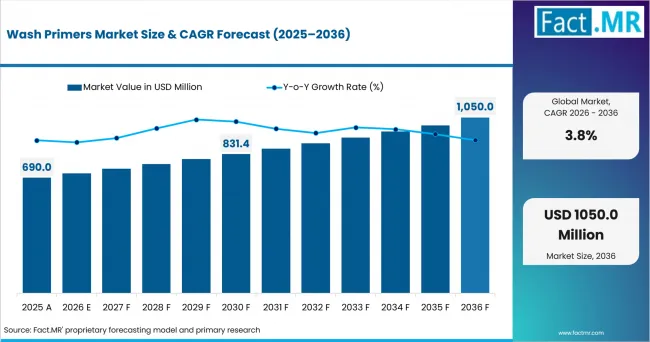
USD 720.0 million in 2026 to USD 1,050.0 million by 2036, at 3.8% CAGR.
- The wash primers market reached USD 690.0 million in 2025. Demand is expected to rise from USD 720.0 million in 2026 to USD 1,050.0 million by 2036.
- The market is projected to record 3.8% CAGR during 2026 to 2036. Growth is led by marine repair, aerospace maintenance and metal fabrication work where adhesion failure creates rework cost.
What are the defining numbers behind wash primers growth?
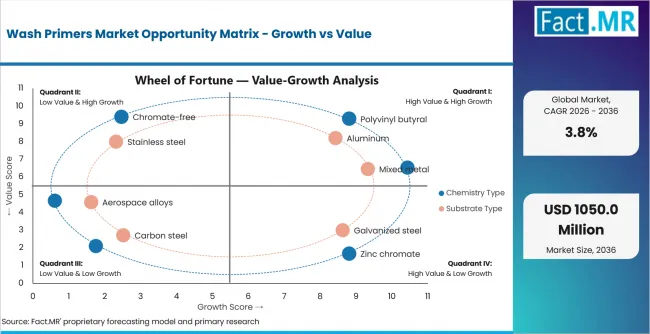
USD 330.0 million absolute opportunity by 2036, led by aluminum substrates and marine applications.
- Demand Drivers in the Market
- Marine repair yards need wash primers when coating systems are applied on cleaned steel surfaces exposed to salt water.
- Aerospace maintenance teams specify qualified primers due to material approval needs during repair release and warranty acceptance.
- Metal fabricators use fast-drying wash primers when assemblies move from pretreatment to coating in short production windows.
- Key Segments Analyzed
- By Chemistry: Polyvinyl butyral systems are expected to hold 34.0% share in 2026 due to proven adhesion on aluminum and galvanized steel.
- By Substrate: Aluminum is projected to account for 38.0% share in 2026 due to aerospace and marine bonding needs before topcoats.
- By Application: Marine is estimated to hold 31.0% share in 2026 as salt exposure keeps surface preparation rules strict.
- By Performance: Adhesion promotion is forecast to hold 42.0% share in 2026 due to rework risk from poor bonding.
- By Region: North America is expected to hold 30.0% share in 2026 due to aerospace repair and regulated refinish activity.
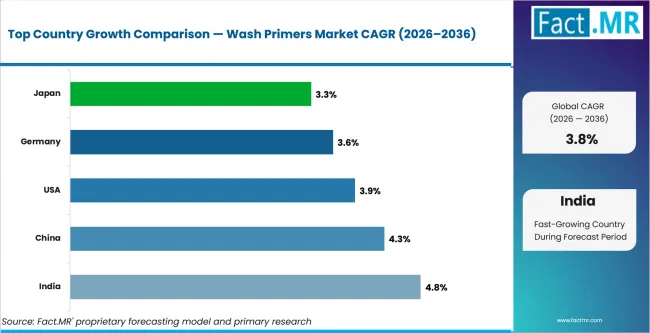
- By Geography: India is projected to record 4.8% CAGR through 2036 as steel fabrication and ship repair activity expand.
- Analyst Opinion at Fact.MR
- Shambhu Nath Jha, Senior Analyst at Fact.MR, states, "Wash primers are not bought like ordinary paint. Buyers use them to avoid coating failure at the first layer. Suppliers that can prove adhesion and chrome-free compliance get a stronger place in approved coating systems."
- Strategic Implications
- Primer suppliers should keep chromated and chromate-free options in parallel until aerospace and defense approvals convert fully.
- Marine distributors should stock small-pack primer kits for repair yards that handle mixed steel and aluminum work.
- Automotive refinish suppliers need volatile organic compound compliant products for regulated air districts and distributor training.
- Industrial coating buyers should validate topcoat compatibility before replacing legacy zinc chromate wash primers.
Wash primers act as the first film on aluminum, galvanized steel and mixed metal surfaces. This role connects the category with anti-corrosion coatings used after pretreatment and surface preparation.
India is projected to record 4.8% CAGR through 2036 due to steel fabrication growth and ship repair work. China is expected to expand at 4.3% CAGR through 2036 as industrial coating use remains tied to metal output. The United States is forecast to grow at 3.9% CAGR through 2036 due to aerospace repair and refinish regulation. Germany is expected to advance at 3.6% CAGR through 2036 due to European chemical review. Japan is projected to rise at 3.3% CAGR through 2036 as shipbuilding and precision metal coating sustain replacement sales.
How does the wash primers market break down by segment?
Polyvinyl butyral systems lead at 34.0%; aluminum substrates lead at 38.0%.
Which chemistry dominates?
Polyvinyl butyral systems hold 34.0% share in 2026.
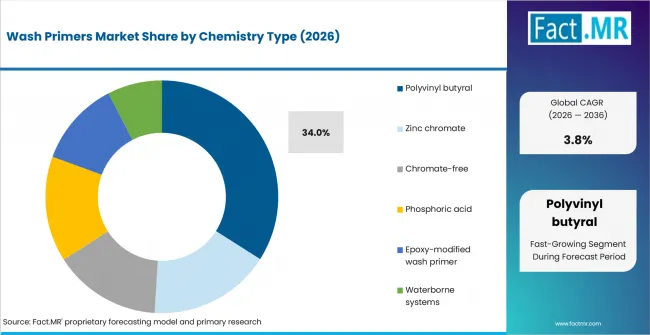
Polyvinyl butyral systems lead due to thin-film adhesion after acid activation. The chemistry remains practical for repair shops and fabricators that need fast handling before topcoat application. Solvent management rules keep waterborne and lower volatile organic compound systems in buyer review.
The shift from zinc chromate toward chrome-free corrosion protection coatings is expected to remain gradual due to coating stack approval cycles.
Which substrate dominates?
Aluminum holds 38.0% share in 2026.
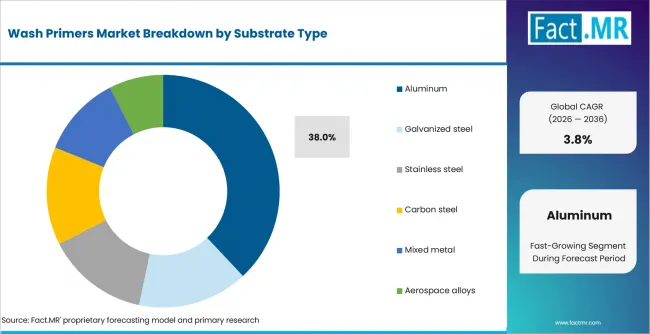
Aluminum leads due to wash primer use on smooth and corrosion-sensitive surfaces. Aircraft panels and boat parts require reliable adhesion before primers and topcoats are applied. Airbus forecasts around 43,400 aircraft deliveries over 20 years in its 2025 outlook. [4] This supports long-cycle coating demand for aircraft surfaces.
Which application dominates?
Marine holds 31.0% share in 2026.
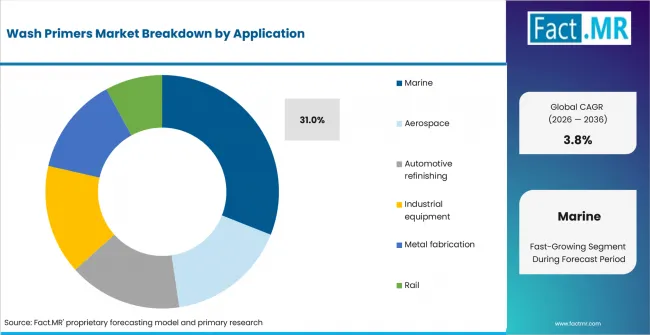
Marine leads due to repair yard coating work on cleaned steel and aluminum surfaces. Salt exposure makes poor adhesion expensive after vessels return to service. United Nations Conference on Trade and Development reported that maritime trade grew 2.2% in 2024. [6] This supports continued repair and coating activity.
Marine wash primer use also overlaps with hull coatings where yard schedules require primers that dry quickly before protective layers.
Which performance criterion dominates?
Adhesion promotion holds 42.0% share in 2026.
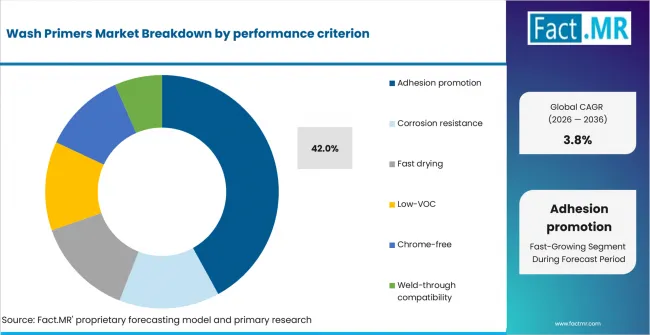
Adhesion promotion leads due to buyer focus on reducing topcoat lift and coating rejection. Corrosion support matters, but the purchase decision usually begins with whether the primer bonds to the substrate. Buyers also compare zinc rich primers when corrosion resistance is more important than a thin pretreatment layer.
What is moving wash primer specifications, and what is limiting faster conversion?
Volatile organic compound rules and chromium review move specifications; qualification time limits faster change.
The main driver is regulatory pressure on older solvent and chromated primer systems. South Coast Air Quality Management District Rule 1151 includes pretreatment wash primers in coating limits and alternative limits beginning in 2028. [1] This supports supplier work on lower volatile organic compound primers and clearer application guidance.
Chromium review is the second driver. In 2025, the European Commission described movement toward a restriction of hexavalent chromium substances under the Registration Evaluation Authorisation and Restriction of Chemicals framework. [2] European Chemicals Agency also lists an active restriction process for selected chromium(VI) substances. [3] Buyers that sell into Europe therefore evaluate chromate-free wash primers before urgent conversion is required.
The main restraint is qualification time. Aerospace and defense buyers do not replace primer chemistry until adhesion and corrosion performance are proven. Marine buyers also require topcoat compatibility before replacement.
Another restraint is application sensitivity. Wash primers depend on surface cleaning, film thickness and recoat timing. Distributor training remains important when misuse creates coating failure that looks like product weakness.
Where do the biggest wash primer opportunities sit?
Chrome-free aerospace qualification, regulated refinish channels and mixed-metal fabrication create the clearest openings.
- Chrome-free aerospace qualification gives suppliers a route into approved repair systems when legacy chromate use becomes harder to defend.
- Regulated refinish channels need primers that match volatile organic compound rules without changing shop workflow too much.
- Mixed-metal fabrication favors primers that bond to aluminum and galvanized steel in the same production line.
- Marine repair distributors can package primers with surface preparation guidance to reduce field failure claims.
Which countries scale wash primer demand fastest?
India 4.8%, China 4.3%, United States 3.9%, Germany 3.6%, Japan 3.3%.
Based on regional analysis, the wash primers market is segmented into North America and Europe. It also covers East Asia and South Asia. Latin America and Middle East and Africa are included in the regional view.
.webp)
| Country | CAGR |
|---|---|
| India | 4.8% |
| China | 4.3% |
| United States | 3.9% |
| Germany | 3.6% |
| Japan | 3.3% |

What is lifting India's wash primer requirement?
4.8% CAGR, supported by metal fabrication and ship repair demand.
India is projected to record 4.8% CAGR through 2036 due to metal fabrication and ship repair demand. The Ministry of Steel, Government of India reported crude steel production of 152.180 million tonnes in fiscal year 2024 to 2025. [7] This output expands the surface preparation base for primers used before industrial coatings. Fabricators need wash primers when coated assemblies move into outdoor equipment, rail and marine repair channels. Faster growth depends on distributor training when incorrect mixing weakens adhesion before the topcoat is applied.
Why does China remain a volume market for wash primers?
4.3% CAGR, supported by industrial coating use and metal output.
China is expected to expand at 4.3% CAGR through 2036 due to steady coatings use in fabrication and transport equipment. World Steel Association reported Chinese crude steel production of 1,005.1 million tonnes in 2024. [8] Industrial buyers use wash primers where galvanized steel and aluminum parts need topcoat bonding before assembly. Automotive and equipment suppliers also compare primer compatibility with automotive OEM coatings during coating-line updates. Chrome-free substitution remains uneven where local low-cost coating work uses older specifications.
What keeps the United States specification-led?
3.9% CAGR, supported by aerospace repair and regulated refinish channels.
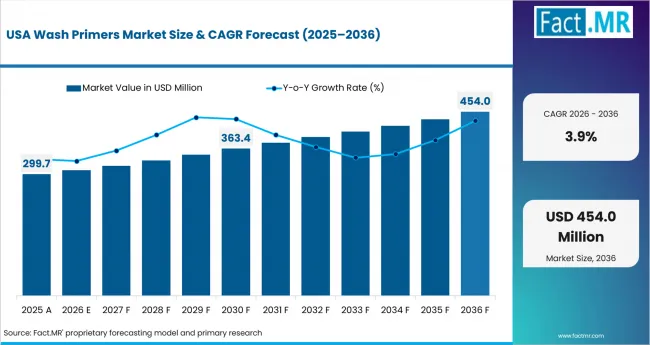
The United States is forecast to grow at 3.9% CAGR through 2036 due to aerospace repair and regulated refinish channels. International Organization of Motor Vehicle Manufacturers reported global vehicle production of 96.4 million units in 2025. [5] This supports refinish and replacement coating demand in channels that also use pretreatment primers. Aerospace maintenance buyers need approved coating systems that reduce rework on aluminum aircraft surfaces. Automotive refinishing also connects wash primer use with automotive coatings where surface repair and topcoat matching are purchased together.
Why does Germany remain a chrome-transition market?
3.6% CAGR, backed by European chromium review and coating-quality expectations.
Germany is expected to advance at 3.6% CAGR through 2036 due to European chromium review and high coating-quality expectations. The market favors suppliers that help buyers move from chromated primers to approved substitutes without coating failures. Industrial equipment makers need documented primer compatibility when components are coated for export markets. Growth is constrained when buyers need long corrosion tests before approving a primer change.
How does Japan support quality-led wash primer use?
3.3% CAGR, supported by shipbuilding quality and precision metal finishing.
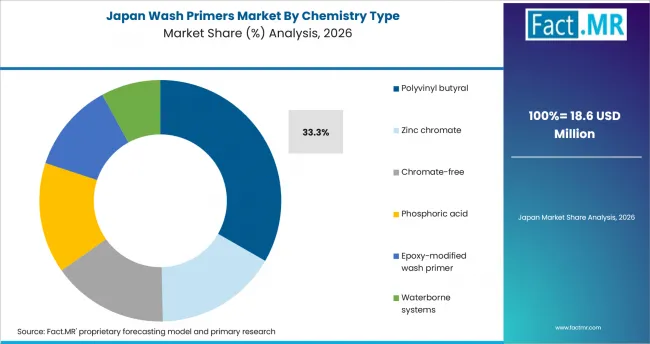
Japan is projected to rise at 3.3% CAGR through 2036 due to shipbuilding quality and precision metal finishing. Buyers focus on primer reliability due to coating defect costs in marine and transport equipment. Shipbuilding and repair yards need wash primers that work under strict surface preparation procedures. Aerospace suppliers need stable adhesion on aluminum alloys before qualified primers and topcoats are applied.
Who leads the wash primers landscape?
PPG, AkzoNobel and Sherwin-Williams lead through coating portfolios and technical-service reach.
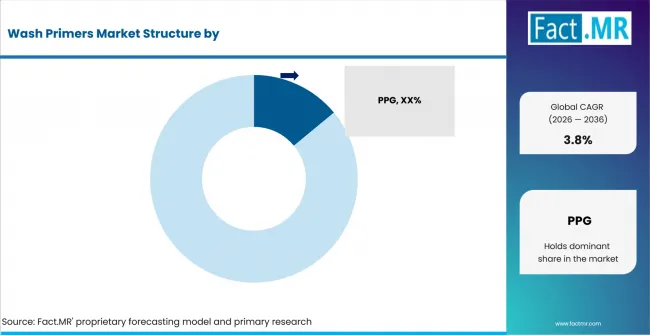
Wash primers are supplied by coating companies serving aerospace, marine, refinish and industrial accounts. PPG is positioned strongly in aerospace primer systems due to its Desoprime CF chrome-free wash primer being marketed for direct metal application in aerospace use. [9] Sherwin-Williams competes through chrome hazard free primer systems for aircraft coating work. [10]
Marine suppliers such as Hempel and Jotun compete through yard relationships and repair-channel availability. Axalta and Sherwin-Williams benefit from refinish distribution where jobbers influence product choice.
Suppliers are best placed when they combine test data, application training and product variants for chromated and chromate-free systems. Buyers are not only purchasing primer. They are buying lower rework risk across a wider performance coatings stack.
Which companies are the key players?
PPG, AkzoNobel, Sherwin-Williams, Axalta, Hempel, Jotun, Kansai Paint, Nippon Paint.
- PPG
- AkzoNobel
- Sherwin-Williams
- Axalta
- Hempel
- Jotun
- Kansai Paint
- Nippon Paint
Bibliography
- [1] South Coast Air Quality Management District. (2024, November 1). Rule 1151: Motor vehicle and mobile equipment non-assembly line coating operations. South Coast Air Quality Management District.
- [2] European Commission. (2025, December 10). Questions and answers: Towards a restriction of hexavalent chromium substances under REACH. European Commission.
- [3] European Chemicals Agency. (2025, June 18). Restricting the use of certain chromium(VI) substances. European Chemicals Agency.
- [4] Airbus. (2025, June). Global market forecast 2025 to 2044. Airbus.
- [5] International Organization of Motor Vehicle Manufacturers. (2026, April 28). Auto industry growth shifted east in 2025 amid global repositioning. International Organization of Motor Vehicle Manufacturers.
- [6] United Nations Conference on Trade and Development. (2025, September 24). Review of maritime transport 2025. United Nations Conference on Trade and Development.
- [7] Ministry of Steel, Government of India. (2026). Annual report 2025 to 2026. Ministry of Steel, Government of India.
- [8] World Steel Association. (2025, June). World Steel in Figures 2025. World Steel Association.
- [9] PPG Aerospace. (2026). PPG Desoprime CF chrome-free wash primer. PPG Aerospace.
- [10] Sherwin-Williams Aerospace. (2026). Chrome hazard free urethane primer. Sherwin-Williams Aerospace.
This Report Addresses
- Strategic intelligence on wash primers across chemistry, substrate, application and performance criteria.
- Segment analysis covering polyvinyl butyral systems, aluminum substrates, marine use and adhesion promotion.
- Regional outlook covering India, China, the United States, Germany and Japan.
- Competitive analysis of PPG, AkzoNobel, Sherwin-Williams, Axalta, Hempel, Jotun, Kansai Paint, Nippon Paint.
- Regulatory assessment covering volatile organic compound limits, chromium review and chromate-free substitution.
- Buyer assessment covering marine repair yards, aerospace maintenance teams, refinish shops and metal fabricators.
- Primary interviews, supplier checks, official source review and market anchor reconciliation support the forecast.
What does the wash primers market cover?
Adhesion-promoting primer systems used before topcoats on metal substrates.
The wash primers market covers acid-activated and resin-based primer systems used to prepare metal for topcoat bonding. It includes polyvinyl butyral and zinc chromate grades. Chromate-free systems and epoxy-modified wash primers are also included.
What is included in the scope?
Thin-film primers used for adhesion, corrosion support and coating compatibility.
The scope includes wash primers supplied to marine yards and aerospace maintenance shops. It also covers refinishing networks, metal fabrication plants and industrial equipment makers. Solventborne and waterborne products are included when sold as primer systems for metal adhesion.
What is excluded from the scope?
Full primer surfacers, heavy-duty topcoats and standalone conversion coatings.
The scope excludes full-build epoxy primers when they are sold without wash primer function. It excludes decorative paints, powder coatings and mechanical surface preparation services. It also excludes conversion coating chemicals that are not sold as wash primers.
How was the analysis built?
120+ sources, 35+ company portfolios, 25+ countries, 24+ interviews.
- Primary Research: Primary checks included coating formulators and distributor technical teams. The interview base also covered aerospace maintenance buyers and marine yard coating managers.
- Desk Research: Desk research reviewed regulatory filings and company product pages. It also covered coating rules, aerospace fleet forecasts and steel output.
- Market-Sizing and Forecasting: Forecasting used market estimates and bottom-up demand checks. Estimates were reconciled against coating use cases and substrate mix.
- Data Validation and Update Cycle: Forecasts were validated through distributor checks and product-line screening. The update cycle tracks volatile organic compound rules, chromium review and aerospace maintenance demand.
What is the report's scope and coverage?
| Attribute | Details |
|---|---|
| Quantitative Units | USD Billion in 2026 to USD Billion by 2036 at CAGR |
| Market Definition | Wash primer systems used for adhesion promotion, corrosion support and topcoat readiness on metal substrates |
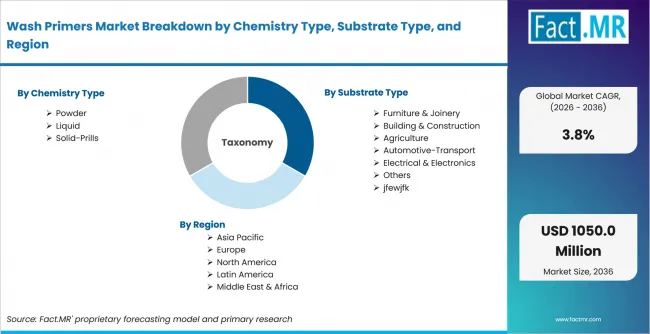
| Chemistry | Polyvinyl butyral, zinc chromate, chromate-free, phosphoric acid, epoxy-modified wash primer and waterborne systems |
| Substrate | Aluminum, galvanized steel, stainless steel, carbon steel, mixed metal and aerospace alloys |
| Application | Marine, aerospace, automotive refinishing, industrial equipment, metal fabrication, rail and defense |
| Performance | Adhesion promotion, corrosion resistance, fast drying, low-VOC, chrome-free and weld-through compatibility |
| Regions Covered | North America, Europe, East Asia, South Asia, Latin America and Middle East and Africa |
| Countries Covered | India, China, United States, Germany and Japan |
| Key Companies Profiled | PPG, AkzoNobel, Sherwin-Williams, Axalta, Hempel, Jotun, Kansai Paint, Nippon Paint |
| Forecast Period | 2026 to 2036 |
| Approach | Hybrid top-down and bottom-up approach using market estimates, supplier portfolios, coating rules, metal output and channel interviews |
How is the market segmented?
-
By Chemistry:
- Polyvinyl butyral
- Zinc chromate
- Chromate-free
- Phosphoric acid
- Epoxy-modified wash primer
- Waterborne systems
-
By Substrate:
- Aluminum
- Galvanized steel
- Stainless steel
- Carbon steel
- Mixed metal
- Aerospace alloys
-
By Application:
- Marine
- Aerospace
- Automotive refinishing
- Industrial equipment
- Metal fabrication
- Rail
- Defense
-
By Performance:
- Adhesion promotion
- Corrosion resistance
- Fast drying
- Low-VOC
- Chrome-free
- Weld-through compatibility
-
By Region:
- North America
- United States
- Canada
- Mexico
- Latin America
- Brazil
- Argentina
- Rest of Latin America
- Europe
- Germany
- United Kingdom
- France
- Italy
- Spain
- Rest of Europe
- East Asia
- China
- Japan
- South Korea
- South Asia
- India
- ASEAN
- Rest of South Asia
- Middle East and Africa
- GCC Countries
- South Africa
- United Arab Emirates
- Rest of Middle East and Africa
- North America
- Frequently Asked Questions -
Which chemistry leads the Wash Primers Market?
Polyvinyl butyral systems lead with 34.0% share in 2026 due to reliable adhesion on aluminum and galvanized steel
Which substrate leads the Wash Primers Market?
Aluminum leads with 38.0% share in 2026 due to aerospace and marine bonding needs before topcoat application.
Which application leads the Wash Primers Market?
Marine leads with 31.0% share in 2026 as salt exposure makes surface preparation and primer bonding important.
Which performance criterion leads the Wash Primers Market?
Adhesion promotion leads with 42.0% share in 2026 due to wash primer use for coating-bond improvement.
Which country expands faster in the Wash Primers Market?
India is projected to record 4.8% CAGR through 2036 due to metal fabrication and ship repair demand.
How does China perform in the Wash Primers Market?
China is expected to expand at 4.3% CAGR through 2036 as industrial coating use stays tied to metal output.
How does the United States perform in the Wash Primers Market?
The United States is forecast to grow at 3.9% CAGR through 2036 due to aerospace repair and regulated refinish channels.
How does Germany perform in the Wash Primers Market?
Germany is expected to advance at 3.6% CAGR through 2036 due to European chromium review and coating-quality expectations.
How does Japan perform in the Wash Primers Market?
Japan is projected to rise at 3.3% CAGR through 2036 due to shipbuilding quality and precision metal finishing.
What is the primary driver in the Wash Primers Market?
The primary driver is the need for reliable adhesion before topcoats are applied on metal substrates.
What is the main restraint in the Wash Primers Market?
The main restraint is qualification time due to buyer requirements for compatibility proof before legacy primer replacement.
Table of Content
- Key Takeaways
- Market Size and CAGR
- Top Growth Driver
- Fastest Growing Segment
- Leading Region
- Key Companies
- Emerging Opportunities
- Executive Summary
- Global Market Outlook
- Demand-side Trends
- Supply-side Trends
- Technology Roadmap Analysis
- Analysis and Recommendations
- Analyst Perspective (What is happening? Why now? What should investors know?)
- Key Questions Answered
- How large is the market?
- What is the CAGR?
- What are key trends?
- Which region dominates?
- Who are the leaders?
- Market Overview
- Market Coverage / Taxonomy
- Market Definition / Scope / Limitations
- Research Methodology
- Chapter Orientation
- Analytical Lens and Working Hypotheses
- Market Structure, Signals, and Trend Drivers
- Benchmarking and Cross-market Comparability
- Market Sizing, Forecasting, and Opportunity Mapping
- Research Design and Evidence Framework
- Desk Research Programme (Secondary Evidence)
- Expert Input and Fieldwork (Primary Evidence)
- Tooling, Models, and Reference Databases
- Data Engineering and Model Build
- Quality Assurance and Audit Trail
- Market Background
- Market Dynamics (Drivers, Restraints, Opportunity, Trends)
- Scenario Forecast (Optimistic, Likely, Conservative)
- Impact Analysis
- AI Impact
- Sustainability Impact
- Regulatory Impact
- Technology Impact
- Consumer / Buyer Analysis
- Purchase Drivers
- Adoption Barriers
- Buyer Journey
- Opportunity Map Analysis
- Product Life Cycle Analysis
- Supply Chain Analysis
- Investment Feasibility Matrix
- Value Chain Analysis
- PESTLE and Porter's Analysis
- Regulatory Landscape
- Regional Parent Market Outlook
- Production and Consumption Statistics
- Import and Export Statistics
- Global Market Analysis and Forecast, 2021 to 2036
- Historical Market Size Value (USD Million) Analysis, 2021 to 2025
- Current and Future Market Size Value (USD Million) Projections, 2026 to 2036
- Y-o-Y Growth Trend Analysis
- Absolute $ Opportunity Analysis
- Global Market Pricing Analysis, 2021 to 2036
- Global Market Analysis and Forecast, By Chemistry Type, 2021 to 2036
- Introduction / Key Findings
- Historical Market Size Value (USD Million) Analysis By Chemistry Type, 2021 to 2025
- Current and Future Market Size Value (USD Million) Analysis and Forecast By Chemistry Type, 2026 to 2036
- Polyvinyl butyral
- Zinc chromate
- Chromate-free
- Phosphoric acid
- Epoxy-modified wash primer
- Waterborne systems
- Polyvinyl butyral
- Y-o-Y Growth Trend Analysis By Chemistry Type, 2021 to 2025
- Absolute $ Opportunity Analysis By Chemistry Type, 2026 to 2036
- Global Market Analysis and Forecast, By Substrate Type, 2021 to 2036
- Introduction / Key Findings
- Historical Market Size Value (USD Million) Analysis By Substrate Type, 2021 to 2025
- Current and Future Market Size Value (USD Million) Analysis and Forecast By Substrate Type, 2026 to 2036
- Aluminum
- Galvanized steel
- Stainless steel
- Carbon steel
- Mixed metal
- Aerospace alloys
- Aluminum
- Y-o-Y Growth Trend Analysis By Substrate Type, 2021 to 2025
- Absolute $ Opportunity Analysis By Substrate Type, 2026 to 2036
- Global Market Analysis and Forecast, By Application, 2021 to 2036
- Introduction / Key Findings
- Historical Market Size Value (USD Million) Analysis By Application, 2021 to 2025
- Current and Future Market Size Value (USD Million) Analysis and Forecast By Application, 2026 to 2036
- Marine
- Aerospace
- Automotive refinishing
- Industrial equipment
- Metal fabrication
- Rail
- Defense
- Marine
- Y-o-Y Growth Trend Analysis By Application, 2021 to 2025
- Absolute $ Opportunity Analysis By Application, 2026 to 2036
- Global Market Analysis and Forecast, By performance criterion, 2021 to 2036
- Introduction / Key Findings
- Historical Market Size Value (USD Million) Analysis By performance criterion, 2021 to 2025
- Current and Future Market Size Value (USD Million) Analysis and Forecast By performance criterion, 2026 to 2036
- Adhesion promotion
- Corrosion resistance
- Fast drying
- Low-VOC
- Chrome-free
- Weld-through compatibility
- Adhesion promotion
- Y-o-Y Growth Trend Analysis By performance criterion, 2021 to 2025
- Absolute $ Opportunity Analysis By performance criterion, 2026 to 2036
- Global Market Analysis and Forecast, By Region, 2021 to 2036
- Introduction
- Historical Market Size Value (USD Million) Analysis By Region, 2021 to 2025
- Current Market Size Value (USD Million) Analysis and Forecast By Region, 2026 to 2036
- North America
- Latin America
- Western Europe
- Eastern Europe
- East Asia
- South Asia and Pacific
- Middle East & Africa
- Market Attractiveness Analysis By Region
- North America Market Analysis and Forecast, By Country, 2021 to 2036
- Historical Market Size Value (USD Million) Trend Analysis By Market Taxonomy, 2021 to 2025
- Market Size Value (USD Million) Forecast By Market Taxonomy, 2026 to 2036
- By Country
- USA
- Canada
- Mexico
- By Chemistry Type
- By Substrate Type
- By Application
- By performance criterion
- By Country
- Market Attractiveness Analysis
- By Country
- By Chemistry Type
- By Substrate Type
- By Application
- By performance criterion
- Key Takeaways
- Latin America Market Analysis and Forecast, By Country
- Historical Market Size Value (USD Million) Trend Analysis By Market Taxonomy, 2021 to 2025
- Market Size Value (USD Million) Forecast By Market Taxonomy, 2026 to 2036
- By Country
- Brazil
- Chile
- Rest of Latin America
- By Chemistry Type
- By Substrate Type
- By Application
- By performance criterion
- By Country
- Market Attractiveness Analysis
- By Country
- By Chemistry Type
- By Substrate Type
- By Application
- By performance criterion
- Key Takeaways
- Western Europe Market Analysis and Forecast, By Country
- Historical Market Size Value (USD Million) Trend Analysis By Market Taxonomy, 2021 to 2025
- Market Size Value (USD Million) Forecast By Market Taxonomy, 2026 to 2036
- By Country
- Germany
- UK
- Italy
- Spain
- France
- Nordic
- BENELUX
- Rest of Western Europe
- By Chemistry Type
- By Substrate Type
- By Application
- By performance criterion
- By Country
- Market Attractiveness Analysis
- By Country
- By Chemistry Type
- By Substrate Type
- By Application
- By performance criterion
- Key Takeaways
- Eastern Europe Market Analysis and Forecast, By Country
- Historical Market Size Value (USD Million) Trend Analysis By Market Taxonomy, 2021 to 2025
- Market Size Value (USD Million) Forecast By Market Taxonomy, 2026 to 2036
- By Country
- Russia
- Poland
- Hungary
- Balkan & Baltic
- Rest of Eastern Europe
- By Chemistry Type
- By Substrate Type
- By Application
- By performance criterion
- By Country
- Market Attractiveness Analysis
- By Country
- By Chemistry Type
- By Substrate Type
- By Application
- By performance criterion
- Key Takeaways
- East Asia Market Analysis and Forecast, By Country
- Historical Market Size Value (USD Million) Trend Analysis By Market Taxonomy, 2021 to 2025
- Market Size Value (USD Million) Forecast By Market Taxonomy, 2026 to 2036
- By Country
- China
- Japan
- South Korea
- By Chemistry Type
- By Substrate Type
- By Application
- By performance criterion
- By Country
- Market Attractiveness Analysis
- By Country
- By Chemistry Type
- By Substrate Type
- By Application
- By performance criterion
- Key Takeaways
- South Asia and Pacific Market Analysis and Forecast, By Country
- Historical Market Size Value (USD Million) Trend Analysis By Market Taxonomy, 2021 to 2025
- Market Size Value (USD Million) Forecast By Market Taxonomy, 2026 to 2036
- By Country
- India
- ASEAN
- Australia & New Zealand
- Rest of South Asia and Pacific
- By Chemistry Type
- By Substrate Type
- By Application
- By performance criterion
- By Country
- Market Attractiveness Analysis
- By Country
- By Chemistry Type
- By Substrate Type
- By Application
- By performance criterion
- Key Takeaways
- Middle East & Africa Market Analysis and Forecast, By Country
- Historical Market Size Value (USD Million) Trend Analysis By Market Taxonomy, 2021 to 2025
- Market Size Value (USD Million) Forecast By Market Taxonomy, 2026 to 2036
- By Country
- Kingdom of Saudi Arabia
- Other GCC Countries
- Turkiye
- South Africa
- Other African Union
- Rest of Middle East & Africa
- By Chemistry Type
- By Substrate Type
- By Application
- By performance criterion
- By Country
- Market Attractiveness Analysis
- By Country
- By Chemistry Type
- By Substrate Type
- By Application
- By performance criterion
- Key Takeaways
- Key Countries Market Analysis
- USA
- Pricing Analysis
- Market Share Analysis, 2025
- By Chemistry Type
- By Substrate Type
- By Application
- By performance criterion
- Canada
- Pricing Analysis
- Market Share Analysis, 2025
- By Chemistry Type
- By Substrate Type
- By Application
- By performance criterion
- Mexico
- Pricing Analysis
- Market Share Analysis, 2025
- By Chemistry Type
- By Substrate Type
- By Application
- By performance criterion
- Brazil
- Pricing Analysis
- Market Share Analysis, 2025
- By Chemistry Type
- By Substrate Type
- By Application
- By performance criterion
- Chile
- Pricing Analysis
- Market Share Analysis, 2025
- By Chemistry Type
- By Substrate Type
- By Application
- By performance criterion
- Germany
- Pricing Analysis
- Market Share Analysis, 2025
- By Chemistry Type
- By Substrate Type
- By Application
- By performance criterion
- UK
- Pricing Analysis
- Market Share Analysis, 2025
- By Chemistry Type
- By Substrate Type
- By Application
- By performance criterion
- Italy
- Pricing Analysis
- Market Share Analysis, 2025
- By Chemistry Type
- By Substrate Type
- By Application
- By performance criterion
- Spain
- Pricing Analysis
- Market Share Analysis, 2025
- By Chemistry Type
- By Substrate Type
- By Application
- By performance criterion
- France
- Pricing Analysis
- Market Share Analysis, 2025
- By Chemistry Type
- By Substrate Type
- By Application
- By performance criterion
- India
- Pricing Analysis
- Market Share Analysis, 2025
- By Chemistry Type
- By Substrate Type
- By Application
- By performance criterion
- ASEAN
- Pricing Analysis
- Market Share Analysis, 2025
- By Chemistry Type
- By Substrate Type
- By Application
- By performance criterion
- Australia & New Zealand
- Pricing Analysis
- Market Share Analysis, 2025
- By Chemistry Type
- By Substrate Type
- By Application
- By performance criterion
- China
- Pricing Analysis
- Market Share Analysis, 2025
- By Chemistry Type
- By Substrate Type
- By Application
- By performance criterion
- Japan
- Pricing Analysis
- Market Share Analysis, 2025
- By Chemistry Type
- By Substrate Type
- By Application
- By performance criterion
- South Korea
- Pricing Analysis
- Market Share Analysis, 2025
- By Chemistry Type
- By Substrate Type
- By Application
- By performance criterion
- Russia
- Pricing Analysis
- Market Share Analysis, 2025
- By Chemistry Type
- By Substrate Type
- By Application
- By performance criterion
- Poland
- Pricing Analysis
- Market Share Analysis, 2025
- By Chemistry Type
- By Substrate Type
- By Application
- By performance criterion
- Hungary
- Pricing Analysis
- Market Share Analysis, 2025
- By Chemistry Type
- By Substrate Type
- By Application
- By performance criterion
- Kingdom of Saudi Arabia
- Pricing Analysis
- Market Share Analysis, 2025
- By Chemistry Type
- By Substrate Type
- By Application
- By performance criterion
- Turkiye
- Pricing Analysis
- Market Share Analysis, 2025
- By Chemistry Type
- By Substrate Type
- By Application
- By performance criterion
- South Africa
- Pricing Analysis
- Market Share Analysis, 2025
- By Chemistry Type
- By Substrate Type
- By Application
- By performance criterion
- USA
- Market Structure Analysis
- Competition Dashboard
- Competition Benchmarking
- Market Share Analysis of Top Players
- By Regional
- By Chemistry Type
- By Substrate Type
- By Application
- By performance criterion
- Emerging Startups
- Innovation Benchmarking
- Competition Analysis
- Competition Deep Dive
- PPG
- Overview
- Product Portfolio
- Profitability by Market Segments (Product/Age /Sales Channel/Region)
- Sales Footprint
- Strategy Overview
- Marketing Strategy
- Product Strategy
- Channel Strategy
- AkzoNobel
- Sherwin-Williams
- Axalta
- Hempel
- Jotun
- Kansai Paint
- Nippon Paint
- PPG
- Competition Deep Dive
- Case Studies
- Success Stories
- Recent Developments
- Assumptions & Acronyms Used
List Of Table
- Table 1: Global Market Value (USD Million) Forecast by Region, 2021 - 2036
- Table 2: Global Market Value (USD Million) Forecast by Chemistry Type, 2021 - 2036
- Table 3: Global Market Value (USD Million) Forecast by Substrate Type, 2021 - 2036
- Table 4: Global Market Value (USD Million) Forecast by Application, 2021 - 2036
- Table 5: Global Market Value (USD Million) Forecast by performance criterion, 2021 - 2036
- Table 6: Global Market rma_anu Forecast by rma_anu, 2021 - 2036
- Table 7: North America Market Value (USD Million) Forecast by Country, 2021 - 2036
- Table 8: North America Market Value (USD Million) Forecast by Chemistry Type, 2021 - 2036
- Table 9: North America Market Value (USD Million) Forecast by Substrate Type, 2021 - 2036
- Table 10: North America Market Value (USD Million) Forecast by Application, 2021 - 2036
- Table 11: North America Market Value (USD Million) Forecast by performance criterion, 2021 - 2036
- Table 12: Latin America Market Value (USD Million) Forecast by Country, 2021 - 2036
- Table 13: Latin America Market Value (USD Million) Forecast by Chemistry Type, 2021 - 2036
- Table 14: Latin America Market Value (USD Million) Forecast by Substrate Type, 2021 - 2036
- Table 15: Latin America Market Value (USD Million) Forecast by Application, 2021 - 2036
- Table 16: Latin America Market Value (USD Million) Forecast by performance criterion, 2021 - 2036
- Table 17: Western Europe Market Value (USD Million) Forecast by Country, 2021 - 2036
- Table 18: Western Europe Market Value (USD Million) Forecast by Chemistry Type, 2021 - 2036
- Table 19: Western Europe Market Value (USD Million) Forecast by Substrate Type, 2021 - 2036
- Table 20: Western Europe Market Value (USD Million) Forecast by Application, 2021 - 2036
- Table 21: Western Europe Market Value (USD Million) Forecast by performance criterion, 2021 - 2036
- Table 22: Eastern Europe Market Value (USD Million) Forecast by Country, 2021 - 2036
- Table 23: Eastern Europe Market Value (USD Million) Forecast by Chemistry Type, 2021 - 2036
- Table 24: Eastern Europe Market Value (USD Million) Forecast by Substrate Type, 2021 - 2036
- Table 25: Eastern Europe Market Value (USD Million) Forecast by Application, 2021 - 2036
- Table 26: Eastern Europe Market Value (USD Million) Forecast by performance criterion, 2021 - 2036
- Table 27: East Asia Market Value (USD Million) Forecast by Country, 2021 - 2036
- Table 28: East Asia Market Value (USD Million) Forecast by Chemistry Type, 2021 - 2036
- Table 29: East Asia Market Value (USD Million) Forecast by Substrate Type, 2021 - 2036
- Table 30: East Asia Market Value (USD Million) Forecast by Application, 2021 - 2036
- Table 31: East Asia Market Value (USD Million) Forecast by performance criterion, 2021 - 2036
- Table 32: South Asia and Pacific Market Value (USD Million) Forecast by Country, 2021 - 2036
- Table 33: South Asia and Pacific Market Value (USD Million) Forecast by Chemistry Type, 2021 - 2036
- Table 34: South Asia and Pacific Market Value (USD Million) Forecast by Substrate Type, 2021 - 2036
- Table 35: South Asia and Pacific Market Value (USD Million) Forecast by Application, 2021 - 2036
- Table 36: South Asia and Pacific Market Value (USD Million) Forecast by performance criterion, 2021 - 2036
- Table 37: Middle East & Africa Market Value (USD Million) Forecast by Country, 2021 - 2036
- Table 38: Middle East & Africa Market Value (USD Million) Forecast by Chemistry Type, 2021 - 2036
- Table 39: Middle East & Africa Market Value (USD Million) Forecast by Substrate Type, 2021 - 2036
- Table 40: Middle East & Africa Market Value (USD Million) Forecast by Application, 2021 - 2036
- Table 41: Middle East & Africa Market Value (USD Million) Forecast by performance criterion, 2021 - 2036
List Of Figures
- Figure 1: Global Market Pricing Analysis
- Figure 2: Global Market Value (USD Million) Forecast 2021-2036
- Figure 3: Global Market Value Share and BPS Analysis by Chemistry Type, 2026 and 2036
- Figure 4: Global Market Y-o-Y Growth Comparison by Chemistry Type, 2026-2036
- Figure 5: Global Market Attractiveness Analysis by Chemistry Type
- Figure 6: Global Market Value Share and BPS Analysis by Substrate Type, 2026 and 2036
- Figure 7: Global Market Y-o-Y Growth Comparison by Substrate Type, 2026-2036
- Figure 8: Global Market Attractiveness Analysis by Substrate Type
- Figure 9: Global Market Value Share and BPS Analysis by Application, 2026 and 2036
- Figure 10: Global Market Y-o-Y Growth Comparison by Application, 2026-2036
- Figure 11: Global Market Attractiveness Analysis by Application
- Figure 12: Global Market Value Share and BPS Analysis by performance criterion, 2026 and 2036
- Figure 13: Global Market Y-o-Y Growth Comparison by performance criterion, 2026-2036
- Figure 14: Global Market Attractiveness Analysis by performance criterion
- Figure 15: Global Market Value (USD Million) Share and BPS Analysis by Region, 2026 and 2036
- Figure 16: Global Market Y-o-Y Growth Comparison by Region, 2026-2036
- Figure 17: Global Market Attractiveness Analysis by Region
- Figure 18: North America Market Incremental Dollar Opportunity, 2026-2036
- Figure 19: Latin America Market Incremental Dollar Opportunity, 2026-2036
- Figure 20: Western Europe Market Incremental Dollar Opportunity, 2026-2036
- Figure 21: Eastern Europe Market Incremental Dollar Opportunity, 2026-2036
- Figure 22: East Asia Market Incremental Dollar Opportunity, 2026-2036
- Figure 23: South Asia and Pacific Market Incremental Dollar Opportunity, 2026-2036
- Figure 24: Middle East & Africa Market Incremental Dollar Opportunity, 2026-2036
- Figure 25: North America Market Value Share and BPS Analysis by Country, 2026 and 2036
- Figure 26: North America Market Value Share and BPS Analysis by Chemistry Type, 2026 and 2036
- Figure 27: North America Market Y-o-Y Growth Comparison by Chemistry Type, 2026-2036
- Figure 28: North America Market Attractiveness Analysis by Chemistry Type
- Figure 29: North America Market Value Share and BPS Analysis by Substrate Type, 2026 and 2036
- Figure 30: North America Market Y-o-Y Growth Comparison by Substrate Type, 2026-2036
- Figure 31: North America Market Attractiveness Analysis by Substrate Type
- Figure 32: North America Market Value Share and BPS Analysis by Application, 2026 and 2036
- Figure 33: North America Market Y-o-Y Growth Comparison by Application, 2026-2036
- Figure 34: North America Market Attractiveness Analysis by Application
- Figure 35: North America Market Value Share and BPS Analysis by performance criterion, 2026 and 2036
- Figure 36: North America Market Y-o-Y Growth Comparison by performance criterion, 2026-2036
- Figure 37: North America Market Attractiveness Analysis by performance criterion
- Figure 38: Latin America Market Value Share and BPS Analysis by Country, 2026 and 2036
- Figure 39: Latin America Market Value Share and BPS Analysis by Chemistry Type, 2026 and 2036
- Figure 40: Latin America Market Y-o-Y Growth Comparison by Chemistry Type, 2026-2036
- Figure 41: Latin America Market Attractiveness Analysis by Chemistry Type
- Figure 42: Latin America Market Value Share and BPS Analysis by Substrate Type, 2026 and 2036
- Figure 43: Latin America Market Y-o-Y Growth Comparison by Substrate Type, 2026-2036
- Figure 44: Latin America Market Attractiveness Analysis by Substrate Type
- Figure 45: Latin America Market Value Share and BPS Analysis by Application, 2026 and 2036
- Figure 46: Latin America Market Y-o-Y Growth Comparison by Application, 2026-2036
- Figure 47: Latin America Market Attractiveness Analysis by Application
- Figure 48: Latin America Market Value Share and BPS Analysis by performance criterion, 2026 and 2036
- Figure 49: Latin America Market Y-o-Y Growth Comparison by performance criterion, 2026-2036
- Figure 50: Latin America Market Attractiveness Analysis by performance criterion
- Figure 51: Western Europe Market Value Share and BPS Analysis by Country, 2026 and 2036
- Figure 52: Western Europe Market Value Share and BPS Analysis by Chemistry Type, 2026 and 2036
- Figure 53: Western Europe Market Y-o-Y Growth Comparison by Chemistry Type, 2026-2036
- Figure 54: Western Europe Market Attractiveness Analysis by Chemistry Type
- Figure 55: Western Europe Market Value Share and BPS Analysis by Substrate Type, 2026 and 2036
- Figure 56: Western Europe Market Y-o-Y Growth Comparison by Substrate Type, 2026-2036
- Figure 57: Western Europe Market Attractiveness Analysis by Substrate Type
- Figure 58: Western Europe Market Value Share and BPS Analysis by Application, 2026 and 2036
- Figure 59: Western Europe Market Y-o-Y Growth Comparison by Application, 2026-2036
- Figure 60: Western Europe Market Attractiveness Analysis by Application
- Figure 61: Western Europe Market Value Share and BPS Analysis by performance criterion, 2026 and 2036
- Figure 62: Western Europe Market Y-o-Y Growth Comparison by performance criterion, 2026-2036
- Figure 63: Western Europe Market Attractiveness Analysis by performance criterion
- Figure 64: Eastern Europe Market Value Share and BPS Analysis by Country, 2026 and 2036
- Figure 65: Eastern Europe Market Value Share and BPS Analysis by Chemistry Type, 2026 and 2036
- Figure 66: Eastern Europe Market Y-o-Y Growth Comparison by Chemistry Type, 2026-2036
- Figure 67: Eastern Europe Market Attractiveness Analysis by Chemistry Type
- Figure 68: Eastern Europe Market Value Share and BPS Analysis by Substrate Type, 2026 and 2036
- Figure 69: Eastern Europe Market Y-o-Y Growth Comparison by Substrate Type, 2026-2036
- Figure 70: Eastern Europe Market Attractiveness Analysis by Substrate Type
- Figure 71: Eastern Europe Market Value Share and BPS Analysis by Application, 2026 and 2036
- Figure 72: Eastern Europe Market Y-o-Y Growth Comparison by Application, 2026-2036
- Figure 73: Eastern Europe Market Attractiveness Analysis by Application
- Figure 74: Eastern Europe Market Value Share and BPS Analysis by performance criterion, 2026 and 2036
- Figure 75: Eastern Europe Market Y-o-Y Growth Comparison by performance criterion, 2026-2036
- Figure 76: Eastern Europe Market Attractiveness Analysis by performance criterion
- Figure 77: East Asia Market Value Share and BPS Analysis by Country, 2026 and 2036
- Figure 78: East Asia Market Value Share and BPS Analysis by Chemistry Type, 2026 and 2036
- Figure 79: East Asia Market Y-o-Y Growth Comparison by Chemistry Type, 2026-2036
- Figure 80: East Asia Market Attractiveness Analysis by Chemistry Type
- Figure 81: East Asia Market Value Share and BPS Analysis by Substrate Type, 2026 and 2036
- Figure 82: East Asia Market Y-o-Y Growth Comparison by Substrate Type, 2026-2036
- Figure 83: East Asia Market Attractiveness Analysis by Substrate Type
- Figure 84: East Asia Market Value Share and BPS Analysis by Application, 2026 and 2036
- Figure 85: East Asia Market Y-o-Y Growth Comparison by Application, 2026-2036
- Figure 86: East Asia Market Attractiveness Analysis by Application
- Figure 87: East Asia Market Value Share and BPS Analysis by performance criterion, 2026 and 2036
- Figure 88: East Asia Market Y-o-Y Growth Comparison by performance criterion, 2026-2036
- Figure 89: East Asia Market Attractiveness Analysis by performance criterion
- Figure 90: South Asia and Pacific Market Value Share and BPS Analysis by Country, 2026 and 2036
- Figure 91: South Asia and Pacific Market Value Share and BPS Analysis by Chemistry Type, 2026 and 2036
- Figure 92: South Asia and Pacific Market Y-o-Y Growth Comparison by Chemistry Type, 2026-2036
- Figure 93: South Asia and Pacific Market Attractiveness Analysis by Chemistry Type
- Figure 94: South Asia and Pacific Market Value Share and BPS Analysis by Substrate Type, 2026 and 2036
- Figure 95: South Asia and Pacific Market Y-o-Y Growth Comparison by Substrate Type, 2026-2036
- Figure 96: South Asia and Pacific Market Attractiveness Analysis by Substrate Type
- Figure 97: South Asia and Pacific Market Value Share and BPS Analysis by Application, 2026 and 2036
- Figure 98: South Asia and Pacific Market Y-o-Y Growth Comparison by Application, 2026-2036
- Figure 99: South Asia and Pacific Market Attractiveness Analysis by Application
- Figure 100: South Asia and Pacific Market Value Share and BPS Analysis by performance criterion, 2026 and 2036
- Figure 101: South Asia and Pacific Market Y-o-Y Growth Comparison by performance criterion, 2026-2036
- Figure 102: South Asia and Pacific Market Attractiveness Analysis by performance criterion
- Figure 103: Middle East & Africa Market Value Share and BPS Analysis by Country, 2026 and 2036
- Figure 104: Middle East & Africa Market Value Share and BPS Analysis by Chemistry Type, 2026 and 2036
- Figure 105: Middle East & Africa Market Y-o-Y Growth Comparison by Chemistry Type, 2026-2036
- Figure 106: Middle East & Africa Market Attractiveness Analysis by Chemistry Type
- Figure 107: Middle East & Africa Market Value Share and BPS Analysis by Substrate Type, 2026 and 2036
- Figure 108: Middle East & Africa Market Y-o-Y Growth Comparison by Substrate Type, 2026-2036
- Figure 109: Middle East & Africa Market Attractiveness Analysis by Substrate Type
- Figure 110: Middle East & Africa Market Value Share and BPS Analysis by Application, 2026 and 2036
- Figure 111: Middle East & Africa Market Y-o-Y Growth Comparison by Application, 2026-2036
- Figure 112: Middle East & Africa Market Attractiveness Analysis by Application
- Figure 113: Middle East & Africa Market Value Share and BPS Analysis by performance criterion, 2026 and 2036
- Figure 114: Middle East & Africa Market Y-o-Y Growth Comparison by performance criterion, 2026-2036
- Figure 115: Middle East & Africa Market Attractiveness Analysis by performance criterion
- Figure 116: Global Market - Tier Structure Analysis
- Figure 117: Global Market - Company Share Analysis