- Market size in 2025:USD 0.9 Bn
- Estimated market size in 2026:USD 1.0 Bn
- Projected market size by 2036:USD 2.1 Bn
- CAGR (2026-2036):7.7%
What is the waterless beauty tablets market forecast to be worth by 2036?
USD 1.0 billion in 2026 to USD 2.1 billion by 2036, at 7.70% CAGR.
- The waterless beauty tablets market crossed a valuation of USD 0.9 billion in 2025.
- Demand is expected to increase from USD 1.0 billion in 2026 to USD 2.1 billion by 2036.
- The market is forecast to record 7.7% CAGR from 2026 to 2036 as beauty consumers adopt face cleanser tablets and handwash refill tablets.
What are the defining numbers behind waterless beauty tablets market growth?
USD 1.1 billion absolute opportunity by 2036, led by pre-dosed tablet formats and refill-led sustainable beauty.
- Demand Drivers in the Market
- Premium beauty consumers need compact cleanser formats that feel easy and travel-ready.
- Sustainable lifestyle consumers need lower-waste products that reduce repeat plastic use.
- DTC brands need refill tablets that support subscription and routine-based buying.
- Concept stores need products that make waterless beauty simple to demonstrate.
- Key Segments Analyzed
- By Product Application: Face cleanser tablets are expected to hold 32.0% share in 2026 because facial cleansing is the strongest premium entry point.
- By Material Route: Refillable systems lead because reuse is easy to explain. The segment is projected to capture 41.0% share in 2026.
- By Consumer Tier: Sustainable lifestyle consumers are likely to account for 37.0% share in 2026 because waterless tablets directly fit lower-waste values.
- By Channel: DTC leads because tablet systems need education, starter kits and refill guidance. The segment is expected to hold 34.0% share in 2026.
- By Sustainability Claim: Reduced plastic is projected to record 40.0% share in 2026 because consumers quickly understand the claim.
- Analyst Opinion at Fact.MR
- Shambhu Nath Jha, Senior Analyst at Fact.MR, states, “Waterless beauty tablets are gaining traction because they make sustainability practical. Consumers can keep a reusable jar or bottle, add water at home and avoid paying for heavy liquid formats. Brands that solve texture, lather and refill simplicity will be better positioned than brands using only plastic-free language.”
- Strategic Implications
- Beauty brands should explain how each tablet activates and how many uses it delivers.
- DTC operators should build starter kits around reusable containers and refill timing.
- Specialty retailers should separate waterless tablets from ordinary minis and travel products.
- Sustainable brands should keep material claims simple and easy to verify.
Waterless beauty tablets sit below the wider zero-waste beauty category because the title focuses on solid, tablet-style and refill-activated beauty formats. The category differs from ordinary liquid beauty because the consumer adds water at the point of use or uses a concentrated solid product.
Seadrop describes its skincare routine around waterless cleanser positioning and skin-type matching through its official skincare guidance. [1] This supports the scope because waterless beauty tablets are finished consumer products, not bulk cosmetic ingredients or commodity packaging.
The United States is projected to record 8.6% CAGR through 2036 as DTC brands, refill models and zero-waste beauty routines expand. The United Kingdom is expected to post 8.2% CAGR through 2036 as refillable personal-care habits support tablet adoption. Germany is likely to record 7.8% CAGR as low-waste retail and plastic-reduction claims gain traction. Japan is forecast to advance at 7.4% CAGR as compact beauty formats fit daily routines and travel. India is set to record 7.0% CAGR as premium sustainable beauty gains ground through marketplaces and DTC channels.
How does the waterless beauty tablets market break down by segment?
Face cleanser tablets lead at 32.0%; refillable material routes lead at 41.0%.
Which product application dominates?
Face cleanser tablets hold 32.0% share in 2026.
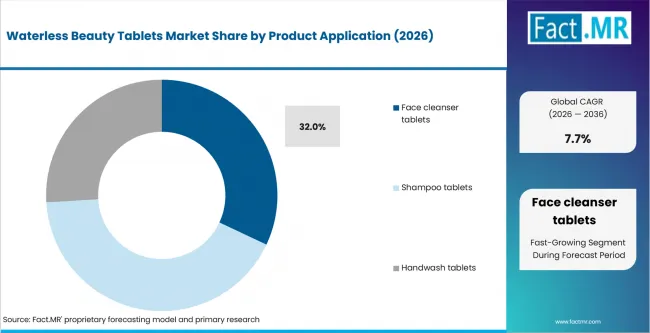
Waterless Beauty Tablets Market Analysis By Product Application | Source: Fact.MR
Face cleanser tablets are expected to hold 32.0% share in 2026 because skincare consumers are open to concentrated formats when the product feels premium and gentle. Shampoo tablets and bars are strong because waterless haircare already has consumer awareness. Body wash tablets gain traction where shower routines shift toward refill systems. Handwash tablets support personal-care adoption at the sink. Multipurpose beauty tablets remain smaller because consumers still prefer concern-specific products.
Which material route dominates?
Refillable systems lead with 41.0% share in 2026.
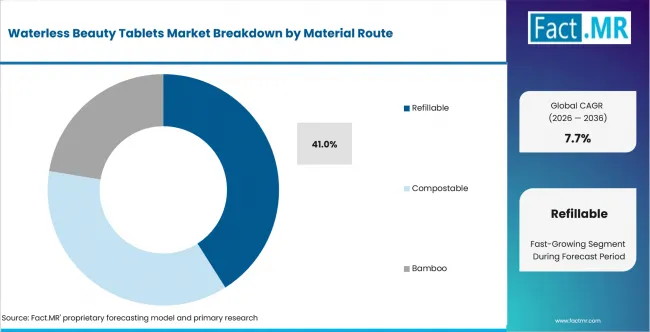
Waterless Beauty Tablets Market Analysis By Material Route | Source: Fact.MR
Refillable systems lead because reuse is the clearest sustainability behavior for consumers. The segment is projected to capture 41.0% share in 2026 as brands combine reusable jars, bottles or tins with tablet refills. Compostable routes are important for refill sleeves and paper tubes. Recycled and plant-based materials help brands reduce plastic dependence. Bamboo, cork and mushroom-leather-inspired routes support premium accessories and storage cases. Ethique’s 2024 guidance states that shampoo bars are highly concentrated and can replace multiple liquid shampoo bottles. [3]
Which consumer tier dominates?
Sustainable lifestyle consumers hold 37.0% share in 2026.
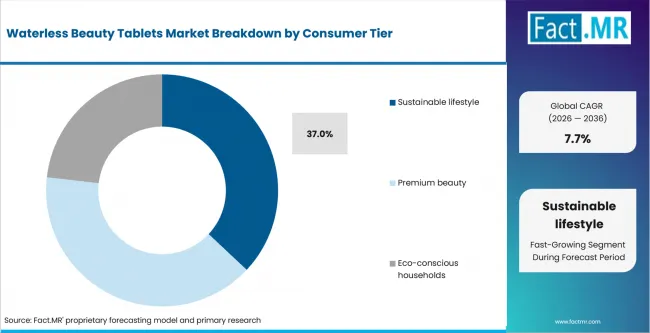
Waterless Beauty Tablets Market Analysis By Consumer Tier | Source: Fact.MR
Sustainable lifestyle consumers lead because waterless beauty tablets directly support lower-waste routines. The tier is likely to account for 37.0% share in 2026 as shoppers look for products that reduce disposable bottles without feeling difficult to use. Premium beauty consumers support face cleanser tablets and luxury packaging. Luxury wellness consumers value compact and design-led formats. Eco-conscious households support handwash and multipurpose refill tablets. The tier connects with sustainable personal care because refill and waterless routines are expanding across bathroom products.
Which channel dominates?
DTC account for 34.0% share in 2026.
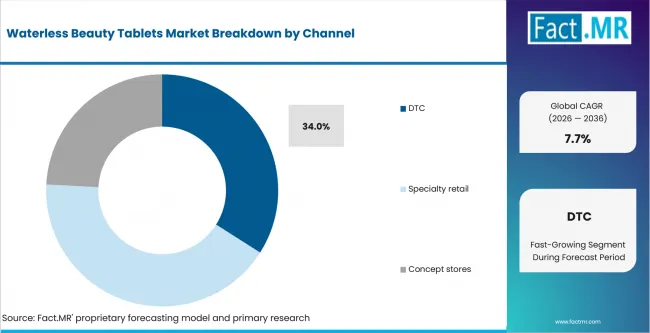
Waterless Beauty Tablets Market Analysis By Channel | Source: Fact.MR
DTC leads because waterless beauty tablets require explanation. Consumers need to understand how to activate the product, store tablets and order refills. The channel is expected to hold 34.0% share in 2026 as brands use starter kits, subscriptions and demonstration videos to teach the routine. Specialty retail supports tactile discovery. Luxury ecommerce supports premium presentation. Concept stores help shoppers compare sustainable formats. Subscription refill models gain traction after the first purchase.
Which sustainability claim dominates?
Reduced plastic holds 40.0% share in 2026.
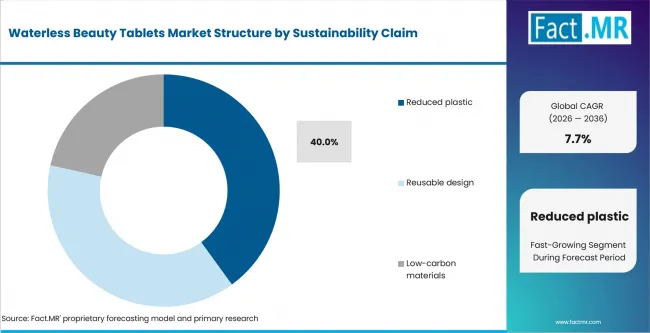
Waterless Beauty Tablets Market Analysis By Sustainability Claim | Source: Fact.MR
Reduced plastic leads because consumers connect beauty tablets with fewer bottles quickly. The claim territory is projected to record 40.0% share in 2026 as brands position reusable containers and tablet refills as lower-waste alternatives. Lower packaging waste follows because it is broad and easy to communicate. Reusable design supports premium starter kits. Low-carbon materials need stronger proof.
What is accelerating the Waterless Beauty Tablets Market adoption, and what is holding it back?
Zero-waste beauty routines and refillable starter kits drive adoption, while format confusion and texture expectations restrain it.
Drivers Impact Analysis
| DRIVER | (~) % IMPACT ON CAGR | GEOGRAPHIC RELEVANCE | IMPACT TIMELINE |
|---|---|---|---|
| Zero-waste beauty routines moving toward concentrated formats | +0.8% | North America, Western Europe, East Asia | Medium term (2–4 years) |
| Refillable starter kits making tablets easier to adopt | +0.7% | United States, United Kingdom, Germany | Short term (≤ 2 years) |
| Travel-friendly beauty formats supporting face cleanser tablets | +0.6% | Global, strongest in urban consumers | Medium term (2–4 years) |
| DTC subscriptions improving refill behavior | +0.5% | North America, Europe, urban Asia | Medium term (2–4 years) |
| Solid shampoo awareness helping waterless tablets gain credibility | +0.4% | United Kingdom, Japan, United States | Long term (≥ 4 years) |
Source: Fact.MR analysis. Updated Jul 2, 2026
- Zero-waste beauty routines
- Zero-waste beauty routines are the strongest driver because consumers want low-waste swaps that still feel premium. Tablets reduce the need to ship and store heavy liquid products. They also create a clear refill behavior. This driver is strongest where consumers already use shampoo bars, refillable deodorants and plastic-free handwash systems.
- Refillable starter kits
- Refillable starter kits make tablet systems easier to understand. The first purchase can include a reusable jar or bottle with tablets. Follow-up orders can focus on refills. This helps brands reduce confusion and build repeat buying. Starter kits also make sustainability easier to see at the shelf.
- Travel-friendly formats
- Travel-friendly formats support demand because tablets avoid spills and liquid restrictions. Face cleanser tablets and mini body wash tablets are easier to carry than bottles. This makes the format useful for premium travel, gyms and weekend routines. Compact tablets also reduce bathroom clutter.
- DTC subscriptions
- DTC subscriptions improve refill behavior because consumers need a regular supply of tablets. Subscriptions can match use frequency and product type. Brands can offer refills by scent, skin concern or hair type. This channel gives brands stronger control over education and repeat purchase.
- Solid shampoo awareness
- Solid shampoo awareness helps consumers accept waterless beauty tablets. Lush describes shampoo bars as plastic-free alternatives to liquid shampoo and as travel-friendly products. [4] This makes consumers more open to other concentrated formats such as cleanser tablets and body wash tablets.
Opportunity Impact Analysis
| OPPORTUNITY | (~) % IMPACT ON CAGR | GEOGRAPHIC RELEVANCE | IMPACT TIMELINE |
|---|---|---|---|
| Face cleanser tablets for premium skincare routines | +0.6% | United States, Japan, Germany | Medium term (2–4 years) |
| Handwash tablet multipacks for eco-conscious households | +0.5% | United States, United Kingdom, India | Short term (≤ 2 years) |
| Shampoo and body wash tablets for travel beauty | +0.5% | Global, strongest in urban consumers | Medium term (2–4 years) |
| Subscription refill boxes for DTC loyalty | +0.4% | North America, Europe, China | Long term (≥ 4 years) |
Source: Fact.MR analysis. Updated Jul 2, 2026
- Face cleanser tablets
- Face cleanser tablets create opportunity because skincare consumers accept premium ritual products. Tablets can be positioned around fresh activation, preservative reduction and travel convenience. Brands need to prove lather, skin feel and residue control. The opportunity is strongest in DTC and luxury ecommerce.
- Handwash tablet multipacks
- Handwash tablet multipacks create opportunity because the sink is an easy entry point for refill behavior. Consumers can use a reusable bottle and buy tablet refills. This supports eco-conscious households and concept-store education. The product is easier to explain than some skincare tablets because the activation step is simple.
- Shampoo and body wash tablets
- Shampoo and body wash tablets can extend waterless beauty into shower routines. Consumers already understand solid shampoo bars, so tablets can build from that base. Body wash tablets need strong foam and fragrance experience to compete with liquid formats. This opportunity connects with waterless shampoo because haircare is one of the strongest waterless beauty entry points.
- Subscription refill boxes
- Subscription refill boxes can turn waterless beauty tablets into recurring purchases. Brands can send cleanser, handwash or body wash tablets on a chosen schedule. Refill boxes can also support scent rotation and seasonal packs. This opportunity connects with zero-waste beauty because subscription systems can reduce packaging while building loyalty.
Restraints Impact Analysis
| RESTRAINT | (~) % IMPACT ON CAGR | GEOGRAPHIC RELEVANCE | IMPACT TIMELINE |
|---|---|---|---|
| Consumer confusion between tablets, bars and refill powders | -0.6% | Global | Short term (≤ 2 years) |
| Texture and lather expectations versus liquid products | -0.5% | Global, strongest in beauty and shower care | Medium term (2–4 years) |
| Storage sensitivity to moisture and humidity | -0.4% | Asia, Latin America, humid regions globally | Medium term (2–4 years) |
| Starter-kit price versus ordinary liquid products | -0.3% | Global, strongest in mass channels | Long term (≥ 4 years) |
Source: Fact.MR analysis. Updated Jul 2, 2026
- Format confusion
- Consumer confusion is the main restraint because shoppers may not understand the difference between tablets, solid bars, refill powders and concentrates. If a brand does not explain activation clearly, the consumer may avoid the product. Product images and simple directions matter. This is especially important for face cleanser tablets and body wash tablets.
- Texture and lather expectations
- Texture and lather can slow repeat purchase if the product does not feel like a familiar cleanser. Consumers expect foam, slip and easy rinse-off. A tablet that feels gritty or takes too long to dissolve may fail. Brands need formulation work that balances compactness with sensory performance.
- Moisture sensitivity
- Moisture sensitivity affects storage because tablets can soften or crumble if exposed to humidity. This matters in bathrooms and travel bags. Reusable jars, tins and refill tubes must protect the product. Clear storage instructions are important in humid markets.
- Starter-kit price
- Starter-kit pricing can slow first purchase because the consumer may need a reusable bottle, jar or case. Ordinary liquid products appear cheaper at checkout. Brands need to explain refill savings and lower packaging waste. Trial sizes and low-cost starter packs can reduce the barrier.
Which countries are scaling waterless beauty tablets fastest?
United States 8.6%; United Kingdom 8.2%; Germany 7.8%; Japan 7.4%; India 7.0%.
Based on regional analysis, the waterless beauty tablets market is segmented into North America, Europe, East Asia, South Asia, Latin America, and Middle East and Africa.
| Country | CAGR |
|---|---|
| United States | 8.6% |
| United Kingdom | 8.2% |
| Germany | 7.8% |
| Japan | 7.4% |
| India | 7.0% |
Source: Fact.MR analysis. Updated Jul 2, 2026
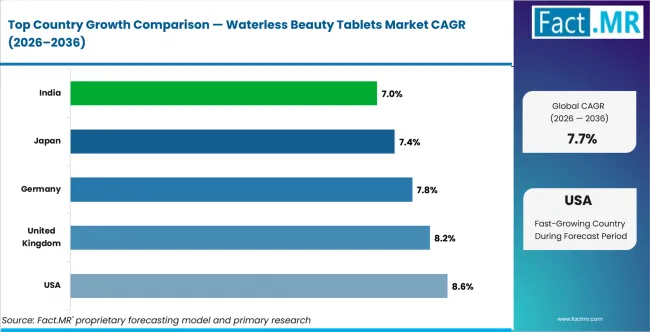
Waterless Beauty Tablets Market Cagr Analysis By Country | Source: Fact.MR
What is powering the United States lead?
8.6% CAGR, driven by Seadrop and DTC waterless skincare adoption.
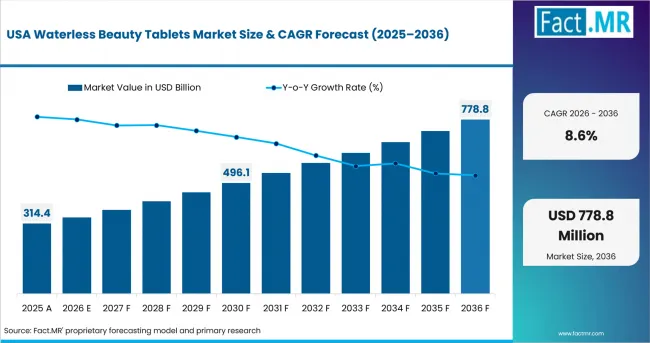
Waterless Beauty Tablets Market Country Value Analysis | Source: Fact.MR
The United States is projected to record 8.6% CAGR from 2026 to 2036 as DTC brands teach consumers how to use face cleanser tablets, handwash refills and starter kits. Growth will favor brands that prove texture, lather and convenience. Sustainable beauty shoppers will support refill models and reusable containers.
How is the United Kingdom scaling waterless beauty tablet demand?
8.2% CAGR, supported by Lush and refillable personal-care habits.
The United Kingdom is expected to post 8.2% CAGR by 2036 as consumers adopt shampoo bars, refillable deodorants and low-waste bathroom products. Waterless tablets will benefit from this existing behavior. Growth will favor compact formats that explain use steps clearly.
What supports Germany’s outlook?
Germany records 7.8% CAGR, driven by low-waste retail and reduced-plastic beauty claims.
Germany is likely to record 7.8% CAGR through 2036 as consumers respond to refillable, compostable and recycled material routes. Specialty retail and sustainable lifestyle channels will support early adoption. Growth will favor refill packs with clear disposal and storage guidance.
What underpins Japan’s growth?
7.4% CAGR, backed by compact beauty routines and travel-friendly formats.
Japan is forecast to advance at 7.4% CAGR through 2036 as consumers adopt neat, space-saving products that fit daily beauty routines. Face cleanser tablets and mini beauty tablets will gain traction where compact packaging and gentle formulas matter. Brands with precise use instructions will be better placed.
How is India scaling waterless beauty tablet adoption?
7.0% CAGR, driven by marketplaces and premium sustainable beauty.
India is set to record 7.0% CAGR through 2036 as urban consumers explore low-waste beauty through marketplaces, DTC and concept stores. Handwash tablets and face cleanser tablets will gain early traction. Affordable refill packs and humidity-safe packaging will shape repeat purchase.
Who leads the waterless beauty tablets market?
Seadrop and MONO Skincare are direct tablet-format benchmarks, while Lush and Ethique lead broader waterless beauty.
Waterless beauty tablets are supplied by tablet skincare brands, waterless haircare companies, refillable personal-care firms and sustainable lifestyle ecosystems. Seadrop is a direct face-cleanser tablet benchmark. MONO Skincare is highly relevant through tablet refill systems for hand soap and personal-care-adjacent use. Lush supports waterless beauty through solid shampoo and cleansing formats. Ethique is relevant through concentrated shampoo, conditioner and plastic-free beauty bars.
By Humankind, 900.care and Everist support the refill-led personal-care pathway. Wild are adjacent refillable personal-care benchmarks, not direct beauty tablet suppliers. Competition connects with natural organic personal care because waterless tablet consumers often compare sustainability with ingredient safety.
Competition through 2036 will depend on tablet stability, lather quality, refill simplicity and storage design. Brands that use waterless claims without strong product performance will face weak repeat purchase. Brands that make activation simple and sensory performance strong can defend higher value. The category also connects with sustainable packaging because refill sleeves, reusable jars and plastic-free cartons are central to the product story.
Which companies are the key providers?
Seadrop and MONO Skincare are direct tablet benchmarks. Lush and Ethique are waterless beauty leaders. By Humankind, 900.care and Everist are also profiled. Wild are adjacent sustainability benchmarks.
- Seadrop
- MONO Skincare
- Lush
- By Humankind
- Ethique
- 900.care
- Everist
- Wild
Bibliography
- Seadrop Skincare. (2024, May 28). How to identify your skin type and tailor your skincare routine.
- Ethique. (2024, September 26). How much shampoo to use: The right amount for your hair type and the benefits of shampoo bars.
- Lush. (2026). Shampoo bars.
- Meliora Cleaning Products. (2026). Foaming hand soap refill tablets - 6-pack plastic-free boxed.
- Meliora Cleaning Products. (2026). How to use foaming hand soap refill tablets.
- Plaine Products. (2026). How reuse works.
- Wild. (2026). Refillable natural deodorants, lip balms, body and hand wash.
This Report Addresses
- Strategic intelligence on waterless beauty tablets across product application and material route.
- Segment analysis covering Face Cleanser Tablets and Refillable Systems.
- Regional outlook covering the United States, United Kingdom, Germany, Japan and India.
- Competitive analysis of Seadrop, MONO Skincare, Lush, By Humankind, Ethique, 900.care, Everist, Wild.
- Technology assessment covering tablet activation, refill storage, waterless formulation, reusable containers and compostable refill tubes.
- Use case assessment covering face cleansing, shampoo, body wash, handwash and multipurpose beauty routines.
- Primary interviews, provider checks and official source review support the forecast.
What does the waterless beauty tablets market cover?
Pre-dosed beauty tablets and concentrated solid formats activated with water or used as refill systems.
The waterless beauty tablets market covers face cleanser tablets and multipurpose beauty tablets. These formats are positioned around lower packaging waste and low-carbon material routes.
The market differs from broad sustainable packaging because it covers finished beauty and personal-care products. It excludes raw packaging components, low-price mass goods without a waterless format and commodity refill packaging sold to manufacturers.
What is included in the scope?
Finished waterless beauty tablets sold through premium and sustainable consumer channels.
The scope includes face cleanser tablets and multipurpose beauty tablets. Material route coverage includes refillable and mushroom-leather-inspired routes when these are part of the consumer product system.
Consumer tier coverage includes premium beauty, sustainable lifestyle, luxury wellness and eco-conscious households. Channel coverage includes specialty retail and subscription refill models. The category connects with premium beauty because many waterless tablets are positioned as premium routine upgrades.
What is excluded from the scope?
Commodity packaging and conventional liquid beauty products are outside the scope.
The scope excludes ordinary liquid cleansers and low-price mass goods without waterless positioning. It also excludes household cleaning tablets unless the product is sold as beauty, handwash or personal-care. Broader waterless shampoo products are outside scope when they are not tablet or refill-activated beauty formats.
How was the analysis built?
100+ sources, 40+ company portfolios, 25+ countries, 20+ interviews.
- Primary Research: Primary research includes interviews with sustainable beauty founders and personal-care product managers. It includes input from DTC refill brands, specialty retailers, concept-store operators and formulation consultants.
- Desk Research: Desk research reviews official product pages, waterless beauty claims, refill system descriptions, plastic-reduction language and consumer subscription models.
- Market-Sizing and Forecasting: Forecasting uses waterless beauty adoption, tablet pricing, refill frequency, product-application mix and channel split.
- Data Validation and Update Cycle: Forecasts are validated through provider checks and channel feedback. SKU mapping and brand portfolio reviews help confirm market direction.
Segmentation
What is the report’s scope and coverage?
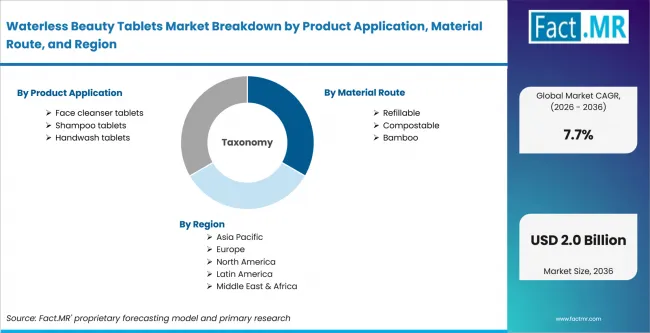
Waterless Beauty Tablets Market Breakdown By Product Application, Material Route, And Region | Source: Fact.MR
| Attribute | Details |
|---|---|
| Quantitative Units | USD Billion in 2026 to USD Billion by 2036 at CAGR |
| Market Definition | Pre-dosed beauty tablets and concentrated solid formats activated with water or used as refill systems |
| Product Application | Face cleanser tablets; shampoo tablets; body wash tablets; handwash tablets; multipurpose beauty tablets |
| Material Route | Refillable; compostable; recycled; plant-based; bamboo; cork; mushroom leather |
| Consumer Tier | Premium beauty; sustainable lifestyle; luxury wellness; eco-conscious households |
| Channel | Specialty retail; DTC; luxury ecommerce; concept stores; subscription refill models |
| Sustainability Claim | Lower packaging waste; reduced plastic; reusable design; low-carbon materials |
| Regions Covered | North America; Europe; East Asia; South Asia; Latin America; Middle East and Africa |
| Countries Covered | United States; United Kingdom; Germany; Japan; India |
| Key Companies Profiled | Seadrop; MONO Skincare; Lush; By Humankind; Ethique; 900.care; Everist; Wild |
| Forecast Period | 2026 to 2036 |
| Approach | Hybrid top-down and bottom-up approach using waterless beauty adoption, tablet SKU mapping, refill frequency and channel validation |
Source: Fact.MR analysis. Updated Jul 2, 2026
How is the market segmented?
-
By Product Application:
- Face cleanser tablets
- Shampoo tablets
- Body wash tablets
- Handwash tablets
- Multipurpose beauty tablets
-
By Material Route:
- Refillable
- Compostable
- Recycled
- Plant-based
- Bamboo
- Cork
- Mushroom leather
-
By Consumer Tier:
- Premium beauty
- Sustainable lifestyle
- Luxury wellness
- Eco-conscious households
-
By Channel:
- Specialty retail
- DTC
- Luxury ecommerce
- Concept stores
- Subscription refill models
-
By Sustainability Claim:
- Lower packaging waste
- Reduced plastic
- Reusable design
- Low-carbon materials
-
Region:
- North America
- United States
- Canada
- Europe
- United Kingdom
- Germany
- France
- Italy
- Netherlands
- East Asia
- Japan
- China
- South Korea
- South Asia
- India
- Thailand
- Singapore
- Latin America
- Brazil
- Mexico
- Chile
- Middle East & Africa
- Saudi Arabia
- South Africa
- North America
Frequently Asked Questions
Which product application leads the Waterless Beauty Tablets Market?
Which material route leads the Waterless Beauty Tablets Market?
Which consumer tier leads the Waterless Beauty Tablets Market?
Which channel leads the Waterless Beauty Tablets Market?
Which sustainability claim leads the Waterless Beauty Tablets Market?
Which country expands fastest in the Waterless Beauty Tablets Market?
How does the United Kingdom perform in the Waterless Beauty Tablets Market?
How does Germany perform in the Waterless Beauty Tablets Market?
How does Japan perform in the Waterless Beauty Tablets Market?
How does India perform in the Waterless Beauty Tablets Market?
What is the primary driver in the Waterless Beauty Tablets Market?
What is the main restraint in the Waterless Beauty Tablets Market?
Why are face cleanser tablets important?
Why does DTC dominate demand?
Who worked on this report


Preview the report firsthand - request a free sample
Free SampleGet the brochure for pricing and purchase details
Download PDF