- Base Value(2024): 345.7 Mn
- Forecast Value (2035): 669.7 Mn
- CAGR (2035): 6.5%
Waterless Cleansers Market Outlook (2025 to 2035)
The global waterless cleansers market is expected to reach USD 669.7 million by 2035, up from USD 367 million in 2025. During the forecast period (2025 to 2035), the industry is projected to expand at a CAGR of 6.2%.
The waterless cleansers market is witnessing robust growth, fueled by heightened consumer awareness of water conservation, rising demand for on-the-go hygiene solutions, expanding applications in premium personal care and cosmetics, and increased adoption within healthcare environments for infection control. These drivers collectively position waterless cleansers as a sustainable, innovative, and high-value proposition in the global hygiene landscape.
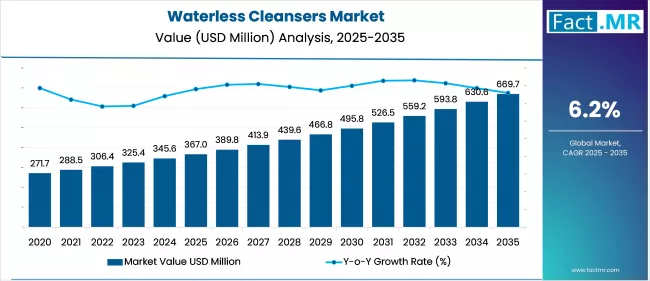
Waterless Cleansers Market Outlook | Source: Fact.MR
Quick Stats for Waterless Cleansers Market
- Industry Value (2025): USD 367 Million
- Projected Value (2035): USD 669.7 Million
- Forecast CAGR (2025 to 2035): 6.2%
- Leading Segment (2025): Vegan / Cruelty-free (25% Market Share)
- Fastest Growing Country (2025-2035): India (7.6% CAGR)
- Top Key Players: Allies Group Pte. Ltd., Blueland, Carter + Jane, Clensta, Dew Mighty, Ethique, Kao Corporation, Loli Beauty, and L’Oréal
What are the key factors driving growth in the Waterless Cleansers Market?
Market growth is driven by rising awareness of water scarcity, the need for on-the-go hygiene, and expanding use in skincare, makeup, and healthcare products. Increasing demand for natural, chemical-free options is also attracting health-conscious consumers. The market expansion is further encouraged by the rising amount of traveling and urbanization, which in turn offers the chance for new, portable cleansing systems of both vintage and newly established brands.
What are the key trends driving growth in the Waterless Cleansers market?
The trends are biodegradable packaging, the addition of nourishing ingredients, hybrid products that are self-cleaning and skincare products in one. Distribution is also taken over by E-commerce in subscription-based businesses and collaborations with influencers. Inclusive marketing allows expansion, innovations geared towards sustainability, ease, and multi-purpose positioning to compete in opposing environments, attracting different, high-velocity markets in the global world.
What factors hinder the growth of the Waterless Cleansers market?
Adoption can be retarded in areas where water is freely available and where consumers will be sensitive to the price of the product. The developed markets have affordability issues with premium offerings.
Synthetic fears affect trust. Poor market awareness in the rural regions, prohibitive rules on claims and the sale of cheap similar products are a serious barrier to wider market penetration.
What are the key regional trends driving the Waterless Cleansers Market growth?What are the key regional trends driving the Waterless Cleansers Market growth?
Commanding hygiene consciousness and durable sales networks, along with the needs in the travel industries and medical care, contribute to the growth across North America. Under the influence of sustainability-driven marketing programs and influencing, brands underline clean label and multi-functional products.
East Asia’s demand is catalyzed by urbanization, increased incomes, and blooming beauty industries. Consumers prefer natural product ingredients, high-quality packaging and the convenience of online stores, particularly in younger and trend-oriented consumer groups who want portable personal hygiene products.
In Europe, adoption has increased due to sustainability regulations and eco-savvy customers. Selective use of biodegradable packaging, organic ingredients and fair sourcing helps promote kale positioning and the product has been sold well in travel, wellness and healthcare applications.
Country-wise Outlook
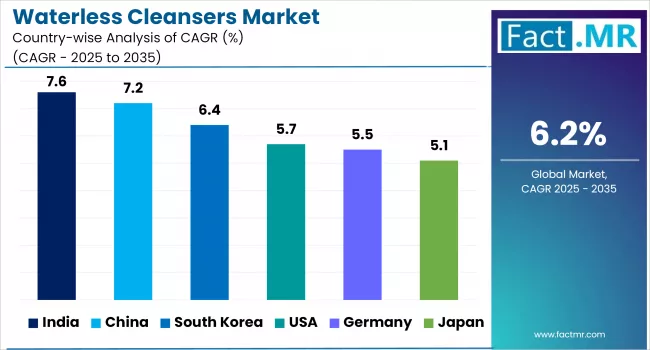
Waterless Cleansers Market Analysis By Country | Source: Fact.MR
Sustainability Trends and Convenience Drive U.S. Waterless Cleansers
The American market has an advantage of upsurges in consumer demand for on-the-go, sustainable personal solutions. Waterless cleansers limit package haul, increase shelf life and are compatible with traveling and an outdoor lifestyle. Eco-friendly millennials and Gen Z drive innovation in concentrated powders, solid bars and foam versions.
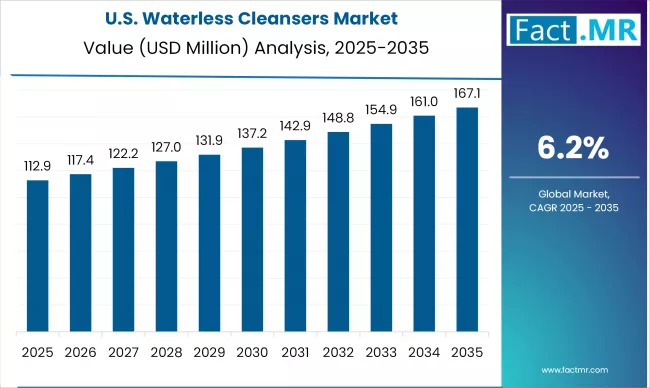
US Waterless Cleansers Market Value 2025 To 2035 | Source: Fact.MR
Supporting labeling standards coupled with expanded retail distribution, both in the mainstream and specialty segments, accelerates adoption. Brands invest in marketing products that are clean, cruelty-free, and multi-functional to deliver a premium personal care product.
Urbanization and E-Commerce Boost China’s Waterless Cleansers
The market in China is growing because urban customers are consuming fast and convenient types of hygiene products, as there is increasing social awareness about the environment. Waterless Cleanser will attract commuters, travelers, and areas with limited water supply.
The increase in demand is accompanied by government encouragement of water conservation and sustainable consumption. The emphasis of product innovation is on the development of products that target consumers with sensitive skin in both domestic and export markets, with gentle and herbal-based products.
Eco-Regulations and Premium Beauty Position Germany as a Waterless Cleansers Hub
The growth of the German market can be attributed to the EU sustainability regulation, demand for natural cosmetics and excellent retail distribution chains. Waterless products can fit the zero-waste and carbon-reduction plans and formats, such as powders, sticks and concentrated gels, are on-trend.
Trusted name brands and indie companies respond with certified organic products and biodegradable or carbon-neutral packages. The high-quality formulas create a demand at home and abroad, as well as exports to the EU; premium placement in drugstores and specialty beauty stores helps the growth.
Category-Wise Market Outlook
Foaming Tablets / Solid Concentrates Surge Ahead Due to Sustainability and Travel Convenience
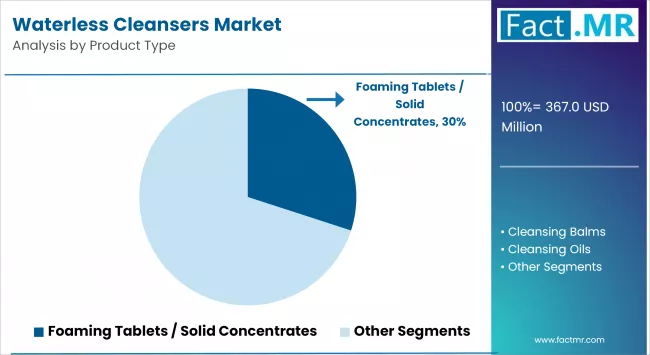
Waterless Cleansers Market Analysis By Product Type | Source: Fact.MR
Foaming tablets and solid concentrates are the second-fastest-growing segment of the Waterless Cleansers market, with low-water / zero-waste formats and ease of portable dosing. The increasing concern over the environment and the miniaturization of bulky liquid packaging have made them the preferred choice of both environmentally conscious and travel-friendly cleansing.
The lightweight quality is also a great plus in e-commerce, where these formats are increasingly used because they help to decrease the costs of shipping and emissions, and are extremely popular among millennial and Gen Z consumers.
Vegan / Cruelty-Free Formulations Lead Growth on Ethical Consumerism and Brand Transparency
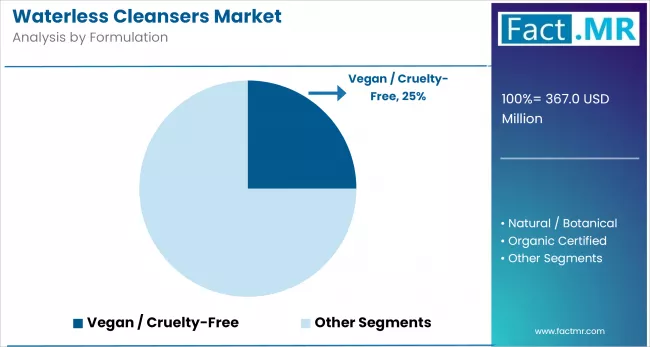
Waterless Cleansers Market Analysis By Formulation | Source: Fact.MR
Cruelty-free and waterless cleansers are witnessing very high growth potentials as consumers are concerned regarding ethical procuring, animal care, and vegan living. Social media activism and PETA certifications, coupled with the growing popularity of clean beauty, are fueling its adoption.
Vehement brands are stampeding on clear listing of ingredients and resonating with social cause celebrity supported ethical campaigns are gaining better market access especially in North America and Europe where cruelty free cosmetics s are becoming a bottom line pre-requisite in the beauty and personal care industry.
Premium / Luxury Tier Expands Fastest Owing to Affluent Consumer Base and Premium Experience
The highest-priced/luxury price level is increasing healthiest among the waterless cleansers due to affluent customers purchasing products that are highly efficacious, sensorial and designed. The exotic botanicals, bioactive complexes and recyclable or refillable premium packaging are in innovation with brands.
This is a category that has benefited from the growing overlap between skincare and wellness; indulgence and perceived self-care value with less sensitivity to price, especially in Mature markets such as Japan, South Korea and Western Europe.
Competitive Analysis
Competitive Outlook: Waterless Cleansers Market
Innovators such as Ethique, Dew Mighty, Clensta, and Loli Beauty top the waterless cleansers market with solid bars, powders, and water-free jellies to cut waste and reduce resources. Ethique and Dew Mighty target zero-waste, refillable formats; and Clensta completely waterless hygiene offerings, including shampoos and body baths in water-scarce environments.
Loli Beauty promotes upcycled, organic, and waterless formulations in eco-friendly packaging. Kao Corporation is a leader in space and drought-stricken communities in creating waterless technologies like dry shampoo sheets.
Blueland sells refillable tablet-based products that work in reusable bottles, and Carter + Jane sells concentrated, multi-use skincare products. Allies Group offers high-quality cleansers without a precise claim about their being waterless, and Lush enjoys the international recognition of solid forms, even due to the lack of other references here.
The niche that LOréal operates in has a low presence. In general, the competition is characterised by sustainability, portability and innovation, and biotech synergies may result in quicker, greener ingredient innovation and accelerated waterless format usage.
Key players in the waterless cleansers industry are Allies Group Pte. Ltd., Blueland, Carter + Jane, Clensta, Dew Mighty, Ethique, Kao Corporation, Loli Beauty, L’Oréal, and Lush.
Recent Development:
In May 2024, Olay (P&G) introduced Cleansing Melts, dry water-activated facial cleanser sheets designed for mess-free, travel-friendly cleansing and lower water usage versus traditional liquids.
In May 2024, HiBAR debuted its Solid Oil Cleanser, a palm-sized, waterless cleansing bar formulated to dissolve sunscreen and makeup without plastic packaging.
Fact.MR has provided detailed information about the price points of key manufacturers of Waterless Cleansers market positioned across regions, sales growth, production capacity, and speculative technological expansion, in the recently published report.
Methodology and Industry Tracking Approach
The Global Waterless Cleansers Market Report by Fact.MR is an analytical piece of work that is the first of its kind, based on the rich flow of data, the report delves into the unraveling process of how cutting-edge innovation eco-systems are revolutionizing product development, ingredient sourcing and commercialization in the personal care, beauty, healthcare and wellness arenas.
Based on over 7,500 stakeholder responses in the different industry participants of 35 countries with a minimum of 300 validated participants, the report presents unparalleled insight on the applicability of biotechnology and the use of AI-assisted formulations sourcing and analytics, the sustainability of ingredient innovation, and the approaches to multi-industry adoption strategies.
The main market trends are the fast adoption of AI and machine learning within the formulation design approach, the rise in the popularity of environmentally conscious and clean-label personal care products among the consumers, and the emergence of bioinformatics to support research and development by maximizing performance and safety.
The 200 respondents are formulation chemists, research and development leaders, innovation managers, supply chain planners, regulatory professionals, and technology developers, as well as investors and policy advisors to influence the sustainable future of products innovation.
The research ranges over the complete 365 days cycle between June 2024 and May 2025 and incorporates analyses of innovations in microbiome friendly cleaning agents, new surfactant options, and digital twin-based formulation testing.
This report is a must-have tool for water-free skincare innovators and FMCG firms, ingredient providers, and investors who want to be ahead of the next wave of sustainable beauty and personal care innovation, based on more than 200 certified data sources, exclusive forecasting algorithms and adoption elasticity mapping.
Segmentation
Segmentation of Waterless Cleansers Market Research
-
By Product Type :
- Cleansing Balms
- Cleansing Oils
- Cleansing Powders
- Cleansing Sticks
- Micellar Cleansing Wipes
- Foaming Tablets / Solid Concentrates
-
By Formulation :
- Natural / Botanical
- Organic Certified
- Vegan / Cruelty-Free
- Dermatologically Tested / Hypoallergenic
- Active-Ingredient Focused
- Synthetic Blends
-
By Price Tier :
- Mass / Economy
- Mid-Range
- Premium / Luxury
-
By Target Consumer :
- Women
- Men
- Unisex
- Children / Baby Care
-
By Packaging Format :
- Solid Bar
- Stick Packaging
- Glass Jars
- Metal Tins
- Paper-Based Sachets
- Pouches
- Refill Pods
- Cartridge Systems
-
By Distribution Channel :
- Online / E-Commerce
- Specialty Beauty Retailers
- Department Stores
- Hypermarkets / Supermarkets
- Pharmacies / Drugstores
- Travel Retail
-
By Region :
- North America
- Latin America
- Western Europe
- Eastern Europe
- East Asia
- South Asia & Pacific
- Middle East & Africa
Frequently Asked Questions
What was the Global Waterless Cleansers Market Size Reported by Fact.MR for 2024?
Who are the Major Players Operating in the Waterless Cleansers Market?
What is the Estimated Valuation of the Waterless Cleansers Market in 2035?
What Value CAGR did the Waterless Cleansers Market Exhibit Over the Last Five Years?
Who worked on this report


Preview the report firsthand - request a free sample
Free SampleGet the brochure for pricing and purchase details
Download PDF