- Base Value(2026): 1.9 Bn
- Estimated Value(2026): 1.9 Bn
- Forecast Value (2036): 3.3 Bn
- CAGR (2026 - 2036): 5.7%
Transfer-Resistant Stain Pigment Systems for Lip and Cheek Tints Market Forecast and Outlook By Fact.MR
- Valuation of the global transfer-resistant stain pigment systems for lip and cheek tints market is projected to grow from USD 1.87 billion in 2026 to USD 3.24 billion by 2036, depicting a compound annual growth rate (CAGR) of 5.7% between 2026 and 2036.
- This translates into a total growth of 73.3%, with the market forecast to expand at a compound annual growth rate (CAGR) of 5.7% between 2026 and 2036.
- The liquid stain formulations segment is set to register 41.2% of the transfer-resistant stain pigment systems for lip and cheek tints market in 2026.
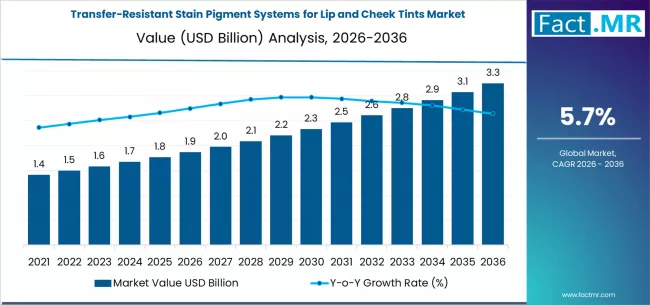
Transfer Resistant Stain Pigment Systems For Lip And Cheek Tints Market Market Value Analysis | Source: Fact.MR
Summary of Transfer-Resistant Stain Pigment Systems for Lip and Cheek Tints Market
- Market Snapshot
- Global transfer-resistant stain pigment systems for lip and cheek tints market revenue stood at USD 1.87 billion in 2026 and is forecast to reach USD 3.24 billion by 2036.
- At aCAGRof 5.7% from 2026 to 2036, this market adds USD 1.37 billion in absolute opportunity, growing 1.73x in value.
- Growth is underpinned by increasing demand for long-wear cosmetic technologies where transfer-resistant pigment systems provide enhanced adhesion control, superior wear-time performance, and color longevity across lip and cheek tint applications.
- The market is transitioning toward high-performance stain-based cosmetic systems, transforming pigment technologies from conventional color cosmetics into precision-engineered beauty platforms emphasizing transfer resistance and formulation stability.
- Demand and Growth Drivers
- Rising consumer preference for smudge-proof, mask-resistant, and long-lasting cosmetic formulations is accelerating demand for transfer-resistant stain pigment systems.
- Increasing adoption of lightweight liquid tint products across premium and mass beauty categories is reinforcing long-term market expansion.
- Professional makeup artists and beauty formulators are prioritizing pigment systems capable of delivering superior adhesion control, color consistency, and extended wear-time performance.
- Advancements in polymer-encapsulated pigments and transfer barrier technologiesare improvingformulation precision, product durability, and application consistency.
- Growing emphasis on multifunctional cosmetic products combining lightweight texture, high pigmentation, and transfer resistance is expanding adoption opportunities across professional and consumer beauty applications.
- Product and Segment View
- Liquid stain formulations lead the application type segment with 41.2% share in 2026, supported by increasing demand for lightweight, long-lasting, and transfer-resistant cosmetic systems.
- Professional makeup applications dominate the end-use segment with 58.3% share in 2026, reflecting strong preference for premium high-performance stain pigment technologies in professional beauty environments.
- Product categories include Water-Based Stain Pigments, Oil-Resistant Color Systems, Polymer-Encapsulated Pigments, and Gel-Based Transfer Barriers supporting diverse cosmetic formulation requirements.
- •Additionalapplication areas include Gel-Based Tint Products, Powder-to-Liquid Systems, and Hybrid Color Complexes for advanced stain cosmetic integration.
- Geography and Competitive Outlook
- Key growth regions include North America, Europe, and Asia Pacific.
- South Korea leads major country-level growth with 6.8%CAGR, supported by rapid expansion of the K-beauty sector and strong adoption of innovative transfer-resistant cosmetic technologies.
- The U.S. market expands at 6.2% CAGR driven by rising beauty industry investment, increasing demand for long-wear cosmetics, and expanding professional makeup technology adoption.
- Japan (5.9%), France (5.7%), Germany (5.5%), China (5.4%), and the U.K. (5.2%) benefit from premium beauty innovation, advanced formulation capabilities, and rising demand for performance-oriented cosmetic systems.
- Key companies active in this market include L'Oréal S.A., Revlon Inc., Maybelline New York,FentyBeauty, and Rare Beauty.
Transfer-Resistant Stain Pigment Systems for Lip and Cheek Tints Market — At a Glance
| Attribute | Details |
|---|---|
| Market Value 2026 | USD 1.87 Billion |
| Market Value 2036 | USD 3.24 Billion |
| Absolute Dollar Opportunity 2026–2036 | USD 1.37 Billion |
| Total Growth 2026–2036 | 73.3% |
| CAGR2026–2036 | 5.7% |
| Growth Multiple | 1.73x |
| Key Demand Theme | Long-wear transfer-resistant pigment systems enabling superior adhesion control,colorlongevity, and lightweight cosmetic performance |
| Leading Segment by Application Type (2026) | Liquid Stain Formulations |
| Application Type Segment Share (2026) | 41.2% |
| Leading Segment by End Use (2026) | Professional Makeup Applications |
| End Use Segment Share (2026) | 58.3% |
| Key Growth Regions | North America, Europe, Asia Pacific |
| CountryCAGRs | South Korea 6.8%, U.S. 6.2%, Japan 5.9%, France 5.7%, Germany 5.5%, China 5.4%, U.K. 5.2% |
| Top Companies | L'Oréal S.A., Revlon Inc., Maybelline New York,FentyBeauty, Rare Beauty |
| Segmentation by Pigment Type | Water-Based Stain Pigments, Oil-ResistantColorSystems, Polymer-Encapsulated Pigments, Gel-Based Transfer Barriers |
| Segmentation by Application Type | Liquid Stain Formulations, Gel-Based Tint Products, Powder-to-Liquid Systems, HybridColorComplexes |
| Segmentation by End Use | Professional Makeup Applications, Consumer Beauty Products, Film andTheaterMakeup, Bridal and Event Services |
| Segmentation by Region | North America, Latin America, Western Europe, Eastern Europe, East Asia, South Asia & Pacific,MEA |
Source: Fact.MR analysis. Updated May 27, 2026
Liquid stain pigment systems enable manufacturers to deliver superior color longevity properties and transfer resistance with enhanced adhesion control characteristics and precise formulation capabilities across multiple cosmetic environments, providing improved performance characteristics for beauty applications and color cosmetic manufacturing. Professional makeup applications are projected to register 58.3% of the transfer-resistant stain pigment systems for lip and cheek tints market in 2026. Transfer-resistant pigment systems in professional makeup applications enable enhanced color performance, standardized wear-time compliance, and formulation compatibility processes that are essential for cosmetic manufacturers, makeup artists, and beauty formulators.
Category
| Category | Segments |
|---|---|
| Pigment Type | Water-Based Stain Pigments; Oil-Resistant Color Systems; Polymer-Encapsulated Pigments; Gel-Based Transfer Barriers |
| Application Type | Liquid Stain Formulations; Gel-Based Tint Products; Powder-to-Liquid Systems; Hybrid Color Complexes |
| End Use | Professional Makeup Applications; Consumer Beauty Products; Film and Theater Makeup; Bridal and Event Services |
| Distribution Channel | Beauty Specialty Retailers; Department Store Cosmetics; Online Beauty Platforms; Professional Makeup Supply |
| Region | North America; Europe; Asia Pacific; Latin America; Middle East & Africa |
Source: Fact.MR analysis. Updated May 27, 2026
Segmental Analysis
By Application Type, Which Segment Holds the Dominant Share in the Transfer-Resistant Stain Pigment Systems for Lip and Cheek Tints Market?
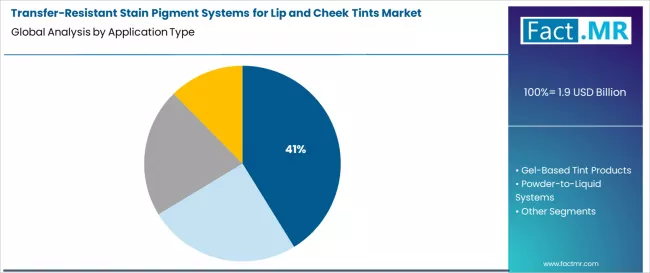
Transfer Resistant Stain Pigment Systems For Lip And Cheek Tints Market Analysis By Application Type | Source: Fact.MR
In terms of application type, the liquid stain formulations segment leads the market with 41.2% share. Cosmetic chemists and formulation specialists increasingly utilize liquid stain pigment systems for their superior transfer resistance properties and color intensity characteristics.
- Institutional investments in advanced cosmetic formulation technology and transfer-resistant compliance continue to strengthen adoption among quality-focused users.
- With makeup artists prioritizing client satisfaction infrastructure reliability and transfer-resistant compatibility, liquid stain pigment systems align with both operational objectives and performance requirements, making them the central component of comprehensive long-wear color strategies.
By End Use, Which Segment Registers the Highest Share in the Transfer-Resistant Stain Pigment Systems for Lip and Cheek Tints Market?
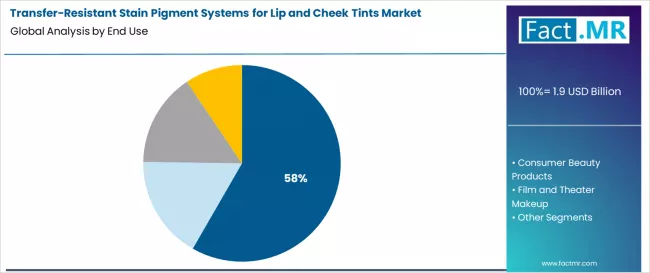
Transfer Resistant Stain Pigment Systems For Lip And Cheek Tints Market Analysis By End Use | Source: Fact.MR
By end use, professional makeup applications dominate with 58.3% share, underscoring their critical role as the primary application sector for performance-conscious users seeking superior color longevity and enhanced transfer resistance credentials. Makeup facility users and cosmetic operators prefer transfer-resistant pigment systems for professional applications due to their established performance requirements.
- Makeup facility users are optimizing pigment selections to support application-specific requirements and comprehensive long-wear color strategies.
- As transfer-resistant pigment technology continues to advance and facilities seek efficient color processing methods, professional makeup applications will continue to drive market growth while supporting formulation quality performance and operational optimization strategies.
What are the Drivers, Restraints, and Key Trends of the Transfer-Resistant Stain Pigment Systems for Lip and Cheek Tints Market?
- Drivers: Performance regulation expansion and long-wear cosmetic manufacturing initiatives drive mandatory adoption of high-performance transfer-resistant pigment solutions across beauty infrastructure.
- Restraint: High procurement costs and technical complexity of integrating specialized transfer-resistant pigments into existing cosmetic formulation processes limit market penetration.
- Trend 1: Shift toward ready-to-use transfer-resistant pigment formulations that minimize preparation requirements and reduce technical handling for deployment.
- Trend 2: Development of specialized multifunctional transfer-resistant pigments supporting multiple cosmetic applications and formulation compatibility standards.
Analysis of the Transfer-Resistant Stain Pigment Systems for Lip and Cheek Tints Market by Key Country
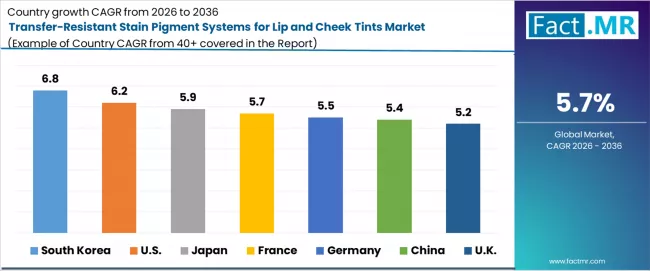
Transfer Resistant Stain Pigment Systems For Lip And Cheek Tints Market Cagr Analysis By Country | Source: Fact.MR
| Country | CAGR (2026-2036) |
|---|---|
| South Korea | 6.8% |
| U.S. | 6.2% |
| Japan | 5.9% |
| France | 5.7% |
| Germany | 5.5% |
| China | 5.4% |
| U.K. | 5.2% |
Source: Fact.MR analysis. Updated May 27, 2026
The report covers an in-depth analysis of 40+ countries; top-performing countries are highlighted below.
What Opportunities Can Transfer-Resistant Pigment Manufacturers Expect in South Korea?
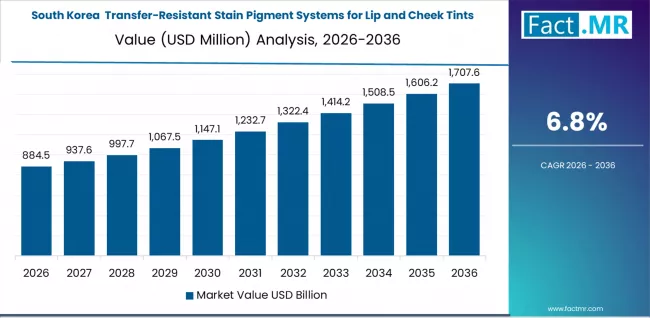
Transfer Resistant Stain Pigment Systems For Lip And Cheek Tints Market Country Value Analysis | Source: Fact.MR
Revenue from transfer-resistant stain pigment systems for lip and cheek tints consumption and sales in South Korea is projected to exhibit exceptional growth with a CAGR of 6.8% through 2036, driven by the country's rapidly expanding K-beauty sector, government policies promoting innovative cosmetic manufacturing standardization, and initiatives supporting professional transfer-resistant processing technologies across major manufacturing regions.
- Established beauty infrastructure and expanding performance consciousness are driving demand for transfer-resistant pigment solutions across manufacturing facilities, commercial developments, and comprehensive color cosmetic systems throughout South Korean beauty markets.
- Strong regulatory development and innovation initiatives are supporting the rapid adoption of premium transfer-resistant pigment systems among quality-focused institutions seeking to meet evolving performance standards and processing requirements.
What is the U.S. Transfer-Resistant Stain Pigment Systems for Lip and Cheek Tints Market Size?
Revenue from transfer-resistant stain pigment systems for lip and cheek tints products in U.S. is projected to expand at a CAGR of 6.2%, supported by rising beauty industry investment, growing performance technology consciousness, and expanding technology distributor capabilities. The country's developing long-wear cosmetic infrastructure and increasing investment in professional technologies are driving demand for transfer-resistant pigment solutions across both traditional and modern beauty applications.
- Rising commercial development and expanding cosmetic capabilities are creating opportunities for transfer-resistant pigment adoption across industrial projects.
- Growing performance technology awareness initiatives and manufacturing technology advancement are driving the adoption of specialized transfer-resistant pigment products and services among facility users.
What is the Japanese Transfer-Resistant Stain Pigment Systems for Lip and Cheek Tints Market Size?
Revenue from transfer-resistant stain pigment systems for lip and cheek tints products in Japan is projected to grow at a CAGR of 5.9% through 2036, supported by the country's commitment to advanced cosmetic technologies, established performance research capabilities, and growing investment in innovative beauty solutions. Japanese cosmetic facilities and technology-focused manufacturers prioritize quality performance and transfer resistance reliability, creating consistent demand for premium transfer-resistant pigment solutions across traditional and emerging applications.
- Growing technology sector investment and expanding cosmetic capabilities are driving demand for specialized transfer-resistant pigment systems across manufacturing facilities and research institutions.
- Strong emphasis on innovation and performance excellence is supporting the adoption of advanced transfer-resistant pigment technologies among users seeking competitive manufacturing advantages and performance optimization.
What Challenges Do Transfer-Resistant Pigment Manufacturers Face in France?
Revenue from transfer-resistant stain pigment systems for lip and cheek tints products in France is projected to grow at a CAGR of 5.7% through 2036, supported by established cosmetic standards, expanding luxury beauty markets, and emphasis on performance efficiency across premium and commercial sectors. French cosmetic users and manufacturing professionals prioritize quality performance and transfer resistance consistency, creating steady demand for premium transfer-resistant pigment solutions.
- Established luxury markets and expanding performance industry are driving demand for quality transfer-resistant pigment systems across cosmetic operations.
- Strong emphasis on quality standards and performance efficiency is supporting the adoption of premium transfer-resistant pigment varieties among users seeking proven performance.
What are the Opportunities for German Transfer-Resistant Pigment Manufacturers?
Revenue from transfer-resistant stain pigment systems for lip and cheek tints products in Germany is projected to grow at a CAGR of 5.5% through 2036, supported by the country's expanding performance industry standards, established government regulations, and leadership in precision technology implementation. Germany's advanced performance development standards and strong support for innovative cosmetic systems are creating steady demand for both traditional and advanced transfer-resistant pigment varieties.
- Advanced performance capabilities and established cosmetic-focused markets are driving demand for premium transfer-resistant pigment systems across manufacturing facilities, processing operations, and others.
- Strong performance industry culture and regulatory development are supporting the adoption of innovative cosmetic technology among users prioritizing manufacturing reliability and performance precision in color applications.
What Challenges Do Chinese Transfer-Resistant Pigment Manufacturers Face?
Revenue from transfer-resistant stain pigment systems for lip and cheek tints products in China is projected to grow at a CAGR of 5.4% through 2036, supported by the country's emphasis on cosmetic precision, technology excellence, and advanced manufacturing system integration requiring efficient performance solutions. Chinese cosmetic users and technology-focused establishments prioritize precision performance and transfer resistance control, making specialized transfer-resistant pigment systems essential components for both traditional and modern color applications.
- Advanced precision technology capabilities and growing performance cosmetic applications are driving demand for transfer-resistant pigment systems across specialty manufacturing applications.
- Strong focus on performance precision and technology excellence is encouraging users and distributors to adopt transfer-resistant pigment solutions that support cosmetic objectives.
Competitive Landscape of the Transfer-Resistant Stain Pigment Systems for Lip and Cheek Tints Market
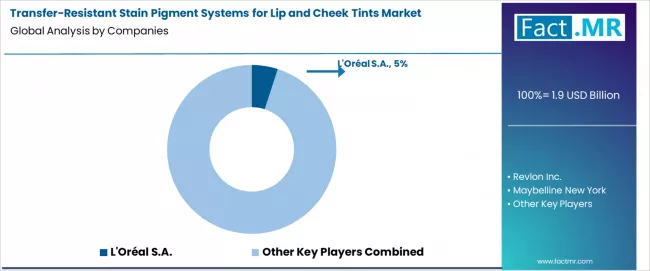
Transfer Resistant Stain Pigment Systems For Lip And Cheek Tints Market Analysis By Company | Source: Fact.MR
The transfer-resistant stain pigment systems for lip and cheek tints market is characterized by competition among established cosmetic companies, specialized pigment manufacturers, and integrated color cosmetic solution providers. Companies are investing in advanced transfer-resistant technologies, specialized pigment platforms, product innovation capabilities, and comprehensive distribution networks to deliver consistent, high-quality, and reliable transfer-resistant pigment systems.
Market players include L'Oréal S.A., Revlon Inc., Maybelline New York, Fenty Beauty, and others, offering institutional and commercial systems with emphasis on performance excellence and color heritage. L'Oréal provides integrated cosmetic automation with a focus on beauty market applications and precision transfer-resistant pigment networks.
Key Players in the Transfer-Resistant Stain Pigment Systems for Lip and Cheek Tints Market
- L'Oréal S.A.
- Revlon Inc.
- Maybelline New York
- Fenty Beauty
- Rare Beauty
- Charlotte Tilbury
- NARS Cosmetics
- Urban Decay
- Benefit Cosmetics
- Glossier Inc.
Segmentation
Scope of the Report
| Items | Values |
|---|---|
| Quantitative Units (2026) | USD 1.87 Billion |
| Pigment Type | Water-Based Stain Pigments, Oil-Resistant Color Systems, Polymer-Encapsulated Pigments, Gel-Based Transfer Barriers |
| Application Type | Liquid Stain Formulations, Gel-Based Tint Products, Powder-to-Liquid Systems, Hybrid Color Complexes |
| End Use | Professional Makeup Applications, Consumer Beauty Products, Film and Theater Makeup, Bridal and Event Services |
| Distribution Channel | Beauty Specialty Retailers, Department Store Cosmetics, Online Beauty Platforms, Professional Makeup Supply |
| Regions Covered | North America, Europe, Asia Pacific, Latin America, Middle East & Africa |
| Countries Covered | South Korea, U.S., Japan, France, Germany, China, U.K., and other countries |
| Key Companies Profiled | L'Oréal S.A., Revlon Inc., Maybelline New York, Fenty Beauty, Rare Beauty, and other leading transfer-resistant pigment companies |
| Additional Attributes | Dollar sales by pigment type, application type, end use, distribution channel, and region; regional demand trends, competitive landscape, technological advancements in transfer-resistant materials engineering, performance optimization initiatives, manufacturing enhancement programs, and premium product development strategies |
Source: Fact.MR analysis. Updated May 27, 2026
Transfer-Resistant Stain Pigment Systems for Lip and Cheek Tints Market by Segments
-
Pigment Type :
- Water-Based Stain Pigments
- Oil-Resistant Color Systems
- Polymer-Encapsulated Pigments
- Gel-Based Transfer Barriers
-
Application Type :
- Liquid Stain Formulations
- Gel-Based Tint Products
- Powder-to-Liquid Systems
- Hybrid Color Complexes
-
End Use :
- Professional Makeup Applications
- Consumer Beauty Products
- Film and Theater Makeup
- Bridal and Event Services
-
Distribution Channel :
- Beauty Specialty Retailers
- Department Store Cosmetics
- Online Beauty Platforms
- Professional Makeup Supply
-
Region :
- North America
- USA
- Canada
- Mexico
- Europe
- Germany
- UK
- France
- Italy
- Spain
- Nordic Countries
- BENELUX
- Rest of Europe
- Asia Pacific
- Japan
- China
- South Korea
- India
- Australia
- Rest of Asia Pacific
- Latin America
- Brazil
- Argentina
- Rest of Latin America
- Middle East & Africa
- Kingdom of Saudi Arabia
- United Arab Emirates
- South Africa
- Rest of Middle East & Africa
- Other Regions
- Oceania
- Central Asia
- Other Markets
- North America
Frequently Asked Questions
How big is the transfer-resistant stain pigment systems for lip and cheek tints market in 2026?
What will be the size of transfer-resistant stain pigment systems for lip and cheek tints market in 2036?
How much will be the transfer-resistant stain pigment systems for lip and cheek tints market growth between 2026 and 2036?
What are the key product types in the transfer-resistant stain pigment systems for lip and cheek tints market?
Which end use segment to contribute significant share in the transfer-resistant stain pigment systems for lip and cheek tints market in 2026?
Who worked on this report


Preview the report firsthand - request a free sample
Free SampleGet the brochure for pricing and purchase details
Download PDF