- Base Value(2025): 1.0 Bn
- Estimated Value(2026): 1.1 Bn
- Forecast Value (2036): 1.4 Bn
- CAGR (2026 - 2036): 4.3%
Watermelon Seed Protein Concentrate Market Forecast and Outlook By FACT.MR
In 2025, the watermelon seed protein concentrate market was valued at USD 1.0 billion. Based on Fact.MR analysis, demand for watermelon seed protein concentrate is estimated to grow to USD 1.1 billion in 2026 and USD 1.4 billion by 2036. FACT.MR projects a CAGR of 4.3% during the forecast period.
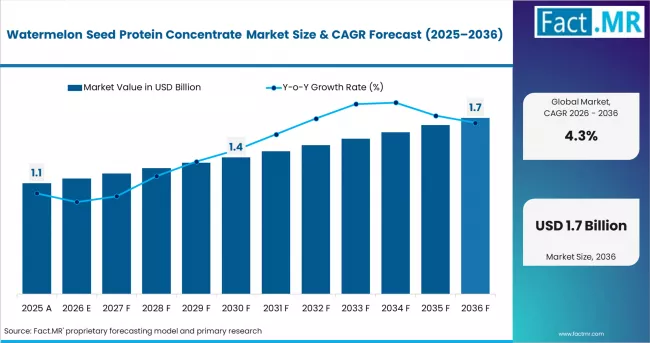
Watermelon Seed Protein Concentrate Market Value Analysis | Source: Fact.MR
Summary Of Watermelon Seed Protein Concentrate Market
- Market Definition
- Market covers watermelon seed protein concentrates and isolates across food, nutraceutical, and cosmetic applications.
- Demand Drivers
- India demand is rising due to GST reduction on plant-based proteins.
- China is expanding approvals through health food regulations.
- EU clean-label norms are driving high-purity concentrate adoption.
- Key Segments Analyzed
- By Product Type: Isolates/concentrates lead with 30% share in 2026.
- By Application: Food industry leads with 46% share driven by protein formulations.
- By Distribution Channel: Offline retail leads with 65% share due to bulk purchasing.
- Analyst Opinion at FACT.MR
- Shambhu Nath Jha highlights a shift toward allergen-free, micro-filtered concentrates. Suppliers with clean-label certification and strong supply chains will gain advantage.
- Strategic Implications
- Invest in advanced extraction and filtration capacity for food-grade quality.
- Develop organic and non-GMO variants for premium markets.
- Methodology
- Market sizing based on producer revenues and processing volumes.
- Supported by regulatory data from FSSAI, NHC, and EU approvals.
- Forecasts include procurement trends, supplement demand, and expert insights.
| Metric | Value |
|---|---|
| Estimated Value in 2026 | USD 1.1 billion |
| Forecast Value in 2036 | USD 1.4 billion |
| Forecast CAGR (2026 to 2036) | 4.3% |
Source: Fact.MR analysis. Updated Apr 21, 2026
Between 2026 and 2036, the market is expected to create an absolute opportunity of USD 0.3 billion. Growth is driven by rising demand for plant-based proteins in functional foods. Nutraceutical supplement usage is also increasing. Cosmetics applications are contributing to ingredient demand. However, growth is limited by raw material supply inconsistency. High processing costs also act as a constraint. Consumer awareness remains lower compared to proteins like pea and soy.
China leads growth with a CAGR of 6.4% through 2036. This is supported by regulatory approvals and expanding functional food production. India follows at around 6.3%, driven by snack consumption and seed processing expansion. The United States grows at 6.0% with strong clean-label protein demand. Spain records 5.7% supported by greenhouse cultivation and seed exports. Brazil grows at 5.6% with strong regional food processing capacity. Germany follows at 4.5% driven by EU compliance and ingredient upgrades.
Segmental Analysis
Watermelon Seed Protein Concentrate Market Analysis by Product Type
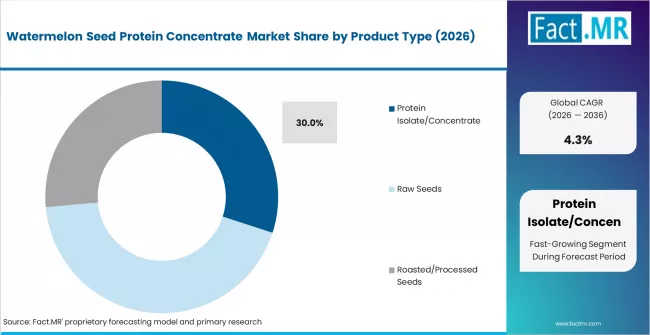
Watermelon Seed Protein Concentrate Market Analysis By Product Type | Source: Fact.MR
Based on Fact.MR, protein isolate and concentrate formats hold around 30% share in 2026. They dominate due to high protein density and formulation flexibility. Their allergen-free and clean-label properties support use in bakery and beverage applications.
- Força Foods MILKish Launch: The company launched MILKish in 2024 as a watermelon seed-based plant milk. It targets dairy-free and nut-free consumers. The product uses protein concentrate as its core ingredient. [1]
- PMC Alkaline Extraction Study: A 2025 study confirmed protein content of over 82% in concentrates. It also showed strong antioxidant and functional properties. This supports industrial-scale extraction adoption. [2]
- Processing Volume Growth: Over 75,000 metric tons of seeds were processed in 2024. Usage is expanding across powders, snacks, and oils. Nutraceutical applications are also increasing steadily. [3]
Watermelon Seed Protein Concentrate Market Analysis by Application
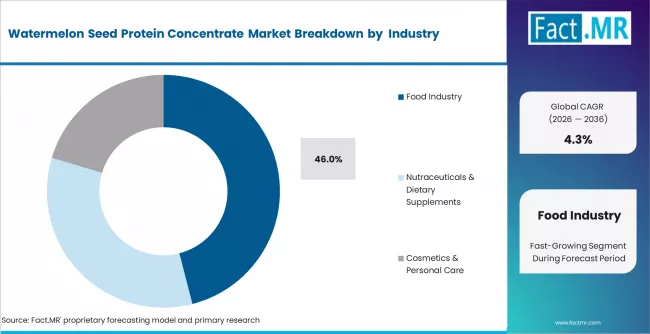
Watermelon Seed Protein Concentrate Market Analysis By Application | Source: Fact.MR
The food industry holds around 46% share in 2026. Growth is driven by use in bakery, protein bars, and plant-based dairy. Allergen-free and neutral taste make it suitable for clean-label products.
- NP Nutra Acquisition: Monterey Bay Herb Co. acquired NP Nutra in 2026. This expands plant-based ingredient supply. It strengthens presence in India and ASEAN markets. [4]
- India GST Reduction: India reduced GST on plant proteins to 5% in 2025. This lowers costs for manufacturers. It supports higher demand in food and supplement sectors.
- ETChem EU Collaboration: ETChem partnered with ZCompany for EU production in 2024. This supports clean-label compliance. It also aligns with EU novel food regulations.
Drivers, Restraints, and Opportunities
Demand is driven by food formulation and supplement use. Clean-label and allergen-free requirements support steady demand.
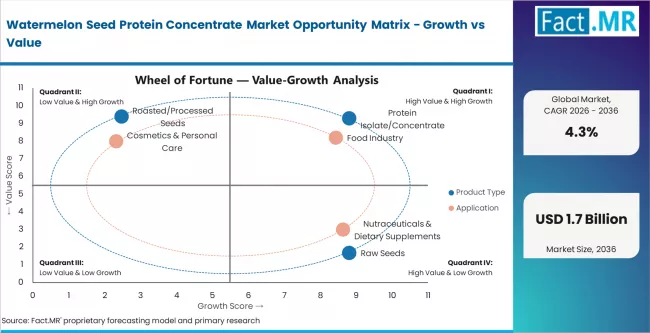
Watermelon Seed Protein Concentrate Market Opportunity Matrix Growth Vs Value | Source: Fact.MR
The market shows clear quality segmentation. Raw seed formats face competition from pea and soy proteins. Demand is shifting toward purified concentrates. These offer better functionality and label appeal. Premium concentrates achieve 15% to 25% higher pricing.
- India GST Reform Impact: Tax reduction supports affordability of plant proteins. It drives procurement by food manufacturers. This acts as a structural demand driver. [5]
- EU Regulatory Expansion: EU policies are supporting novel food approvals. Aktin Chemicals is advancing certification efforts. This supports compliance-driven demand in Europe. [6]
- China Health Food Expansion: China is expanding health food regulations. Suppliers are pursuing novel food approvals. This creates strong future demand potential. [7]
Regional Analysis
The watermelon seed protein concentrate market is assessed across Asia Pacific, Europe, North America, Latin America, and Middle East and Africa, covering 40+ countries with distinct demand profiles shaped by functional food manufacturing intensity, supplement procurement scale, clean-label regulatory frameworks, and agricultural seed processing capacity. The full report offers market attractiveness analysis by region and country.
.webp "Top Country Growth Comparison Watermelon Seed Protein Concentrate Market Cagr (2026 2036)")
Top Country Growth Comparison Watermelon Seed Protein Concentrate Market Cagr (2026 2036) | Source: Fact.MR
| Country | CAGR (2026 to 2036) |
|---|---|
| China | 6.4% |
| India | 6.3% |
| United States | 6.0% |
| Spain | 5.7% |
| Brazil | 5.6% |
| Germany | 4.5% |
Source: Fact.MR analysis. Updated Apr 21, 2026
Source: Fact.MR (FACT.MR) analysis, based on proprietary forecasting model and primary research
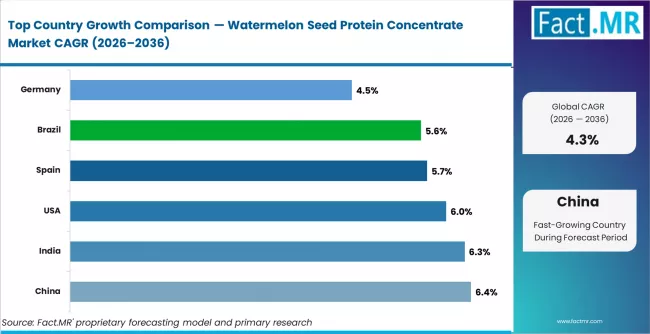
Watermelon Seed Protein Concentrate Market Cagr Analysis By Country | Source: Fact.MR
Asia Pacific Watermelon Seed Protein Concentrate Market Analysis
Asia Pacific is the fastest-growing region. Growth is driven by India’s policy support and China’s regulatory expansion. Regional demand reflects a mix of policy-led and industrial procurement models. NP Nutra and ETChem support supply with targeted grade offerings.
- India: India is emerging as a key demand centre with strong policy support. Demand is projected to grow at 6.3% CAGR through 2036. GST reduction to 5% has lowered cost barriers for manufacturers. NP Nutra supplies supplement formulators through private-label contracts. FSSAI frameworks are also supporting category expansion
- China: China is growing at 6.2% to 6.4% CAGR through 2036. Health food approvals are increasing under national regulatory frameworks. ZCompany supplies co-manufactured concentrate powders to food service channels. Growth is driven by regulated procurement within functional food manufacturing.
FACT.MR covers China, India, Japan, South Korea, ASEAN, and Australia & New Zealand. Includes regulatory trends and procurement benchmarks.
North America Watermelon Seed Protein Concentrate Market Analysis
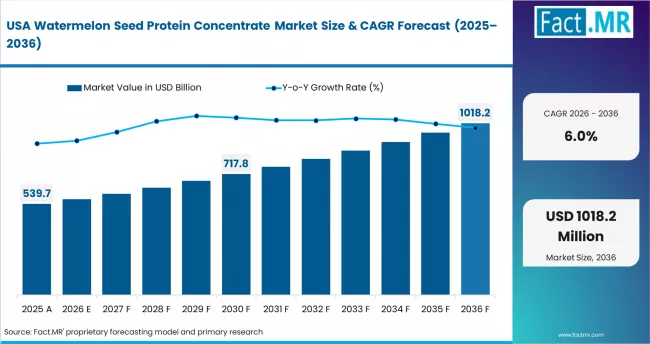
Watermelon Seed Protein Concentrate Market Country Value Analysis | Source: Fact.MR
North America is a clean-label driven market. Demand is supported by plant-based protein adoption in functional foods and supplements. Amino Labs Inc. and Força Foods focus on premium ingredient positioning.
- United States: The United States is growing at 6.0% CAGR through 2036. Clean-label and allergen-free demand is shaping product development strategies. Força Foods launched MILKish targeting dairy-free consumers. Regulatory pathways such as GRAS are influencing supplier entry and certification.
FACT.MR covers the U.S., Canada, and Mexico. Includes clean-label demand trends and ingredient procurement data.
Latin America Watermelon Seed Protein Concentrate Market Analysis
Latin America is a developing market led by Brazil. Growth is supported by food processing expansion and agricultural seed supply. Regional dynamics include local processors and global partnerships.
- Brazil: Brazil is the primary growth engine in the region. Demand is projected to grow at 5.6% CAGR through 2036. ORIGENE Seeds reported rising seed demand in 2025. Food processors are expanding plant-based product lines. Growth is driven by agricultural and export-linked supply chains.
FACT.MR covers Brazil, Argentina, Chile, and Rest of Latin America. Includes supply benchmarks and processing capacity insights.
Europe Watermelon Seed Protein Concentrate Market Analysis
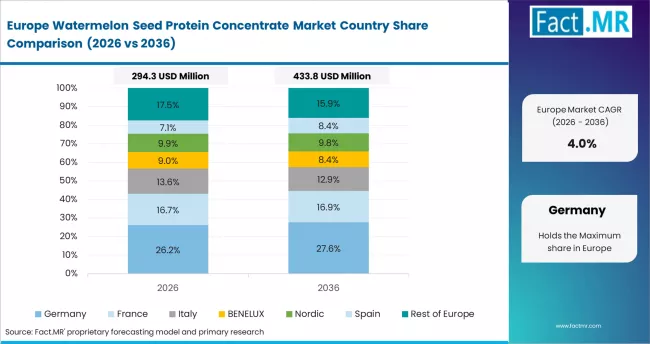
Watermelon Seed Protein Concentrate Market Europe Country Market Share Analysis, 2026 & 2036 | Source: Fact.MR
Europe is a regulation-driven market. Demand is shaped by clean-label requirements and novel food approval pathways. ETChem, ZCompany, and Aktin Chemicals support supply through compliance-focused strategies.
- Spain is growing at 5.7% CAGR through 2036. Syngenta is investing in breeding and greenhouse infrastructure. This strengthens Europe’s hybrid seed and ingredient supply base. Regulatory frameworks are shaping supplier entry.
- Germany: Germany is growing at 4.5% CAGR through 2036. EU regulations are driving adoption of certified plant protein ingredients. Aktin Chemicals is advancing compliance for food and cosmetic applications. Demand is driven by functional food and supplement manufacturers.
FACT.MR covers Germany, France, the UK, Italy, Spain, and Rest of Europe. Includes regulatory data, compliance trends, and market forecasts.
Competitive Aligners for Market Players
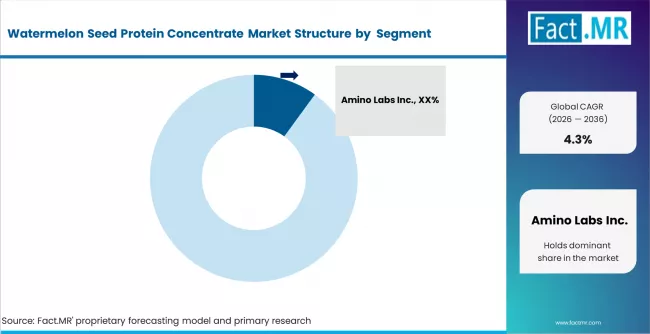
Watermelon Seed Protein Concentrate Market Analysis By Company | Source: Fact.MR
Market players in the watermelon seed protein concentrate industry are aligning strategies around functional differentiation, regulatory compliance, and supply chain integration. Leading companies such as Força Foods, NP Nutra, ETChem, and Aktin Chemicals are focusing on high-purity, micro-filtered protein concentrates to meet clean-label and allergen-free formulation requirements.
A key strategic aligner is investment in advanced processing technologies. Alkaline extraction and micro-filtration capabilities are being scaled to deliver consistent protein content, improved solubility, and neutral taste profiles. This enables suppliers to position their products as functional ingredients across bakery, beverage, and nutraceutical applications.
Regulatory alignment remains critical for global expansion. Companies are prioritizing compliance with frameworks such as EU novel food approvals, FSSAI standards, and U.S. GRAS pathways. This includes developing technical documentation, amino acid profiling, and safety validation to support procurement decisions by large food and supplement manufacturers.
Supply chain integration is another important competitive lever. Players are strengthening backward linkages with seed suppliers and investing in processing infrastructure in regions such as India, China, and Spain. This ensures raw material consistency and cost optimization while supporting scalable production. Product innovation is increasingly focused on application-specific formulations. Companies are developing customized protein blends for plant-based dairy, protein bars, and cosmetic formulations. Clean-label certification, organic sourcing, and non-GMO positioning are being used to capture premium segments in North America and Europe. Strategic partnerships and acquisitions are also shaping the competitive landscape. Collaborations with food manufacturers and contract formulators enable faster market penetration and long-term supply agreements, strengthening competitive positioning in both emerging and mature markets.
Key Players
- Amino Labs Inc.
- Z-Company
- Aktin Chemicals Inc.
- NP Nutra
- ETChem
- Força Foods
Bibliography
- [1] Força Foods. (October 2024). Guilherme Maia Silva Interview: Watermelon Seed MILKish Product Launch and Protein Nutritional Positioning. Green Queen. October 2024. greenqueen.com.hk
- [2] PMC / MDPI. (January 2025). Preliminary Data of the Nutritive, Antioxidative, and Functional Properties of Watermelon Seed Flour and Protein Concentrate: Alkaline Extraction Method Yielding 82.52 g per 100 g Protein Concentrate. Received November 2024, Accepted January 2025. pmc.ncbi.nlm.nih.gov/articles/PMC11721404
- [3] Market Reports World. (2024). Watermelon Seeds Market Analysis 2024: Over 75,000 Metric Tons of Dehulled Watermelon Seeds Processed into Protein Powders, Snacks, and Oils. Nutraceutical Formulation Data. 2024. marketreportsworld.com
- [4] PR Newswire / Frontenac. (Early 2026). Monterey Bay Herb Co. Acquires NP Nutra, Expanding Leadership in Nutraceutical Ingredients Including Plant-Based Protein Ingredient Supply. prnewswire.com
- [5] Green Queen. (December 2025). 2025 Wrapped: Biggest Alternative Protein Policy Stories of the Year. India GST Reform Reducing Plant-Based Protein Tax from 12% to 18% Down to 5%. December 2025. greenqueen.com.hk
- [6] Green Queen / EU Biotech Act. (2025). EU Biotech Act Novel Food Regulatory Guidance Expansion for Plant Protein Ingredient Approval Pathways Including Watermelon Seed Protein Certification. 2025.
- [7] Freyr Solutions. (2024). Essential Guide to China Updated Health Food Regulations 2024: State Administration for Market Regulation SAMR Plant Protein Raw Material Approval and Novel Food Notification Process. freyrsolutions.com
This Report Addresses
- Strategic intelligence on watermelon seed protein concentrate demand across food ingredient procurement, nutraceutical supplement formulation, cosmetics active ingredient sourcing, and plant-based dairy alternative manufacturing globally.
- Market forecast from USD 1.1 billion in 2026 to USD 1.4 billion by 2036 at a CAGR of 4.3%.
- Growth opportunity mapping across India GST-driven plant protein adoption, China health food regulatory expansion, U.S. clean-label superfood demand, Spain greenhouse seed supply, and EU novel food compliance-led ingredient procurement.
- Segment analysis by product type (protein isolate/concentrate, raw seeds, roasted/processed seeds), application (food industry, nutraceuticals, cosmetics), and distribution channel (offline, online).
- Regional outlook covering Asia Pacific demand-led growth, North America clean-label protein procurement, and Europe EU novel food regulation-driven ingredient adoption cycles.
- Competitive landscape of Amino Labs Inc., Z-Company, Aktin Chemicals Inc., NP Nutra, ETChem, and Força Foods. Focus on extraction technology certification, allergen-free credentials, and application-specific grade positioning.
- Regulatory impact analysis covering India GST reform for plant-based proteins, EU Biotech Act novel food guidance, China NHC health food approval expansion, and FDA GRAS pathway updates for plant protein ingredient certification.
- Report delivery in PDF, Excel datasets, and presentation formats supported by primary interviews, producer revenue data, FSSAI and NHC regulatory filings, and application-level procurement benchmarks.
Market Definition
The market covers protein concentrates and isolates derived from dehulled watermelon seeds. These are produced using alkaline extraction and precipitation processes. Protein content ranges from 80% to 82%.
Watermelon Seed Protein Concentrate Market Inclusions
Includes global and regional forecasts from 2026 to 2036 by product type, application, and channel. Covers isolates, concentrates, and processed seed formats. Includes use across food, nutraceutical, and personal care sectors.
Watermelon Seed Protein Concentrate Market Exclusions
Excludes whole watermelon fruit and seed oil products. Agricultural seeds used for farming are not included. Finished food products with minor protein content are excluded. Focus remains on ingredient-level supply.
Watermelon Seed Protein Concentrate Market Research Methodology
- Primary Research
- Includes interviews with producers, buyers, formulators, and procurement managers across key markets.
- Desk Research
- Covers analysis of Força Foods, NP Nutra, ETChem, and Aktin Chemicals. Also includes USDA data, FSSAI updates, and trade statistics.
- Market Sizing and Forecasting
- Uses a hybrid top-down and bottom-up model. Based on producer revenues, volumes, and application-level demand.
- Data Validation and Update Cycle
- Validated through company data, regulatory filings, and expert interviews. Updated periodically.
Segmentation
Scope of Report
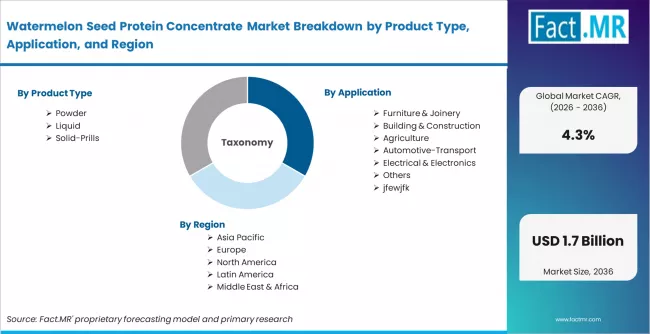
Watermelon Seed Protein Concentrate Market Breakdown By Product Type, Application, And Region | Source: Fact.MR
| Attribute | Details |
|---|---|
| Quantitative Units | USD 1.1 billion (2026) to USD 1.4 billion (2036), at a CAGR of 4.3% |
| Market Definition | Market includes watermelon seed protein concentrates and isolates in powder and processed forms for food, nutraceutical, and cosmetics applications globally. |
| Product Segmentation | Protein Isolate/Concentrate, Raw Seeds, Roasted/Processed Seeds |
| Application Segmentation | Food Industry, Nutraceuticals & Dietary Supplements, Cosmetics & Personal Care |
| Application Coverage | Protein bar and functional food ingredient supply, dietary supplement formulation, plant-based dairy alternative manufacturing, and cosmetics active ingredient procurement. |
| Regions Covered | North America, Europe, Asia Pacific, Latin America, Middle East and Africa |
| Countries Covered | USA, Canada, Mexico, Germany, UK, France, Italy, Spain, Nordic, BENELUX, China, Japan, South Korea, India, ASEAN, Australia and New Zealand, Brazil, Argentina, Chile, Saudi Arabia, GCC, Turkey, South Africa, Rest of MEA |
| Key Companies Profiled | Amino Labs Inc., Z-Company, Aktin Chemicals Inc., NP Nutra, ETChem, Força Foods |
| Forecast Period | 2026 to 2036 |
| Approach | Hybrid top-down and bottom-up model using plant protein producer revenues, seed processing volumes by product type, average selling prices by application grade, procurement benchmarks, and primary interviews with food ingredient and supplement buyers. |
Source: Fact.MR analysis. Updated Apr 21, 2026
Watermelon Seed Protein Concentrate Market by Segments
-
By Product Type:
- Protein Isolate/Concentrate
- Raw Seeds
- Roasted/Processed Seeds
-
By Application:
- Food Industry
- Nutraceuticals & Dietary Supplements
- Cosmetics & Personal Care
-
By Distribution Channel:
- Offline (Retail/Specialty Stores)
- Online (E-commerce)
-
By Region:
- North America
- United States
- Canada
- Mexico
- Latin America
- Brazil
- Mexico
- Argentina
- Chile
- Rest of Latin America
- Western Europe
- Germany
- United Kingdom
- France
- Italy
- Spain
- Nordic Countries
- BENELUX
- Rest of Western Europe
- Eastern Europe
- Russia
- Poland
- Hungary
- Balkan and Baltic
- Rest of Eastern Europe
- East Asia
- China
- Japan
- South Korea
- South Asia and Pacific
- India
- ASEAN
- Australia and New Zealand
- Rest of South Asia and Pacific
- Middle East and Africa
- Kingdom of Saudi Arabia
- Other GCC Countries
- Turkey
- South Africa
- Rest of Middle East and Africa
- North America
Frequently Asked Questions
How large is the global watermelon seed protein concentrate market in 2025?
What will the market size be in 2026?
What is the projected market size by 2036?
What is the expected CAGR from 2026 to 2036?
Which product segment is poised to lead the market?
Which application segment holds the largest share?
Which country shows the fastest growth?
What is watermelon seed protein concentrate used for?
What drives demand in this market?
Who are the key players in the market?
What are the major restraints?
Who worked on this report


Preview the report firsthand - request a free sample
Free SampleGet the brochure for pricing and purchase details
Download PDF