- Base Value(2025): 94.2 Bn
- Estimated Value(2026): 103.8 Bn
- Forecast Value (2036): 274.2 Bn
- CAGR (2026 - 2036): 10.2%
Wearable Computing Devices Market Forecast and Outlook By Fact.MR
In 2025, the wearable computing devices market was valued at USD 94.2 billion. Based on Fact.MR analysis, demand for wearable computing devices is estimated to grow to USD 103.8 billion in 2026 and USD 274.2 billion by 2036. FACT.MR projects a CAGR of 10.2% during the forecast period.
FACT.MR analysis suggests that the wearable computing devices market will generate an absolute dollar opportunity of USD 170.4 billion between 2026 and 2036. This transformational expansion reflects accelerating convergence of consumer health monitoring, enterprise AR/VR deployment, and clinical remote patient monitoring. Growth is moderated by battery life limitations in compact wearable form factors, consumer privacy concerns around continuous biometric data collection, and fragmented healthcare reimbursement frameworks that slow clinical-grade wearable adoption in key markets.
Country growth reflects consumer health adoption, enterprise AR deployment, and digital health reimbursement policies. China leads at 9.0% CAGR, supported by Huawei and Xiaomi smartwatch growth and industrial AR deployment. The United States follows at 8.8%, driven by Medicare wearable health coverage and Apple Watch medical features. The United Kingdom grows at 7.6% through NHS digital health programmes. South Korea records 7.8% with Samsung health platform expansion. France and Germany grow at 7.5% through EU clinical wearable approvals. Japan posts 7.0%, supported by ageing population remote health monitoring demand.
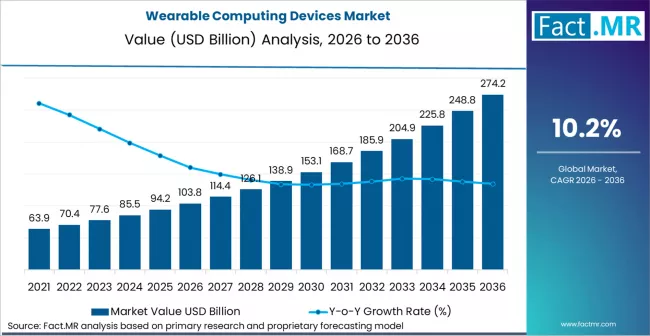
Wearable Computing Devices Market Market Value Analysis | Source: Fact.MR
| Metric | Value |
|---|---|
| Estimated Value in 2026 | USD 103.8 billion |
| Forecast Value in 2036 | USD 274.2 billion |
| Forecast CAGR (2026 to 2036) | 10.2% |
Source: Fact.MR analysis. Updated Mar 12, 2026
Market Definition
The wearable computing devices market includes body-worn electronics with sensors, processors, and wireless connectivity. Products include smartwatches, fitness trackers, AR/VR headsets, ear-worn devices, smart clothing, body cameras, and industrial exoskeletons used in consumer, healthcare, enterprise, and defence sectors.
Market Inclusions
Includes global and regional forecasts from 2026 to 2036 by product type and application. Covers smartwatches, HMDs, smart clothing, ear-worn devices, fitness trackers, body cameras, and exoskeletons across fitness, medical, infotainment, and industrial applications.
Market Exclusions
Excludes implantable medical devices, non-wearable health monitoring equipment, standalone VR consoles, smartphone accessories without computing capability, and military-only command electronics.
Research Methodology
- Primary Research: Interviews with wearable OEM managers, healthcare procurement teams, digital health policy experts, and wearable software developers.
- Desk Research: Sources include OEM earnings reports, FDA 510(k) databases, EU MDR digital health registrations, IDC shipment tracker, and industrial AR deployment studies.
- Market Sizing and Forecasting: Hybrid model using device shipment volumes, average selling prices, health platform subscription revenue, and enterprise AR deployment investments.
- Data Validation and Update Cycle: Data validated using OEM revenues, IDC shipment data, regulatory databases, and enterprise AR deployment announcements.
Summary
- Market Definition
- Wearable computing devices include smartwatches, fitness trackers, AR/VR headsets, ear-worn devices, smart clothing, body cameras, and exoskeletons used for health monitoring and hands-free computing.
- Demand Drivers
- Apple Watch sleep apnoea detection clearance is enabling insurance reimbursement and expanding medical wearable adoption.
- Industrial AR head-mounted displays are being deployed by manufacturing and logistics companies for hands-free operations.
- China’s industrial internet programme is supporting enterprise AR wearable adoption in manufacturing facilities.
- Key Segments Analyzed
- By Product Type Smartwatches hold about 64% share in 2026 due to strong health monitoring and smartphone integration.
- By Application Fitness and wellness leads with about 58% share in 2026 driven by activity tracking and health monitoring.
- By Geography China records the fastest growth at 9.0% CAGR while North America generates the highest revenue.
- Analyst Opinion at FACT.MR
- Shambhu Nath Jha, Principal Consultant at Fact.MR, opines that CXOs will find this report helpful for understanding how healthcare reimbursement expansion, smartwatch medical feature approvals, and enterprise AR wearable adoption in manufacturing and logistics.
- Strategic Implications
- OEMs should obtain FDA and EU medical device approvals to enable insurance reimbursement for wearable health features.
- Companies should develop industry-specific AR wearable platforms for manufacturing and logistics sectors.
- Manufacturers should build digital health platforms generating recurring subscription revenue.
- Methodology
- Market sizing used device shipment volumes and selling prices validated with OEM revenue disclosures and shipment trackers.
- Regulatory approvals, insurance reimbursement programmes, and enterprise AR deployments supported demand analysis.
- Forecasts included health feature adoption trends, enterprise AR investments, and primary interviews with OEM and enterprise teams.
Segmental Analysis
Wearable Computing Devices Market Analysis by Product Type
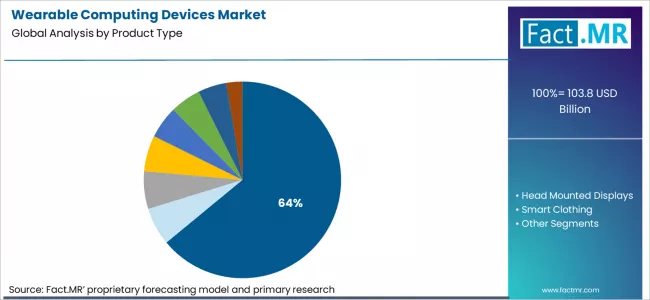
Wearable Computing Devices Market Analysis By Product Type | Source: Fact.MR
Based on FACT.MR’s report, smartwatches are expected to hold about 64% share in 2026. They combine health tracking, notifications, payments, and fitness features, making them the most widely used wearable device.
- Apple Watch Health Platform Investment: In 2024, Apple received FDA clearance for sleep apnoea detection on Apple Watch Series 10. The Apple Health platform now tracks over 100 health metrics, enabling integration with insurance and health monitoring programmes.
- Samsung Galaxy Watch Technology Development: Samsung launched Galaxy Watch 7 and Galaxy Watch Ultra in 2024 with improved BioActive sensors. The device supports advanced health monitoring and received FDA clearance for sleep apnoea detection.
- Smartwatch Shipment Volume Trend: IDC reported global smartwatch shipments reached 42.1 million units in Q3 2024. Apple, Samsung, and Huawei remained the leading brands, with premium smartwatch demand rising strongly.
Wearable Computing Devices Market Analysis by Application
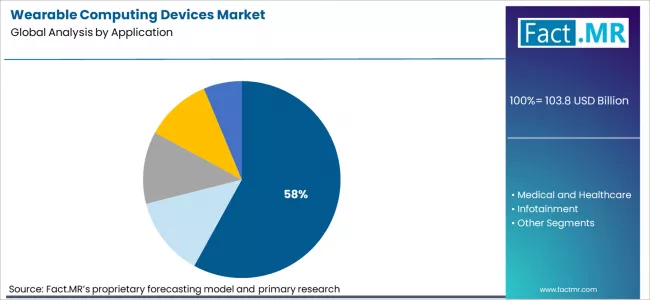
Wearable Computing Devices Market Analysis By Application | Source: Fact.MR
Based on FACT.MR’s report, fitness and wellness applications will hold about 58% share in 2026. Activity tracking, heart rate monitoring, and sleep analysis remain the main reasons consumers purchase wearable devices.
- Garmin Medical Healthcare Investment: In 2025, Garmin expanded its Garmin Health platform and partnered with employer wellness programmes in Germany, the United Kingdom, and Switzerland.
- Oura Ring Healthcare Technology: In 2024, Oura launched Oura Ring Generation 4 with improved temperature sensors and AI health coaching. The company also partnered with Dexcom to integrate glucose monitoring data.
- Industrial Defense Application Trend: Microsoft delivered over 10,000 HoloLens-based AR headsets to the U.S. Army under the IVAS programme in 2024, highlighting defence as a major enterprise wearable deployment segment.
Drivers, Restraints, and Opportunities
FACT.MR analysts observe that the wearable computing devices market, valued at USD 94.2 billion in 2025, is expanding due to improved biometric sensors, device miniaturisation, and healthcare digitalisation. Wearables are shifting from simple fitness gadgets to continuous health monitoring platforms used in both consumer wellness and clinical care.
The market shows a split between low-cost fitness trackers and premium smartwatches with clinical features. Chinese brands compete on price in entry segments, while Apple and Samsung lead premium devices with ECG, blood oxygen, and sleep monitoring capabilities that support subscription health services and insurance-linked healthcare programmes.
- FDA Medical Device Clearances: The U.S. FDA granted 510(k) clearance to Apple Watch Series 10 sleep apnoea detection in September 2024. Samsung Galaxy Watch 7 received similar clearance in October 2024. This enables health insurance coverage for wearable health monitoring in several Medicare Advantage plans.
- EU MDR Digital Health Expansion: EU Medical Device Regulation class IIa approvals expanded for wearables in 2024. Devices such as Withings ScanWatch 2 and Samsung Galaxy Watch ECG gained MDR certification. This enables clinical prescription and insurance reimbursement in several European countries.
- China Industrial AR Deployment: China expanded its Industrial Internet programme in 2025. Government co-investment supports enterprise AR headset deployment in manufacturing. Huawei Vision Glass and Rokid AR devices recorded over 50,000 enterprise activations by the end of 2024.
Regional Analysis
The wearable computing devices market is analysed across Asia Pacific, Europe, North America, Latin America, and Middle East and Africa, covering 40+ countries with demand profiles shaped by consumer health monitoring adoption, enterprise AR deployment programmes, digital health reimbursement frameworks, and OEM manufacturing investment. The full report offers market attractiveness analysis based on health insurance reimbursement timelines, enterprise AR adoption rates, and regulatory medical device classification pathways.
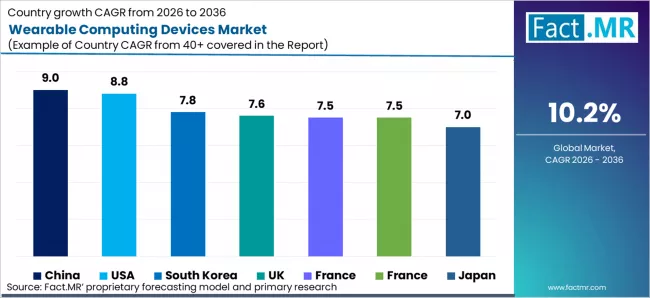
Wearable Computing Devices Market Cagr Analysis By Country | Source: Fact.MR
| Country | CAGR (2026-2036) |
|---|---|
| China | 9.0% |
| United States | 8.8% |
| South Korea | 7.8% |
| United Kingdom | 7.6% |
| France | 7.5% |
| Germany | 7.5% |
| Japan | 7.0% |
Source: Fact.MR analysis. Updated Mar 12, 2026
Source: Fact.MR (FACT.MR) analysis, based on proprietary forecasting model and primary research
Asia Pacific Wearable Computing Devices Market Analysis
Asia Pacific is the largest production hub and fastest-growing consumer wearable region. China drives high-volume smartwatch demand, while South Korea leads premium health platform development. Domestic brands compete strongly with global manufacturers across the region.
- China: China will grow at 9.0% CAGR through 2036. MIIT expanded Industrial Internet programme grants for enterprise AR headsets in 2025. Huawei Vision Glass and Rokid AR reported over 80,000 enterprise device activations by 2024. Xiaomi launched Redmi Watch 5 below CNY 500 to expand smartwatch adoption in Tier 3 and Tier 4 cities. Huawei GT 5 Pro with ECG and blood oxygen monitoring strengthened domestic premium smartwatch competition.
- South Korea: South Korea is projected to grow at 7.8% CAGR through 2036. Samsung launched Galaxy Watch 7 and Galaxy Watch Ultra in 2024 with advanced BioActive sensors. The devices received FDA clearance for sleep apnoea detection. Korea’s K-Digital Initiative funded KRW 50 billion for enterprise AR adoption. Hyundai deployed Samsung AR smart glasses for quality inspection at its Ulsan plant.
- Japan: Japan is forecast to grow at 7.0% CAGR through 2036. The government expanded its Digital Health Promotion Strategy in 2025 to include wearable biometric monitoring. Sony introduced Xperia Ear Duo 2 with fall detection and health monitoring for elderly users. Apple Watch sleep apnoea detection received PMDA medical device clearance in 2024, enabling pharmacy distribution.
FACT.MR’s Asia Pacific analysis of the wearable computing devices market covers China, Japan, South Korea, India, Australia and New Zealand, ASEAN, and Rest of South Asia and Pacific. Readers can find country CAGR forecasts, MIIT industrial AR programme data, Samsung and Huawei health platform investment timelines, and wearable medical device reimbursement policy benchmarks by country.
Europe Wearable Computing Devices Market Analysis
Europe is a regulation-driven wearable market shaped by EU MDR certification requirements. Clinical-grade wearable devices and enterprise AR deployment in manufacturing drive demand.
- United Kingdom: The United Kingdom will grow at 7.6% CAGR through 2036. NHS Digital Health Futures programme added GBP 40 million funding for remote patient monitoring in 2024. AliveCor KardiaMobile received UKCA approval for wearable ECG monitoring. Fitbit integration with the NHS App enables smartwatch health data transfer to patient records.
- France: France is expected to grow at 7.5% CAGR through 2036. The HAS PECAN programme allows reimbursement for connected health devices. Withings ScanWatch 2 achieved EU MDR class IIa certification for ECG monitoring. Dassault Systèmes deployed Vuzix AR headsets for engineering collaboration at its Saint-Cloud facility.
- Germany: Germany will expand at 7.5% CAGR through 2036. The Digital Act (DigiG) extended DiGA coverage to class IIa wearable medical devices. Samsung Galaxy Watch ECG and Withings ScanWatch are under GKV prescription review. Volkswagen deployed HoloLens 2 and RealWear AR headsets across manufacturing plants.
FACT.MR’s European analysis of the wearable computing devices market covers Germany, France, the United Kingdom, Italy, Spain, Nordic countries, BENELUX, and Rest of Western Europe. Readers can find EU MDR wearable certification timelines, GKV and NHS reimbursement programmes, enterprise AR deployment benchmarks, and country-level forecasts by product type and application.
North America Wearable Computing Devices Market Analysis
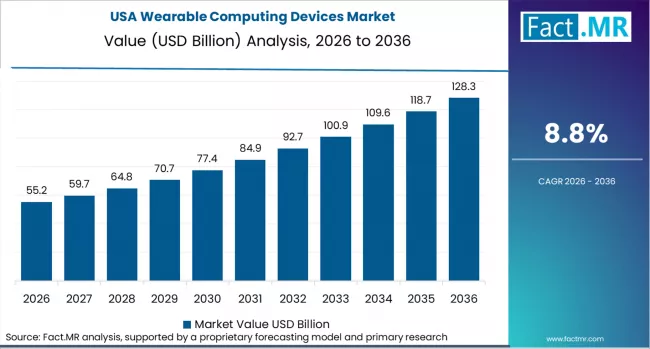
Wearable Computing Devices Market Country Value Analysis | Source: Fact.MR
North America generates the highest revenue in the wearable computing devices market. Apple Watch health platform adoption and enterprise AR deployments support strong demand.
- United States: The United States will grow at 8.8% CAGR through 2036. Medicare Advantage plans allow wearable monitoring device benefits. Insurers including UnitedHealth, Humana, and CVS Aetna added wearable coverage in 2025 plans. Apple Watch Series 10 sleep apnoea detection received FDA clearance in 2024. Microsoft delivered over 10,000 HoloLens AR headsets to the U.S. Army under the IVAS programme.
FACT.MR’s North American analysis of the wearable computing devices market covers the United States, Canada, and Mexico. Readers can find Medicare Advantage wearable benefit policies, FDA smartwatch clearance timelines, enterprise AR deployment benchmarks, and country-level forecasts by product type and application.
Latin America Wearable Computing Devices Market Analysis
Latin America is an emerging wearable market driven by smartwatch adoption and expanding e-commerce distribution of global brands.
- Brazil: Brazil’s wearable computing devices market is expanding steadily. ANVISA updated its digital medical device registration pathway in 2024. Samsung Galaxy Watch ECG and AliveCor KardiaMobile obtained ANVISA medical device registration. Apple launched Apple Watch Series 10 through authorised resellers in Brazil in 2024 with Portuguese health features.
FACT.MR’s Latin American analysis of the wearable computing devices market covers Brazil, Chile, Ecuador, and Rest of Latin America. Readers can find ANVISA medical device registration data, smartwatch e-commerce adoption trends, consumer health awareness insights, and country-level forecasts by product type.
Competitive Aligners for Market Players
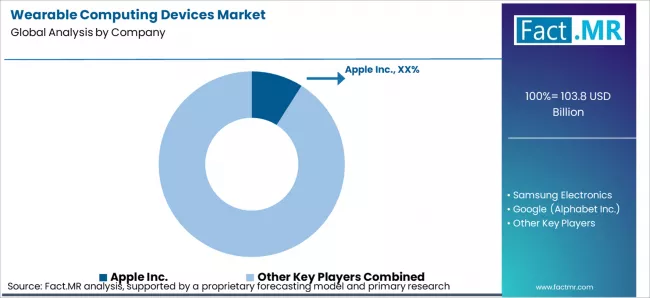
Wearable Computing Devices Market Analysis By Company | Source: Fact.MR
The wearable computing devices market has a mix of strong global leaders and intense competition, depending on the product segment. Premium smartwatches and enterprise AR devices are dominated by a few major brands, while mid-range smartwatches and fitness trackers face heavy price competition. Apple leads the premium smartwatch segment through its Apple Watch ecosystem, tightly connected with the iPhone and Apple Health platform. Samsung competes closely in the Android ecosystem, while Garmin maintains a strong presence in sports and outdoor wearables thanks to accurate sensors and long battery life. Huawei and Xiaomi compete aggressively in the entry and mid-range smartwatch categories, especially in price-sensitive markets.
Technology, ecosystem integration, and regulatory approvals create major competitive advantages. Apple benefits from tight integration between hardware, software, and health data platforms, making it difficult for users to switch brands. Garmin’s long experience in sports tracking and GPS technology helps it maintain credibility among athletes and outdoor users. Samsung also strengthens its position through Galaxy Watch health features and integration with its broader smartphone ecosystem.
Consumers often change wearable brands during upgrade cycles, but health data history and app compatibility create switching barriers. In enterprise and healthcare markets, long-term contracts and regulatory approvals give established wearable brands stronger pricing power and stability.
Key Players
- Apple Inc.
- Samsung Electronics
- Google (Alphabet Inc.)
- Garmin Ltd.
- Huawei Technologies Co., Ltd.
- Fitbit (Google-owned)
- Xiaomi Corporation
- Sony Corporation
- Oura Health Ltd.
Bibliography
- [1] Apple Inc. (2024). Newsroom: Apple Watch Series 10 Sleep Apnoea Detection Feature FDA 510(k) Clearance Announcement as Class II Medical Device. September 2024. apple.com/newsroom
- [2] Centers for Medicare and Medicaid Services. (2024). Medicare Advantage and Part D Final Rule 2025: Supplemental Wearable Health Monitoring Device Benefit Policy and Chronic Condition Coverage Provisions. April 2024. cms.gov
- [3] European Medicines Agency and Notified Body Network. (2024). EU Medical Device Regulation 2017/745 Class IIa Digital Health Wearable Conformity Assessment Update: Withings ScanWatch 2 and Samsung Galaxy Watch ECG Certification Status. November 2024. ema.europa.eu
- [4] Ministry of Industry and Information Technology, People’s Republic of China. (2025). Industrial Internet Integration Innovation Application Programme: Enterprise AR Headset Co-Investment Grant Criteria and 2025 Programme Expansion Announcement. January 2025. miit.gov.cn
- [5] Apple Inc. (2024). Newsroom: Apple Watch Health App Milestone 100 Health and Fitness Metrics and FDA-Cleared Sleep Apnoea Detection for Series 10. September 2024. apple.com/newsroom
- [6] Samsung Electronics Co., Ltd. (2024). Galaxy Watch 7 and Galaxy Watch Ultra Product Launch: BioActive Sensor Update, Blood Glucose Trend Monitoring, and Sleep Apnoea FDA Clearance. July and October 2024. news.samsung.com
- [7] International Data Corporation (IDC). (2024). Worldwide Wearable Device Tracker Q3 2024: Smartwatch Shipment Volume, Year-on-Year Growth, and Vendor Share by Price Tier. December 2024. idc.com
- [8] Garmin Ltd. (2025). Press Release: Garmin Health Enterprise Wellness Programme Partnerships with European Employer Health Benefit Providers in Germany, United Kingdom, and Switzerland. January 2025. garmin.com
- [9] Oura Health Ltd. (2024). Product Launch and Partnership Announcement: Oura Ring Generation 4 Enhanced Sensing Features and Dexcom CGM Data Integration Partnership. October 2024. ouraring.com
- [10] Microsoft Corporation. (2024). IVAS Programme Update: HoloLens 2-Based Integrated Visual Augmentation System Delivery Progress to U.S. Army and IVAS Contract Status. December 2024. microsoft.com
This Report Addresses
- Strategic intelligence on FDA and EU MDR wearable medical device approvals, China MIIT AR deployment grants, Korea NHI ECG reimbursement, and NHS digital health wearable procurement.
- Market forecast from USD 103.8 billion in 2026 to USD 274.2 billion by 2036 at 10.2% CAGR, segmented by product type, application, and region.
- Growth opportunities across U.S. Medicare wearable benefits, EU wearable cardiac monitoring reimbursement, South Korea enterprise AR deployment, Japan digital health programmes, and China industrial AR investment.
- Country CAGR outlook: China 9.0%, United States 8.8%, United Kingdom 8.1%, South Korea 7.8%, France 7.5%, Germany 7.5%, and Japan 7.0%.
- Competitive analysis of Apple, Samsung, Garmin, Huawei, Xiaomi, Oura Health, and Google Fitbit covering health platforms, regulatory approvals, and enterprise AR strategies.
- Technology tracking including blood glucose monitoring development, sleep apnoea detection, enterprise AR headsets, industrial exoskeletons, and AI health coaching platforms.
- Regulatory analysis covering FDA 510(k) approvals, EU MDR wearable certification, UKCA registration, Japan PMDA approvals, and China NMPA wearable device regulations.
- Report delivered in PDF, Excel datasets, PowerPoint summary, and dashboard formats supported by OEM earnings reports, shipment data, regulatory databases, and primary interviews.
Segmentation
Scope of Report
| Quantitative Units | USD 103.8 billion (2026) to USD 274.2 billion (2036), at a CAGR of 10.2% |
|---|---|
| Market Definition | Body-worn electronic devices including smartwatches, HMDs, smart clothing, ear-worn, fitness trackers, body cameras, and exoskeletons for fitness, healthcare, and industrial use. |
| Product Type Segmentation | Smartwatches, Head Mounted Displays, Smart Clothing, Ear-Worn, Fitness Trackers, Body Worn Camera, Exoskeleton, Others |
| Application Segmentation | Fitness and Wellness, Medical and Healthcare, Infotainment, Industrial and Defense, Others |
| Application Coverage | Consumer health monitoring, clinical remote patient monitoring, AR/VR enterprise training, industrial worker safety, defence situational awareness, and sports performance tracking. |
| Regions Covered | Asia Pacific, Europe, North America, Latin America, Middle East and Africa |
| Countries Covered | China, Japan, South Korea, India, Australia and New Zealand, ASEAN, Rest of South Asia and Pacific, Germany, UK, France, Italy, Spain, Nordic, BENELUX, Rest of Western Europe, Russia, Poland, Hungary, Balkan and Baltic, USA, Canada, Mexico, Brazil, Chile, Ecuador, Rest of Latin America, Saudi Arabia, GCC, Turkey, South Africa, Rest of MEA |
| Key Companies Profiled | Apple Inc., Samsung Electronics, Google (Alphabet Inc.), Garmin Ltd., Huawei Technologies, Fitbit (Google), Xiaomi Corporation, Sony Corporation, Oura Health Ltd. |
| Forecast Period | 2026 to 2036 |
| Approach | Hybrid top-down and bottom-up model using device shipment volumes, ASPs by product and application, consumer health adoption surveys, and primary interviews with OEM product teams and enterprise procurement managers. |
Source: Fact.MR analysis. Updated Mar 12, 2026
Wearable Computing Devices Market by Segments
-
By Product Type:
- Smartwatches
- Head Mounted Displays
- Smart Clothing
- Ear-Worn
- Fitness Trackers
- Body Worn Camera
- Exoskeleton
- Others
-
By Application:
- Fitness and Wellness
- Medical and Healthcare
- Infotainment
- Industrial and Defense
- Others
-
By Region:
- North America
- United States
- Canada
- Mexico
- Latin America
- Brazil
- Chile
- Ecuador
- Rest of Latin America
- Western Europe
- Germany
- United Kingdom
- France
- Italy
- Spain
- Nordic
- BENELUX
- Rest of Western Europe
- Eastern Europe
- Russia
- Poland
- Hungary
- Balkan and Baltic
- Rest of Eastern Europe
- East Asia
- China
- Japan
- South Korea
- South Asia and Pacific
- India
- ASEAN
- Australia and New Zealand
- Rest of South Asia and Pacific
- Middle East and Africa
- Kingdom of Saudi Arabia
- Other GCC Countries
- Turkey
- South Africa
- Other African Union
- Rest of Middle East and Africa
- North America
Frequently Asked Questions
How large is the wearable computing devices market in 2025?
What will the market size be in 2026?
What is the projected market size by 2036?
What is the expected CAGR?
Which product type leads the market?
Which application segment dominates?
Which country shows the fastest growth?
Which country is expected to grow the fastest in the wearable computing devices market?
What is the projected growth rate of the wearable computing devices market in South Korea?
How fast is the wearable computing devices market growing in the United Kingdom?
What is the expected CAGR of the wearable computing devices market in France?
How quickly will the wearable computing devices market grow in Germany?
What is the projected growth rate of the wearable computing devices market in Japan?
Who worked on this report


Preview the report firsthand - request a free sample
Free SampleGet the brochure for pricing and purchase details
Download PDF