- Base Value(2026): 2.5 Bn
- Estimated Value(2026): 2.5 Bn
- Forecast Value (2036): 8.0 Bn
- CAGR (2026 - 2036): 12.4%
Wearable Device Packaging Market Forecast and Outlook 2026 to 2036
The period begins with the wearable device packaging market at USD 2.5 billion in 2026 and moves toward USD 8.0 billion by 2036, which corresponds to a 12.40% CAGR.
Wearable Device Packaging Market Key Takeaways
- Wearable Device Packaging Market Value (2026): USD 2.5 billion
- Wearable Device Packaging Market Forecast Value (2036): USD 8.0 billion
- Wearable Device Packaging Market Forecast CAGR 2026 to 2036: 12.4%
- Leading Device Class in Wearable Device Packaging Market: Smartwatches
- Key Growth Regions in Wearable Device Packaging Market: Asia Pacific, North America, Europe, Latin America, Middle East & Africa
- Top Players in Wearable Device Packaging Market: WestRock, Graphic Packaging, Sealed Air
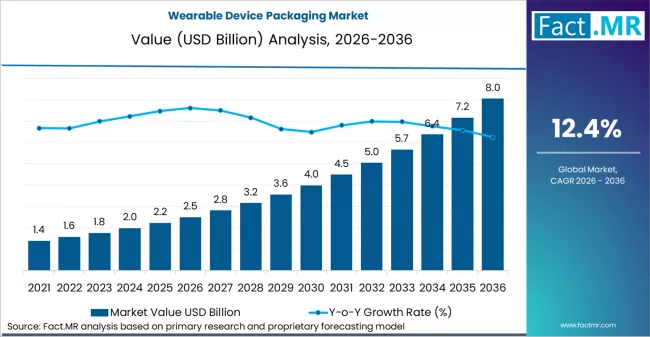
Wearable Device Packaging Market Market Value Analysis | Source: Fact.MR
This segment supports products sold as personal electronics, which places emphasis on protection, presentation, and efficient fulfillment at the same time. Packs must secure delicate screens and sensors while still allowing compact shipping and clear shelf display. Brand owners prefer formats that can be shared across several models since tooling, inserts, and assembly steps are reused within product families.
Once a packaging system is approved, change tends to be limited because it affects kitting lines, instruction sets, and retail layouts. Buyers focus on drop resistance, packing speed, and visual consistency more than on decorative features. Volume growth follows higher device shipments and wider channel coverage rather than frequent redesign of core pack structures.
Wearable Device Packaging Market
| Metric | Value |
|---|---|
| Market Value (2026) | USD 2.5 billion |
| Forecast Value (2036) | USD 8.0 billion |
| Forecast CAGR 2026 to 2036 | 12.4% |
Source: Fact.MR analysis. Updated Jan 27, 2026
Category
| Category | Segments |
|---|---|
| Device Class | Smartwatches; Fitness bands; Medical wearables; Premium devices |
| Protection Level | Premium rigid boxes; Folding cartons; Protective mailers; Drawer boxes |
| Material | Paperboard; SBS board; Corrugated board; Specialty board |
| Region | North America; Europe; Asia Pacific; Latin America; Middle East & Africa |
Source: Fact.MR analysis. Updated Jan 27, 2026
Segmental Analysis
Why Do Smartwatches Represent the Largest Share of Packaging Volume in This Market?
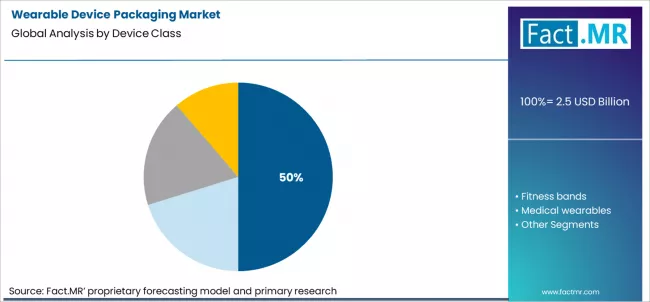
Wearable Device Packaging Market Analysis By Device Class | Source: Fact.MR
Smartwatches account for 50% of device class usage in the wearable device packaging market. This category sits at the intersection of consumer electronics and personal accessories, which drives high unit sales across multiple price tiers. Product cycles involve frequent model updates, limited editions, and regional variants, all of which increase packaging turnover. Retail distribution also plays a role, with smartwatches sold through electronics stores, brand outlets, and online channels that each require consistent presentation standards. Packaging teams plan around these volumes when setting box sizes, inserts, and protective features. Fitness bands and medical wearables contribute steady demand. The scale and frequency of smartwatch launches keep this device class as the main anchor for packaging programs.
What Protection Level Is Used Most Often for Shipping and Display of Wearable Devices?
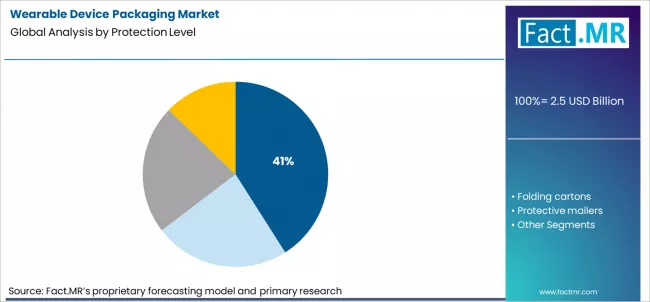
Wearable Device Packaging Market Analysis By Protection Level | Source: Fact.MR
Premium rigid boxes represent 41% of protection level usage in this market. This format supports both transport safety and retail presentation in a single structure. Rigid boxes protect screens and sensors from compression and impact during shipping and handling. At the same time, they serve as the main presentation element on shelves and in unboxing experiences. Inserts and compartments inside these boxes also help secure accessories and chargers. Folding cartons, mailers, and drawer boxes appear in specific segments. The combination of physical protection and display function keeps rigid boxes as the most widely used packaging format for wearable devices.
What are the Drivers, Restraints, and Key Trends of the Wearable Device Packaging Market?
- Drivers: Protective requirements for sensitive electronic components, the need to convey product features and brand identity, and retailer specifications for secure, shelf-ready presentation are shaping packaging solutions for wearable devices across consumer electronics and healthcare segments.
- Restraint: Cost constraints tied to high-volume production and the challenge of balancing robust protection with material and logistics efficiency limit adoption of premium packaging formats.
- Trend 1: Packaging designs that integrate user instructions and QR-linked setup guidance to streamline unboxing and first-use experiences.
- Trend 2: Expanded use of tailored inserts and compartmentalization to secure accessories such as chargers, bands, and sensors within compact packaging footprints.
Country
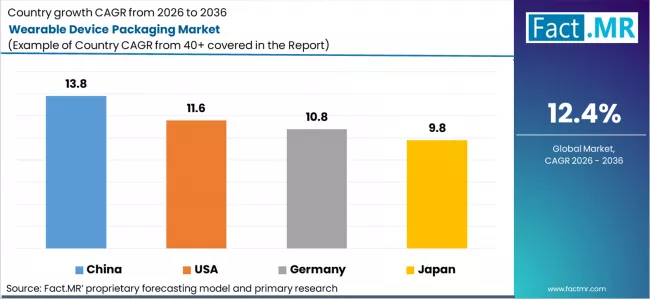
Wearable Device Packaging Market Cagr Analysis By Country | Source: Fact.MR
| Country | CAGR 2026 to 2036 |
|---|---|
| China | 13.8% |
| USA | 11.6% |
| Germany | 10.8% |
| Japan | 9.8% |
Source: Fact.MR analysis. Updated Jan 27, 2026
The report covers an in-depth analysis of 30+ countries; top-performing countries are highlighted below.
What Is Driving Rapid Expansion of Wearable Device Packaging in China?
Growth in China runs at about 13.8% per year through 2036. Demand is shaped by high volumes of smart bands, watches, and health trackers moving through online and offline channels. Brand owners focus on protection during transit, compact pack sizes, and strong shelf presentation for gifting. Packaging formats favor rigid cartons with molded inserts and accessory compartments. Purchasing aligns with product launch cycles and seasonal promotion schedules. Local manufacturing scale influences supplier choice. Volume increases follow device model refresh waves and platform sales events. Market development remains tied to electronics production scale and retail campaign intensity rather than long replacement cycles.
How Are Direct-to-Consumer Channels in USA Shaping Wearable Device Packaging?
Growth in USA runs at about 11.6% per year through 2036. Demand follows expansion of direct to consumer sales and large electronics retail chains. Buyers emphasize unboxing experience, damage resistance, and clear accessory organization. Packaging decisions balance cost, freight efficiency, and branding impact. Conversions often occur during device generation updates. Distribution relies on contract packers and specialized electronic packaging suppliers. Volume growth tracks wearable category expansion and health monitoring adoption rather than short term fashion cycles. Market development stays tied to product innovation cadence and marketing launch intensity across consumer electronics brands.
Why Do Quality and Compliance Standards in Germany Influence Wearable Device Packaging?
Growth in Germany runs at about 10.8% per year through 2036. Demand follows steady sales of fitness and medical adjacent wearables through electronics and pharmacy channels. Buyers focus on protection, labeling accuracy, and recycling compliance. Packaging formats emphasize sturdy cartons and secure internal fixtures. Purchasing decisions remain specification driven and conservative. Conversions proceed cautiously because logistics performance and return rates receive attention. Distribution stays concentrated among established electronics packaging suppliers. Volume growth tracks gradual category expansion and product upgrades rather than aggressive model churn or short product life cycles.
How Are Presentation and Gifting Norms in Japan Shaping Wearable Device Packaging?
Growth in Japan runs at about 9.8% per year through 2036. Demand follows strong emphasis on neat presentation, compact design, and careful handling. Buyers prioritize precise fit, clean finishes, and orderly accessory layout. Packaging decisions emphasize consistency and premium feel even in mass products. Conversions happen through scheduled product refresh cycles. Distribution remains concentrated among approved packaging partners. Volume growth tracks steady wearable adoption in health and lifestyle categories. Market development stays tied to disciplined product planning and gifting occasions rather than rapid expansion of low cost device segments.
How Do Retail Presentation and Damage Risk Management Shape Competition in the Wearable Device Packaging Market?
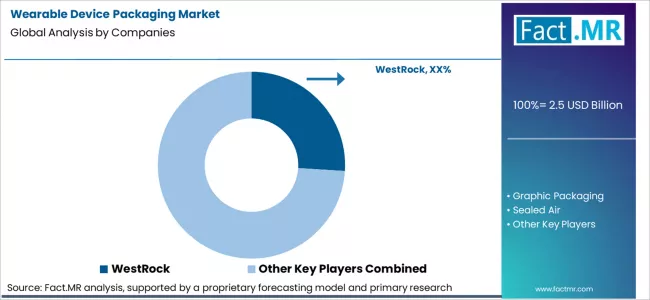
Wearable Device Packaging Market Analysis By Company | Source: Fact.MR
Launch schedules for consumer electronics usually lock packaging decisions months before volume commitments are placed. Product teams first define unboxing sequence, accessory layout, and drop resistance targets, then test packs against retail and parcel handling conditions. WestRock and Graphic Packaging compete by designing folding carton systems that balance shelf presentation with tamper control and internal fit.
Sealed Air participates where cushioning performance and transit protection drive format choice. Buyers compare suppliers using damage rates, pack assembly time, material efficiency, and print consistency across runs. Logistics groups also review cube utilization and reverse logistics behavior. Once a pack design is approved for a device family, it remains fixed through model refresh cycles. Volume changes follow product launches and channel expansion rather than rebidding exercises.
Key Players in Wearable Device Packaging Market
- WestRock
- Graphic Packaging
- Sealed Air
References
- European Commission. (2024). Proposal for a regulation of the European Parliament and of the Council on packaging and packaging waste and repealing Directive 94/62/EC. European Commission.
- European Commission, Joint Research Centre. (2023). The future of packaging in a circular economy: Material use, reuse systems and waste prevention. Publications Office of the European Union.
- International Organization for Standardization. (2023). ISO 2248: Packaging - Complete, filled transport packages - Vertical impact test by dropping. ISO.
- International Organization for Standardization. (2023). ISO 12048: Packaging - Complete, filled transport packages - Compression and stacking tests. ISO.
- International Organization for Standardization. (2023). ISO 4180: Packaging - Complete, filled transport packages - General rules for the compilation of performance test schedules. ISO.
Segmentation
Scope of the Report
| Items | Values |
|---|---|
| Quantitative Units (2026) | USD billion |
| Device Class | Smartwatches, fitness bands, medical wearables, premium devices |
| Protection Level | Premium rigid boxes, folding cartons, protective mailers, drawer boxes |
| Material | Paperboard, SBS board, corrugated board, specialty board |
| Regions Covered | Asia Pacific, Europe, North America, Latin America, Middle East & Africa |
| Countries Covered | United States, Canada, Mexico, Germany, United Kingdom, France, Italy, Spain, Nordics, BENELUX, China, Japan, South Korea, India, Australia & New Zealand, ASEAN, Brazil, Chile, Saudi Arabia, Turkey, South Africa, and other regional markets |
| Key Companies Profiled | WestRock, Graphic Packaging, Sealed Air |
| Additional Attributes | Dollar sales by device class, protection level, and material; performance focus on drop resistance, insert fit, and packing speed; demand driven by consumer electronics launches, DTC channels, and retail presentation requirements |
Source: Fact.MR analysis. Updated Jan 27, 2026
Wearable Device Packaging Market Segmentation
-
Device Class :
- Smartwatches
- Fitness bands
- Medical wearables
- Premium devices
-
Protection Level :
- Premium rigid boxes
- Folding cartons
- Protective mailers
- Drawer boxes
-
Material :
- Paperboard
- SBS board
- Corrugated board
- Specialty board
-
Region :
- Asia Pacific
- China
- Japan
- South Korea
- India
- Australia & New Zealand
- ASEAN
- Rest of Asia Pacific
- Europe
- Germany
- United Kingdom
- France
- Italy
- Spain
- Nordic
- BENELUX
- Rest of Europe
- North America
- United States
- Canada
- Mexico
- Latin America
- Brazil
- Chile
- Rest of Latin America
- Middle East & Africa
- Kingdom of Saudi Arabia
- Other GCC Countries
- Turkey
- South Africa
- Other African Union
- Rest of Middle East & Africa
- Asia Pacific
Frequently Asked Questions
How big is the wearable device packaging market in 2026?
What will be the size of wearable device packaging market in 2036?
How much will be the wearable device packaging market growth between 2026 and 2036?
What are the key product types in the wearable device packaging market?
Which protection level segment to contribute significant share in the wearable device packaging market in 2026?
Who worked on this report


Preview the report firsthand - request a free sample
Free SampleGet the brochure for pricing and purchase details
Download PDF