- Market Value (2025): USD 430.0 Mn
- Estimated Value (2026): USD 449.6 Mn
- Forecast Value (2036): USD 702.3 Mn
- CAGR (2026-2036): 4.6%
What is the Weighing Indicator Controller Market forecast to be worth by 2036?
USD 449.6 million in 2026 to USD 702.3 million by 2036 at a 4.6% CAGR.
- As per Fact.MR analysis, the weighing indicator controller market reached USD 430.0 million in 2025.
- Demand will increase from USD 449.6 million in 2026 to USD 702.3 million by 2036.
- The weighing indicator controller market will record 4.6% CAGR from 2026 to 2036.
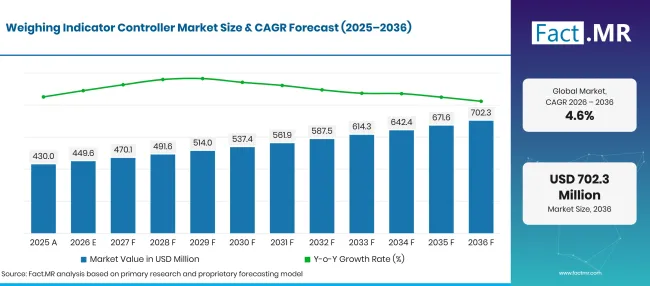
Factmr Weighing Indicator Controller Market Forecast Global | Source: Fact.MR
| Year | Basis | Market value (USD Million) |
|---|---|---|
| 2025 | Actual | 430.0 |
| 2026 | Estimate | 449.6 |
| 2036 | Forecast | 702.3 |
| CAGR 2026 to 2036 | Forecast period | 4.6% |
Source: Fact.MR analysis. Updated Oct 13, 2026
What are the defining numbers behind Weighing Indicator Controller Market growth?
An absolute opportunity of USD 252.7 million will be created between 2026 and 2036.
- Demand Drivers in the Market
- Legal metrology rules are sustaining a regular replacement cycle. Weighing instruments used in trade must satisfy type-approval and verification requirements, including OIML R 76-1, the EU Non-automatic Weighing Instruments Directive and NIST Handbook 44 in the United States [1][2][3]. Operators upgrading scales to remain compliant will specify digital indicators with sealed calibration and audit trails.
- Process automation is bringing weight data into plant control systems. Controllers with Ethernet and fieldbus interfaces are enabling batching, filling and dosing lines to exchange weight values with PLCs and supervisory software, which will increase the value of each unit sold.
- Traceability requirements are expanding across food, pharmaceutical and logistics operations. Recorded weights are supporting lot tracking, label accuracy and shipment verification.
- Hazardous-area and washdown designs are extending the range of applications. Indicators certified for explosive atmospheres under the EU ATEX Directive and housed in stainless steel enclosures will be used in chemical, grain and food plants where earlier units were unsuitable [4].
- Key Segments Analyzed
- By Product Type: Digital Weighing Indicator Controllers will command 62.5% share in 2026 since digital units offer filtering, calibration storage, setpoint control and communications in one device.
- By Application: Industrial will contribute 38.2% share in 2026, supported by batching, filling and process weighing across plants.
- By End-User: Food and Beverage will secure 26.4% share in 2026 owing to portioning, ingredient dosing and label-weight compliance.
- By Distribution Channel: Direct Sales will constitute 48.2% share in 2026, given that buyers value configuration support and system integration.
- Analyst Opinion at Fact.MR
- Shambhu Nath Jha, Principal Consultant at Fact.MR, states, “Weighing indicator controllers will be specified as connected control points within automated production and logistics systems through 2036. Buyers will favor certified, digital units with open Ethernet and fieldbus interfaces, sealed calibration records and hardware rated for washdown and hazardous-area duty. Suppliers that pair approved hardware with integration support and local service will gain the most from food processors, manufacturers and logistics operators.”
- Strategic Implications
- Indicator manufacturers will need to broaden Ethernet and fieldbus support, since integrators are selecting controllers on ease of connection to PLCs and plant software.
- Product teams are expected to maintain current legal-for-trade approvals in each target market, as units without valid approval cannot be used for commercial transactions.
- Suppliers serving food and beverage plants are advised to supply stainless steel, washdown-rated models with batching and checkweighing functions, which processors will require for hygiene and label-weight compliance.
- Distributors and system integrators are encouraged to develop service and recalibration offers, because replacement and compliance work will continue to recur across the installed base.
Germany will lead at 5.5% CAGR on its large machinery and process-equipment base. Brazil will follow at 5.0% as food processing and agribusiness expand. The United States will record 4.6%, in line with the global rate, on steady industrial and logistics demand. The United Kingdom will post 4.1% on a mature, compliance-driven installed base, while Japan will close at 3.6% in a market with high existing automation levels.
How does the Weighing Indicator Controller Market break down by segment?
Digital Weighing Indicator Controllers will lead Product Type at 62.5%; Industrial will lead Application at 38.2%; Food and Beverage will lead End-User at 26.4%; Direct Sales will lead Distribution Channel at 48.2%.
Which Product Type dominates?
Digital Weighing Indicator Controllers will hold 62.5% share in 2026.
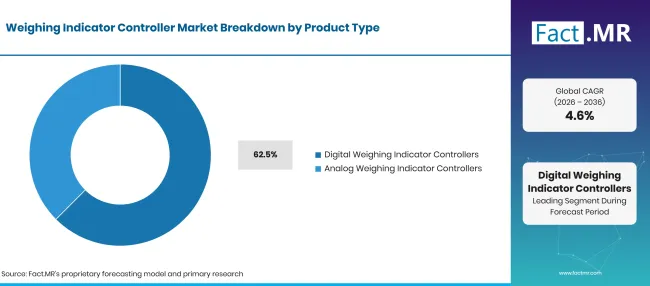
Factmr Weighing Indicator Controller Market Breakdown Product Type | Source: Fact.MR
Product Type, share in 2026
| Product Type | Share (2026) |
|---|---|
| Digital Weighing Indicator Controllers (Leading segment) | 62.5% |
| Analog Weighing Indicator Controllers | 37.5% |
| Total | 100.0% |
Source: Fact.MR analysis. Updated Oct 13, 2026
Digital controllers will lead because they are converting load cell signals through high-resolution converters, applying filtering, and storing calibration and setpoints electronically. They are also supporting serial, Ethernet and fieldbus links, which analog units cannot match. Analog Weighing Indicator Controllers are retaining a role in basic, low-cost duties and in legacy installations where operators are preserving existing wiring and panels. Their share will narrow as these units are reaching end of life and being replaced by digital models.
What supports Industrial within Application?
Industrial will account for 38.2% share in 2026.
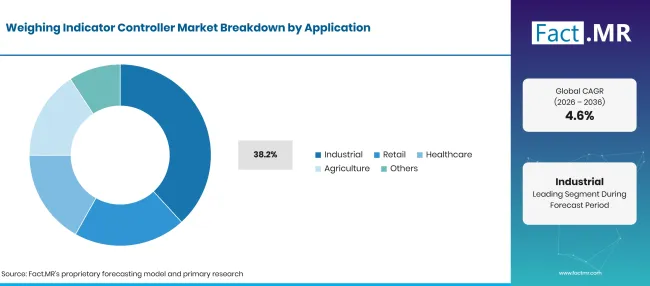
Factmr Weighing Indicator Controller Market Breakdown Application | Source: Fact.MR
| Application | Share (2026) |
|---|---|
| Industrial (Leading segment) | 38.2% |
| Other segments combined | 61.8% |
| Total | 100.0% |
Source: Fact.MR analysis. Updated Oct 13, 2026
Industrial use will lead since plants are relying on weight-based control for batching, blending, filling, tank and silo level monitoring, and truck and vehicle weighing. Setpoint outputs and process communications are turning the controller into an operating component of the line rather than a display. Retail applications are using indicators in counter and price-computing scales. Healthcare applications are covering patient and clinical weighing where accuracy and approval will remain mandatory. Agriculture is deploying indicators for grain, feed and livestock weighing, while other uses will extend to laboratories and specialty settings
What leads the End-User segment?
Food and Beverage will capture 26.4% share in 2026.
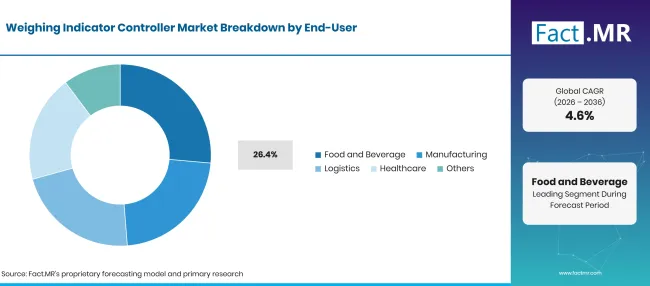
Factmr Weighing Indicator Controller Market Breakdown End User | Source: Fact.MR
| End-User | Share (2026) |
|---|---|
| Food and Beverage (Leading segment) | 26.4% |
| Other segments combined | 73.6% |
| Total | 100.0% |
Source: Fact.MR analysis. Updated Oct 13, 2026
Food and Beverage will lead as processors are weighing ingredients, portions and finished packs while maintaining label weights within legal tolerances. Hygienic enclosures and traceable records will remain central purchase criteria. Manufacturing is deploying controllers across assembly, chemical and materials processing. Logistics operators are using them for parcel, pallet and freight weighing. Healthcare and other end-users will contribute smaller but consistent demand.
How does Distribution Channel shape demand?
Direct Sales will represent 48.2% share in 2026.
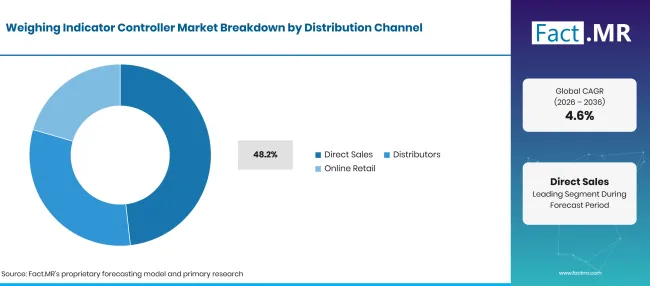
Factmr Weighing Indicator Controller Market Breakdown Distribution Channel | Source: Fact.MR
| Distribution Channel | Share (2026) |
|---|---|
| Direct Sales (Leading segment) | 48.2% |
| Other segments combined | 51.8% |
| Total | 100.0% |
Source: Fact.MR analysis. Updated Oct 13, 2026
Direct Sales will lead because large buyers are requiring configuration, commissioning, certification support and service contracts from the manufacturer. Complex batching and integration projects will continue to be sold through direct engagement rather than as catalog items. Distributors are serving regional buyers that need local stock, installation and calibration service. Online Retail is reaching small businesses and repeat buyers of standard indicators who are evaluating models and prices.
What is accelerating Weighing Indicator Controller Market adoption, and what is holding it back?
Demand will rise through the shift to digital units, process automation and compliance needs. Growth is held back by price pressure, competition from PLC-based weighing modules and long product replacement cycles.
Drivers Impact Analysis
| DRIVER | (~) % IMPACT ON CAGR | GEOGRAPHIC RELEVANCE | IMPACT TIMELINE |
|---|---|---|---|
| Replacement of analog units, 37.5% of 2026 demand, with digital indicator controllers | +1.6% | Global | Short term (<= 2 years) |
| Legal metrology and traceability requirements | +1.2% | Global | Medium term (2-4 years) |
| Process automation and fieldbus connectivity | +1.0% | Western Europe, North America, East Asia | Medium term (2-4 years) |
| Expanding food processing and logistics activity in Latin America | +0.6% | Latin America | Long term (>= 4 years) |
Source: Fact.MR analysis. Updated Oct 13, 2026
Opportunity Impact Analysis
| OPPORTUNITY | (~) % IMPACT ON CAGR | GEOGRAPHIC RELEVANCE | IMPACT TIMELINE |
|---|---|---|---|
| Cloud-connected indicators with remote diagnostics | +0.8% | Global | Medium term (2-4 years) |
| Retrofit of installed weighing systems with industrial networking | +0.6% | Western Europe, North America | Short term (<= 2 years) |
| Hygienic and washdown designs for food and beverage plants | +0.4% | Global | Long term (>= 4 years) |
| Online purchasing of standard indicators | +0.2% | North America, Western Europe | Short term (<= 2 years) |
Source: Fact.MR analysis. Updated Oct 13, 2026
Restraints Impact Analysis
| RESTRAINT | (~) % IMPACT ON CAGR | GEOGRAPHIC RELEVANCE | IMPACT TIMELINE |
|---|---|---|---|
| Price pressure from low-cost suppliers | -0.8% | Global | Short term (<= 2 years) |
| Weighing modules built into PLC platforms replacing stand-alone indicators | -0.6% | Western Europe, North America | Medium term (2-4 years) |
| Long service life of installed indicators | -0.4% | Global | Long term (>= 4 years) |
Source: Fact.MR analysis. Updated Oct 13, 2026
Which countries are scaling the Weighing Indicator Controller Market through 2036?
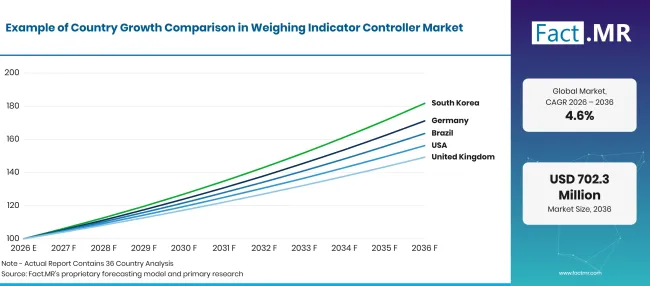
Factmr Weighing Indicator Controller Market Growth Index | Source: Fact.MR
| Country | CAGR (2026-2036) |
|---|---|
| Germany | 5.5% |
| Brazil | 5.0% |
| USA | 4.6% |
| UK | 4.1% |
| Japan | 3.6% |
Source: Fact.MR analysis. Updated Oct 13, 2026
What supports Germany adoption?
5.5% CAGR, supported by a large machinery and process-equipment base.
German machinery builders embed weighing controllers in packaging, filling and process lines, and Germany hosts suppliers such as Minebea Intec and Siemens. Instruments used in trade must comply with the national Measures and Verification Act and EU rules, which keeps certified units in demand [2].
How is Brazil scaling demand?
5.0% CAGR, driven by food processing and agribusiness.
Brazil’s meat, grain and beverage processors weigh large volumes of raw material and finished product, and export quality requirements are pushing buyers toward digital, traceable weighing controls. Inmetro oversees approval and verification of legal-for-trade instruments, so certified units will remain essential as plants modernize.
What supports United States adoption?
4.6% CAGR, supported by industrial and logistics demand.
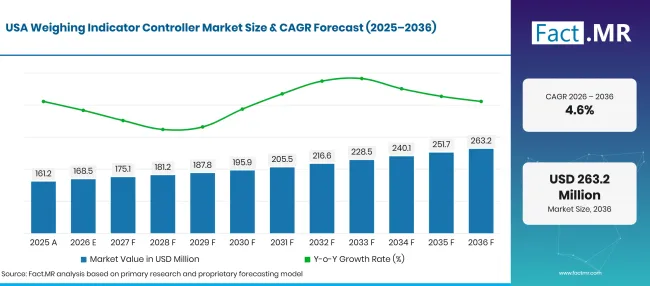
Factmr Weighing Indicator Controller Market Forecast Usa | Source: Fact.MR
U.S. buyers purchase indicators with NTEP certification under NIST Handbook 44 for commercial use [3], and state weights and measures officials inspect devices in service. Large logistics networks and food plants, together with domestic suppliers such as Rice Lake and Cardinal Scale and a deep distributor base, sustain replacement and upgrade demand.
How does the United Kingdom perform?
4.1% CAGR, shaped by a mature, compliance-driven installed base.
The UK has a developed food manufacturing and logistics sector, and trading standards officers enforce legal metrology requirements under the Weights and Measures Act 1985 and the Non-automatic Weighing Instruments Regulations 2016. Most demand will come from replacement and compliance work rather than new capacity.
How is Japan developing demand?
3.6% CAGR, backed by precision manufacturing but limited by high existing automation.
Japan has a strong domestic weighing industry, with suppliers such as Yamato Scale and A&D, and a high level of installed automation. The Measurement Act governs instruments used in trade. Growth will come from upgrades to connected controllers in food packaging and electronics production rather than first-time installation.
Who leads the Weighing Indicator Controller Market?
Competition falls into two groups. Global precision weighing and automation groups compete on technology breadth, certifications and worldwide service networks: Mettler Toledo offers IND-series weighing terminals, Minebea Intec supplies Combics and Maxxis indicators, Siemens AG markets SIWAREX weighing modules for automation systems, Ohaus Corporation sells Defender-series weighing systems, and A&D Company Limited provides AD-series weighing indicators.
Scale and weighing-system specialists compete on application focus, regional distribution and price: Rice Lake Weighing Systems offers the 920i and 880 Performance Series indicators, Cardinal Scale Manufacturing supplies the 205 and 225 indicators, and Avery Weigh-Tronix provides ZM-series indicators. Hardy Process Solutions focuses on process weighing and batching through HI-series weight controllers and WAVERSAVER vibration-filtering technology, while Yamato Scale Co., Ltd. serves food packaging through Dataweigh combination weighers and checkweighers. Connectivity, legal-for-trade approvals, hygienic design and local service will decide competition through 2036.
Which companies are the key providers?
Key companies include Mettler Toledo; Avery Weigh-Tronix; Rice Lake Weighing Systems; Cardinal Scale Manufacturing; Hardy Process Solutions; Ohaus Corporation; Siemens AG; Minebea Intec; Yamato Scale Co., Ltd.; and A&D Company Limited.
- Mettler Toledo
- Avery Weigh-Tronix
- Rice Lake Weighing Systems
- Cardinal Scale Manufacturing
- Hardy Process Solutions
- Ohaus Corporation
- Siemens AG
- Minebea Intec
- Yamato Scale Co., Ltd.
- A&D Company Limited
Bibliography
- [1] Williams, J., Minnich, L., Lee, G., Konijnenburg, J., Baucom, I., & Lippa, K. (2025, January 10). NIST Handbook 44: Specifications, tolerances, and other technical requirements for weighing and measuring devices (2025 ed.). National Institute of Standards and Technology.
- [2] Office for Product Safety and Standards. (2025, March 24). Non-Automatic Weighing Instruments Regulations 2016: Great Britain. GOV.UK.
- [3] Yang, P., Cai, C., Wang, J., Li, X., Zhong, R., Wang, X., & Zhuo, C. (2025, July). Digital transformation attempts in daily work of OIML-CS: Remote Testing Laboratory. OIML Bulletin, 66(3).
- [4] Kamada, T. (2026). Preserving legal-metrology integrity in AI-assisted logging: Auditable linking of recognition and weighing. OIML Bulletin, 67(3).
- [5] Office for Product Safety and Standards. (2025, August 8). Measuring instruments regulations and non-automatic weighing instruments regulations. GOV.UK.
- [6] Rice Lake Weighing Systems. (2025, November 12). 920i® Series programmable weight indicator and controller: Firmware version 5.14.00.
- [7] Mettler-Toledo International Inc. (n.d.). Scale indicators, weighing controllers and transmitters.
- [8] Rice Lake Weighing Systems. (n.d.). 920i® Series programmable weight indicator and controller.
- [9] European Parliament & Council of the European Union. (2014, February 26). Directive 2014/31/EU of the European Parliament and of the Council on the harmonisation of the laws of the Member States relating to the making available on the market of non-automatic weighing instruments (recast). EUR-Lex.
- [10] European Parliament & Council of the European Union. (2014, February 26). Directive 2014/34/EU of the European Parliament and of the Council on the harmonisation of the laws of the Member States relating to equipment and protective systems intended for use in potentially explosive atmospheres (recast). EUR-Lex.
This Report Answers
- The report explains how weighing indicator controllers are used by product type, application, end-user and distribution channel.
- Segment analysis identifies the subsegment that leads each segment and the buyer needs behind its 2026 share.
- Country analysis compares the five listed countries through industrial activity, regulatory rules and installed base maturity.
- Competitive analysis reviews global precision weighing groups and scale and weighing-system specialists.
- Regulatory analysis tracks legal-for-trade approvals and hazardous-area certification requirements.
What does the Weighing Indicator Controller Market cover?
The Weighing Indicator Controller Market covers electronic indicators and controllers that process load cell signals and present or act on weight data. Typical functions include weight display, tare and zero, setpoint and relay control, batching and filling sequences, checkweighing, and data output over serial, Ethernet and fieldbus links.
The assessment tracks digital and analog units used in industrial, retail, healthcare and agricultural settings. Indicators depend on the wider load cell and weighing platform supply chain, which provides the sensing hardware they read.
What is included in the scope?
The scope includes stand-alone indicators, panel-mount and washdown-rated controllers, hazardous-area certified units, and indicators with batching, filling or checkweighing functions. It covers units sold with legal-for-trade approval as well as industrial units sold for process use.
Weighing modules for PLC systems are included when they perform indicator and controller functions. Complete scale systems are counted only for the value of the indicator or controller.
What is excluded from the scope?
The scope excludes load cells, weighing platforms, structures and junction boxes sold without an indicator. Stand-alone weighing software and general-purpose PLCs without a weighing function are also excluded.
Laboratory balances and complete scales fall outside the revenue boundary except for the indicator value defined above. Services such as calibration, installation and maintenance contracts are excluded.
How Was the Analysis Built?
The analysis draws on 120+ sources, 35+ company portfolios, 25+ countries, and more than 20 industry interviews.
- Primary Research: Primary research includes discussions with manufacturers, service providers, technology developers, distributors, end users, and subject-matter experts. These conversations examine purchasing priorities, product adoption, operational challenges, approval requirements, competitive positioning, and the factors that influence wider market acceptance.
- Desk Research: Desk research covers government statistics, regulatory publications, company filings, trade data, technical studies, industry associations, standards, public policy, and other authoritative sources. Every source used in the analysis is documented in the bibliography.
- Market Sizing and Forecasting: Market estimates combine historical performance, demand indicators, pricing and volume trends, segment shares, company participation, country-level growth, adoption patterns, investment activity, and barriers to market expansion.
- Data Validation and Update Cycle: Findings are validated by comparing primary interviews with public data, company activity, regulatory changes, trade patterns, and industry developments. Regular updates review new product launches, capacity changes, partnerships, approvals, and shifts in commercial adoption.
Segmentation
What is the report’s scope and coverage?
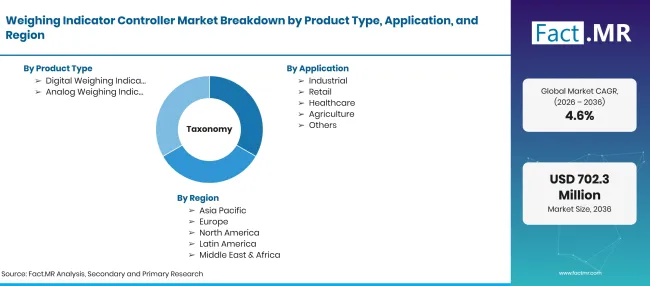
Factmr Weighing Indicator Controller Market Taxonomy | Source: Fact.MR
| Attribute | Details |
|---|---|
| Quantitative Units | USD 449.6 million in 2026 to USD 702.3 million by 2036 at a 4.6% CAGR |
| Market Definition | Electronic instruments that receive signals from load cells, convert them to weight values, display them and provide control functions such as setpoints, batching, filling and checkweighing, with data communications to plant systems. |
| Product Type | Digital Weighing Indicator Controllers; Analog Weighing Indicator Controllers |
| Application | Industrial; Retail; Healthcare; Agriculture; Others |
| End-User | Food and Beverage; Manufacturing; Logistics; Healthcare; Others |
| Distribution Channel | Direct Sales; Distributors; Online Retail |
| Regions Covered | North America; Latin America; Western Europe; Eastern Europe; East Asia; South Asia & Pacific; Middle East & Africa |
| Countries Covered | Germany; Brazil; United States; United Kingdom; Japan |
| Key Companies Profiled | Mettler Toledo; Avery Weigh-Tronix; Rice Lake Weighing Systems; Cardinal Scale Manufacturing; Hardy Process Solutions; Ohaus Corporation; Siemens AG; Minebea Intec; Yamato Scale Co., Ltd.; A&D Company Limited |
| Forecast Period | 2026 to 2036 |
| Approach | Hybrid top-down and bottom-up approach using industrial and logistics activity by region; indicator replacement cycles; regulatory requirements by country; distribution channel mix; country growth; and supplier portfolio review. |
Source: Fact.MR analysis. Updated Oct 13, 2026
How is the market segmented?
-
By Product Type
- Digital Weighing Indicator Controllers
- Analog Weighing Indicator Controllers
-
By Application
- Industrial
- Retail
- Healthcare
- Agriculture
- Others
-
By End-User
- Food and Beverage
- Manufacturing
- Logistics
- Healthcare
- Others
-
By Distribution Channel
- Direct Sales
- Distributors
- Online Retail
-
By Region
- North America
- Latin America
- Western Europe
- Eastern Europe
- East Asia
- South Asia & Pacific
- Middle East & Africa
Frequently Asked Questions
How big is the weighing indicator controller market in 2026?
What is the CAGR of the weighing indicator controller market from 2026 to 2036?
Which product type leads the weighing indicator controller market?
Which application leads the weighing indicator controller market?
Which end-user leads the weighing indicator controller market?
Which distribution channel leads the weighing indicator controller market?
Which country will grow the most in the weighing indicator controller market?
Who are the main companies in the weighing indicator controller market?
Who worked on this report


Preview the report firsthand - request a free sample
Free SampleGet the brochure for pricing and purchase details
Download PDF