- Market Value (2025): USD 1.6 Bn
- Estimated Value (2026): USD 1.7 Bn
- Forecast Value (2036): USD 3.5 Bn
- CAGR (2026-2036): 7.1%
What is the Lab Weighing Workstations Market forecast to be worth by 2036?
USD 1.7 billion in 2026 to USD 3.5 billion by 2036 at 7.1% CAGR.
- The Lab Weighing Workstations Market reached USD 1.6 billion in 2025.
- Demand is projected to increase from USD 1.7 billion in 2026 to USD 3.5 billion by 2036.
- The market is forecast to record 7.1% CAGR from 2026 to 2036 as pharma, chemical and research laboratories standardize documented weighing steps.
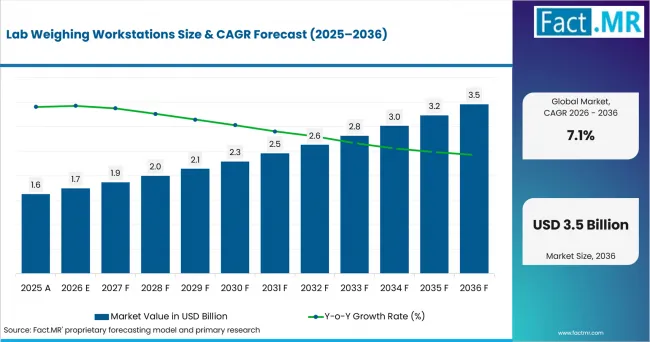
Lab Weighing Workstations Value Analysis | Source: Fact.MR
What are the defining numbers behind Lab Weighing Workstations Market growth?
USD 1.8 billion absolute opportunity is expected between 2026 and 2036.
- Demand Drivers in the Market
- Pharma quality teams need balance stations that combine draft protection, minimum-weight control and audit-ready records for batch release work.
- The FDA reported 13,711 registered drug establishments in FY2025. FDA cGMP requirements also emphasize controlled weighing and measuring operations and appropriate calibration of weighing equipment in regulated drug-manufacturing and laboratory activities.
- The Office for Life Sciences estimated that 7,320 companies operated in the UK life sciences industry in 2023/2024.
- Chemical laboratories need semi-contained weighing areas for powders and volatile ingredients where operator handling and sample loss affect results.
- Research teams need compact microbalance workstations as smaller sample masses raise sensitivity requirements in formulation and environmental testing.
- Key Segments Analyzed
- By Workstation Type: Analytical balance station is expected to hold 35.0% share in 2026 because it fits routine high-precision work across quality-control benches.
- By Automation: Manual digital workflow is projected to account for 38.0% share in 2026 due to lower installation effort and easier validation steps.
- By Industry: Pharma is anticipated to capture 31.0% share in 2026 owing to audited weighing, batch records and compendial repeatability checks.
- By Capacity: 100-500 g is estimated to represent 31.0% share in 2026 since the range covers routine analytical samples and prepared mixtures.
- Analyst Opinion at Fact.MR
- Shambhu Nath Jha, Principal Consultant at Fact.MR, states, "Weighing workstations are becoming compliance tools, beyond balance accessories. Demand is expected to rise where laboratories must prove who weighed a sample, which method was used and whether the balance stayed within tolerance. Suppliers that combine precision hardware, enclosure design, software records and service documentation are better placed for regulated accounts."
- Strategic Implications
- Balance manufacturers should bundle draft shields, ionizers, barcode input and validated software so laboratories receive a ready workstation package.
- Laboratory distributors should train sales teams to map capacity, readability and containment needs before recommending workstation configurations.
- Quality leaders should align workstation purchases with calibration plans, user permissions and method validation requirements.
- Service teams should link preventive maintenance with minimum-weight checks because regulated laboratories evaluate downtime and audit readiness together.
The UK is projected to post 8.4% CAGR through 2036, supported by life-science R&D. The USA is expected to record 8.1% CAGR as regulated drug and device labs use documented weighing. Japan is anticipated to advance at 7.8% CAGR owing to pharmaceutical production. Germany is estimated to hold 7.5% CAGR through chemical-pharma laboratories. Switzerland is forecast to reach 6.2% CAGR as authorization activity supports controlled weighing.
How does the Lab Weighing Workstations Market break down by segment?
Analytical balance station leads Workstation Type at 35.0%; manual digital workflow leads Automation at 38.0%.
Which Workstation Type dominates?
Analytical balance station is expected to hold 35.0% share in 2026.
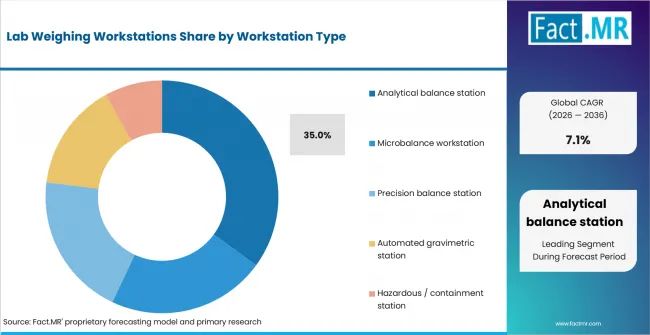
Lab Weighing Workstations Analysis By Workstation Type | Source: Fact.MR
Analytical balance stations are expected to lead workstation type due to daily quality-control weighing where readability and repeatability are central. Microbalance workstations serve low-mass testing where drafts and static affect results. Precision balance stations support broader bench use. Supplier activity around newer analytical balances supports smaller sample workflows and stronger repeatability control.
What leads the Automation segment?
Manual digital workflow is projected to account for 38.0% share in 2026.
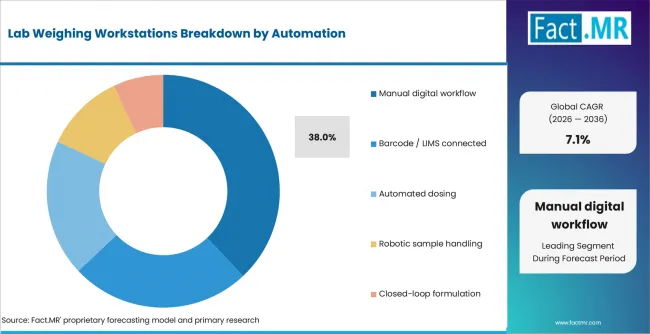
Lab Weighing Workstations Analysis By Automation | Source: Fact.MR
Manual digital workflow is projected to lead automation because many labs want electronic weighing records before robotic handling. Barcode and LIMS-connected systems reduce transcription errors while preserving operator control. Automated dosing is used for repeated formulation and assay preparation. Sartorius presents Cubis II balance integration with STARLIMS, which aligns with connected weighing workflows.
How does Industry shape demand?
Pharma is anticipated to represent 31.0% share in 2026.
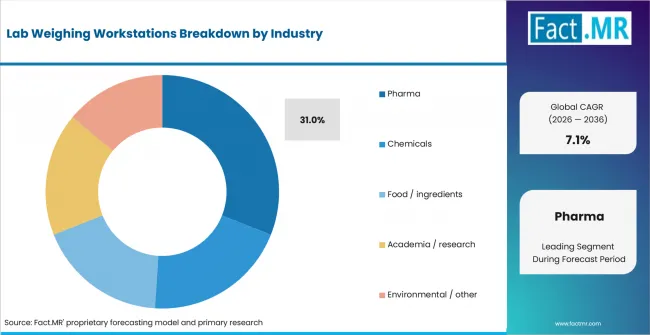
Lab Weighing Workstations Analysis By Industry | Source: Fact.MR
Pharma is anticipated to lead industry demand owing to batch release, API testing and documented sample preparation. Chemical laboratories use workstation balances for formulation checks. Food and ingredient laboratories rely on repeatable weighing during residue and moisture testing. Academia keeps demand active where funding supports instrument upgrades and shared records.
What supports the 100-500 g Capacity segment?
100-500 g is estimated to represent 31.0% share in 2026.
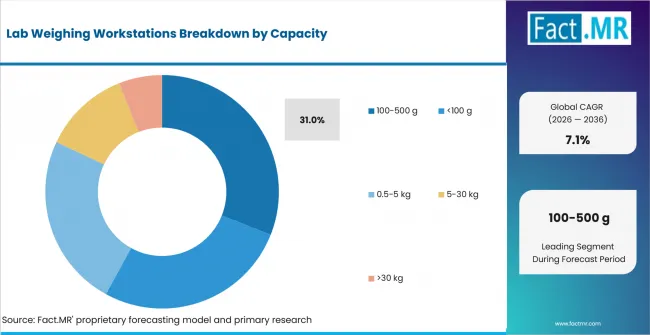
Lab Weighing Workstations Analysis By Capacity | Source: Fact.MR
The 100-500 g capacity band is estimated to lead capacity because it covers routine analytical and formulation tasks. Laboratories use this range for sample vessels, standards and prepared mixtures. The under 100 g range remains tied to microbalance tasks. Larger ranges serve bulkier preparation needs.
What is accelerating Lab Weighing Workstations Market adoption, and what is holding it back?
Regulated weighing drives it; validation cost restrains it.
Drivers Impact Analysis
| DRIVER | (~) % IMPACT ON CAGR | GEOGRAPHIC RELEVANCE | IMPACT TIMELINE |
|---|---|---|---|
| Pharma quality-control documentation | +1.4% | North America, Europe, Japan | Short term (<= 2 years) |
| Barcode and LIMS-connected weighing | +1.1% | Global | Medium term (2-4 years) |
| Automated dosing and sample preparation | +0.9% | USA, Germany, Switzerland | Medium term (2-4 years) |
| Microbalance use in small-sample testing | +0.6% | Japan, Western Europe | Long term (>= 4 years) |
| Containment for hazardous powders | +0.5% | Global | Short term (<= 2 years) |
Source: Fact.MR analysis. Updated Sep 10, 2026
Opportunity Impact Analysis
| OPPORTUNITY | (~) % IMPACT ON CAGR | GEOGRAPHIC RELEVANCE | IMPACT TIMELINE |
|---|---|---|---|
| Validated workstation bundles for pharma labs | +0.8% | USA, UK, Switzerland | Short term (<= 2 years) |
| Robotic gravimetric dosing in formulation | +0.7% | Japan, Germany, USA | Medium term (2-4 years) |
| Service plans for calibration and software | +0.5% | Global | Medium term (2-4 years) |
| Compact stations for research facilities | +0.4% | UK, Germany, Japan | Long term (>= 4 years) |
Source: Fact.MR analysis. Updated Sep 10, 2026
Restraints Impact Analysis
| RESTRAINT | (~) % IMPACT ON CAGR | GEOGRAPHIC RELEVANCE | IMPACT TIMELINE |
|---|---|---|---|
| Validation and data-integrity cost | -0.6% | USA, Europe, Japan | Short term (<= 2 years) |
| Sensitivity to vibration and airflow | -0.4% | Global | Medium term (2-4 years) |
| Compatibility with legacy LIMS | -0.3% | North America, Europe | Medium term (2-4 years) |
| Higher cost than stand-alone balances | -0.2% | Global | Long term (>= 4 years) |
Source: Fact.MR analysis. Updated Sep 10, 2026
Which countries are scaling the Lab Weighing Workstations Market through 2036?
- The country comparison spans 2.2 percentage points and forms three practical growth bands across the forecast period.
- The UK remains 0.3 percentage point above the USA through life-science R&D and regulated laboratory activity.
- The USA remains 0.3 percentage point above Japan as FDA-regulated establishments sustain documented weighing demand.
- Japan remains 0.3 percentage point above Germany due to pharmaceutical production and domestic precision-instrument capability.
- Germany remains 1.3 percentage points above Switzerland through R&D spending and chemical-pharma laboratory use.
- Switzerland closes the displayed range with high-value pharmaceutical laboratories and authorization activity.
Comparable CAGRs create different entry conditions due to funding, regulated manufacturing, service coverage and replacement cycles. Full report coverage includes North America, Latin America, Western Europe, Eastern Europe, East Asia, South Asia & Pacific, Middle East & Africa.
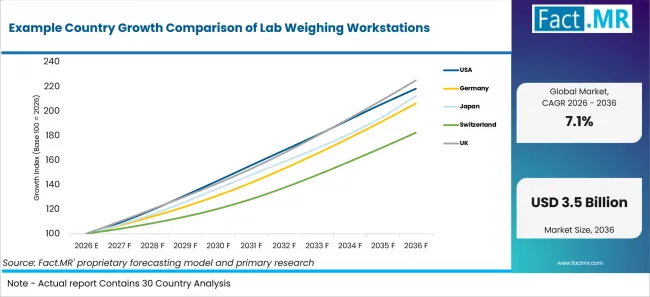
Example Country Growth Comparison Of Lab Weighing Workstations | Source: Fact.MR
| Country | CAGR |
|---|---|
| UK | 8.4% |
| USA | 8.1% |
| Japan | 7.8% |
| Germany | 7.5% |
| Switzerland | 6.2% |
Source: Fact.MR analysis. Updated Sep 10, 2026
What supports the UK outlook?
8.4% CAGR, supported by life-science laboratory spending and public R&D.
The UK market to post 8.4% CAGR through 2036. The Office for National Statistics reported that UK government net R&D expenditure reached GBP 20.4 billion in 2024. This public R&D environment as contextual support for laboratory instrument activity and digital weighing workflows.
How is the USA scaling workstation demand?
8.1% CAGR, driven by regulated establishments and quality inspections.
The USA market to record 8.1% CAGR through 2036. FDA reported 3,732 inspections of domestic and foreign drug and device establishments in FY2025. This regulatory oversight as contextual support for laboratory workflows emphasizing repeatable performance and audit-ready records.
What supports Japan adoption?
7.8% CAGR, led by pharmaceutical production and precision-instrument capability.
Japan to advance at 7.8% CAGR through 2036. The Ministry of Health, Labour and Welfare reported domestic pharmaceutical production of JPY 10.2485 trillion in 2024. The scale of pharmaceutical production as contextual support for laboratory weighing activity involving minimum-weight performance and controlled workflows.
What underpins Germany growth?
7.5% CAGR, supported by R&D spending and chemical-pharma laboratories.
Germany to record 7.5% CAGR through 2036. Destatis reported that German R&D expenditure reached EUR 137.1 billion in 2024. This R&D base as contextual support for continued investment in analytical laboratory infrastructure.
How does Switzerland perform?
6.2% CAGR, driven by authorization activity and high-value pharmaceutical laboratories.
Switzerland to record 6.2% CAGR through 2036. Swissmedic reported that 40 human medicinal products with new active substances were authorized for the Swiss market in 2025. This authorization activity as contextual evidence of an active regulated pharmaceutical environment.
Who leads the Lab Weighing Workstations Market?
Mettler Toledo and Sartorius are profiled for laboratory weighing systems with software, connectivity and automation options, while Shimadzu and A&D Company are also profiled for precision laboratory weighing.
Mettler Toledo participates through analytical balances, automated powder and liquid dosing systems, and LabX laboratory software for instrument-data management and workflow automation. Its 2025 annual filing includes laboratory balances within its laboratory instruments portfolio and identifies LabX as a platform for managing and analyzing data generated by balances and other laboratory instruments.
Sartorius supports laboratory weighing through Cubis II balances, configurable Pharma software packages and LIMS/ELN connectivity. Cubis II provides capabilities including user management, electronic signatures, audit trails, data exchange and centralized record handling that support data integrity and regulated laboratory workflows.
Shimadzu, A&D Company, and RADWAG also maintain active laboratory-weighing portfolios spanning analytical, micro, semi-micro or precision balances. Across these suppliers, product portfolios emphasize weighing and minimum-weight performance, draft-shield and balance design, instrument connectivity, data integrity, workflow software and compliance-oriented functionality.
Which companies are the key providers?
The profiled company set comprises Mettler Toledo, Sartorius, Shimadzu, A&D Company, Radwag.
- Mettler Toledo
- Sartorius
- Shimadzu
- A&D Company
- Radwag
Bibliography
- U.S. Food and Drug Administration. (2026). Annual report on inspections of establishments: FY 2025 [Report to Congress].
- U.S. Food and Drug Administration, Center for Drug Evaluation and Research, Office of Pharmaceutical Quality. (2026). Report on the state of pharmaceutical quality: FY2025.
- Office for Life Sciences, Department for Science, Innovation and Technology, Department of Health and Social Care, & Department for Business and Trade. (2025, October 2). Bioscience and health technology sector statistics 2023 to 2024.
- Office for National Statistics. (2026, April 17). Research and development expenditure by the UK government: 2024.
- Shimadzu Corporation. (2025, November 10). Supporting pharmacopoeia repeatability tests, with a class-leading minimum weight of 13 mg: Simultaneous release of 8 models of AP W-AD ex and AP W ex analytical balances.
- Statistisches Bundesamt (Destatis). (2026, March 27). 3,8 % mehr Ausgaben für Forschung und Entwicklung im Jahr 2024.
- Swiss Federal Statistical Office. (2025, June 26). Almost CHF 26 billion invested in R&D in Switzerland in 2023.
- Swissmedic. (2026, February 17). Authorisations of human medicinal products with a new active substance and additional indications 2025.
- Mettler-Toledo International Inc. (2026, February 6). Annual report on Form 10-K for the fiscal year ended December 31, 2025 [Form 10-K]. U.S. Securities and Exchange Commission.
This Report Answers
- The report explains how workstation type and automation level shape laboratory weighing decisions.
- Segment analysis identifies analytical balance stations and manual digital workflows as the main share anchors.
- Country analysis examines the UK, USA, Japan, Germany and Switzerland across the forecast period.
- Competitive analysis reviews Mettler Toledo, Sartorius, Shimadzu, A&D Company, Radwag.
- Application analysis assesses pharma, chemical, food and research laboratories where weighing records influence quality decisions.
- Technology assessment covers barcode links, LIMS integration, automated dosing, robotic sample handling and containment stations.
- The forecast uses primary interviews, official statistics review, provider checks and product-portfolio mapping.
What does the Lab Weighing Workstations Market cover?
Analytical, microbalance, precision, automated gravimetric and containment stations used for controlled laboratory weighing.
The Lab Weighing Workstations Market covers integrated systems that combine a laboratory balance with enclosure, software, sample handling or documentation tools. These systems support accurate weighing in pharma, chemical, food, academic and environmental laboratories.
The assessment differs from the broader laboratory balance category because it focuses on workstation-level arrangements around the balance. Stand-alone bench balances enter the scope when they are configured with documentation, containment, barcode connection or automated dosing functions.
What is included in the scope?
Lab weighing workstation systems used in regulated, research and quality-control laboratories.
The scope includes analytical balance stations, microbalance workstations, precision balance stations, automated gravimetric stations and hazardous or containment stations. It covers manual digital workflows, barcode or LIMS-connected setups, automated dosing, robotic sample handling and closed-loop formulation.
What is excluded from the scope?
Stand-alone industrial scales and general laboratory furniture are outside the scope.
The scope excludes raw balance components, industrial floor scales, retail scales and general laboratory furniture when these items are sold alone. General LIMS software and broad test and measurement equipment remain separate unless the product is bundled directly with weighing workflow control.
How Was the Analysis Built?
The analysis draws on 120+ sources, 35+ company portfolios, 25+ countries, and more than 20 industry interviews.
- Primary Research: Primary research includes discussions with manufacturers, service providers, technology developers, distributors, end users, and subject-matter experts. These conversations examine purchasing priorities, product adoption, operational challenges, approval requirements, competitive positioning, and the factors that influence wider market acceptance.
- Desk Research: Desk research covers government statistics, regulatory publications, company filings, trade data, technical studies, industry associations, standards, public policy, and other authoritative sources. Every source used in the analysis is documented in the bibliography.
- Market Sizing and Forecasting: Market estimates combine historical performance, demand indicators, pricing and volume trends, segment shares, company participation, country-level growth, adoption patterns, investment activity, and barriers to market expansion.
- Data Validation and Update Cycle: Findings are validated by comparing primary interviews with public data, company activity, regulatory changes, trade patterns, and industry developments. Regular updates review new product launches, capacity changes, partnerships, approvals, and shifts in commercial adoption.
Segmentation
What is the report's scope and coverage?
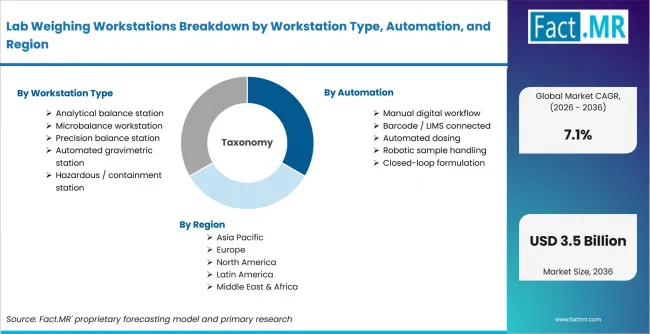
Lab Weighing Workstations Breakdown By Workstation Type, Automation, And Region | Source: Fact.MR
| Attribute | Details |
|---|---|
| Quantitative Units | USD billion |
| Market Definition | Integrated laboratory weighing systems that combine balances with enclosure, software, sample handling, connectivity or documentation tools for controlled bench weighing. |
| Workstation Type | Analytical balance station; Microbalance workstation; Precision balance station; Automated gravimetric station; Hazardous or containment station |
| Automation | Manual digital workflow; Barcode and LIMS connected; Automated dosing; Robotic sample handling; Closed-loop formulation |
| Industry | Pharma; Chemicals; Food and ingredients; Academia and research; Environmental and other |
| Capacity | <100 g; 100-500 g; 0.5-5 kg; 5-30 kg; >30 kg |
| Regions Covered | North America; Latin America; Western Europe; Eastern Europe; East Asia; South Asia & Pacific; Middle East & Africa |
| Countries Covered | USA; Germany; Japan; Switzerland; UK |
| Key Companies Profiled | Mettler Toledo; Sartorius; Shimadzu; A&D Company; Radwag |
| Forecast Period | 2026 to 2036 |
| Approach | Hybrid top-down and bottom-up approach using workstation type mix, automation level, industry use, capacity range, country adoption and provider portfolio review. |
Source: Fact.MR analysis. Updated Sep 10, 2026
How is the market segmented?
-
By Workstation Type
- Analytical balance station
- Microbalance workstation
- Precision balance station
- Automated gravimetric station
- Hazardous or containment station
-
By Automation
- Manual digital workflow
- Barcode and LIMS connected
- Automated dosing
- Robotic sample handling
- Closed-loop formulation
-
By Industry
- Pharma
- Chemicals
- Food and ingredients
- Academia and research
- Environmental and other
-
By Capacity
- <100 g
- 100-500 g
- 0.5-5 kg
- 5-30 kg
- >30 kg
-
By Region
- North America
- Latin America
- Western Europe
- Eastern Europe
- East Asia
- South Asia & Pacific
- Middle East & Africa
Frequently Asked Questions
How big is the Lab Weighing Workstations Market in 2026?
What is the CAGR of the Lab Weighing Workstations Market from 2026 to 2036?
Which workstation type leads the Lab Weighing Workstations Market?
Which automation type leads the Lab Weighing Workstations Market?
Who are the leading companies in the Lab Weighing Workstations Market?
Who worked on this report


Preview the report firsthand - request a free sample
Free SampleGet the brochure for pricing and purchase details
Download PDF