- Base Value(2025): 400.0 Mn
- Estimated Value(2026): 428.8 Mn
- Forecast Value (2036): 859.4 Mn
- CAGR (2026 - 2036): 7.2%
Wide Beam Sensors Market Overview, Growth Outlook, and Forecast by Fact.MR
- In 2025, the wide beam sensors market was valued at USD 400.0 million.
- Based on market estimates, demand for wide beam sensors is projected to grow to USD 428.8 million in 2026 and USD 859.4 million by 2036.
- The market is expected to expand at a CAGR of 7.2% during the forecast period.
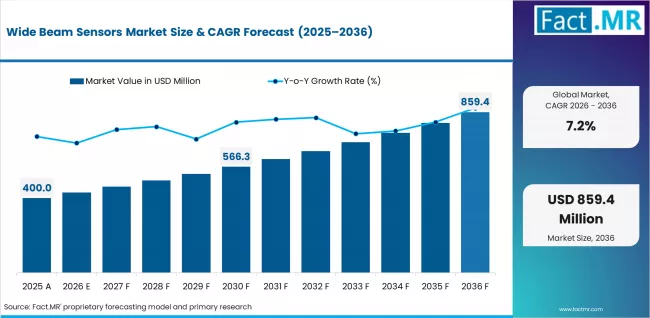
Wide Beam Sensors Market Value Analysis | Source: Fact.MR
Summary of the Wide Beam Sensors Market
- Market Snapshot
- In 2025, the global wide beam sensors market was valued at USD 400.0 million.
- The market is projected to grow from USD 428.8 million in 2026 to USD 859.4 million by 2036.
- The wide beam sensors market is anticipated to expand at a CAGR of 7.2% during the forecast period.
- The market is expected to create an absolute dollar opportunity of USD 430.6 million between 2026 and 2036.
- Photoelectric Sensors are expected to dominate the market by type in 2026, accounting for nearly 39.6% share, supported by strong adoption across industrial automation and object detection applications.
- India (10.4% CAGR), Japan (9.3% CAGR), and China (9.0% CAGR) are projected to be the fastest-growing country-level markets during the forecast period, driven by rapid industrialization, robotics adoption, and expanding smart manufacturing investments.
- Demand and Growth Drivers
- Wide beam sensor adoption is being propelled by growth of industrial automation and intelligent manufacturing systems in the production plants.
- Increased utilization of robotics, automated conveyor systems, and material handling systems is boosting demand for further advanced object detection and motion sensing technology.
- The surge in wide beam sensor applications in automotive safety and robots navigation as well as vehicle assistance systems is driving the market.
- Increasing adoption of Industry 4.0 and connected factory solutions is driving the demand for intelligent sensing and real-time monitoring solutions.
- Advances in LiDAR, radar, infrared and photoelectric sensing technologies can achieve higher detection accuracy, sensing distance, robust operation, and energy saving.
- Increasing usage of presence sensing and motion detection applications across the world due to growing adoption of smart building systems and occupancy monitoring solutions.
- Product and Segment View
- Photoelectric Sensors in the type segment hold the largest share of 39.6%, due to strong demand in industrial automation, conveyor monitoring, and object detection. Applications
- Ultrasonic Sensors have a 24.8% share, because of the growing usage in robotics, distance measurement, and warehouse automation. Systems
- End-Use Industry Industrial Automation contributes 30.6%, owing to increase in investments in smart factories, automated production systems, and materials handling systems.
- The increasing usage of advanced sensing systems in automobiles such as in parking assist and obstacle detection among others are supporting the automotive segment, which holds 25.4% of this market. Systems
- Object Detection is becoming more and more integrally involved in these applications, which account for 37.2% of the application segment, which is boosted by high demand in industrial automation, logistics, and smart manufacturing.
- Motion Detection holds 27.9% share, fueled by rising deployment in security systems, smart buildings, and automated operational systems.
- Geography and Competitive Outlook
- East Asia will hold a significant portion in the Wide Beam Sensors Market on the back of rapid industrial automation, growing robotics application, smart manufacturing infrastructure, and much more.
- The significant contributions of North America and Western Europe still remain owing to the investments in Industry 4.0, smart factory systems, automotive sensing technologies and integration of industrial robotics.
- Key market players: Omron Corporation, SICK AG, KEYENCE Corporation, Pepperl+Fuchs SE and Banner Engineering Corp.
- Analyst Opinion
- Shambhu Nath Jha, Principal Consultant at Fact.MR, says “The wide beam sensors market is increasingly driven by rapid industrial automation, smart manufacturing expansion, and rising demand for non-contact sensing technologies. Growth is being supported by increasing adoption of robotics, warehouse automation systems, advanced object detection solutions, and AI-enabled sensing technologies across industrial, automotive, and smart infrastructure applications.
Wide Beam Sensors Market— At a Glance
| Attribute | Details |
|---|---|
| Market Value 2025 | USD 400.0 Million |
| Market Value 2026 | USD 428.8 Million |
| Market Value 2036 | USD 859.4 Million |
| Absolute Dollar Opportunity | USD 430.6 Million |
| Total Growth | 100.42% |
| CAGR | 7.20% |
| Growth Multiple | 2.0x |
| Key Demand Theme | Rising industrial automation, smart manufacturing adoption, warehouse automation expansion, robotics integration, and increasing demand for non-contact sensing technologies |
| Leading Sensor Type | Photoelectric Sensors |
| Sensor Type Share | 39.60% |
| Leading Technology | Non-Contact Sensors |
| Technology Share | 75.20% |
| Leading Range Type | Short-Range Sensors |
| Range Share | 43.80% |
| Leading Application | Object Detection |
| Application Share | 37.20% |
| Leading End-Use Industry | Industrial Automation |
| End-Use Industry Share | 30.60% |
| Key Growth Regions | East Asia, South Asia & Pacific, North America |
| Key Companies | Omron Corporation, SICK AG, KEYENCE Corporation, Pepperl+Fuchs SE, Banner Engineering Corp., Balluff GmbH, Baumer Group, Panasonic Industry, Rockwell Automation Inc., Leuze Electronic GmbH + Co. KG |
| Segmentation by Type | Photoelectric Sensors, Ultrasonic Sensors, Infrared Sensors, Radar Sensors, LiDAR Sensors |
| Segmentation by Technology | Contact Sensors, Non-Contact Sensors |
| Segmentation by Range | Short-Range Sensors, Medium-Range Sensors, Long-Range Sensors |
| Segmentation by Application | Object Detection, Motion Detection, Distance Measurement, Presence Sensing |
| Segmentation by End-Use Industry | Industrial Automation, Automotive, Consumer Electronics, Logistics & Warehousing, Aerospace & Defense, Healthcare, Building Automation & Security |
| Segmentation by Region | North America, Latin America, East Asia, South Asia & Pacific, Western Europe, Eastern Europe, Middle East & Africa |
Source: Fact.MR analysis. Updated May 9, 2026
Key Growth Drivers, Constraints, and Opportunities
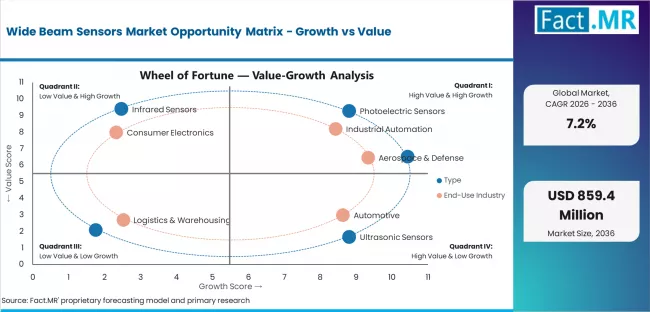
Wide Beam Sensors Market Opportunity Matrix Growth Vs Value | Source: Fact.MR
Key Factors Driving Growth
- The adoption of industrial automation, robotics, and smart manufacturing systems is proliferating among production and warehouse environments, which, in turn, is propelling the demand for wide beam sensors.
- The increasing focus towards enhancing operational efficiency, minimizing downtime, and improving accuracy of object detection is propelling the adoption of non-contact sensing technology.
- The increasing integration of the wide beam sensor into AI-based monitoring systems, industrial IoT platforms, AGVs, automated conveyor systems, etc., is driving the demand for a connected industrial infrastructure.
- Growing preference towards accurate and more reliable broad-area sensing resource in automotive, logistics, food processing and electronic manufacturing sectors is boosting the growth of the market.
- Innovations in photoelectric, radar, and LiDAR sensing technologies facilitated enhancements in sensing range, detection accuracy, and operating environment applicability for a wide range of industrial fields.
- Smart warehouses and automated material handling systems are expanding, bringing about strong demand for wide beam sensor in object tracking and positioning, as well as motion detection, applications globally.
| Growth Driver | Demand Impact | Time Horizon | Key Impact Area | Fact.MR Insight |
|---|---|---|---|---|
| Rising adoption of industrial automation and smart manufacturing systems | High | Short–Mid Term | Factory automation & operational efficiency | Increasing deployment of robotics, automated conveyor systems, and smart production lines is driving strong demand for wide beam sensing technologies across manufacturing facilities. |
| Growing demand for non-contact sensing and real-time monitoring | High | Short–Mid Term | Detection accuracy & process optimization | Industries are increasingly adopting non-contact sensors to improve operational reliability, reduce maintenance requirements, and enhance real-time object detection capabilities. |
| Expansion of warehouse automation and smart logistics infrastructure | High | Short–Mid Term | Material handling & warehouse automation | Rapid growth in e-commerce fulfillment centers and automated warehousing is accelerating adoption of wide beam sensors for pallet detection, AGV navigation, and conveyor monitoring applications. |
| Advancements in LiDAR, radar, and photoelectric sensing technologies | Medium-High | Mid–Long Term | Technology innovation & sensing performance | Integration of advanced sensing technologies is improving detection range, object recognition accuracy, environmental adaptability, and automation efficiency across industrial applications. |
Source: Fact.MR analysis. Updated May 9, 2026
Key Market Constraints
- The upfront cost to deploy and integrate sophisticated wide beam sensing systems may be prohibitive for small to medium-sized manufacturers, hindering adoption.
- Performance limitations in highly reflective, high temperature, or complicated industrial environments may pose challenges to operation for some sensing technologies.
- The penetration of cost-effective traditional sensing solutions such as simple proximity or diffuse sensor may be hindered in price sensitive market.
- The complexity of integration with current infrastructure in industrial automation, robotic system, and Industrial IoT can lead to longer implementation periods and higher operation costs.
Key Opportunity Areas
- The development of smart factories, warehouse automation and Industry 4.0 infrastructure is driving a robust demand for high-end non-contact sensing solutions.
- Widespread adoption of AI-based industrial monitoring and predictive maintenance systems is contributing to the growth of intelligent sensing and real-time detection solutions.
- Increasing investments in automotive safety systems, advanced driver assistance systems (ADAS) and smart mobility solutions are providing opportunities for radar- and LiDAR based wide beam sensors.
Segment-wise Analysis of the Wide Beam Sensors Market
- Photoelectric Sensors account for 39.6% share of the type segment in 2026, driven by strong adoption across industrial automation, conveyor monitoring, object detection, and material handling applications due to their cost-efficiency and reliable detection performance.
- Non-Contact Sensors hold 75.2% share of the technology segment in 2026, supported by increasing demand for touchless sensing, reduced maintenance requirements, and rising deployment in robotics, smart manufacturing, and warehouse automation systems.
- Short-Range Sensors represent 43.8% share of the range segment in 2026, owing to their widespread usage in factory automation, proximity sensing, conveyor systems, and industrial monitoring applications.
Wide Beam Sensors Market is divided by type, technology, range, application, end-use industry, and region.
Which Type Segment Topped the Wide Beam Sensors Market?
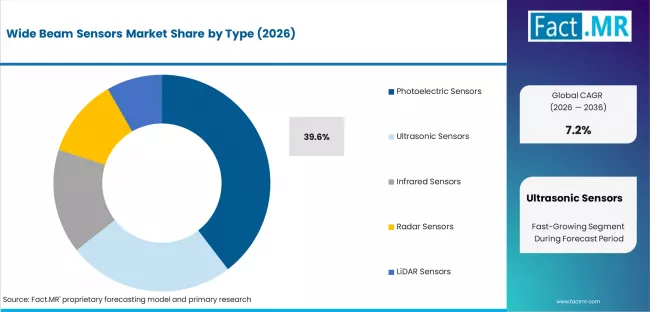
Wide Beam Sensors Market Analysis By Type | Source: Fact.MR
Photoelectric Sensors are expected to hold the largest share in the Wide Beam Sensors Market by 2026, with 39.6% of the market share. This domination can be attributed to their extensive application in industrial automation, conveyor monitoring, object detection, and material handling, among others, as they offer reliable performance, cost-efficiency, and easy integration.
Which Technology Segment Accounts for the Highest Share in the Market?
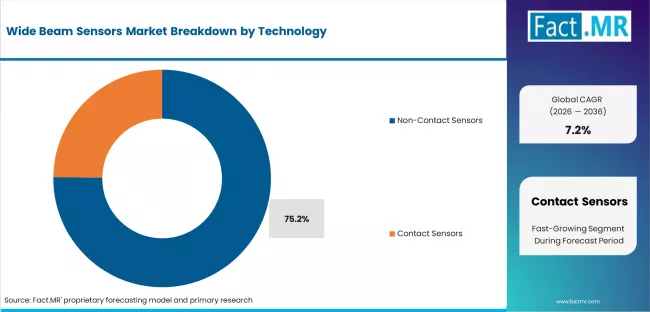
Wide Beam Sensors Market Analysis By Technology | Source: Fact.MR
Non-Contact Sensors are predicted to dominate the technology segment, accounting for 75.2% share in 2026. Their dominance is because of rising demand for touch-free sensing, low maintenance needs, high efficiency of operation, and increasing applications in robot, smart factory, and warehouse automation system.
Which Range Segment Leads the Market?
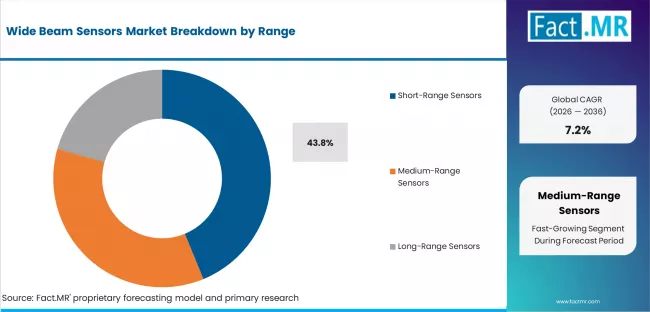
Wide Beam Sensors Market Analysis By Range | Source: Fact.MR
Short-Range Sensors are expected to hold the largest market share of 43.8%, in 2026 owing to the wide usage of these sensors in factory automation, conveyor systems, proximity sensing, and industrial object detection.
Which Application Segment Holds the Largest Share in the Market?
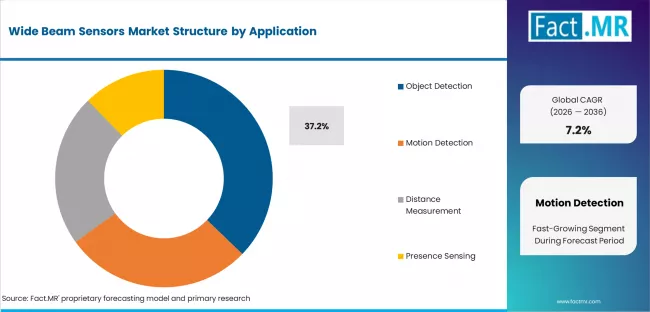
Wide Beam Sensors Market Analysis By Application | Source: Fact.MR
Object Detection is expected to be the leading application segment, accounting for 37.2% share in 2026. This is supported by rising demand for automated monitoring, conveyor tracking, obstacle detection, and real-time sensing across industrial and logistics operations.
Which End-Use Industry Segment Holds the Highest Share in the Market?
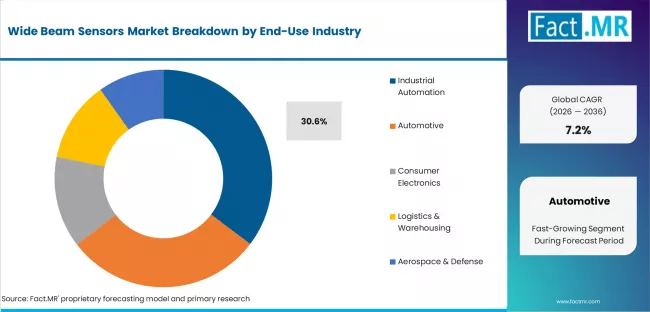
Wide Beam Sensors Market Analysis By End Use Industry | Source: Fact.MR
Industrial Automation leads the market with a 30.6% share in 2026, supported by increasing investments in smart manufacturing, robotics integration, automated production systems, and Industry 4.0 infrastructure globally.
Regional Outlook Across Key Markets
- India is projected to grow at 10.4%, driven by rapid industrial automation, smart manufacturing expansion, warehouse modernization, and increasing robotics deployment.
- The United States is expected to grow at 6.1%, supported by strong adoption of Industry 4.0 technologies, factory automation systems, and smart warehouse infrastructure.
- China is forecast to grow at 9.0%, fueled by rising manufacturing automation, robotics integration, and investments in smart factory infrastructure.
- Germany is expected to grow at 4.3%, driven by continued investments in industrial automation, automotive manufacturing, and Industry 4.0 implementation.
.webp "Top Country Growth Comparison Wide Beam Sensors Market Cagr (2026 2036)")
Top Country Growth Comparison Wide Beam Sensors Market Cagr (2026 2036) | Source: Fact.MR
CAGR Table
| Country | CAGR (%) |
|---|---|
| India | 10.4% |
| Japan | 9.3% |
| China | 9.0% |
| South Korea | 6.5% |
| United States | 6.1% |
| United Kingdom | 4.8% |
| Germany | 4.3% |
Source: Fact.MR analysis. Updated May 9, 2026
Source: Fact.MR (FMR) analysis, based on proprietary forecasting model and primary research.
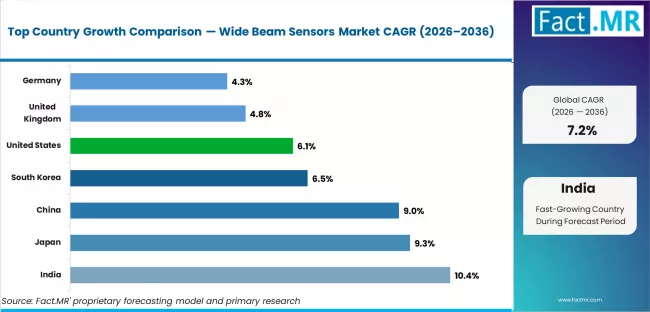
Wide Beam Sensors Market Cagr Analysis By Country | Source: Fact.MR
North America – The Advanced Industrial Automation & Smart Manufacturing Hub
North America is a technologically advanced wide beam sensor market due to higher penetration of Industry 4.0, warehouse automation, robotics integration and smart manufacturing systems. Prominent sensor suppliers are working on AI-based sensing, non-contact monitoring and high-accuracy industrial automation solutions. The focus is on operational efficiency, connected factory infrastructure, and intelligent industrial monitoring systems in the region.
- U.S.: Demand for wide beam sensors in the U.S. is projected to rise at 6.1% CAGR through 2036.
Western Europe – The Precision Engineering & Industrial Automation Market
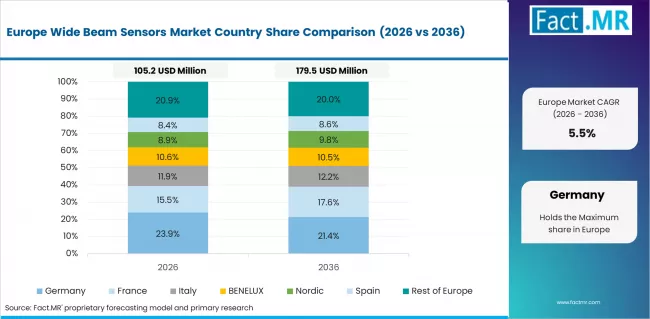
Wide Beam Sensors Market Europe Country Market Share Analysis, 2026 & 2036 | Source: Fact.MR
Western Europe is a mature industrial automation market where demand is supported by advanced manufacturing infrastructure, automotive automation, and stringent industrial safety standards. Companies are emphasizing energy-efficient sensing systems, precision automation technologies, and Industry 4.0 integration across manufacturing facilities.
- Germany: Demand for wide beam sensors in Germany is projected to rise at 4.3% CAGR through 2036.
- U.K.: Demand for wide beam sensors in the U.K. is projected to rise at 4.8% CAGR through 2036.
East Asia – The Smart Manufacturing & Robotics Powerhouse
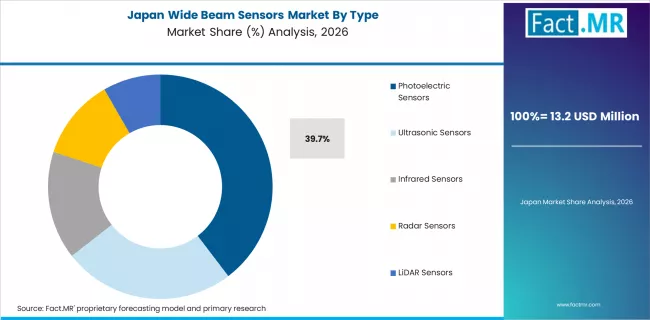
Wide Beam Sensors Market Japan Market Share Analysis By Type | Source: Fact.MR
East Asia is a major production and industrial automation center, supported by strong electronics manufacturing, robotics deployment, automotive production, and smart factory investments. Companies are expanding advanced sensing capabilities and industrial automation infrastructure to support high-volume manufacturing operations.
- China: Demand for wide beam sensors in China is projected to rise at 9.0% CAGR through 2036.
- Japan: Demand for wide beam sensors in Japan is projected to rise at 9.3% CAGR through 2036.
South Asia & Pacific – The Fastest-Growing Industrial Automation Market
South Asia & Pacific is emerging as the fastest-growing regional market due to rapid industrialization, expanding warehouse automation, rising smart manufacturing investments, and increasing adoption of robotics technologies. Sensor manufacturers are strengthening regional distribution and industrial automation partnerships to address growing demand.
- India: Demand for wide beam sensors in India is projected to rise at 10.4% CAGR through 2036.
Latin America – The Emerging Manufacturing & Logistics Automation Market
Latin America represents a developing industrial automation market supported by increasing manufacturing modernization, warehouse infrastructure development, and growing adoption of automation technologies across logistics and industrial sectors. Companies are expanding regional partnerships and automation capabilities to strengthen market penetration.
- Brazil: Demand for wide beam sensors in Brazil is projected to witness steady growth through 2036, supported by increasing industrial automation and logistics modernization activities.
Middle East & Africa – The Expanding Smart Infrastructure & Industrial Development Zone
The Middle East & Africa is an emerging market benefiting from increasing investments in industrial infrastructure, logistics modernization, and smart building technologies. Growth in industrial automation projects and warehouse development is creating new opportunities for wide beam sensing solutions across manufacturing and commercial sectors.
- KSA: Demand for wide beam sensors in KSA is projected to experience stable growth through 2036, driven by rising investments in industrial diversification, logistics infrastructure, and smart manufacturing initiatives.
Fact.MR’s analysis of the Wide Beam Sensors Market provides a comprehensive regional outlook covering North America, Western Europe, East Asia, South Asia & Pacific, Latin America, and Middle East & Africa. Readers can access country-wise insights, industrial automation trends, sensing technology adoption patterns, and demand dynamics shaping both mature and emerging industrial sensing markets.
Competitive Benchmarking and Company Positioning
Leading Companies Shaping the Wide Beam Sensors Market
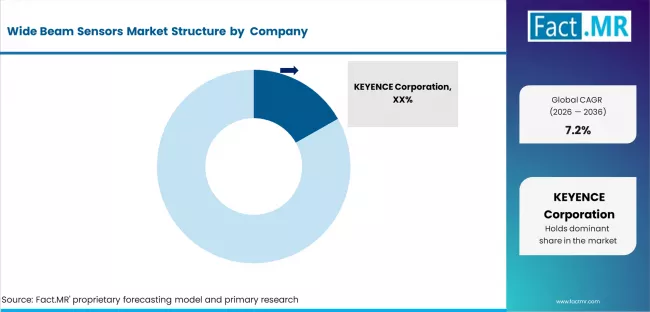
Wide Beam Sensors Market Analysis By Company | Source: Fact.MR
The wide beam sensors market is moderately fragmented, led by KEYENCE Corporation, SICK AG, Omron Corporation, Pepperl+Fuchs SE, and Banner Engineering Corp. Competition is driven by sensing accuracy, detection range, non-contact sensing capabilities, industrial durability, and smart automation integration. Leading companies maintain strong positions through advanced industrial automation portfolios, global distribution networks, and partnerships across manufacturing, automotive, logistics, and robotics sectors. Market participants are increasingly focusing on AI-enabled sensing, Industrial IoT integration, LiDAR and radar technologies, and high-speed object detection systems. Regional manufacturers compete through customized sensing solutions, competitive pricing, and application-specific automation products targeting SMEs and emerging industrial markets. Vendors offering advanced industrial monitoring and robotics-compatible sensing solutions continue to maintain premium market positioning globally.
Recent Industry Developments
- Banner Engineering Enhances Reliable Package Detection with B25 Wide Beam Sensor (2025)
- Banner Engineering highlighted reliable package detection capabilities using its B25 Wide Beam Sensor for conveyor systems, logistics automation, and warehouse operations. The solution is designed to improve object detection reliability, reduce missed package detection, and enhance operational efficiency in high-speed material handling and fulfillment environments.
- SICK and Endress+Hauser Launch Strategic Partnership for Process Automation (2025)
- SICK AG and Endress+Hauser announced a strategic partnership focused on advancing industrial process automation and smart sensing technologies. The collaboration aims to strengthen industrial sensing capabilities, improve process monitoring solutions, and support automation efficiency across manufacturing and industrial operations.
- KEYENCE Launches GL-V Series Small & Robust Safety Light Curtains (2025)
- KEYENCE introduced the GL-V Series Safety Light Curtains designed for compact industrial safety and wide-area sensing applications. The solution enhances machine safety, object detection accuracy, and operational reliability while supporting flexible deployment across industrial automation and manufacturing environments.
- OMRON and Cognizant Partner to Accelerate Smart Manufacturing Integration (2025)
- OMRON and Cognizant partnered to deliver integrated IT-OT manufacturing solutions focused on smart factory transformation and industrial automation optimization. The collaboration supports connected manufacturing systems, Industrial IoT integration, and intelligent sensing infrastructure for advanced production environments.
- Pepperl+Fuchs Showcases Advanced Industrial Sensing Solutions at SPS 2025 (2025)
- Pepperl+Fuchs showcased advanced industrial sensing and automation technologies at SPS 2025, including retroreflective area sensors and object detection solutions for smart manufacturing environments. The company emphasized industrial automation, non-contact sensing, and intelligent factory integration technologies supporting next-generation manufacturing systems.
Leading Companies Shaping the Wide Beam Sensors Market
- Omron Corporation
- SICK AG
- KEYENCE Corporation
- Pepperl+Fuchs SE
- Banner Engineering Corp.
- Balluff GmbH
- Baumer Group
- Panasonic Industry
- Rockwell Automation Inc.
- Leuze Electronic GmbH + Co. KG
Sources and Research References
- [1] Banner Engineering, “Reliable Package Detection with the B25 Wide Beam Sensor”, June 2025
- [2] SICK AG, “SICK and Endress+Hauser Start Strategic Partnership for Process Automation”, January 2025
- [3] KEYENCE Corporation, “Small & Robust Safety Light Curtain - GL-V Series”, June 2025
- [4] OMRON Corporation & Cognizant, “OMRON and Cognizant Partner to Revolutionize Manufacturing with Unique One-Stop IT-OT Integration”, April 2025
- [5] Pepperl+Fuchs SE, “Pepperl+Fuchs at SPS 2025—Bringing Automation to Life”, October 2025
Wide Beam Sensors Market Definition
Wide beam sensors market mainly includes sensing devices engineered to sense objects, motion, distance, presence within a wide area of detection through various technologies such as photoelectric, ultrasonic, infrared, radar, and LiDAR sensing. These sensors are mainly applied to non-contact sensing and monitoring in industry automation, automotive, robotics, warehouse automation, intelligent building and security. Wide beam sensors can enhance the workflow, detect level, automation performance and real time monitoring in all areas of production, logistics, automotive, and smart infrastructures.
Wide Beam Sensors Market Inclusions
This study analyzes the worldwide and regional market size of wide beam sensors, providing values for the years 2026–2036. The study has segmented the market by type, technology, range, application, and end-use industry. Further, the report includes pricing analysis, technology trends, regional growth projections, adoption trends in industrial automation and smart sensing systems, and competitive landscaping of prominent wide beam sensor manufacturers within key industrial & automotive applications.
Wide Beam Sensors Market Exclusions
The scope does not cover exotic machine vision systems, advanced imaging systems, and stand-alone industrial automation software that does not have direct ties to the wide beam sensing functions. Report Scope: The report does not consider the traditional narrow-beam sensors and consumer motion detectors. Furthermore, equipment for manufacturing semiconductors, stand-alone control systems and aftermarket sensor integration services are not covered, unless they relate specifically to the deployment of the wide beam sensors. This research is concentrated on wide scop-area non-contact sensing methods for industrial automation, object detection, motion sensing, distance estimation, and presence detecting applications.
Wide Beam Sensors Market Research Methodology
- Primary Research
- Interviews with wide beam sensor manufacturers, industrial automation providers, system integrators, distributors and end users in the industrial automation, automotive, logistics, robotics and smart infrastructure sectors were held to understand demand trends and technology adoption in real time.
- Desk Research
- Market size, technology trends, and the competitive environment were confirmed with analysis of company 10-K filings, earnings and investor presentations, industrial automation journals, sensor industry databases, trade organization reports, and other sensing technology publicly available information.
- Market-Sizing and Forecasting
- Market estimation and forecasting was carried out using a combination of bottom-up (company revenues, product portfolio analysis, pricing trends, and shipment estimates) and top-down (industrial sensors market benchmarks, automation industry trends, and regional manufacturing growth trends) analyses.
- Data Validation and Update Cycle
- All market estimates and forecast data were triangulated through expert interviews and periodically updated based on industrial automation trends, sensing technology advancements, robotics adoption, and macroeconomic factors influencing the global sensors industry.
Segmentation
Scope of Analysis
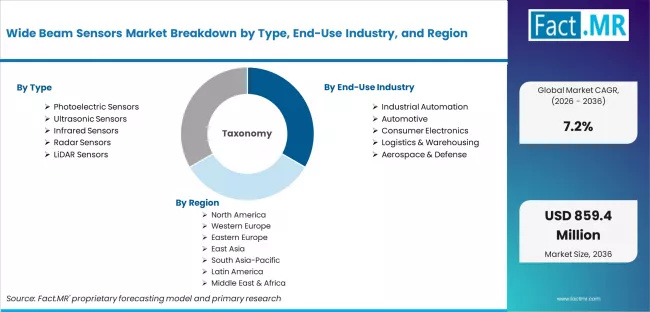
Wide Beam Sensors Market Breakdown By Type, End Use Industry, And Region | Source: Fact.MR
Parameter |
Details |
|---|---|
| Quantitative Units | USD 400.0 Million (2025) to USD 859.4 Million (2036), at a CAGR of 7.2% |
| Market Definition | The Wide Beam Sensors Market covers sensing technologies designed for broad-area object detection, motion sensing, distance measurement, and presence monitoring across industrial automation, automotive, logistics, robotics, smart buildings, and manufacturing applications. These systems include photoelectric, ultrasonic, infrared, radar, and LiDAR sensing technologies integrated with industrial automation platforms, robotics systems, conveyor monitoring systems, AGVs, and Industrial IoT infrastructure to improve operational efficiency, real-time monitoring, and smart manufacturing capabilities. |
| Regions Covered | North America, Eastern Europe, Western Europe, East Asia, South Asia & Pacific, Latin America, Middle East & Africa |
| Countries Covered | USA, Canada, UK, Germany, China, Japan, India, South Korea, Brazil, Saudi Arabia, UAE, and 20+ countries |
| Key Companies | KEYENCE Corporation, SICK AG, Omron Corporation, Pepperl+Fuchs SE, Banner Engineering Corp., Balluff GmbH, Baumer Group, Panasonic Industry, Rockwell Automation Inc., Leuze Electronic GmbH + Co. KG |
| Forecast Period | 2026 to 2036 |
| Approach | Hybrid demand-side and top-down methodology based on industrial automation growth, smart manufacturing adoption, warehouse automation expansion, robotics deployment, and increasing demand for non-contact sensing technologies, validated through primary interviews with sensor manufacturers, industrial automation providers, distributors, robotics integrators, logistics operators, and smart manufacturing solution providers across key regions. |
Source: Fact.MR analysis. Updated May 9, 2026
Analysis by Type, Technology, Range, Application, End-Use Industry, and Region
-
Wide Beam Sensors Market by Type
- Photoelectric Sensors
- Through-Beam Sensors
- Retro-Reflective Sensors
- Diffuse Reflective Sensors
- Ultrasonic Sensors
- Proximity Sensors
- Distance Measurement Sensors
- Level Detection Sensors
- Infrared Sensors
- Passive Infrared (PIR) Sensors
- Active Infrared Sensors
- Thermal Infrared Sensors
- Radar Sensors
- Short-Range Radar
- Medium-Range Radar
- Long-Range Radar
- LiDAR Sensors
- Mechanical LiDAR
- Solid-State LiDAR
- Flash LiDAR
- Photoelectric Sensors
-
Wide Beam Sensors Market by Technology
- Contact Sensors
- Non-Contact Sensors
-
Wide Beam Sensors Market by Range
- Short-Range Sensors
- Medium-Range Sensors
- Long-Range Sensors
-
Wide Beam Sensors Market by Application
- Object Detection
- Conveyor Monitoring
- Product Counting
- Obstacle Detection
- Motion Detection
- Security Systems
- Smart Lighting
- Automatic Doors
- Distance Measurement
- Position Tracking
- Robotics Navigation
- Vehicle Assistance
- Presence Sensing
- Occupancy Detection
- Human Presence Monitoring
- Smart Building Systems
- Object Detection
-
Wide Beam Sensors Market by End-Use Industry
- Industrial Automation
- Automotive
- Consumer Electronics
- Logistics & Warehousing
- Aerospace & Defense
- Healthcare
- Building Automation & Security
-
Wide Beam Sensors Market by Region
- North America
- USA
- Canada
- Mexico
- Latin America
- Brazil
- Chile
- Rest of LATAM
- East Asia
- China
- Japan
- South Korea
- Taiwan
- South Asia & Pacific
- India
- Singapore
- Australia
- ASEAN
- Western Europe
- Germany
- France
- U.K.
- Italy
- Spain
- BENELUX
- Nordic
- Rest of Western Europe
- Eastern Europe
- Poland
- Hungary
- Czech Republic
- Balkan & Baltics
- Rest of Eastern Europe
- Middle East and Africa
- Kingdom of Saudi Arabia
- United Arab Emirates
- South Africa
- Rest of Middle East and Africa
- North America
Frequently Asked Questions
How large is the demand for Wide Beam Sensors in the global market in 2025?
What will be the market size of Wide Beam Sensors in the global market by 2036?
What is the expected demand growth for Wide Beam Sensors in the global market between 2026 and 2036?
Which sensor type segment is expected to dominate the market?
How significant is the growth outlook for India in this market?
Which company is identified as a leading player in the Wide Beam Sensors Market?
Who worked on this report


Preview the report firsthand - request a free sample
Free SampleGet the brochure for pricing and purchase details
Download PDF