Robotic Sensors Market
Robotic Sensors Market Size and Share Forecast Outlook 2026 to 2036
Robotic sensors market is projected to grow from USD 2.8 billion in 2026 to USD 7.9 billion by 2036, at a CAGR of 10.9%. Force and Torque Sensors will dominate with a 31.2% market share, while industrial robotics will lead the application segment with a 58.3% share.
Robotic Sensors Market Forecast and Outlook 2026 to 2036
The global robotic sensors market is valued at USD 2.8 billion in 2026 and is set to reach USD 7.9 billion by 2036, recording a compound annual growth rate (CAGR) of 10.9% between 2026 and 2036. In 2026, the force and torque sensor segment is projected to hold a 31.2% share, while industrial robotics applications account for 58.3% of the total demand.
Key Takeaways from the Robotic Sensors Market
- Robotic Sensors Market Value (2026): USD 2.8 billion
- Robotic Sensors Market Forecast Value (2036): USD 7.9 billion
- Robotic Sensors Market Forecast CAGR: 10.9%
- Leading Sensor Type in Robotic Sensors Market: Force and Torque Sensors (31.2%)
- Key Growth Regions in Robotic Sensors Market: Asia Pacific, North America, Europe
- Key Players in Robotic Sensors Market: ATI Industrial Automation, Honeywell International Inc., SICK AG, Cognex Corporation, OMRON Corporation
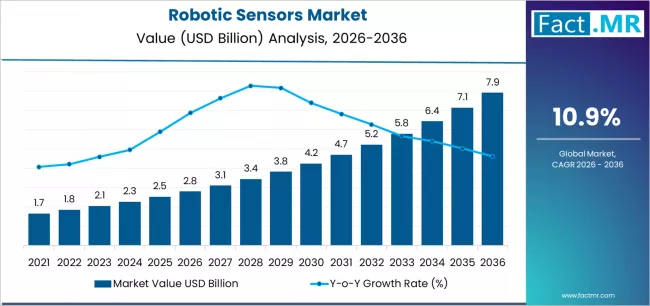
Market expansion is fundamentally driven by the accelerating adoption of automation across manufacturing, logistics, and service sectors. The rise of collaborative robots (cobots), autonomous mobile robots (AMRs), and increasingly complex robotic tasks necessitates advanced sensing for precision, safety, and adaptability. Sensors are the critical components that enable robots to perceive their environment, interact safely with humans, and perform delicate operations with high repeatability.
Technological innovation and system integration will define growth over the forecast period. Advances in sensor fusion, miniaturization (MEMS), and embedded AI are creating smarter, more capable sensors. Concurrently, the integration of Industrial Internet of Things (IIoT) platforms and wireless connectivity allows for real-time data analytics, predictive maintenance, and seamless communication within automated ecosystems, unlocking new levels of operational intelligence and efficiency.
Robotic Sensors Market
| Metric | Value |
|---|---|
| Estimated Value in (2026E) | USD 2.8 billion |
| Forecast Value in (2036F) | USD 7.9 billion |
| Forecast CAGR (2026 to 2036) | 10.9% |
Category
| Category | Segments |
|---|---|
| Sensor Type | Force/Torque, Vision, Proximity, Position, Others |
| Application | Industrial Robotics, Service Robotics, Military/Defense, Others |
| End-Use Industry | Manufacturing, Healthcare, Automotive, Logistics, Others |
| Region | North America, Europe, Asia Pacific, Latin America, MEA |
Segmental Analysis
By Sensor Type, Which Segment of the Robotic Sensors Market Commands the Leading Share?
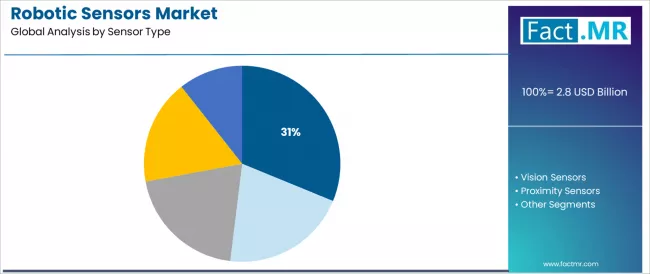
Force and torque sensors will command a 31.2% market share in 2026, as it is essential for enabling safe and precise physical interaction. These sensors allow robots to measure the forces they apply and experience, which is critical for collaborative applications where humans and robots work side-by-side, for delicate assembly tasks (like electronics), and for quality control. Their dominance is reinforced by the rapid growth of cobots and complex manipulation tasks that go beyond simple pick-and-place.
- The proliferation of cobots across small and medium-sized enterprises (SMEs) is a primary driver, as force sensing is a foundational safety feature required for close human-robot collaboration.
- Advancements in sensor design are leading to more compact, affordable, and accurate models, further expanding their integration into a wider array of robotic arms and grippers.
Which Application Segment Generates Maximum Demand for Robotic Sensors?
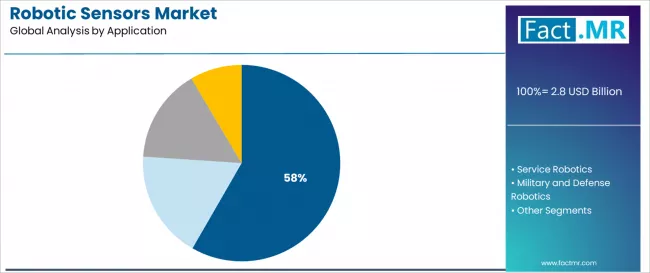
Industrial robotics applications are projected to hold a dominant 58.3% share in 2026. This segment represents the traditional and largest base for robotic adoption, encompassing automotive manufacturing, electronics assembly, metalworking, and food & beverage production. In these high-volume, precision-driven environments, sensors are indispensable for tasks like guidance, inspection, error-proofing, and ensuring consistent quality, making them a core component of any advanced automation cell.
- The ongoing trend towards smart factories and Industry 4.0 is driving the integration of more and smarter sensors to create flexible, data-rich production lines.
- The need for robots to perform increasingly complex, non-repetitive tasks such as bin picking or intricate assembly is pushing demand for advanced vision, force, and tactile sensing solutions.
What are the Drivers, Restraints, and Key Trends of the Robotic Sensors Market?
The market is primarily driven by the global acceleration of industrial automation and the deployment of collaborative robots. Secondary drivers include the growth of autonomous mobile robots in logistics and warehousing, stringent safety regulations requiring sophisticated sensing, and the increasing complexity of robotic applications demanding higher perception capabilities. Key restraints include the high cost of advanced sensor systems, integration challenges with legacy machinery, and a shortage of skilled personnel to deploy and maintain sensor-enabled robotic systems.
The market is trending strongly towards sensor fusion and AI at the edge, where data from multiple sensors (vision, force, lidar) is combined and processed locally to enable real-time decision-making. Another key trend is the rise of IIoT-connected sensors for continuous monitoring, predictive maintenance, and performance optimization across fleets of robots. Furthermore, there is significant innovation in soft robotics and tactile sensing, aiming to replicate the nuanced sensing capabilities of human skin for delicate handling applications.
Analysis of the Robotic Sensors Market by Key Countries
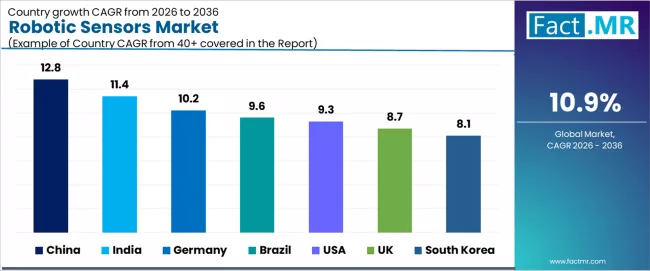
| Country | CAGR (2026-2036) |
|---|---|
| China | 12.8% |
| India | 11.4% |
| Germany | 10.2% |
| Brazil | 9.6% |
| USA | 9.3% |
| UK | 8.7% |
| South Korea | 8.1% |
What is Propelling China's Leadership in Market Growth?
The market in China is projected to grow at a leading CAGR of 12.8% through 2036. As the world's manufacturing powerhouse, China's aggressive push towards industrial automation and smart manufacturing under initiatives like Made in China 2025 creates immense demand. The country is both the largest consumer and a major producer of industrial robots and their components, fueling a robust domestic sensor market.
How is India's Manufacturing Growth Driving Adoption?
The market in India is forecast to grow at a CAGR of 11.4%. India's expanding manufacturing base, government incentives for automation ("Make in India"), and the need to improve productivity and quality are key drivers. Growth is particularly strong in automotive, electronics, and pharmaceuticals, where precision and consistency are paramount.
How does Germany's Advanced Industrial Base Shape its Market?
The market in Germany is forecast to grow at a CAGR of 10.2%. Germany's leadership in high-precision manufacturing (automotive, machinery) and its early adoption of Industry 4.0 principles create demand for premium, reliable sensor solutions. The market is characterized by a focus on quality, integration, and advanced functionalities for complex automation tasks.
Why is Brazil a Key Growth Market in Latin America?
The market in Brazil is set to grow at a CAGR of 9.6%. Brazil's large industrial sector, particularly automotive and agribusiness, is investing in automation to enhance competitiveness. While starting from a smaller base, the need for modernization and efficiency gains is driving steady sensor adoption.
What Underpins the Mature US Market's Steady Growth?
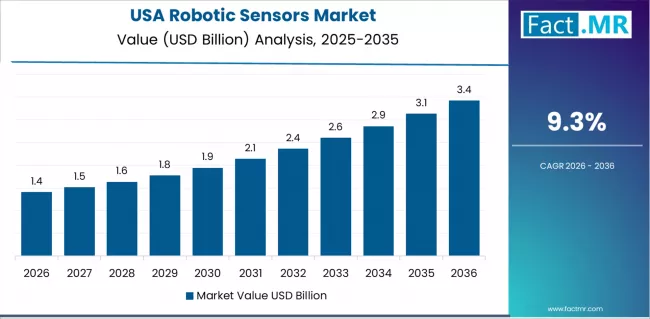
The market in the USA is expected to grow at a CAGR of 9.3%. The US has a mature but innovative automation landscape. Growth is driven by reshoring of manufacturing, adoption of next-generation cobots and AMRs across industries, and strong R&D in robotics, which trickles down to demand for advanced sensing technologies.
What Supports the UK's Focus on High-Tech and Flexible Automation?
The market in the UK is projected to grow at a CAGR of 8.7%. The UK market emphasizes high-value manufacturing, pharmaceuticals, and flexible automation. Demand is driven by the need for agile production systems and cobot deployments, which rely heavily on sophisticated sensors for safety and adaptability.
How does South Korea's Tech-Intensive Industry Influence the Market?
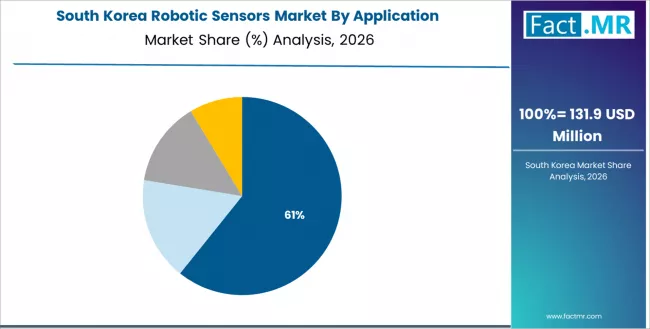
The market in South Korea is projected to grow at a CAGR of 8.1%. South Korea's dominance in semiconductors, consumer electronics, and automotive manufacturing necessitates ultra-precise automation. This drives demand for high-end vision, force, and positioning sensors to maintain its competitive edge in global high-tech supply chains.
Competitive Landscape of the Robotic Sensors Market
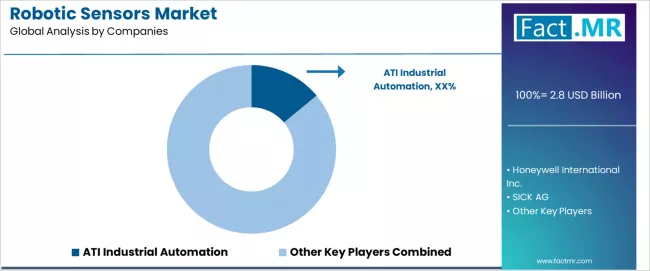
The competitive landscape features a mix of established industrial sensor giants, specialized robotic component manufacturers, and semiconductor companies. Competition centers on technological precision, reliability, speed of data processing, ease of integration, and the ability to provide complete solutions that combine both sensor and software. Leading players are investing heavily in R&D for smarter, smaller, and more interconnected sensors.
Strategic partnerships between sensor companies and robot OEMs are common to develop optimized, application-specific solutions. Success depends on deep understanding of end-user challenges in sectors like automotive or electronics and providing sensors that improve throughput, yield, and operational safety.
Key Players in the Robotic Sensors Market
- ATI Industrial Automation
- Honeywell International Inc.
- SICK AG
- Cognex Corporation
- OMRON Corporation
- FANUC Corporation
- Bosch Sensortec GmbH
- Infineon Technologies AG
- STMicroelectronics
- Analog Devices Inc.
- Texas Instruments Incorporated
- Keyence Corporation
- Baumer Group
- ifm electronic GmbH
Scope of the Report
| Items | Values |
|---|---|
| Quantitative Units (2026) | USD 2.8 Billion |
| Sensor Type | Force and Torque Sensors, Vision Sensors, Proximity Sensors, Position Sensors, Other Sensor Configurations |
| Application | Industrial Robotics, Service Robotics, Military and Defense Robotics, Others |
| End-Use Industry | Manufacturing, Healthcare, Automotive, Logistics, Others |
| Technology | MEMS, Optical, Magnetic, Other Technology Platforms |
| Regions Covered | North America, Europe, Asia Pacific, Latin America, MEA, Other Regions |
| Countries Covered | China, India, Germany, Brazil, USA, UK, South Korea, and 40+ countries |
| Key Companies Profiled | ATI Industrial Automation, Honeywell International Inc., SICK AG, Cognex Corporation, OMRON Corporation, and other leading robotic sensor companies |
| Additional Attributes | Dollar sales by sensor type, application, end-use industry, technology, and region; regional demand trends, competitive landscape, technological advancements in sensing engineering, automation optimization initiatives, sensor enhancement programs, and premium product development strategies |
Robotic Sensors Market by Segments
-
Sensor Type :
- Force and Torque Sensors
- Vision Sensors
- Proximity Sensors
- Position Sensors
- Other Sensor Configurations
-
Application :
- Industrial Robotics
- Service Robotics
- Military and Defense Robotics
- Others
-
End-Use Industry :
- Manufacturing
- Healthcare
- Automotive
- Logistics
- Others
-
Technology :
- MEMS
- Optical
- Magnetic
- Other Technology Platforms
-
Region :
-
North America
- USA
- Canada
- Mexico
-
Europe
- Germany
- UK
- France
- Italy
- Spain
- Nordic Countries
- BENELUX
- Rest of Europe
-
Asia Pacific
- China
- India
- Japan
- South Korea
- Australia
- Rest of Asia Pacific
-
Latin America
- Brazil
- Argentina
- Rest of Latin America
-
MEA
- Saudi Arabia
- UAE
- South Africa
- Rest of MEA
-
Table of Content
- Executive Summary
- Global Market Outlook
- Demand to side Trends
- Supply to side Trends
- Technology Roadmap Analysis
- Analysis and Recommendations
- Market Overview
- Market Coverage / Taxonomy
- Market Definition / Scope / Limitations
- Market Background
- Market Dynamics
- Drivers
- Restraints
- Opportunity
- Trends
- Scenario Forecast
- Demand in Optimistic Scenario
- Demand in Likely Scenario
- Demand in Conservative Scenario
- Opportunity Map Analysis
- Product Life Cycle Analysis
- Supply Chain Analysis
- Investment Feasibility Matrix
- Value Chain Analysis
- PESTLE and Porter’s Analysis
- Regulatory Landscape
- Regional Parent Market Outlook
- Production and Consumption Statistics
- Import and Export Statistics
- Market Dynamics
- Global Market Analysis 2021 to 2025 and Forecast, 2026 to 2036
- Historical Market Size Value (USD Million) Analysis, 2021 to 2025
- Current and Future Market Size Value (USD Million) Projections, 2026 to 2036
- Y to o to Y Growth Trend Analysis
- Absolute $ Opportunity Analysis
- Global Market Pricing Analysis 2021 to 2025 and Forecast 2026 to 2036
- Global Market Analysis 2021 to 2025 and Forecast 2026 to 2036, By Sensor Type
- Introduction / Key Findings
- Historical Market Size Value (USD Million) Analysis By Sensor Type, 2021 to 2025
- Current and Future Market Size Value (USD Million) Analysis and Forecast By Sensor Type, 2026 to 2036
- Force and Torque Sensors
- Vision Sensors
- Proximity Sensors
- Position Sensors
- Other Sensor Configurations
- Y to o to Y Growth Trend Analysis By Sensor Type, 2021 to 2025
- Absolute $ Opportunity Analysis By Sensor Type, 2026 to 2036
- Global Market Analysis 2021 to 2025 and Forecast 2026 to 2036, By Application
- Introduction / Key Findings
- Historical Market Size Value (USD Million) Analysis By Application, 2021 to 2025
- Current and Future Market Size Value (USD Million) Analysis and Forecast By Application, 2026 to 2036
- Industrial Robotics
- Service Robotics
- Military and Defense Robotics
- Others
- Y to o to Y Growth Trend Analysis By Application, 2021 to 2025
- Absolute $ Opportunity Analysis By Application, 2026 to 2036
- Global Market Analysis 2021 to 2025 and Forecast 2026 to 2036, By Region
- Introduction
- Historical Market Size Value (USD Million) Analysis By Region, 2021 to 2025
- Current Market Size Value (USD Million) Analysis and Forecast By Region, 2026 to 2036
- North America
- Latin America
- Western Europe
- Eastern Europe
- East Asia
- South Asia and Pacific
- Middle East & Africa
- Market Attractiveness Analysis By Region
- North America Market Analysis 2021 to 2025 and Forecast 2026 to 2036, By Country
- Historical Market Size Value (USD Million) Trend Analysis By Market Taxonomy, 2021 to 2025
- Market Size Value (USD Million) Forecast By Market Taxonomy, 2026 to 2036
- By Country
- USA
- Canada
- Mexico
- By Sensor Type
- By Application
- By Country
- Market Attractiveness Analysis
- By Country
- By Sensor Type
- By Application
- Key Takeaways
- Latin America Market Analysis 2021 to 2025 and Forecast 2026 to 2036, By Country
- Historical Market Size Value (USD Million) Trend Analysis By Market Taxonomy, 2021 to 2025
- Market Size Value (USD Million) Forecast By Market Taxonomy, 2026 to 2036
- By Country
- Brazil
- Chile
- Rest of Latin America
- By Sensor Type
- By Application
- By Country
- Market Attractiveness Analysis
- By Country
- By Sensor Type
- By Application
- Key Takeaways
- Western Europe Market Analysis 2021 to 2025 and Forecast 2026 to 2036, By Country
- Historical Market Size Value (USD Million) Trend Analysis By Market Taxonomy, 2021 to 2025
- Market Size Value (USD Million) Forecast By Market Taxonomy, 2026 to 2036
- By Country
- Germany
- UK
- Italy
- Spain
- France
- Nordic
- BENELUX
- Rest of Western Europe
- By Sensor Type
- By Application
- By Country
- Market Attractiveness Analysis
- By Country
- By Sensor Type
- By Application
- Key Takeaways
- Eastern Europe Market Analysis 2021 to 2025 and Forecast 2026 to 2036, By Country
- Historical Market Size Value (USD Million) Trend Analysis By Market Taxonomy, 2021 to 2025
- Market Size Value (USD Million) Forecast By Market Taxonomy, 2026 to 2036
- By Country
- Russia
- Poland
- Hungary
- Balkan & Baltic
- Rest of Eastern Europe
- By Sensor Type
- By Application
- By Country
- Market Attractiveness Analysis
- By Country
- By Sensor Type
- By Application
- Key Takeaways
- East Asia Market Analysis 2021 to 2025 and Forecast 2026 to 2036, By Country
- Historical Market Size Value (USD Million) Trend Analysis By Market Taxonomy, 2021 to 2025
- Market Size Value (USD Million) Forecast By Market Taxonomy, 2026 to 2036
- By Country
- China
- Japan
- South Korea
- By Sensor Type
- By Application
- By Country
- Market Attractiveness Analysis
- By Country
- By Sensor Type
- By Application
- Key Takeaways
- South Asia and Pacific Market Analysis 2021 to 2025 and Forecast 2026 to 2036, By Country
- Historical Market Size Value (USD Million) Trend Analysis By Market Taxonomy, 2021 to 2025
- Market Size Value (USD Million) Forecast By Market Taxonomy, 2026 to 2036
- By Country
- India
- ASEAN
- Australia & New Zealand
- Rest of South Asia and Pacific
- By Sensor Type
- By Application
- By Country
- Market Attractiveness Analysis
- By Country
- By Sensor Type
- By Application
- Key Takeaways
- Middle East & Africa Market Analysis 2021 to 2025 and Forecast 2026 to 2036, By Country
- Historical Market Size Value (USD Million) Trend Analysis By Market Taxonomy, 2021 to 2025
- Market Size Value (USD Million) Forecast By Market Taxonomy, 2026 to 2036
- By Country
- Kingdom of Saudi Arabia
- Other GCC Countries
- Turkiye
- South Africa
- Other African Union
- Rest of Middle East & Africa
- By Sensor Type
- By Application
- By Country
- Market Attractiveness Analysis
- By Country
- By Sensor Type
- By Application
- Key Takeaways
- Key Countries Market Analysis
- USA
- Pricing Analysis
- Market Share Analysis, 2025
- By Sensor Type
- By Application
- Canada
- Pricing Analysis
- Market Share Analysis, 2025
- By Sensor Type
- By Application
- Mexico
- Pricing Analysis
- Market Share Analysis, 2025
- By Sensor Type
- By Application
- Brazil
- Pricing Analysis
- Market Share Analysis, 2025
- By Sensor Type
- By Application
- Chile
- Pricing Analysis
- Market Share Analysis, 2025
- By Sensor Type
- By Application
- Germany
- Pricing Analysis
- Market Share Analysis, 2025
- By Sensor Type
- By Application
- UK
- Pricing Analysis
- Market Share Analysis, 2025
- By Sensor Type
- By Application
- Italy
- Pricing Analysis
- Market Share Analysis, 2025
- By Sensor Type
- By Application
- Spain
- Pricing Analysis
- Market Share Analysis, 2025
- By Sensor Type
- By Application
- France
- Pricing Analysis
- Market Share Analysis, 2025
- By Sensor Type
- By Application
- India
- Pricing Analysis
- Market Share Analysis, 2025
- By Sensor Type
- By Application
- ASEAN
- Pricing Analysis
- Market Share Analysis, 2025
- By Sensor Type
- By Application
- Australia & New Zealand
- Pricing Analysis
- Market Share Analysis, 2025
- By Sensor Type
- By Application
- China
- Pricing Analysis
- Market Share Analysis, 2025
- By Sensor Type
- By Application
- Japan
- Pricing Analysis
- Market Share Analysis, 2025
- By Sensor Type
- By Application
- South Korea
- Pricing Analysis
- Market Share Analysis, 2025
- By Sensor Type
- By Application
- Russia
- Pricing Analysis
- Market Share Analysis, 2025
- By Sensor Type
- By Application
- Poland
- Pricing Analysis
- Market Share Analysis, 2025
- By Sensor Type
- By Application
- Hungary
- Pricing Analysis
- Market Share Analysis, 2025
- By Sensor Type
- By Application
- Kingdom of Saudi Arabia
- Pricing Analysis
- Market Share Analysis, 2025
- By Sensor Type
- By Application
- Turkiye
- Pricing Analysis
- Market Share Analysis, 2025
- By Sensor Type
- By Application
- South Africa
- Pricing Analysis
- Market Share Analysis, 2025
- By Sensor Type
- By Application
- USA
- Market Structure Analysis
- Competition Dashboard
- Competition Benchmarking
- Market Share Analysis of Top Players
- By Regional
- By Sensor Type
- By Application
- Competition Analysis
- Competition Deep Dive
- ATI Industrial Automation
- Overview
- Product Portfolio
- Profitability by Market Segments (Product/Age /Sales Channel/Region)
- Sales Footprint
- Strategy Overview
- Marketing Strategy
- Product Strategy
- Channel Strategy
- Honeywell International Inc.
- SICK AG
- Cognex Corporation
- OMRON Corporation
- FANUC Corporation
- Bosch Sensortec GmbH
- Infineon Technologies AG
- STMicroelectronics
- Analog Devices Inc.
- Texas Instruments Incorporated
- Keyence Corporation
- Baumer Group
- ifm electronic GmbH
- ATI Industrial Automation
- Competition Deep Dive
- Assumptions & Acronyms Used
- Research Methodology
List Of Table
- Table 1: Global Market Value (USD Million) Forecast by Region, 2021 to 2036
- Table 2: Global Market Value (USD Million) Forecast by Sensor Type, 2021 to 2036
- Table 3: Global Market Value (USD Million) Forecast by Application, 2021 to 2036
- Table 4: North America Market Value (USD Million) Forecast by Country, 2021 to 2036
- Table 5: North America Market Value (USD Million) Forecast by Sensor Type, 2021 to 2036
- Table 6: North America Market Value (USD Million) Forecast by Application, 2021 to 2036
- Table 7: Latin America Market Value (USD Million) Forecast by Country, 2021 to 2036
- Table 8: Latin America Market Value (USD Million) Forecast by Sensor Type, 2021 to 2036
- Table 9: Latin America Market Value (USD Million) Forecast by Application, 2021 to 2036
- Table 10: Western Europe Market Value (USD Million) Forecast by Country, 2021 to 2036
- Table 11: Western Europe Market Value (USD Million) Forecast by Sensor Type, 2021 to 2036
- Table 12: Western Europe Market Value (USD Million) Forecast by Application, 2021 to 2036
- Table 13: Eastern Europe Market Value (USD Million) Forecast by Country, 2021 to 2036
- Table 14: Eastern Europe Market Value (USD Million) Forecast by Sensor Type, 2021 to 2036
- Table 15: Eastern Europe Market Value (USD Million) Forecast by Application, 2021 to 2036
- Table 16: East Asia Market Value (USD Million) Forecast by Country, 2021 to 2036
- Table 17: East Asia Market Value (USD Million) Forecast by Sensor Type, 2021 to 2036
- Table 18: East Asia Market Value (USD Million) Forecast by Application, 2021 to 2036
- Table 19: South Asia and Pacific Market Value (USD Million) Forecast by Country, 2021 to 2036
- Table 20: South Asia and Pacific Market Value (USD Million) Forecast by Sensor Type, 2021 to 2036
- Table 21: South Asia and Pacific Market Value (USD Million) Forecast by Application, 2021 to 2036
- Table 22: Middle East & Africa Market Value (USD Million) Forecast by Country, 2021 to 2036
- Table 23: Middle East & Africa Market Value (USD Million) Forecast by Sensor Type, 2021 to 2036
- Table 24: Middle East & Africa Market Value (USD Million) Forecast by Application, 2021 to 2036
List Of Figures
- Figure 1: Global Market Pricing Analysis
- Figure 2: Global Market Value (USD Million) Forecast 2021 to 2036
- Figure 3: Global Market Value Share and BPS Analysis by Sensor Type, 2026 and 2036
- Figure 4: Global Market Y to o to Y Growth Comparison by Sensor Type, 2026 to 2036
- Figure 5: Global Market Attractiveness Analysis by Sensor Type
- Figure 6: Global Market Value Share and BPS Analysis by Application, 2026 and 2036
- Figure 7: Global Market Y to o to Y Growth Comparison by Application, 2026 to 2036
- Figure 8: Global Market Attractiveness Analysis by Application
- Figure 9: Global Market Value (USD Million) Share and BPS Analysis by Region, 2026 and 2036
- Figure 10: Global Market Y to o to Y Growth Comparison by Region, 2026 to 2036
- Figure 11: Global Market Attractiveness Analysis by Region
- Figure 12: North America Market Incremental Dollar Opportunity, 2026 to 2036
- Figure 13: Latin America Market Incremental Dollar Opportunity, 2026 to 2036
- Figure 14: Western Europe Market Incremental Dollar Opportunity, 2026 to 2036
- Figure 15: Eastern Europe Market Incremental Dollar Opportunity, 2026 to 2036
- Figure 16: East Asia Market Incremental Dollar Opportunity, 2026 to 2036
- Figure 17: South Asia and Pacific Market Incremental Dollar Opportunity, 2026 to 2036
- Figure 18: Middle East & Africa Market Incremental Dollar Opportunity, 2026 to 2036
- Figure 19: North America Market Value Share and BPS Analysis by Country, 2026 and 2036
- Figure 20: North America Market Value Share and BPS Analysis by Sensor Type, 2026 and 2036
- Figure 21: North America Market Y to o to Y Growth Comparison by Sensor Type, 2026 to 2036
- Figure 22: North America Market Attractiveness Analysis by Sensor Type
- Figure 23: North America Market Value Share and BPS Analysis by Application, 2026 and 2036
- Figure 24: North America Market Y to o to Y Growth Comparison by Application, 2026 to 2036
- Figure 25: North America Market Attractiveness Analysis by Application
- Figure 26: Latin America Market Value Share and BPS Analysis by Country, 2026 and 2036
- Figure 27: Latin America Market Value Share and BPS Analysis by Sensor Type, 2026 and 2036
- Figure 28: Latin America Market Y to o to Y Growth Comparison by Sensor Type, 2026 to 2036
- Figure 29: Latin America Market Attractiveness Analysis by Sensor Type
- Figure 30: Latin America Market Value Share and BPS Analysis by Application, 2026 and 2036
- Figure 31: Latin America Market Y to o to Y Growth Comparison by Application, 2026 to 2036
- Figure 32: Latin America Market Attractiveness Analysis by Application
- Figure 33: Western Europe Market Value Share and BPS Analysis by Country, 2026 and 2036
- Figure 34: Western Europe Market Value Share and BPS Analysis by Sensor Type, 2026 and 2036
- Figure 35: Western Europe Market Y to o to Y Growth Comparison by Sensor Type, 2026 to 2036
- Figure 36: Western Europe Market Attractiveness Analysis by Sensor Type
- Figure 37: Western Europe Market Value Share and BPS Analysis by Application, 2026 and 2036
- Figure 38: Western Europe Market Y to o to Y Growth Comparison by Application, 2026 to 2036
- Figure 39: Western Europe Market Attractiveness Analysis by Application
- Figure 40: Eastern Europe Market Value Share and BPS Analysis by Country, 2026 and 2036
- Figure 41: Eastern Europe Market Value Share and BPS Analysis by Sensor Type, 2026 and 2036
- Figure 42: Eastern Europe Market Y to o to Y Growth Comparison by Sensor Type, 2026 to 2036
- Figure 43: Eastern Europe Market Attractiveness Analysis by Sensor Type
- Figure 44: Eastern Europe Market Value Share and BPS Analysis by Application, 2026 and 2036
- Figure 45: Eastern Europe Market Y to o to Y Growth Comparison by Application, 2026 to 2036
- Figure 46: Eastern Europe Market Attractiveness Analysis by Application
- Figure 47: East Asia Market Value Share and BPS Analysis by Country, 2026 and 2036
- Figure 48: East Asia Market Value Share and BPS Analysis by Sensor Type, 2026 and 2036
- Figure 49: East Asia Market Y to o to Y Growth Comparison by Sensor Type, 2026 to 2036
- Figure 50: East Asia Market Attractiveness Analysis by Sensor Type
- Figure 51: East Asia Market Value Share and BPS Analysis by Application, 2026 and 2036
- Figure 52: East Asia Market Y to o to Y Growth Comparison by Application, 2026 to 2036
- Figure 53: East Asia Market Attractiveness Analysis by Application
- Figure 54: South Asia and Pacific Market Value Share and BPS Analysis by Country, 2026 and 2036
- Figure 55: South Asia and Pacific Market Value Share and BPS Analysis by Sensor Type, 2026 and 2036
- Figure 56: South Asia and Pacific Market Y to o to Y Growth Comparison by Sensor Type, 2026 to 2036
- Figure 57: South Asia and Pacific Market Attractiveness Analysis by Sensor Type
- Figure 58: South Asia and Pacific Market Value Share and BPS Analysis by Application, 2026 and 2036
- Figure 59: South Asia and Pacific Market Y to o to Y Growth Comparison by Application, 2026 to 2036
- Figure 60: South Asia and Pacific Market Attractiveness Analysis by Application
- Figure 61: Middle East & Africa Market Value Share and BPS Analysis by Country, 2026 and 2036
- Figure 62: Middle East & Africa Market Value Share and BPS Analysis by Sensor Type, 2026 and 2036
- Figure 63: Middle East & Africa Market Y to o to Y Growth Comparison by Sensor Type, 2026 to 2036
- Figure 64: Middle East & Africa Market Attractiveness Analysis by Sensor Type
- Figure 65: Middle East & Africa Market Value Share and BPS Analysis by Application, 2026 and 2036
- Figure 66: Middle East & Africa Market Y to o to Y Growth Comparison by Application, 2026 to 2036
- Figure 67: Middle East & Africa Market Attractiveness Analysis by Application
- Figure 68: Global Market - Tier Structure Analysis
- Figure 69: Global Market - Company Share Analysis
- FAQs -
How big is the robotic sensors market in 2026?
The global robotic sensors market is estimated to be valued at USD 2.8 billion in 2026.
What will be the size of robotic sensors market in 2036?
The market size for the robotic sensors market is projected to reach USD 7.9 billion by 2036.
How much will be the robotic sensors market growth between 2026 and 2036?
The robotic sensors market is expected to grow at a 10.9% CAGR between 2026 and 2036.
What are the key product types in the robotic sensors market?
The key product types in robotic sensors market are force and torque sensors, vision sensors, proximity sensors, position sensors and other sensor configurations.
Which application segment to contribute significant share in the robotic sensors market in 2026?
In terms of application, industrial robotics segment to command 58.3% share in the robotic sensors market in 2026.