Zero-waste Construction Materials Market Size, Share, Growth and Forecast (2026 - 2036)
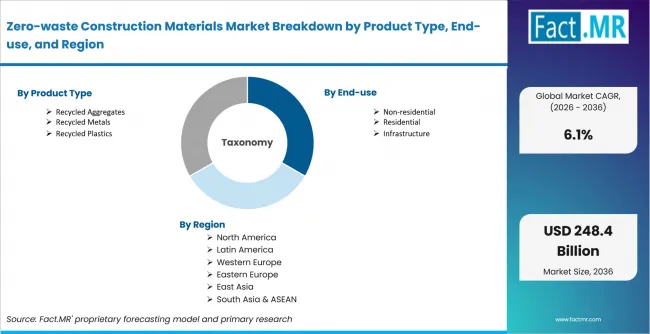
The Zero-waste Construction Materials Market is segmented by Product Type, by End-use, by Material Source, by Distribution Mode, by Construction Stage, by Application Area, and by Region. Forecast for 2026 to 2036.
Zero-waste Construction Materials Market Forecast and Outlook by Fact.MR
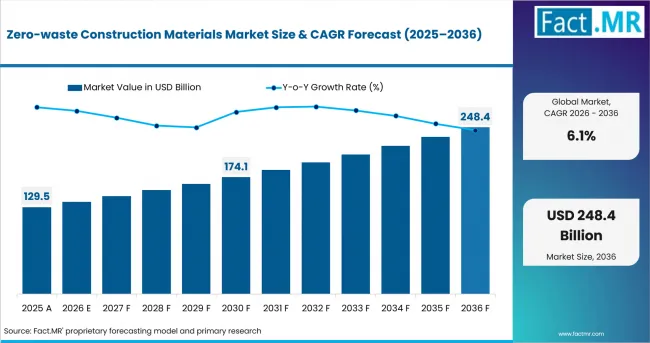
- The zero-waste construction materials market crossed a valuation of USD 129.5 billion in 2025.
- Based on Fact.MR analysis, sales are estimated to rise to USD 137.4 billion in 2026 and USD 248.4 billion by 2036.
- Fact.MR projects a 6.1% CAGR during the 2026 to 2036 forecast period.
| Metric | Value |
|---|---|
| Estimated Value in 2026 | USD 137.4 billion |
| Forecast Value in 2036 | USD 248.4 billion |
| Forecast CAGR (2026 to 2036) | 6.1% |
Summary of the Zero-waste Construction Materials Market
- Demand Drivers
- Material recovery is becoming part of project planning because buildings and construction accounted for 34% of global carbon dioxide emissions in 2023. Developers are using more recycled mineral inputs and reusable components. [1]
- Road contractors are using more recycled asphalt and recovered aggregate because road base materials can accept processed debris more easily.
- Factory-made walls and panels help reduce site waste because materials are cut in controlled factory conditions before delivery.
- Key Segments Analyzed
- By Product Type: Recycled Aggregates hold 44.1% share in 2026, with crushed concrete and asphalt debris moving back into road base and concrete production through familiar testing routes.
- By End-use: Non-residential Construction leads with 55.8% share in 2026 as offices and schools need material records for project reporting.
- By Material Source: C&D Debris captures 52.4% share in 2026 since demolition activity creates sortable concrete and brick streams for recovery.
- By Distribution Mode: Direct Supply accounts for 61.2% share in 2026 as large projects depend on batch records and material test files.
- By Construction Stage: New Construction holds 58.6% share in 2026, with early design approval helping contractors specify recovered inputs before materials are locked.
- By Application Area: Structural Works account for 46.8% share in 2026 as beams and slabs offer clear testing routes for recycled mineral inputs.
- Analyst Opinion at Fact.MR
- Shambhu Nath Jha, Principal Consultant at Fact.MR opines, ‘CXOs will see zero-waste construction material demand moving toward traceable recycled inputs and reuse-ready building products. Public agencies and private developers are expanding use of recovered aggregates and low-carbon binders as project approval increasingly depends on material recovery records.’
- Strategic Implications
- Manufacturers should focus on recycled aggregate and low-carbon binder lines as contractors try to lower disposal costs and reduce virgin material use.
- Companies should prepare clear approval files for construction aggregate substitutes because engineers need strength records before acceptance.
- Suppliers should work directly with public works contractors because documented batch quality is now a key order requirement.
The market is set to generate an incremental revenue opportunity of USD 111.0 billion between 2026 and 2036. Market expansion is supported by efforts to keep construction debris away from landfills. Recycled aggregates and reusable building inputs are gaining approval in infrastructure and non-residential projects.
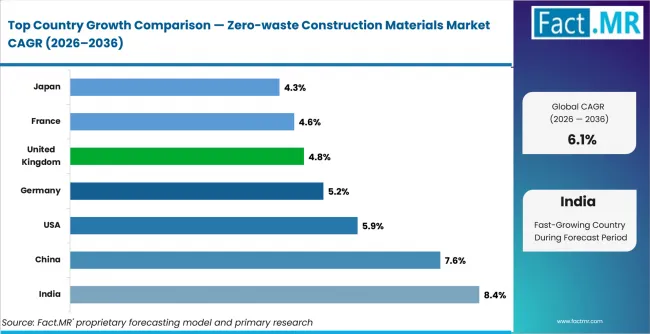
India is projected to record 8.4% CAGR through 2036. C&D waste rules place more recovery duty on large building projects. China follows at 7.6% CAGR by 2036 as national waste recycling targets raise demand for recycled mineral inputs. The United States advances at 5.9% CAGR from 2026 to 2036 because landfill diversion and road reuse practices are moving into public works orders. Germany grows at 5.2% CAGR by 2036 as mineral construction waste recycling gives producers a steady feedstock stream. The United Kingdom records 4.8% CAGR from 2026 to 2036 because recovery targets keep recycled aggregates in public and private projects. France grows at 4.6% CAGR through 2036 as building material recovery rules increase take-back activity. Japan records 4.3% CAGR by 2036 as urban redevelopment keeps demand steady for compact recovery systems.
Segmental Analysis
Zero-waste Construction Materials Market Analysis by Product Type
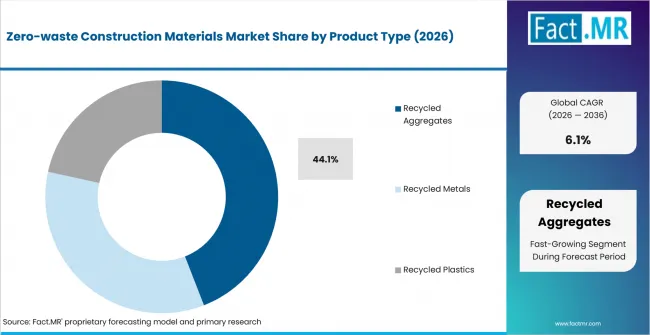
Recycled Aggregates are projected to account for 44.1% share in 2026 as crushed concrete and asphalt debris can be reused in road base and concrete production. Volume shows why mineral recovery is a key entry point for recycled construction inputs.
- Aggregate recovery growth: Contractors accept recovered stone faster because gradation and strength can be checked with standard tests.
- Recycled metals supply: Structural steel and rebar producers use scrap-based inputs in projects that need strength and lower waste claims.
- Polymer reuse expansion: Construction polymers gain orders in panels and pavers as processors offer molded formats for light-duty building use.
Zero-waste Construction Materials Market Analysis by End-use
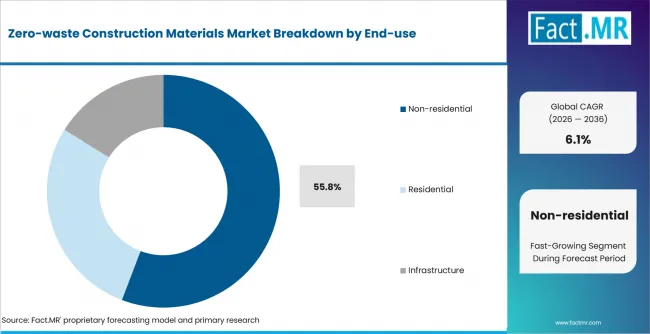
Non-residential Construction is projected to account for 55.8% share in 2026 as offices and schools give more weight to material records. Warehouses and public buildings add project volume through site diversion plans. Large projects can spread testing costs across higher material volumes. Recycled aggregate and reclaimed components become easier to approve in these jobs.
- Commercial building use: Developers choose recovered content products to meet tenant reporting needs and lower disposal costs during interior work.
- Public facility orders: Schools and health buildings use products with documented recycled content to match grant and project scoring rules.
- Infrastructure pull: Road and bridge projects accept asphalt concrete with processed debris because testing gives engineers clear approval records.
Zero-waste Construction Materials Market Analysis by Material Source
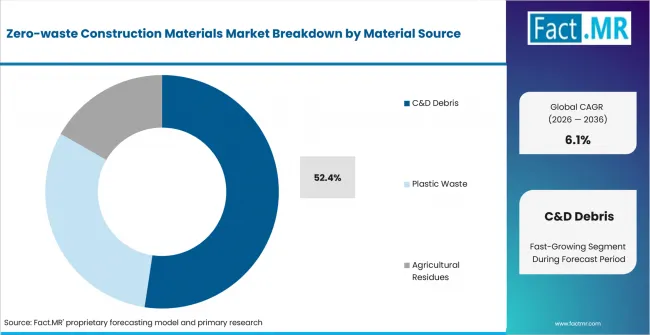
C&D Debris is projected to account for 52.4% share in 2026 as demolition waste can be sorted into concrete and brick streams. Asphalt and timber add more recovery value. India estimates annual construction and demolition waste in the 150 to 500 million tonnes range. The feedstock range supports sorting plants and project-level recovery plans. [4]
- Demolition source control: Contractors separate concrete and brick on site to protect material value and reduce mixed waste handling.
- Industrial by-product use: Cement and binder producers use by-products in low-carbon cement to cut clinker intensity and landfill exposure.
- Agricultural residue panels: Straw-based boards and insulation panels use farm residue streams with low value for rural producers.
Zero-waste Construction Materials Market Analysis by Distribution Mode
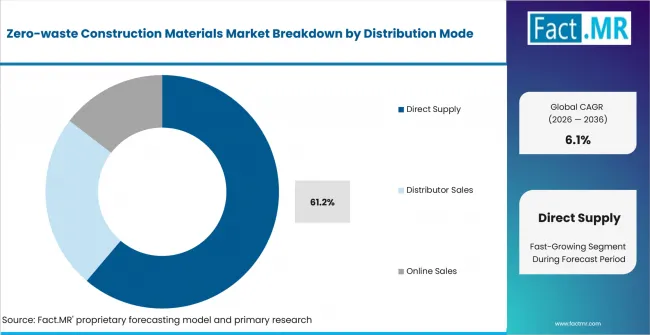
Direct Supply is projected to account for 61.2% share in 2026 as large construction jobs need batch records and material test files. Delivery timing control adds another reason for direct supply. Distributors serve small contractors. Direct supply has greater weight in public works and large buildings. Suppliers that reserve recovered feedstock for named projects gain an advantage.
- Direct contract preference: Large contractors use direct supply so strength records and recycled content papers stay tied to each batch.
- Distributor channel use: Regional distributors serve renovation jobs that need smaller volumes and faster delivery from local yards.
- Municipal channel role: Public recycling plants create supply for road base and pavers after local demolition waste is sorted.
Zero-waste Construction Materials Market Analysis by Construction Stage
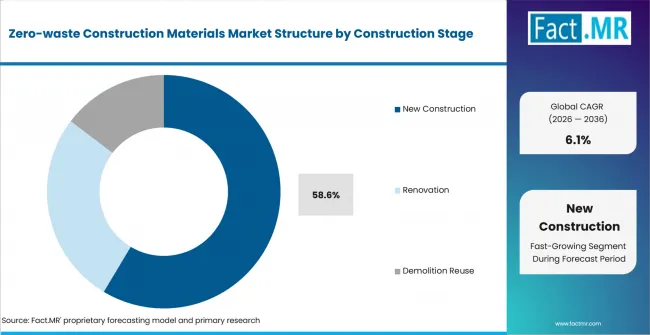
New Construction is projected to account for 58.6% share in 2026 as architects and contractors can approve recovered materials before bills of material are fixed. Recovery choices are harder in late-stage renovation because drawings and safety approvals are already set. Early design coordination is important for material conversion.
- Early design approval: Engineers can test recycled aggregate and reclaimed panels before tender release in new building projects.
- Renovation material reuse: Renovation contractors reuse doors and boards after inspection confirms quality for secondary use. Pavers add another reuse stream.
- Modular work impact: Modular construction fasteners and factory-prepared panels reduce offcut waste by shifting cutting work away from open sites.
Zero-waste Construction Materials Market Analysis by Application Area
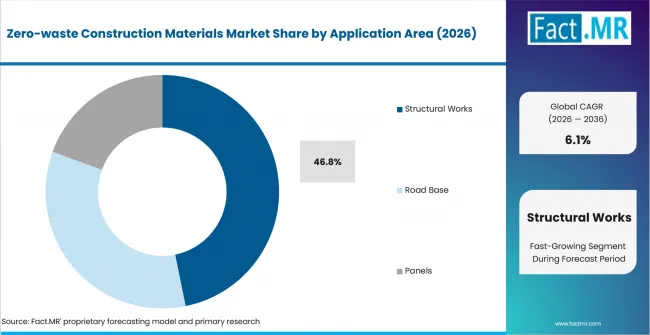
Structural Works are projected to account for 46.8% share in 2026 as beams and slabs have clear test routes for recycled mineral inputs. Load-bearing products gain higher value after approval. Structural approval needs proof of strength and steady supply. Suppliers that pass these checks can move from low-value fill into higher-value building uses.
- Concrete mix use: Recovered aggregate enters structural concrete after grading tests confirm particle size and performance consistency.
- Panel demand shift: Building panels made with reclaimed wood or agricultural fibers gain use in walls and interior partitions.
- Road base conversion: Processed demolition debris enters base layers as road agencies use established compaction and grading checks.
Drivers, Restraints, and Opportunities
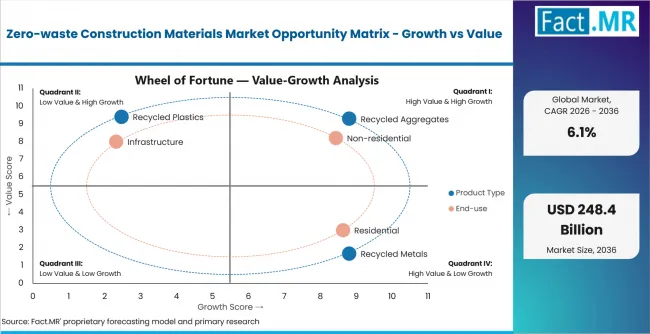
The market expands as public agencies and developers move construction debris away from landfills. Recycling programs are helping contractors use recovered aggregates in roadwork and new building projects.
The main restraint is uneven feedstock quality. Mixed debris can contain wood, gypsum, plastic, and soil contamination, reducing construction value. Material processors need sorting and testing systems. Storage control is needed before contractors can approve saleable products.
- Public works projects are using more recovered mineral inputs as agencies seek lower disposal volumes and better material traceability.
- Project engineers can reject recovered inputs if strength tests and contamination records are incomplete. Missing batch papers create the same risk.
- Suppliers that combine waste handling with saleable construction inputs can capture value from sorting and resale.
Regional Analysis
The zero-waste construction materials market is assessed across North America, Europe, Asia Pacific, Latin America, and the Middle East and Africa, covering 40+ countries by product type, end-use, material source, distribution mode, construction stage, and application area. The full report includes market attractiveness analysis by region and country.
.webp)
| Country | CAGR (2026 to 2036) |
|---|---|
| India | 8.4% |
| China | 7.6% |
| United States | 5.9% |
| Germany | 5.2% |
| United Kingdom | 4.8% |
| France | 4.6% |
| Japan | 4.3% |
Source: Fact.MR analysis, based on proprietary forecasting model and primary research
Asia Pacific Zero-waste Construction Materials Market Analysis
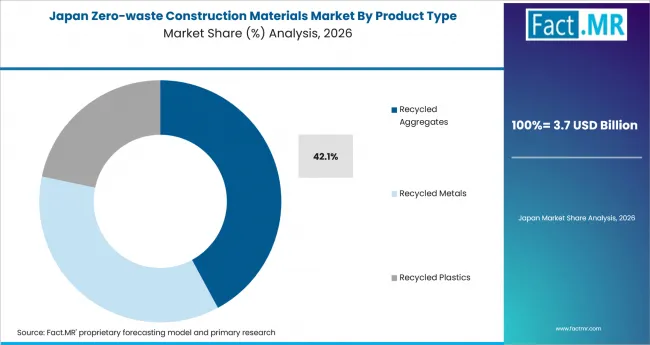
Asia Pacific is the fastest-growing regional market for zero-waste construction materials. Dense urban construction creates large construction and demolition debris streams across major cities. New recovery rules and public construction programs are raising demand for sorting yards and recycled aggregates.
- India: India is expected to grow at 8.4% CAGR from 2026 to 2036. New construction waste rules are increasing responsibility for large building projects. Contractors need better recovery plans for demolition debris. Sorting yards and recycled aggregates gain demand as compliance pressure rises.
- China: China is forecast to expand at 7.6% CAGR through 2036. The State Council set a waste recycling system target for 2030. Urban renewal and public construction programs are increasing recycled aggregate use. Policy support helps recycled materials enter city redevelopment projects. [3]
- Japan: Japan advances at 4.3% CAGR by 2036. Dense city redevelopment keeps demolition material recovery near active project sites. Contractors prefer compact sorting and reuse systems that reduce haulage time in high-density urban districts.
North America Zero-waste Construction Materials Market Analysis
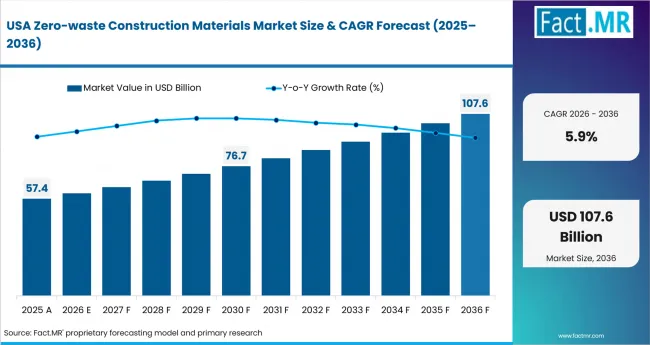
North America has steady demand for zero-waste construction materials through replacement work and road reuse. Recycled aggregate use is gaining support as landfill costs rise. Public works agencies prefer suppliers with testing records and material traceability.
- United States: The United States is expected to rise at 5.9% CAGR by 2036. State road agencies and private developers use recycled aggregate to control landfill costs. Public works orders favor suppliers that provide test records and material traceability. Road reuse keeps demand steady across construction material recovery channels.
Europe Zero-waste Construction Materials Market Analysis
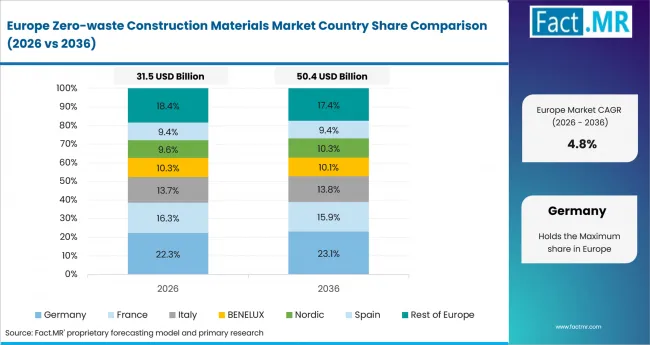
Europe has advanced recovery rules for construction materials. High recycling levels create a dependable feedstock stream for aggregate processors and recycled building material suppliers. Extended producer responsibility programs are increasing take-back and material separation across building product channels.
- Germany: Germany is forecast to expand at 5.2% CAGR during the forecast period. Mineral construction waste recycling passed 90% for the first time. This creates a reliable feedstock stream for aggregate processors. Recycled building material suppliers gain from steady construction waste availability. [5]
- United Kingdom: The United Kingdom reaches 4.8% CAGR through 2036. England recovered 94.3% of non-hazardous construction and demolition waste in 2022. High recovery levels support recycled aggregate supply for roads and public buildings. Private construction can use the same channel for recovered materials. [2]
- France: France advances at 4.6% CAGR by 2036. Extended producer responsibility for building products is increasing take-back and material separation. Manufacturers with recycling partners gain an advantage in tenders that require proof of recovered content.
Competitive Aligners for Market Players
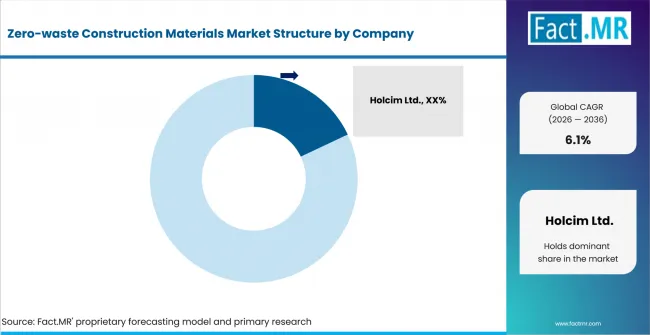
Competition is moving toward suppliers that can turn recovered feedstock into approved building inputs. Large cement and aggregate firms are expanding into recycled material supply. This gives contractors more reliable recovered aggregates for construction projects.
Large material companies compete through cement and aggregate networks that already serve contractors. Ready-mix operations support local project supply. Smaller specialists compete through plastic bricks and straw panels. Testing depth and batch records separate larger suppliers from smaller specialists. Repeat project volume will be the next test.
Manufacturers with recycled mineral capacity can pair aggregate recovery with low carbon cement and reuse-ready concrete products. Specialists can win smaller orders by solving specific project needs such as plastic pavers. Reclaimed interior products create another sales route.
Key Players in the Zero-waste Construction Materials Market
- Holcim Ltd.
- Heidelberg Materials AG
- CRH plc
- Cemex S.A.B. de C.V.
- Saint-Gobain S.A.
- ANGIRUS IND PVT LTD
- Strawcture Eco Pvt. Ltd.
- a:gain ApS
Bibliography
- [1] United Nations Environment Programme, & Global Alliance for Buildings and Construction. (2025, March 17). Global Status Report for Buildings and Construction 2024/2025: Not just another brick in the wall.
- [2] Department for Environment, Food & Rural Affairs. (2025, July 23). UK statistics on waste. GOV.UK.
- [3] The State Council of the People’s Republic of China. (2024, February 9). China issues guidelines to establish a waste recycling system.
- [4] Prakash, S., & Patra, A. (2026, March 30). Explained: India’s updated Construction and Demolition Waste Management Rules. Council on Energy, Environment and Water.
- [5] Deutscher Abbruchverband e.V. (2024, December 12). Circular economy: Over 90% of all mineral construction waste recycled for the first time.
This Report Addresses
- Strategic demand analysis for zero-waste construction materials across residential construction, non-residential construction, and infrastructure projects globally.
- Market forecast from USD 137.4 billion in 2026 to USD 248.4 billion by 2036 at 6.1% CAGR.
- Opportunity mapping across India, China, the United States, Germany, the United Kingdom, France, and Japan based on recovery rules and construction reuse activity.
- Segment analysis by product type, end-use, material source, distribution mode, construction stage, and application area with regional forecasts through 2036.
- Competitive analysis of Holcim Ltd., Heidelberg Materials AG, CRH plc, Cemex S.A.B. de C.V., Saint-Gobain S.A., ANGIRUS IND PVT LTD, Strawcture Eco Pvt. Ltd., and a:gain ApS.
- Regulatory impact analysis covering C&D debris recovery rules, public works material approval, recycled aggregate testing, and building product take-back activity.
- Report delivery in PDF, Excel, and presentation formats supported by supplier catalogs, project-level material records, public waste datasets, and primary interviews.
Zero-waste Construction Materials Market Definition
The zero-waste construction materials market covers recovered and reuse-ready building inputs used across construction and infrastructure projects. These materials include recycled aggregates, recycled metals, recycled plastics, reclaimed wood, bio-composites, and low-carbon binders. The market supports projects that need documented material recovery and lower dependence on disposal routes. Products are used in structural works, road base, insulation, panels, and paver applications.
Zero-waste Construction Materials Market Inclusions
Covers global and regional market forecasts from 2026 to 2036 by product type and end-use. It includes material source, distribution mode, construction stage, and application area analysis. Product coverage includes recycled aggregates, recycled metals, recycled plastics, reclaimed wood, bio-composites, and low-carbon binders. End-use coverage includes residential construction, non-residential construction, and infrastructure projects. The scope includes direct supply, distributor sales, municipal channels, and online sales across new construction, renovation, and demolition reuse.
Zero-waste Construction Materials Market Exclusions
Excludes general waste management services where recovered materials are not converted into saleable construction inputs. Omits landfill disposal, hauling services, and demolition work that does not produce reusable building materials. Excludes virgin construction materials sold without recycled or reuse-ready content. It also excludes recycling machinery, sorting equipment, and plant infrastructure unless the material output is the direct revenue-generating product.
Zero-waste Construction Materials Market Research Methodology
- Primary Research
- Interviews with construction material suppliers, recycled aggregate processors, public works contractors, and project engineers across the United States, Germany, India, China, and the United Kingdom.
- Desk Research
- Review of Holcim, Heidelberg Materials, CRH, Cemex, and Saint-Gobain public disclosures and circular construction updates. Supplemented by waste recovery records, construction and demolition debris rules, and public agency material recovery publications.
- Market-Sizing and Forecasting
- Hybrid model combining top-down construction material revenue estimates with bottom-up recovered material volume checks by application area. Average selling prices by product type and distribution route are modeled separately before regional aggregation.
- Data Validation and Update Cycle
- Validated through supplier catalogs, project-level material records, public waste recovery datasets, and construction material acceptance guidelines. Updated annually with recycling rule changes, infrastructure project activity, and supplier capacity additions.
Scope of the Report

| Attribute | Details |
|---|---|
| Quantitative Units | USD 137.4 billion in 2026 to USD 248.4 billion by 2036 at 6.1% CAGR |
| Market Definition | Recovered and reuse-ready construction materials used across building and infrastructure projects. These materials include recycled aggregates, recycled metals, recycled plastics, reclaimed wood, bio-composites, and low-carbon binders. |
| Product Type Segmentation | Recycled Aggregates, Recycled Metals, Recycled Plastics, Reclaimed Wood, Bio-Composites, Low-Carbon Binders |
| End-use Segmentation | Residential, Non-residential, Infrastructure |
| Material Source Segmentation | C&D Debris, Industrial By-products, Plastic Waste, Agricultural Residues |
| Distribution Mode Segmentation | Direct Supply, Distributor Sales, Municipal Channels, Online Sales |
| Construction Stage Segmentation | New Construction, Renovation, Demolition Reuse |
| Application Area Segmentation | Structural Works, Road Base, Insulation, Panels, Pavers |
| Regions Covered | North America, Europe, Asia Pacific, Latin America, Middle East and Africa |
| Countries Covered | United States, China, India, Germany, United Kingdom, France, Japan |
| Key Companies Profiled | Holcim Ltd., Heidelberg Materials AG, CRH plc, Cemex S.A.B. de C.V., Saint-Gobain S.A., ANGIRUS IND PVT LTD, Strawcture Eco Pvt. Ltd., and a:gain ApS |
| Forecast Period | 2026 to 2036 |
| Approach | Hybrid top-down and bottom-up model using construction material revenue estimates, recovered material volume checks, supplier catalogs, project-level material records, public waste recovery datasets, and primary interviews with construction material suppliers, recycled aggregate processors, public works contractors, and project engineers. |
Zero-waste Construction Materials Market Analysis by Segments
-
By Product Type:
- Recycled Aggregates
- Recycled Metals
- Recycled Plastics
- Reclaimed Wood
- Bio-Composites
- Low-Carbon Binders
-
By End-use:
- Residential
- Non-residential
- Infrastructure
-
By Material Source:
- C&D Debris
- Industrial By-products
- Plastic Waste
- Agricultural Residues
-
By Distribution Mode
- Direct Supply
- Distributor Sales
- Municipal Channels
- Online Sales
-
By Construction Stage:
- New Construction
- Renovation
- Demolition Reuse
-
By Application Area:
- Structural Works
- Road Base
- Insulation
- Panels
- Pavers
-
By Region:
- North America
- Europe
- Asia Pacific
- Latin America
- Middle East and Africa
- Frequently Asked Questions -
How large is the global zero-waste construction materials market in 2025?
The global zero-waste construction materials market crossed USD 129.5 billion in 2025.
What will the zero-waste construction materials market size be in 2026?
Based on Fact.MR analysis, the zero-waste construction materials market is estimated to reach USD 137.4 billion in 2026.
What is the projected zero-waste construction materials market size by 2036?
The market is projected to reach USD 248.4 billion by 2036, generating USD 111.0 billion in incremental revenue opportunity.
What is the expected CAGR for the zero-waste construction materials market from 2026 to 2036?
Fact.MR projects a 6.1% CAGR for the global zero-waste construction materials market during the forecast period.
Which product type segment leads the zero-waste construction materials market?
Recycled aggregates lead with 44.1% share in 2026 as crushed concrete and asphalt debris return to road base and concrete production.
Which end-use segment holds the leading zero-waste construction materials market share?
Non-residential construction leads with 55.8% share in 2026 as offices and schools give more weight to material recovery records.
Which country shows the fastest growth in the zero-waste construction materials market?
India leads at 8.4% CAGR through 2036 as new construction waste rules increase recovery responsibility for large building projects.
Table of Content
- Executive Summary
- Global Market Outlook
- Demand to side Trends
- Supply to side Trends
- Technology Roadmap Analysis
- Analysis and Recommendations
- Market Overview
- Market Coverage / Taxonomy
- Market Definition / Scope / Limitations
- Research Methodology
- Chapter Orientation
- Analytical Lens and Working Hypotheses
- Market Structure, Signals, and Trend Drivers
- Benchmarking and Cross-market Comparability
- Market Sizing, Forecasting, and Opportunity Mapping
- Research Design and Evidence Framework
- Desk Research Programme (Secondary Evidence)
- Company Annual and Sustainability Reports
- Peer-reviewed Journals and Academic Literature
- Corporate Websites, Product Literature, and Technical Notes
- Earnings Decks and Investor Briefings
- Statutory Filings and Regulatory Disclosures
- Technical White Papers and Standards Notes
- Trade Journals, Industry Magazines, and Analyst Briefs
- Conference Proceedings, Webinars, and Seminar Materials
- Government Statistics Portals and Public Data Releases
- Press Releases and Reputable Media Coverage
- Specialist Newsletters and Curated Briefings
- Sector Databases and Reference Repositories
- Fact.MR Internal Proprietary Databases and Historical Market Datasets
- Subscription Datasets and Paid Sources
- Social Channels, Communities, and Digital Listening Inputs
- Additional Desk Sources
- Expert Input and Fieldwork (Primary Evidence)
- Primary Modes
- Qualitative Interviews and Expert Elicitation
- Quantitative Surveys and Structured Data Capture
- Blended Approach
- Why Primary Evidence is Used
- Field Techniques
- Interviews
- Surveys
- Focus Groups
- Observational and In-context Research
- Social and Community Interactions
- Stakeholder Universe Engaged
- C-suite Leaders
- Board Members
- Presidents and Vice Presidents
- R&D and Innovation Heads
- Technical Specialists
- Domain Subject-matter Experts
- Scientists
- Physicians and Other Healthcare Professionals
- Governance, Ethics, and Data Stewardship
- Research Ethics
- Data Integrity and Handling
- Primary Modes
- Tooling, Models, and Reference Databases
- Desk Research Programme (Secondary Evidence)
- Data Engineering and Model Build
- Data Acquisition and Ingestion
- Cleaning, Normalisation, and Verification
- Synthesis, Triangulation, and Analysis
- Quality Assurance and Audit Trail
- Market Background
- Market Dynamics
- Drivers
- Restraints
- Opportunity
- Trends
- Scenario Forecast
- Demand in Optimistic Scenario
- Demand in Likely Scenario
- Demand in Conservative Scenario
- Opportunity Map Analysis
- Product Life Cycle Analysis
- Supply Chain Analysis
- Investment Feasibility Matrix
- Value Chain Analysis
- PESTLE and Porter’s Analysis
- Regulatory Landscape
- Regional Parent Market Outlook
- Production and Consumption Statistics
- Import and Export Statistics
- Market Dynamics
- Global Market Analysis 2021 to 2025 and Forecast, 2026 to 2036
- Historical Market Size Value (USD Million) Analysis, 2021 to 2025
- Current and Future Market Size Value (USD Million) Projections, 2026 to 2036
- Y to o to Y Growth Trend Analysis
- Absolute $ Opportunity Analysis
- Global Market Pricing Analysis 2021 to 2025 and Forecast 2026 to 2036
- Global Market Analysis 2021 to 2025 and Forecast 2026 to 2036, By Propulsion
- Introduction / Key Findings
- Historical Market Size Value (USD Million) Analysis By Propulsion , 2021 to 2025
- Current and Future Market Size Value (USD Million) Analysis and Forecast By Propulsion , 2026 to 2036
- Gasoline
- Electric
- Gasoline
- Y to o to Y Growth Trend Analysis By Propulsion , 2021 to 2025
- Absolute $ Opportunity Analysis By Propulsion , 2026 to 2036
- Global Market Analysis 2021 to 2025 and Forecast 2026 to 2036, By Drive Type
- Introduction / Key Findings
- Historical Market Size Value (USD Million) Analysis By Drive Type, 2021 to 2025
- Current and Future Market Size Value (USD Million) Analysis and Forecast By Drive Type, 2026 to 2036
- Dual Hydrostatic
- Single Hydrostatic
- Electric Wheel Motor
- Dual Hydrostatic
- Y to o to Y Growth Trend Analysis By Drive Type, 2021 to 2025
- Absolute $ Opportunity Analysis By Drive Type, 2026 to 2036
- Global Market Analysis 2021 to 2025 and Forecast 2026 to 2036, By Application
- Introduction / Key Findings
- Historical Market Size Value (USD Million) Analysis By Application, 2021 to 2025
- Current and Future Market Size Value (USD Million) Analysis and Forecast By Application, 2026 to 2036
- Commercial
- Residential
- Commercial
- Y to o to Y Growth Trend Analysis By Application, 2021 to 2025
- Absolute $ Opportunity Analysis By Application, 2026 to 2036
- Global Market Analysis 2021 to 2025 and Forecast 2026 to 2036, By Sales Channel
- Introduction / Key Findings
- Historical Market Size Value (USD Million) Analysis By Sales Channel, 2021 to 2025
- Current and Future Market Size Value (USD Million) Analysis and Forecast By Sales Channel, 2026 to 2036
- Dealers
- Online
- Rental
- Dealers
- Y to o to Y Growth Trend Analysis By Sales Channel, 2021 to 2025
- Absolute $ Opportunity Analysis By Sales Channel, 2026 to 2036
- Global Market Analysis 2021 to 2025 and Forecast 2026 to 2036, By Cutting Width
- Introduction / Key Findings
- Historical Market Size Value (USD Million) Analysis By Cutting Width, 2021 to 2025
- Current and Future Market Size Value (USD Million) Analysis and Forecast By Cutting Width, 2026 to 2036
- 50 to 60 Inches
- Less than 50 Inches
- More than 60 Inches
- 50 to 60 Inches
- Y to o to Y Growth Trend Analysis By Cutting Width, 2021 to 2025
- Absolute $ Opportunity Analysis By Cutting Width, 2026 to 2036
- Global Market Analysis 2021 to 2025 and Forecast 2026 to 2036, By End User
- Introduction / Key Findings
- Historical Market Size Value (USD Million) Analysis By End User, 2021 to 2025
- Current and Future Market Size Value (USD Million) Analysis and Forecast By End User, 2026 to 2036
- Landscaping Services
- Golf Courses
- Public Agencies
- Landscaping Services
- Y to o to Y Growth Trend Analysis By End User, 2021 to 2025
- Absolute $ Opportunity Analysis By End User, 2026 to 2036
- Global Market Analysis 2021 to 2025 and Forecast 2026 to 2036, By Region
- Introduction
- Historical Market Size Value (USD Million) Analysis By Region, 2021 to 2025
- Current Market Size Value (USD Million) Analysis and Forecast By Region, 2026 to 2036
- North America
- Latin America
- Western Europe
- Eastern Europe
- East Asia
- South Asia and Pacific
- Middle East & Africa
- Market Attractiveness Analysis By Region
- North America Market Analysis 2021 to 2025 and Forecast 2026 to 2036, By Country
- Historical Market Size Value (USD Million) Trend Analysis By Market Taxonomy, 2021 to 2025
- Market Size Value (USD Million) Forecast By Market Taxonomy, 2026 to 2036
- By Country
- USA
- Canada
- Mexico
- By Propulsion
- By Drive Type
- By Application
- By Sales Channel
- By Cutting Width
- By End User
- By Country
- Market Attractiveness Analysis
- By Country
- By Propulsion
- By Drive Type
- By Application
- By Sales Channel
- By Cutting Width
- By End User
- Key Takeaways
- Latin America Market Analysis 2021 to 2025 and Forecast 2026 to 2036, By Country
- Historical Market Size Value (USD Million) Trend Analysis By Market Taxonomy, 2021 to 2025
- Market Size Value (USD Million) Forecast By Market Taxonomy, 2026 to 2036
- By Country
- Brazil
- Chile
- Rest of Latin America
- By Propulsion
- By Drive Type
- By Application
- By Sales Channel
- By Cutting Width
- By End User
- By Country
- Market Attractiveness Analysis
- By Country
- By Propulsion
- By Drive Type
- By Application
- By Sales Channel
- By Cutting Width
- By End User
- Key Takeaways
- Western Europe Market Analysis 2021 to 2025 and Forecast 2026 to 2036, By Country
- Historical Market Size Value (USD Million) Trend Analysis By Market Taxonomy, 2021 to 2025
- Market Size Value (USD Million) Forecast By Market Taxonomy, 2026 to 2036
- By Country
- Germany
- UK
- Italy
- Spain
- France
- Nordic
- BENELUX
- Rest of Western Europe
- By Propulsion
- By Drive Type
- By Application
- By Sales Channel
- By Cutting Width
- By End User
- By Country
- Market Attractiveness Analysis
- By Country
- By Propulsion
- By Drive Type
- By Application
- By Sales Channel
- By Cutting Width
- By End User
- Key Takeaways
- Eastern Europe Market Analysis 2021 to 2025 and Forecast 2026 to 2036, By Country
- Historical Market Size Value (USD Million) Trend Analysis By Market Taxonomy, 2021 to 2025
- Market Size Value (USD Million) Forecast By Market Taxonomy, 2026 to 2036
- By Country
- Russia
- Poland
- Hungary
- Balkan & Baltic
- Rest of Eastern Europe
- By Propulsion
- By Drive Type
- By Application
- By Sales Channel
- By Cutting Width
- By End User
- By Country
- Market Attractiveness Analysis
- By Country
- By Propulsion
- By Drive Type
- By Application
- By Sales Channel
- By Cutting Width
- By End User
- Key Takeaways
- East Asia Market Analysis 2021 to 2025 and Forecast 2026 to 2036, By Country
- Historical Market Size Value (USD Million) Trend Analysis By Market Taxonomy, 2021 to 2025
- Market Size Value (USD Million) Forecast By Market Taxonomy, 2026 to 2036
- By Country
- China
- Japan
- South Korea
- By Propulsion
- By Drive Type
- By Application
- By Sales Channel
- By Cutting Width
- By End User
- By Country
- Market Attractiveness Analysis
- By Country
- By Propulsion
- By Drive Type
- By Application
- By Sales Channel
- By Cutting Width
- By End User
- Key Takeaways
- South Asia and Pacific Market Analysis 2021 to 2025 and Forecast 2026 to 2036, By Country
- Historical Market Size Value (USD Million) Trend Analysis By Market Taxonomy, 2021 to 2025
- Market Size Value (USD Million) Forecast By Market Taxonomy, 2026 to 2036
- By Country
- India
- ASEAN
- Australia & New Zealand
- Rest of South Asia and Pacific
- By Propulsion
- By Drive Type
- By Application
- By Sales Channel
- By Cutting Width
- By End User
- By Country
- Market Attractiveness Analysis
- By Country
- By Propulsion
- By Drive Type
- By Application
- By Sales Channel
- By Cutting Width
- By End User
- Key Takeaways
- Middle East & Africa Market Analysis 2021 to 2025 and Forecast 2026 to 2036, By Country
- Historical Market Size Value (USD Million) Trend Analysis By Market Taxonomy, 2021 to 2025
- Market Size Value (USD Million) Forecast By Market Taxonomy, 2026 to 2036
- By Country
- Kingdom of Saudi Arabia
- Other GCC Countries
- Turkiye
- South Africa
- Other African Union
- Rest of Middle East & Africa
- By Propulsion
- By Drive Type
- By Application
- By Sales Channel
- By Cutting Width
- By End User
- By Country
- Market Attractiveness Analysis
- By Country
- By Propulsion
- By Drive Type
- By Application
- By Sales Channel
- By Cutting Width
- By End User
- Key Takeaways
- Key Countries Market Analysis
- USA
- Pricing Analysis
- Market Share Analysis, 2025
- By Propulsion
- By Drive Type
- By Application
- By Sales Channel
- By Cutting Width
- By End User
- Canada
- Pricing Analysis
- Market Share Analysis, 2025
- By Propulsion
- By Drive Type
- By Application
- By Sales Channel
- By Cutting Width
- By End User
- Mexico
- Pricing Analysis
- Market Share Analysis, 2025
- By Propulsion
- By Drive Type
- By Application
- By Sales Channel
- By Cutting Width
- By End User
- Brazil
- Pricing Analysis
- Market Share Analysis, 2025
- By Propulsion
- By Drive Type
- By Application
- By Sales Channel
- By Cutting Width
- By End User
- Chile
- Pricing Analysis
- Market Share Analysis, 2025
- By Propulsion
- By Drive Type
- By Application
- By Sales Channel
- By Cutting Width
- By End User
- Germany
- Pricing Analysis
- Market Share Analysis, 2025
- By Propulsion
- By Drive Type
- By Application
- By Sales Channel
- By Cutting Width
- By End User
- UK
- Pricing Analysis
- Market Share Analysis, 2025
- By Propulsion
- By Drive Type
- By Application
- By Sales Channel
- By Cutting Width
- By End User
- Italy
- Pricing Analysis
- Market Share Analysis, 2025
- By Propulsion
- By Drive Type
- By Application
- By Sales Channel
- By Cutting Width
- By End User
- Spain
- Pricing Analysis
- Market Share Analysis, 2025
- By Propulsion
- By Drive Type
- By Application
- By Sales Channel
- By Cutting Width
- By End User
- France
- Pricing Analysis
- Market Share Analysis, 2025
- By Propulsion
- By Drive Type
- By Application
- By Sales Channel
- By Cutting Width
- By End User
- India
- Pricing Analysis
- Market Share Analysis, 2025
- By Propulsion
- By Drive Type
- By Application
- By Sales Channel
- By Cutting Width
- By End User
- ASEAN
- Pricing Analysis
- Market Share Analysis, 2025
- By Propulsion
- By Drive Type
- By Application
- By Sales Channel
- By Cutting Width
- By End User
- Australia & New Zealand
- Pricing Analysis
- Market Share Analysis, 2025
- By Propulsion
- By Drive Type
- By Application
- By Sales Channel
- By Cutting Width
- By End User
- China
- Pricing Analysis
- Market Share Analysis, 2025
- By Propulsion
- By Drive Type
- By Application
- By Sales Channel
- By Cutting Width
- By End User
- Japan
- Pricing Analysis
- Market Share Analysis, 2025
- By Propulsion
- By Drive Type
- By Application
- By Sales Channel
- By Cutting Width
- By End User
- South Korea
- Pricing Analysis
- Market Share Analysis, 2025
- By Propulsion
- By Drive Type
- By Application
- By Sales Channel
- By Cutting Width
- By End User
- Russia
- Pricing Analysis
- Market Share Analysis, 2025
- By Propulsion
- By Drive Type
- By Application
- By Sales Channel
- By Cutting Width
- By End User
- Poland
- Pricing Analysis
- Market Share Analysis, 2025
- By Propulsion
- By Drive Type
- By Application
- By Sales Channel
- By Cutting Width
- By End User
- Hungary
- Pricing Analysis
- Market Share Analysis, 2025
- By Propulsion
- By Drive Type
- By Application
- By Sales Channel
- By Cutting Width
- By End User
- Kingdom of Saudi Arabia
- Pricing Analysis
- Market Share Analysis, 2025
- By Propulsion
- By Drive Type
- By Application
- By Sales Channel
- By Cutting Width
- By End User
- Turkiye
- Pricing Analysis
- Market Share Analysis, 2025
- By Propulsion
- By Drive Type
- By Application
- By Sales Channel
- By Cutting Width
- By End User
- South Africa
- Pricing Analysis
- Market Share Analysis, 2025
- By Propulsion
- By Drive Type
- By Application
- By Sales Channel
- By Cutting Width
- By End User
- USA
- Market Structure Analysis
- Competition Dashboard
- Competition Benchmarking
- Market Share Analysis of Top Players
- By Regional
- By Propulsion
- By Drive Type
- By Application
- By Sales Channel
- By Cutting Width
- By End User
- Competition Analysis
- Competition Deep Dive
- Deere & Company
- Overview
- Product Portfolio
- Profitability by Market Segments (Product/Age /Sales Channel/Region)
- Sales Footprint
- Strategy Overview
- Marketing Strategy
- Product Strategy
- Channel Strategy
- The Toro Company
- Husqvarna Group
- Kubota Corporation
- AriensCo
- Stanley Black & Decker Inc.
- Bobcat Company
- Altoz Inc.
- Deere & Company
- Competition Deep Dive
- Assumptions & Acronyms Used
List Of Table
- Table 1: Global Market Value (USD Million) Forecast by Region, 2021 to 2036
- Table 2: Global Market Value (USD Million) Forecast by Propulsion, 2021 to 2036
- Table 3: Global Market Value (USD Million) Forecast by Drive Type, 2021 to 2036
- Table 4: Global Market Value (USD Million) Forecast by Application, 2021 to 2036
- Table 5: Global Market Value (USD Million) Forecast by Sales Channel, 2021 to 2036
- Table 6: Global Market Value (USD Million) Forecast by Cutting Width, 2021 to 2036
- Table 7: Global Market Value (USD Million) Forecast by End User, 2021 to 2036
- Table 8: North America Market Value (USD Million) Forecast by Country, 2021 to 2036
- Table 9: North America Market Value (USD Million) Forecast by Propulsion, 2021 to 2036
- Table 10: North America Market Value (USD Million) Forecast by Drive Type, 2021 to 2036
- Table 11: North America Market Value (USD Million) Forecast by Application, 2021 to 2036
- Table 12: North America Market Value (USD Million) Forecast by Sales Channel, 2021 to 2036
- Table 13: North America Market Value (USD Million) Forecast by Cutting Width, 2021 to 2036
- Table 14: North America Market Value (USD Million) Forecast by End User, 2021 to 2036
- Table 15: Latin America Market Value (USD Million) Forecast by Country, 2021 to 2036
- Table 16: Latin America Market Value (USD Million) Forecast by Propulsion, 2021 to 2036
- Table 17: Latin America Market Value (USD Million) Forecast by Drive Type, 2021 to 2036
- Table 18: Latin America Market Value (USD Million) Forecast by Application, 2021 to 2036
- Table 19: Latin America Market Value (USD Million) Forecast by Sales Channel, 2021 to 2036
- Table 20: Latin America Market Value (USD Million) Forecast by Cutting Width, 2021 to 2036
- Table 21: Latin America Market Value (USD Million) Forecast by End User, 2021 to 2036
- Table 22: Western Europe Market Value (USD Million) Forecast by Country, 2021 to 2036
- Table 23: Western Europe Market Value (USD Million) Forecast by Propulsion, 2021 to 2036
- Table 24: Western Europe Market Value (USD Million) Forecast by Drive Type, 2021 to 2036
- Table 25: Western Europe Market Value (USD Million) Forecast by Application, 2021 to 2036
- Table 26: Western Europe Market Value (USD Million) Forecast by Sales Channel, 2021 to 2036
- Table 27: Western Europe Market Value (USD Million) Forecast by Cutting Width, 2021 to 2036
- Table 28: Western Europe Market Value (USD Million) Forecast by End User, 2021 to 2036
- Table 29: Eastern Europe Market Value (USD Million) Forecast by Country, 2021 to 2036
- Table 30: Eastern Europe Market Value (USD Million) Forecast by Propulsion, 2021 to 2036
- Table 31: Eastern Europe Market Value (USD Million) Forecast by Drive Type, 2021 to 2036
- Table 32: Eastern Europe Market Value (USD Million) Forecast by Application, 2021 to 2036
- Table 33: Eastern Europe Market Value (USD Million) Forecast by Sales Channel, 2021 to 2036
- Table 34: Eastern Europe Market Value (USD Million) Forecast by Cutting Width, 2021 to 2036
- Table 35: Eastern Europe Market Value (USD Million) Forecast by End User, 2021 to 2036
- Table 36: East Asia Market Value (USD Million) Forecast by Country, 2021 to 2036
- Table 37: East Asia Market Value (USD Million) Forecast by Propulsion, 2021 to 2036
- Table 38: East Asia Market Value (USD Million) Forecast by Drive Type, 2021 to 2036
- Table 39: East Asia Market Value (USD Million) Forecast by Application, 2021 to 2036
- Table 40: East Asia Market Value (USD Million) Forecast by Sales Channel, 2021 to 2036
- Table 41: East Asia Market Value (USD Million) Forecast by Cutting Width, 2021 to 2036
- Table 42: East Asia Market Value (USD Million) Forecast by End User, 2021 to 2036
- Table 43: South Asia and Pacific Market Value (USD Million) Forecast by Country, 2021 to 2036
- Table 44: South Asia and Pacific Market Value (USD Million) Forecast by Propulsion, 2021 to 2036
- Table 45: South Asia and Pacific Market Value (USD Million) Forecast by Drive Type, 2021 to 2036
- Table 46: South Asia and Pacific Market Value (USD Million) Forecast by Application, 2021 to 2036
- Table 47: South Asia and Pacific Market Value (USD Million) Forecast by Sales Channel, 2021 to 2036
- Table 48: South Asia and Pacific Market Value (USD Million) Forecast by Cutting Width, 2021 to 2036
- Table 49: South Asia and Pacific Market Value (USD Million) Forecast by End User, 2021 to 2036
- Table 50: Middle East & Africa Market Value (USD Million) Forecast by Country, 2021 to 2036
- Table 51: Middle East & Africa Market Value (USD Million) Forecast by Propulsion, 2021 to 2036
- Table 52: Middle East & Africa Market Value (USD Million) Forecast by Drive Type, 2021 to 2036
- Table 53: Middle East & Africa Market Value (USD Million) Forecast by Application, 2021 to 2036
- Table 54: Middle East & Africa Market Value (USD Million) Forecast by Sales Channel, 2021 to 2036
- Table 55: Middle East & Africa Market Value (USD Million) Forecast by Cutting Width, 2021 to 2036
- Table 56: Middle East & Africa Market Value (USD Million) Forecast by End User, 2021 to 2036
List Of Figures
- Figure 1: Global Market Pricing Analysis
- Figure 2: Global Market Value (USD Million) Forecast 2021-2036
- Figure 3: Global Market Value Share and BPS Analysis by Propulsion, 2026 and 2036
- Figure 4: Global Market Y-o-Y Growth Comparison by Propulsion, 2026 to 2036
- Figure 5: Global Market Attractiveness Analysis by Propulsion
- Figure 6: Global Market Value Share and BPS Analysis by Drive Type, 2026 and 2036
- Figure 7: Global Market Y-o-Y Growth Comparison by Drive Type, 2026 to 2036
- Figure 8: Global Market Attractiveness Analysis by Drive Type
- Figure 9: Global Market Value Share and BPS Analysis by Application, 2026 and 2036
- Figure 10: Global Market Y-o-Y Growth Comparison by Application, 2026 to 2036
- Figure 11: Global Market Attractiveness Analysis by Application
- Figure 12: Global Market Value Share and BPS Analysis by Sales Channel, 2026 and 2036
- Figure 13: Global Market Y-o-Y Growth Comparison by Sales Channel, 2026 to 2036
- Figure 14: Global Market Attractiveness Analysis by Sales Channel
- Figure 15: Global Market Value Share and BPS Analysis by Cutting Width, 2026 and 2036
- Figure 16: Global Market Y-o-Y Growth Comparison by Cutting Width, 2026 to 2036
- Figure 17: Global Market Attractiveness Analysis by Cutting Width
- Figure 18: Global Market Value Share and BPS Analysis by End User, 2026 and 2036
- Figure 19: Global Market Y-o-Y Growth Comparison by End User, 2026 to 2036
- Figure 20: Global Market Attractiveness Analysis by End User
- Figure 21: Global Market Value (USD Million) Share and BPS Analysis by Region, 2026 and 2036
- Figure 22: Global Market Y-o-Y Growth Comparison by Region, 2026 to 2036
- Figure 23: Global Market Attractiveness Analysis by Region
- Figure 24: North America Market Incremental Dollar Opportunity, 2026 to 2036
- Figure 25: Latin America Market Incremental Dollar Opportunity, 2026 to 2036
- Figure 26: Western Europe Market Incremental Dollar Opportunity, 2026 to 2036
- Figure 27: Eastern Europe Market Incremental Dollar Opportunity, 2026 to 2036
- Figure 28: East Asia Market Incremental Dollar Opportunity, 2026 to 2036
- Figure 29: South Asia and Pacific Market Incremental Dollar Opportunity, 2026 to 2036
- Figure 30: Middle East & Africa Market Incremental Dollar Opportunity, 2026 to 2036
- Figure 31: North America Market Value Share and BPS Analysis by Country, 2026 and 2036
- Figure 32: North America Market Value Share and BPS Analysis by Propulsion, 2026 and 2036
- Figure 33: North America Market Y-o-Y Growth Comparison by Propulsion, 2026 to 2036
- Figure 34: North America Market Attractiveness Analysis by Propulsion
- Figure 35: North America Market Value Share and BPS Analysis by Drive Type, 2026 and 2036
- Figure 36: North America Market Y-o-Y Growth Comparison by Drive Type, 2026 to 2036
- Figure 37: North America Market Attractiveness Analysis by Drive Type
- Figure 38: North America Market Value Share and BPS Analysis by Application, 2026 and 2036
- Figure 39: North America Market Y-o-Y Growth Comparison by Application, 2026 to 2036
- Figure 40: North America Market Attractiveness Analysis by Application
- Figure 41: North America Market Value Share and BPS Analysis by Sales Channel, 2026 and 2036
- Figure 42: North America Market Y-o-Y Growth Comparison by Sales Channel, 2026 to 2036
- Figure 43: North America Market Attractiveness Analysis by Sales Channel
- Figure 44: North America Market Value Share and BPS Analysis by Cutting Width, 2026 and 2036
- Figure 45: North America Market Y-o-Y Growth Comparison by Cutting Width, 2026 to 2036
- Figure 46: North America Market Attractiveness Analysis by Cutting Width
- Figure 47: North America Market Value Share and BPS Analysis by End User, 2026 and 2036
- Figure 48: North America Market Y-o-Y Growth Comparison by End User, 2026 to 2036
- Figure 49: North America Market Attractiveness Analysis by End User
- Figure 50: Latin America Market Value Share and BPS Analysis by Country, 2026 and 2036
- Figure 51: Latin America Market Value Share and BPS Analysis by Propulsion, 2026 and 2036
- Figure 52: Latin America Market Y-o-Y Growth Comparison by Propulsion, 2026 to 2036
- Figure 53: Latin America Market Attractiveness Analysis by Propulsion
- Figure 54: Latin America Market Value Share and BPS Analysis by Drive Type, 2026 and 2036
- Figure 55: Latin America Market Y-o-Y Growth Comparison by Drive Type, 2026 to 2036
- Figure 56: Latin America Market Attractiveness Analysis by Drive Type
- Figure 57: Latin America Market Value Share and BPS Analysis by Application, 2026 and 2036
- Figure 58: Latin America Market Y-o-Y Growth Comparison by Application, 2026 to 2036
- Figure 59: Latin America Market Attractiveness Analysis by Application
- Figure 60: Latin America Market Value Share and BPS Analysis by Sales Channel, 2026 and 2036
- Figure 61: Latin America Market Y-o-Y Growth Comparison by Sales Channel, 2026 to 2036
- Figure 62: Latin America Market Attractiveness Analysis by Sales Channel
- Figure 63: Latin America Market Value Share and BPS Analysis by Cutting Width, 2026 and 2036
- Figure 64: Latin America Market Y-o-Y Growth Comparison by Cutting Width, 2026 to 2036
- Figure 65: Latin America Market Attractiveness Analysis by Cutting Width
- Figure 66: Latin America Market Value Share and BPS Analysis by End User, 2026 and 2036
- Figure 67: Latin America Market Y-o-Y Growth Comparison by End User, 2026 to 2036
- Figure 68: Latin America Market Attractiveness Analysis by End User
- Figure 69: Western Europe Market Value Share and BPS Analysis by Country, 2026 and 2036
- Figure 70: Western Europe Market Value Share and BPS Analysis by Propulsion, 2026 and 2036
- Figure 71: Western Europe Market Y-o-Y Growth Comparison by Propulsion, 2026 to 2036
- Figure 72: Western Europe Market Attractiveness Analysis by Propulsion
- Figure 73: Western Europe Market Value Share and BPS Analysis by Drive Type, 2026 and 2036
- Figure 74: Western Europe Market Y-o-Y Growth Comparison by Drive Type, 2026 to 2036
- Figure 75: Western Europe Market Attractiveness Analysis by Drive Type
- Figure 76: Western Europe Market Value Share and BPS Analysis by Application, 2026 and 2036
- Figure 77: Western Europe Market Y-o-Y Growth Comparison by Application, 2026 to 2036
- Figure 78: Western Europe Market Attractiveness Analysis by Application
- Figure 79: Western Europe Market Value Share and BPS Analysis by Sales Channel, 2026 and 2036
- Figure 80: Western Europe Market Y-o-Y Growth Comparison by Sales Channel, 2026 to 2036
- Figure 81: Western Europe Market Attractiveness Analysis by Sales Channel
- Figure 82: Western Europe Market Value Share and BPS Analysis by Cutting Width, 2026 and 2036
- Figure 83: Western Europe Market Y-o-Y Growth Comparison by Cutting Width, 2026 to 2036
- Figure 84: Western Europe Market Attractiveness Analysis by Cutting Width
- Figure 85: Western Europe Market Value Share and BPS Analysis by End User, 2026 and 2036
- Figure 86: Western Europe Market Y-o-Y Growth Comparison by End User, 2026 to 2036
- Figure 87: Western Europe Market Attractiveness Analysis by End User
- Figure 88: Eastern Europe Market Value Share and BPS Analysis by Country, 2026 and 2036
- Figure 89: Eastern Europe Market Value Share and BPS Analysis by Propulsion, 2026 and 2036
- Figure 90: Eastern Europe Market Y-o-Y Growth Comparison by Propulsion, 2026 to 2036
- Figure 91: Eastern Europe Market Attractiveness Analysis by Propulsion
- Figure 92: Eastern Europe Market Value Share and BPS Analysis by Drive Type, 2026 and 2036
- Figure 93: Eastern Europe Market Y-o-Y Growth Comparison by Drive Type, 2026 to 2036
- Figure 94: Eastern Europe Market Attractiveness Analysis by Drive Type
- Figure 95: Eastern Europe Market Value Share and BPS Analysis by Application, 2026 and 2036
- Figure 96: Eastern Europe Market Y-o-Y Growth Comparison by Application, 2026 to 2036
- Figure 97: Eastern Europe Market Attractiveness Analysis by Application
- Figure 98: Eastern Europe Market Value Share and BPS Analysis by Sales Channel, 2026 and 2036
- Figure 99: Eastern Europe Market Y-o-Y Growth Comparison by Sales Channel, 2026 to 2036
- Figure 100: Eastern Europe Market Attractiveness Analysis by Sales Channel
- Figure 101: Eastern Europe Market Value Share and BPS Analysis by Cutting Width, 2026 and 2036
- Figure 102: Eastern Europe Market Y-o-Y Growth Comparison by Cutting Width, 2026 to 2036
- Figure 103: Eastern Europe Market Attractiveness Analysis by Cutting Width
- Figure 104: Eastern Europe Market Value Share and BPS Analysis by End User, 2026 and 2036
- Figure 105: Eastern Europe Market Y-o-Y Growth Comparison by End User, 2026 to 2036
- Figure 106: Eastern Europe Market Attractiveness Analysis by End User
- Figure 107: East Asia Market Value Share and BPS Analysis by Country, 2026 and 2036
- Figure 108: East Asia Market Value Share and BPS Analysis by Propulsion, 2026 and 2036
- Figure 109: East Asia Market Y-o-Y Growth Comparison by Propulsion, 2026 to 2036
- Figure 110: East Asia Market Attractiveness Analysis by Propulsion
- Figure 111: East Asia Market Value Share and BPS Analysis by Drive Type, 2026 and 2036
- Figure 112: East Asia Market Y-o-Y Growth Comparison by Drive Type, 2026 to 2036
- Figure 113: East Asia Market Attractiveness Analysis by Drive Type
- Figure 114: East Asia Market Value Share and BPS Analysis by Application, 2026 and 2036
- Figure 115: East Asia Market Y-o-Y Growth Comparison by Application, 2026 to 2036
- Figure 116: East Asia Market Attractiveness Analysis by Application
- Figure 117: East Asia Market Value Share and BPS Analysis by Sales Channel, 2026 and 2036
- Figure 118: East Asia Market Y-o-Y Growth Comparison by Sales Channel, 2026 to 2036
- Figure 119: East Asia Market Attractiveness Analysis by Sales Channel
- Figure 120: East Asia Market Value Share and BPS Analysis by Cutting Width, 2026 and 2036
- Figure 121: East Asia Market Y-o-Y Growth Comparison by Cutting Width, 2026 to 2036
- Figure 122: East Asia Market Attractiveness Analysis by Cutting Width
- Figure 123: East Asia Market Value Share and BPS Analysis by End User, 2026 and 2036
- Figure 124: East Asia Market Y-o-Y Growth Comparison by End User, 2026 to 2036
- Figure 125: East Asia Market Attractiveness Analysis by End User
- Figure 126: South Asia and Pacific Market Value Share and BPS Analysis by Country, 2026 and 2036
- Figure 127: South Asia and Pacific Market Value Share and BPS Analysis by Propulsion, 2026 and 2036
- Figure 128: South Asia and Pacific Market Y-o-Y Growth Comparison by Propulsion, 2026 to 2036
- Figure 129: South Asia and Pacific Market Attractiveness Analysis by Propulsion
- Figure 130: South Asia and Pacific Market Value Share and BPS Analysis by Drive Type, 2026 and 2036
- Figure 131: South Asia and Pacific Market Y-o-Y Growth Comparison by Drive Type, 2026 to 2036
- Figure 132: South Asia and Pacific Market Attractiveness Analysis by Drive Type
- Figure 133: South Asia and Pacific Market Value Share and BPS Analysis by Application, 2026 and 2036
- Figure 134: South Asia and Pacific Market Y-o-Y Growth Comparison by Application, 2026 to 2036
- Figure 135: South Asia and Pacific Market Attractiveness Analysis by Application
- Figure 136: South Asia and Pacific Market Value Share and BPS Analysis by Sales Channel, 2026 and 2036
- Figure 137: South Asia and Pacific Market Y-o-Y Growth Comparison by Sales Channel, 2026 to 2036
- Figure 138: South Asia and Pacific Market Attractiveness Analysis by Sales Channel
- Figure 139: South Asia and Pacific Market Value Share and BPS Analysis by Cutting Width, 2026 and 2036
- Figure 140: South Asia and Pacific Market Y-o-Y Growth Comparison by Cutting Width, 2026 to 2036
- Figure 141: South Asia and Pacific Market Attractiveness Analysis by Cutting Width
- Figure 142: South Asia and Pacific Market Value Share and BPS Analysis by End User, 2026 and 2036
- Figure 143: South Asia and Pacific Market Y-o-Y Growth Comparison by End User, 2026 to 2036
- Figure 144: South Asia and Pacific Market Attractiveness Analysis by End User
- Figure 145: Middle East & Africa Market Value Share and BPS Analysis by Country, 2026 and 2036
- Figure 146: Middle East & Africa Market Value Share and BPS Analysis by Propulsion, 2026 and 2036
- Figure 147: Middle East & Africa Market Y-o-Y Growth Comparison by Propulsion, 2026 to 2036
- Figure 148: Middle East & Africa Market Attractiveness Analysis by Propulsion
- Figure 149: Middle East & Africa Market Value Share and BPS Analysis by Drive Type, 2026 and 2036
- Figure 150: Middle East & Africa Market Y-o-Y Growth Comparison by Drive Type, 2026 to 2036
- Figure 151: Middle East & Africa Market Attractiveness Analysis by Drive Type
- Figure 152: Middle East & Africa Market Value Share and BPS Analysis by Application, 2026 and 2036
- Figure 153: Middle East & Africa Market Y-o-Y Growth Comparison by Application, 2026 to 2036
- Figure 154: Middle East & Africa Market Attractiveness Analysis by Application
- Figure 155: Middle East & Africa Market Value Share and BPS Analysis by Sales Channel, 2026 and 2036
- Figure 156: Middle East & Africa Market Y-o-Y Growth Comparison by Sales Channel, 2026 to 2036
- Figure 157: Middle East & Africa Market Attractiveness Analysis by Sales Channel
- Figure 158: Middle East & Africa Market Value Share and BPS Analysis by Cutting Width, 2026 and 2036
- Figure 159: Middle East & Africa Market Y-o-Y Growth Comparison by Cutting Width, 2026 to 2036
- Figure 160: Middle East & Africa Market Attractiveness Analysis by Cutting Width
- Figure 161: Middle East & Africa Market Value Share and BPS Analysis by End User, 2026 and 2036
- Figure 162: Middle East & Africa Market Y-o-Y Growth Comparison by End User, 2026 to 2036
- Figure 163: Middle East & Africa Market Attractiveness Analysis by End User
- Figure 164: Global Market - Tier Structure Analysis
- Figure 165: Global Market - Company Share Analysis