- Base Value(2025): 126.0 Bn
- Estimated Value(2026): 130.0 Bn
- Forecast Value (2036): 178.2 Bn
- CAGR (2026 - 2036): 3.2%
Construction Glass Market Analysis and Forecast by Fact.MR
- The global construction glass market is estimated to be around USD 130.0 billion in 2026 and has been forecast to expand at a CAGR of 3.2% to reach USD 178.2 billion by 2036.
- Residential buildings account for 41.7% of the application segment, with windows, doors, facades, and interior partitions creating the primary demand base for construction glass.
- These factors are expected to sustain demand across both established and emerging markets through the forecast period.
.webp "Top Country Growth Comparison Construction Glass Market Cagr (2026 2036)")
Top Country Growth Comparison Construction Glass Market Cagr (2026 2036) | Source: Fact.MR
Summary of Construction Glass Market
- Market Snapshot
- In 2025, the global Construction Glass Market was valued at approximately USD 126.0 billion.
- The market is estimated to reach USD 130.0 billion in 2026 and is projected to attain USD 178.2 billion by 2036.
- The construction glass market is likely to expand at a CAGR of 3.2% during the forecast period.
- The market is anticipated to create an absolute dollar opportunity of USD 48.2 billion between 2026 and 2036.
- Flat Glass accounts for 36.9% of product share in 2026.
- Mexico (3.4%) and Germany (3.1%) are the key growth markets during the forecast period.
- Demand and Growth Drivers
- Residential buildings account for 41.
- Energy efficient glass accounts for 37.
- The float process accounts for 54.
- Commercial building facade design increasingly specifies large-format, high-performance glass curtain walls that maxi...
- Medium thickness glass accounts for 48.
- Product and Segment View
- Flat Glass accounts for 36.9% of product share in 2026.
- Residential Buildings accounts for 41.7% of application share in 2026.
- Medium Thickness Glass accounts for 48.2% of thickness share in 2026.
- Key segmentation includes:
- Product: Flat Glass
- Application: Residential Buildings
- Thickness: Medium Thickness Glass
- Manufacturing: Float Process
- Functionality: Energy Efficient Glass
- Geography and Competitive Outlook
- North America: Energy code updates raise glazing performance specifications progressively.
- Europe: EPBD directive drives the most stringent glazing specifications globally.
- Asia Pacific: China and India construction activity drives the largest glass demand volumes.
- Mexico (3.4%) and Germany (3.1%) are the key growth markets.
- Some of the major players in this market are Saint-Gobain, AGC, Guardian Glass, NSG Group, Xinyi Glass, and Central Glass Co., Ltd..
- Analyst Opinion
- Shambhu Nath Jha, Principal Consultant at Fact.MR, says 'The construction glass market is undergoing a value transformation driven by building energy codes that progressively raise glazing performance requirements. This regulatory trend converts construction glass from a commodity building material into a performance-specified component that directly impacts building energy consumption and occupant comfort. The specification escalation from clear glass to low-E, double to triple glazing, and static to dynamic smart glass raises per-building glass content value while concentrating procurement among manufacturers with broad technology portfolios. Float glass manufacturing concentration gives the top producers structural pricing influence, while coating and processing capability determines premium market access.'
Key Growth Drivers, Constraints, and Opportunities
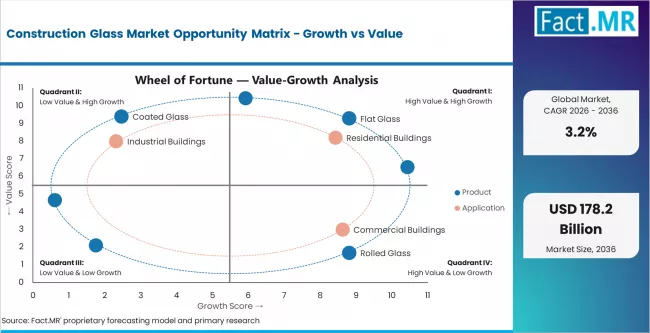
Construction Glass Market Opportunity Matrix Growth Vs Value | Source: Fact.MR
Key Factors Driving Growth
- Residential buildings account for 41.
- Energy efficient glass accounts for 37.
- The float process accounts for 54.
Key Market Constraints
- Price pressure from competitive alternatives and cost-sensitive buyers affects margins in entry-level segments.
- Supply chain concentration and material availability create procurement uncertainties in certain product categories.
- Regulatory compliance complexity and regional specification differences increase market entry costs.
Key Opportunity Areas
- Commercial building facade design increasingly specifies large-format, high-performance glass curtain walls that maximize natural light while meeting thermal and solar control requirements.
- Medium thickness glass accounts for 48.
- Smart glass technologies including electrochromic, thermochromic, and photochromic glazing represent the premium product frontier in construction glass.
Segment-wise Analysis of the Construction Glass Market
- Flat Glass accounts for 36.9% of the product segment in 2026.
- Residential Buildings accounts for 41.7% of the application segment in 2026.
- Medium Thickness Glass accounts for 48.2% of the thickness segment in 2026.
The construction glass market is segmented by product, application, thickness, manufacturing, functionality, and region. Flat Glass leads by value in the near term, while Energy Efficient Glass in functionality is expected to shape medium-term growth as specifications evolve and application requirements expand.
Which Product Segment Dominates the Construction Glass Market?
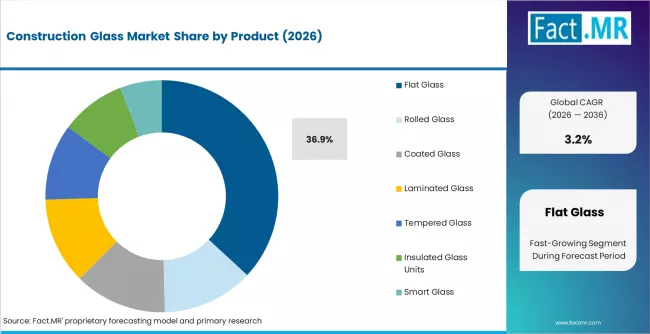
Construction Glass Market Analysis By Product | Source: Fact.MR
Flat Glass accounts for 36.9% of the product segment in 2026. This leadership is supported by strong demand fundamentals, established buyer preference, and application depth across major end-use categories. The segment benefits from a combination of performance characteristics, price accessibility, and compatibility with existing infrastructure that sustains its leading position in both mature and emerging markets.
The segment is expected to maintain its leading position through the forecast period as demand patterns continue to favor established formats with proven operational track records. Buyer procurement criteria in the highest-volume applications prioritize reliability, specification compliance, and total cost of ownership, all of which favor this segment's continued market share leadership.
Which Application Segment Dominates the Construction Glass Market?
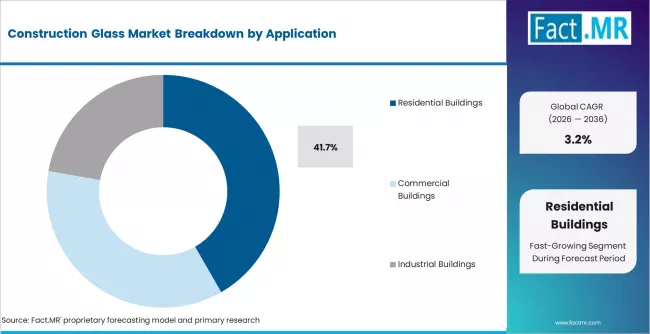
Construction Glass Market Analysis By Application | Source: Fact.MR
Residential Buildings accounts for 41.7% of the application segment in 2026. This leadership is supported by strong demand fundamentals, established buyer preference, and application depth across major end-use categories. The segment benefits from a combination of performance characteristics, price accessibility, and compatibility with existing infrastructure that sustains its leading position in both mature and emerging markets.
The segment is expected to maintain its leading position through the forecast period as demand patterns continue to favor established formats with proven operational track records. Buyer procurement criteria in the highest-volume applications prioritize reliability, specification compliance, and total cost of ownership, all of which favor this segment's continued market share leadership.
Which Product Trend is Shaping the Next Phase of Growth in the Construction Glass Market?
Smart glass technologies including electrochromic, thermochromic, and photochromic glazing represent the premium product frontier in construction glass. Electrochromic glass that changes tint in response to electrical signals allows building operators to manage solar heat gain and glare without blinds or external shading. Smart glass commands 5 to 10 times the price of standard low-E insulating units but delivers measurable energy savings and occupant comfort benefits. Commercial adoption is growing in high-specification office buildings and hospitality projects where the investment is justified by energy performance and tenant value.
This shift reflects a broader change in buyer expectations and operational priorities. As specifications evolve and application requirements expand, this trend is expected to create new competitive differentiation points and reshape market dynamics across both established and emerging regional markets.
Regional Outlook Across Key Markets
Top Country Growth Comparison Construction Glass Market Cagr (2026 2036) | Source: Fact.MR
- North America: Energy code updates raise glazing performance specifications progressively.
- Europe: EPBD directive drives the most stringent glazing specifications globally.
- Asia Pacific: China and India construction activity drives the largest glass demand volumes.
CAGR Table
| Country | CAGR (%) |
|---|---|
| Mexico | 3.4% |
| Germany | 3.1% |
| France | 2.9% |
| UK | 2.7% |
| South Korea | 2.6% |
Source: Fact.MR analysis. Updated May 18, 2026
Source: Fact MR (FMR) analysis, based on proprietary forecasting model and primary research.
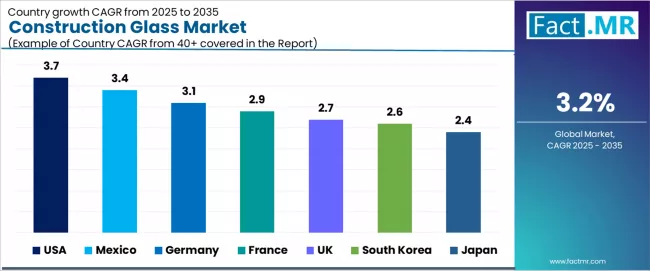
Construction Glass Market Cagr Analysis By Country | Source: Fact.MR
Construction Glass Demand Outlook in Mexico
The Mexico construction glass market is projected to grow at a CAGR of 3.4% through 2036, making it the fastest-growing country in the study. Demand is driven by residential construction, nearshoring-linked commercial building, and growing adoption of energy-efficient glazing specifications.
- Residential construction drives core glass demand.
- Nearshoring-linked commercial building creates premium procurement.
- Energy-efficient glazing adoption is growing.
Germany Construction Glass Market Demand Analysis
The Germany construction glass market is projected to grow at a CAGR of 3.1% through 2036. Demand is driven by building energy renovation, commercial facade specification, and residential construction. Germany mandates high-performance glazing in both new construction and renovation.
- Building energy renovation drives glazing replacement demand.
- Commercial facade specifications support premium glass procurement.
- High-performance glazing mandates shape all new construction.
France Construction Glass Market Growth Outlook
The France construction glass market is projected to grow at a CAGR of 2.9% through 2036. Demand is supported by residential construction, commercial building, and energy renovation programs. French building codes mandate progressively higher glazing performance.
- Residential construction and renovation sustain core demand.
- Energy renovation programs create glazing replacement procurement.
- Building codes mandate progressively higher glass performance.
United Kingdom Construction Glass Market Assessment
The UK construction glass market is projected to grow at a CAGR of 2.7% through 2036. Demand is supported by residential construction, commercial facade projects, and energy efficiency retrofit programs. Building regulations progressively tighten glazing performance requirements.
- Residential construction drives core glass demand.
- Commercial facade projects support premium glass procurement.
- Energy efficiency retrofit programs create replacement demand.
South Korea Construction Glass Market Trends
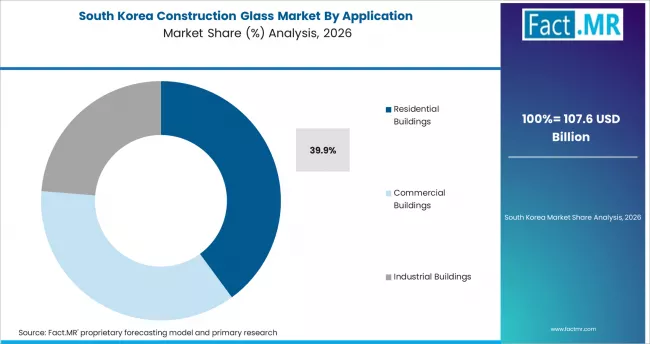
Construction Glass Market South Korea Market Share Analysis By Application | Source: Fact.MR
The South Korea construction glass market is projected to grow at a CAGR of 2.6% through 2036. Demand is driven by commercial building construction, residential development, and growing energy-efficient glazing adoption. South Korean buyers prioritize thermal performance and aesthetic quality.
- Commercial building construction drives premium glass demand.
- Residential development sustains core market volume.
- Energy-efficient glazing adoption supports specification upgrades.
Competitive Benchmarking and Company Positioning
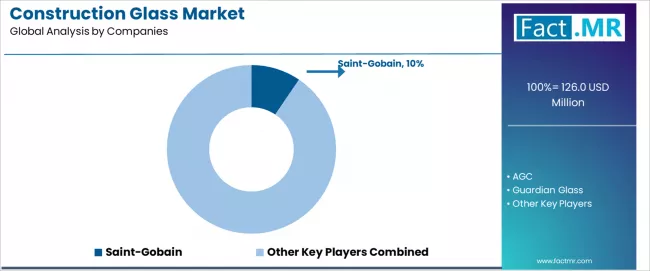
Construction Glass Market Analysis By Company | Source: Fact.MR
Construction Glass Market Analysis By Company
- Saint-Gobain, AGC, Guardian Glass, and NSG Group hold dominant positions through integrated float glass manufacturing, comprehensive coated and processed glass portfolios, and established relationships with construction companies, facade contractors, and window manufacturers globally.
- Xinyi Glass, Central Glass, Vitro, and Sisecam compete through regional manufacturing strength, cost competitiveness, and growing capability in coated and energy-efficient glass products.
- Competition is shaped by manufacturing scale, coating technology breadth, distribution reach, and the ability to provide architectural specification support. Float glass manufacturing concentration creates a supply structure where the top 5 manufacturers control the majority of global capacity. Downstream processing and coating capability differentiates premium positioning. Energy-efficient product portfolio breadth is becoming a competitive necessity as building codes tighten.
Competition is shaped by manufacturing scale, coating technology breadth, distribution reach, and the ability to provide architectural specification support. Float glass manufacturing concentration creates a supply structure where the top 5 manufacturers control the majority of global capacity. Downstream processing and coating capability differentiates premium positioning. Energy-efficient product portfolio breadth is becoming a competitive necessity as building codes tighten.
Key Companies in the Construction Glass Market
- Saint-Gobain, AGC, Guardian Glass, NSG Group.
- Xinyi Glass, Central Glass Co., Ltd., Vitro S.A.B., Taiwan Glass Ind. Corp..
- Sisecam, Schott AG.
Recent Industry Developments
- Saint-Gobain – Product Launch / Advanced Low-E Glass (2025)
- Saint-Gobain introduced a next-generation triple-silver low-emissivity glass with improved solar control and thermal insulation performance for commercial facade and residential window applications.
- AGC – Technology Enhancement / Electrochromic Smart Glass (2025)
- AGC advanced its electrochromic smart glass technology for commercial building applications, offering improved switching speed and expanded color range for dynamic facade control.
- Xinyi Glass – Capacity Expansion / Float Line Investment (2026)
- Xinyi Glass commenced construction of a new float glass production line to expand capacity for both domestic Chinese construction demand and growing export markets across Asia Pacific.
Leading Companies Shaping the Construction Glass Market
- Saint-Gobain
- AGC
- Guardian Glass
- NSG Group
- Xinyi Glass
- Central Glass Co., Ltd.
- Vitro S.A.B.
- Taiwan Glass Ind. Corp.
- Sisecam
- Schott AG
Sources and Research References
- Saint-Gobain. Product portfolio and market activity updates.
- AGC. Technology and product development announcements.
- Guardian Glass. Product and market expansion updates.
- Industry association statistics, regulatory publications, trade data, customs databases, and company product catalogs.
- Primary interviews with manufacturers, distributors, system integrators, and end users.
This bibliography is provided for reader reference and is not exhaustive. The full report contains the complete reference list and detailed citations.
Key Questions This Report Addresses
- What is the current and future size of the Construction Glass Market?
- How fast is the Construction Glass Market expected to grow between 2026 and 2036?
- Which product type is likely to lead the market by 2026?
- Which application segment is expected to account for the highest demand by 2026?
- What factors are driving demand globally?
- How is technology evolution influencing the market?
- Why are Mexico and Germany emerging as the fastest-growing markets?
- Which countries are projected to show the fastest growth through 2036?
- Who are the key companies active in the Construction Glass Market?
- How does Fact.MR estimate and validate the market forecast?
Construction Glass Market Definition
The construction glass market covers the global and regional market for construction glass products and systems used across manufacturing and functionality categories. It includes analysis across product type, application, end use, and regional demand patterns.
Construction Glass Market Inclusions
- The scope covers global and regional market size and forecasts for 2026 to 2036 across product, application, thickness, manufacturing, functionality, and region.
- It includes regional demand analysis across major geographies, based on factors such as industrial activity, end-use application demand, regulatory conditions, and infrastructure investment.
- The report includes pricing and cost analysis across entry-level, mid-range, and premium products, including component costs and operational expenditure considerations.
- It covers technology trends, market drivers and constraints, and the competitive landscape, including product portfolios, pricing strategy, geographic reach, and distribution expansion of leading players.
Construction Glass Market Exclusions
- The scope excludes products and systems not classified within the construction glass category or those serving fundamentally different end-use applications.
- It excludes software-only solutions, standalone analytics platforms, and services sold independently without associated hardware or system components.
- The report excludes custom-built, non-commercial, and prototype-stage systems without established market presence or commercial sales records.
Construction Glass Market Research Methodology
- The methodology combines secondary research, primary interviews, and forecast modelling.
- It draws on 120+ secondary sources and benchmarks 65+ company product portfolios.
- Market sizing covers 30+ countries through a demand-side model, supported by top-down validation.
- Key inputs include end-use application demand, regulatory conditions, infrastructure investment patterns, and product adoption trends.
- The model cross-checks demand with shipments, pricing trends, channel mix, and product launches.
- Primary validation includes 25+ interviews across manufacturers, distributors, and end users.
- Final estimates go through trade-flow checks, sales-pattern review, and sensitivity testing.
Segmentation
Scope of Analysis
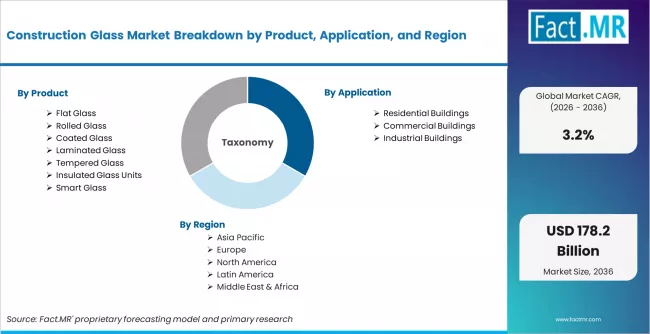
Construction Glass Market Breakdown By Product, Application, And Region | Source: Fact.MR
| Parameter | Details |
|---|---|
| Quantitative Units | USD 130.0 billion to USD 178.2 billion, at a CAGR of 3.2% |
| Market Definition | The Construction Glass Market covers products and systems used across product, application, thickness, manufacturing, functionality, and regional categories. |
| Regions Covered | North America, Latin America, Europe, East Asia, South Asia and Pacific, Middle East and Africa |
| Countries Covered | Mexico, Germany, France, UK, South Korea, Japan, 30 plus countries |
| Key Companies | Saint-Gobain, AGC, Guardian Glass, NSG Group, Xinyi Glass, Central Glass Co., Ltd., Vitro S.A.B., Taiwan Glass Ind. Corp., Sisecam, Schott AG |
| Forecast Period | 2026 to 2036 |
| Approach | Hybrid demand-side and top-down methodology built on country-level application demand, product benchmarking, pricing analysis, shipment validation, and primary interviews across manufacturers, distributors, and end users |
Source: Fact.MR analysis. Updated May 18, 2026
Construction Glass Market Segmentation
-
Construction Glass Market Segmented by Product:
- Flat Glass
- Rolled Glass
- Patterned Glass
- Wired Glass
- Coated Glass
- Low Emissivity Glass
- Hard Coat Low Emissivity Glass
- Soft Coat Low Emissivity Glass
- Reflective Glass
- Low Emissivity Glass
- Laminated Glass
- Safety Laminated Glass
- Acoustic Laminated Glass
- Tempered Glass
- Heat Strengthened Glass
- Fully Tempered Glass
- Insulated Glass Units
- Double Glazed Units
- Triple Glazed Units
- Smart Glass
- Electrochromic Glass
- Thermochromic Glass
- Photochromic Glass
-
Construction Glass Market Segmented by Application:
- Residential Buildings
- Windows And Doors
- Facades And Curtain Walls
- Commercial Buildings
- Office Buildings
- Retail Spaces
- Industrial Buildings
- Factories And Warehouses
- Public Infrastructure
- Airports And Railway Stations
- Residential Buildings
-
Construction Glass Market Segmented by Glass Thickness:
- Medium Thickness Glass
- 4 To 10 Millimeters
- Thin Glass
- Up To 4 Millimeters
- Thick Glass
- Above 10 Millimeters
- Medium Thickness Glass
-
Construction Glass Market Segmented by Manufacturing Process:
- Float Process
- Rolled Process
- Coating Process
- Low Emissivity Coating
- Reflective Coating
- Lamination Process
- Tempering Process
-
Construction Glass Market Segmented by Functionality:
- Energy Efficient Glass
- Solar Control Glass
- Thermal Insulation Glass
- Safety And Security Glass
- Fire Resistant Glass
- Bullet Resistant Glass
- Acoustic Insulation Glass
- Decorative Glass
- Colored Glass
- Textured Glass
- Energy Efficient Glass
-
Construction Glass Market by Region:
- North America
- USA
- Canada
- Mexico
- Latin America
- Brazil
- Chile
- Rest of Latin America
- Western Europe
- Germany
- UK
- Italy
- Spain
- France
- Nordic
- BENELUX
- Rest of Western Europe
- Eastern Europe
- Russia
- Poland
- Hungary
- Balkan & Baltic
- Rest of Eastern Europe
- East Asia
- China
- Japan
- South Korea
- South Asia and Pacific
- India
- ASEAN
- Australia & New Zealand
- Rest of South Asia and Pacific
- Middle East & Africa
- Kingdom of Saudi Arabia
- Other GCC Countries
- Turkiye
- South Africa
- Other African Union
- Rest of Middle East & Africa
- North America
Frequently Asked Questions
How big is the construction glass market in 2025?
What will be the size of the construction glass market in 2036?
How much will the construction glass market grow between 2026 and 2036?
What are the key product types in the construction glass market?
Which segment will contribute significant share in the construction glass market in 2026?
Which are the fastest-growing countries in the construction glass market?
Who are the key companies in the construction glass market?
Who worked on this report


Preview the report firsthand - request a free sample
Free SampleGet the brochure for pricing and purchase details
Download PDF