- Base Value(2025): 1.4 Bn
- Estimated Value(2026): 1.5 Bn
- Forecast Value (2036): 2.4 Bn
- CAGR (2026 - 2036): 5.2%
Zinc Rich Primers Market Forecast and Outlook 2026 to 2036
In 2025, the zinc rich primers market was valued at USD 1.4 billion. Based on Fact.MR analysis, demand for zinc rich primers is estimated to grow to USD 1.5 billion in 2026 and USD 2.4 billion by 2036. Fact.MR projects a CAGR of 5.2% during the forecast period. Value expansion occurs where protective coatings are specified for corrosion mitigation and long maintenance intervals in infrastructure, marine and industrial applications.
The market expands by USD 1.0 billion over the decade, a sustained progression without abrupt swings. Demand is underpinned by regulatory corrosion protection standards and asset refurbishment cycles, while per unit pricing reflects zinc content and formulation complexity. Growth is constrained where environmental rules limit volatile organic compound emissions, creating segmentation in performance pricing between compliant and conventional products.
As Tim Knavish, chairman and chief executive officer of PPG, said regarding product direction in the industrial sector, “PPG delivered sustainably advantaged solutions meeting the demand from customers to improve their productivity and reduce overall value chain impacts,” noting that these solutions comprised a substantial share of total sales in 2024, including lower VOC and powder based primers aligned with industrial coatings demand. [1]
India records the fastest growth at 6.6% CAGR, driven by bridge rehabilitation and rail asset maintenance standards. Vietnam follows at 6.1% on port and maritime coatings demand, and China at 6.0% through fabrication and export manufacturing. Indonesia posts 5.9% as scheduled upkeep of national infrastructure supports usage, while Saudi Arabia grows at 5.4% due to energy sector maintenance specifications. Mature markets including the United States at 3.7%, Germany at 2.8%, and Japan at 2.4% remain replacement driven, constrained by long service life coatings cycles and strict project specifications.
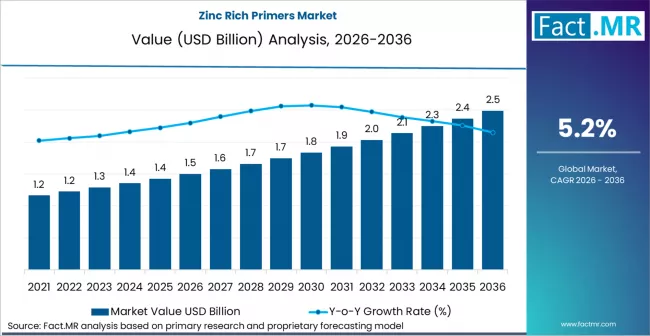
Zinc Rich Primers Market Market Value Analysis | Source: Fact.MR
Zinc Rich Primers Market Definition
The zinc rich primers market covers the manufacture and sale of protective coating materials formulated with a high proportion of metallic zinc dust, as defined under ISO 12944 corrosion protection standards [2]. These primers are applied to steel and iron surfaces so that zinc corrodes before the base metal, reducing rust formation. They are used where long term corrosion control is required for exposed metal assets. Common end uses include bridges, pipelines, storage tanks, marine structures, and industrial facilities governed by infrastructure and asset protection specifications.
Zinc Rich Primers Market Inclusions
The report covers global and regional market size estimates in both volume and value terms, with a forecast period from 2026 to 2036. Segmentation includes binder systems such as inorganic silicate and organic resin primers referenced in ASTM D520 zinc dust specifications [3]. Application coverage spans infrastructure, marine assets, and industrial facilities, while end use industries include construction, oil and gas, and power generation, aligned with international steel consumption and trade data from UN Comtrade [4]
Zinc Rich Primers Market Exclusions
The scope excludes anticorrosive coatings that do not rely on zinc as the primary corrosion control mechanism, including general purpose metal primers regulated separately under environmental coating rules issued by the US Environmental Protection Agency [5]. Finished topcoats, sealants, and bundled multi-layer coating systems are excluded. Consumer grade paints, do it yourself coatings, laboratory scale formulations, and experimental surface treatments without documented industrial deployment under regulatory frameworks are not considered.
Zinc Rich Primers Market Research Methodology
- Primary Research: Primary research involved interviews with industrial coating manufacturers, zinc powder suppliers, and corrosion engineers supplying materials under infrastructure procurement frameworks published by national transport and port authorities such as the US Federal Highway Administration
- Desk Research: Desk research relied on ISO coating standards, ASTM material specifications, public infrastructure tenders, defense procurement records, and company annual reports and technical datasheets filed with securities regulators such as the US Securities and Exchange Commission.
- Market Sizing and Forecasting: Market sizing applied a hybrid top down and bottom up model using steel production data from the World Steel Association and corrosion protection coverage rates specified in ISO 12944.
Data Validation and Update Cycle
Outputs were validated through cross checks against UN Comtrade trade statistics, regulatory filings, and government infrastructure spending disclosures, with updates applied when verified public data sources release revisions.
Summary of zinc rich primers market
Market definition
- The zinc rich primers market covers industrial protective coatings formulated with high metallic zinc content that provide sacrificial corrosion protection for steel assets used in infrastructure, marine, energy, and industrial applications, as per Fact.MR, aligned with ISO 12944 corrosion protection standards
Demand drivers
- Infrastructure owners and EPC contractors specify zinc rich primers to meet corrosion protection requirements under ISO 12944 and related standards tied to asset life extension mandates, based on Fact.MR analysis
- Oil and gas operators, marine authorities, and power utilities procure zinc rich primers as part of scheduled maintenance cycles rather than new construction activity, as documented in public infrastructure and asset preservation frameworks
- Environmental and worker safety regulations limiting VOC emissions are shifting buyer specifications toward waterborne and high-solid zinc rich primer formulations, as per Fact.MR
Key segments analyzed
- Chemistry or product type: Epoxy zinc rich primers lead consumption with about 50% share in 2026 due to compatibility with multi-layer coating systems and corrosion test standards, based on Fact.MR
- End use or application: Marine and offshore applications account for roughly 30% of demand due to saltwater exposure and high humidity corrosion risk, as per Fact.MR
- Geography: Asia Pacific records the fastest growth, led by India, China, and Vietnam, while North America and Europe remain replacement-driven markets, according to Fact.MR analysis
Analyst opinion at Fact.MR
- Shambhu Nath Jha, Principal Consultant at Fact.MR, opines, ‘CXOs will find that zinc rich primer demand follows regulated maintenance schedules, where compliance with corrosion standards and asset refurbishment cycles matters more than new steel additions.’
Strategic implications and executive takeaways
- Fact.MR is of the opinion that suppliers should align capacity planning with maintenance-driven procurement rather than headline construction cycles
- Fact.MR opines that product portfolios should prioritize epoxy and compliant low-emission systems to remain eligible for specification-led tenders
- Fact.MR analysts recommend strengthening technical service capabilities and approval-track records to secure repeat participation in infrastructure and energy maintenance contracts
Methodology
- Based on Fact.MR’s report, estimates draw on primary interviews with coating manufacturers, zinc powder suppliers, and corrosion engineers supplying public infrastructure projects
- Fact.MR analysis integrates ISO standards, ASTM material specifications, and company disclosures filed with securities regulators
Outputs were validated through cross-checks with steel production data and international trade statistics
Segmental Analysis
Zinc rich primers market analysis by chemistry
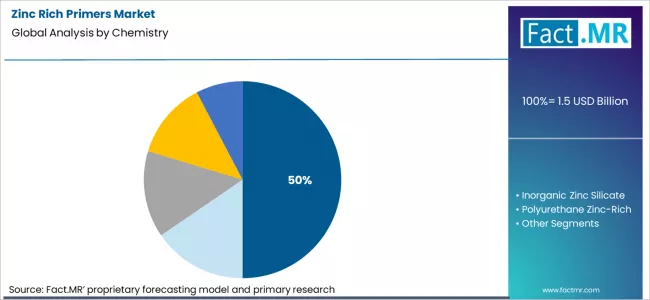
Zinc Rich Primers Market Analysis By Chemistry | Source: Fact.MR
Based on FACT.MR's zinc rich primers market report, consumption of epoxy zinc-rich primers is estimated to hold 50.0% share in 2026. FACT.MR analysts note epoxy zinc-rich primers are widely chosen because formulations with high zinc content provide measurable sacrificial cathodic protection for steel surfaces, allowing coating systems to operate longer before maintenance. As per FACT.MR, buyers in protective coatings select epoxy zinc-rich products to meet standardized corrosion protection requirements under widely recognized industrial standards and to ensure compatibility with multi-layer top coats on metal infrastructure.
- Market segmentation data: Published global industry segmentation shows epoxy zinc-rich primers as a primary class among resin types used for protective coatings worldwide, as listed in official market categories.
- Product specification: Industry primer products certified to meet DIN EN ISO 12944-4 contain high zinc by weight in dry film, supporting corrosion protection across service environments.
- Zinc-rich coating classification: As described in standard technical resources, zinc-rich coatings including organic epoxy binders are classified by the high proportion of zinc dust they contain, enabling electrochemical protection mechanisms relevant to active corrosion environments.
Zinc rich primers market analysis by end use
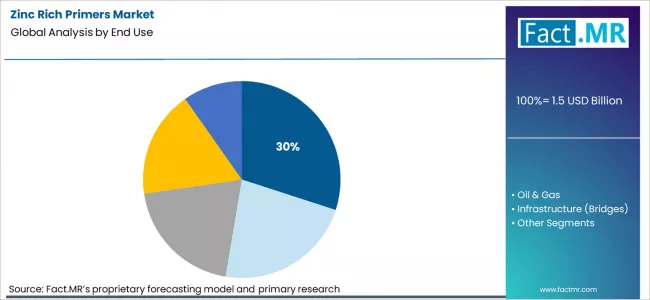
Zinc Rich Primers Market Analysis By End Use | Source: Fact.MR
Based on FACT.MR's report, consumption of zinc rich primers in marine and offshore applications is estimated to hold 30% share in 2026. FACT.MR is of the opinion that this segment continues to lead because steel assets exposed to saltwater and high humidity environments demand coating systems that incorporate high zinc content for measurable sacrificial protection. As per FACT.MR, buyers in large marine projects specify zinc-rich primers as the foundational protective layer in multi-coat systems to achieve extended service life in corrosive service categories.
- ISO corrosion protection standards: Protective coatings including zinc-rich primers are referenced by the ISO 12944 standard for corrosion protection of steel structures exposed to aggressive environments including marine conditions.
- Primer application context: Zinc-rich coatings are widely documented in industrial literature for their use on marine and offshore steel structures where cathodic protection is required as part of a protective coating system.
- Market size context: The global zinc-rich primer market size has been tracked in published industry reports as growing year-on-year, reflecting sustained demand across protective end uses including maritime applications.
Zinc rich primers market drivers, restraints, and opportunities
Fact.MR analysis indicates that the zinc rich primers market has evolved as a structurally stable segment within protective coatings, primarily driven by corrosion mitigation needs in heavy industrial end uses such as infrastructure, oil and gas, and shipbuilding. The market exists at its current size because zinc rich primers provide cathodic protection at a lower total lifecycle cost than many alternatives, supporting long service intervals for steel substrates. FACT.MR analysts observe that recent valuation levels reflect compliance with industrial corrosion standards such as SSPC and ISO corrosion test regimens, leading to specification requirements in long-cycle asset classes rather than speculative demand
FACT.MR is of the opinion that the market is defined by a shift between traditional solvent-borne zinc rich products and higher-performance, low-emission alternatives. Based on FACT.MR’s report, demand for conventional formulations is restrained where environmental and worker safety rules limit VOC emissions
Growth is occurring in water-reducible and high-solid zinc rich primers that meet stricter coating performance benchmarks, even though these products often carry higher per-unit pricing due to formulation complexity. As per FACT.MR, this pricing differential across product classes results in moderate value growth that partially compensates for slower tonnage uptake where standard primers are displaced by compliant alternatives.
- Regulatory emissions standards: FACT.MR analysts note that VOC limits under regulations such as the US EPA National Emission Standards for Hazardous Air Pollutants influence buyer specifications, pushing demand toward waterborne and high-solid zinc rich primers that meet environmental compliance
- Infrastructure-driven replacement cycles: Based on FACT.MR’s report, corrosion protection requirements for bridges, rail assets, and industrial plants in North America and Europe are sustaining steady demand by aligning coating renewal cycles with long-term maintenance
- Asia Pacific fabrication growth: FACT.MR opines that expanding heavy fabrication activity in China, India, and Southeast Asia is encouraging adoption of zinc rich primers to support export-oriented manufacturing, where international corrosion standards are specified by global buyers
Regional Analysis
Based on regional assessment, the zinc rich primers sector is analyzed across North America, Latin America, Europe, East Asia, South Asia, Oceania, and the Middle East & Africa, spanning more than 40+ countries. Regional performance varies according to infrastructure activity, regulatory stringency, and industrial coatings demand. The report also presents a comparative market attractiveness evaluation grounded in region-specific demand trends.
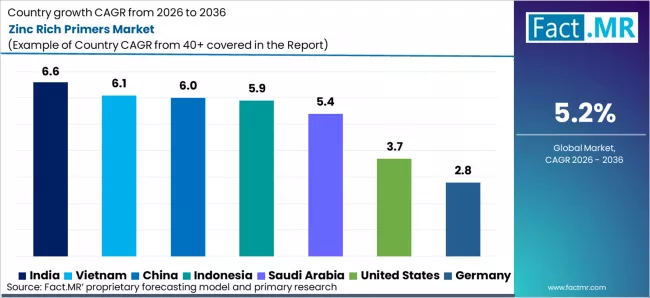
Zinc Rich Primers Market Cagr Analysis By Country | Source: Fact.MR
| Country | CAGR |
|---|---|
| India | 6.6% |
| China | 6.0% |
| Vietnam | 6.1% |
| Indonesia | 5.9% |
| Saudi Arabia | 5.4% |
| United States | 3.7% |
| Germany | 2.8% |
| Japan | 2.4% |
Source: Fact.MR analysis. Updated Feb 16, 2026
Source: Fact.MR analysis, based on proprietary forecasting models and primary research
Asia Pacific zinc rich primers market analysis
Asia Pacific acts as the global production epicenter for zinc rich primers, supported by infrastructure expansion, export manufacturing, and shipbuilding activity. Regional supply benefits from proximity to zinc processing and industrial coatings capacity. Asian Paints, Kansai Nerolac, and Nippon Paint hold strong positions through contractor networks and OEM-aligned industrial coatings portfolios.
- India: Demand for zinc rich primers in India is projected to rise at 6.6% CAGR through 2036. Growth is supported by bridge rehabilitation tenders under revised Ministry of Road Transport guidelines issued in March 2021 and corrosion protection norms adopted by Indian Railways in October 2022, as per Fact.MR.
- China: Demand for zinc rich primers in China is projected to rise at 6.0% CAGR through 2036. Uptake is tied to steel durability codes issued by the Ministry of Housing in July 2021 and transmission tower coating standards revised by State Grid Corporation in January 2023, according to Fact.MR.
- Vietnam: Demand for zinc rich primers in Vietnam is projected to rise at 6.1% CAGR through 2036. Port infrastructure standards approved by the Ministry of Transport in June 2020 and offshore coating requirements issued by PetroVietnam in September 2022 support usage, based on Fact.MR analysis.
- Indonesia: Demand for zinc rich primers in Indonesia is projected to rise at 5.9% CAGR through 2036. Growth is linked to corrosion protection rules for National Strategic Projects issued in August 2021 and refinery maintenance specifications updated by Pertamina in February 2023, as per Fact.MR.
- Japan: Demand for zinc rich primers in Japan is projected to rise at 2.4% CAGR through 2036. Consumption is sustained by bridge corrosion guidelines revised by MLIT in April 2020 and rolling stock maintenance standards reaffirmed by Japan Railways Group in October 2021, according to Fact.MR.
Fact.MR’s analysis of the zinc rich primers market in Asia Pacific consists of country-wise assessment that includes India, China, Vietnam, Indonesia, and Japan. Readers can find standards adoption trends, public procurement activity, and application-level demand patterns.
Middle East zinc rich primers market analysis
The Middle East functions as an asset-maintenance-driven region where zinc rich primers are specified for oil, gas, and desalination infrastructure. Demand is shaped by lifecycle maintenance rather than new construction. Regional procurement is influenced by energy operators and industrial maintenance contractors.
- Saudi Arabia: Demand for zinc rich primers in Saudi Arabia is projected to rise at 5.4% CAGR through 2036. Usage is driven by Saudi Aramco coating standards revised in January 2021 and desalination plant retrofit specifications issued by the National Water Company in July 2022, based on Fact.MR.
Fact.MR’s analysis of the zinc rich primers market in the Middle East consists of country-wise assessment that includes Saudi Arabia. Readers can find energy-sector maintenance trends and coating specification requirements.
North America zinc rich primers market analysis
North America operates as a regulation-led replacement market where zinc rich primers are tied to infrastructure refurbishment and defense maintenance. Federal procurement standards and lifecycle cost control shape demand. PPG Industries and Sherwin-Williams maintain strong positions across transportation and public works coatings.
- United States: Demand for zinc rich primers in the United States is projected to rise at 3.7% CAGR through 2036. Growth is supported by bridge rehabilitation funding under the Infrastructure Investment and Jobs Act enacted in November 2021 and naval maintenance coating standards reaffirmed in March 2022, as per Fact.MR.
Fact.MR’s analysis of the zinc rich primers market in North America consists of country-wise assessment that includes the United States. Readers can find federal procurement trends and application-based demand analysis.
Europe zinc rich primers market analysis
Europe acts as a standards-driven refurbishment region where zinc rich primers are specified through regulated maintenance cycles. Demand centers on asset life extension rather than capacity growth. BASF and Hempel retain strong positions through infrastructure and industrial maintenance coatings.
- Germany: Demand for zinc rich primers in Germany is projected to rise at 2.8% CAGR through 2036. Consumption is supported by bridge maintenance directives updated by the Federal Ministry of Transport in June 2020 and rail infrastructure coating specifications reaffirmed by Deutsche Bahn in February 2022, according to Fact.MR.
Fact.MR’s analysis of the zinc rich primers market in Europe consists of country-wise assessment that includes Germany. Readers can find regulatory frameworks, refurbishment trends, and application-level demand insights.
Competitive Aligners for Market Players
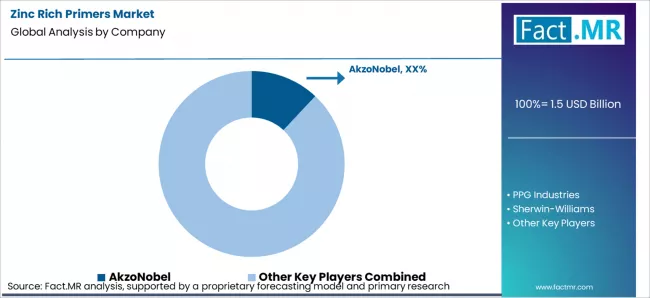
Zinc Rich Primers Market Analysis By Company | Source: Fact.MR
The zinc rich primers segment is moderately concentrated, with effective competition limited to a small group of multinational coatings suppliers serving infrastructure, marine, and industrial maintenance demand. Participation is governed by specification led procurement, where approved vendor lists restrict access to suppliers with certified inorganic and epoxy zinc systems. Competition centers on applied cost, service coverage, and compliance history rather than formulation differentiation. Scale and regional presence determine access to large tenders and influence pricing outcomes.
Structural advantages accrue to suppliers with integrated formulation, manufacturing, and technical service capabilities. Companies operating global production networks and captive development functions manage zinc powder sourcing risk and maintain consistency across primers, intermediates, and topcoats. This integration supports execution across regions and reduces exposure to project delays, while smaller producers remain dependent on spot procurement and episodic project demand.
Buyer leverage remains high. Asset owners and EPC contractors apply dual sourcing and framework agreements to limit dependency. Pricing discussions focus on lifecycle maintenance cost, constraining supplier margins.
Recent developments
- The report includes full coverage of key trends from competitive benchmarking. Some of the recent developments covered in the reports:
- PPG showcased its PRIMERON® Optimal zinc-rich powder primer at FABTECH 2025. This product is a significant market pivot because it achieves ISO C5 (extreme corrosivity) protection with much lower zinc density, improving transfer efficiency by 85%. [6]
- Sherwin-Williams launched its Global Core product line, ensuring that their high-performance Inorganic Zinc Primers have identical formulations and performance standards worldwide. [7]
Key Players in zinc rich primers market
- AkzoNobel
- PPG Industries
- Sherwin-Williams
- Jotun
- Hempel
- Nippon Paint
- Kansai Paint
- Axalta
- RPM International (Carboline)
- Sika
Bibliography
- [1] PPG Industries, Inc. (2025). PPG highlights 2024 performance during annual meeting of shareholders. PPG Industries.
- [2] International Organization for Standardization. (2018). ISO 12944-4: Paints and varnishes - Corrosion protection of steel structures by protective paint systems - Part 4: Types of surface and surface preparation. ISO.
- [3] ASTM International. (2023). ASTM D520-23: Standard specification for zinc dust pigment. ASTM International.
- [4] United Nations Statistics Division. (2024). UN Comtrade database. United Nations.
- [5] U.S. Environmental Protection Agency. (2024). Regulations for coatings and surface coating operations. EPA.
- [6] PPG Industries, Inc. (2025). PPG to showcase industrial finishing innovations at FABTECH 2025. PPG Industries.
- [7] Sherwin-Williams Company. (2024). Sherwin-Williams expands Global Core™ product offering for protective and marine coatings. Sherwin-Williams.
Segmentation
Scope of the Report
| Metric | Value |
|---|---|
| Quantitative Units | USD 1.5 billion (2026) to USD 2.4 billion (2036), at a CAGR of 5.2% |
| Market Definition | The zinc rich primers market covers industrial protective coatings formulated with high metallic zinc content to provide sacrificial corrosion protection for steel assets, including bridges, pipelines, storage tanks, marine structures, and industrial facilities, aligned with ISO 12944 corrosion protection standards. |
| Chemistry Segmentation | Epoxy Zinc-Rich, Inorganic Zinc Silicate, Polyurethane Zinc-Rich, Waterborne Zinc-Rich, Other |
| End Use Segmentation | Marine & Offshore, Oil & Gas, Infrastructure (Bridges), Industrial Plants, Power & Utilities |
| Substrate/Application | Structural Steel, Pipelines, Offshore Structures, Rebar/Concrete Steel, Storage Tanks |
| Regions Covered | Asia Pacific, Europe, North America, Latin America, Middle East & Africa |
| Countries Covered | India, China, Japan, South Korea, Indonesia, Australia & New Zealand, ASEAN, Rest of Asia Pacific, Germany, Italy, France, United Kingdom, Spain, Benelux, Nordics, Central & Eastern Europe, Rest of Europe, United States, Canada, Mexico, Brazil, Argentina, Chile, Rest of Latin America, Kingdom of Saudi Arabia, United Arab Emirates, South Africa, Turkey, Rest of Middle East & Africa |
| Key Companies Profiled | AkzoNobel, PPG Industries, Sherwin-Williams, Jotun, Hempel, Nippon Paint, Kansai Paint, Axalta, RPM International (Carboline), Sika |
| Forecast Period | 2026 to 2036 |
| Approach | Hybrid top-down and bottom-up market modeling validated through primary interviews with coating manufacturers, zinc powder suppliers, and corrosion engineers, supported by ISO and ASTM standard references, UN Comtrade trade data, and infrastructure project procurement records. |
Source: Fact.MR analysis. Updated Feb 16, 2026
zinc rich primers market Analysis by Segments
-
Chemistry :
- Epoxy Zinc-Rich
- Inorganic Zinc Silicate
- Polyurethane Zinc-Rich
- Waterborne Zinc-Rich
- Other
-
End Use :
- Marine & Offshore
- Oil & Gas
- Infrastructure (Bridges)
- Industrial Plants
- Power & Utilities
-
Substrate/Application :
- Structural Steel
- Pipelines
- Offshore Structures
- Rebar/Concrete Steel
- Storage Tanks
-
Region :
- Asia Pacific
- India
- China
- Japan
- South Korea
- Indonesia
- Australia & New Zealand
- ASEAN
- Rest of Asia Pacific
- Europe
- Germany
- Italy
- France
- United Kingdom
- Spain
- Benelux
- Nordics
- Central & Eastern Europe
- Rest of Europe
- North America
- United States
- Canada
- Mexico
- Latin America
- Brazil
- Argentina
- Chile
- Rest of Latin America
- Middle East & Africa
- Kingdom of Saudi Arabia
- United Arab Emirates
- South Africa
- Turkey
- Rest of Middle East & Africa
- Asia Pacific
Frequently Asked Questions
How large is the zinc rich primers market in 2026?
What will the zinc rich primers market size be by 2036?
What is the expected CAGR of the zinc rich primers market during the forecast period?
How much absolute value growth will the zinc rich primers market generate over the decade?
What was the market valuation of zinc rich primers in 2025?
Which chemistry segment is poised to lead the zinc rich primers market in 2026?
How significant are marine and offshore applications in overall demand?
Which country is expected to record the fastest growth in the zinc rich primers market?
How does Vietnam compare in terms of growth outlook?
What is the projected growth rate of the zinc rich primers market in China?
How fast is the zinc rich primers market growing in Indonesia?
What is the growth outlook for Saudi Arabia in this market?
How does the United States market perform relative to emerging economies?
What is the expected growth rate of the zinc rich primers market in Germany?
How mature is the zinc rich primers market in Japan?
Which region records the fastest overall growth in the zinc rich primers market?
How does market growth differ between emerging and mature regions?
What drives the steady expansion of the zinc rich primers market?
Does the zinc rich primers market experience volatile growth cycles?
How important are compliance-led specifications to overall market value growth?
Who worked on this report


Preview the report firsthand - request a free sample
Free SampleGet the brochure for pricing and purchase details
Download PDF