Rhizosphere Signal Molecule Enriched Nutrient Market

Rhizosphere Signal Molecule Enriched Nutrient Market Size and Share Forecast Outlook 2026 to 2036

Rhizosphere signal molecule enriched nutrient market is projected to grow from USD 62.2 million in 2026 to USD 357.1 million by 2036, at a CAGR of 19.1%. Cereals will dominate with a 50.2% market share, while granular will lead the form segment with a 43.8% share.

Rhizosphere Signal Molecule Enriched Nutrient Market Forecast and Outlook 2026 to 2036

Projected to grow from USD 62.18 million in 2026 to USD 357.07 million by 2036, the rhizosphere signal molecule enriched nutrient market is advancing at an exceptional CAGR of 19.1%. This growth captures the cutting edge of plant communication science applied to agronomy.

These products infuse conventional fertilizers with specific biochemical signaling compounds that naturally mediate dialogue between plant roots and soil microbes. This targeted chemical signaling orchestrates root architecture, enhances symbiotic relationships, and upregulates plant intrinsic pathways for nutrient acquisition and stress tolerance, moving beyond passive nutrition to active physiological management.

Key Takeaways from the Rhizosphere Signal Molecule Enriched Nutrient Market

  • Market Value for 2026: USD 62.18 Million
  • Market Value for 2036: USD 357.07 Million
  • Forecast CAGR (2026 to 2036): 19.1%
  • Leading Crop Share (2026): Cereals (50%)
  • Leading Form Share (2026): Granular (44%)
  • Leading Sales Channel Share (2026): Ag-Retailers (49%)
  • Key Players in the Market: BASF SE, Syngenta, Corteva, UPL, ICL Group, Novonesis
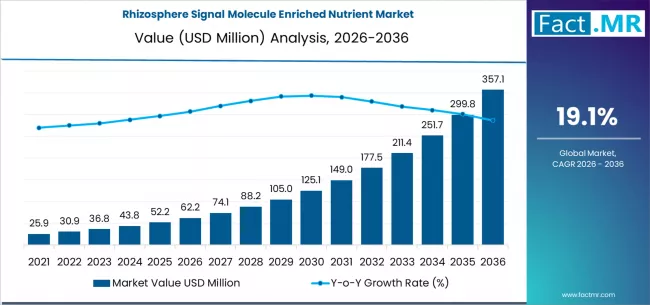
Rhizosphere Signal Molecule Enriched Nutrient Market Market Value Analysis

Cereal crops are the dominant application segment, representing 50% of the market, as their extensive root systems and pivotal role in global food security make them prime candidates for advanced biological optimization.

Granular formulations lead with a 44% share, providing a stable, protective matrix for these often delicate signaling compounds and enabling precise placement in the root zone. Ag-Retailers form the core sales channel at 49%, as their technical staff is essential for explaining the nuanced mode of action and integrating these signaling tools into broader crop management strategies that respect soil biology.

Market expansion is driven by the pursuit of unprecedented nutrient use efficiency and crop resilience. By priming the rhizosphere with specific signals, these enriched nutrients can trigger plants to exude more organic acids to unlock phosphorus, foster stronger associations with mycorrhizal fungi, or accelerate nitrogen assimilation.

This represents a shift from simply feeding the plant to programming its root environment for optimal performance, offering a sophisticated lever to improve yield stability, reduce fertilizer input levels, and build systemic plant health in the face of environmental stresses.

Metric

Metric Value
Market Value (2026) USD 62.18 Million
Market Forecast Value (2036) USD 357.07 Million
Forecast CAGR (2026-2036) 19.1%

Category

Category Segments
Crop Cereals, Oilseeds, Fruits, Vegetables
Form Granular, Liquid, Powder, Suspension
Sales Channel Ag-Retailers, Direct-to-Farmer, Online Marketplaces, Cooperatives
Region North America, Latin America, Western Europe, Eastern Europe, East Asia, South Asia & Pacific, MEA

Segmental Analysis

By Crop, Which System Benefits from Orchestrated Root-Soil Communication?
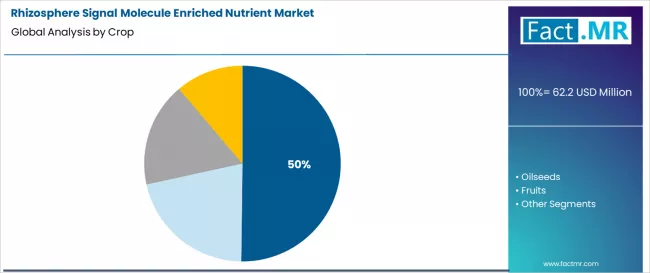
Rhizosphere Signal Molecule Enriched Nutrient Market Analysis By Crop

Cereal crops lead with a 50% share. The high demand and production scale of wheat, rice, and corn justify investment in advanced yield-enabling technologies. Signal molecules can be used to optimize crown root development in cereals, improve foraging efficiency for nitrogen and phosphorus, and enhance associations with beneficial bacteria like Azospirillum. The economic impact of even marginal efficiency gains across millions of hectares of cereals drives significant R&D and product development in this segment.

By Form, Which Provides Optimal Stability for Sensitive Biochemicals?
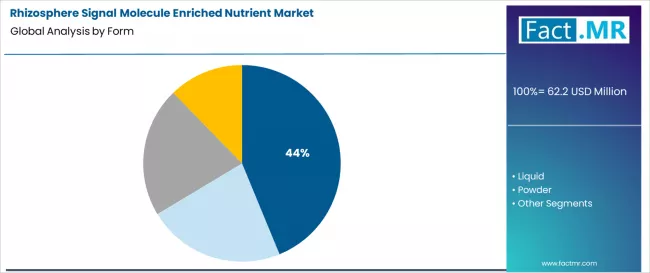
Rhizosphere Signal Molecule Enriched Nutrient Market Analysis By Form

Granular formulations hold the largest share at 44%. The granular matrix acts as a protective delivery vehicle, shielding sensitive signal molecules from UV degradation and rapid microbial breakdown in the soil.

This allows for a more controlled, sustained release of the signaling compounds, ensuring they are present in the rhizosphere during key early growth stages when root architecture and microbial colonization are being established.

By Sales Channel, Who Decodes the Science of Plant Signaling for Growers?

Rhizosphere Signal Molecule Enriched Nutrient Market Analysis By Sales Channel

Ag-Retailers are the pivotal channel, facilitating 49% of sales. The concept of applying signaling molecules is highly sophisticated, requiring an understanding of plant physiology and soil ecology.

Retail agronomists play an indispensable educational role, helping farmers select the right signal blend for their crop and soil challenges, and explaining that the benefits manifest as improved vigor and efficiency rather than an immediate color change or growth spurt typical of direct nutrients.

What are the Drivers, Restraints, and Key Trends of the Market?

The primary driver is the quest for next-level input efficiency that transcends physical or microbial approaches. As the understanding of plant biochemistry deepens, targeting specific genetic and physiological pathways with signal molecules offers a highly precise tool. Regulatory pressures to minimize nutrient runoff and the demand for residue-free, high-quality produce from specialty crops further incentivize adoption of these biological priming agents. The convergence of molecular biology and agronomy makes this advanced intervention possible.

A significant restraint is the high cost of research, synthesis, and stabilization of pure, active signal molecules. Their efficacy can be highly context-dependent, varying with soil type, existing microbiome, and crop genotype, requiring sophisticated matching that may not be feasible for all farmers. The subtlety of their action makes field demonstration and quantification of ROI more challenging than for standard fertilizers, potentially slowing adoption among those who prefer visually dramatic responses.

Key trends include the development of signal molecule cocktails designed to trigger multiple beneficial pathways simultaneously, such as combining a strigolactone analog to stimulate mycorrhization with a flavonoid to attract nitrogen-fixing bacteria. There is a move toward using plant-derived or fermentation-based biosimilars of these compounds to improve sustainability and reduce synthetic chemistry costs. The integration of soil metatranscriptomic testing is also emerging to diagnose which native signaling pathways are deficient and prescribe a targeted molecular correction.

Analysis of the Rhizosphere Signal Molecule Enriched Nutrient Market by Key Countries
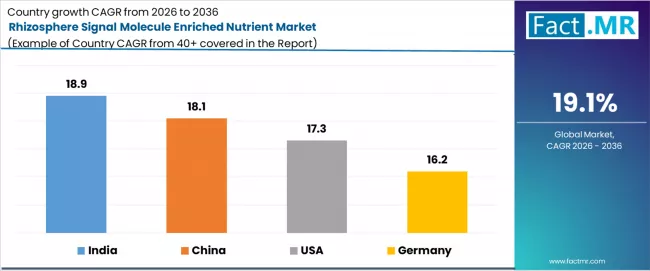
Rhizosphere Signal Molecule Enriched Nutrient Market Cagr Analysis By Country

Country CAGR (2026 to 2036)
India 18.9%
China 18.1%
USA 17.3%
Germany 16.2%

How are USA’s High-Value Crops and Carbon Farming Initiatives Creating a Premium Niche?
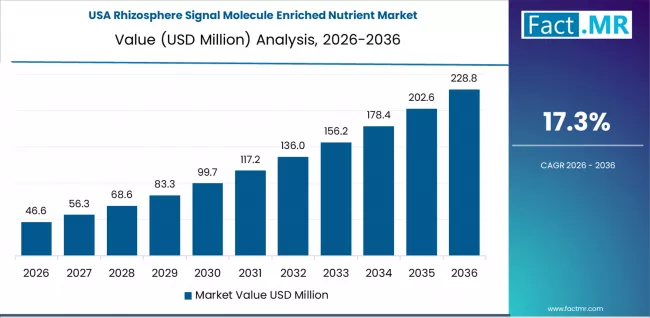
Rhizosphere Signal Molecule Enriched Nutrient Market Country Value Analysis

The USA's 17.3% growth is characterized by adoption in two key areas: high-value horticulture and carbon farming projects. For almonds, vineyards, and leafy greens, signal molecules are used to enhance root systems for better water/nutrient uptake and stress tolerance, directly impacting premium quality.

In commodity systems, they are integrated into carbon farming protocols to verify enhanced nutrient efficiency and root carbon deposition, creating a data-driven value proposition beyond yield alone.

What Role Does China's Focus on Agricultural Biotechnology Sovereignty Play?

China's 18.1% CAGR is closely tied to its national strategy for leadership in agricultural biotechnology. Major state-backed research initiatives are identifying and commercializing novel signal molecules derived from traditional Chinese medicinal plants or tailored for major staple crops.

The goal is to create proprietary, domestically controlled biological tools that increase food production efficiency and reduce reliance on imported ag-tech, driving rapid scaling through government-affiliated channels.

Why is Germany the European Center for Precision Biological Engineering?

Germany's 16.2% growth reflects its strength in precision engineering and rigorous environmental science. German companies and research institutes are pioneering the precise quantification of signal molecule effects on root exudation and microbiome shifts.

The stringent EU regulatory framework demands this high level of proof for product claims, making Germany a hub for developing and testing highly characterized, efficacy-proven signal molecule products that meet the highest regulatory bars.

How is India's Drive for Input Efficiency Unlocking Adoption Among Progressive Growers?

India's leading CAGR of 18.9% is propelled by the acute need to maximize returns from every unit of input amidst volatile margins. Progressive growers of high-value vegetables, fruits, and hybrid cereals are early adopters.

Agritech startups are packaging these technologies with digital advisory services, offering soil health assessments that recommend specific signaling additives to correct imbalances, making advanced biochemistry accessible and actionable for yield-conscious farmers.

Competitive Landscape of the Rhizosphere Signal Molecule Enriched Nutrient Market

Rhizosphere Signal Molecule Enriched Nutrient Market Analysis By Company

Agrochemical giants define the competitive landscape with deep R&D resources competing with specialized biotechnology firms. The battleground is intellectual property around novel compound discovery, efficient synthesis or fermentation pathways, and advanced formulation technologies that ensure field stability.

Success requires not only cutting-edge science but also the ability to conduct complex field trials that convincingly demonstrate physiological changes and yield advantages, translating molecular biology into tangible agronomic benefits for farmers.

Key Players in the Rhizosphere Signal Molecule Enriched Nutrient Market

  • BASF SE
  • Syngenta
  • Corteva
  • UPL
  • ICL Group
  • Novonesis

Scope of Report

Items Values
Quantitative Units USD Million
Crop Cereals, Oilseeds, Fruits, Vegetables
Form Granular, Liquid, Powder, Suspension
Sales Channel Ag-Retailers, Direct-to-Farmer, Online Marketplaces, Cooperatives
Key Countries USA, Germany, China, India
Key Companies BASF SE, Syngenta, Corteva, UPL, ICL Group, Novonesis
Additional Analysis Biosynthesis and mode of action of key rhizosphere signal molecules (e.g., strigolactones, flavonoids); analytical methods for detecting and quantifying these compounds in soil; impact on soil microbial network structure and function; economic modeling of physiological efficiency gains vs. product cost; regulatory pathways for plant biostimulants based on signaling compounds.

Market by Segments

Crop :

  • Cereals
  • Oilseeds
  • Fruits
  • Vegetables

Form :

  • Granular
  • Liquid
  • Powder
  • Suspension

Sales Channel :

  • Ag-Retailers
  • Direct-to-Farmer
  • Online Marketplaces
  • Cooperatives

Region :

  • North America
    • USA
    • Canada
  • Latin America
    • Brazil
    • Mexico
    • Argentina
    • Rest of Latin America
  • Western Europe
    • Germany
    • UK
    • France
    • Spain
    • Italy
    • BENELUX
    • Rest of Western Europe
  • Eastern Europe
    • Russia
    • Poland
    • Czech Republic
    • Rest of Eastern Europe
  • East Asia
    • China
    • Japan
    • South Korea
    • Rest of East Asia
  • South Asia & Pacific
    • India
    • ASEAN
    • Australia
    • Rest of South Asia & Pacific
  • MEA
    • Saudi Arabia
    • UAE
    • Turkiye
    • Rest of MEA

Table of Content

  1. Executive Summary
    • Global Market Outlook
    • Demand to side Trends
    • Supply to side Trends
    • Technology Roadmap Analysis
    • Analysis and Recommendations
  2. Market Overview
    • Market Coverage / Taxonomy
    • Market Definition / Scope / Limitations
  3. Market Background
    • Market Dynamics
      • Drivers
      • Restraints
      • Opportunity
      • Trends
    • Scenario Forecast
      • Demand in Optimistic Scenario
      • Demand in Likely Scenario
      • Demand in Conservative Scenario
    • Opportunity Map Analysis
    • Product Life Cycle Analysis
    • Supply Chain Analysis
    • Investment Feasibility Matrix
    • Value Chain Analysis
    • PESTLE and Porter’s Analysis
    • Regulatory Landscape
    • Regional Parent Market Outlook
    • Production and Consumption Statistics
    • Import and Export Statistics
  4. Global Market Analysis 2021 to 2025 and Forecast, 2026 to 2036
    • Historical Market Size Value (USD Million) Analysis, 2021 to 2025
    • Current and Future Market Size Value (USD Million) Projections, 2026 to 2036
      • Y to o to Y Growth Trend Analysis
      • Absolute $ Opportunity Analysis
  5. Global Market Pricing Analysis 2021 to 2025 and Forecast 2026 to 2036
  6. Global Market Analysis 2021 to 2025 and Forecast 2026 to 2036, By Crop
    • Introduction / Key Findings
    • Historical Market Size Value (USD Million) Analysis By Crop, 2021 to 2025
    • Current and Future Market Size Value (USD Million) Analysis and Forecast By Crop, 2026 to 2036
      • Cereals
      • Oilseeds
      • Fruits
      • Vegetables
    • Y to o to Y Growth Trend Analysis By Crop, 2021 to 2025
    • Absolute $ Opportunity Analysis By Crop, 2026 to 2036
  7. Global Market Analysis 2021 to 2025 and Forecast 2026 to 2036, By Form
    • Introduction / Key Findings
    • Historical Market Size Value (USD Million) Analysis By Form, 2021 to 2025
    • Current and Future Market Size Value (USD Million) Analysis and Forecast By Form, 2026 to 2036
      • Granular
      • Liquid
      • Powder
      • Suspension
    • Y to o to Y Growth Trend Analysis By Form, 2021 to 2025
    • Absolute $ Opportunity Analysis By Form, 2026 to 2036
  8. Global Market Analysis 2021 to 2025 and Forecast 2026 to 2036, By Sales Channel
    • Introduction / Key Findings
    • Historical Market Size Value (USD Million) Analysis By Sales Channel, 2021 to 2025
    • Current and Future Market Size Value (USD Million) Analysis and Forecast By Sales Channel, 2026 to 2036
      • Ag-Retailers
      • Direct-to-Farmer
      • Online Marketplaces
      • Cooperatives
    • Y to o to Y Growth Trend Analysis By Sales Channel, 2021 to 2025
    • Absolute $ Opportunity Analysis By Sales Channel, 2026 to 2036
  9. Global Market Analysis 2021 to 2025 and Forecast 2026 to 2036, By Region
    • Introduction
    • Historical Market Size Value (USD Million) Analysis By Region, 2021 to 2025
    • Current Market Size Value (USD Million) Analysis and Forecast By Region, 2026 to 2036
      • North America
      • Latin America
      • Western Europe
      • Eastern Europe
      • East Asia
      • South Asia and Pacific
      • Middle East & Africa
    • Market Attractiveness Analysis By Region
  10. North America Market Analysis 2021 to 2025 and Forecast 2026 to 2036, By Country
    • Historical Market Size Value (USD Million) Trend Analysis By Market Taxonomy, 2021 to 2025
    • Market Size Value (USD Million) Forecast By Market Taxonomy, 2026 to 2036
      • By Country
        • USA
        • Canada
        • Mexico
      • By Crop
      • By Form
      • By Sales Channel
    • Market Attractiveness Analysis
      • By Country
      • By Crop
      • By Form
      • By Sales Channel
    • Key Takeaways
  11. Latin America Market Analysis 2021 to 2025 and Forecast 2026 to 2036, By Country
    • Historical Market Size Value (USD Million) Trend Analysis By Market Taxonomy, 2021 to 2025
    • Market Size Value (USD Million) Forecast By Market Taxonomy, 2026 to 2036
      • By Country
        • Brazil
        • Chile
        • Rest of Latin America
      • By Crop
      • By Form
      • By Sales Channel
    • Market Attractiveness Analysis
      • By Country
      • By Crop
      • By Form
      • By Sales Channel
    • Key Takeaways
  12. Western Europe Market Analysis 2021 to 2025 and Forecast 2026 to 2036, By Country
    • Historical Market Size Value (USD Million) Trend Analysis By Market Taxonomy, 2021 to 2025
    • Market Size Value (USD Million) Forecast By Market Taxonomy, 2026 to 2036
      • By Country
        • Germany
        • UK
        • Italy
        • Spain
        • France
        • Nordic
        • BENELUX
        • Rest of Western Europe
      • By Crop
      • By Form
      • By Sales Channel
    • Market Attractiveness Analysis
      • By Country
      • By Crop
      • By Form
      • By Sales Channel
    • Key Takeaways
  13. Eastern Europe Market Analysis 2021 to 2025 and Forecast 2026 to 2036, By Country
    • Historical Market Size Value (USD Million) Trend Analysis By Market Taxonomy, 2021 to 2025
    • Market Size Value (USD Million) Forecast By Market Taxonomy, 2026 to 2036
      • By Country
        • Russia
        • Poland
        • Hungary
        • Balkan & Baltic
        • Rest of Eastern Europe
      • By Crop
      • By Form
      • By Sales Channel
    • Market Attractiveness Analysis
      • By Country
      • By Crop
      • By Form
      • By Sales Channel
    • Key Takeaways
  14. East Asia Market Analysis 2021 to 2025 and Forecast 2026 to 2036, By Country
    • Historical Market Size Value (USD Million) Trend Analysis By Market Taxonomy, 2021 to 2025
    • Market Size Value (USD Million) Forecast By Market Taxonomy, 2026 to 2036
      • By Country
        • China
        • Japan
        • South Korea
      • By Crop
      • By Form
      • By Sales Channel
    • Market Attractiveness Analysis
      • By Country
      • By Crop
      • By Form
      • By Sales Channel
    • Key Takeaways
  15. South Asia and Pacific Market Analysis 2021 to 2025 and Forecast 2026 to 2036, By Country
    • Historical Market Size Value (USD Million) Trend Analysis By Market Taxonomy, 2021 to 2025
    • Market Size Value (USD Million) Forecast By Market Taxonomy, 2026 to 2036
      • By Country
        • India
        • ASEAN
        • Australia & New Zealand
        • Rest of South Asia and Pacific
      • By Crop
      • By Form
      • By Sales Channel
    • Market Attractiveness Analysis
      • By Country
      • By Crop
      • By Form
      • By Sales Channel
    • Key Takeaways
  16. Middle East & Africa Market Analysis 2021 to 2025 and Forecast 2026 to 2036, By Country
    • Historical Market Size Value (USD Million) Trend Analysis By Market Taxonomy, 2021 to 2025
    • Market Size Value (USD Million) Forecast By Market Taxonomy, 2026 to 2036
      • By Country
        • Kingdom of Saudi Arabia
        • Other GCC Countries
        • Turkiye
        • South Africa
        • Other African Union
        • Rest of Middle East & Africa
      • By Crop
      • By Form
      • By Sales Channel
    • Market Attractiveness Analysis
      • By Country
      • By Crop
      • By Form
      • By Sales Channel
    • Key Takeaways
  17. Key Countries Market Analysis
    • USA
      • Pricing Analysis
      • Market Share Analysis, 2025
        • By Crop
        • By Form
        • By Sales Channel
    • Canada
      • Pricing Analysis
      • Market Share Analysis, 2025
        • By Crop
        • By Form
        • By Sales Channel
    • Mexico
      • Pricing Analysis
      • Market Share Analysis, 2025
        • By Crop
        • By Form
        • By Sales Channel
    • Brazil
      • Pricing Analysis
      • Market Share Analysis, 2025
        • By Crop
        • By Form
        • By Sales Channel
    • Chile
      • Pricing Analysis
      • Market Share Analysis, 2025
        • By Crop
        • By Form
        • By Sales Channel
    • Germany
      • Pricing Analysis
      • Market Share Analysis, 2025
        • By Crop
        • By Form
        • By Sales Channel
    • UK
      • Pricing Analysis
      • Market Share Analysis, 2025
        • By Crop
        • By Form
        • By Sales Channel
    • Italy
      • Pricing Analysis
      • Market Share Analysis, 2025
        • By Crop
        • By Form
        • By Sales Channel
    • Spain
      • Pricing Analysis
      • Market Share Analysis, 2025
        • By Crop
        • By Form
        • By Sales Channel
    • France
      • Pricing Analysis
      • Market Share Analysis, 2025
        • By Crop
        • By Form
        • By Sales Channel
    • India
      • Pricing Analysis
      • Market Share Analysis, 2025
        • By Crop
        • By Form
        • By Sales Channel
    • ASEAN
      • Pricing Analysis
      • Market Share Analysis, 2025
        • By Crop
        • By Form
        • By Sales Channel
    • Australia & New Zealand
      • Pricing Analysis
      • Market Share Analysis, 2025
        • By Crop
        • By Form
        • By Sales Channel
    • China
      • Pricing Analysis
      • Market Share Analysis, 2025
        • By Crop
        • By Form
        • By Sales Channel
    • Japan
      • Pricing Analysis
      • Market Share Analysis, 2025
        • By Crop
        • By Form
        • By Sales Channel
    • South Korea
      • Pricing Analysis
      • Market Share Analysis, 2025
        • By Crop
        • By Form
        • By Sales Channel
    • Russia
      • Pricing Analysis
      • Market Share Analysis, 2025
        • By Crop
        • By Form
        • By Sales Channel
    • Poland
      • Pricing Analysis
      • Market Share Analysis, 2025
        • By Crop
        • By Form
        • By Sales Channel
    • Hungary
      • Pricing Analysis
      • Market Share Analysis, 2025
        • By Crop
        • By Form
        • By Sales Channel
    • Kingdom of Saudi Arabia
      • Pricing Analysis
      • Market Share Analysis, 2025
        • By Crop
        • By Form
        • By Sales Channel
    • Turkiye
      • Pricing Analysis
      • Market Share Analysis, 2025
        • By Crop
        • By Form
        • By Sales Channel
    • South Africa
      • Pricing Analysis
      • Market Share Analysis, 2025
        • By Crop
        • By Form
        • By Sales Channel
  18. Market Structure Analysis
    • Competition Dashboard
    • Competition Benchmarking
    • Market Share Analysis of Top Players
      • By Regional
      • By Crop
      • By Form
      • By Sales Channel
  19. Competition Analysis
    • Competition Deep Dive
      • BASF SE
        • Overview
        • Product Portfolio
        • Profitability by Market Segments (Product/Age /Sales Channel/Region)
        • Sales Footprint
        • Strategy Overview
          • Marketing Strategy
          • Product Strategy
          • Channel Strategy
      • Syngenta
      • Corteva
      • UPL
      • ICL Group
      • Novonesis
  20. Assumptions & Acronyms Used
  21. Research Methodology

List Of Table

  • Table 1: Global Market Value (USD Million) Forecast by Region, 2021 to 2036
  • Table 2: Global Market Value (USD Million) Forecast by Crop, 2021 to 2036
  • Table 3: Global Market Value (USD Million) Forecast by Form, 2021 to 2036
  • Table 4: Global Market Value (USD Million) Forecast by Sales Channel, 2021 to 2036
  • Table 5: North America Market Value (USD Million) Forecast by Country, 2021 to 2036
  • Table 6: North America Market Value (USD Million) Forecast by Crop, 2021 to 2036
  • Table 7: North America Market Value (USD Million) Forecast by Form, 2021 to 2036
  • Table 8: North America Market Value (USD Million) Forecast by Sales Channel, 2021 to 2036
  • Table 9: Latin America Market Value (USD Million) Forecast by Country, 2021 to 2036
  • Table 10: Latin America Market Value (USD Million) Forecast by Crop, 2021 to 2036
  • Table 11: Latin America Market Value (USD Million) Forecast by Form, 2021 to 2036
  • Table 12: Latin America Market Value (USD Million) Forecast by Sales Channel, 2021 to 2036
  • Table 13: Western Europe Market Value (USD Million) Forecast by Country, 2021 to 2036
  • Table 14: Western Europe Market Value (USD Million) Forecast by Crop, 2021 to 2036
  • Table 15: Western Europe Market Value (USD Million) Forecast by Form, 2021 to 2036
  • Table 16: Western Europe Market Value (USD Million) Forecast by Sales Channel, 2021 to 2036
  • Table 17: Eastern Europe Market Value (USD Million) Forecast by Country, 2021 to 2036
  • Table 18: Eastern Europe Market Value (USD Million) Forecast by Crop, 2021 to 2036
  • Table 19: Eastern Europe Market Value (USD Million) Forecast by Form, 2021 to 2036
  • Table 20: Eastern Europe Market Value (USD Million) Forecast by Sales Channel, 2021 to 2036
  • Table 21: East Asia Market Value (USD Million) Forecast by Country, 2021 to 2036
  • Table 22: East Asia Market Value (USD Million) Forecast by Crop, 2021 to 2036
  • Table 23: East Asia Market Value (USD Million) Forecast by Form, 2021 to 2036
  • Table 24: East Asia Market Value (USD Million) Forecast by Sales Channel, 2021 to 2036
  • Table 25: South Asia and Pacific Market Value (USD Million) Forecast by Country, 2021 to 2036
  • Table 26: South Asia and Pacific Market Value (USD Million) Forecast by Crop, 2021 to 2036
  • Table 27: South Asia and Pacific Market Value (USD Million) Forecast by Form, 2021 to 2036
  • Table 28: South Asia and Pacific Market Value (USD Million) Forecast by Sales Channel, 2021 to 2036
  • Table 29: Middle East & Africa Market Value (USD Million) Forecast by Country, 2021 to 2036
  • Table 30: Middle East & Africa Market Value (USD Million) Forecast by Crop, 2021 to 2036
  • Table 31: Middle East & Africa Market Value (USD Million) Forecast by Form, 2021 to 2036
  • Table 32: Middle East & Africa Market Value (USD Million) Forecast by Sales Channel, 2021 to 2036

List Of Figures

  • Figure 1: Global Market Pricing Analysis
  • Figure 2: Global Market Value (USD Million) Forecast 2021-2036
  • Figure 3: Global Market Value Share and BPS Analysis by Crop, 2026 and 2036
  • Figure 4: Global Market Y to o to Y Growth Comparison by Crop, 2026-2036
  • Figure 5: Global Market Attractiveness Analysis by Crop
  • Figure 6: Global Market Value Share and BPS Analysis by Form, 2026 and 2036
  • Figure 7: Global Market Y to o to Y Growth Comparison by Form, 2026-2036
  • Figure 8: Global Market Attractiveness Analysis by Form
  • Figure 9: Global Market Value Share and BPS Analysis by Sales Channel, 2026 and 2036
  • Figure 10: Global Market Y to o to Y Growth Comparison by Sales Channel, 2026-2036
  • Figure 11: Global Market Attractiveness Analysis by Sales Channel
  • Figure 12: Global Market Value (USD Million) Share and BPS Analysis by Region, 2026 and 2036
  • Figure 13: Global Market Y to o to Y Growth Comparison by Region, 2026-2036
  • Figure 14: Global Market Attractiveness Analysis by Region
  • Figure 15: North America Market Incremental Dollar Opportunity, 2026-2036
  • Figure 16: Latin America Market Incremental Dollar Opportunity, 2026-2036
  • Figure 17: Western Europe Market Incremental Dollar Opportunity, 2026-2036
  • Figure 18: Eastern Europe Market Incremental Dollar Opportunity, 2026-2036
  • Figure 19: East Asia Market Incremental Dollar Opportunity, 2026-2036
  • Figure 20: South Asia and Pacific Market Incremental Dollar Opportunity, 2026-2036
  • Figure 21: Middle East & Africa Market Incremental Dollar Opportunity, 2026-2036
  • Figure 22: North America Market Value Share and BPS Analysis by Country, 2026 and 2036
  • Figure 23: North America Market Value Share and BPS Analysis by Crop, 2026 and 2036
  • Figure 24: North America Market Y to o to Y Growth Comparison by Crop, 2026-2036
  • Figure 25: North America Market Attractiveness Analysis by Crop
  • Figure 26: North America Market Value Share and BPS Analysis by Form, 2026 and 2036
  • Figure 27: North America Market Y to o to Y Growth Comparison by Form, 2026-2036
  • Figure 28: North America Market Attractiveness Analysis by Form
  • Figure 29: North America Market Value Share and BPS Analysis by Sales Channel, 2026 and 2036
  • Figure 30: North America Market Y to o to Y Growth Comparison by Sales Channel, 2026-2036
  • Figure 31: North America Market Attractiveness Analysis by Sales Channel
  • Figure 32: Latin America Market Value Share and BPS Analysis by Country, 2026 and 2036
  • Figure 33: Latin America Market Value Share and BPS Analysis by Crop, 2026 and 2036
  • Figure 34: Latin America Market Y to o to Y Growth Comparison by Crop, 2026-2036
  • Figure 35: Latin America Market Attractiveness Analysis by Crop
  • Figure 36: Latin America Market Value Share and BPS Analysis by Form, 2026 and 2036
  • Figure 37: Latin America Market Y to o to Y Growth Comparison by Form, 2026-2036
  • Figure 38: Latin America Market Attractiveness Analysis by Form
  • Figure 39: Latin America Market Value Share and BPS Analysis by Sales Channel, 2026 and 2036
  • Figure 40: Latin America Market Y to o to Y Growth Comparison by Sales Channel, 2026-2036
  • Figure 41: Latin America Market Attractiveness Analysis by Sales Channel
  • Figure 42: Western Europe Market Value Share and BPS Analysis by Country, 2026 and 2036
  • Figure 43: Western Europe Market Value Share and BPS Analysis by Crop, 2026 and 2036
  • Figure 44: Western Europe Market Y to o to Y Growth Comparison by Crop, 2026-2036
  • Figure 45: Western Europe Market Attractiveness Analysis by Crop
  • Figure 46: Western Europe Market Value Share and BPS Analysis by Form, 2026 and 2036
  • Figure 47: Western Europe Market Y to o to Y Growth Comparison by Form, 2026-2036
  • Figure 48: Western Europe Market Attractiveness Analysis by Form
  • Figure 49: Western Europe Market Value Share and BPS Analysis by Sales Channel, 2026 and 2036
  • Figure 50: Western Europe Market Y to o to Y Growth Comparison by Sales Channel, 2026-2036
  • Figure 51: Western Europe Market Attractiveness Analysis by Sales Channel
  • Figure 52: Eastern Europe Market Value Share and BPS Analysis by Country, 2026 and 2036
  • Figure 53: Eastern Europe Market Value Share and BPS Analysis by Crop, 2026 and 2036
  • Figure 54: Eastern Europe Market Y to o to Y Growth Comparison by Crop, 2026-2036
  • Figure 55: Eastern Europe Market Attractiveness Analysis by Crop
  • Figure 56: Eastern Europe Market Value Share and BPS Analysis by Form, 2026 and 2036
  • Figure 57: Eastern Europe Market Y to o to Y Growth Comparison by Form, 2026-2036
  • Figure 58: Eastern Europe Market Attractiveness Analysis by Form
  • Figure 59: Eastern Europe Market Value Share and BPS Analysis by Sales Channel, 2026 and 2036
  • Figure 60: Eastern Europe Market Y to o to Y Growth Comparison by Sales Channel, 2026-2036
  • Figure 61: Eastern Europe Market Attractiveness Analysis by Sales Channel
  • Figure 62: East Asia Market Value Share and BPS Analysis by Country, 2026 and 2036
  • Figure 63: East Asia Market Value Share and BPS Analysis by Crop, 2026 and 2036
  • Figure 64: East Asia Market Y to o to Y Growth Comparison by Crop, 2026-2036
  • Figure 65: East Asia Market Attractiveness Analysis by Crop
  • Figure 66: East Asia Market Value Share and BPS Analysis by Form, 2026 and 2036
  • Figure 67: East Asia Market Y to o to Y Growth Comparison by Form, 2026-2036
  • Figure 68: East Asia Market Attractiveness Analysis by Form
  • Figure 69: East Asia Market Value Share and BPS Analysis by Sales Channel, 2026 and 2036
  • Figure 70: East Asia Market Y to o to Y Growth Comparison by Sales Channel, 2026-2036
  • Figure 71: East Asia Market Attractiveness Analysis by Sales Channel
  • Figure 72: South Asia and Pacific Market Value Share and BPS Analysis by Country, 2026 and 2036
  • Figure 73: South Asia and Pacific Market Value Share and BPS Analysis by Crop, 2026 and 2036
  • Figure 74: South Asia and Pacific Market Y to o to Y Growth Comparison by Crop, 2026-2036
  • Figure 75: South Asia and Pacific Market Attractiveness Analysis by Crop
  • Figure 76: South Asia and Pacific Market Value Share and BPS Analysis by Form, 2026 and 2036
  • Figure 77: South Asia and Pacific Market Y to o to Y Growth Comparison by Form, 2026-2036
  • Figure 78: South Asia and Pacific Market Attractiveness Analysis by Form
  • Figure 79: South Asia and Pacific Market Value Share and BPS Analysis by Sales Channel, 2026 and 2036
  • Figure 80: South Asia and Pacific Market Y to o to Y Growth Comparison by Sales Channel, 2026-2036
  • Figure 81: South Asia and Pacific Market Attractiveness Analysis by Sales Channel
  • Figure 82: Middle East & Africa Market Value Share and BPS Analysis by Country, 2026 and 2036
  • Figure 83: Middle East & Africa Market Value Share and BPS Analysis by Crop, 2026 and 2036
  • Figure 84: Middle East & Africa Market Y to o to Y Growth Comparison by Crop, 2026-2036
  • Figure 85: Middle East & Africa Market Attractiveness Analysis by Crop
  • Figure 86: Middle East & Africa Market Value Share and BPS Analysis by Form, 2026 and 2036
  • Figure 87: Middle East & Africa Market Y to o to Y Growth Comparison by Form, 2026-2036
  • Figure 88: Middle East & Africa Market Attractiveness Analysis by Form
  • Figure 89: Middle East & Africa Market Value Share and BPS Analysis by Sales Channel, 2026 and 2036
  • Figure 90: Middle East & Africa Market Y to o to Y Growth Comparison by Sales Channel, 2026-2036
  • Figure 91: Middle East & Africa Market Attractiveness Analysis by Sales Channel
  • Figure 92: Global Market - Tier Structure Analysis
  • Figure 93: Global Market - Company Share Analysis

- FAQs -

How big is the rhizosphere signal molecule enriched nutrient market in 2026?

The global rhizosphere signal molecule enriched nutrient market is estimated to be valued at USD 62.2 million in 2026.

What will be the size of rhizosphere signal molecule enriched nutrient market in 2036?

The market size for the rhizosphere signal molecule enriched nutrient market is projected to reach USD 357.1 million by 2036.

How much will be the rhizosphere signal molecule enriched nutrient market growth between 2026 and 2036?

The rhizosphere signal molecule enriched nutrient market is expected to grow at a 19.1% CAGR between 2026 and 2036.

What are the key product types in the rhizosphere signal molecule enriched nutrient market?

The key product types in rhizosphere signal molecule enriched nutrient market are cereals, oilseeds, fruits and vegetables.

Which form segment to contribute significant share in the rhizosphere signal molecule enriched nutrient market in 2026?

In terms of form, granular segment to command 43.8% share in the rhizosphere signal molecule enriched nutrient market in 2026.

Rhizosphere Signal Molecule Enriched Nutrient Market