- Base Value(2025): 32.4 Bn
- Estimated Value(2026): 34.3 Bn
- Forecast Value (2036): 59.6 Bn
- CAGR (2026 - 2036): 5.7%
Chassis and Powertrain Wiring Harness Systems for Trucks Market Forecast and Outlook By FACT.MR
In 2025, the chassis and powertrain wiring harness systems for trucks market was valued at USD 32.4 billion. Based on Fact.MR analysis, demand for truck wiring harness systems is estimated to grow to USD 34.3 billion in 2026 and USD 59.6 billion by 2036. FACT.MR projects a CAGR of 5.7% during the forecast period.
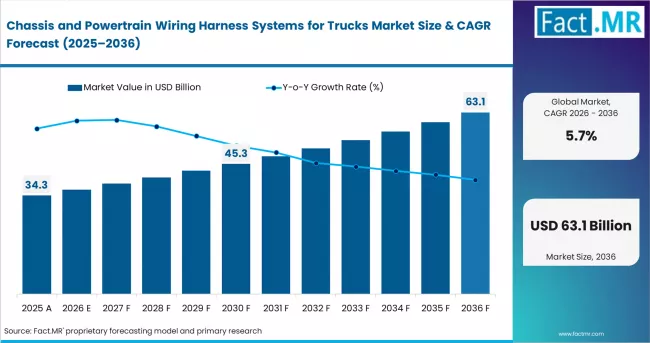
Chassis And Powertrain Wiring Harness Systems For Trucks Market Value Analysis | Source: Fact.MR
Summary of Chassis and Powertrain Wiring Harness Systems for Trucks Market
- Market Definition
- Market includes chassis and powertrain wiring harness assemblies for heavy-duty, medium-duty, and light commercial trucks across diesel, hybrid, and electric powertrain platforms globally.
- Demand Drivers
- Emission Compliance Wiring: Euro VII and EPA GHG Phase 3 regulations are adding aftertreatment sensor and actuator harness circuits to diesel and CNG truck platforms, increasing per-vehicle harness content.
- Truck Electrification: Battery-electric medium- and heavy-duty truck programmes at Daimler Truck, Volvo, and Chinese OEMs are multiplying high-voltage harness content per vehicle versus conventional diesel.
- Telematics Mandates: Freight telematics mandates in the EU, U.S., and India are adding CAN bus, sensor, and data harness circuits to all new truck platforms, raising per-unit wiring value.
- Key Segments Analyzed
- By Harness Type: Chassis wiring harness leads at approximately 35% share in 2026, integrating the broadest range of vehicle electrical functions across frame, axle, and body systems.
- By Vehicle Type: Heavy-duty trucks hold approximately 48% share in 2026, driven by high per-vehicle harness content and large global long-haul freight fleet sizes.
- By Application: Power distribution and engine control leads at approximately 40% share in 2026, as it underpins fundamental vehicle operation across all powertrain types.
- Analyst Opinion at FACT.MR
- Shambhu Nath Jha, Principal Consultant at Fact.MR, 'CXOs will find that per vehicle harness value is emerging as the primary growth driver. Electric truck platforms carry significantly higher harness content, often three to five times that of diesel systems. This is due to the addition of high voltage power distribution, battery integration, and advanced electronic architectures.’
- Strategic Implications
- Invest in high-voltage harness qualification for class 6-8 battery-electric truck platforms to capture per-unit value uplift ahead of OEM fleet electrification ramps in 2027 to 2030.
- Secure platform supply agreements with Chinese truck OEMs on NEV programmes where volume and speed of electrification are highest among all regional markets.
- Develop Euro VII and EPA GHG Phase 3 compliant aftertreatment harness modules as a near-term revenue bridge while electric truck volumes scale.
- Methodology
- Market sizing uses truck production volumes by class and region, average harness content per vehicle by powertrain type, and Tier-1 pricing benchmarks by harness category.
- Analysis incorporates OICA truck production data, OEM annual reports, and regulatory compliance timelines from EPA, European Commission, and CPCB India.
- Forecasts account for electrification adoption rates, Euro VII and EPA GHG Phase 3 timelines, copper price sensitivity, and platform qualification cycle lengths.
| Metric | Value |
|---|---|
| Estimated Value in 2026 | USD 34.3 billion |
| Forecast Value in 2036 | USD 59.6 billion |
| Forecast CAGR (2026 to 2036) | 5.7% |
Source: Fact.MR analysis. Updated Apr 23, 2026
The market is projected to generate USD 25.3 billion in absolute opportunity between 2026 and 2036. Growth is structurally underpinned by global freight volume expansion, electrification of medium-duty urban delivery trucks, and rising harness content per vehicle driven by telematics, ADAS, and emission-control wiring. Constraints include copper price volatility, extended OEM qualification timelines, and the capital intensity of transitioning harness production lines from 24V to high-voltage configurations.
China leads at 7.2% CAGR, driven by NEV truck mandates and domestic freight electrification under the 14th Five-Year Plan. Brazil follows at 6.2%, underpinned by Mercosur freight expansion and domestic truck OEM production at Mercedes-Benz and IVECO Brasil. India records 6.8%, supported by Bharat Stage VI Phase 2 after treatment wiring demand and FAME-III electric truck incentives. The United States grows at 5.8%, anchored by EPA GHG Phase 3 compliance harness requirements and class 6-7 electric truck programmes. Germany records 5.5%, driven by truck electrification at Daimler Truck and TRATON. Japan grows at 5.2%, led by UD Trucks and Hino electrification programmes and stable freight fleet replacement demand, with long qualification cycles representing a structural constraint for new harness entrants.
Segmental Analysis
Chassis and Powertrain Wiring Harness Systems for Trucks Market Analysis by Harness Type
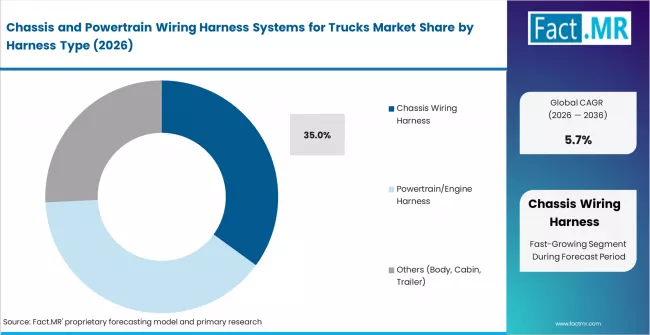
Chassis And Powertrain Wiring Harness Systems For Trucks Market Analysis By Harness Type | Source: Fact.MR
Based on FACT.MR analysis, chassis harnesses hold about 35 percent share in 2026. They integrate lighting, braking, suspension, and frame electronics. Powertrain and engine harnesses hold higher value share due to electrification. Chassis harnesses lead due to broad application across truck types.
- Aptiv Truck Harness: Aptiv expanded high voltage harness production in Slovakia in 2025. The facility supports European electric truck OEMs. It covers both chassis and powertrain harness systems for 400V and 800V architectures. [4]
- Sumitomo Electric HV Harness: Sumitomo Electric Industries launched an 800V heavy duty harness line in 2024. It targets electric and fuel cell truck platforms. The system includes high temperature insulation and sealed connectors for harsh environments. [5]
- Telematics Harness Growth: Smart tachograph V2 mandates in Europe are increasing telematics wiring demand. Retrofit requirements extend through 2025. Yazaki Corporation reported strong growth in telematics harness orders in 2024. [6]
Chassis and Powertrain Wiring Harness Systems for Trucks Market Analysis by Vehicle Type
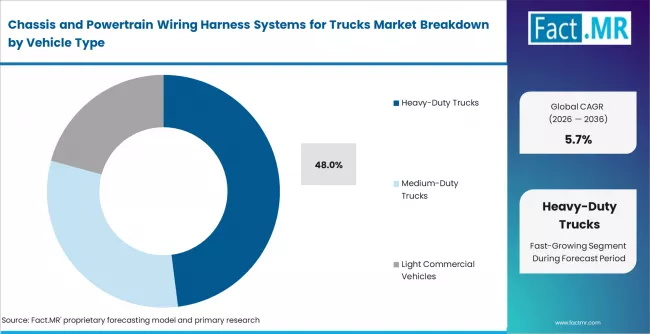
Chassis And Powertrain Wiring Harness Systems For Trucks Market Analysis By Vehicle Type | Source: Fact.MR
Based on FACT.MR analysis, heavy duty trucks account for about 48 percent share in 2026. This segment leads due to higher harness value per vehicle. A class 8 truck carries significantly higher wiring content than medium duty vehicles. Electrification is further increasing this value. Fleet replacement cycles also support steady demand.
- Daimler Truck Electric Platform: Daimler Truck confirmed production of the Mercedes Benz eActros 600 in 2024. The platform uses a new high voltage harness architecture. Aptiv is supplying harness systems under long term agreements. This represents one of the highest value harness platforms. [7]
- PACCAR Platform Investment: PACCAR announced investment in electric and hydrogen truck platforms in 2024. This includes Kenworth and Peterbilt programs. High voltage harness sourcing is under qualification for 2026 production. [8]
- Medium Duty Urban EV Trend: Volvo Trucks reported strong growth in medium duty electric truck orders in 2024. These platforms require dedicated 300–400V harness systems. Suppliers such as Leoni AG and Furukawa Electric are increasing engineering investments. [9]
Drivers, Restraints, and Opportunities
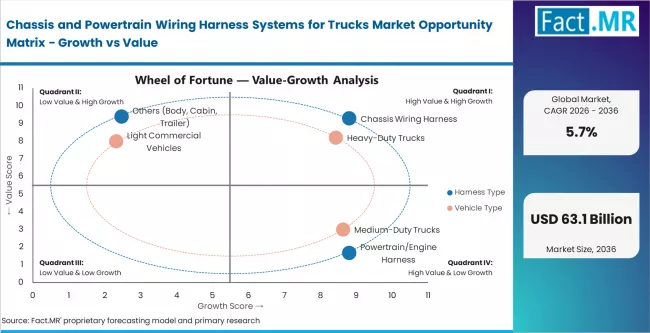
Chassis And Powertrain Wiring Harness Systems For Trucks Market Opportunity Matrix Growth Vs Value | Source: Fact.MR
Fact.MR analysts observe that the chassis and powertrain wiring harness market for trucks is large and structurally stable. Growth is now driven more by electrification than volume expansion. The USD 34.3 billion valuation in 2026 reflects global truck production scale. Harness content per diesel vehicle is mature. Regulatory compliance is adding incremental wiring circuits. Euro VII in Europe and EPA GHG Phase 3 in the U.S. are key drivers. This supports near term revenue growth ahead of full electrification.
Conventional 24V diesel harness demand remains high in volume terms. Pricing pressure is increasing due to low cost Asian suppliers. Value is shifting toward high voltage harness systems for electric and fuel cell trucks. Integrated telematics and ADAS wiring is also gaining importance.
- Euro VII Regulation: Euro VII will apply to heavy duty vehicles from 2027. It mandates stricter NOx, particulate, and CO2 limits. This requires additional sensors and monitoring circuits. Daimler Truck and Volvo Group began platform development in 2024. This is increasing harness design activity ahead of compliance. [1]
- China NEV Truck Policy: China extended NEV truck incentives through 2025. This supports electric truck production at BYD, SANY, and Foton Motor. Yazaki Corporation expanded high voltage harness capacity in Wuhan in 2024. China leads global adoption, driving both volume and value growth. [2]
- India BS VI Phase 2 and FAME III: India introduced BS VI Phase 2 OBD requirements in 2024. This mandates real driving emissions monitoring circuits. Tata Motors updated chassis harness designs across truck ranges. The FAME III program announced in 2025–26 supports electric truck adoption. This is creating additional high voltage harness demand. [3]
Regional Analysis
The chassis and powertrain wiring harness systems for trucks market is assessed across Asia Pacific, North America, Europe, Latin America, and Middle East and Africa, covering 40+ countries with demand shaped by truck production volumes, emission regulation timelines, electrification programmes, and fleet replacement cycles. The full report offers market attractiveness analysis by region and country.
.webp "Top Country Growth Comparison Chassis And Powertrain Wiring Harness Systems For Trucks Market Cagr (2026 2036)")
Top Country Growth Comparison Chassis And Powertrain Wiring Harness Systems For Trucks Market Cagr (2026 2036) | Source: Fact.MR
| Country | CAGR (2026 to 2036) |
|---|---|
| China | 7.2% |
| India | 6.8% |
| Brazil | 6.2% |
| United States | 5.8% |
| Germany | 5.5% |
| Japan | 5.2% |
Source: Fact.MR analysis. Updated Apr 23, 2026
Source: Fact.MR (FACT.MR) analysis, based on proprietary forecasting model and primary research
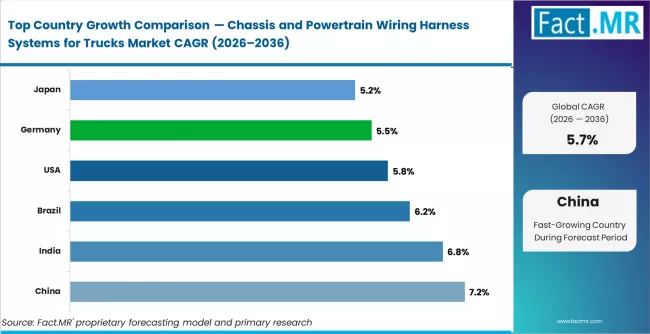
Chassis And Powertrain Wiring Harness Systems For Trucks Market Cagr Analysis By Country | Source: Fact.MR
Asia Pacific Chassis and Powertrain Wiring Harness for Trucks Market Analysis
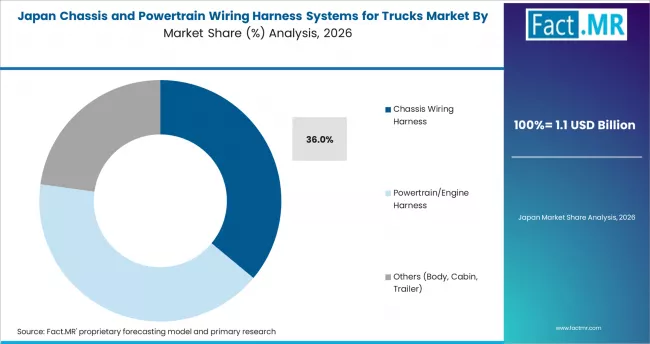
Chassis And Powertrain Wiring Harness Systems For Trucks Market Japan Market Share Analysis By Harness Type | Source: Fact.MR
Asia Pacific represents the largest production and demand base for truck wiring harness systems. Growth is supported by freight expansion, electrification, and regulatory upgrades. Yazaki Corporation, Sumitomo Electric Industries, and Tata AutoComp hold strong regional supply positions with deep OEM integration.
- China: The outlook indicates steady expansion at about 7.2 percent CAGR through 2036. Electric truck adoption is accelerating rapidly, exceeding 18 percent of new sales in 2024. BYD and Foton Motor increased electric truck output in 2024. Yazaki Corporation expanded Wuhan capacity to support high voltage harness demand. Public procurement policies are sustaining long term volumes.
- India: Industry momentum is expected near 6.8 percent CAGR through 2036. Emission compliance is increasing wiring complexity across truck platforms. Tata Motors integrated OBD systems into updated harness designs in 2024. Ashok Leyland partnered with Samvardhana Motherson International for electric platform harness supply. Policy support under FAME III is driving future high voltage demand.
- Japan: Growth outlook stands near 5.2 percent CAGR through 2036. UD Trucks is advancing fuel cell truck programs. These platforms require complex high voltage harness systems. Hino Motors is developing electric medium duty trucks. Suppliers are expanding engineering capabilities to support next generation platforms.
Fact.MR’s Asia Pacific analysis covers China, India, Japan, South Korea, ASEAN, and Australia. It includes production trends, policy impact, and supplier expansion data.
North America Chassis and Powertrain Wiring Harness for Trucks Market Analysis
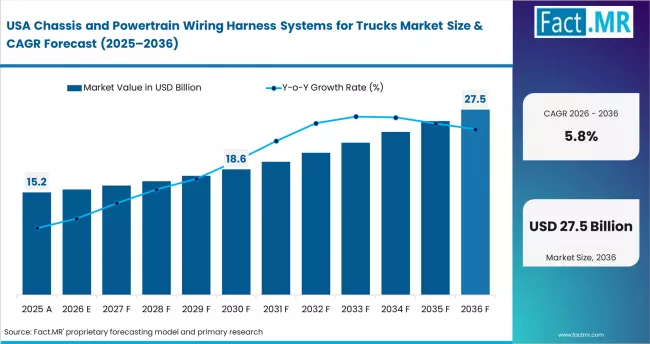
Chassis And Powertrain Wiring Harness Systems For Trucks Market Country Value Analysis | Source: Fact.MR
North America remains a mature and high value region supported by heavy truck production and regulatory compliance. Electrification and emission standards are increasing harness content per vehicle. Aptiv and Lear Corporation dominate Tier 1 supply through long term OEM agreements.
- United States: The growth path is estimated at around 5.8 percent CAGR through 2036. Regulatory pressure from EPA GHG Phase 3 is increasing harness complexity. PACCAR is investing in electric and hydrogen truck platforms. State level ZEV mandates are accelerating electric truck adoption. This is creating new demand for high voltage harness systems.
Fact.MR’s North America coverage includes the United States, Canada, and Mexico. It tracks regulatory timelines, OEM investment, and supplier capacity.
Europe Chassis and Powertrain Wiring Harness for Trucks Market Analysis
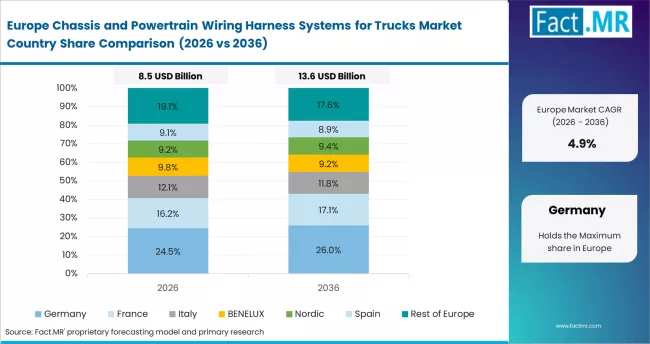
Chassis And Powertrain Wiring Harness Systems For Trucks Market Europe Country Market Share Analysis, 2026 & 2036 | Source: Fact.MR
Europe operates as a regulation driven market shaping global standards. Emission rules and electrification programs define harness requirements. Leoni AG, Aptiv, and Yazaki Corporation supply major OEMs.
- Germany: Demand progression is projected at roughly 5.5 percent CAGR through 2036. Daimler Truck launched electric truck production in 2024, increasing high voltage harness demand. TRATON Group is advancing Euro VII powertrain programs. Strict compliance requirements continue to support established suppliers.
Fact.MR’s Europe analysis includes Germany, France, UK, Italy, Spain, Sweden, and BENELUX. It covers regulatory impact, electrification timelines, and supplier footprint.
Latin America Chassis and Powertrain Wiring Harness for Trucks Market Analysis
Latin America is a developing region driven by freight expansion and agricultural logistics. Brazil remains the central contributor. OEM production supports consistent harness demand.
- Brazil: Expansion is anticipated at close to 6.2 percent CAGR through 2036. Emission standards under PROCONVE P8 are increasing harness requirements. Mercedes-Benz updated truck platforms to meet compliance needs. CNH Industrial introduced new truck models with upgraded wiring systems. Infrastructure expansion is supporting fleet growth.
Fact.MR’s Latin America analysis covers Brazil, Argentina, Chile, Mexico, and Rest of the region. It includes emission standards, freight demand, and OEM production.
Competitive Aligners for Market Players
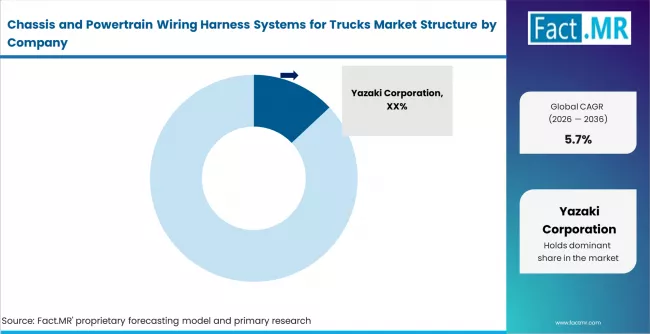
Chassis And Powertrain Wiring Harness Systems For Trucks Market Analysis By Company | Source: Fact.MR
Key Players
- Yazaki Corporation
- Sumitomo Electric Industries, Ltd.
- Aptiv PLC
- Lear Corporation
- Leoni AG
- Furukawa Electric Co., Ltd.
- Delphi Technologies
- PKC Group Oy
- Samvardhana Motherson International Ltd.
- Tata AutoComp Systems Ltd.
Bibliography
- [1] European Commission. Regulation (EU) 2024/1257: Euro VII Standards for Heavy-Duty Vehicle Emissions Technical Harness and Aftertreatment Sensor Circuit Requirements for Trucks and Buses. Official Journal of the European Union, April 2024. eur-lex.europa.eu
- [2] Ministry of Industry and Information Technology, China. NEV Production and Sales Statistics H1 2024: Electric Truck Market Share Data, OEM Production Volumes, and Subsidy Programme Extension for New Energy Heavy Commercial Vehicles. July 2024. miit.gov.cn
- [3] Ministry of Road Transport and Highways, Government of India. FAME-III Electric Vehicle Incentive Programme Announcement and BS VI Phase 2 OBD Implementation Update for Commercial Vehicles. Union Budget 2025-26 and April 2024 Gazette Notification. morth.nic.in
- [4] Aptiv PLC. Q1 2025 Operations Update: High-Voltage Commercial Vehicle Harness Production Expansion at Banska Bystrica, Slovakia Facility for European Electric Truck OEM Programmes. March 2025. aptiv.com/investors
- [5] Sumitomo Electric Industries, Ltd. Press Release: Launch of 800V-Rated Fuel-Cell and Battery-Electric Truck Powertrain Harness Line for Japanese and European Heavy-Duty OEM Qualification Programmes. Q2 2024. sei.co.jp/english/news
- [6] European Commission Directorate-General for Mobility and Transport. Smart Tachograph Version 2 (V2) Implementation Mandate for New Trucks and Retrofit Deadline Schedule for Existing Fleet Operators Under Commission Implementing Regulation (EU) 2023/980. 2023–2025. ec. europa.eu/transport
- [7] Daimler Truck AG. Press Release: Mercedes-Benz eActros 600 Series Production Launch 600km Range Long-Haul Electric Truck with 400V Architecture and High-Voltage Chassis Harness System. Q4 2024. daimlertruck.com/newsroom
- [8] PACCAR Inc. Q3 2024 Investor Presentation: USD 400 Million Battery-Electric and Hydrogen Fuel-Cell Truck Platform Investment for Kenworth and Peterbilt Class 8 Programmes with 2026 Production Targets. October 2024. paccar.com/investors
- [9] Volvo Trucks. H1 2024 Sales Report: FE Electric and FL Electric Medium-Duty Urban Delivery Truck Order Growth of 31% in Northern Europe and Updated Chassis Harness Architecture for 300-400V Electric Platforms. August 2024. volvotrucks.com/investors
This Report Addresses
- Strategic intelligence on chassis and powertrain harness demand across heavy-duty, medium-duty, and LCV truck OEM programmes and aftermarket channels globally.
- Market forecast from USD 34.3 billion in 2026 to USD 59.6 billion by 2036 at a CAGR of 5.7%.
- Growth opportunity mapping across China NEV truck electrification, India BS VI Phase 2 and FAME-III demand, U.S. EPA GHG Phase 3 compliance, Germany eActros and TRATON Euro VII programmes, Brazil PROCONVE P8 upgrades, and Japan fuel-cell truck harness development.
- Segment analysis by harness type (chassis, powertrain/engine, others), vehicle type (heavy-duty, medium-duty, LCV), and application (power distribution, safety, lighting, telematics) across global and regional markets.
- Regional outlook covering Asia Pacific NEV-led volume growth, North America EPA- and ZEV-mandate-driven content uplift, Europe Euro VII and smart tachograph compliance trends, and Latin America PROCONVE P8 emission standard implementation.
- Competitive landscape of Yazaki, Sumitomo Electric, Aptiv, Lear Corporation, and Leoni AG covering OEM platform design-in positions, high-voltage harness qualification status, and co-development programme depth.
- Regulatory analysis covering Euro VII heavy-duty emission harness requirements, EPA GHG Phase 3 compliance timelines, India BS VI Phase 2 OBD mandates, China NEV truck policy, and EU smart tachograph V2 retrofit requirements.
- Report delivered in PDF, Excel datasets, and presentation formats supported by primary interviews, OICA truck production data, OEM annual reports, and Tier-1 supplier capacity disclosures.
Chassis and Powertrain Wiring Harness Systems for Trucks Market Definition
This market covers chassis and powertrain wiring harness assemblies engineered for trucks across heavy-duty, medium-duty, and light commercial vehicle segments. These harnesses route electrical power and signals between the engine, chassis, drivetrain, braking systems, lighting, and telematics modules.
Chassis and Powertrain Wiring Harness Systems for Trucks Market Inclusions
Covers global and regional forecasts from 2026 to 2036. Includes chassis, powertrain/engine, and body harness types across heavy-duty, medium-duty, and LCV segments. Covers power distribution, safety, lighting, and telematics applications. Includes OEM and aftermarket channel analysis with regional breakdowns.
Chassis and Powertrain Wiring Harness Systems for Trucks Market Exclusions
Excludes passenger car and SUV wiring harnesses. Omits bus and coach wiring unless part of a shared truck platform. Scope excludes standalone connectors and terminals not integrated into harness assemblies. Does not cover electronic control units, sensors, or ADAS hardware beyond the harness interface.
Chassis and Powertrain Wiring Harness Systems for Trucks Market Research Methodology
- Primary Research
- Interviews with truck OEM procurement teams, Tier-1 harness engineers, aftermarket distributors, and fleet electrification programme managers at freight and logistics operators across North America, Europe, Asia Pacific, and Latin America.
- Desk Research
- Uses OEM annual reports from Daimler Truck, Volvo Group, PACCAR, TRATON, and Tata Motors; company filings from Yazaki, Sumitomo Electric, and Aptiv; and truck production data from OICA and regional transport ministries (2024–2025).
- Market-Sizing and Forecasting
- Hybrid bottom-up model using truck production volumes by class and region, average harness content value per vehicle by powertrain type, and pricing by harness type. Top-down validation against total commercial vehicle electrical systems market benchmarks from OEM sourcing disclosures.
- Data Validation and Update Cycle
- Validated using OEM production announcements, OICA truck shipment data, and Tier-1 supplier capacity disclosures from annual reports. Updated annually with Q4 OEM production figures and supplier earnings data.
Segmentation
Scope of Report
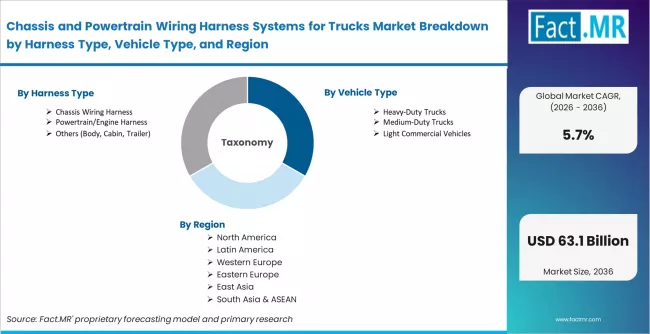
Chassis And Powertrain Wiring Harness Systems For Trucks Market Breakdown By Harness Type Vehicle Type And Region | Source: Fact.MR
| Attribute | Details |
|---|---|
| Quantitative Units | USD 34.3 billion (2026) to USD 59.6 billion (2036), at a CAGR of 5.7% |
| Market Definition | Chassis and powertrain wiring harness assemblies for heavy-duty, medium-duty, and light commercial trucks across diesel, CNG, hybrid, and battery-electric powertrain configurations for OEM and aftermarket channels globally. |
| Harness Type Segmentation | Chassis Wiring Harness, Powertrain/Engine Harness, Others (Body, Cabin, Trailer) |
| Vehicle Type Segmentation | Heavy-Duty Trucks, Medium-Duty Trucks, Light Commercial Vehicles |
| Application Segmentation | Power Distribution & Engine Control, Safety & Braking Systems, Lighting & Chassis Electronics, Telematics & Connectivity |
| Application Coverage | Long-haul freight chassis harness, urban delivery electric truck powertrain harness, emission compliance aftertreatment sensor wiring, braking and ADAS safety harness, and fleet telematics circuit integration. |
| Regions Covered | North America, Europe, Asia Pacific, Latin America, Middle East and Africa |
| Countries Covered | USA, Canada, Mexico, Germany, UK, France, Italy, Spain, Sweden, BENELUX, China, Japan, India, South Korea, ASEAN, Australia and New Zealand, Brazil, Argentina, Chile, Saudi Arabia, GCC, Turkey, South Africa, Rest of MEA |
| Key Companies Profiled | Yazaki Corporation, Sumitomo Electric Industries, Aptiv PLC, Lear Corporation, Leoni AG, Furukawa Electric, PKC Group Oy, Delphi Technologies, Samvardhana Motherson International, Tata AutoComp Systems |
| Forecast Period | 2026 to 2036 |
| Approach | Hybrid bottom-up and top-down model using truck production volumes by class and region, average harness content per vehicle by powertrain type, Tier-1 supplier pricing benchmarks by harness category, and primary interviews with OEM procurement and harness engineering teams. |
Source: Fact.MR analysis. Updated Apr 23, 2026
Chassis and Powertrain Wiring Harness Systems for Trucks Market by Segments
-
By Harness Type:
- Chassis Wiring Harness
- Powertrain/Engine Harness
- Others (Body, Cabin, Trailer)
-
By Vehicle Type:
- Heavy-Duty Trucks
- Medium-Duty Trucks
- Light Commercial Vehicles
-
By Application:
- Power Distribution & Engine Control
- Safety & Braking Systems
- Lighting & Chassis Electronics
- Telematics & Connectivity
-
By Region:
- North America
- United States
- Canada
- Mexico
- Latin America
- Brazil
- Argentina
- Chile
- Rest of Latin America
- Western Europe
- Germany
- France
- United Kingdom
- Italy
- Spain
- Sweden
- BENELUX
- Rest of Western Europe
- Eastern Europe
- Russia
- Poland
- Hungary
- Balkan and Baltic
- Rest of Eastern Europe
- East Asia
- China
- Japan
- South Korea
- South Asia and Pacific
- India
- ASEAN
- Australia and New Zealand
- Rest of South Asia and Pacific
- Middle East and Africa
- Kingdom of Saudi Arabia
- Other GCC Countries
- Turkey
- South Africa
- Rest of Middle East and Africa
- North America
Frequently Asked Questions
How large is the global chassis and powertrain wiring harness systems for trucks market in 2025?
What will the market size be in 2026?
What is the projected market size by 2036?
What is the expected CAGR from 2026 to 2036?
Which harness type segment is poised to lead the market?
Which vehicle type holds the largest share?
Which country shows the fastest growth?
What is driving demand for truck wiring harness systems?
Who worked on this report


Preview the report firsthand - request a free sample
Free SampleGet the brochure for pricing and purchase details
Download PDF