- Base Value(2025): 2.9 Bn
- Estimated Value(2026): 3.1 Bn
- Forecast Value (2036): 6.1 Bn
- CAGR (2026 - 2036): 6.7%
High-Voltage Interlock Loop Wiring Components Market Forecast and Outlook by Fact.MR
- The high-voltage interlock loop wiring components market was valued at USD 2.9 billion in 2025.
- According to Fact.MR, demand is projected to reach USD 3.1 billion in 2026 and expand to USD 6.1 billion by 2036, reflecting a CAGR of 6.7% during the forecast period.
- The market is expected to create an absolute opportunity of USD 2.94 billion between 2026 and 2036, supported by the increasing spread of high-voltage architectures across electric vehicles.
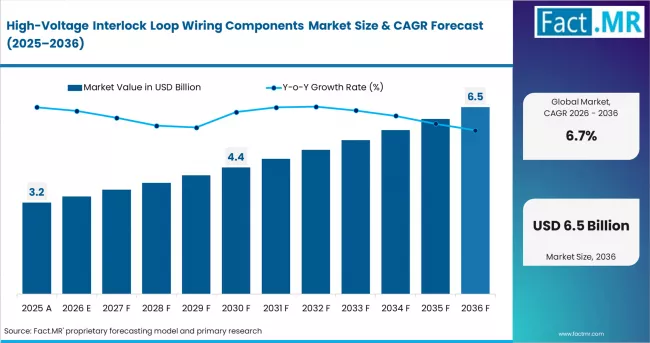
High Voltage Interlock Loop Wiring Components Market Value Analysis | Source: Fact.MR
| Metric | Value |
|---|---|
| Estimated Value in 2026 | USD 3.18 billion |
| Forecast Value in 2036 | USD 6.12 billion |
| Forecast CAGR (2026 to 2036) | 6.78% |
Source: Fact.MR analysis. Updated May 11, 2026
Summary of the High-Voltage Interlock Loop Wiring Components Market
- Market Definition
- The high-voltage interlock loop wiring components market includes the connector, cable, and disconnect-side hardware that confirms HV mating integrity and supports safe shutdown of EV high-voltage systems.
- Demand Drivers
- EV platform teams need safer ways to monitor connector and service-disconnect status across a growing number of HV interfaces.
- OEMs are expanding integrated HVIL use as battery, inverter, auxiliary, and charging connection architectures become more modular.
- Higher-voltage platforms increase the value of touch-safe, error-resistant, and interlock-aware connection systems.
- Key Segments Analyzed
- By Component Type: HVIL Connectors are expected to account for 37.0% share in 2026, supported by their central role in embedding interlock continuity inside high-voltage mating interfaces.
- By Application: Battery Pack Systems are projected to hold 34.0% share in 2026 because pack-level disconnects and internal HV interfaces rely heavily on interlock-safe connection logic.
- By Vehicle Type: Passenger Cars are expected to capture 64.0% share in 2026 due to broad EV deployment across high-volume passenger platforms.
- By Geography: China leads growth with a 7.3% CAGR through 2036, supported by EV scale and strong localized high-voltage interconnect manufacturing.
- Analyst Opinion at Fact.MR
- Shambhu Nath Jha, Senior Analyst at Fact.MR, sates that the strongest change in this market is that HVIL hardware is no longer treated as a minor secondary circuit. As EV architectures add more high-voltage connection points, the interlock path becomes part of the vehicle’s active safety logic. That makes connector design, service-disconnect behavior, and interlock continuity more strategically important than a simple signal loop would suggest.
- Strategic Implications
- Suppliers that combine compact packaging, touch safety, and robust HVIL integration will be better placed in next-generation EV architectures.
- OEMs need interconnect vendors that support validation, service safety, and packaging optimization across multiple HV interfaces.
- Aftermarket participants gain more from correct fitment and service-safe replacement than from low-cost generic substitution.
- Methodology
- Market sizing used EV production, HV connection-point density, and integrated interlock content as baseline anchors.
- Analysis incorporated supplier positioning around HVIL-enabled connectors and disconnect systems.
- Forecasts were checked against EV safety standards and the migration toward higher-voltage platforms with more distributed HV interfaces.
HVIL content is increasing as more connectors, service disconnect points, and high-voltage subassemblies are integrated across battery packs, inverters, auxiliary units, and power distribution systems. Rising EV architecture complexity is creating stronger demand for safe disconnect pathways across a broader set of components, supporting the need for dedicated interlock loop wiring solutions. Aptiv notes that its high-voltage interconnect systems distribute power across core EV subsystems, while HVIL functions cut power when a connector is unintentionally unmated. TE Connectivity positions AMP+ manual service disconnects to open the HVIL circuit before live contacts separate. [1]
China is projected to remain the fastest-growing country, with a CAGR of 7.3% from 2026 to 2036, followed by India at 7.0% and South Korea at 6.6%. Germany is expected to expand at 6.3%, the United States at 6.1%. Fact.MR views this spread as a reflection of differences in EV production scale, localized high-voltage interconnect manufacturing, and the pace at which OEMs migrate toward higher-voltage architectures and denser HV connection points.
Segmental Analysis
High-Voltage Interlock Loop Wiring Components Market Analysis by Component Type
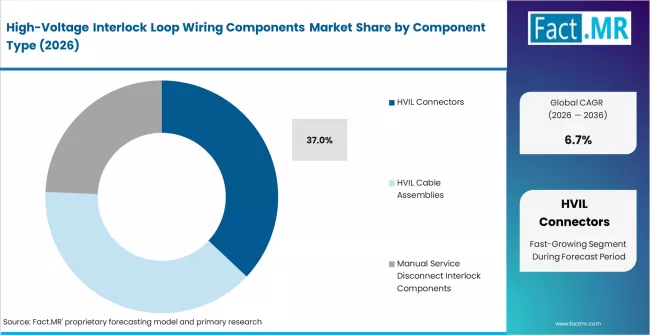
High Voltage Interlock Loop Wiring Components Market Analysis By Component Type | Source: Fact.MR
HVIL connectors continue to lead demand within the high-voltage interlock loop wiring components market because the connector is where interlock continuity and mechanical mating integrity come together. Reliable connector performance is essential for maintaining circuit continuity, secure locking, and safe disconnection across EV high-voltage systems. HVIL connectors are expected to account for 37.0% share in 2026. Aptiv markets integrated HVIL across its high-voltage interconnect portfolio, while TE Connectivity, Rosenberger, and Amphenol highlight HVIL-enabled connector families for power distribution, e-drive, charging, and auxiliary functions. This keeps connectors at the center of commercial value capture.
- Mating integrity: HVIL connectors verify connection status where HV contact safety matters most.
- Packaging value: Integrated HVIL reduces the need for separate safety hardware around each high-voltage interface.
- Validation priority: Connector-level interlock behavior is easier for OEMs to validate than loosely added external signal logic.
High-Voltage Interlock Loop Wiring Components Market Analysis by Application
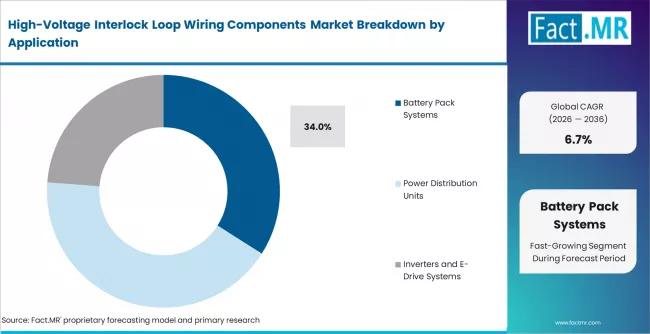
High Voltage Interlock Loop Wiring Components Market Analysis By Application | Source: Fact.MR
Service safety and power isolation requirements are making battery pack systems the leading use case for HVIL components. These systems manage major high-voltage circuits and require reliable interlock functions during maintenance, replacement, and emergency disconnect scenarios. Battery pack systems are projected to represent 34.0% share in 2026. TE Connectivity markets its AMP+ manual service disconnect to trigger HVIL opening before high-voltage contact separation. Aptiv and Rosenberger also support battery-linked and PDU applications with HVIL-integrated solutions, reinforcing this segment’s leadership. [3]
- Service safety: Battery pack disconnect points depend on safe HVIL sequencing during maintenance and emergency response.
- Architecture centrality: Pack systems sit at the center of multiple HV branches, making interlock continuity more commercially important.
- Fault consequence: Errors at pack interfaces carry wider system-level implications than many peripheral HV nodes.
High-Voltage Interlock Loop Wiring Components Market Analysis by Vehicle Type
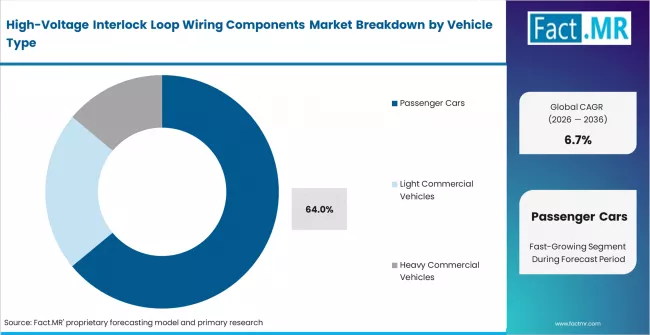
High Voltage Interlock Loop Wiring Components Market Analysis By Vehicle Type | Source: Fact.MR
Passenger cars are projected to hold 64.0% share in 2026. The lead comes from EV volume concentration in passenger platforms and the broad spread of high-voltage interfaces across mainstream BEV and PHEV architectures. Aptiv’s HVIL and high-voltage interconnect materials are oriented around hybrid and electric vehicles at large, while TE, Rosenberger, Yazaki, and Amphenol all maintain HV connector ecosystems suited to passenger vehicle electrification. [4]
- Volume leverage: Passenger EV programs spread HVIL content across the largest production base.
- Architecture density: Passenger EVs increasingly use multiple HV nodes across packs, auxiliaries, and charging paths.
- Platform repeatability: OEMs can standardize HVIL component families across multiple passenger vehicle lines.
High-Voltage Interlock Loop Wiring Components Market Drivers, Restraints, and Opportunities
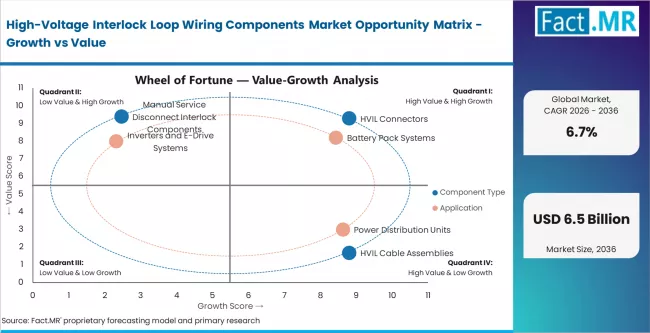
High Voltage Interlock Loop Wiring Components Market Opportunity Matrix Growth Vs Value | Source: Fact.MR
The strongest market driver is the increase in high-voltage interfaces across electrified vehicle platforms. Every additional pack, inverter, charger, auxiliary, or PDU interface raises the need for reliable interlock continuity and safe disconnect behavior. Aptiv’s recent white paper makes clear that HV interconnects tie together charge inlets, batteries, inverters, and motors, while TE’s service disconnect and connector families show how HVIL is integrated into the physical connection strategy. That combination supports strong growth in HVIL-specific wiring components as EV architectures become more distributed.
The main restraint is validation burden under tight packaging constraints. HVIL components may carry low current, though they sit inside demanding environments involving vibration, sealing, shielding, touch-safety requirements, and precise sequencing. Rosenberger, TE, and Aptiv all emphasize protection classes, vibration compliance, and touch-safe design in their high-voltage connector materials, which shows that interlock hardware must satisfy broader connector-system demands, not just circuit continuity. [5]
Opportunities in the High-Voltage Interlock Loop Wiring Components Market
- Higher-voltage platform rollout: 800 V and 1000 V architectures create room for more compact, better-sequenced, and more robust HVIL-enabled interconnects. Rosenberger’s HVR25 launch directly supports this direction.
- Service disconnect scaling: More battery variants and service-safety requirements increase demand for disconnects with integrated interlock logic. TE’s manual service disconnect and SD 125 illustrate this opportunity.
- Auxiliary HV node growth: As EVs add more powered auxiliaries and distributed HV devices, OEMs need more low-current interlock paths embedded across the vehicle. Aptiv, TE, and Amphenol all market HVIL-equipped connectivity for accessory and auxiliary applications.
Regional Analysis
Based on the regional analysis, the High-Voltage Interlock Loop Wiring Components Market is segmented into East Asia, South Asia and Pacific, North America, Europe, Latin America, and Middle East and Africa across 40 plus countries.
.webp "Top Country Growth Comparison High Voltage Interlock Loop Wiring Components Market Cagr (2026 2036)")
Top Country Growth Comparison High Voltage Interlock Loop Wiring Components Market Cagr (2026 2036) | Source: Fact.MR
| Country | CAGR (2026 to 2036) |
|---|---|
| China | 7.3% |
| India | 7.0% |
| South Korea | 6.6% |
| Germany | 6.3% |
| United States | 6.1% |
Source: Fact.MR analysis. Updated May 11, 2026
Source: Fact.MR analysis, based on proprietary forecasting model and primary research
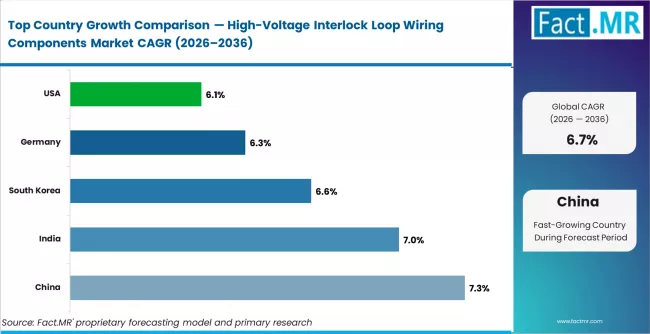
High Voltage Interlock Loop Wiring Components Market Cagr Analysis By Country | Source: Fact.MR
East Asia High-Voltage Interlock Loop Wiring Components Market Analysis
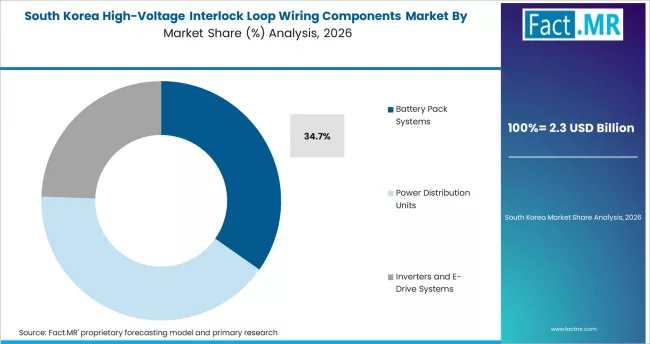
High Voltage Interlock Loop Wiring Components Market South Korea Market Share Analysis By Application | Source: Fact.MR
East Asia remains the strongest production and supply base for this market. The region combines high EV output with deep connector, harness, and component manufacturing capability. That matters because HVIL wiring content scales best when OEMs and connector suppliers can co-develop compact, validated interconnect solutions close to vehicle production. China, Japan, and South Korea each contribute differently, with China adding EV scale, Japan reinforcing connection-system quality discipline, and South Korea supporting electronics-dense EV programs. Rosenberger, Aptiv, Amphenol, and Yazaki product materials all support the importance of localized high-voltage interconnect capability in this region. [6]
- China: Strong EV production, rising high-voltage architecture complexity, and localized interconnect manufacturing support China’s lead. High-voltage interlock loop wiring components demand in China is projected to grow at a CAGR of 7.3% by 2036. The country benefits from rapid EV scaling and wider deployment of HVIL-enabled high-voltage connectors across battery, inverter, and auxiliary systems.
- South Korea: South Korea is expected to grow at a 6.6% through 2036. Its role is tied to fast-moving EV programs and stronger integration of high-voltage connection systems in electronics-dense vehicle platforms. Suppliers that can support compact, shielded, and HVIL-capable interfaces are well positioned here.
Fact.MR’s report also covers ASEAN, Australia and New Zealand, and other South Asia and Pacific countries. These markets matter where EV assembly expands and where high-voltage connector ecosystems move closer to regional production footprints.
North America High-Voltage Interlock Loop Wiring Components Market Analysis
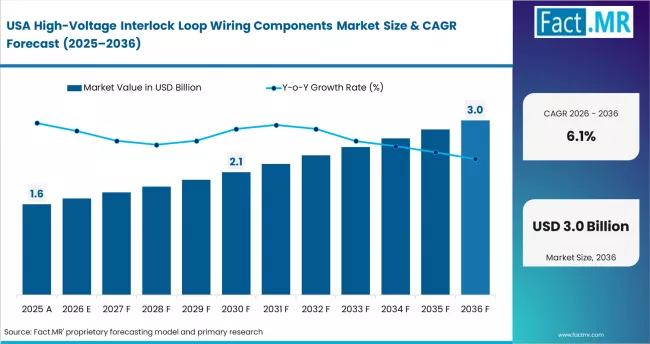
High Voltage Interlock Loop Wiring Components Market Country Value Analysis | Source: Fact.MR
North America is shaped by EV program expansion, growing battery-pack assembly activity, and strong service-safety expectations. HVIL components matter in this region because OEMs and service organizations place heavy emphasis on safe disconnect behavior and validated high-voltage repair procedures. TE’s service-disconnect positioning and Aptiv’s framing of HVIL as a vehicle-lifecycle safety feature fit this regional profile closely.
- United States: High-voltage interlock loop wiring components demand in the United States is projected to rise at a CAGR of 6.1% over the study period. The market is supported by EV platform development, strong emphasis on service-safe battery access, and continued growth in high-voltage interconnect complexity across passenger and commercial applications.
Fact.MR’s report also includes Canada and the wider North American supply ecosystem. Additional value comes from battery service needs, EV manufacturing growth, and strong demand for validated high-voltage connection safety.
Europe High-Voltage Interlock Loop Wiring Components Market Analysis
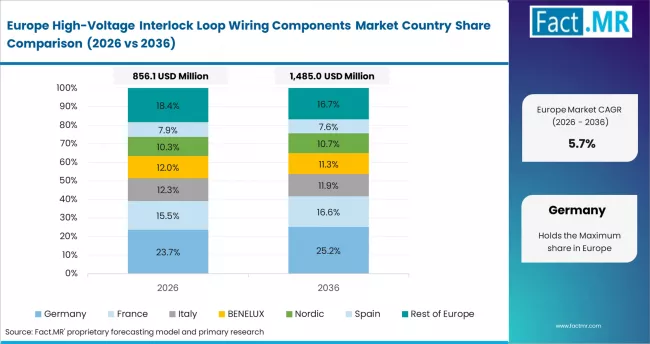
High Voltage Interlock Loop Wiring Components Market Europe Country Market Share Analysis, 2026 & 2036 | Source: Fact.MR
Europe remains a high-discipline market rather than the fastest-growing one. Vehicle makers in the region put strong weight on electrical safety, connector validation, and higher-voltage migration. ISO 6469-3 and UNECE Regulation No. 100 form an important part of the regulatory backdrop, while Rosenberger’s current product and launch materials show direct alignment with 800 V and 1000 V architectures, HVIL integration, and stringent sealing or vibration expectations.
- Germany: Germany is projected to expand at a CAGR of 6.3% from 2026 to 2036. Its importance comes from EV engineering intensity, supplier depth in high-voltage connectivity, and strong demand for compact, shielded, and interlock-capable interfaces that meet rigorous validation standards. Rosenberger’s German high-voltage connector portfolio supports this structural position.
Fact.MR’s report also covers France, Italy, the United Kingdom, Spain, and the rest of Europe. These markets add commercial depth through continued EV platform development and strong emphasis on safe, validated high-voltage interconnect systems.
Competitive Aligners for Market Players
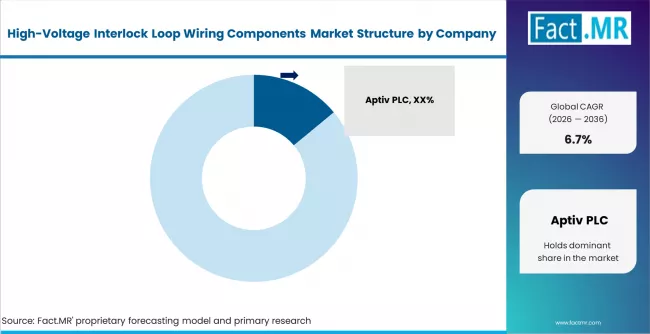
High Voltage Interlock Loop Wiring Components Market Analysis By Company | Source: Fact.MR
The high-voltage interlock loop wiring components market is moderately consolidated. Buyers do not choose suppliers only on conductor size or connector current rating. They choose on interlock integrity, touch safety, sealing, packaging efficiency, vibration robustness, and the supplier’s ability to support validation in harsh EV environments. Aptiv, TE, Rosenberger, Amphenol, and Yazaki remain visible because they operate close to the core interconnect interfaces where HVIL value is embedded.
Established suppliers hold an advantage because HVIL functionality is difficult to separate from the complete connector-system design. A new entrant may develop a functional loop, but matching OEM confidence is more challenging. Suppliers must support mating sequence control, shielding performance, touch safety, disconnect behavior, and packaging efficiency across the full high-voltage pathway. These requirements make HVIL a system-level engineering task rather than a standalone component feature. Aptiv reinforces this view by presenting HVIL as part of a broader high-voltage interconnect strategy rather than an isolated function.
Key Players in High-Voltage Interlock Loop Wiring Components Market
- Aptiv PLC
- TE Connectivity
- Rosenberger Group
- Amphenol Corporation
- Yazaki Corporation
- Sumitomo Wiring Systems, Ltd.
- LEONI AG
- Coroplast Fritz Müller GmbH & Co. KG
- Intercable Automotive Solutions
- Molex
- Furukawa Electric Co., Ltd.
- Phoenix Contact E-Mobility
Bibliography
- [1] Aptiv. What Is HVIL? Official article explaining high-voltage interlock loop as a safety feature in hybrid and electric vehicles.
- [2] ISO. ISO 6469-3:2021. Official standard page for electrical safety requirements for voltage class B electric circuits in electrically propelled road vehicles.
- [3] TE Connectivity. Manual Service Disconnect technical sheet. PDF stating that HVIL is integrated into the MSD to help prevent arcs during mating and unmating.
- [4] Aptiv. For High-Voltage Interconnects, One Size Does Not Fit All. 2026 white paper discussing HV interconnect architecture and HVIL behavior.
- [5] Rosenberger. Connector Systems for E-Mobility catalog. 2024 product catalog showing HVIL across multiple HVR connector families and EV use cases.
- [6] Amphenol. Universal Power Connector press release. PDF describing HVIL in high-current EV connection applications.
This Report Addresses
- Strategic demand outlook for high-voltage interlock loop wiring components across EV high-voltage safety architectures.
- Market forecast from USD 3.1 billion in 2026 to USD 6.1 billion by 2036.
- The growing role of HVIL-enabled connectors, cable assemblies, and service disconnects in EV safety design.
- The effect of 800 V and 1000 V platform migration on compact, interlock-capable connection systems.
- OEM versus aftermarket demand patterns in a validation-sensitive EV interconnect category.
- Regional differences in EV output, connector manufacturing depth, and higher-voltage architecture adoption.
- Competitive positioning of suppliers active in HV connectors, disconnect systems, and interlock-capable interconnects.
- Segment analysis by component type, application, vehicle type, sales channel, and geography.
High-Voltage Interlock Loop Wiring Components Market Definition
The market covers the wiring-side components that enable and preserve high-voltage interlock loop continuity inside electrified vehicle systems. This includes HVIL-enabled connectors, low-current interlock circuits integrated into high-voltage connector bodies, cable assemblies that carry interlock paths, service-disconnect interlock elements, and related mating interfaces used to confirm safe HV connection status.
High-Voltage Interlock Loop Wiring Components Market Inclusions
The market includes HVIL-equipped connector systems, headers, terminals, cable assemblies, integrated interlock loops inside service disconnects, and related wiring-side interfaces used across EV battery packs, PDUs, inverters, onboard chargers, e-motors, and auxiliary HV devices.
High-Voltage Interlock Loop Wiring Components Market Exclusions
The market excludes standalone high-voltage busbars, full traction battery packs, complete vehicle HV harnesses where interlock value cannot be isolated, and non-automotive industrial interlock systems. It also excludes high-voltage contactors and controllers sold without relevant wiring-side interlock components.
High-Voltage Interlock Loop Wiring Components Market Research Methodology
- Primary Research
- Interviews with EV connection-system engineers, battery-pack integration managers, high-voltage harness designers, connector-validation teams, and aftermarket service specialists handling electrified vehicle repair.
- Desk Research
- Review of supplier connector catalogs, white papers, service disconnect specifications, official safety standards for electric road vehicles, and recent product materials from Aptiv, TE, Rosenberger, Amphenol, and Yazaki.
- Market-Sizing and Forecasting
- Fact.MR used a blended model based on EV production, high-voltage connection-point density, HVIL integration per vehicle, migration toward higher-voltage platforms, and replacement or service demand in the electrified vehicle parc.
- Data Validation and Update Cycle
- Forecasts were cross-checked through official road-vehicle electrical safety standards, connector supplier product positioning, and the increasing use of integrated HVIL in service disconnects and high-voltage interconnect families. ISO 6469-3 specifies electrical safety requirements for voltage class B circuits, while UNECE Regulation No. 100 remains a core regulatory framework for electric power train safety. [2]
Segmentation
Scope of the Report
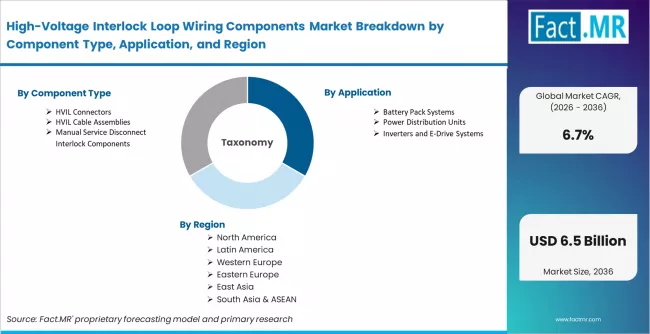
High Voltage Interlock Loop Wiring Components Market Breakdown By Component Type, Application, And Region | Source: Fact.MR
| Attribute | Details |
|---|---|
| Quantitative Units | USD 3.1 billion in 2026 to USD 6.1 billion in 2036, at a CAGR of 6.7% |
| Market Definition | High-voltage interlock loop wiring components that maintain or verify interlock continuity across EV high-voltage connectors, cable assemblies, disconnects, and related interfaces. |
| Component Type Segmentation | HVIL Connectors, HVIL Cable Assemblies, Manual Service Disconnect Interlock Components, Header and Terminal Interfaces, Others |
| Application Segmentation | Battery Pack Systems, Power Distribution Units, Inverters and E-Drive Systems, Charging and Auxiliary HV Systems, Others |
| Vehicle Type Segmentation | Passenger Cars, Light Commercial Vehicles, Heavy Commercial Vehicles, Electric Industrial & Commercial Vehicles |
| Sales Channel Segmentation | OEM, Aftermarket |
| Regions Covered | East Asia, South Asia and Pacific, North America, Europe, Latin America, Middle East and Africa |
| Countries Covered | China, India, South Korea, Germany, United States, Japan, Mexico, and 40+ countries |
| Key Companies Profiled | Aptiv, TE Connectivity, Rosenberger, Amphenol, Yazaki, Sumitomo Wiring Systems, LEONI, Coroplast, Intercable Automotive, Molex, Furukawa Electric, Phoenix Contact E-Mobility |
| Forecast Period | 2026 to 2036 |
| Approach | Fact.MR combined primary interviews with EV interconnect stakeholders, desk research across connector and standards materials, and a forecast model anchored in EV production, HV connection-point density, and integrated interlock adoption. |
Source: Fact.MR analysis. Updated May 11, 2026
High-Voltage Interlock Loop Wiring Components Market by Segments
-
By Component Type:
- HVIL Connectors
- HVIL Cable Assemblies
- Manual Service Disconnect Interlock Components
- Header and Terminal Interfaces
- Others
-
By Application:
- Battery Pack Systems
- Power Distribution Units
- Inverters and E-Drive Systems
- Charging and Auxiliary HV Systems
- Others
-
By Vehicle Type:
- Passenger Cars
- Light Commercial Vehicles
- Heavy Commercial Vehicles
- Electric Industrial & Commercial Vehicles
-
By Region:
- North America
- United States
- Canada
- Mexico
- Latin America
- Brazil
- Argentina
- Rest of Latin America
- Europe
- Germany
- France
- United Kingdom
- Italy
- Spain
- Rest of Europe
- East Asia
- China
- Japan
- South Korea
- South Asia and Pacific
- India
- ASEAN
- Australia and New Zealand
- Rest of South Asia and Pacific
- Middle East and Africa
- GCC Countries
- South Africa
- Turkey
- Rest of Middle East and Africa
- North America
Frequently Asked Questions
What is the estimated size of the high-voltage interlock loop wiring components market in 2026?
How large is the market expected to become by 2036?
What is the forecast CAGR for 2026 to 2036?
Which component type leads the market?
Which application dominates demand?
Why does the OEM channel dominate?
Why are HVIL components important here?
What is the strongest demand driver?
What is the key restraint?
Which country is growing fastest?
Why is China ahead?
How does India compare?
Why does South Korea rank strongly?
How do 800 V and 1000 V architectures affect this market?
Is this a fragmented supplier market?
What do OEM buyers prioritize?
Why do service disconnects matter in this segment?
Which companies are most visible in this market?
What is the broader outlook through 2036?
Who worked on this report


Preview the report firsthand - request a free sample
Free SampleGet the brochure for pricing and purchase details
Download PDF