- Base Value(2025): 4.06 Bn
- Estimated Value(2026): 4.26 Bn
- Forecast Value (2036): 7.01 Bn
- CAGR (2026 - 2036): 5.1%
Motorcycle Filter Market Size, Market Forecast and Outlook By FACT.MR
The motorcycle filter market was valued at USD 4.06 billion in 2025, projected to reach USD 4.26 billion in 2026, and is forecast to expand to USD 7.01 billion by 2036 at a 5.1% CAGR. The absolute dollar opportunity of approximately USD 2.75 billion added over the forecast decade reflects the expanding global motorcycle parc, tightening emission norms that mandate filtration upgrades, and growing aftermarket replacement culture across Asia Pacific. Based on FACT.MR's analysis, the shift toward synthetic filter media and multi-layer filtration designs is creating value uplift within an otherwise volume-driven product category.
Motorcycle filter demand is governed by the interaction between OEM production volumes, aftermarket replacement intervals, and emission regulation stringency. Bharat Stage VI norms in India, Euro 5 standards in Europe, and equivalent emission frameworks in Southeast Asia require higher-efficiency intake air filtration to protect fuel injection and catalytic converter systems. Oil filter replacement intervals are shortening as riders adopt performance-oriented maintenance schedules influenced by manufacturer recommendations and aftermarket brand marketing. FACT.MR analysts note that synthetic filter media is displacing cellulose in premium and performance applications, offering improved dust-holding capacity and airflow characteristics that justify higher per-unit pricing.
India and Southeast Asia account for the majority of global motorcycle production and in-use fleet volumes, creating a massive aftermarket filter replacement base. China's domestic motorcycle market is transitioning toward higher-displacement models with more complex filtration requirements. The United States motorcycle filter market concentrates on premium and aftermarket performance brands, where riders invest in high-flow intake air filters for engine performance optimization. Germany's motorcycle market emphasizes OEM-quality replacement parts compliant with manufacturer service specifications. FACT.MR opines that Japan's domestic filter manufacturers such as Roki maintain technology leadership in compact, high-efficiency filtration media design for small-displacement engines.
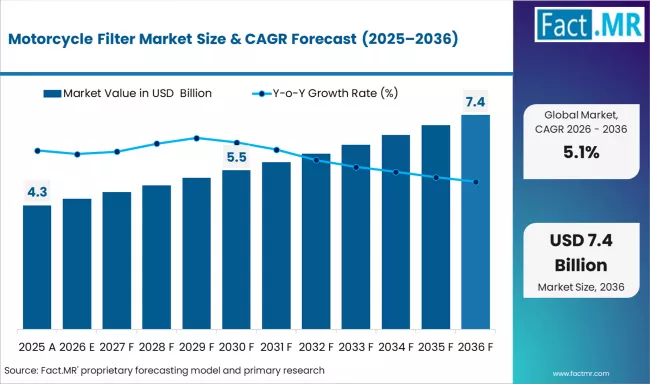
Motorcycle Filter Market Market Value Analysis | Source: Fact.MR
Motorcycle Filter Market Key Takeaways
| Metric | Details |
|---|---|
| Industry Size (2026) | USD 4.26 billion |
| Industry Value (2036) | USD 7.01 billion |
| CAGR (2026 to 2036) | 5.1% |
Source: Fact.MR analysis. Updated Mar 18, 2026
Motorcycle Filter Market Definition
Motorcycle filters encompass air intake filters, fuel filters, and oil filters designed specifically for motorcycle engine applications. These components remove particulate matter, debris, and contaminants from intake air, fuel supply, and lubricating oil to protect engine internals and emission control systems. Products are manufactured from synthetic and cellulose filter media and sold through OEM, original equipment supplier, and independent aftermarket channels.
Motorcycle Filter Market Inclusions
Market scope covers global and regional sales volumes and values for motorcycle filters, forecast period from 2026 to 2036, segment breakdowns by filter type, filter media, and sales channel. Emission regulation impact analysis and filter media technology trend assessments are included.
Motorcycle Filter Market Exclusions
The scope excludes automotive passenger car and commercial vehicle filters, industrial filtration systems, cabin air filters for enclosed vehicles, and exhaust system components such as catalytic converters. Motorcycle engine lubricants and coolants are excluded.
Motorcycle Filter Market Research Methodology
Primary Research: Analysts engaged with filtration product managers, motorcycle OEM procurement leads, and aftermarket distribution executives across 30 countries to validate shipment volumes and replacement patterns.
Desk Research: Data collection aggregated national emission regulation frameworks, motorcycle production statistics from industry associations, and vehicle registration databases.
Market-Sizing and Forecasting: Baseline values derive from a bottom-up aggregation of OEM fitment and aftermarket shipment data, applying motorcycle parc growth projections and filter replacement interval assumptions.
Data Validation and Update Cycle: Projections are cross-validated against publicly reported revenue data from major filtration manufacturers and motorcycle industry association production statistics.
Summary of Motorcycle Filter Market
- Motorcycle Filter Market Definition
- Motorcycle filters encompass air intake, fuel, and oil filtration components for motorcycle engines, manufactured from synthetic and cellulose media and sold through OEM and aftermarket channels to protect engine internals and emission control systems.
- Demand Drivers in the Market
- India's Bharat Stage VI and Europe's Euro 5 emission standards mandate higher-efficiency filtration, creating replacement demand for upgraded filter specifications in existing motorcycle fleets.
- Expanding motorcycle parc in India, Indonesia, Vietnam, and the Philippines generates a growing aftermarket filter replacement base as vehicles pass their initial service intervals.
- Synthetic filter media adoption in premium and performance categories creates per-unit value uplift as riders invest in improved dust-holding capacity and airflow characteristics over basic cellulose alternatives.
- Key Segments Analyzed in the FACT.MR Report
- Intake Air filters hold 46.7% of filter type share in 2026, reflecting the critical role of air filtration in protecting fuel injection and emission control systems from particulate contamination.
- Synthetic media commands 58.3% of filter media share, driven by performance advantages in dust-holding capacity, airflow efficiency, and durability over cellulose alternatives.
- OEMs account for 52.6% of sales channel share, reflecting the high volume of factory-fitment filters shipped with new motorcycle production across major manufacturing markets.
- Analyst Opinion at FACT.MR
- As per FACT.MR, the motorcycle filter market is transitioning from a commodity replacement parts category toward a performance-differentiated product segment where filter media technology, emission compliance certification, and brand positioning determine pricing power. Manufacturers that invest in synthetic media development and emission-standard certification testing will capture the margin premium available in markets where regulatory enforcement tightens. The aftermarket channel remains the long-term revenue generator, with each motorcycle requiring multiple filter replacements over its operational life.
- Strategic Implications / Executive Takeaways
- Filter manufacturers must certify products against both current and upcoming emission standards to maintain OEM approval status and aftermarket equivalence claims across major motorcycle markets.
- Companies targeting India and Southeast Asian aftermarket channels should develop multi-tier product portfolios spanning economy cellulose and premium synthetic filters to address the full price-sensitivity spectrum.
- Performance aftermarket brands should invest in airflow testing data and engine dynamometer validation to differentiate their intake air filter products from commodity alternatives in enthusiast motorcycle segments.
- Methodology
- Primary Research: FACT.MR conducted interviews with filtration managers, motorcycle OEM procurement leads, and aftermarket distributors across 30 countries.
- Desk Research: Analysts aggregated emission regulation data, motorcycle production statistics, and vehicle registration databases.
- Market-Sizing and Forecasting: Models apply a bottom-up methodology from OEM fitment and aftermarket shipment data, integrating motorcycle parc growth and replacement interval assumptions.
Why is the Requirement for Efficient Motorcycle Filters Increasing Worldwide?
Ongoing Advancements in Filter Technology Driving Up Market Growth
Motorcycle filters are becoming more durable and efficient because of technological advancements in material science and design. The latest ongoing technological advances in filtration media, multi-layered filters, and sealing technologies are making filters collect a lot more harmful particles and pollutants, thus they protect the engine and improve its overall performance.
In addition, by making the filters' life span longer, the substitutions and repairs are not so regularly necessary. This makes the maintenance easier and cheaper. These high-tech filters are extensively preferred over outdated filters as more people want products that are of excellent quality and perform reliably for a long time.
Which Issues are Negatively Affecting the Market Growth?
Rising Consumers' Interest in Electric Motorcycles
The increasing popularity of electric motorcycles is hindering the demand for filters globally. Since electric motorcycles run on electricity rather than fuel, they do not require air or oil filters to control combustion processes, in contrast to internal combustion engines. With lower filtration requirements, this move to electric vehicles eventually resulted in a drop in the market for traditional motorbike filters.
The market for conventional filters gradually contracting as more people choose electric motorcycles due to their efficiency and environmental advantages, which is impacting the long-term growth prospects.
Country-wise Insights
The East Asia region is projected to account for 36.5% of the global motorcycle filter market share in 2026. The increasing popularity of high-performance bikes and a growing number of owners are contributing to motorcycle filter market growth in the region. European countries are home to some of the most beautiful landscapes and picturesque touring roads in the world and this is what is attracting more people to opt for motorcycle touring. A growing number of motorcycle enthusiasts in European countries such as the United Kingdom, Germany, and France are also favoring motorcycle filter sales.
.webp "Top Country Growth Comparison Motorcycle Filter Market Cagr (2026 2036)")
Top Country Growth Comparison Motorcycle Filter Market Cagr (2026 2036) | Source: Fact.MR
What is the Demand Outlook for Motorcycle Filters in the United States?
Continuously Increasing Motorcycle Ownership Providing New Opportunities to Suppliers
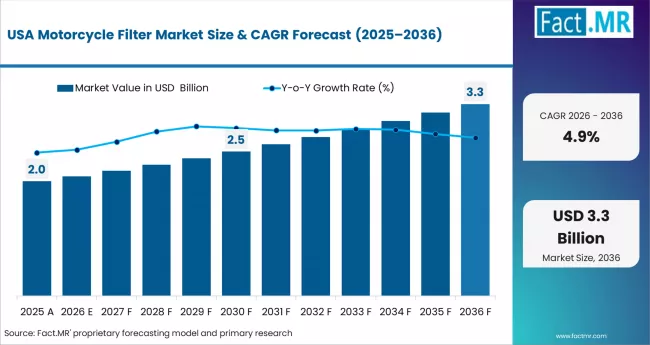
Motorcycle Filter Market Country Value Analysis | Source: Fact.MR
| Attribute | United States |
|---|---|
| Market Value (2026E) | US$ 811.8 Million |
| Growth Rate (2026 to 2036) | 5.6% CAGR |
| Projected Value (2036F) | US$ 1.4 Billion |
Source: Fact.MR analysis. Updated Mar 18, 2026
The market in the United States is expanding continuously due to rising motorcycle ownership. Off-road motorcycles are gaining massive popularity in the country and are projected to boost sales. The growing number of people buying motorcycles for recreational purposes is also creating new opportunities for motorcycle filter suppliers in the United States.
Advancements in filter technology are also pushing motorcycle filter producers to launch new products that make vehicles more efficient and compliant with sustainability regulations. Growing demand for better ride comfort among riders is also resulting in increased motorcycle filter installation and maintenance activity in the country.
Why do Motorcycle Filter Manufacturers Consider Japan a Lucrative Market?
Important Role of Filters in Maintaining Aged Motorcycles
| Attribute | Japan |
|---|---|
| Market Value (2026E) | US$ 360.5 Million |
| Growth Rate (2026 to 2036) | 6% CAGR |
| Projected Value (2036F) | US$ 646 Million |
Source: Fact.MR analysis. Updated Mar 18, 2026
The high number of aged motorcycles in Japan is stimulating the requirements for filters to maintain their best performance and longevity. This includes changing filters regularly, which is vital for keeping the engine safe and operating efficiently. An older fleet of vehicles needs more regular maintenance for motorcycles, which is driving a consistent demand for replacement filters in the aftermarket in Japan. This demand is steady as older bikes are kept on the road longer, which is driving the market growth for motorcycle filters in Japan.
Category-wise Insights
Based on filer media, the market is segmented into cellulose and synthetic. The synthetic segment holds a significant portion of the global market due to its longer lifespan and better performance. Better filtration efficiency is provided by synthetic filters, which retain superior flow properties while catching tiny particles.
Why is Demand for Fuel Filters High Compared to Other Options?
Essential Role of Fuel Filters in Shielding Engine from Pollutants and Impurities
| Attribute | Fuel Filters |
|---|---|
| Segment Value (2026E) | US$ 1.82 Billion |
| Growth Rate (2026 to 2036) | 5.4% CAGR |
| Projected Value (2036F) | US$ 3.08 Billion |
Source: Fact.MR analysis. Updated Mar 18, 2026
Demand for fuel filters is high in comparison with oil and intake air filters. Fuel filters are important in shielding the engine from impurities and debris, which are more common and dangerous in fuel than in oil or air. Regular gasoline filter changes are required due to the wide variation in fuel quality, particularly between suppliers and different areas. Other than this, the fuel filters come with a shorter lifespan, because of this reason they need to be replaced more regularly to maintain the best possible engine performance and fuel efficiency.
By keeping pollutants and impurities out of the fuel system, motorcycle fuel filters are essential to the engine's smooth and effective performance. The performance and lifetime of motorcycles are directly impacted by the quality of the fuel, and because of this, their demand is continuously increasing.
Which Sales Channel Holds a Significant Market Share?
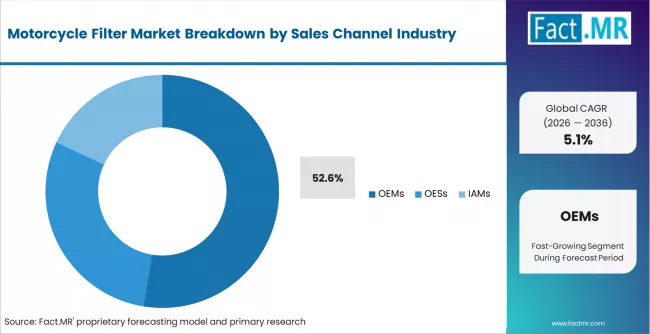
Motorcycle Filter Market Analysis By Sales Channel | Source: Fact.MR
High Demand in Aftermarket with Growing Preference for Modified Motorcycles
Based on sales channels, the market is segmented into OEMs, OESs, and IAMs. IAMs (Independent Aftermarket Channels) are projected to hold a significant market share throughout the projection period. The trend of customization is nothing new when it comes to the motorcycle market as people have been modifying their bikes ever since they first came out. The rising popularity of motorsports on a global scale is increasing the demand for aftermarket performance enhancement parts, which is helping independent aftermarket channels to hold a leading position.
Competitive Landscape
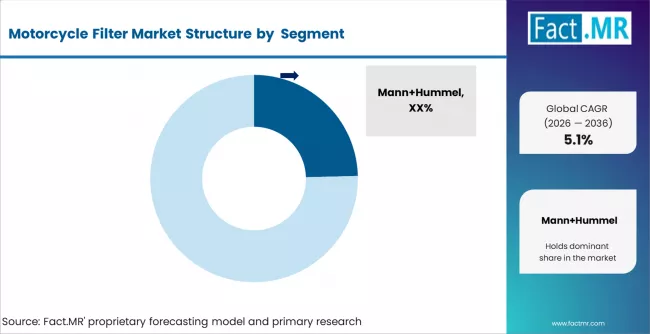
Motorcycle Filter Market Analysis By Company | Source: Fact.MR
Key players in the motorcycle filter industry are focusing on launching new products to improve their sales potential and market share in the global landscape.
- In January 2023, Uni Filter, an Australian supplier of filters for cars and motorcycles, announced the release of new air filters. The newly launched O2Rush air filter is a single-stage performance filter that provides better filtration and airflow.
- In April 2023, FRAM, a renowned American automotive replacement part brand, announced the launch of its new synthetic oil filter. FRAM synthetic oil filters are exclusively available at Walmart retail stores in the United States.
Fact.MR provides detailed information about the price points of key manufacturers of motorcycle filters positioned across the world, sales growth, production capacity, and speculative technological expansion, in this updated market report.
Bibliography
- Government of India, Ministry of Road Transport and Highways. (2024). Bharat Stage VI emission standards: Implementation and compliance report. MoRTH.
- European Commission. (2024). Regulation (EU) No 168/2013: Type approval of two-wheelers, Euro 5 emission standards. EC.
- International Organization of Motor Vehicle Manufacturers (OICA). (2024). Global motorcycle production statistics. OICA.
- Japan Automobile Manufacturers Association. (2024). Motorcycle industry data. JAMA.
- Society of Indian Automobile Manufacturers. (2024). Indian motorcycle production and sales data. SIAM.
- ASEAN Automotive Federation. (2024). ASEAN automotive statistics: Motorcycle segment. AAF.
This bibliography is provided for reader reference. The full FACT.MR report contains the complete reference list with primary research documentation.
This Report Addresses
- Market sizing and quantitative forecast metrics detailing global motorcycle filter sales volumes and values through 2036.
- Segmentation analysis mapping demand patterns across filter types, media technologies, and sales channels.
- Regional deployment intelligence comparing high-volume Asian OEM production markets against developed market aftermarket premiumization.
- Regulatory compliance assessment analyzing emission standard phase-in timelines and their impact on filtration specification requirements.
- Competitive landscape evaluation tracking market positioning of major filtration manufacturers and their OEM certification portfolios.
- Strategic product development guidance identifying synthetic media, multi-layer design, and performance validation investment priorities.
- Aftermarket distribution analysis identifying OES, independent distributor, and online platform channel dynamics by region.
- Custom data delivery formats encompassing interactive dashboards, raw Excel datasets, and comprehensive PDF narrative reports.
Segmentation
Scope of the Report
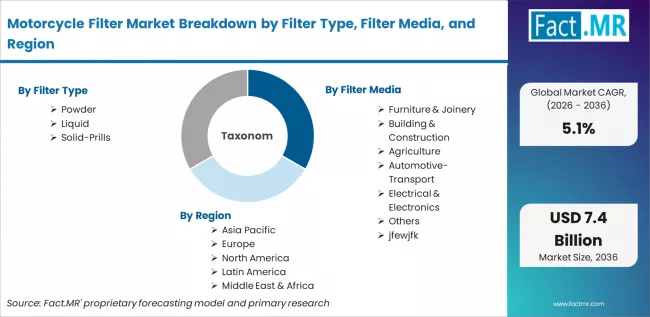
Motorcycle Filter Market Breakdown By Filter Type, Filter Media, And Region | Source: Fact.MR
| Metric | Value |
|---|---|
| Quantitative Units | USD 4.26 billion to USD 7.01 billion, at a CAGR of 5.1% |
| Market Definition | Motorcycle filters encompass air intake, fuel, and oil filtration components for motorcycle engines, manufactured from synthetic and cellulose media and sold through OEM and aftermarket channels to protect engine internals and emission control systems. |
| Filter Type Segmentation | Intake Air, Fuel, Oil |
| Filter Media Segmentation | Synthetic, Cellulose |
| Sales Channel Segmentation | OEMs, OESs, IAMs |
| Regions Covered | North America, Latin America, Europe, East Asia, South Asia, Oceania, Middle East & Africa |
| Countries Covered | India, China, USA, Canada, UK, Germany, Japan, and 40 plus countries |
| Key Companies Profiled | Mann+Hummel GmbH, MAHLE GmbH, K & N Engineering Inc., BMC S.r.l., Uni Filter Inc., Roki Co., Ltd., DNA Filters, Pipercross Performance Filters, Filtrak Brandt GmbH, SIMOTA |
| Forecast Period | 2026 to 2036 |
| Approach | Forecasting models apply a bottom-up methodology starting with OEM fitment and aftermarket shipment data, integrating motorcycle parc growth projections, emission regulation phase-in timelines, and filter replacement interval assumptions. |
Source: Fact.MR analysis. Updated Mar 18, 2026
Segmentation of Motorcycle Filter Market Research
-
By Filter Type :
- Fuel
- Oil
- Intake Air
-
By Filter Media :
- Cellulose
- Synthetic
-
By Sales Channel :
- OEMs
- OESs
- IAMs
-
By Region :
- North America
- Western Europe
- Eastern Europe
- Latin America
- East Asia
- South Asia & Pacific
- Middle East & Africa
Frequently Asked Questions
How large is the demand for motorcycle filters in the global market in 2026?
What will be the market size of motorcycle filters by 2036?
What is the expected demand growth for motorcycle filters between 2026 and 2036?
Which filter type is poised to lead by 2026?
How significant is the role of Synthetic in driving motorcycle filters demand?
What sales channel segment leads in 2026?
What is motorcycle filters and what is it mainly used for?
What is included in the scope of this report?
What is excluded from the scope of this report?
How does FACT.MR build and validate this forecast?
Does the report cover USA in its regional analysis?
Does the report cover Germany in its regional analysis?
Does the report cover India in its regional analysis?
Who worked on this report


Preview the report firsthand - request a free sample
Free SampleGet the brochure for pricing and purchase details
Download PDF