- Market Value (2025): USD 2.4 Bn
- Estimated Value (2026): USD 2.6 Bn
- Forecast Value (2036): USD 4.7 Bn
- CAGR (2026-2036): 6.2%
What is the Motorcycle Monoshock Suspension Market forecast to be worth by 2036?
USD 2.6 billion in 2026 to USD 4.7 billion by 2036 at a 6.2% CAGR.
- The motorcycle monoshock suspension market reached USD 2.4 billion in 2025.
- Demand is projected to increase from USD 2.6 billion in 2026 to USD 4.7 billion by 2036.
- The market is forecast to record 6.2% CAGR from 2026 to 2036 as OEM engineering teams and aftermarket dealers standardize rear-suspension packages.
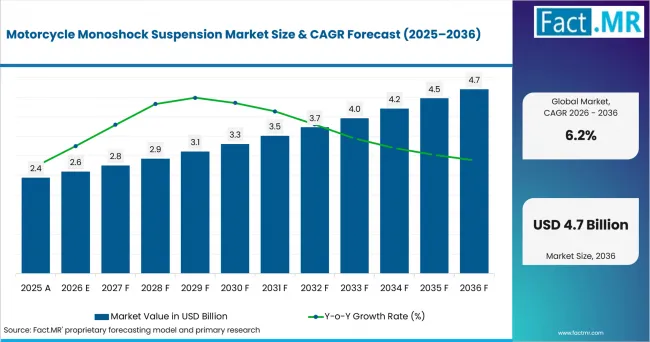
Motorcycle Monoshock Suspension Market Value Analysis | Source: Fact.MR
What are the defining numbers behind Motorcycle Monoshock Suspension Market growth?
An absolute opportunity of USD 2.1 billion is expected between 2026 and 2036.
- Demand Drivers in the Market
- Motorcycle manufacturers need compact rear suspension because a central shock controls packaging across standard, sports and touring frames.
- Aftermarket workshops need rebuildable units and service parts as riders replace worn shocks, change spring rates and tune preload for commuting or touring loads.
- Dealer networks need model-specific fitment because monoshock geometry depends on linkage, swingarm position and rider weight.
- Premium riders need adjustable damping for changing road conditions, so compression, rebound and preload documentation shape supplier selection.
- Key Segments Analyzed
- By Sale Channel: Original Equipment Manufacturer is projected to hold 82.10% share in 2026 because factory fitment sets the rear-suspension architecture before the motorcycle reaches dealers.
- By Motorcycle Type: Standard is expected to account for 42.30% share in 2026 owing to commuter and naked motorcycle volumes that use monoshock layouts for balanced cost and ride control.
- Analyst Opinion at Fact.MR
- Shambhu Nath Jha, Principal Consultant at Fact.MR, states, "The market is shaped by fitment discipline more than broad component availability. A monoshock has to match the motorcycle frame, swingarm and rider load, so buyers value suppliers that provide application data and service support. Providers with OEM relationships and a clear aftermarket setup route are expected to gain the most defensible accounts."
- Strategic Implications
- OEM suppliers should document spring rates, damper settings and linkage compatibility so engineering teams can shorten validation work across related models.
- Aftermarket brands should build searchable fitment databases because riders and workshops need confidence before ordering a replacement shock online.
- Seal and component vendors should support rebuild programs, since serviceability influences the lifetime cost of premium monoshock systems.
Germany is projected to record 6.8% CAGR through premium motorcycle use and replacement activity. Brazil is expected to post 6.2% CAGR as Manaus-based motorcycle output keeps OEM sourcing active. The USA is anticipated to advance at 5.6% CAGR owing to a large registered motorcycle base. The U.K. is forecast to hold 5.0% CAGR through road-use and servicing activity. Japan is estimated to reach 4.4% CAGR as replacement purchasing supports selective rear-shock upgrades.
How does the Motorcycle Monoshock Suspension Market break down by segment?
Original Equipment Manufacturer leads Sale Channel at 82.10%; Standard leads Motorcycle Type at 42.30%.
Which Sale Channel dominates?
Original Equipment Manufacturer is expected to hold 82.10% share in 2026.
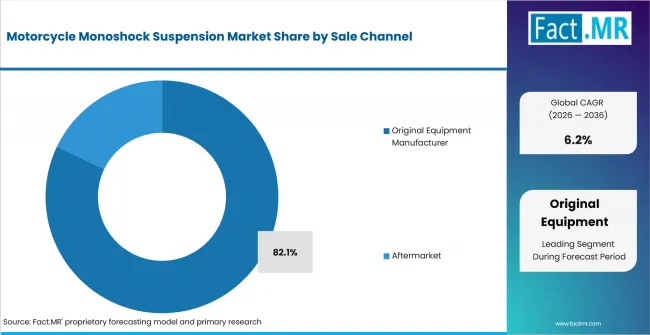
Motorcycle Monoshock Suspension Market Analysis By Sale Channel | Source: Fact.MR
OEM supply leads because the rear shock is chosen during frame and swingarm engineering. Once mounting points are fixed, the original shock supplier influences ride behavior and service parts.
What leads the Motorcycle Type segment?
Standard is projected to account for 42.30% share in 2026.
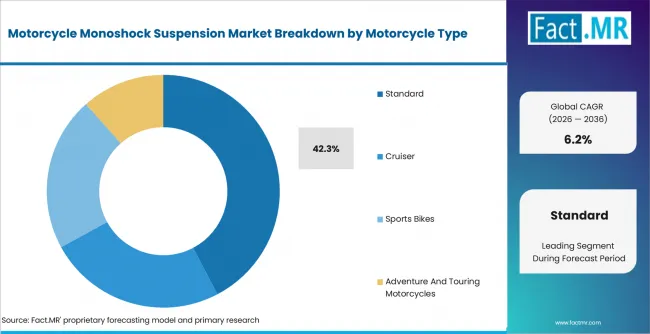
Motorcycle Monoshock Suspension Market Analysis By Motorcycle Type | Source: Fact.MR
Standard motorcycles lead because commuter and naked models combine higher volumes with cost-sensitive engineering. Monoshock systems balance packaging efficiency with daily ride control.
Cruiser, sports and adventure motorcycles create narrower demand pockets. These models often need stronger springs or more damping adjustment, making technical support a selling factor.
What is accelerating Motorcycle Monoshock Suspension Market adoption, and what is holding it back?
Demand is expected to rise through OEM fitment, replacement cycles and adjustable upgrade kits. Growth is constrained by price sensitivity, model-specific fitment and safety validation needs.
Drivers Impact Analysis
| DRIVER | (~) % IMPACT ON CAGR | GEOGRAPHIC RELEVANCE | IMPACT TIMELINE |
|---|---|---|---|
| OEM fitment standardization across standard motorcycles | +1.4% | Global | Short term (<= 2 years) |
| Replacement cycles for worn rear shock absorbers | +1.0% | North America, Europe, Japan | Medium term (2-4 years) |
| Adjustable upgrade kits for sports and touring riders | +0.8% | Europe, USA, Japan | Medium term (2-4 years) |
| Adventure and touring use requiring load control | +0.7% | Europe, Brazil, USA | Long term (>= 4 years) |
Source: Fact.MR analysis. Updated Aug 20, 2026
- OEM fitment standardization across standard motorcycles: Motorcycle producers use monoshock layouts to control rear-wheel movement and package high-volume frames consistently.
- Replacement cycles for worn rear shock absorbers: FHWA reported in February 2026 that U.S. motorcycles averaged 2,401 miles traveled per registered vehicle in 2024, providing a measurable usage base for wear-related servicing and replacement demand.
- Adjustable upgrade kits for sports and touring riders: Faster riding and loaded touring increase the value of repeatable rebound, compression and preload settings.
Opportunity Impact Analysis
| OPPORTUNITY | (~) % IMPACT ON CAGR | GEOGRAPHIC RELEVANCE | IMPACT TIMELINE |
|---|---|---|---|
| Model-specific online fitment and setup tools | +0.9% | Global | Short term (<= 2 years) |
| Semi-active damping control on premium motorcycles | +0.7% | USA, Europe, Japan | Long term (>= 4 years) |
| Serviceable shock programs for aftermarket workshops | +0.5% | Europe, USA, Brazil | Medium term (2-4 years) |
Source: Fact.MR analysis. Updated Aug 20, 2026
- Model-specific online fitment and setup tools: Clear fitment data reduces ordering errors and helps dealers match spring rates to rider weight and usage.
- Semi-active damping control on premium motorcycles: Electronically adjusted damping creates an upgrade path for suppliers serving higher-priced motorcycles.
- Serviceable shock programs for aftermarket workshops: Rebuild kits and seal support extend product life and help premium brands defend higher prices.
Restraints Impact Analysis
| RESTRAINT | (~) % IMPACT ON CAGR | GEOGRAPHIC RELEVANCE | IMPACT TIMELINE |
|---|---|---|---|
| Price sensitivity in commuter and low-displacement motorcycles | -0.6% | Brazil, Asia, Latin America | Short term (<= 2 years) |
| Model-specific fitment and validation burden | -0.4% | Global | Medium term (2-4 years) |
| Incorrect setup risk after aftermarket installation | -0.3% | USA, Europe, Japan | Medium term (2-4 years) |
Source: Fact.MR analysis. Updated Aug 20, 2026
- Price sensitivity in commuter and low-displacement motorcycles: Entry-level riders often prioritize acquisition cost, limiting room for premium adjustable rear shocks.
- Model-specific fitment and validation burden: Shock length, eyelet type and linkage ratio vary by model. Suppliers therefore need more application testing before catalog expansion.
- Incorrect setup risk after aftermarket installation: Poor sag or preload setup can weaken ride benefit, so suppliers need clear instructions.
Which countries are scaling the Motorcycle Monoshock Suspension Market through 2036?
- The country comparison spans 2.4 percentage points across the forecast period.
- Germany remains 0.6 percentage point above Brazil through premium motorcycle use and replacement suspension demand.
- Brazil remains 0.6 percentage point above the USA as Manaus production supports OEM sourcing and commuter motorcycle volumes.
- The USA remains 0.6 percentage point above the U.K. through registered motorcycle stock and aftermarket service depth.
- The U.K. remains 0.6 percentage point above Japan as road-use recovery and specialist workshop networks support replacement shocks.
- Japan closes the displayed range through replacement purchasing and selective premium motorcycle production.
Comparable CAGRs create different entry conditions because factory fitment, rider income and service density vary by country. Full report coverage includes North America; Latin America; Western Europe; Eastern Europe; East Asia; South Asia & Pacific; Middle East & Africa.
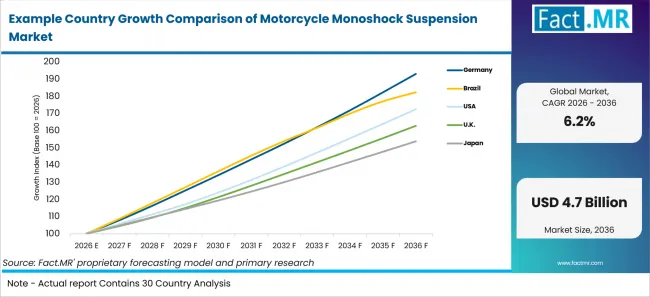
Example Country Growth Comparison Of Motorcycle Monoshock Suspension Market | Source: Fact.MR
| Country | CAGR (2026-2036) |
|---|---|
| Germany | 6.8% |
| Brazil | 6.2% |
| United States | 5.6% |
| United Kingdom | 5.0% |
| Japan | 4.4% |
Source: Fact.MR analysis. Updated Aug 20, 2026
What supports Germany adoption?
6.8% CAGR, supported by premium motorcycle use and replacement suspension demand.
Germany’s growth reflects a large motorcycle stock, continued new registrations and demand for premium suspension fitment. Germany recorded 158,944 new registrations of motorcycles and scooters in 2025, while more than 5.0 million vehicles above 50 cc were in use at the start of the year. Touring and passenger-load requirements support adjustable monoshocks, although premium pricing, fitment approvals and model-specific homologation can increase supplier costs.
How is Brazil scaling demand?
6.2% CAGR, driven by Manaus production and commuter motorcycle replacement needs.
Brazil’s growth is tied to rising motorcycle registrations, strong domestic production and heavy commuter use. Registrations reached a record 2.20 million units in 2025, while Manaus factories produced 932,522 motorcycles during January-May 2026. High-mileage commuting and delivery use support replacement demand for durable monoshocks, although service-center distance, currency exposure and premium import costs may restrict higher-value aftermarket purchases.
What supports USA adoption?
5.6% CAGR, supported by registered motorcycle stock and aftermarket service depth.
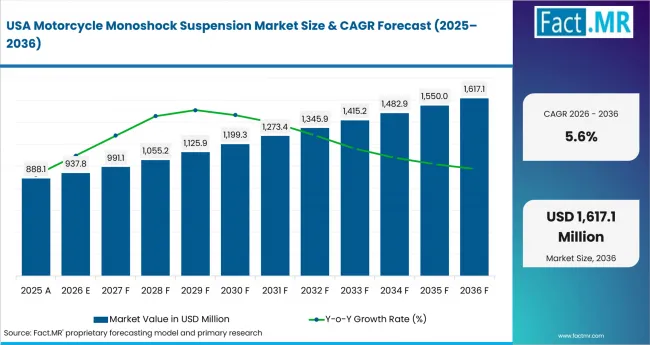
Motorcycle Monoshock Suspension Market Country Value Analysis | Source: Fact.MR
The USA’s growth reflects a large installed motorcycle base and a well-developed aftermarket network. More than 9.26 million motorcycles were registered in 2024, while North American retail motorcycle sales at Harley-Davidson increased 14% year over year in the first quarter of 2026. Specialist dealers and online channels support model-specific suspension upgrades, although labor costs and broad platform variety can increase replacement and catalog complexity.
What supports the U.K. growth?
5.0% CAGR, backed by road-use recovery and specialist suspension services.
The U.K.’s growth is supported by rising motorcycle traffic and a measurable installed base of road-using motorcycles. DfT reported that motorcycle and scooter traffic in Great Britain reached 3.0 billion vehicle miles in 2025, while 1.36 million road-using motorcycles were licensed across the United Kingdom at year-end. Touring, track-day use and specialist rebuild services support adjustable monoshock demand, although weather exposure, lower annual mileage and cost-sensitive replacement behavior may lengthen purchase cycles.
How does Japan perform?
4.4% CAGR, led by replacement purchasing and selective premium motorcycle production.
Japan’s growth reflects established motorcycle manufacturing and continued demand for application-specific suspension systems. Domestic motorcycle production reached 639,000 units in 2024, including 427,000 units above 250 cc, while Honda recorded 205 thousand motorcycle unit sales in Japan for the fiscal year ended March 2026. Premium touring and OEM engineering support monoshock demand, although an older rider base and weaker sales in some displacement categories may limit broader aftermarket growth.
Who leads the Motorcycle Monoshock Suspension Market?
Öhlins launched the SD20 motorcycle steering damper in April 2025, providing adjacent evidence of continued motorcycle damping-product development, although the SD20 is a steering damper rather than a rear monoshock.
Nitron Racing Shocks and WP Suspension strengthen the specialist aftermarket. Hagon Shocks Limited, TFX Suspension Technology add fitment breadth. Competition centers on fitment coverage, setup documentation and rebuild support.
Which companies are the key providers?
Key companies include Ohlins Racing, Nitron Racing Shocks, WP Suspension, Hagon Shocks Limited, Hitachi Astemo, Ltd. / SHOWA, Endurance Technologies Limited, TFX Suspension Technology.
- Ohlins Racing
- Nitron Racing Shocks
- WP Suspension
- Hagon Shocks Limited
- Hitachi Astemo, Ltd. / SHOWA
- Endurance Technologies Limited
- TFX Suspension Technology
Bibliography
- Associação Brasileira dos Fabricantes de Motocicletas, Ciclomotores, Motonetas, Bicicletas e Similares. (2026, June). Produção de motocicletas ultrapassa 900 mil unidades nos primeiros cinco meses de 2026.
- Department for Transport. (2026, May 20). Road traffic estimates in Great Britain, 2025: Traffic in Great Britain by vehicle type.
- Department for Transport. (2026, July 30). RRCGB 2025: Road user type.
- Statistisches Bundesamt. (2026, February 25). Unfallbilanz 2025: 44 Verkehrstote mehr als im Vorjahr.
- Statistisches Bundesamt. (2026, March 23). Neuzulassungen von Kraftfahrzeugen in Deutschland.
- Federal Highway Administration. (2026, February). Table VM-1: Annual vehicle distance traveled in miles and related data—2024, by highway category and vehicle type.
- Harley-Davidson, Inc. (2026, May 5). Harley-Davidson delivers first quarter financial results.
- Industrie-Verband Motorrad Deutschland e. V. (2026). Jahresbericht 2025.
- Japan Automobile Manufacturers Association, Inc. (2025, October 1). The motor industry of Japan 2025.
- Federação Nacional da Distribuição de Veículos Automotores. (2026, January 13). Ano de 2025 encerra com crescimento de 8% nos emplacamentos de veículos, tendo motocicletas como destaque.
This Report Answers
- The report explains where motorcycle monoshock suspension systems are used across OEM and aftermarket channels.
- Segment analysis identifies the sale channel and motorcycle type where rear monoshock demand is concentrated.
- Country analysis examines Germany and Brazil. It also covers the United States, the United Kingdom and Japan through vehicle stock and production signals.
- Competitive analysis reviews current providers across shock absorbers, seals, OEM platforms and damping-control systems.
- Application analysis assesses how fitment, rider load, serviceability and setup documentation influence supplier selection.
What does the Motorcycle Monoshock Suspension Market cover?
The rear monoshock systems assessment covers central single-shock units used on motorcycles. It includes factory-installed shocks, replacement shocks, performance upgrades and rebuild-related components for rear-suspension use.
The analysis is positioned within the wider motorcycle suspension system context because riders and OEMs evaluate rear shocks together with fork behavior and ride-height setup. Demand is assessed by sale channel, motorcycle type and region.
The outlook also considers the motorcycle demand base behind factory fitment and long-term service needs. Sizing remains limited to motorcycle rear monoshock systems and directly related replacement units.
What is included in the scope?
The scope includes OEM monoshock supply, direct-fit aftermarket replacement shocks and motorcycle accessories sold for rear-suspension performance or service. It covers spring-rate selection, damping adjustment, rebuild parts and fitment support.
It includes rear shocks used on standard, cruiser, sports and adventure or touring motorcycles. Related off-road motorcycle accessories are included only where the product directly supports rear-shock installation or servicing.
What is excluded from the scope?
The scope excludes front fork-only products, wheel assemblies, braking systems and general two-wheeler accessories that do not change rear-suspension function. It also excludes car suspension parts and heavy-vehicle dampers.
Adjacent automotive shock absorbers are excluded when designed for cars, trucks or commercial vehicles. Similarly, automotive vibration absorbers are counted only when sold as motorcycle rear-suspension components.
Electronic systems are included only when sold for motorcycle damping control. Standalone active suspension damper actuators and adaptive suspension dampers outside motorcycles remain excluded.
How Was the Analysis Built?
The analysis draws on 120+ sources, 35+ company portfolios, 25+ countries and more than 20 industry interviews.
- Primary Research: Primary research includes discussions with manufacturers and service providers. It also covers distributors, end users and procurement teams. These conversations examine purchasing priorities and adoption barriers.
- Desk Research: Desk research covers government statistics and regulatory publications. It also reviews company filings and trade data. Technical studies, associations and standards support cross-checks. Every source used is documented in the bibliography.
- Market Sizing and Forecasting: Market estimates combine historical performance and demand indicators. They also use pricing trends and segment shares. Country growth, adoption patterns and barriers support the forecast.
- Data Validation and Update Cycle: Findings are validated against public data, company activity, regulatory changes and trade patterns. Updates review product launches, approvals, procurement trends and adoption shifts.
Segmentation
What is the report’s scope and coverage?
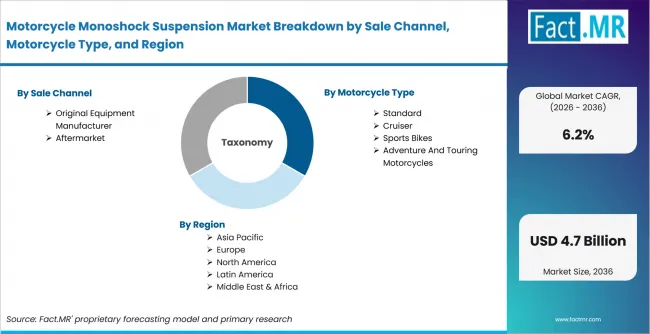
Motorcycle Monoshock Suspension Market Breakdown By Sale Channel, Motorcycle Type, And Region | Source: Fact.MR
| Attribute | Details |
|---|---|
| Quantitative Units | USD billion in 2026 to USD billion by 2036 at a CAGR |
| Market Definition | Rear monoshock suspension systems and related replacement units used on motorcycles, including OEM fitment shocks, aftermarket replacement shocks, performance upgrade shocks and serviceable shock components. |
| Sale Channel | Original Equipment Manufacturer; Aftermarket |
| Motorcycle Type | Standard; Cruiser; Sports Bikes; Adventure And Touring Motorcycles |
| Regions Covered | North America; Latin America; Western Europe; Eastern Europe; East Asia; South Asia & Pacific; Middle East & Africa |
| Countries Covered | Germany; Brazil; United States; United Kingdom; Japan |
| Key Companies Profiled | Ohlins Racing, Nitron Racing Shocks, WP Suspension, Hagon Shocks Limited, Hitachi Astemo, Ltd. / SHOWA, Endurance Technologies Limited, TFX Suspension Technology. |
| Forecast Period | 2026 to 2036 |
| Approach | Hybrid top-down and bottom-up approach using OEM motorcycle output, registered motorcycle stock, replacement cycles, motorcycle type mix, country growth patterns and provider portfolio review. |
Source: Fact.MR analysis. Updated Aug 20, 2026
How is the market segmented?
-
By Sale Channel
- Original Equipment Manufacturer
- Aftermarket
-
By Motorcycle Type
- Standard
- Cruiser
- Sports Bikes
- Adventure And Touring Motorcycles
-
By Region
- North America
- Latin America
- Western Europe
- Eastern Europe
- East Asia
- South Asia & Pacific
- Middle East & Africa
Frequently Asked Questions
How big is the motorcycle monoshock suspension market in 2026?
What is the CAGR of the motorcycle monoshock suspension market from 2026 to 2036?
Which sale channel leads the motorcycle monoshock suspension market?
Which motorcycle type leads the motorcycle monoshock suspension market?
Who are the leading companies in the motorcycle monoshock suspension market?
Who worked on this report


Preview the report firsthand - request a free sample
Free SampleGet the brochure for pricing and purchase details
Download PDF