- Market Value (2025): USD 4.6 Bn
- Estimated Value (2026): USD 4.8 Bn
- Forecast Value (2036): USD 7.6 Bn
- CAGR (2026-2036): 4.7%
What is the Lysine Market forecast to be worth by 2036?
USD 7.6 billion by 2036.
- The Lysine Market reached approximately USD 4.6 billion in 2025.
- Demand is projected to increase from USD 4.8 billion in 2026 to USD 7.6 billion by 2036.
- The market is forecast to record 4.7% CAGR from 2026 to 2036 as feed formulation requirements sustain industrial lysine consumption.
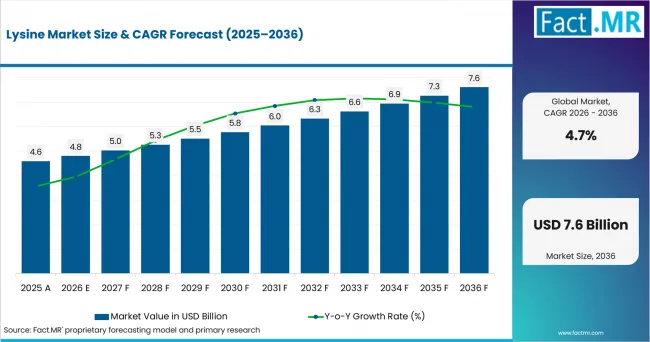
Lysine Market Value Analysis | Source: Fact.MR
What are the defining numbers behind Lysine Market growth?
USD 2.8 billion absolute opportunity by 2036.
- Demand Drivers in the Market
- Animal feed remains the central demand base because lysine is an essential amino acid used to balance cereal-based livestock diets. USDA research identifies lysine as frequently the first or second limiting amino acid for growth in cereal-based diets for livestock. [1]
- Lower-protein feed formulation supports supplemental lysine use. FAO analysis shows that crystalline amino acids can allow formulators to reduce crude protein while maintaining amino-acid balance and lowering nitrogen excretion. [2]
- Regulatory acceptance supports continued use in feed. EFSA concluded in 2025 that L-lysine sulfate is an efficacious source of L-lysine for non-ruminant species, while a further 2026 assessment reached an efficacy conclusion for another fermentation-derived L-lysine sulfate additive. [3][4]
- Commercial suppliers continue to position fermentation-derived lysine around feed efficiency. CJ BIO describes amino-acid solutions as part of balanced animal nutrition, while Evonik markets Biolys as an L-lysine source for swine and poultry feed. [5][6]
- Key Segments Analyzed
- By Product: L-Lysine Hydrochloride is projected to hold 63.8% share in 2026.
- By Application: Animal Feed Applications are expected to account for 74.1% share in 2026.
- By End Use: Feed Manufacturers are anticipated to represent 57.6% share in 2026.
- By Technology: Microbial Fermentation Technology is projected to hold 42.7% share in 2026.
- By Formulation: Powder Formulations are expected to account for 68.5% share in 2026.
- By Distribution Channel: Direct Industrial Sales are estimated to hold 36.9% share in 2026.
- Analyst Opinion at Fact.MR
- The commercial case for lysine remains strongest where customers can measure feed efficiency and amino-acid balance. Feed-grade volumes should continue to anchor demand, while suppliers can build additional value through pharmaceutical-grade and nutraceutical-grade products where purity specifications create a different buying process.
- Strategic Implications
- Producers should protect fermentation efficiency because feed-grade lysine remains exposed to industrial purchasing economics.
- Suppliers serving higher-purity applications need grade-specific quality systems rather than treating all lysine demand as one commodity pool.
- Feed manufacturers can use lysine within broader precision-nutrition programs that reduce unnecessary crude-protein input.
- Distribution strategy should distinguish large industrial contracts from smaller specialty ingredient requirements.
Germany is projected to record 5.41% CAGR from 2026 to 2036. Brazil follows at 4.93%, while the USA is forecast at 4.46%. The UK is projected at 4.0%, with Japan at 3.52%.
How does the Lysine Market break down by segment?
L-Lysine Hydrochloride is expected to lead Product at 63.8% share in 2026. Animal Feed Applications are projected to lead Application at 74.1% share in 2026.
Why does L-Lysine Hydrochloride lead Product?
L-Lysine Hydrochloride is projected to account for 63.8% share in 2026.
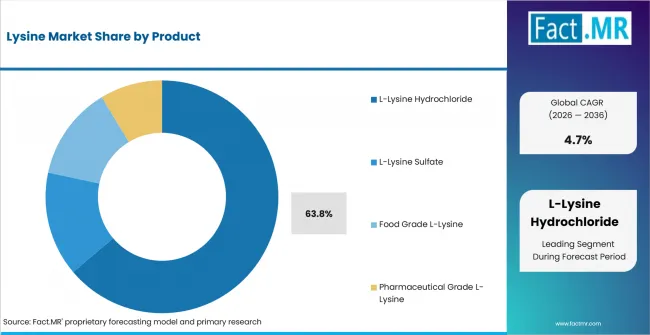
Lysine Market Analysis By Product | Source: Fact.MR
L-Lysine Hydrochloride holds the largest product share because it is established as a concentrated lysine source for feed formulation. Commercial feed applications require predictable lysine content and compatibility with compound-feed production. Feed Grade L-Lysine HCl supports high-volume animal nutrition requirements, while Industrial Grade L-Lysine HCl extends the product group into other processing requirements.
L-Lysine Sulfate provides another feed-oriented route. Food Grade L-Lysine serves fortification and nutraceutical use, while Pharmaceutical Grade L-Lysine addresses formulation requirements where purity and production controls have greater importance.
Why do Animal Feed Applications lead Application?
Animal Feed Applications are expected to hold 74.1% share in 2026.
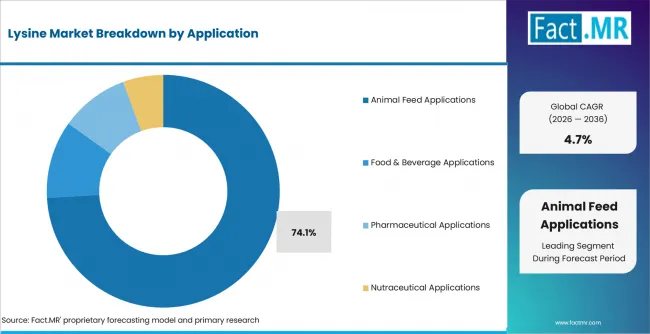
Lysine Market Analysis By Application | Source: Fact.MR
Animal Feed Applications dominate because lysine supplementation directly addresses amino-acid limitations in livestock diets. FAO notes that lysine is normally the first limiting amino acid in practical pig diets, reinforcing its importance in formulated feed. [2]
Livestock Feed Formulations and Poultry Feed Formulations therefore form the principal application base. Food & Beverage Applications use lysine for fortification or functional formulations. Pharmaceutical Applications cover clinical nutrition and drug-formulation uses, while Nutraceutical Applications include dietary supplements and sports nutrition.
Why do Feed Manufacturers lead End Use?
Feed Manufacturers are anticipated to represent 57.6% share in 2026.
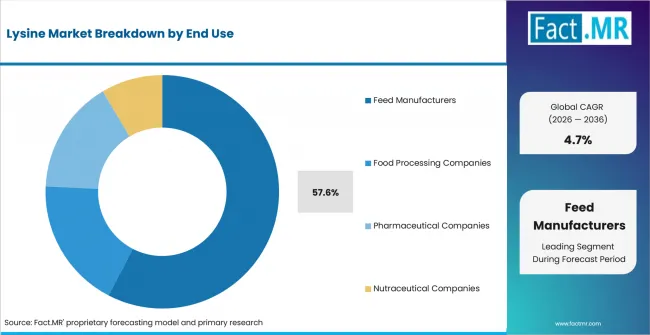
Lysine Market Analysis By End Use | Source: Fact.MR
Feed Manufacturers hold the largest end-use share because lysine is typically purchased as an ingredient within compound-feed and premix operations. Compound Feed Producers require standardized amino-acid inputs for formulation control, while Premix Manufacturers integrate lysine with other nutritional additives.
Food Processing Companies represent a separate customer group through packaged-food and beverage applications. Pharmaceutical Companies focus on higher-purity formulations. Nutraceutical Companies create additional demand through dietary-supplement and sports-nutrition products.
What supports Microbial Fermentation Technology?
Microbial Fermentation Technology is projected to hold 42.7% share in 2026.
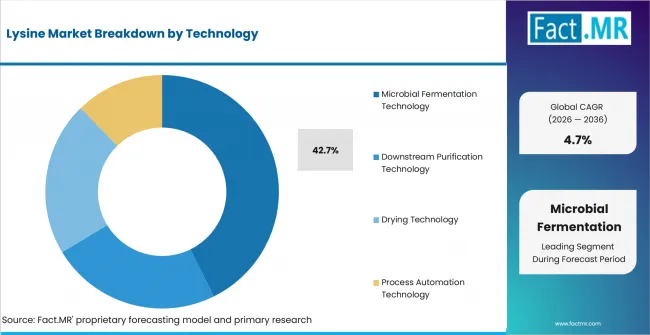
Lysine Market Analysis By Technology | Source: Fact.MR
Microbial fermentation is central to commercial lysine production. CJ BIO identifies sustainable fermentation technology as the basis of its amino-acid business, while Evonik states that its Biolys production uses microorganisms to convert corn-derived dextrose into L-lysine. [5][7]
Batch Fermentation Systems and Continuous Fermentation Systems address production-scale requirements. Downstream Purification Technology covers filtration and crystallization. Drying Technology prepares commercial product forms, while Process Automation Technology supports control and optimization of fermentation operations.
Why do Powder Formulations lead Formulation?
Powder Formulations are expected to account for 68.5% share in 2026.
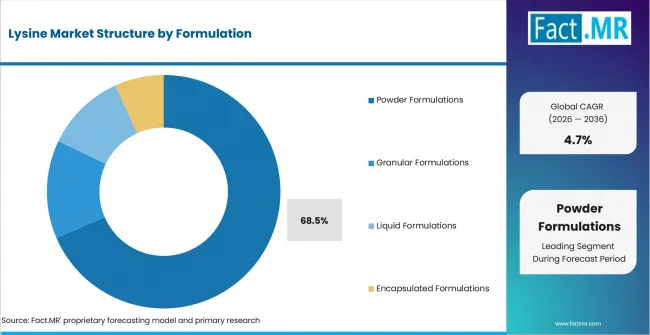
Lysine Market Analysis By Formulation | Source: Fact.MR
Powder Formulations fit bulk ingredient handling because they can be incorporated into premixes and compound-feed systems. Fine Powder Systems provide a conventional ingredient format, while Free Flow Powder Systems support handling where consistent material movement is important.
Granular Formulations address feed and industrial handling requirements. Liquid Formulations serve concentrated or blended delivery systems. Encapsulated Formulations create routes for controlled-release or microencapsulated applications.
Why do Direct Industrial Sales lead Distribution Channel?
Direct Industrial Sales are estimated to hold 36.9% share in 2026.
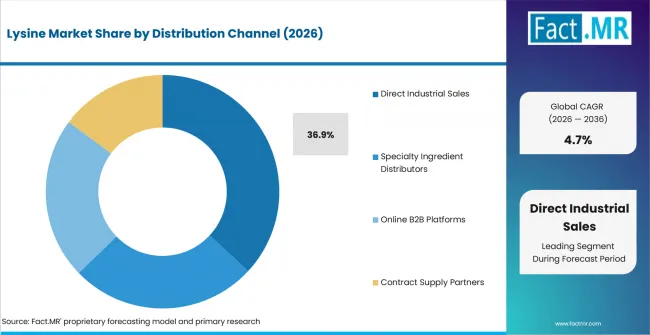
Lysine Market Analysis By Distribution Channel | Source: Fact.MR
Direct Industrial Sales account for the largest channel share because high-volume buyers can procure lysine through negotiated supply arrangements. Long Term Supply Contracts support recurring industrial demand, while OEM Procurement Programs allow suppliers to work directly with large ingredient users.
Specialty Ingredient Distributors serve customers requiring regional availability or smaller order sizes. Online B2B Platforms add digital procurement routes. Contract Supply Partners cover private-label and trading relationships.
What is accelerating Lysine Market adoption, and what is holding it back?
Demand is supported by animal-feed amino-acid balancing and fermentation-based supply. Growth can be moderated by input-cost volatility, regulatory qualification requirements and pricing pressure in standardized feed-grade products.
Drivers Impact Analysis
| DRIVER | (~) % IMPACT ON CAGR | GEOGRAPHIC RELEVANCE | IMPACT TIMELINE |
|---|---|---|---|
| Amino-acid balancing in animal feed | +1.3% | Global, USA, Brazil | Short term (<= 2 years) |
| Lower-protein feed formulation | +1.0% | Europe, USA, Brazil | Short term (<= 2 years) |
| Fermentation process efficiency | +0.8% | Global manufacturing hubs | Medium term (2-4 years) |
| Food and pharmaceutical-grade diversification | +0.6% | USA, Germany, Japan | Medium term (2-4 years) |
| Precision animal nutrition | +0.4% | Developed livestock markets | Long term (>= 4 years) |
Source: Fact.MR analysis. Updated Aug 14, 2026
- Amino-acid balancing in animal feed: Lysine supplementation helps feed formulators meet nutritional requirements when cereal-based diets provide insufficient lysine. USDA research identifies lysine as a limiting amino acid in several livestock diets. [1]
- Lower-protein feed formulation: FAO analysis links amino-acid supplementation with reduced reliance on excess dietary protein and lower nitrogen output from livestock production. [2]
- Fermentation process efficiency: Commercial suppliers continue to use fermentation platforms for amino-acid production. CJ BIO and Evonik both identify fermentation as central to their amino-acid operations. [5][7]
Opportunity Impact Analysis
| OPPORTUNITY | (~) % IMPACT ON CAGR | GEOGRAPHIC RELEVANCE | IMPACT TIMELINE |
|---|---|---|---|
| Precision feed formulation programs | +0.9% | USA, Brazil, Europe | Short term (<= 2 years) |
| Pharmaceutical and nutraceutical grades | +0.8% | USA, Germany, Japan | Medium term (2-4 years) |
| Ruminant-targeted lysine systems | +0.6% | Brazil, USA, Japan | Medium term (2-4 years) |
| Process automation in fermentation | +0.5% | Major production centers | Medium term (2-4 years) |
| Specialty ingredient distribution | +0.4% | Regional food and nutraceutical markets | Long term (>= 4 years) |
Source: Fact.MR analysis. Updated Aug 14, 2026
- Precision feed formulation programs: Suppliers can expand beyond ingredient supply by supporting customers that formulate diets against specific amino-acid requirements.
- Pharmaceutical and nutraceutical grades: Evonik lists L-Lysine hydrochloride and L-Lysine monohydrate within its amino-acid portfolio for pharmaceutical, biopharma and nutraceutical applications. [8]
- Ruminant-targeted lysine systems: Ajinomoto describes AjiPro-L as a lysine formulation used to improve amino-acid balance in cattle feed, demonstrating a route beyond conventional poultry and swine applications. [9]
Restraints Impact Analysis
| RESTRAINT | (~) % IMPACT ON CAGR | GEOGRAPHIC RELEVANCE | IMPACT TIMELINE |
|---|---|---|---|
| Feedstock and production-cost volatility | -1.0% | Global | Short term (<= 2 years) |
| Price competition in feed-grade lysine | -0.9% | Global industrial markets | Short term (<= 2 years) |
| Regulatory qualification requirements | -0.7% | Europe, UK, Japan | Medium term (2-4 years) |
| Higher cost of specialty-grade production | -0.5% | USA, Germany, Japan | Medium term (2-4 years) |
| Customer reformulation and substitution risk | -0.4% | Feed manufacturing markets | Long term (>= 4 years) |
Source: Fact.MR analysis. Updated Aug 14, 2026
- Feedstock and production-cost volatility: Fermentation economics remain linked to carbohydrate feedstocks and processing efficiency, making cost control important for standardized lysine grades.
- Regulatory qualification requirements: Feed additives must meet jurisdiction-specific authorization and safety requirements. The UK Food Standards Agency completed an assessment covering liquid L-lysine base in 2025, while EFSA continues to evaluate fermentation-derived lysine additives. [3][10]
- Higher cost of specialty-grade production: Pharmaceutical and biopharma applications require tighter purity and regulatory controls than mainstream feed use. Evonik states that its pharmaceutical amino-acid operations maintain specific quality and regulatory certifications. [8]
How do country growth rates compare in the Lysine Market?
Germany is projected at 5.41% CAGR from 2026 to 2036. Brazil follows at 4.93%, the USA at 4.46%, the UK at 4.0% and Japan at 3.52%.
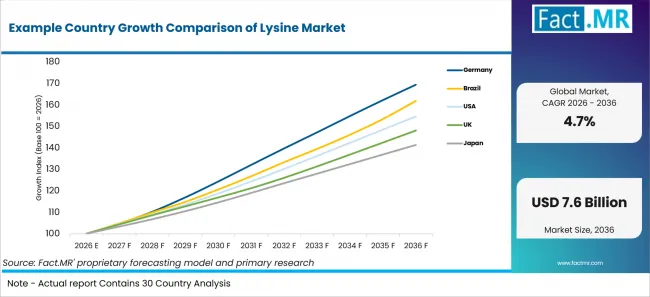
Example Country Growth Comparison Of Lysine Market | Source: Fact.MR
| Country | CAGR (2026-2036) |
|---|---|
| Germany | 5.41% |
| Brazil | 4.93% |
| USA | 4.46% |
| UK | 4.0% |
| Japan | 3.52% |
Source: Fact.MR analysis. Updated Aug 14, 2026
What supports Germany’s Lysine Market through 2036?
5.41% CAGR from 2026 to 2036.
Germany’s lysine demand is supported by its position within the European animal-feed and ingredient market. EU feed systems continue to use soybean meal as an important protein component for poultry and swine, while supplemental amino acids allow formulators to balance dietary protein more precisely. USDA’s 2026 EU oilseeds assessment identifies soybean meal as a significant feed component and a source of lysine. [11]
EU safety and authorization requirements keep supplier qualification important. Continued EFSA assessment of L-lysine feed additives reinforces the need for validated production strains and defined product specifications. [3][4]
What supports Brazil’s Lysine Market?
4.93% CAGR from 2026 to 2036.
Brazil’s outlook is linked to its large poultry and swine production base. The Brazilian Animal Protein Association’s 2026 annual report covers poultry and swine production during 2025, providing the livestock backdrop for continued compound-feed demand. [12]
Lysine also has a route into cattle nutrition. Ajinomoto has highlighted AjiPro-L use in Brazil as part of amino-acid balancing for cattle feed, showing how lysine suppliers can address additional livestock systems beyond conventional monogastric feed. [9]
How is USA demand developing?
4.46% CAGR from 2026 to 2036.
The USA Lysine Market is valued at approximately USD 1.73 billion in 2026. Feed manufacturers remain an important demand base because poultry and swine diets rely on amino-acid formulation. USDA research identifies lysine as a limiting amino acid in cereal-based livestock diets. [1]
The market also has exposure to higher-purity applications through pharmaceutical and nutraceutical ingredients. This creates a second commercial route alongside high-volume feed demand.
What shapes the UK Lysine Market?
4.0% CAGR from 2026 to 2036.
The UK market operates under defined feed-additive authorization requirements. A 2025 Food Standards Agency assessment concluded there was sufficient evidence regarding the safety and efficacy of a specified liquid L-lysine base additive, while UK regulations separately authorize forms of L-lysine for animal nutrition. [10][13]
This environment favors suppliers that can support regulatory documentation and consistent product specifications alongside commercial availability.
What supports Japan’s Lysine Market?
3.52% CAGR from 2026 to 2036.
Japan’s Lysine Market is valued at approximately USD 233.4 million in 2026. Feed applications remain commercially relevant. Japan’s Food and Agricultural Materials Inspection Center lists both L-Lysine Monohydrochloride and L-Lysine sulphate among authorized amino-acid feed additives. [14]
Japan also supports higher-value amino-acid applications through established domestic fermentation expertise and specialized formulations. The Ministry of Agriculture, Forestry
How is competition structured in the Lysine Market?
Competition spans large fermentation-based amino-acid suppliers, specialty ingredient providers and companies serving downstream nutrition applications.
CJ CheilJedang maintains a direct commercial presence in amino acids through its BIO business and positions fermentation technology at the center of its animal-nutrition portfolio. [5] Evonik supplies Biolys for animal feed and also offers higher-purity amino acids for pharmaceutical and nutraceutical applications. [6][8]
Ajinomoto participates through amino-acid technology and specialized lysine formulations. Its AjiPro-L product demonstrates an application-specific approach to cattle nutrition. [9]
Competitive differentiation therefore depends on fermentation efficiency, grade consistency and ability to support application-specific requirements. Feed-grade business is driven by industrial procurement economics. Pharmaceutical or nutraceutical applications place greater weight on purity and qualification.
Which companies are the key providers?
Companies associated with the Lysine Market include CJ CheilJedang Corp, Evonik Industries, Amino GmbH and AJINOMOTO Co., Inc., alongside the other providers identified within the market coverage.
- CJ CheilJedang Corp
- Evonik Industries
- Amino GmbH
- Beijing YaMei Biotechnology Co., Ltd.
- AJINOMOTO Co., Inc.
- Meihua Group
- Parchem Fine & Specialty Chemicals
- Elixir Group
- Swanson Health Products
Bibliography
- U.S. Department of Agriculture, Agricultural Research Service. Research publication on lysine requirements and lysine as a limiting amino acid in livestock diets.
- Food and Agriculture Organization of the United Nations. Lysine and other amino acids for feed and protein nutrition guidance for farmed livestock.
- European Food Safety Authority. 2025 scientific opinion on the safety and efficacy of L-lysine sulfate as a feed additive.
- European Food Safety Authority. 2026 scientific opinion on L-lysine sulfate produced using Corynebacterium glutamicum.
- CJ CheilJedang. CJ BIO amino-acid and animal-nutrition business information.
- Evonik Industries. Amino-acid portfolio including Biolys L-lysine for animal nutrition.
- Evonik Industries. Biolys product update describing fermentation-based L-lysine production.
- Evonik Industries. REXIM amino acids for pharmaceutical, biopharmaceutical and nutraceutical applications.
- Ajinomoto Group. 2025 management and sustainability information covering AjiPro-L lysine formulation.
- UK Food Standards Agency and Food Standards Scotland. 2025 assessment of liquid L-lysine base as a feed additive.
- U.S. Department of Agriculture, Foreign Agricultural Service. 2026 European Union Oilseeds and Products Annual.
- Brazilian Animal Protein Association. 2026 Annual Report covering 2025 poultry and swine production.
- UK legislation covering authorization and use of L-lysine feed additives.
- Food and Agricultural Materials Inspection Center, Japan. List of feed additives including L-Lysine Monohydrochloride and L-Lysine sulphate.
- Ministry of Agriculture, Forestry and Fisheries, Japan. Information on AjiPro-L lysine formulation for cattle.
This Report Answers
- The report provides strategic intelligence on the Lysine Market across product forms used in feed, food, pharmaceutical and nutraceutical applications.
- Segment analysis covers product and application choices that determine commercial demand across industrial lysine purchasing.
- End-use analysis assesses feed manufacturers alongside food processors, pharmaceutical companies and nutraceutical businesses.
- Technology assessment covers microbial fermentation and downstream purification together with drying and process-control routes.
- Formulation analysis examines powder, granular, liquid and encapsulated lysine systems.
- Country outlook evaluates Germany and Brazil alongside the USA, UK and Japan.
- Competitive analysis reviews companies operating across fermentation, specialty ingredients and downstream amino-acid applications.
- Distribution analysis assesses direct industrial sales, specialty ingredient distribution, digital procurement and contract supply.
What does the Lysine Market cover?
The Lysine Market covers commercially supplied lysine ingredients used to balance amino-acid requirements in animal nutrition and support food, pharmaceutical and nutraceutical formulations.
The market includes L-Lysine Hydrochloride and L-Lysine Sulfate. Food Grade L-Lysine and Pharmaceutical Grade L-Lysine are included where they are supplied as commercial ingredients.
Coverage extends to Animal Feed Applications, Food & Beverage Applications, Pharmaceutical Applications and Nutraceutical Applications. Feed Manufacturers form part of the end-use base alongside Food Processing Companies, Pharmaceutical Companies and Nutraceutical Companies.
What is included in the scope?
The scope includes industrial lysine products and formulations supplied across feed, food, pharmaceutical and nutraceutical value chains.
The scope covers Product, Application, End Use and Technology. Formulation and Distribution Channel complete the market structure.
Production coverage includes Microbial Fermentation Technology and Downstream Purification Technology. Drying Technology and Process Automation Technology are included where they support commercial lysine manufacturing.
Powder Formulations and Granular Formulations are included alongside Liquid Formulations and Encapsulated Formulations.
What is excluded from the scope?
Finished products are excluded when lysine is only one ingredient and is no longer sold as a distinct commercial lysine input.
The scope excludes complete animal feeds sold as finished feed products. Finished pharmaceuticals are excluded when the commercial transaction relates to the drug rather than lysine as an ingredient.
Finished foods and beverages are excluded unless the transaction being measured concerns the lysine ingredient supplied for fortification or formulation. General amino-acid products are excluded when lysine cannot be identified as the commercial product being supplied.
How Was the Analysis Built?
The analysis combines the market forecast and supplied segment structure with regulatory evidence, agricultural information and direct company disclosures relevant to lysine production and use.
- Desk Research: Research covers agricultural agencies, food and feed regulators, technical publications and direct supplier disclosures. Evidence is used to test the commercial logic behind feed demand and grade-specific applications.
- Market Sizing and Forecasting: Historical values are evaluated against the 2026 base value, the 2036 forecast and the stated CAGR. Segment shares and country growth rates are applied within the defined market structure.
- Segment Validation: Product categories are reviewed against their parent-child hierarchy so subsegments remain attached to the correct market segment.
- Data Validation and Update Cycle: External evidence is checked against recent regulatory assessments and company product information to identify changes that could affect demand conditions or commercial positioning.
Segmentation
What is the report’s scope and coverage?
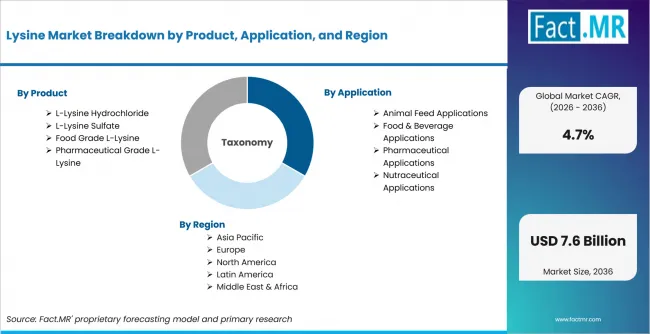
Lysine Market Breakdown By Product, Application, And Region | Source: Fact.MR
| Attribute | Details |
|---|---|
| Quantitative Units | USD Billion |
| Market Definition | Commercial lysine ingredients supplied for animal feed, food and beverage formulation, pharmaceutical applications and nutraceutical use |
| Product | L-Lysine Hydrochloride; L-Lysine Sulfate; Food Grade L-Lysine; Pharmaceutical Grade L-Lysine |
| Application | Animal Feed Applications; Food & Beverage Applications; Pharmaceutical Applications; Nutraceutical Applications |
| End Use | Feed Manufacturers; Food Processing Companies; Pharmaceutical Companies; Nutraceutical Companies |
| Technology | Microbial Fermentation Technology; Downstream Purification Technology; Drying Technology; Process Automation Technology |
| Formulation | Powder Formulations; Granular Formulations; Liquid Formulations; Encapsulated Formulations |
| Distribution Channel | Direct Industrial Sales; Specialty Ingredient Distributors; Online B2B Platforms; Contract Supply Partners |
| Regions Covered | North America; Latin America; Western Europe; Eastern Europe; East Asia; South Asia and Pacific; Middle East and Africa |
| Countries Analyzed for CAGR | Germany; Brazil; USA; UK; Japan |
| Key Companies Profiled | CJ CheilJedang Corp; Evonik Industries; Amino GmbH; Beijing YaMei Biotechnology Co., Ltd.; AJINOMOTO Co., Inc.; Meihua Group; Parchem Fine & Specialty Chemicals; Elixir Group; Swanson Health Products |
| Forecast Period | 2026 to 2036 |
| Approach | Market-value forecasting supported by segment-share analysis, country growth assessment and external evidence on lysine production and end-use demand |
Source: Fact.MR analysis. Updated Aug 14, 2026
How is the market segmented?
-
By Product:
- L-Lysine Hydrochloride
- Feed Grade L-Lysine HCl
- Industrial Grade L-Lysine HCl
- L-Lysine Sulfate
- Animal Nutrition L-Lysine Sulfate
- Specialty L-Lysine Sulfate
- Food Grade L-Lysine
- Fortification Grade L-Lysine
- Nutraceutical Grade L-Lysine
- Pharmaceutical Grade L-Lysine
- Injectable Grade L-Lysine
- Formulation Grade L-Lysine
- L-Lysine Hydrochloride
-
By Application:
- Animal Feed Applications
- Livestock Feed Formulations
- Poultry Feed Formulations
- Food & Beverage Applications
- Food Fortification
- Functional Beverage Formulation
- Pharmaceutical Applications
- Clinical Nutrition Products
- Drug Formulation Applications
- Nutraceutical Applications
- Dietary Supplement Production
- Sports Nutrition Products
- Animal Feed Applications
-
By End Use:
- Feed Manufacturers
- Compound Feed Producers
- Premix Manufacturers
- Food Processing Companies
- Packaged Food Manufacturers
- Beverage Manufacturers
- Pharmaceutical Companies
- Generic Drug Manufacturers
- Clinical Nutrition Companies
- Nutraceutical Companies
- Dietary Supplement Brands
- Sports Nutrition Companies
- Feed Manufacturers
-
By Technology:
- Microbial Fermentation Technology
- Batch Fermentation Systems
- Continuous Fermentation Systems
- Downstream Purification Technology
- Filtration Systems
- Crystallization Systems
- Drying Technology
- Spray Drying Systems
- Fluid Bed Drying Systems
- Process Automation Technology
- Digital Process Control
- AI Assisted Optimization
- Microbial Fermentation Technology
-
By Formulation:
- Powder Formulations
- Fine Powder Systems
- Free Flow Powder Systems
- Granular Formulations
- Feed Granule Systems
- Industrial Granule Systems
- Liquid Formulations
- Concentrated Liquid Systems
- Blended Liquid Systems
- Encapsulated Formulations
- Controlled Release Systems
- Microencapsulated Systems
- Powder Formulations
-
By Distribution Channel:
- Direct Industrial Sales
- Long Term Supply Contracts
- OEM Procurement Programs
- Specialty Ingredient Distributors
- Regional Ingredient Suppliers
- Global Distribution Networks
- Online B2B Platforms
- Digital Procurement Portals
- Manufacturer Portals
- Contract Supply Partners
- Private Label Suppliers
- Trading Companies
- Direct Industrial Sales
-
By Region:
- North America
- Latin America
- Western Europe
- Eastern Europe
- East Asia
- South Asia and Pacific
- Middle East and Africa
Frequently Asked Questions
The Lysine Market was valued at approximately USD 4.6 billion in 2025.
What is the Lysine Market worth in 2026?
What is the projected Lysine Market size by 2036?
What CAGR is projected for the Lysine Market?
What absolute dollar opportunity is expected between 2026 and 2036?
Which Product leads the Lysine Market?
Which Application leads the Lysine Market?
Which End Use leads the Lysine Market?
Which Technology leads the Lysine Market?
Which Formulation leads the Lysine Market?
Which Distribution Channel leads the Lysine Market?
Which listed country records the highest CAGR?
What is the primary demand driver for lysine?
What is a key restraint on Lysine Market growth?
What is the USA Lysine Market value in 2026?
What is the Japan Lysine Market value in 2026?
What is the South Korea Lysine Market value in 2026?
Who worked on this report


Preview the report firsthand - request a free sample
Free SampleGet the brochure for pricing and purchase details
Download PDF