- Market Value (2025): USD 141.8 Mn
- Estimated Value (2026): USD 160.8 Mn
- Forecast Value (2036): USD 565.0 Mn
- CAGR (2026-2036): 13.4%
What is the Industrial Ethernet Switch Units Market forecast to be worth by 2036?
USD 160.8 million in 2026 to USD 565.0 million by 2036 at a 13.4% CAGR.
- Fact.MR estimates that the Industrial Ethernet Switch Units Market was valued at USD 141.8 million in 2025.
- Demand is projected to grow from USD 160.8 million in 2026 to USD 565.0 million by 2036.
- The forecast indicates a 13.4% CAGR from 2026 to 2036 as industrial facilities expand connected automation systems and require dependable network infrastructure for machine-level communication.
| Year | Basis | Market Value (USD million) |
|---|---|---|
| 2025 | Actual | 141.8 |
| 2026 | Estimate | 160.8 |
| 2036 | Forecast | 565.0 |
| CAGR 2026 to 2036 | Forecast period | 13.4% |
Source: Fact.MR analysis. Updated Nov 11, 2026
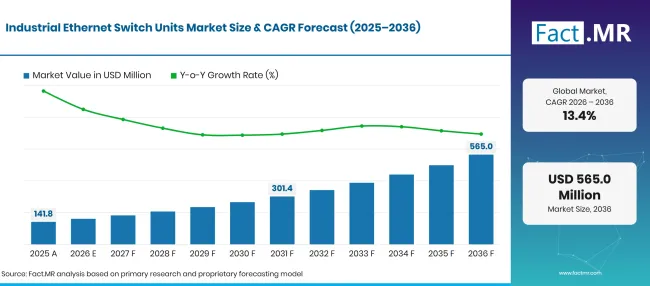
Industrial Ethernet Switch Units Forecast Global | Source: Fact.MR
What are the defining numbers behind Industrial Ethernet Switch Units Market growth?
USD 404.2 million in additional market value between 2026 and 2036.
- Demand Drivers in the Market
- Manufacturing facilities are connecting more controllers, sensors, production equipment, and monitoring systems to support data-driven operations. China's National Bureau of Statistics reported that 89.6% of industrial enterprises above the designated size had undertaken digital transformation by the end of 2025, supporting demand for industrial communication infrastructure.
- Industrial Ethernet networks need dependable communication when a link or switch fails. The IEC 62439-2 standard specifies a Media Redundancy Protocol designed to support recovery following a single inter-switch link or switch failure, reinforcing the importance of network resilience in automation environments.
- Manufacturers are adopting higher-performance networks to connect machines and systems across production facilities. Time-sensitive networking is also gaining relevance, with IEEE/IEC 60802-2026 defining TSN profiles for industrial automation networks.
- Demand spans compact machine-level switches and higher-port-count equipment for plant backbones. Buyers consider port density, managed-network functions, power over Ethernet, fiber connectivity, redundancy, and environmental ratings when selecting equipment.
- Key Segments Analyzed
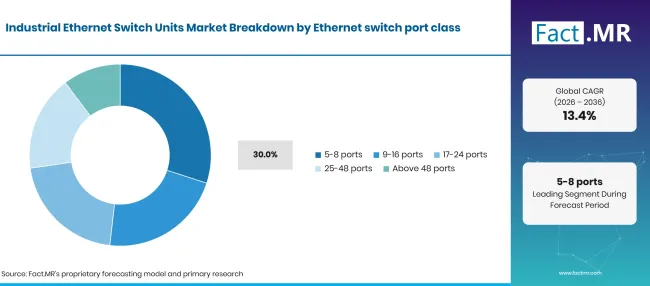
- By Ethernet Switch Port Class: 5–8-port switches are projected to account for 30.0% of the market in 2026, reflecting demand for compact connectivity at machine and equipment level.
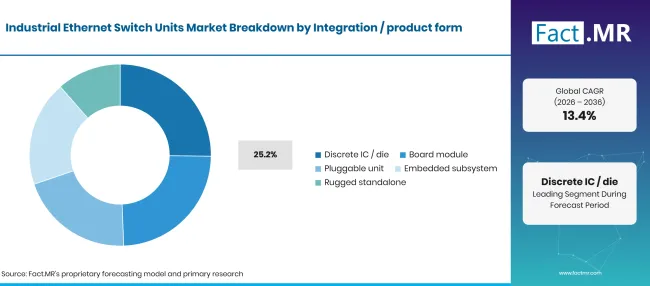
- By Integration / Product Form: Discrete IC / die is the largest category reported in the segment table, accounting for 25.2% in 2026.
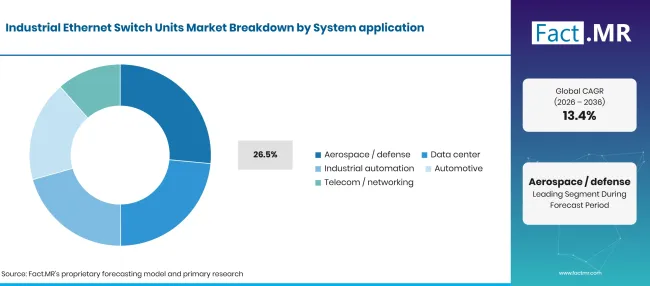
- By System Application: Aerospace and defense account for 26.5% of the market, supported by requirements for ruggedized networking and dependable communication in mission-critical systems.
- By Procurement Route: System integrators lead with a 26.7% share, reflecting the role of network design, equipment selection, installation, and commissioning in industrial projects.
- Analyst Opinion at Fact.MR
- Shambhu Nath Jha, Principal Consultant at Fact.MR, states, “Industrial Ethernet switches are becoming an important part of connected production environments. Buyers need to assess more than port counts, with network resilience, integration requirements, cybersecurity, and long-term product support influencing equipment selection.”
- Strategic Implications
- Switch manufacturers can strengthen product positioning by offering clear port configurations, managed and unmanaged options, and industrial certifications suited to different operating environments.
- Industrial automation suppliers must improve project compatibility by validating switch performance with programmable logic controllers, sensors, drives, and supervisory control systems before deployment.
- System integrators should differentiate their services through network architecture planning, redundancy configuration, cybersecurity assessment, and lifecycle support rather than relying only on hardware supply.
- Procurement teams need to compare total ownership costs, including installation, network management, replacement availability, and downtime exposure, when selecting industrial Ethernet switch equipment.
Taiwan is projected to record the highest CAGR of 15.7% through 2036, followed by China at 14.8% and South Korea at 14.7%. while the USA is forecast to register 13.3%. Japan is expected to record a 13.1% CAGR.
How does the Industrial Ethernet Switch Units Market break down by segment?
Fact.MR finds that 5–8-port switches lead Ethernet Switch Port Class at 30.0%; discrete IC / die leads Integration / Product Form at 25.2%; aerospace and defense lead System Application at 26.5%; and system integrators lead Procurement Route at 26.7%.
Which Ethernet Switch Port Class dominates?
5–8-port switches are set to hold a 30.0% share in 2026.
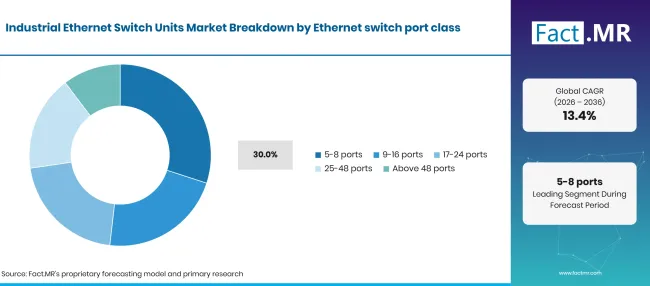
Industrial Ethernet Switch Units Breakdown Ethernet Switch Port Class | Source: Fact.MR
| Ethernet Switch Port Class | Share (2026) |
|---|---|
| 5–8 ports (Leading segment) | 30.0% |
| Other segments combined | 70.0% |
| Total | 100.0% |
Source: Fact.MR analysis. Updated Nov 11, 2026
Compact switches serve machine-level connectivity requirements where a limited number of devices need to communicate over an industrial network. These configurations can connect controllers, sensors, and equipment within individual production units. Higher-port-count switches support larger network sections and centralized connections, making them relevant for plant-wide communication and network expansion.
Which Integration / Product Form leads?
Discrete IC / die is shown as the leading category at 25.2% in the 2026 segment table.
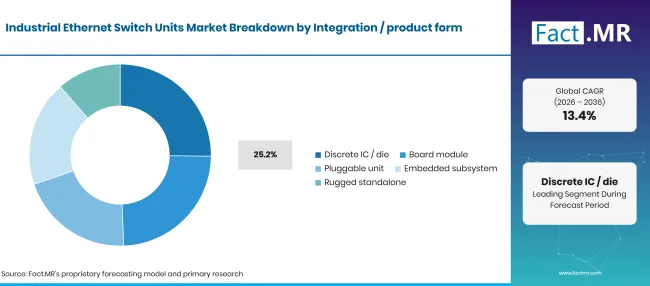
Industrial Ethernet Switch Units Breakdown Integration Product Form | Source: Fact.MR
| Integration / Product Form | Share (2026) |
|---|---|
| Discrete IC / die (Leading segment) | 25.2% |
| Other segments combined | 74.8% |
| Total | 100.0% |
Source: Fact.MR analysis. Updated Nov 11, 2026
Demand for discrete ICs / dies is supported by rising industrial automation and the integration of Ethernet switching functions into compact controllers and embedded equipment. Growing requirements for real-time communication and higher network speeds encourage adoption of advanced switching chips. Industrial applications also require reliable components with wider operating temperature ranges and support for managed networking and cybersecurity functions.
Which System Application leads demand?
Aerospace and defense are projected to account for 26.5% of the market in 2026.
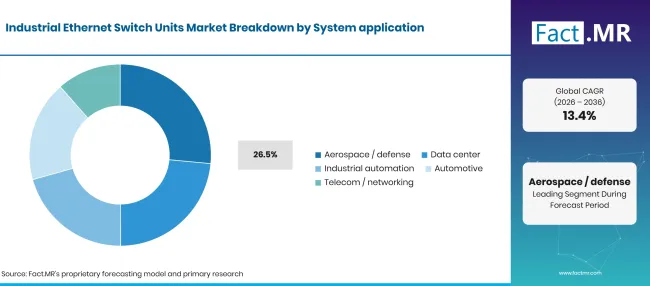
Industrial Ethernet Switch Units Breakdown System Application | Source: Fact.MR
| System Application | Share (2026) |
|---|---|
| Aerospace / defense (Leading segment) | 26.5% |
| Other segments combined | 73.5% |
| Total | 100.0% |
Source: Fact.MR analysis. Updated Nov 11, 2026
Aerospace and defense applications require dependable communication across connected equipment and mission-critical systems. Ruggedized switches can support network installations exposed to vibration, temperature variation, and demanding operating conditions. Industrial automation and automotive applications also contribute to demand as manufacturers connect production machinery, control systems, and inspection equipment. Telecom and networking applications represent another use area where industrial-grade connectivity is required.
Which Procurement Route accounts for the largest share?
System integrators are set to account for 26.7% of the market in 2026.
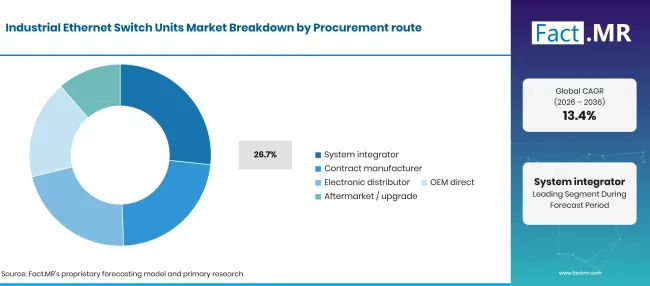
Industrial Ethernet Switch Units Breakdown Procurement Route | Source: Fact.MR
| Procurement Route | Share (2026) |
|---|---|
| System integrator (Leading segment) | 26.7% |
| Other segments combined | 73.3% |
| Total | 100.0% |
Source: Fact.MR analysis. Updated Nov 11, 2026
System integrators lead because industrial Ethernet switch selection often forms part of a larger automation or network deployment project. Integrators assess port requirements, network topology, redundancy, compatibility, and installation conditions before selecting equipment. Aftermarket upgrades also contribute to purchasing activity as facilities replace older switches or expand existing networks. Electronic distributors, OEM direct sales, and contract manufacturers serve different purchasing and integration requirements.
What is accelerating Industrial Ethernet Switch Units Market adoption, and what is holding it back?
Fact.MR finds that 5–8-port switches lead Ethernet Switch Port Class at 30.0%; discrete IC / die leads Integration / Product Form at 25.2%; aerospace and defense lead System Application at 26.5%; and system integrators lead Procurement Route at 26.7%.
Which Ethernet Switch Port Class dominates?
5–8-port switches are set to hold a 30.0% share in 2026.
Industrial Ethernet Switch Units Breakdown Ethernet Switch Port Class 1 | Source: Fact.MR
| Ethernet Switch Port Class | Share (2026) |
|---|---|
| 5–8 ports (Leading segment) | 30.0% |
| Other segments combined | 70.0% |
| Total | 100.0% |
Source: Fact.MR analysis. Updated Nov 11, 2026
Compact switches serve machine-level connectivity requirements where a limited number of devices need to communicate over an industrial network. These configurations can connect controllers, sensors, and equipment within individual production units. Higher-port-count switches support larger network sections and centralized connections, making them relevant for plant-wide communication and network expansion.
Which Integration / Product Form leads?
Discrete IC / die is shown as the leading category at 25.2% in the 2026 segment table.
Industrial Ethernet Switch Units Breakdown Integration Product Form 2 | Source: Fact.MR
| Integration / Product Form | Share (2026) |
|---|---|
| Discrete IC / die (Leading segment) | 25.2% |
| Other segments combined | 74.8% |
| Total | 100.0% |
Source: Fact.MR analysis. Updated Nov 11, 2026
Demand for discrete ICs / dies is supported by rising industrial automation and the integration of Ethernet switching functions into compact controllers and embedded equipment. Growing requirements for real-time communication and higher network speeds encourage adoption of advanced switching chips. Industrial applications also require reliable components with wider operating temperature ranges and support for managed networking and cybersecurity functions.
Which System Application leads demand?
Aerospace and defense are projected to account for 26.5% of the market in 2026.
Industrial Ethernet Switch Units Breakdown System Application 1 | Source: Fact.MR
| System Application | Share (2026) |
|---|---|
| Aerospace / defense (Leading segment) | 26.5% |
| Other segments combined | 73.5% |
| Total | 100.0% |
Source: Fact.MR analysis. Updated Nov 11, 2026
Aerospace and defense applications require dependable communication across connected equipment and mission-critical systems. Ruggedized switches can support network installations exposed to vibration, temperature variation, and demanding operating conditions. Industrial automation and automotive applications also contribute to demand as manufacturers connect production machinery, control systems, and inspection equipment. Telecom and networking applications represent another use area where industrial-grade connectivity is required.
Which Procurement Route accounts for the largest share?
System integrators are set to account for 26.7% of the market in 2026.
Industrial Ethernet Switch Units Breakdown Procurement Route | Source: Fact.MR
| Procurement Route | Share (2026) |
|---|---|
| System integrator (Leading segment) | 26.7% |
| Other segments combined | 73.3% |
| Total | 100.0% |
Source: Fact.MR analysis. Updated Nov 11, 2026
System integrators lead because industrial Ethernet switch selection often forms part of a larger automation or network deployment project. Integrators assess port requirements, network topology, redundancy, compatibility, and installation conditions before selecting equipment. Aftermarket upgrades also contribute to purchasing activity as facilities replace older switches or expand existing networks. Electronic distributors, OEM direct sales, and contract manufacturers serve different purchasing and integration requirements.
Which countries are scaling the Industrial Ethernet Switch Units Market through 2036?
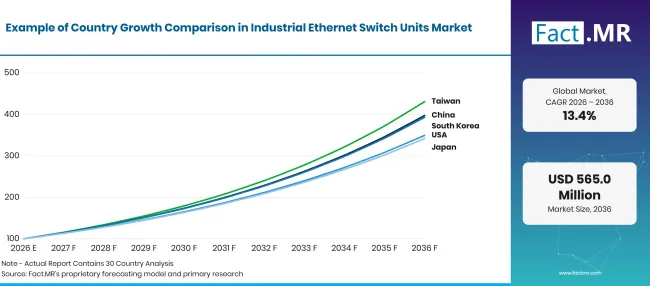
Industrial Ethernet Switch Units Growth Index | Source: Fact.MR
| Country | CAGR (2026–2036) |
|---|---|
| Taiwan | 15.7% |
| South Korea | 14.7% |
| China | 14.8% |
| USA | 13.3% |
| Japan | 13.1% |
Source: Fact.MR analysis. Updated Nov 11, 2026
What supports Taiwan adoption?
15.7% CAGR, supported by semiconductor manufacturing, electronics production, and demand for connected factory equipment.
Taiwan's market opportunity is linked to its electronics and semiconductor manufacturing base, where production equipment requires dependable communication between controllers, inspection systems, and automated machinery. Industrial Ethernet switches can support machine connectivity and production monitoring across these environments. Suppliers offering compact managed switches, embedded solutions, and high-speed uplinks can address the requirements of electronics manufacturers and equipment integrators.
What supports South Korea’s market growth?
14.7% CAGR, shaped by smart factory development and automation across advanced manufacturing industries.
South Korea's growth opportunity reflects the adoption of connected production systems across automotive, electronics, and industrial manufacturing. The Ministry of SMEs and Startups reported that 19.5% of surveyed small and midsize manufacturers with factories had adopted smart factories in its 2024 survey. Greater deployment of automated equipment and connected production lines can support demand for industrial switches with reliable communication and network management features.
Which Factors Drive market growth in China?
14.8% CAGR, driven by large-scale manufacturing digitalization and wider deployment of connected industrial equipment.
China's market is benefiting from the expansion of digital manufacturing and industrial automation. The National Bureau of Statistics reported that 89.6% of industrial enterprises above the designated size had undertaken digital transformation by the end of 2025. As factories connect more production equipment and monitoring systems, demand can increase for industrial Ethernet switches that support reliable data exchange, network expansion, and equipment integration.
What Factors are Driving the Growth of U.S. in the Market?
13.3% CAGR, supported by advanced manufacturing investment and demand for secure industrial networking.
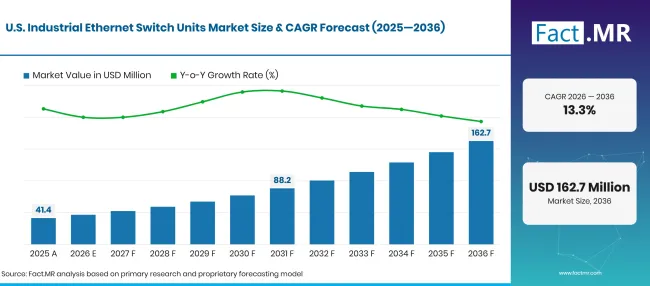
Industrial Ethernet Switch Units Forecast Usa | Source: Fact.MR
The United States market is supported by investment in advanced manufacturing and the modernization of industrial infrastructure. The Manufacturing USA network brings together public and private manufacturing innovation institutes focused on strengthening domestic manufacturing capabilities.Industrial Ethernet switches can support communication across automated production equipment, aerospace and defense systems, and connected manufacturing facilities. Suppliers with ruggedized hardware and industrial cybersecurity features can address these requirements.
What supports Japan adoption?
13.1% CAGR, driven by manufacturing automation and investment in AI-enabled industrial technologies.
Japan's market opportunity is linked to efforts to strengthen manufacturing competitiveness through digital technologies and automation. The Ministry of Economy, Trade and Industry's 2026 manufacturing white paper highlights the importance of AI and digital technology adoption for improving manufacturing competitiveness. Industrial Ethernet switches can support communication between production equipment, control systems, and connected manufacturing platforms.
Who leads the Industrial Ethernet Switch Units Market?
Fact.MR identifies Moxa, Hirschmann under Belden, Siemens, Cisco Systems, HMS Networks, and Advantech as the key companies profiled in the Industrial Ethernet Switch Units Market.
Moxa Inc. offers industrial Ethernet switches across managed, unmanaged, PoE, rackmount, and rail networking categories. Its portfolio includes compact switches, modular products, and industrial network management solutions. Hirschmann (Belden Inc.) supplies ruggedized industrial Ethernet switches through its Hirschmann product portfolio. Its BOBCAT range includes managed switches with TSN support and configurations of up to 24 ports.
Siemens AG offers SCALANCE industrial communication products for manufacturing and process automation. Its portfolio includes managed and unmanaged switches, compact machine-level products, and higher-capacity Layer 3 switches. Cisco Systems, Inc. supplies industrial Ethernet switches through its Catalyst Industrial Ethernet portfolio. Its product range includes ruggedized, modular, rackmount, and embedded switch configurations for industrial automation and other demanding applications
HMS Networks AB participates in industrial networking through its N-Tron and Red Lion brands. N-Tron provides industrial-grade switches for applications that require rugged network infrastructure, while the wider HMS portfolio includes embedded communication interfaces and industrial connectivity solutions. Advantech Co., Ltd. offers industrial Ethernet switches through its EKI product families. Its portfolio includes managed and unmanaged switches, PoE models, and products designed for demanding industrial environments and rail applications.
Commercial competition depends on product reliability, port configurations, network management features, environmental ratings, and integration capabilities. Suppliers also need to support industrial protocols and network redundancy requirements. System integrators and OEMs evaluate product compatibility and technical support alongside hardware specifications when selecting equipment for new installations and upgrades.
Which companies are the key providers?
Key companies include Moxa Inc.; Hirschmann (Belden Inc.); Siemens AG; Cisco Systems, Inc.; HMS Networks AB; and Advantech Co., Ltd.
- Moxa Inc.
- Hirschmann (Belden Inc.)
- Siemens AG
- Cisco Systems, Inc.
- HMS Networks AB
- Advantech Co., Ltd.
What is the report's scope and coverage?
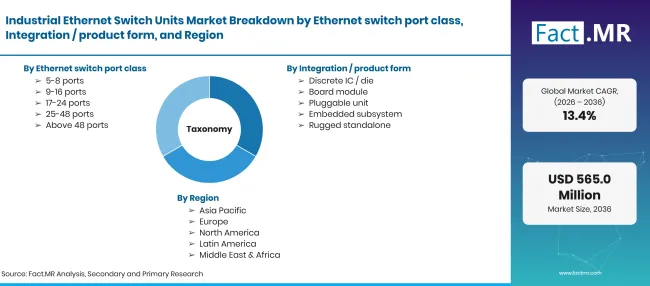
Industrial Ethernet Switch Units Taxonomy | Source: Fact.MR
| Attribute | Details |
|---|---|
| Quantitative Units | USD million |
| Market Definition | The Industrial Ethernet Switch Units Market comprises hardware devices and embedded switching components designed to connect industrial equipment across Ethernet-based networks. These solutions enable reliable data communication between controllers and sensors as well as machines and monitoring systems. |
| Ethernet Switch Port Class | 5–8 ports; 9–16 ports; 17–24 ports; 25–48 ports; Above 48 ports |
| Integration / Product Form | Discrete IC / die; Board module; Pluggable unit; Embedded subsystem; Rugged standalone |
| System Application | Aerospace / defense; Data center; Industrial automation; Automotive; Telecom / networking |
| Procurement Route | System integrator; Contract manufacturer; Electronic distributor; OEM direct; Aftermarket / upgrade |
| Regions Covered | North America; Latin America; Western Europe; Eastern Europe; East Asia; South Asia & Pacific; Middle East & Africa |
| Countries Covered | China; USA; Taiwan; South Korea; Japan |
| Companies Profiled | Moxa Inc.; Hirschmann (Belden Inc.); Siemens AG; Cisco Systems, Inc.; HMS Networks AB; Advantech Co., Ltd. |
| Forecast Period | 2026 to 2036 |
| Approach | Market segmentation and scenario-based analysis supported by industrial digitalization trends, technical standards, and company product portfolios |
Source: Fact.MR analysis. Updated Nov 11, 2026
How is the market segmented?
-
By Ethernet Switch Port Class
- 5–8 ports
- 9–16 ports
- 17–24 ports
- 25–48 ports
- Above 48 ports
-
By Integration / Product Form
- Discrete IC / die
- Board module
- Pluggable unit
- Embedded subsystem
- Rugged standalone
-
By System Application
- Aerospace / defense
- Data center
- Industrial automation
- Automotive
- Telecom / networking
-
By Procurement Route
- System integrator
- Contract manufacturer
- Electronic distributor
- OEM direct
- Aftermarket / upgrade
-
By Region
- North America
- Latin America
- Western Europe
- Eastern Europe
- East Asia
- South Asia & Pacific
- Middle East & Africa
Bibliography
- Belden Inc. (n.d.). Hirschmann BOBCAT Next-Generation Managed Switches.
- Cisco Systems, Inc. (n.d.). Industrial Ethernet Switches.
- IEEE Standards Association. (2026, June 29). IEEE/IEC 60802-2026: IEC/IEEE International Standard – Time-Sensitive Networking Profile for Industrial Automation.
- International Electrotechnical Commission. (2021, December 15). IEC 62439-2:2021: Industrial communication networks – High availability automation networks – Part 2: Media Redundancy Protocol (MRP).
- Ministry of Economy, Trade and Industry, Japan. (2026, May 29). FY2025 Measures to Promote Manufacturing Technology (White Paper on Manufacturing Industries 2026) Released.
- Ministry of SMEs and Startups, Republic of Korea. (2025, April 28). 2024년 스마트제조혁신실태조사 결과 발표 [Results of the 2024 Smart Manufacturing Innovation Survey].
- Moxa Inc. (n.d.). Ethernet Switches.
- National Bureau of Statistics of China. (2026, June 2). “ [Achievements in economic and social development during the 14th Five-Year Plan period: Innovation-driven quality and efficiency improvements]. (https://www.stats.gov.cn/zt_18555/ztfx/sswjjshfzcjbg/202606/t20260601_1963833.html)
- National Institute of Standards and Technology. (2026, March 17). Manufacturing USA 2025 Annual Report. NIST Advanced Manufacturing Series 600-19.
- Siemens AG. (n.d.). SCALANCE.
This Report Answers
- The report examines demand for industrial Ethernet switch units across the specified port classes and integration formats.
- Segment analysis compares embedded subsystems, rugged standalone products, pluggable units, board modules, and discrete IC / die categories.
- Application analysis evaluates demand across aerospace and defense, data centers, industrial automation, automotive, and telecom / networking.
- Country analysis compares China, the USA, Taiwan, South Korea, and Japan using their projected growth rates.
- The competitive overview profiles Moxa, Hirschmann, Siemens, Cisco, HMS Networks, and Advantech.
What does the Industrial Ethernet Switch Units Market cover?
The market covers industrial Ethernet switching products and associated embedded switching solutions used to establish wired communication between industrial devices, controllers, machines, and network systems. It includes products classified by port capacity, integration format, application, and procurement route. Purchasing decisions depend on network reliability, environmental durability, port density, compatibility, and support for industrial communication requirements.
What is included in the scope?
Included products comprise industrial Ethernet switches and embedded switching solutions intended for industrial network applications.
The scope covers compact and high-port-count configurations, managed and unmanaged switch designs, rugged standalone units, pluggable products, and embedded formats, subject to the final revenue boundary adopted for the study.
What is excluded from the scope?
The analysis excludes general-purpose enterprise Ethernet switches that are not designed or marketed for industrial applications.
Industrial routers, wireless access points, gateways, media converters, cables, and network management software are excluded when sold as separate products rather than as part of an included switching solution. General-purpose semiconductor components are also excluded unless the market definition explicitly includes discrete switching ICs or dies.
How Was the Analysis Built?
The analysis draws on 120+ sources, 35+ company portfolios, 25+ countries, and more than 20 industry interviews.
- Primary Research: Primary research includes discussions with manufacturers, system integrators, distributors, OEMs, industrial automation providers, end users, and subject-matter experts. These conversations examine purchasing priorities, product adoption, network requirements, installation challenges, technical support, and competitive positioning.
- Desk Research: Desk research covers government statistics, industrial policies, technical standards, company product portfolios, corporate filings, trade publications, industry associations, and technical documentation. Sources used in the analysis are documented in the bibliography.
- Market Sizing and Forecasting: Market estimates combine historical performance, demand indicators, product pricing, volume trends, segment shares, company participation, country-level growth, industrial investment, and adoption patterns.
- Data Validation and Update Cycle: Findings are validated by comparing primary interviews with public data, company product information, standards, industrial investment trends, and market developments. Regular updates review new product launches, portfolio changes, partnerships, and shifts in industrial networking requirements.
Frequently Asked Questions
How big is the Industrial Ethernet Switch Units Market in 2026?
What is the CAGR from 2026 to 2036?
Which Ethernet Switch Port Class has the largest share?
Which Integration / Product Form leads?
Which System Application leads the market?
Which Procurement Route has the largest share?
Which country is projected to grow fastest?
Which companies are covered?
Who worked on this report


Preview the report firsthand - request a free sample
Free SampleGet the brochure for pricing and purchase details
Download PDF