Actuators Market Size, Share, Growth and Forecast (2026 - 2036)

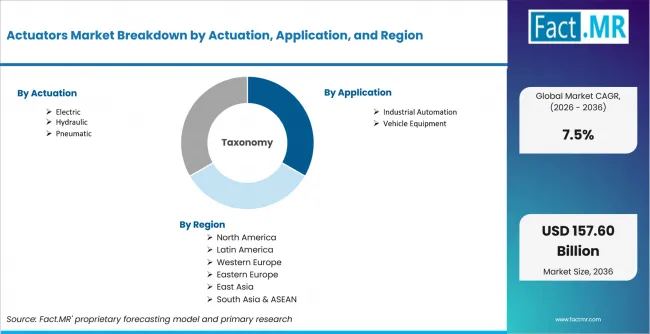
The Actuators Market is segmented by Actuation (Electric, Hydraulic, Pneumatic, and Others), Application (Vehicle Equipment, Robotics, and Industrial Automation), Type (Linear Actuators and Rotary Actuators), Vertical (Food & Beverages, Oil & Gas, Metals, Mining & Machinery, and Power), End Use Industry (Manufacturing, Automotive, Healthcare, Aerospace & Defense, Energy & Utilities, and Logistics & Warehousing) and Region. Forecast for 2026 to 2036.

Actuators Market Forecast and Outlook By FACT MR

  • In 2025, the actuators market was valued at USD 71.2 billion. Based on Fact.MR analysis, demand for actuators is estimated to grow to USD 76.5 billion in 2026 and USD 157.6 billion by 2036. Fact.MR projects a CAGR of 7.5% during the forecast period.
  • The market is projected to generate approximately USD 81.1 billion in additional revenue between 2026 and 2036. Expansion reflects rising factory automation investment and wider deployment of robotics systems.
  • Demand is supported by manufacturing modernization and industrial digitalization. Adoption is constrained by high capital expenditure requirements and integration complexity across legacy production facilities.
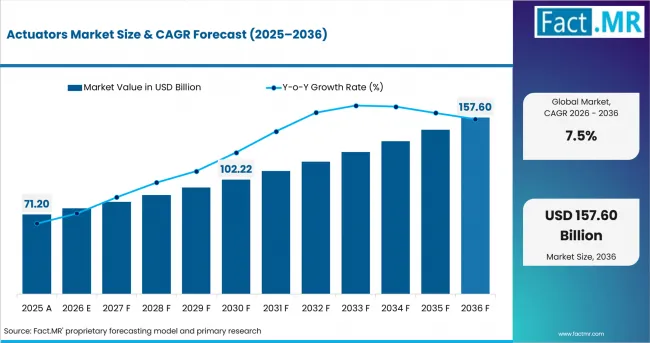
Actuators Market Value Analysis

Summary of Actuators Market

  • Demand Drivers
    • Industrial automation investment is increasing deployment of motion control systems. Equipment modernization supports actuator demand.
    • Robotics adoption is expanding across manufacturing facilities. Precision movement requirements strengthen installation activity.
    • Smart factory implementation is improving utilization of automated equipment. Digital manufacturing supports market expansion.
  • Key Segments Analyzed
    • By Actuation: Electric actuators account for 48% share in 2026 due to precision control and lower maintenance requirements.
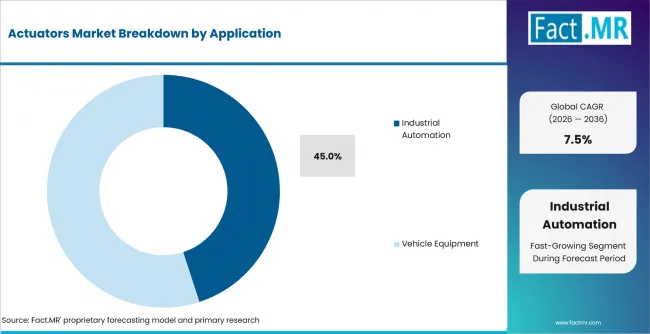
    • By Application: Industrial automation contributes 45% share in 2026 supported by manufacturing modernization activity.
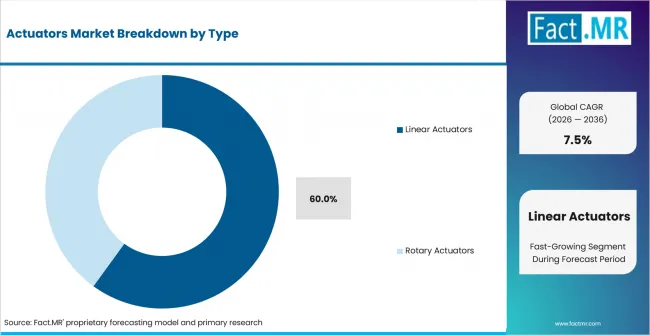
    • By Type: Linear actuators capture 60% share in 2026 due to broad utilization across automated production systems.
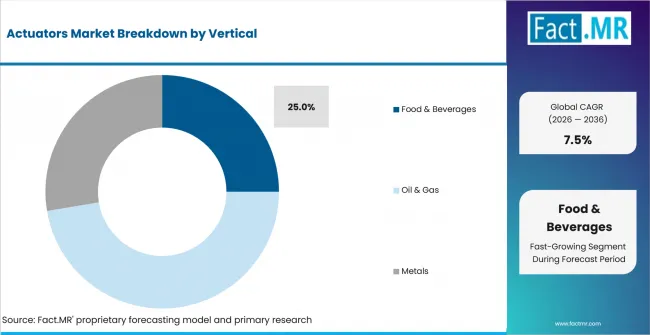
    • By Vertical: Food & Beverages generate 25% share in 2026 supported by increasing automation deployment across processing facilities.
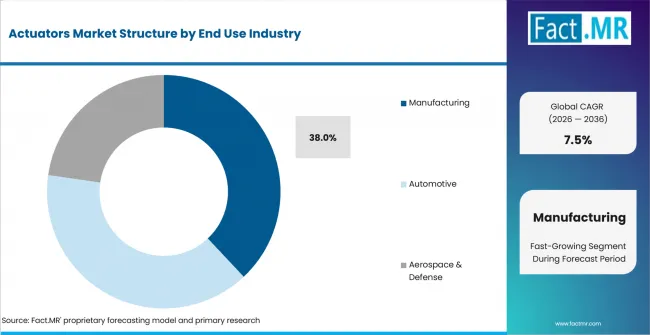
    • By End Use Industry: Manufacturing contributes 38% share in 2026 due to expanding factory automation investment.
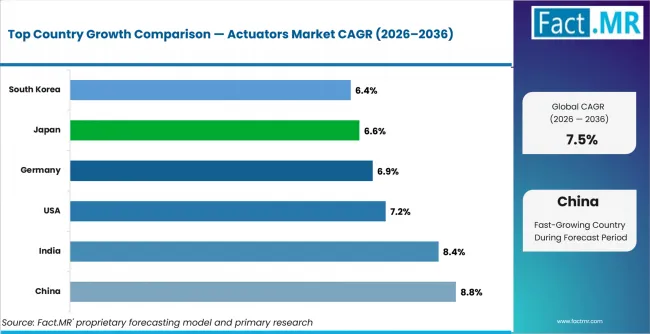
    • By Geography: China is projected to record 8.8% CAGR through 2036 supported by large-scale industrial automation adoption.
  • Analyst Opinion at Fact.MR
    • Shambhu Nath Jha, Principal Consultant at Fact.MR, opines, 'Automation investment and robotics deployment will shape actuator demand through 2036. Manufacturers with strong electric actuator portfolios are positioned to capture greater revenue opportunities.'
  • Strategic Implications
    • Actuator manufacturers should expand electric automotive actuator production capacity. Automation demand supports long-term revenue growth.
    • Industrial equipment suppliers should strengthen integration capabilities. System compatibility improves commercial opportunity.
    • Manufacturing firms should accelerate automation investment planning. Productivity improvement supports operational efficiency.
Metric Value
Estimated Value in 2026 USD 76.5 billion
Forecast Value in 2036 USD 157.6 billion
Forecast CAGR (2026 to 2036) 7.5%

Segmental Analysis

Actuators Market Analysis by Actuation
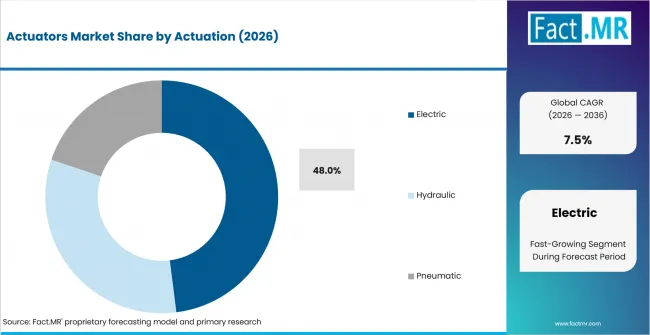
Actuators Market Analysis By Actuation

Electric actuators are estimated to account for 48% share in 2026. Manufacturing facilities increasingly prioritize precise motion control and lower maintenance requirements. Electrification trends support deployment across automation systems and robotics platforms. Rotork announced the acquisition of Noah Actuation, a South Korean manufacturer of electric actuators, for approximately £44 million, to expand its electric actuator product range and strengthen its presence in Asia-Pacific markets. The acquisition supports Rotork’s Growth+ strategy and enhances its offerings across water, power, and industrial flow control applications. [1]

  • Precision Control: Electric actuators support accurate positioning across automated production equipment. Motion consistency improves process efficiency.
  • Maintenance Benefits: Electric systems reduce servicing requirements compared with hydraulic alternatives. Lower operating costs support deployment decisions.
  • Energy Efficiency: Manufacturers prioritize equipment that improves power utilization. Efficiency objectives support adoption across industrial facilities.

Actuators Market Analysis by Application
Actuators Market Analysis By Application

Industrial automation is estimated to hold 45% share in 2026. Factory modernization programs are increasing demand for automated motion control solutions. Equipment upgrades support installation activity across manufacturing environments. Emerson launched the Fisher™ easy-Drive™ 200R electric actuator, designed for precise valve control in extreme environments such as remote oil and gas installations. The actuator reduces emissions by replacing gas-operated systems and improves uptime, energy efficiency, and operational reliability. [2]

  • Factory Modernization: Manufacturing facilities are expanding automation investment. Equipment upgrades strengthen actuator demand.
  • Process Optimization: Production operators seek improved throughput and consistency. Motion control systems support operational targets.
  • Robotics Integration: Automation platforms increasingly incorporate robotic equipment. Installation growth supports actuator consumption.

Actuators Market Analysis by Type
Actuators Market Analysis By Type

Linear actuators are estimated to capture 60% share in 2026. These systems support positioning and movement functions across industrial equipment. Broad application scope strengthens segment concentration.

  • Equipment Compatibility: Linear motion systems integrate across multiple automation applications. Utilization breadth supports demand.
  • Material Handling: Production facilities deploy linear actuators within handling equipment. Automation requirements strengthen installation activity.
  • Process Control: Manufacturing systems require precise movement capability. Performance requirements support segment growth.

Actuators Market Analysis by Vertical
Actuators Market Analysis By Vertical

Food & Beverages are estimated to contribute 25% share in 2026. Processing facilities increasingly deploy automated equipment to improve production consistency. Hygiene requirements support investment in advanced motion control systems. At SPS 2025, major industrial automation players including Siemens, Beckhoff, Rockwell Automation, ABB, and Schneider Electric showcased advancements in industrial AI, digital twins, and software-defined automation (SDA). The focus was on integrating AI-driven control systems, virtual PLCs, and connected automation architectures to improve flexibility, efficiency, and production optimization. [5]

  • Production Efficiency: Food manufacturers seek higher throughput and operational consistency. Automation investment supports actuator demand.
  • Quality Standards: Processing facilities require accurate equipment movement. Precision control supports production objectives.
  • Capacity Expansion: Food processing investment is increasing across developing economies. Facility growth supports installation activity.

Actuators Market Analysis by End Use Industry
Actuators Market Analysis By End Use Industry

Manufacturing is estimated to generate 38% share in 2026. Industrial facilities continue expanding automation investment to improve productivity and reduce labor dependence. Equipment modernization supports sustained demand. ABB Robotics introduced its OmniCore™ automation platform at Automate 2025. The controller platform was designed to deliver faster and more precise robot movement, increasing demand for advanced actuator and motion control systems. [3]

  • Automation Spending: Manufacturing companies are increasing capital expenditure on automated equipment. Investment activity strengthens market demand.
  • Productivity Targets: Production facilities seek operational efficiency improvements. Motion control systems support performance objectives.
  • Digital Manufacturing: Smart factory deployment increases actuator utilization. Connected equipment supports installation growth.

Drivers, Restraints, and Opportunities

Actuators Market Opportunity Matrix Growth Vs Value

Fact.MR analysts observe that the actuators market is progressing through a period of industrial automation expansion. Demand is linked to factory modernization and equipment replacement activity. Manufacturing investment remains the primary force supporting market value growth.

Motion control systems are becoming more important across robotics and automated production environments. Electric actuator technologies are capturing greater installation activity due to efficiency advantages. Industrial facilities increasingly prioritize precision and reliability across equipment deployments. Siemens launched a next-generation motion control system combining SINAMICS servo-drive systems, SIMOTICS motors, and the SIMATIC S7-1200 G2 controller to improve performance in basic automation applications such as handling, moving, and positioning. The system enhances precision, safety, and integration for industrial automation and machine control. [4]

  • Automation Investment: Manufacturing companies are expanding automation programs across production facilities. Growth is supported by productivity improvement initiatives and smart factory deployment.
  • Robotics Expansion: Industrial robot installations are increasing across automotive and electronics manufacturing. Demand is driven by precision movement requirements.
  • Integration Costs: Adoption is constrained by system integration expenses and equipment upgrade requirements. Legacy infrastructure can slow deployment activity.

Regional Analysis

The actuators market is assessed across North America, Europe, Asia Pacific, Latin America, and the Middle East & Africa. The study evaluates industrial automation activity, manufacturing investment, robotics deployment, and equipment modernization across major industrial economies.

Top Country Growth Comparison Actuators Market Cagr (2026 2036)

Country CAGR (2026 to 2036)
China 8.8%
India 8.4%
United States 7.2%
Germany 6.9%
Japan 6.6%
South Korea 6.4%

Actuators Market Cagr Analysis By Country

Asia Pacific Actuators Market Analysis

Actuators Market Japan Market Share Analysis By Actuation

Asia Pacific represents the primary growth center for actuator demand. Manufacturing investment and industrial automation activity support equipment installation. Production expansion strengthens long-term market opportunities.

  • China: Demand for actuators in China is projected to rise at 8.8% CAGR. Industrial automation investment is expanding across manufacturing facilities. Electronics and machinery production support equipment deployment. Growth is attributable to large-scale factory modernization and robotics adoption.
  • India: India is expected to expand at 8.4% CAGR driven by industrial modernization programs and manufacturing investment. Production facilities are increasing automation deployment. Industrial expansion supports installation activity. Growth reflects rising equipment investment across domestic manufacturing sectors.
  • Japan: Japan is projected to register 6.6% CAGR by 2036 supported by industrial robotics utilization and precision manufacturing activity. Equipment upgrades support motion control demand. Factory automation remains a strategic priority. Growth is driven by advanced manufacturing requirements.
  • South Korea: South Korea is anticipated to witness 6.4% CAGR due to semiconductor manufacturing investment and automation deployment. Electronics production facilities require advanced motion control systems. Industrial technology adoption supports demand. Growth reflects equipment modernization activity.

Actuators Market South Korea Market Share Analysis By Application

North America Actuators Market Analysis
Actuators Market Country Value Analysis

North America benefits from established manufacturing infrastructure and strong automation adoption. Industrial facilities continue investing in digital production technologies. Equipment replacement supports demand generation.

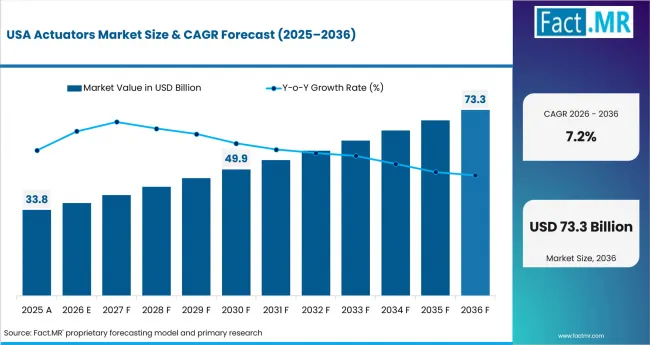
  • United States: The United States is projected to expand at 7.2% CAGR through 2036 as smart factory implementation increases across manufacturing facilities. Robotics deployment supports motion control requirements. Industrial investment strengthens equipment demand. Growth is attributable to advanced automation adoption and digital manufacturing strategies.

Europe Actuators Market Analysis

Actuators Market Europe Country Market Share Analysis, 2026 & 2036

Europe benefits from advanced manufacturing capability and strong engineering expertise. Industrial facilities continue prioritizing efficiency improvement and production automation. Equipment modernization supports long-term demand.

  • Germany: Germany is expected to grow at 6.9% CAGR supported by industrial machinery production and automotive manufacturing activity. Factory automation investment supports actuator deployment. Precision engineering requirements strengthen demand. Growth reflects advanced manufacturing infrastructure and equipment modernization programs.

Competitive Aligners for Market Players
Actuators Market Analysis By Company

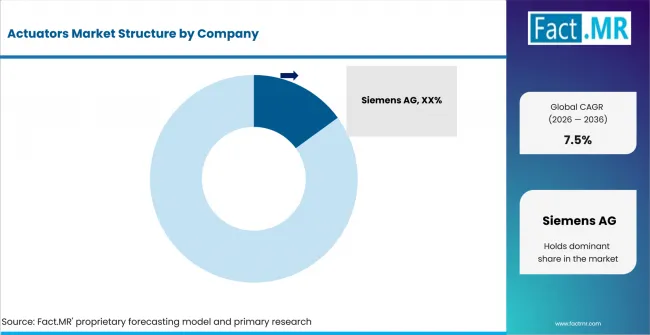
The actuators market reflects competition among global automation suppliers and motion control technology providers. Product reliability influences equipment selection across industrial facilities. Companies with broad automation portfolios maintain stronger commercial positioning across manufacturing and process industries. Engineering expertise supports long-term customer relationships.

Organizations with extensive manufacturing footprints benefit from shorter delivery timelines and stronger supply chain control. Product integration capability improves market access across factory automation projects. Technical support remains an important differentiator across industrial equipment deployments. Established distribution networks strengthen commercial reach. Industrial manufacturers evaluate suppliers based on performance consistency and lifecycle costs. Automation integrators prioritize compatibility with existing production systems. Long qualification cycles create barriers for new suppliers. Established relationships influence replacement and expansion purchasing decisions.

Commercial success is increasingly linked to electric actuator capability and automation integration expertise. Demand is shifting toward suppliers that support digital manufacturing strategies. Motion control innovation is emerging as a major source of competitive differentiation across industrial automation markets.

Key Players

  • Siemens AG
  • ABB Ltd.
  • Emerson Electric Co.
  • Rockwell Automation, Inc.
  • Schneider Electric SE
  • SMC Corporation

Bibliography

  • [1] Rotork plc. (2025). Acquisition of Noah Actuation. July 2025. London Stock Exchange.
  • [2] Emerson Electric Co. (2024). Emerson's new eco-friendly electric valve actuator ensures accurate process control in adverse conditions. October 2024.
  • [3] ABB Ltd. (2025). ABB to unleash the power of OmniCore at Automate 2025. May 2025. Association for Advancing Automation (A3).
  • [4] Siemens AG. (2025). Siemens next-generation motion control system for basic automation applications. May 2025.
  • [5] IoT Analytics GmbH. (2025). Industrial automation future: Siemens, Beckhoff, Rockwell, and ABB at SPS 2025. December 2025.

This Report Addresses

  • Analysis of actuator demand across industrial automation and motion control applications.
  • Market forecast from USD 76.5 billion in 2026 to USD 157.6 billion by 2036 at 7.5% CAGR.
  • Opportunity assessment across electric actuators and factory automation systems.
  • Segment forecasts covering actuation, application, type, vertical, and end use industry demand.
  • Competitive assessment of automation suppliers and motion control technology providers.
  • Evaluation of manufacturing investment and robotics deployment trends.
  • Country-level analysis across China, India, the United States, Germany, Japan, and South Korea.
  • Report delivery through PDF and Excel formats supported by primary interviews and industrial equipment analysis.

Actuators Market Definition

The actuators market covers mechanical devices that convert electrical, hydraulic, or pneumatic energy into controlled motion. These systems perform movement functions within industrial equipment, vehicles, robotics systems, and process automation infrastructure. Actuators are utilized to automate positioning, control movement, regulate flow systems, and improve operational efficiency across manufacturing and industrial environments. The market includes linear and rotary motion technologies deployed across industrial, commercial, transportation, and energy applications.

Actuators Market  Inclusions

The study covers global and regional forecasts from 2026 to 2036 by actuation, application, type, vertical, and end use industry. It includes electric and hydraulic actuator technologies utilized across industrial automation, robotics, manufacturing, and process industries. The report evaluates installation trends, automation investment activity, and equipment demand across major industrial economies.

Actuators Market Exclusions

The study excludes industrial sensors, programmable controllers, drive systems, and standalone automation software. Revenue associated with complete robotic systems is excluded unless directly attributable to actuator components. General maintenance services are excluded unless linked directly to actuator replacement and installation activity.

Actuators Market Research Methodology

  • Primary Research
    • Interviews were conducted with automation engineers, industrial equipment manufacturers, robotics integrators, plant managers, and motion control specialists across major industrial markets.
  • Desk Research
    • Analysis included company disclosures, industrial automation publications, manufacturing reports, equipment installation data, and technology announcements released during 2024 and 2025.
  • Market-Sizing and Forecasting
    • Hybrid top-down and bottom-up model using industrial equipment demand, automation investment trends, and manufacturing output assessments.
  • Data Validation and Update Cycle
    • Forecast was validated through industry interviews, distributor feedback, equipment utilization analysis, and manufacturing investment assessments.

Scope of Report

Actuators Market Breakdown By Actuation, Application, And Region

Attribute Details
Quantitative Units USD 76.5 billion (2026) to USD 157.6 billion (2036) at a CAGR of 7.5%
Market Definition Covers devices that convert electrical, hydraulic, or pneumatic energy into controlled motion
Actuation Segmentation Electric, Hydraulic, Pneumatic, Others
Application Segmentation Vehicle Equipment, Robotics, Industrial Automation
Type Segmentation Linear Actuators, Rotary Actuators
Vertical Segmentation Food & Beverages, Oil & Gas, Metals, Mining & Machinery, Power
End Use Industry Segmentation Manufacturing, Automotive, Healthcare, Aerospace & Defense, Energy & Utilities, Logistics & Warehousing
Regions Covered North America, Europe, Asia Pacific, Latin America, Middle East & Africa
Countries Covered China, India, United States, Germany, Japan, South Korea
Key Companies Profiled Siemens AG, ABB Ltd., Emerson Electric Co., Rockwell Automation, Schneider Electric
Forecast Period 2026 to 2036
Approach Hybrid top-down and bottom-up model using automation investment and equipment demand analysis

Actuators Market by Segment

  • By Actuation:

    • Electric
    • Hydraulic
    • Pneumatic
    • Others
  • By Application:

    • Vehicle Equipment
    • Robotics
    • Industrial Automation
  • By Type:

    • Linear Actuators
    • Rotary Actuators
  • By Vertical:

    • Food & Beverages
    • Oil & Gas
    • Metals
    • Mining & Machinery
    • Power
  • By End Use Industry:

    • Manufacturing
    • Automotive
    • Healthcare
    • Aerospace & Defense
    • Energy & Utilities
    • Logistics & Warehousing
  • By Region:

    • North America
      • United States
      • Canada
      • Mexico
    • Latin America
      • Brazil
      • Argentina
      • Rest of Latin America
    • Europe
      • Germany
      • United Kingdom
      • France
      • Italy
      • Rest of Europe
    • Asia Pacific
      • China
      • India
      • Japan
      • South Korea
      • ASEAN
    • Middle East & Africa
      • UAE
      • Saudi Arabia
      • South Africa
      • Rest of Middle East & Africa

- Frequently Asked Questions -

How large is the global actuators market in 2025?

The global actuators market was valued at USD 71.2 billion in 2025 based on Fact.MR analysis.

What will the actuators market size be in 2026?

Based on Fact.MR analysis, demand for actuators is estimated to reach USD 76.5 billion in 2026.

What is the projected actuators market size by 2036?

The market is projected to reach USD 157.6 billion by 2036 supported by automation investment and robotics deployment across manufacturing industries.

What is the expected CAGR for the actuators market from 2026 to 2036?

Fact.MR projects the global actuators market to expand at a CAGR of 7.5% during the forecast period.

Which actuation segment is expected to contribute prominent demand in 2026?

Electric actuators contribute 48% share in 2026 due to precision control capability and lower maintenance requirements.

Which application segment generates substantial market demand?

Industrial automation contributes 45% share in 2026 supported by manufacturing modernization and smart factory deployment.

Which country records stronger growth through 2036?

China is projected to expand at 8.8% CAGR through 2036 supported by factory automation investment and industrial modernization activity.

Table of Content

  1. Executive Summary
    • Global Market Outlook
    • Demand to side Trends
    • Supply to side Trends
    • Technology Roadmap Analysis
    • Analysis and Recommendations
  2. Market Overview
    • Market Coverage / Taxonomy
    • Market Definition / Scope / Limitations
  3. Research Methodology
    • Chapter Orientation
    • Analytical Lens and Working Hypotheses
      • Market Structure, Signals, and Trend Drivers
      • Benchmarking and Cross-market Comparability
      • Market Sizing, Forecasting, and Opportunity Mapping
    • Research Design and Evidence Framework
      • Desk Research Programme (Secondary Evidence)
        • Company Annual and Sustainability Reports
        • Peer-reviewed Journals and Academic Literature
        • Corporate Websites, Product Literature, and Technical Notes
        • Earnings Decks and Investor Briefings
        • Statutory Filings and Regulatory Disclosures
        • Technical White Papers and Standards Notes
        • Trade Journals, Industry Magazines, and Analyst Briefs
        • Conference Proceedings, Webinars, and Seminar Materials
        • Government Statistics Portals and Public Data Releases
        • Press Releases and Reputable Media Coverage
        • Specialist Newsletters and Curated Briefings
        • Sector Databases and Reference Repositories
        • Fact.MR Internal Proprietary Databases and Historical Market Datasets
        • Subscription Datasets and Paid Sources
        • Social Channels, Communities, and Digital Listening Inputs
        • Additional Desk Sources
      • Expert Input and Fieldwork (Primary Evidence)
        • Primary Modes
          • Qualitative Interviews and Expert Elicitation
          • Quantitative Surveys and Structured Data Capture
          • Blended Approach
        • Why Primary Evidence is Used
        • Field Techniques
          • Interviews
          • Surveys
          • Focus Groups
          • Observational and In-context Research
          • Social and Community Interactions
        • Stakeholder Universe Engaged
          • C-suite Leaders
          • Board Members
          • Presidents and Vice Presidents
          • R&D and Innovation Heads
          • Technical Specialists
          • Domain Subject-matter Experts
          • Scientists
          • Physicians and Other Healthcare Professionals
        • Governance, Ethics, and Data Stewardship
          • Research Ethics
          • Data Integrity and Handling
      • Tooling, Models, and Reference Databases
    • Data Engineering and Model Build
      • Data Acquisition and Ingestion
      • Cleaning, Normalisation, and Verification
      • Synthesis, Triangulation, and Analysis
    • Quality Assurance and Audit Trail
  4. Market Background
    • Market Dynamics
      • Drivers
      • Restraints
      • Opportunity
      • Trends
    • Scenario Forecast
      • Demand in Optimistic Scenario
      • Demand in Likely Scenario
      • Demand in Conservative Scenario
    • Opportunity Map Analysis
    • Product Life Cycle Analysis
    • Supply Chain Analysis
    • Investment Feasibility Matrix
    • Value Chain Analysis
    • PESTLE and Porter’s Analysis
    • Regulatory Landscape
    • Regional Parent Market Outlook
    • Production and Consumption Statistics
    • Import and Export Statistics
  5. Global Market Analysis 2021 to 2025 and Forecast, 2026 to 2036
    • Historical Market Size Value (USD Million) Analysis, 2021 to 2025
    • Current and Future Market Size Value (USD Million) Projections, 2026 to 2036
      • Y to o to Y Growth Trend Analysis
      • Absolute $ Opportunity Analysis
  6. Global Market Pricing Analysis 2021 to 2025 and Forecast 2026 to 2036
  7. Global Market Analysis 2021 to 2025 and Forecast 2026 to 2036, By Product Type
    • Introduction / Key Findings
    • Historical Market Size Value (USD Million) Analysis By Product Type , 2021 to 2025
    • Current and Future Market Size Value (USD Million) Analysis and Forecast By Product Type , 2026 to 2036
      • Recycled Aggregates
      • Recycled Metals
      • Recycled Plastics
    • Y to o to Y Growth Trend Analysis By Product Type , 2021 to 2025
    • Absolute $ Opportunity Analysis By Product Type , 2026 to 2036
  8. Global Market Analysis 2021 to 2025 and Forecast 2026 to 2036, By End-use
    • Introduction / Key Findings
    • Historical Market Size Value (USD Million) Analysis By End-use, 2021 to 2025
    • Current and Future Market Size Value (USD Million) Analysis and Forecast By End-use, 2026 to 2036
      • Non-residential
      • Residential
      • Infrastructure
    • Y to o to Y Growth Trend Analysis By End-use, 2021 to 2025
    • Absolute $ Opportunity Analysis By End-use, 2026 to 2036
  9. Global Market Analysis 2021 to 2025 and Forecast 2026 to 2036, By Material Source
    • Introduction / Key Findings
    • Historical Market Size Value (USD Million) Analysis By Material Source, 2021 to 2025
    • Current and Future Market Size Value (USD Million) Analysis and Forecast By Material Source, 2026 to 2036
      • C&D Debris
      • Plastic Waste
      • Agricultural Residues
    • Y to o to Y Growth Trend Analysis By Material Source, 2021 to 2025
    • Absolute $ Opportunity Analysis By Material Source, 2026 to 2036
  10. Global Market Analysis 2021 to 2025 and Forecast 2026 to 2036, By Distribution Mode
    • Introduction / Key Findings
    • Historical Market Size Value (USD Million) Analysis By Distribution Mode, 2021 to 2025
    • Current and Future Market Size Value (USD Million) Analysis and Forecast By Distribution Mode, 2026 to 2036
      • Direct Supply
      • Distributor Sales
      • Online Sales
    • Y to o to Y Growth Trend Analysis By Distribution Mode, 2021 to 2025
    • Absolute $ Opportunity Analysis By Distribution Mode, 2026 to 2036
  11. Global Market Analysis 2021 to 2025 and Forecast 2026 to 2036, By Construction Stage
    • Introduction / Key Findings
    • Historical Market Size Value (USD Million) Analysis By Construction Stage, 2021 to 2025
    • Current and Future Market Size Value (USD Million) Analysis and Forecast By Construction Stage, 2026 to 2036
      • New Construction
      • Renovation
      • Demolition Reuse
    • Y to o to Y Growth Trend Analysis By Construction Stage, 2021 to 2025
    • Absolute $ Opportunity Analysis By Construction Stage, 2026 to 2036
  12. Global Market Analysis 2021 to 2025 and Forecast 2026 to 2036, By Application Area
    • Introduction / Key Findings
    • Historical Market Size Value (USD Million) Analysis By Application Area, 2021 to 2025
    • Current and Future Market Size Value (USD Million) Analysis and Forecast By Application Area, 2026 to 2036
      • Structural Works
      • Road Base
      • Panels
    • Y to o to Y Growth Trend Analysis By Application Area, 2021 to 2025
    • Absolute $ Opportunity Analysis By Application Area, 2026 to 2036
  13. Global Market Analysis 2021 to 2025 and Forecast 2026 to 2036, By Region
    • Introduction
    • Historical Market Size Value (USD Million) Analysis By Region, 2021 to 2025
    • Current Market Size Value (USD Million) Analysis and Forecast By Region, 2026 to 2036
      • North America
      • Latin America
      • Western Europe
      • Eastern Europe
      • East Asia
      • South Asia and Pacific
      • Middle East & Africa
    • Market Attractiveness Analysis By Region
  14. North America Market Analysis 2021 to 2025 and Forecast 2026 to 2036, By Country
    • Historical Market Size Value (USD Million) Trend Analysis By Market Taxonomy, 2021 to 2025
    • Market Size Value (USD Million) Forecast By Market Taxonomy, 2026 to 2036
      • By Country
        • USA
        • Canada
        • Mexico
      • By Product Type
      • By End-use
      • By Material Source
      • By Distribution Mode
      • By Construction Stage
      • By Application Area
    • Market Attractiveness Analysis
      • By Country
      • By Product Type
      • By End-use
      • By Material Source
      • By Distribution Mode
      • By Construction Stage
      • By Application Area
    • Key Takeaways
  15. Latin America Market Analysis 2021 to 2025 and Forecast 2026 to 2036, By Country
    • Historical Market Size Value (USD Million) Trend Analysis By Market Taxonomy, 2021 to 2025
    • Market Size Value (USD Million) Forecast By Market Taxonomy, 2026 to 2036
      • By Country
        • Brazil
        • Chile
        • Rest of Latin America
      • By Product Type
      • By End-use
      • By Material Source
      • By Distribution Mode
      • By Construction Stage
      • By Application Area
    • Market Attractiveness Analysis
      • By Country
      • By Product Type
      • By End-use
      • By Material Source
      • By Distribution Mode
      • By Construction Stage
      • By Application Area
    • Key Takeaways
  16. Western Europe Market Analysis 2021 to 2025 and Forecast 2026 to 2036, By Country
    • Historical Market Size Value (USD Million) Trend Analysis By Market Taxonomy, 2021 to 2025
    • Market Size Value (USD Million) Forecast By Market Taxonomy, 2026 to 2036
      • By Country
        • Germany
        • UK
        • Italy
        • Spain
        • France
        • Nordic
        • BENELUX
        • Rest of Western Europe
      • By Product Type
      • By End-use
      • By Material Source
      • By Distribution Mode
      • By Construction Stage
      • By Application Area
    • Market Attractiveness Analysis
      • By Country
      • By Product Type
      • By End-use
      • By Material Source
      • By Distribution Mode
      • By Construction Stage
      • By Application Area
    • Key Takeaways
  17. Eastern Europe Market Analysis 2021 to 2025 and Forecast 2026 to 2036, By Country
    • Historical Market Size Value (USD Million) Trend Analysis By Market Taxonomy, 2021 to 2025
    • Market Size Value (USD Million) Forecast By Market Taxonomy, 2026 to 2036
      • By Country
        • Russia
        • Poland
        • Hungary
        • Balkan & Baltic
        • Rest of Eastern Europe
      • By Product Type
      • By End-use
      • By Material Source
      • By Distribution Mode
      • By Construction Stage
      • By Application Area
    • Market Attractiveness Analysis
      • By Country
      • By Product Type
      • By End-use
      • By Material Source
      • By Distribution Mode
      • By Construction Stage
      • By Application Area
    • Key Takeaways
  18. East Asia Market Analysis 2021 to 2025 and Forecast 2026 to 2036, By Country
    • Historical Market Size Value (USD Million) Trend Analysis By Market Taxonomy, 2021 to 2025
    • Market Size Value (USD Million) Forecast By Market Taxonomy, 2026 to 2036
      • By Country
        • China
        • Japan
        • South Korea
      • By Product Type
      • By End-use
      • By Material Source
      • By Distribution Mode
      • By Construction Stage
      • By Application Area
    • Market Attractiveness Analysis
      • By Country
      • By Product Type
      • By End-use
      • By Material Source
      • By Distribution Mode
      • By Construction Stage
      • By Application Area
    • Key Takeaways
  19. South Asia and Pacific Market Analysis 2021 to 2025 and Forecast 2026 to 2036, By Country
    • Historical Market Size Value (USD Million) Trend Analysis By Market Taxonomy, 2021 to 2025
    • Market Size Value (USD Million) Forecast By Market Taxonomy, 2026 to 2036
      • By Country
        • India
        • ASEAN
        • Australia & New Zealand
        • Rest of South Asia and Pacific
      • By Product Type
      • By End-use
      • By Material Source
      • By Distribution Mode
      • By Construction Stage
      • By Application Area
    • Market Attractiveness Analysis
      • By Country
      • By Product Type
      • By End-use
      • By Material Source
      • By Distribution Mode
      • By Construction Stage
      • By Application Area
    • Key Takeaways
  20. Middle East & Africa Market Analysis 2021 to 2025 and Forecast 2026 to 2036, By Country
    • Historical Market Size Value (USD Million) Trend Analysis By Market Taxonomy, 2021 to 2025
    • Market Size Value (USD Million) Forecast By Market Taxonomy, 2026 to 2036
      • By Country
        • Kingdom of Saudi Arabia
        • Other GCC Countries
        • Turkiye
        • South Africa
        • Other African Union
        • Rest of Middle East & Africa
      • By Product Type
      • By End-use
      • By Material Source
      • By Distribution Mode
      • By Construction Stage
      • By Application Area
    • Market Attractiveness Analysis
      • By Country
      • By Product Type
      • By End-use
      • By Material Source
      • By Distribution Mode
      • By Construction Stage
      • By Application Area
    • Key Takeaways
  21. Key Countries Market Analysis
    • USA
      • Pricing Analysis
      • Market Share Analysis, 2025
        • By Product Type
        • By End-use
        • By Material Source
        • By Distribution Mode
        • By Construction Stage
        • By Application Area
    • Canada
      • Pricing Analysis
      • Market Share Analysis, 2025
        • By Product Type
        • By End-use
        • By Material Source
        • By Distribution Mode
        • By Construction Stage
        • By Application Area
    • Mexico
      • Pricing Analysis
      • Market Share Analysis, 2025
        • By Product Type
        • By End-use
        • By Material Source
        • By Distribution Mode
        • By Construction Stage
        • By Application Area
    • Brazil
      • Pricing Analysis
      • Market Share Analysis, 2025
        • By Product Type
        • By End-use
        • By Material Source
        • By Distribution Mode
        • By Construction Stage
        • By Application Area
    • Chile
      • Pricing Analysis
      • Market Share Analysis, 2025
        • By Product Type
        • By End-use
        • By Material Source
        • By Distribution Mode
        • By Construction Stage
        • By Application Area
    • Germany
      • Pricing Analysis
      • Market Share Analysis, 2025
        • By Product Type
        • By End-use
        • By Material Source
        • By Distribution Mode
        • By Construction Stage
        • By Application Area
    • UK
      • Pricing Analysis
      • Market Share Analysis, 2025
        • By Product Type
        • By End-use
        • By Material Source
        • By Distribution Mode
        • By Construction Stage
        • By Application Area
    • Italy
      • Pricing Analysis
      • Market Share Analysis, 2025
        • By Product Type
        • By End-use
        • By Material Source
        • By Distribution Mode
        • By Construction Stage
        • By Application Area
    • Spain
      • Pricing Analysis
      • Market Share Analysis, 2025
        • By Product Type
        • By End-use
        • By Material Source
        • By Distribution Mode
        • By Construction Stage
        • By Application Area
    • France
      • Pricing Analysis
      • Market Share Analysis, 2025
        • By Product Type
        • By End-use
        • By Material Source
        • By Distribution Mode
        • By Construction Stage
        • By Application Area
    • India
      • Pricing Analysis
      • Market Share Analysis, 2025
        • By Product Type
        • By End-use
        • By Material Source
        • By Distribution Mode
        • By Construction Stage
        • By Application Area
    • ASEAN
      • Pricing Analysis
      • Market Share Analysis, 2025
        • By Product Type
        • By End-use
        • By Material Source
        • By Distribution Mode
        • By Construction Stage
        • By Application Area
    • Australia & New Zealand
      • Pricing Analysis
      • Market Share Analysis, 2025
        • By Product Type
        • By End-use
        • By Material Source
        • By Distribution Mode
        • By Construction Stage
        • By Application Area
    • China
      • Pricing Analysis
      • Market Share Analysis, 2025
        • By Product Type
        • By End-use
        • By Material Source
        • By Distribution Mode
        • By Construction Stage
        • By Application Area
    • Japan
      • Pricing Analysis
      • Market Share Analysis, 2025
        • By Product Type
        • By End-use
        • By Material Source
        • By Distribution Mode
        • By Construction Stage
        • By Application Area
    • South Korea
      • Pricing Analysis
      • Market Share Analysis, 2025
        • By Product Type
        • By End-use
        • By Material Source
        • By Distribution Mode
        • By Construction Stage
        • By Application Area
    • Russia
      • Pricing Analysis
      • Market Share Analysis, 2025
        • By Product Type
        • By End-use
        • By Material Source
        • By Distribution Mode
        • By Construction Stage
        • By Application Area
    • Poland
      • Pricing Analysis
      • Market Share Analysis, 2025
        • By Product Type
        • By End-use
        • By Material Source
        • By Distribution Mode
        • By Construction Stage
        • By Application Area
    • Hungary
      • Pricing Analysis
      • Market Share Analysis, 2025
        • By Product Type
        • By End-use
        • By Material Source
        • By Distribution Mode
        • By Construction Stage
        • By Application Area
    • Kingdom of Saudi Arabia
      • Pricing Analysis
      • Market Share Analysis, 2025
        • By Product Type
        • By End-use
        • By Material Source
        • By Distribution Mode
        • By Construction Stage
        • By Application Area
    • Turkiye
      • Pricing Analysis
      • Market Share Analysis, 2025
        • By Product Type
        • By End-use
        • By Material Source
        • By Distribution Mode
        • By Construction Stage
        • By Application Area
    • South Africa
      • Pricing Analysis
      • Market Share Analysis, 2025
        • By Product Type
        • By End-use
        • By Material Source
        • By Distribution Mode
        • By Construction Stage
        • By Application Area
  22. Market Structure Analysis
    • Competition Dashboard
    • Competition Benchmarking
    • Market Share Analysis of Top Players
      • By Regional
      • By Product Type
      • By End-use
      • By Material Source
      • By Distribution Mode
      • By Construction Stage
      • By Application Area
  23. Competition Analysis
    • Competition Deep Dive
      • Holcim Ltd.
        • Overview
        • Product Portfolio
        • Profitability by Market Segments (Product/Age /Sales Channel/Region)
        • Sales Footprint
        • Strategy Overview
          • Marketing Strategy
          • Product Strategy
          • Channel Strategy
      • Heidelberg Materials AG
      • CRH plc
      • Cemex S.A.B. de C.V.
      • Saint-Gobain S.A.
      • ANGIRUS IND PVT LTD
  24. Assumptions & Acronyms Used

List Of Table

  • Table 1: Global Market Value (USD Million) Forecast by Region, 2021 to 2036
  • Table 2: Global Market Value (USD Million) Forecast by Product Type , 2021 to 2036
  • Table 3: Global Market Value (USD Million) Forecast by End-use, 2021 to 2036
  • Table 4: Global Market Value (USD Million) Forecast by Material Source, 2021 to 2036
  • Table 5: Global Market Value (USD Million) Forecast by Distribution Mode, 2021 to 2036
  • Table 6: Global Market Value (USD Million) Forecast by Construction Stage, 2021 to 2036
  • Table 7: Global Market Value (USD Million) Forecast by Application Area, 2021 to 2036
  • Table 8: North America Market Value (USD Million) Forecast by Country, 2021 to 2036
  • Table 9: North America Market Value (USD Million) Forecast by Product Type , 2021 to 2036
  • Table 10: North America Market Value (USD Million) Forecast by End-use, 2021 to 2036
  • Table 11: North America Market Value (USD Million) Forecast by Material Source, 2021 to 2036
  • Table 12: North America Market Value (USD Million) Forecast by Distribution Mode, 2021 to 2036
  • Table 13: North America Market Value (USD Million) Forecast by Construction Stage, 2021 to 2036
  • Table 14: North America Market Value (USD Million) Forecast by Application Area, 2021 to 2036
  • Table 15: Latin America Market Value (USD Million) Forecast by Country, 2021 to 2036
  • Table 16: Latin America Market Value (USD Million) Forecast by Product Type , 2021 to 2036
  • Table 17: Latin America Market Value (USD Million) Forecast by End-use, 2021 to 2036
  • Table 18: Latin America Market Value (USD Million) Forecast by Material Source, 2021 to 2036
  • Table 19: Latin America Market Value (USD Million) Forecast by Distribution Mode, 2021 to 2036
  • Table 20: Latin America Market Value (USD Million) Forecast by Construction Stage, 2021 to 2036
  • Table 21: Latin America Market Value (USD Million) Forecast by Application Area, 2021 to 2036
  • Table 22: Western Europe Market Value (USD Million) Forecast by Country, 2021 to 2036
  • Table 23: Western Europe Market Value (USD Million) Forecast by Product Type , 2021 to 2036
  • Table 24: Western Europe Market Value (USD Million) Forecast by End-use, 2021 to 2036
  • Table 25: Western Europe Market Value (USD Million) Forecast by Material Source, 2021 to 2036
  • Table 26: Western Europe Market Value (USD Million) Forecast by Distribution Mode, 2021 to 2036
  • Table 27: Western Europe Market Value (USD Million) Forecast by Construction Stage, 2021 to 2036
  • Table 28: Western Europe Market Value (USD Million) Forecast by Application Area, 2021 to 2036
  • Table 29: Eastern Europe Market Value (USD Million) Forecast by Country, 2021 to 2036
  • Table 30: Eastern Europe Market Value (USD Million) Forecast by Product Type , 2021 to 2036
  • Table 31: Eastern Europe Market Value (USD Million) Forecast by End-use, 2021 to 2036
  • Table 32: Eastern Europe Market Value (USD Million) Forecast by Material Source, 2021 to 2036
  • Table 33: Eastern Europe Market Value (USD Million) Forecast by Distribution Mode, 2021 to 2036
  • Table 34: Eastern Europe Market Value (USD Million) Forecast by Construction Stage, 2021 to 2036
  • Table 35: Eastern Europe Market Value (USD Million) Forecast by Application Area, 2021 to 2036
  • Table 36: East Asia Market Value (USD Million) Forecast by Country, 2021 to 2036
  • Table 37: East Asia Market Value (USD Million) Forecast by Product Type , 2021 to 2036
  • Table 38: East Asia Market Value (USD Million) Forecast by End-use, 2021 to 2036
  • Table 39: East Asia Market Value (USD Million) Forecast by Material Source, 2021 to 2036
  • Table 40: East Asia Market Value (USD Million) Forecast by Distribution Mode, 2021 to 2036
  • Table 41: East Asia Market Value (USD Million) Forecast by Construction Stage, 2021 to 2036
  • Table 42: East Asia Market Value (USD Million) Forecast by Application Area, 2021 to 2036
  • Table 43: South Asia and Pacific Market Value (USD Million) Forecast by Country, 2021 to 2036
  • Table 44: South Asia and Pacific Market Value (USD Million) Forecast by Product Type , 2021 to 2036
  • Table 45: South Asia and Pacific Market Value (USD Million) Forecast by End-use, 2021 to 2036
  • Table 46: South Asia and Pacific Market Value (USD Million) Forecast by Material Source, 2021 to 2036
  • Table 47: South Asia and Pacific Market Value (USD Million) Forecast by Distribution Mode, 2021 to 2036
  • Table 48: South Asia and Pacific Market Value (USD Million) Forecast by Construction Stage, 2021 to 2036
  • Table 49: South Asia and Pacific Market Value (USD Million) Forecast by Application Area, 2021 to 2036
  • Table 50: Middle East & Africa Market Value (USD Million) Forecast by Country, 2021 to 2036
  • Table 51: Middle East & Africa Market Value (USD Million) Forecast by Product Type , 2021 to 2036
  • Table 52: Middle East & Africa Market Value (USD Million) Forecast by End-use, 2021 to 2036
  • Table 53: Middle East & Africa Market Value (USD Million) Forecast by Material Source, 2021 to 2036
  • Table 54: Middle East & Africa Market Value (USD Million) Forecast by Distribution Mode, 2021 to 2036
  • Table 55: Middle East & Africa Market Value (USD Million) Forecast by Construction Stage, 2021 to 2036
  • Table 56: Middle East & Africa Market Value (USD Million) Forecast by Application Area, 2021 to 2036

List Of Figures

  • Figure 1: Global Market Pricing Analysis
  • Figure 2: Global Market Value (USD Million) Forecast 2021-2036
  • Figure 3: Global Market Value Share and BPS Analysis by Product Type, 2026 and 2036
  • Figure 4: Global Market Y-o-Y Growth Comparison by Product Type,2026 to 2036
  • Figure 5: Global Market Attractiveness Analysis by Product Type
  • Figure 6: Global Market Value Share and BPS Analysis by End-use, 2026 and 2036
  • Figure 7: Global Market Y-o-Y Growth Comparison by End-use,2026 to 2036
  • Figure 8: Global Market Attractiveness Analysis by End-use
  • Figure 9: Global Market Value Share and BPS Analysis by Material Source, 2026 and 2036
  • Figure 10: Global Market Y-o-Y Growth Comparison by Material Source,2026 to 2036
  • Figure 11: Global Market Attractiveness Analysis by Material Source
  • Figure 12: Global Market Value Share and BPS Analysis by Distribution Mode, 2026 and 2036
  • Figure 13: Global Market Y-o-Y Growth Comparison by Distribution Mode,2026 to 2036
  • Figure 14: Global Market Attractiveness Analysis by Distribution Mode
  • Figure 15: Global Market Value Share and BPS Analysis by Construction Stage, 2026 and 2036
  • Figure 16: Global Market Y-o-Y Growth Comparison by Construction Stage,2026 to 2036
  • Figure 17: Global Market Attractiveness Analysis by Construction Stage
  • Figure 18: Global Market Value Share and BPS Analysis by Application Area, 2026 and 2036
  • Figure 19: Global Market Y-o-Y Growth Comparison by Application Area,2026 to 2036
  • Figure 20: Global Market Attractiveness Analysis by Application Area
  • Figure 21: Global Market Value (USD Million) Share and BPS Analysis by Region, 2026 and 2036
  • Figure 22: Global Market Y-o-Y Growth Comparison by Region,2026 to 2036
  • Figure 23: Global Market Attractiveness Analysis by Region
  • Figure 24: North America Market Incremental Dollar Opportunity,2026 to 2036
  • Figure 25: Latin America Market Incremental Dollar Opportunity,2026 to 2036
  • Figure 26: Western Europe Market Incremental Dollar Opportunity,2026 to 2036
  • Figure 27: Eastern Europe Market Incremental Dollar Opportunity,2026 to 2036
  • Figure 28: East Asia Market Incremental Dollar Opportunity,2026 to 2036
  • Figure 29: South Asia and Pacific Market Incremental Dollar Opportunity,2026 to 2036
  • Figure 30: Middle East & Africa Market Incremental Dollar Opportunity,2026 to 2036
  • Figure 31: North America Market Value Share and BPS Analysis by Country, 2026 and 2036
  • Figure 32: North America Market Value Share and BPS Analysis by Product Type, 2026 and 2036
  • Figure 33: North America Market Y-o-Y Growth Comparison by Product Type,2026 to 2036
  • Figure 34: North America Market Attractiveness Analysis by Product Type
  • Figure 35: North America Market Value Share and BPS Analysis by End-use, 2026 and 2036
  • Figure 36: North America Market Y-o-Y Growth Comparison by End-use,2026 to 2036
  • Figure 37: North America Market Attractiveness Analysis by End-use
  • Figure 38: North America Market Value Share and BPS Analysis by Material Source, 2026 and 2036
  • Figure 39: North America Market Y-o-Y Growth Comparison by Material Source,2026 to 2036
  • Figure 40: North America Market Attractiveness Analysis by Material Source
  • Figure 41: North America Market Value Share and BPS Analysis by Distribution Mode, 2026 and 2036
  • Figure 42: North America Market Y-o-Y Growth Comparison by Distribution Mode,2026 to 2036
  • Figure 43: North America Market Attractiveness Analysis by Distribution Mode
  • Figure 44: North America Market Value Share and BPS Analysis by Construction Stage, 2026 and 2036
  • Figure 45: North America Market Y-o-Y Growth Comparison by Construction Stage,2026 to 2036
  • Figure 46: North America Market Attractiveness Analysis by Construction Stage
  • Figure 47: North America Market Value Share and BPS Analysis by Application Area, 2026 and 2036
  • Figure 48: North America Market Y-o-Y Growth Comparison by Application Area,2026 to 2036
  • Figure 49: North America Market Attractiveness Analysis by Application Area
  • Figure 50: Latin America Market Value Share and BPS Analysis by Country, 2026 and 2036
  • Figure 51: Latin America Market Value Share and BPS Analysis by Product Type, 2026 and 2036
  • Figure 52: Latin America Market Y-o-Y Growth Comparison by Product Type,2026 to 2036
  • Figure 53: Latin America Market Attractiveness Analysis by Product Type
  • Figure 54: Latin America Market Value Share and BPS Analysis by End-use, 2026 and 2036
  • Figure 55: Latin America Market Y-o-Y Growth Comparison by End-use,2026 to 2036
  • Figure 56: Latin America Market Attractiveness Analysis by End-use
  • Figure 57: Latin America Market Value Share and BPS Analysis by Material Source, 2026 and 2036
  • Figure 58: Latin America Market Y-o-Y Growth Comparison by Material Source,2026 to 2036
  • Figure 59: Latin America Market Attractiveness Analysis by Material Source
  • Figure 60: Latin America Market Value Share and BPS Analysis by Distribution Mode, 2026 and 2036
  • Figure 61: Latin America Market Y-o-Y Growth Comparison by Distribution Mode,2026 to 2036
  • Figure 62: Latin America Market Attractiveness Analysis by Distribution Mode
  • Figure 63: Latin America Market Value Share and BPS Analysis by Construction Stage, 2026 and 2036
  • Figure 64: Latin America Market Y-o-Y Growth Comparison by Construction Stage,2026 to 2036
  • Figure 65: Latin America Market Attractiveness Analysis by Construction Stage
  • Figure 66: Latin America Market Value Share and BPS Analysis by Application Area, 2026 and 2036
  • Figure 67: Latin America Market Y-o-Y Growth Comparison by Application Area,2026 to 2036
  • Figure 68: Latin America Market Attractiveness Analysis by Application Area
  • Figure 69: Western Europe Market Value Share and BPS Analysis by Country, 2026 and 2036
  • Figure 70: Western Europe Market Value Share and BPS Analysis by Product Type, 2026 and 2036
  • Figure 71: Western Europe Market Y-o-Y Growth Comparison by Product Type,2026 to 2036
  • Figure 72: Western Europe Market Attractiveness Analysis by Product Type
  • Figure 73: Western Europe Market Value Share and BPS Analysis by End-use, 2026 and 2036
  • Figure 74: Western Europe Market Y-o-Y Growth Comparison by End-use,2026 to 2036
  • Figure 75: Western Europe Market Attractiveness Analysis by End-use
  • Figure 76: Western Europe Market Value Share and BPS Analysis by Material Source, 2026 and 2036
  • Figure 77: Western Europe Market Y-o-Y Growth Comparison by Material Source,2026 to 2036
  • Figure 78: Western Europe Market Attractiveness Analysis by Material Source
  • Figure 79: Western Europe Market Value Share and BPS Analysis by Distribution Mode, 2026 and 2036
  • Figure 80: Western Europe Market Y-o-Y Growth Comparison by Distribution Mode,2026 to 2036
  • Figure 81: Western Europe Market Attractiveness Analysis by Distribution Mode
  • Figure 82: Western Europe Market Value Share and BPS Analysis by Construction Stage, 2026 and 2036
  • Figure 83: Western Europe Market Y-o-Y Growth Comparison by Construction Stage,2026 to 2036
  • Figure 84: Western Europe Market Attractiveness Analysis by Construction Stage
  • Figure 85: Western Europe Market Value Share and BPS Analysis by Application Area, 2026 and 2036
  • Figure 86: Western Europe Market Y-o-Y Growth Comparison by Application Area,2026 to 2036
  • Figure 87: Western Europe Market Attractiveness Analysis by Application Area
  • Figure 88: Eastern Europe Market Value Share and BPS Analysis by Country, 2026 and 2036
  • Figure 89: Eastern Europe Market Value Share and BPS Analysis by Product Type, 2026 and 2036
  • Figure 90: Eastern Europe Market Y-o-Y Growth Comparison by Product Type,2026 to 2036
  • Figure 91: Eastern Europe Market Attractiveness Analysis by Product Type
  • Figure 92: Eastern Europe Market Value Share and BPS Analysis by End-use, 2026 and 2036
  • Figure 93: Eastern Europe Market Y-o-Y Growth Comparison by End-use,2026 to 2036
  • Figure 94: Eastern Europe Market Attractiveness Analysis by End-use
  • Figure 95: Eastern Europe Market Value Share and BPS Analysis by Material Source, 2026 and 2036
  • Figure 96: Eastern Europe Market Y-o-Y Growth Comparison by Material Source,2026 to 2036
  • Figure 97: Eastern Europe Market Attractiveness Analysis by Material Source
  • Figure 98: Eastern Europe Market Value Share and BPS Analysis by Distribution Mode, 2026 and 2036
  • Figure 99: Eastern Europe Market Y-o-Y Growth Comparison by Distribution Mode,2026 to 2036
  • Figure 100: Eastern Europe Market Attractiveness Analysis by Distribution Mode
  • Figure 101: Eastern Europe Market Value Share and BPS Analysis by Construction Stage, 2026 and 2036
  • Figure 102: Eastern Europe Market Y-o-Y Growth Comparison by Construction Stage,2026 to 2036
  • Figure 103: Eastern Europe Market Attractiveness Analysis by Construction Stage
  • Figure 104: Eastern Europe Market Value Share and BPS Analysis by Application Area, 2026 and 2036
  • Figure 105: Eastern Europe Market Y-o-Y Growth Comparison by Application Area,2026 to 2036
  • Figure 106: Eastern Europe Market Attractiveness Analysis by Application Area
  • Figure 107: East Asia Market Value Share and BPS Analysis by Country, 2026 and 2036
  • Figure 108: East Asia Market Value Share and BPS Analysis by Product Type, 2026 and 2036
  • Figure 109: East Asia Market Y-o-Y Growth Comparison by Product Type,2026 to 2036
  • Figure 110: East Asia Market Attractiveness Analysis by Product Type
  • Figure 111: East Asia Market Value Share and BPS Analysis by End-use, 2026 and 2036
  • Figure 112: East Asia Market Y-o-Y Growth Comparison by End-use,2026 to 2036
  • Figure 113: East Asia Market Attractiveness Analysis by End-use
  • Figure 114: East Asia Market Value Share and BPS Analysis by Material Source, 2026 and 2036
  • Figure 115: East Asia Market Y-o-Y Growth Comparison by Material Source,2026 to 2036
  • Figure 116: East Asia Market Attractiveness Analysis by Material Source
  • Figure 117: East Asia Market Value Share and BPS Analysis by Distribution Mode, 2026 and 2036
  • Figure 118: East Asia Market Y-o-Y Growth Comparison by Distribution Mode,2026 to 2036
  • Figure 119: East Asia Market Attractiveness Analysis by Distribution Mode
  • Figure 120: East Asia Market Value Share and BPS Analysis by Construction Stage, 2026 and 2036
  • Figure 121: East Asia Market Y-o-Y Growth Comparison by Construction Stage,2026 to 2036
  • Figure 122: East Asia Market Attractiveness Analysis by Construction Stage
  • Figure 123: East Asia Market Value Share and BPS Analysis by Application Area, 2026 and 2036
  • Figure 124: East Asia Market Y-o-Y Growth Comparison by Application Area,2026 to 2036
  • Figure 125: East Asia Market Attractiveness Analysis by Application Area
  • Figure 126: South Asia and Pacific Market Value Share and BPS Analysis by Country, 2026 and 2036
  • Figure 127: South Asia and Pacific Market Value Share and BPS Analysis by Product Type, 2026 and 2036
  • Figure 128: South Asia and Pacific Market Y-o-Y Growth Comparison by Product Type,2026 to 2036
  • Figure 129: South Asia and Pacific Market Attractiveness Analysis by Product Type
  • Figure 130: South Asia and Pacific Market Value Share and BPS Analysis by End-use, 2026 and 2036
  • Figure 131: South Asia and Pacific Market Y-o-Y Growth Comparison by End-use,2026 to 2036
  • Figure 132: South Asia and Pacific Market Attractiveness Analysis by End-use
  • Figure 133: South Asia and Pacific Market Value Share and BPS Analysis by Material Source, 2026 and 2036
  • Figure 134: South Asia and Pacific Market Y-o-Y Growth Comparison by Material Source,2026 to 2036
  • Figure 135: South Asia and Pacific Market Attractiveness Analysis by Material Source
  • Figure 136: South Asia and Pacific Market Value Share and BPS Analysis by Distribution Mode, 2026 and 2036
  • Figure 137: South Asia and Pacific Market Y-o-Y Growth Comparison by Distribution Mode,2026 to 2036
  • Figure 138: South Asia and Pacific Market Attractiveness Analysis by Distribution Mode
  • Figure 139: South Asia and Pacific Market Value Share and BPS Analysis by Construction Stage, 2026 and 2036
  • Figure 140: South Asia and Pacific Market Y-o-Y Growth Comparison by Construction Stage,2026 to 2036
  • Figure 141: South Asia and Pacific Market Attractiveness Analysis by Construction Stage
  • Figure 142: South Asia and Pacific Market Value Share and BPS Analysis by Application Area, 2026 and 2036
  • Figure 143: South Asia and Pacific Market Y-o-Y Growth Comparison by Application Area,2026 to 2036
  • Figure 144: South Asia and Pacific Market Attractiveness Analysis by Application Area
  • Figure 145: Middle East & Africa Market Value Share and BPS Analysis by Country, 2026 and 2036
  • Figure 146: Middle East & Africa Market Value Share and BPS Analysis by Product Type, 2026 and 2036
  • Figure 147: Middle East & Africa Market Y-o-Y Growth Comparison by Product Type,2026 to 2036
  • Figure 148: Middle East & Africa Market Attractiveness Analysis by Product Type
  • Figure 149: Middle East & Africa Market Value Share and BPS Analysis by End-use, 2026 and 2036
  • Figure 150: Middle East & Africa Market Y-o-Y Growth Comparison by End-use,2026 to 2036
  • Figure 151: Middle East & Africa Market Attractiveness Analysis by End-use
  • Figure 152: Middle East & Africa Market Value Share and BPS Analysis by Material Source, 2026 and 2036
  • Figure 153: Middle East & Africa Market Y-o-Y Growth Comparison by Material Source,2026 to 2036
  • Figure 154: Middle East & Africa Market Attractiveness Analysis by Material Source
  • Figure 155: Middle East & Africa Market Value Share and BPS Analysis by Distribution Mode, 2026 and 2036
  • Figure 156: Middle East & Africa Market Y-o-Y Growth Comparison by Distribution Mode,2026 to 2036
  • Figure 157: Middle East & Africa Market Attractiveness Analysis by Distribution Mode
  • Figure 158: Middle East & Africa Market Value Share and BPS Analysis by Construction Stage, 2026 and 2036
  • Figure 159: Middle East & Africa Market Y-o-Y Growth Comparison by Construction Stage,2026 to 2036
  • Figure 160: Middle East & Africa Market Attractiveness Analysis by Construction Stage
  • Figure 161: Middle East & Africa Market Value Share and BPS Analysis by Application Area, 2026 and 2036
  • Figure 162: Middle East & Africa Market Y-o-Y Growth Comparison by Application Area,2026 to 2036
  • Figure 163: Middle East & Africa Market Attractiveness Analysis by Application Area
  • Figure 164: Global Market - Tier Structure Analysis
  • Figure 165: Global Market - Company Share Analysis

Actuators Market

Buy Report Now