- Market Value (2025): USD 120.8 Mn
- Estimated Value (2026): USD 125.5 Mn
- Forecast Value (2036): USD 184.7 Mn
- CAGR (2026-2036): 3.9%
What is the 2,4-Dichlorotoluene Market forecast to be worth by 2036?
USD 125.5 million in 2026 to USD 184.7 million by 2036 at a 3.9% CAGR.
- According to Fact.MR analysis, the 2,4-dichlorotoluene market was valued at USD 120.8 million in 2025.
- Sales are projected to grow from USD 125.5 million in 2026 to USD 184.7 million by 2036 as customers continue to purchase the compound for defined synthesis routes.
- The forecast CAGR is 3.9% for 2026 to 2036, with chemical intermediates and selected agricultural chemical applications shaping demand.
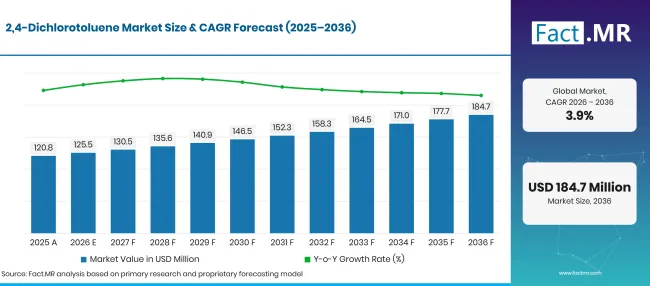
24 Dichlorotoluene Market Forecast Global | Source: Fact.MR
| Year | Basis | Market Value (USD million) |
|---|---|---|
| 2025 | Actual | 120.8 |
| 2026 | Estimate | 125.5 |
| 2036 | Forecast | 184.7 |
| CAGR 2026 to 2036 | Forecast period | 3.9% |
Source: Fact.MR analysis. Updated Nov 4, 2026
What are the defining numbers behind 2,4-Dichlorotoluene Market growth?
The market is forecast to generate USD 59.2 million in value between 2026 and 2036, supported by sales of high-purity grades and chemical intermediates.
- Demand Drivers in the Market
- Chemical synthesis teams need a stable supply of the correct dichlorotoluene isomer. Iharanikkei identifies 2,4-dichlorotoluene as a distinct commercial product under CAS 95-73-8, making precise identification part of material selection [8].
- Research laboratories assess purity and analytical records before buying a reagent.
- Industrial chemical producers schedule purchases of specialized intermediates around production batches and the requirements of subsequent reactions.
- Chemical distributors also review storage and transport requirements when quoting the product.
- Key Segments Analyzed
- By Purity: High Purity accounts for 61.7% of 2026 value as analytical specifications influence reagent selection and quality-sensitive synthesis.
- By Application: Chemical Intermediates lead with 42.3% in 2026, reflecting the use of the compound as a building block in further chemical reactions.
- By End-User Industry: Chemicals represent 42.3% of 2026 value, consistent with industrial use of chlorinated aromatic feedstocks.
- Analyst Opinion at Fact.MR
- Shambhu Nath Jha, Principal Consultant at Fact.MR, states, “Repeat orders for 2,4-dichlorotoluene depend on verified isomer identity and consistent purity. Manufacturers need a grade that fits an established reaction route, together with the batch documents required for quality checks.”
- Strategic Implications
- Manufacturers can explain the production route and identity controls used for the correct isomer so downstream customers can assess the material before approving a new source.
- Laboratory distributors need to keep safety data sheets and certificates of analysis readily available because customers often require both before approving a reagent.
- Chemical processors can schedule repeat deliveries around production timing and the shipping requirements of this specialized aromatic intermediate.
- Suppliers benefit from handling small-pack laboratory orders separately from industrial-volume contracts because packaging, delivery and technical-support needs differ.
The USA is forecast to grow at 4.8% CAGR through 2036, followed by the UK at 4.3% and Germany at 3.8%. Japan is projected at 3.1% and Brazil at 2.8%. These estimates cover the defined 2,4-dichlorotoluene market in each country.
How does the 2,4-Dichlorotoluene Market break down by segment?
High Purity accounts for 61.7%; Chemical Intermediates and Chemicals each account for 42.3% in 2026.
Which Purity category dominates?
High Purity accounts for 61.7% of 2026 value.
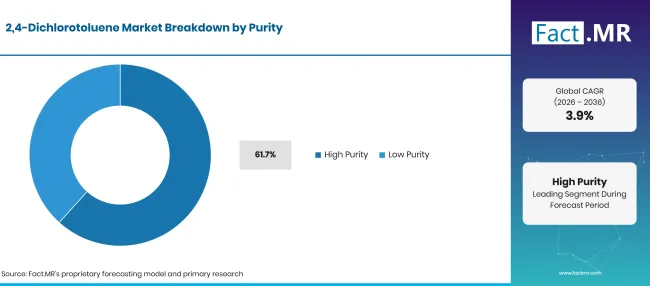
24 Dichlorotoluene Market Breakdown Purity | Source: Fact.MR
| Purity | Share (2026) |
|---|---|
| High Purity (Leading segment) | 61.7% |
| Low Purity | 38.3% |
| Total | 100.0% |
Source: Fact.MR analysis. Updated Nov 4, 2026
High-purity 2,4-dichlorotoluene suits customers who need narrow specifications before synthesis or analytical testing. Laboratory suppliers publish assay information because the grade is part of the purchasing decision. TCI documents an assay above 98.0% by gas chromatography for its D0419 product [5]. Thermo Scientific Chemicals separately lists a 99% grade and identifies the exact CAS number [6]. Lower-purity material serves applications where the process can accommodate different input specifications.
What leads the Application segment?
Chemical Intermediates represent 42.3% of 2026 value.
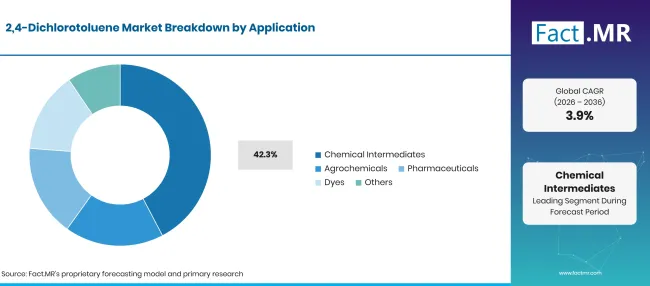
24 Dichlorotoluene Market Breakdown Application | Source: Fact.MR
| Application | Share (2026) |
|---|---|
| Chemical Intermediates (Leading segment) | 42.3% |
| Other applications combined | 57.7% |
| Total | 100.0% |
Source: Fact.MR analysis. Updated Nov 4, 2026
Chemical intermediates are used as building blocks in downstream synthesis where the correct isomer, purity level and batch consistency are important for process reliability. Buyers typically review certificates of analysis, safety documentation and supplier controls before approving a material. Industrial users also consider repeat delivery schedules, packaging requirements and compatibility with existing production steps when selecting a commercial source.
How does End-User Industry shape demand?
Chemicals account for 42.3% of estimated 2026 value.
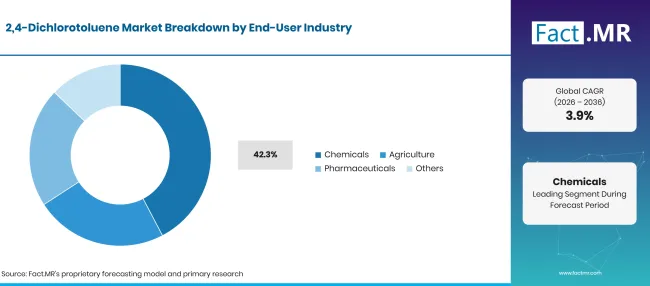
24 Dichlorotoluene Market Breakdown End User Industry | Source: Fact.MR
| End-User Industry | Share (2026) |
|---|---|
| Chemicals (Leading segment) | 42.3% |
| Other industries combined | 57.7% |
| Total | 100.0% |
Source: Fact.MR analysis. Updated Nov 4, 2026
Chemical companies use intermediate grades as feedstocks or research materials in synthesis programs. The commercial discussion normally centers on isomer identity, available volume and quality records. Agriculture refers to chemical production linked to crop-protection supply chains, while pharmaceuticals refers to synthesis and research activities within that industry.
What is accelerating 2,4-Dichlorotoluene Market adoption, and what is holding it back?
Exact isomer identification and dependable purity are expected to support sales, while safety review and input qualification can lengthen purchasing cycles.
Drivers Impact Analysis
| DRIVER | (~) % IMPACT ON CAGR | GEOGRAPHIC RELEVANCE | IMPACT TIMELINE |
|---|---|---|---|
| Quality-controlled intermediate purchasing | +0.8% | USA, Japan, Germany | Short term (≤ 2 years) |
| Demand for higher assay specifications | +0.6% | USA, UK, Japan | Medium term (2–4 years) |
| Access to validated distribution channels | +0.4% | Global | Short term (≤ 2 years) |
| Chemical synthesis research activity | +0.3% | North America, East Asia | Medium term (2–4 years) |
| Industrial intermediate supply planning | +0.2% | Europe, Latin America | Long term (≥ 4 years) |
Source: Fact.MR analysis. Updated Nov 4, 2026
Opportunity Impact Analysis
| OPPORTUNITY | (~) % IMPACT ON CAGR | GEOGRAPHIC RELEVANCE | IMPACT TIMELINE |
|---|---|---|---|
| Traceable high-purity supply | +0.5% | Japan, USA, Germany | Medium term (2–4 years) |
| Documented industrial packaging | +0.4% | Global | Short term (≤ 2 years) |
| Specialty intermediate sourcing | +0.3% | Europe, Asia | Medium term (2–4 years) |
| Laboratory-to-production qualification | +0.2% | Global | Long term (≥ 4 years) |
Source: Fact.MR analysis. Updated Nov 4, 2026
Restraints Impact Analysis
| RESTRAINT | (~) % IMPACT ON CAGR | GEOGRAPHIC RELEVANCE | IMPACT TIMELINE |
|---|---|---|---|
| Chemical handling and compliance costs | −0.5% | Global | Short term (≤ 2 years) |
| Impurity and isomer qualification work | −0.4% | Global | Medium term (2–4 years) |
| Variable industrial plant utilization | −0.3% | Germany, Brazil | Short term (≤ 2 years) |
| Limited product-specific capacity disclosure | −0.2% | Global | Long term (≥ 4 years) |
Source: Fact.MR analysis. Updated Nov 4, 2026
Which countries are scaling the 2,4-Dichlorotoluene Market through 2036?
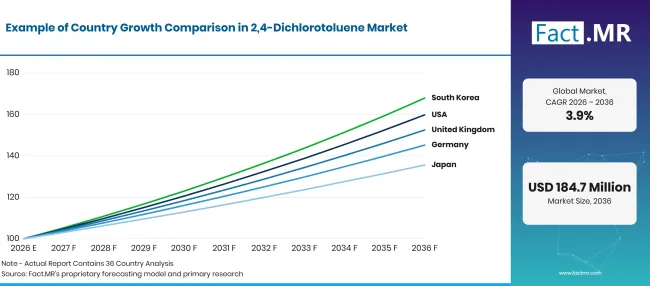
24 Dichlorotoluene Market Growth Index | Source: Fact.MR
| Country | CAGR (2026 to 2036) |
|---|---|
| USA | 4.8% |
| UK | 4.3% |
| Germany | 3.8% |
| Japan | 3.1% |
| Brazil | 2.8% |
Source: Fact.MR analysis. Updated Nov 4, 2026
What supports USA adoption?
4.8% CAGR, linked to chemical synthesis and laboratory sourcing.
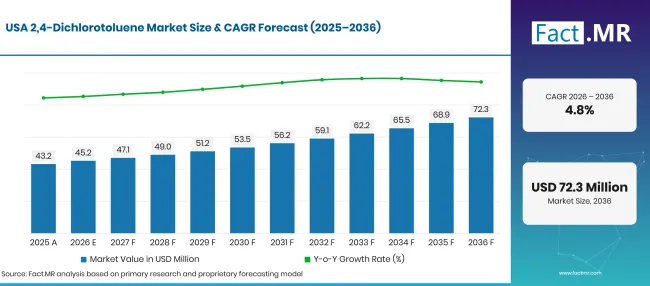
24 Dichlorotoluene Market Forecast Usa | Source: Fact.MR
American chemical manufacturers and research laboratories assess 2,4-dichlorotoluene by its exact isomer identity before placing an order. The USA is forecast to record 4.8% CAGR through 2036. buyers value documented purity because even closely related chlorinated compounds may follow different synthesis routes. Thermo Scientific Chemicals lists a 99% grade under CAS 95-73-8, giving laboratories a clear technical point of comparison. The U.S. Bureau of Labor Statistics publishes chemical-manufacturing price indices that help purchasers review changing input costs [1].
What supports UK adoption?
4.3% CAGR, associated with specialized chemical buying and distribution.
Chemical laboratories in the United Kingdom commonly need defined grades for reaction testing and repeat experiments. The UK market is projected to expand at 4.3% CAGR between 2026 and 2036. accessible laboratory distribution gives customers a practical way to compare certificates and pack sizes before considering larger purchases. In July 2026, the Office for National Statistics reported that UK manufacturers sold GBP 452.0 billion of products during 2025 [4].
What supports Germany adoption?
3.8% CAGR, shaped by chemical production standards and industrial sourcing.
Germany has an established chemical manufacturing base where specialty intermediates are selected against clear technical requirements. Its 2,4-dichlorotoluene market is estimated to register 3.8% CAGR through 2036. consistent purity and reliable production scheduling support repeat orders from chemical synthesis teams. The German Chemical Industry Association reported in March 2026 that chemical plant capacity utilization averaged 72.5% in 2025 [2].
What supports Japan adoption?
3.1% CAGR, influenced by precise intermediate grades and local supplier networks.
Japanese chemical firms can source the target compound through named domestic catalog and industrial channels. Japan is anticipated to register 3.1% CAGR in the 2,4-dichlorotoluene market through 2036. the local availability of a clearly identified 2,4-isomer helps laboratories compare technical requirements and order quantities. Tokyo Chemical Industry lists 2,4-dichlorotoluene as product D0419 with purity above 98.0% by gas chromatography. The Ministry of Economy, Trade and Industry published its 2025 Current Survey of Production yearbook in June 2026 [7].
What supports Brazil adoption?
2.8% CAGR, tied to chemical intermediate supply and import competition.
Brazilian chemical processors consider the availability and delivered cost of specialized aromatic intermediates when planning synthesis work. The country is forecast to post 2.8% CAGR between 2026 and 2036. import arrangements and clear documentation influence the timing of orders for specific chemical isomers. The Brazilian Institute of Geography and Statistics reported in February 2026 that national industrial production grew 0.6% during 2025 [3].
Who leads the 2,4-Dichlorotoluene Market?
Verified supplier records identify several ways to obtain 2,4-dichlorotoluene.
Thermo Fisher Scientific supplies a 99% laboratory grade, while TCI lists material above 98.0% GC purity. Sigma-Aldrich documents the compound under product 145009. Kumiai identifies it within an industrial product portfolio and directs chlorotoluene inquiries to Iharanikkei.
Which companies are the key providers?
Key companies include Thermo Fisher Scientific Inc.; Tokyo Chemical Industry Co., Ltd. (TCI); Kumiai Chemical Industry Co., Ltd. / Iharanikkei Chemical Industry Co., Ltd.; and Merck KGaA (Sigma-Aldrich).
- Thermo Fisher Scientific Inc.
- Tokyo Chemical Industry Co., Ltd. (TCI)
- Kumiai Chemical Industry Co., Ltd. / Iharanikkei Chemical Industry Co., Ltd.
- Merck KGaA (Sigma-Aldrich)
Bibliography
- [1] U.S. Bureau of Labor Statistics. (2026). Recent price trends in the chemicals industry: An overview of chemical manufacturing price indexes.
- [2] Verband der Chemischen Industrie. (2026, March 13). Chemical industry still in trouble.
- [3] Instituto Brasileiro de Geografia e Estatística. (2026, February 3). Produção industrial recua 1,2% em dezembro.
- [4] Office for National Statistics. (2026, July 24). UK manufacturers’ sales by product: 2025.
- [5] Tokyo Chemical Industry. (n.d.). 2,4-Dichlorotoluene (Product No. D0419).
- [6] Thermo Fisher Scientific. (n.d.). 2,4-Dichlorotoluene, 99% (Catalog No. AC163282500).
- [7] Ministry of Economy, Trade and Industry. (2026, June 30). Current Survey of Production: 2025 yearbook.
- [8] Iharanikkei Chemical Industry Co., Ltd. (n.d.). Product list: Chlorotoluenes.
This Report Answers
- How the purity of 2,4-dichlorotoluene affects material selection for research and industrial synthesis.
- How chemical intermediate use differs from agrochemical and pharmaceutical application classifications.
- How laboratory catalogs and industrial product portfolios differ as customer supply channels.
- Why exact CAS identification and quality records influence supplier qualification.
- How country-level chemical industry conditions shape purchasing context without establishing compound-specific volumes.
What does the 2,4-Dichlorotoluene Market cover?
The market covers commercial purchases of the specific chlorinated aromatic compound 2,4-dichlorotoluene under CAS 95-73-8. It includes grades sold for chemical synthesis and laboratory use. Both high-purity and lower-purity categories are counted under the approved segmentation.
What is included in the scope?
Sales of the named compound for chemical intermediates and the listed downstream application categories fall within scope.
Industrial supply arrangements and small-container reagent distribution are included when the underlying product has the correct chemical identity.
What is excluded in the scope?
Other dichlorotoluene isomers fall outside the market boundary because the analysis is limited to 2,4-dichlorotoluene under CAS 95-73-8.
Finished agrochemical, pharmaceutical and dye products are excluded because the market counts the intermediate itself rather than downstream product value.
Other chlorinated aromatics, unrelated laboratory reagents and chemical products without the specified 2,4-dichlorotoluene identity are also excluded. Equipment used to manufacture or analyze the compound is outside the defined market.
How Was the Analysis Built?
The analysis draws on 120+ sources, 35+ company portfolios, 25+ countries, and more than 20 industry interviews.
- Primary Research: Primary research includes discussions with manufacturers, service providers, technology developers, distributors, end users, and subject-matter experts. These conversations examine purchasing priorities, product adoption, operational challenges, approval requirements, competitive positioning, and the factors that influence wider market acceptance.
- Desk Research: Desk research covers government statistics, regulatory publications, company filings, trade data, technical studies, industry associations, standards, public policy, and other authoritative sources. Every source used in the analysis is documented in the bibliography.
- Market Sizing and Forecasting: Market estimates combine historical performance, demand indicators, pricing and volume trends, segment shares, company participation, country-level growth, adoption patterns, investment activity, and barriers to market expansion.
- Data Validation and Update Cycle: Findings are validated by comparing primary interviews with public data, company activity, regulatory changes, trade patterns, and industry developments. Regular updates review new product launches, capacity changes, partnerships, approvals, and shifts in commercial adoption.
Segmentation
What is the report’s scope and coverage?
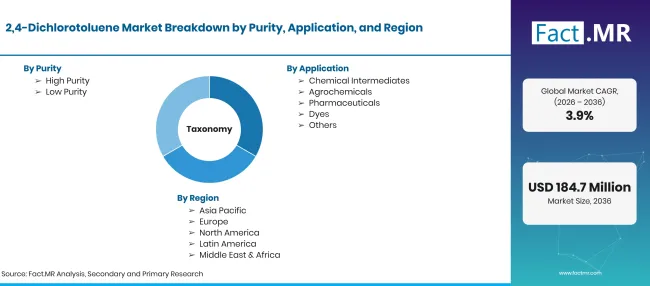
24 Dichlorotoluene Market Taxonomy | Source: Fact.MR
| Attribute | Details |
|---|---|
| Quantitative Units | USD million |
| Market Definition | 2,4-Dichlorotoluene, CAS 95-73-8, counted as a chemical input or reagent; unrelated dichlorotoluene isomers excluded |
| Purity | High Purity; Low Purity |
| Application | Chemical Intermediates; Agrochemicals; Pharmaceuticals; Dyes; Others |
| End-User Industry | Chemicals; Agriculture; Pharmaceuticals; Others |
| Regions Covered | North America; Latin America; Western Europe; Eastern Europe; East Asia; South Asia & Pacific; Middle East & Africa |
| Countries Covered | USA; UK; Germany; Japan; Brazil |
| Companies Profiled | Thermo Fisher Scientific Inc.; Tokyo Chemical Industry Co., Ltd. (TCI); Kumiai Chemical Industry Co., Ltd. / Iharanikkei Chemical Industry Co., Ltd.; and Merck KGaA (Sigma-Aldrich) |
| Forecast Period | 2026 to 2036 |
| Approach | Market forecast and segmentation assessment informed by first-party chemical product records and official industrial statistics |
Source: Fact.MR analysis. Updated Nov 4, 2026
How is the market segmented?
-
By Purity
- High Purity
- Low Purity
-
By Application
- Chemical Intermediates
- Agrochemicals
- Pharmaceuticals
- Dyes
- Others
-
By End-User Industry
- Chemicals
- Agriculture
- Pharmaceuticals
- Others
-
By Region
- North America
- Latin America
- Western Europe
- Eastern Europe
- East Asia
- South Asia & Pacific
- Middle East & Africa
Frequently Asked Questions
How big is the 2,4-dichlorotoluene market in 2026?
What is the CAGR for 2026 to 2036?
Which purity category has the greater share?
Which application accounts for the largest share?
Which companies offer the exact compound?
Who worked on this report


Preview the report firsthand - request a free sample
Free SampleGet the brochure for pricing and purchase details
Download PDF