- Market Value (2025): USD 1.24 Bn
- Estimated Value (2026): USD 1.33 Bn
- Forecast Value (2036): USD 2.6 Bn
- CAGR (2026-2036): 6.9%
What is the HEPA (High Efficiency Particulate Air) Vacuum Filters Market forecast to be worth by 2036?
USD 1.3 billion in 2026 to USD 2.6 billion by 2036 at a 6.9% CAGR.
- According to Fact.MR analysis, the HEPA vacuum filters market was valued at USD 1.24 billion in 2025.
- Demand is projected to reach from USD 1.33 billion in 2026 to USD 2.6 billion in 2036 as commercial cleaning and industrial dust control sustain filter replacement cycles.
- The market is projected to grow at a 6.9% CAGR from 2026 to 2036, across professional and residential vacuum filter applications.
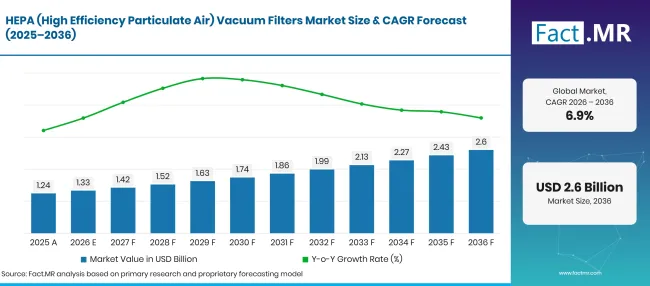
Hepa High Efficiency Particulate Air Vacuum Filters Market Forecast Global | Source: Fact.MR
| Year | Basis | Market Value (USD billion) |
|---|---|---|
| 2025 | Actual | 1.24 |
| 2026 | Estimate | 1.33 |
| 2036 | Forecast | 2.6 |
| CAGR 2026 to 2036 | Forecast period | 6.9% |
Source: Fact.MR analysis. Updated Nov 4, 2026
What are the defining numbers behind HEPA (High Efficiency Particulate Air) Vacuum Filters Market growth?
This represents USD 1.3 billion in additional market value between 2026 and 2036.
- Demand Drivers in the Market
- Commercial cleaners need filters compatible with their machines and cleaning schedules. Replacing a saturated element helps maintain performance and helps control fine dust during repeated building-cleaning assignments.
- Lead-safe renovation work creates a specific professional use case. A January 2026 U.S. Environmental Protection Agency guidance document defines a HEPA vacuum as a machine whose final-stage filter captures 99.97% of particles at 0.3 microns and whose design directs all exhaust air through that filter [1].
- Industrial maintenance teams rely on dust extraction around machinery, fabrication areas and sensitive workstations. Because dust loads differ between sites, buyers review cartridge size, airflow requirements and fit with the installed machine before deciding how many replacements to keep in stock.
- Key Segments Analyzed
- By Type: HEPA/ULPA filters account for 38.5% of 2026 market value because sealed fine-particle exhaust is central to the product category, as also discussed under industrial filtration.
- By Application: Commercial cleaning represents 37.1% of 2026 value as janitorial teams maintain vacuum fleets across multiple facilities.
- Analyst Opinion at Fact.MR
- Shambhu Nath Jha, Principal Consultant at Fact.MR, states, “A replacement filter must function within the vacuum system for which it was designed. Even a high-efficiency element cannot deliver the intended exhaust performance when air bypasses the seal.”
- Strategic Implications
- Vacuum manufacturers should publish filter part numbers and supported machine models so service teams can order compatible replacements without trial fitting, as also discussed under dust collector systems.
- Filter manufacturers need to control cartridge dimensions and seal quality because small gaps can allow dust to bypass the intended filtration path. These details affect performance after the filter is fitted into a vacuum, not just its laboratory rating.
- Cleaning contractors can reduce interruptions by checking filter condition and scheduling replacements around site workloads and the equipment maker’s maintenance instructions.
- Distributors supplying professional cleaning fleets can support repeat orders by stocking the correct original cartridges for widely used machines. Clear model references help maintenance staff identify the right replacement without unnecessary trial fitting.
Germany is forecast to grow at 8.2% CAGR through 2036, followed by Brazil at 7.5%. The USA is projected at 6.8%, the UK at 6.0% and Japan at 5.3%. The differences reflect local cleaning requirements, industrial equipment use and access to replacement filters.
How does the HEPA (High Efficiency Particulate Air) Vacuum Filters Market break down by segment?
HEPA/ULPA holds 38.5% of Type value, while commercial cleaning represents 37.1% of Application value in 2026.
Which Type holds the largest share?
HEPA/ULPA accounts for 38.5% in 2026.
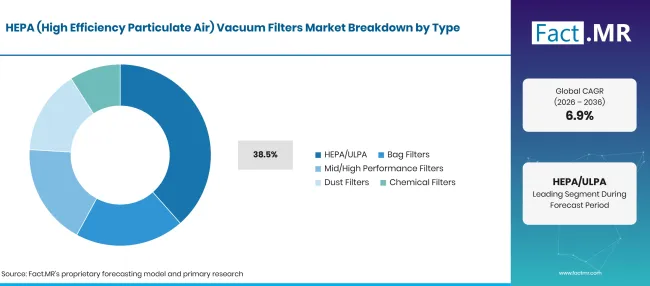
Hepa High Efficiency Particulate Air Vacuum Filters Market Breakdown Type | Source: Fact.MR
| Type | Share (2026) |
|---|---|
| HEPA/ULPA (Leading segment) | 38.5% |
| Other types combined | 61.5% |
| Total | 100.0% |
Source: Fact.MR analysis. Updated Nov 4, 2026
HEPA and ULPA elements occupy the specialized end of vacuum filtration, where fine-particle retention is a design objective. A machine must direct exhausted air through its intended filtration path to achieve suitable system performance. Bag filters collect bulk debris before it reaches downstream components. Mid/high performance filters serve equipment whose duty cycle and dust profile do not call for the same final-stage specification. Dust filters handle routine particles, while chemical filters address selected gases or odors where the vacuum design supports that function.
How does Application shape purchases?
Commercial cleaning leads with 37.1% in 2026.
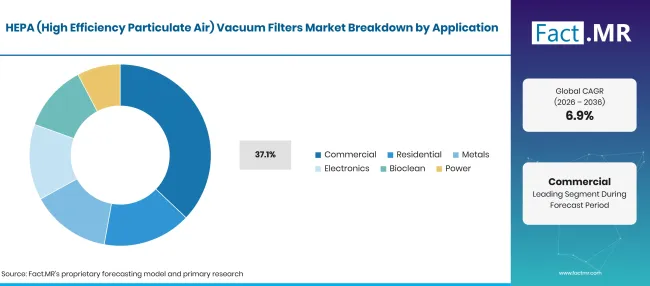
Hepa High Efficiency Particulate Air Vacuum Filters Market Breakdown Application | Source: Fact.MR
| Application | Share (2026) |
|---|---|
| Commercial (Leading segment) | 37.1% |
| Other applications combined | 62.9% |
| Total | 100.0% |
Source: Fact.MR analysis. Updated Nov 4, 2026
Cleaning service operators generally purchase filters through repeat maintenance orders, while households often replace cartridges less frequently. Commercial buyers pay attention to service intervals because an idle machine interrupts scheduled work. Residential demand depends on compatible vacuum ownership and access to replacement parts. Metals facilities prioritize collection of process dust. Electronics sites pay close attention to particles around sensitive work, and bioclean areas typically require documented cleaning methods. Power installations have site-specific maintenance needs.
What is accelerating HEPA (High Efficiency Particulate Air) Vacuum Filters Market adoption, and what is holding it back?
Workplace dust control supports demand; sealed-system performance and replacement cost shape purchasing decisions.
Drivers Impact Analysis
| DRIVER | (~) % IMPACT ON CAGR | GEOGRAPHIC RELEVANCE | IMPACT TIMELINE |
|---|---|---|---|
| Professional cleaning fleet replacements | +1.1% | Europe, North America | Short term |
| Fine-dust management at work sites | +0.9% | Global | Medium term |
| Machine-specific HEPA replacement needs | +0.7% | Global | Short term |
| Industrial cleaning schedules | +0.6% | Germany, Japan, USA | Medium term |
| Portable professional vacuum offerings | +0.4% | Global | Long term |
Source: Fact.MR analysis. Updated Nov 4, 2026
Opportunity Impact Analysis
| OPPORTUNITY | (~) % IMPACT ON CAGR | GEOGRAPHIC RELEVANCE | IMPACT TIMELINE |
|---|---|---|---|
| Original replacement filter programs | +0.7% | Global | Short term |
| Commercial cordless cleaning | +0.5% | Europe, North America | Medium term |
| Filter maintenance services | +0.3% | Global | Medium term |
Source: Fact.MR analysis. Updated Nov 4, 2026
Restraints Impact Analysis
| RESTRAINT | (~) % IMPACT ON CAGR | GEOGRAPHIC RELEVANCE | IMPACT TIMELINE |
|---|---|---|---|
| Cartridge and housing compatibility | -0.6% | Global | Short term |
| Higher cost of certified assemblies | -0.5% | Global | Medium term |
| Variable construction workload | -0.3% | Europe, USA | Short term |
Source: Fact.MR analysis. Updated Nov 4, 2026
Which countries are scaling the HEPA (High Efficiency Particulate Air) Vacuum Filters Market through 2036?
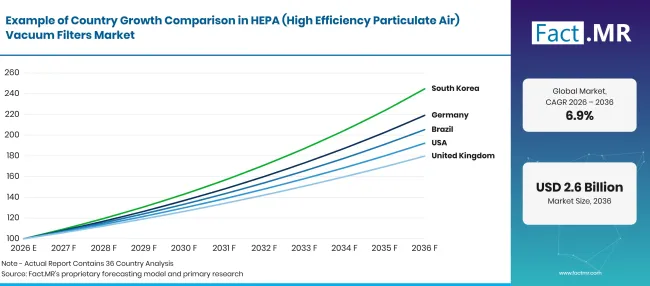
Hepa High Efficiency Particulate Air Vacuum Filters Market Growth Index | Source: Fact.MR
| Country | CAGR (2026 to 2036) |
|---|---|
| Germany | 8.2% |
| Brazil | 7.5% |
| USA | 6.8% |
| UK | 6.0% |
| Japan | 5.3% |
Source: Fact.MR analysis. Updated Nov 4, 2026
What supports Germany’s adoption?
8.2% CAGR, reflecting professional cleaning and industrial filtration requirements.
German demand is tied to professional cleaning, construction work and industrial maintenance where fine dust needs controlled extraction. Destatis reported EUR 120.5 billion in main construction turnover in 2025 [2]. Contractors operating established vacuum fleets also create repeat demand for compatible replacement cartridges, while mixed equipment brands can increase inventory requirements for dealers.
How is Brazil developing demand?
7.5% CAGR, associated with commercial maintenance and replacement-filter distribution.
Brazilian demand comes from commercial cleaning contractors and service companies maintaining vacuum equipment across offices and public buildings. IBGE reported that maintenance, repair and installation of machinery and equipment output increased 9.6% in 2025 [4]. Replacement activity remains important because contractors often compare filter costs with the expense of replacing complete vacuum systems.
What is supporting United States adoption?
6.8% CAGR, supported by renovation cleaning and recurring service demand.
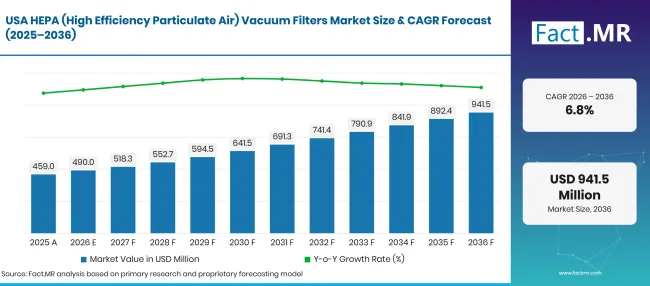
Hepa High Efficiency Particulate Air Vacuum Filters Market Forecast Usa | Source: Fact.MR
U.S. contractors use HEPA-filtered vacuum systems for fine-dust work during construction, renovation and professional cleaning. OSHA guidance on silica control reinforces the need for suitable filter maintenance and correct machine setup [5]. Demand also comes from service teams managing mixed equipment fleets, where clearly identified replacement cartridges can reduce compatibility errors and support repeat purchases.
How is the United Kingdom developing demand?
6.0% CAGR, linked to contractor cleaning fleets and industrial service work.
UK professional cleaners and renovation contractors rely on portable vacuum systems across offices, occupied buildings and construction sites. Replacement demand is shaped by filter compatibility and the need to keep existing machines operating between projects. ONS reported a 1.0% decline in construction output in the three months to August 2026 [3], which can influence the timing of new equipment purchases.
How is Japan scaling demand?
5.3% CAGR, tied to disciplined maintenance across commercial and industrial premises.
Japanese facilities teams and specialist contractors place emphasis on correct filter fit and dependable replacement supply. The Ministry of Land, Infrastructure, Transport and Tourism reported that orders from major construction firms rose 12.0% in fiscal 2025 [6]. Routine servicing of long-life vacuum systems supports recurring cartridge demand even when complete equipment replacement occurs gradually.
Who leads the HEPA (High Efficiency Particulate Air) Vacuum Filters Market?
Vacuum equipment brands compete through system specifications and replacement filter availability. Nilfisk and Kärcher sell professional cleaning equipment with HEPA options.
Makita and DEWALT serve tool-linked dust extraction and mobile workplace cleaning, while Festool is associated with workshop extraction. RIDGID supplies HEPA filter kits designed for specific wet/dry vacuum models. Freudenberg Filtration Technologies has wider filtration portfolios, although a broad filtration presence.
Which companies are the key providers?
Key companies include Freudenberg Filtration Technologies; Nilfisk A/S; Alfred Kärcher SE & Co. KG; Festool GmbH; Makita Corporation; Stanley Black & Decker, Inc. (DEWALT); RIDGID.
- Freudenberg Filtration Technologies
- Nilfisk A/S
- Alfred Kärcher SE & Co. KG
- Festool GmbH
- Makita Corporation
- Stanley Black & Decker, Inc. (DEWALT)
- RIDGID
Bibliography
- [1] U.S. Environmental Protection Agency. (2026, January 12). EPA Lead-Based Paint Program frequent questions.
- [2] Statistisches Bundesamt (Destatis). (2026, February 25). Auftragseingang im Bauhauptgewerbe 2025 um 6,8 % höher als im Vorjahr.
- [3] Office for National Statistics. (2026, October 15). Construction output in Great Britain: August 2026.
- [4] Instituto Brasileiro de Geografia e Estatística. (2026, February 3). Produção industrial recua 1,2% em dezembro.
- [5] Occupational Safety and Health Administration. (n.d.). Occupational exposure to respirable crystalline silica, 29 C.F.R. § 1926.1153: Frequently asked questions for the construction industry.
- [6] Ministry of Land, Infrastructure, Transport and Tourism. (2026, April 30). 令和7年度の建設工事受注動態統計調査(大手50社調査)結果 [FY2025 construction contract survey results for 50 major firms].
This Report Answers
- The report compares fine-particle HEPA/ULPA filters with other vacuum filter types used in commercial and industrial machines.
- The application review explains how commercial maintenance differs from residential cleaning and specialized worksite extraction.
- Country outlooks consider cleaning practices and equipment servicing in Germany, Brazil, the USA, the UK and Japan.
- Competitive coverage examines equipment makers and filter portfolios without attributing unsupported company market shares.
What does the HEPA (High Efficiency Particulate Air) Vacuum Filters Market cover?
Coverage includes replaceable vacuum filters used to collect dust or filter exhaust in consumer and professional machines.
What is included in the scope?
HEPA/ULPA cartridges, filter bags and other listed filter types are included when sold for use in vacuum equipment.
Replacement purchases and elements installed in new qualifying machines form the relevant demand streams.
What is excluded from the scope?
Standalone room air purifiers, building HVAC filters and general ventilation systems are excluded unless a filter is specifically sold for vacuum equipment.
Whole-vacuum revenue and unrelated personal protective equipment are not included.
How Was the Analysis Built?
The analysis draws on 120+ sources, 35+ company portfolios, 25+ countries, and more than 20 industry interviews.
- Primary Research: Primary research includes discussions with manufacturers, service providers, technology developers, distributors, end users, and subject-matter experts. These conversations examine purchasing priorities, product adoption, operational challenges, approval requirements, competitive positioning, and the factors that influence wider market acceptance.
- Desk Research: Desk research covers government statistics, regulatory publications, company filings, trade data, technical studies, industry associations, standards, public policy, and other authoritative sources. Every source used in the analysis is documented in the bibliography.
- Market Sizing and Forecasting: Market estimates combine historical performance, demand indicators, pricing and volume trends, segment shares, company participation, country-level growth, adoption patterns, investment activity, and barriers to market expansion.
- Data Validation and Update Cycle: Findings are validated by comparing primary interviews with public data, company activity, regulatory changes, trade patterns, and industry developments. Regular updates review new product launches, capacity changes, partnerships, approvals, and shifts in commercial adoption.
Segmentation
What is the report’s scope and coverage?
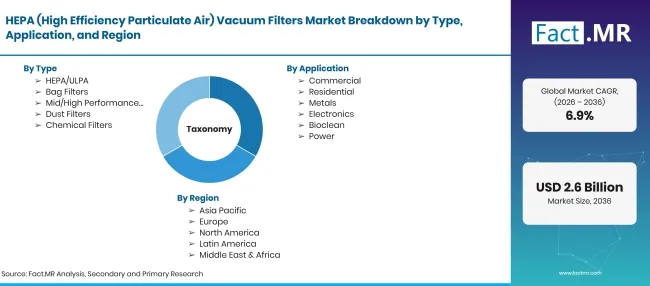
Hepa High Efficiency Particulate Air Vacuum Filters Market Taxonomy | Source: Fact.MR
| Attribute | Details |
|---|---|
| Quantitative units | USD billion |
| Market definition | Replaceable vacuum filters designed for particulate collection and exhaust filtration, including machine-specific HEPA/ULPA components. |
| Type | HEPA/ULPA; Bag Filters; Mid/High Performance Filters; Dust Filters; Chemical Filters |
| Application | Commercial; Residential; Metals; Electronics; Bioclean; Power |
| Regions covered | North America; Latin America; Western Europe; Eastern Europe; East Asia; South Asia & Pacific; Middle East & Africa |
| Countries covered | Germany; Brazil; USA; UK; Japan |
| Forecast period | 2026 to 2036 |
| Companies profiled | Freudenberg Filtration Technologies; Nilfisk A/S; Alfred Kärcher SE & Co. KG; Festool GmbH; Makita Corporation; Stanley Black & Decker, Inc. (DEWALT); RIDGID |
| Approach | Filter demand examined by installed vacuum fleet, compatibility, replacement frequency and cleaning application |
Source: Fact.MR analysis. Updated Nov 4, 2026
How is the market segmented?
-
By Type
- HEPA/ULPA
- Bag Filters
- Mid/High Performance Filters
- Dust Filters
- Chemical Filters
-
By Application
- Commercial
- Residential
- Metals
- Electronics
- Bioclean
- Power
-
By Region
- North America
- Latin America
- Western Europe
- Eastern Europe
- East Asia
- South Asia & Pacific
- Middle East & Africa
Frequently Asked Questions
How big is the HEPA vacuum filters market in 2026?
What is the forecast CAGR through 2036?
Which filter type has the greatest market share?
Which application accounts for the greatest share?
Which companies are included?
Who worked on this report


Preview the report firsthand - request a free sample
Free SampleGet the brochure for pricing and purchase details
Download PDF