- Base Value(2025): 720.00 Mn
- Estimated Value(2026): 789.8 Mn
- Forecast Value (2036): 1993.5 Mn
- CAGR (2026 - 2036): 9.7%
Gallium Oxide Market Size, Market Forecast and Outlook By Fact.MR
The gallium oxide market was valued at USD 720.00 million in 2025, projected to reach USD 789.84 million in 2026, and is forecast to expand to USD 1993.45 million by 2036 at a 9.7% CAGR. is emerging as the next frontier in wide-bandgap semiconductor materials, where beta-phase Ga2O3 substrates with a 4.8 eV bandgap offer theoretical performance advantages over silicon carbide in high-voltage power switching applications, attracting R&D investment from defence agencies and power electronics companies positioning for the post-SiC technology generation.
The absolute dollar expansion between 2026 and 2036 amounts to approximately USD 1,203.61 million. Growth reflects the transition of Ga2O3 from laboratory-scale crystal growth to early commercial substrate and device production. The material's ultra-wide bandgap (4.8 eV versus 3.3 eV for SiC) enables theoretical breakdown voltages exceeding 8 MV/cm, positioning it for high-voltage power electronics in grid infrastructure, EV fast charging, and military power systems. Limited substrate availability, high defect density, and thermal management challenges act as adoption constraints.
Power electronics device engineers at defence contractors and grid equipment manufacturers are evaluating beta-Ga2O3 Schottky diodes and MOSFETs for applications above 1,200 V where SiC device performance approaches theoretical limits. Substrate suppliers unable to deliver 2-inch Ga2O3 wafers with edge dislocation density below 10^4 cm-2 face qualification delays at device fabrication facilities.
All major regional markets reflect differentiated growth parameters. USA sets the pace at 11.2% CAGR. Mexico registers at 10.5% CAGR. Germany registers at 9.6% CAGR. France registers at 9.4% CAGR. UK registers at 9.3% CAGR. South Korea registers at 9.1% CAGR. Japan registers at 8.9% CAGR.
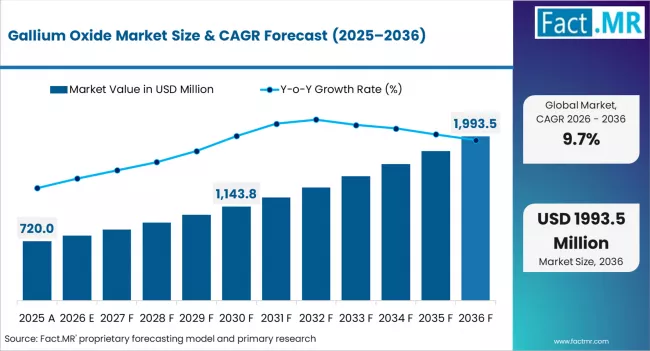
Gallium Oxide Market Market Value Analysis | Source: Fact.MR
Gallium Oxide Market Key Takeaways
| Metric | Details |
|---|---|
| Industry Size (2026) | USD 789.84 million |
| Industry Value (2036) | USD 1993.45 million |
| CAGR (2026 to 2036) | 9.7% |
Source: Fact.MR analysis. Updated Mar 24, 2026
Gallium Oxide Market Definition
Gallium oxide (Ga2O3) is a ultra-wide-bandgap semiconductor material with five polymorphs, of which the beta phase (monoclinic) is thermodynamically stable and commercially relevant. Beta-Ga2O3 has a bandgap of 4.8 eV, the widest among commercially developed semiconductor materials, enabling high breakdown voltage, low on-resistance power devices. Unlike SiC and GaN, Ga2O3 single crystals can be grown from melt using Czochralski, edge-defined film-fed growth (EFG), and floating zone methods, potentially enabling lower substrate costs at scale.
Gallium Oxide Market Inclusions
Market scope covers global and regional revenue for gallium oxide across powders and substrates, epitaxial wafers, and other forms. Application segments include power electronics, RF/5G devices, and optoelectronics. End-user segments span semiconductor fabs, research and labs, and others. The forecast period is 2026 to 2036.
Gallium Oxide Market Exclusions
The scope excludes gallium metal and gallium arsenide (GaAs) substrates. Gallium nitride (GaN) materials and devices are excluded. Gallium oxide used as a catalyst or optical coating material without semiconductor function falls outside the boundary.
Gallium Oxide Market Research Methodology
- Primary Research: Analysts engaged with procurement specialists, process engineers, and supply chain directors across producing and consuming regions to map the specific decision criteria triggering purchasing and specification changes.
- Desk Research: Data collection aggregated regulatory filings, trade body publications, standards body documentation, and company disclosures relevant to the product category.
- Market-Sizing and Forecasting: Baseline values derive from a bottom-up aggregation of production volumes and trade flows, applying region-specific demand curves to project adoption velocity through 2036.
- Data Validation and Update Cycle: Projections are tested against publicly reported industry expenditure guidance and cross-referenced with primary interview data to ensure internal consistency.
Summary of Gallium Oxide Market
- Gallium Oxide Market Definition
- Gallium oxide (Ga2O3) is a ultra-wide-bandgap semiconductor material with five polymorphs, of which the beta phase (monoclinic) is thermodynamically stable and commercially relevant. Beta-Ga2O3 has a bandgap of 4.8 eV, the widest among commercially developed semiconductor materials, enabling high breakdown voltage, low on-resistance power devices.
- Demand Drivers in the Market
- U.S. DARPA and DOE R&D investment: The U.S.
- EV fast charging voltage escalation: 800V and 1,200V EV architectures from Porsche (Taycan), Hyundai (E-GMP), and GM (Ultium) require power switching devices rated above 1,200V.
- Melt-growth cost advantage potential: Ga2O3 crystals grown by EFG at Tamura Corporation and Novel Crystal Technology demonstrate the potential for 4 to 6 inch diameter substrates at production costs 30% to 50% below equivalent SiC substrates.
- Key Segments Analyzed in the Fact.MR Report
- Powders & Substrates form: 54.0% share in 2026.
- Power Electronics application: 46.0% share in 2026.
- USA: 11.2% compound growth through 2036.
- Analyst Opinion at Fact.MR
- The fundamental advantage is melt-growth capability. SiC substrates must be grown by sublimation (PVT) at 2,200 degrees C, limiting crystal size and driving costs of USD 800 to 1,500 per 150 mm wafer. Ga2O3 can be grown from melt at 1,800 degrees C using Czochralski and EFG methods that are scalable to larger diameters at lower energy cost. Novel Crystal Technology (Japan) and Kyma Technologies (USA) are the leading Ga2O3 substrate producers, supplying 10 mm to 2-inch wafers to device R&D programmes.
- Strategic Implications / Executive Takeaways
- Procurement teams must establish multi-year supply agreements with qualified producers to secure allocation ahead of anticipated demand increases.
- Product development resources should prioritize formulations that meet tightening regulatory specifications in key markets.
- Regional expansion strategies must account for divergent growth rates and regulatory environments across major consuming nations.
Gallium Oxide Market Definition
Gallium oxide (Ga2O3) is a ultra-wide-bandgap semiconductor material with five polymorphs, of which the beta phase (monoclinic) is thermodynamically stable and commercially relevant. Beta-Ga2O3 has a bandgap of 4.8 eV, the widest among commercially developed semiconductor materials, enabling high breakdown voltage, low on-resistance power devices. Unlike SiC and GaN, Ga2O3 single crystals can be grown from melt using Czochralski, edge-defined film-fed growth (EFG), and floating zone methods, potentially enabling lower substrate costs at scale.
Gallium Oxide Market Inclusions
Market scope covers global and regional revenue for gallium oxide across powders and substrates, epitaxial wafers, and other forms. Application segments include power electronics, RF/5G devices, and optoelectronics. End-user segments span semiconductor fabs, research and labs, and others. The forecast period is 2026 to 2036.
Gallium Oxide Market Exclusions
The scope excludes gallium metal and gallium arsenide (GaAs) substrates. Gallium nitride (GaN) materials and devices are excluded. Gallium oxide used as a catalyst or optical coating material without semiconductor function falls outside the boundary.
Gallium Oxide Market Research Methodology
- Primary Research: Structured interviews with category procurement managers, production engineers, and regulatory affairs specialists provided first-hand insight into purchasing decision frameworks and specification evolution.
- Desk Research: Systematic review of government regulatory databases, standards body publications, trade association reports, and company investor presentations formed the secondary data foundation.
- Market-Sizing and Forecasting: A hybrid top-down and bottom-up approach reconciles production capacity data with trade flow analysis and end-use consumption modelling across all covered regions.
- Data Validation and Update Cycle: All forecast outputs undergo cross-validation against primary interview findings and quarterly industry data releases to maintain projection accuracy.
Gallium Oxide Market Analysis by Form
Based on Fact.MR's gallium oxide market report, consumption of Powders and Substrates is estimated to hold 54.0% share in 2026. This form dominates because the current market is substrate-supply-driven, with single-crystal Ga2O3 wafers serving as the foundational material for all epitaxial growth and device fabrication activities at semiconductor research facilities and early-stage device producers.
- Substrate crystal growth progress: Novel Crystal Technology (Japan) produces beta-Ga2O3 substrates up to 2 inches in diameter by EFG method, with commercial availability of 10 x 15 mm substrates and custom larger formats. Tamura Corporation operates parallel Ga2O3 crystal growth programmes targeting 4-inch diameter capability [1].
- Powder for ceramic and phosphor applications: Ga2O3 powder (99.99% purity) serves as a precursor for transparent conductive oxide deposition, ceramic sintering, and phosphor host material in scintillator and UV detection applications. Sumitomo Metal Mining and Materion Corporation supply high-purity Ga2O3 powder to electronics and optics manufacturers [2].
- Research substrate demand: University and national laboratory Ga2O3 device research programmes consume the majority of current substrate production. AFRL (Air Force Research Laboratory), NREL, and multiple Japanese and German university groups operate Ga2O3 device fabrication capabilities that require a continuous supply of characterized substrate material [3].
Gallium Oxide Market Analysis by Application
As per Fact.MR's analysis, Power Electronics accounts for 46.0% of gallium oxide market share in 2026. Power electronics leadership reflects the primary commercial motivation for Ga2O3 development: achieving higher breakdown voltage, lower on-resistance power switching devices that outperform SiC in applications above 1,200V where SiC approaches its material limits.
- High-voltage device prototyping: Beta-Ga2O3 vertical Schottky barrier diodes with breakdown voltages exceeding 2,600V have been demonstrated at AFRL and Kyma Technologies. These prototype devices validate the theoretical voltage handling advantage of the 4.8 eV bandgap and establish the performance benchmarks that justify continued R&D investment [4].
- Grid power conversion potential: Medium-voltage grid power converters operating at 3.3 kV to 15 kV currently use series-stacked silicon IGBTs. Ga2O3 devices rated above 3,000V could replace these series-stacked configurations with single-device solutions, reducing power conversion system complexity and loss by 30% to 40% [5].
- Defence power systems: Military vehicle electrification and directed energy weapon programmes require compact, high-efficiency power conversion at voltages above 1,500V. The U.S. Army Research Laboratory funds Ga2O3 device development for pulsed power and power conditioning applications where device voltage rating directly determines system power density [6].
Gallium Oxide Market Drivers, Restraints, and Opportunities
Fact.MR analysis indicates the gallium oxide market is at the earliest stage of commercial development among wide-bandgap semiconductor materials. While SiC and GaN have achieved multi-billion-dollar commercial markets, Ga2O3 is transitioning from academic research to pilot-scale device demonstration, with commercial device availability expected between 2027 and 2030.
The fundamental advantage is melt-growth capability. SiC substrates must be grown by sublimation (PVT) at 2,200 degrees C, limiting crystal size and driving costs of USD 800 to 1,500 per 150 mm wafer. Ga2O3 can be grown from melt at 1,800 degrees C using Czochralski and EFG methods that are scalable to larger diameters at lower energy cost. Novel Crystal Technology (Japan) and Kyma Technologies (USA) are the leading Ga2O3 substrate producers, supplying 10 mm to 2-inch wafers to device R&D programmes. Powders and substrates hold 54% share. Semiconductor fabs hold 61% of end-user share as device prototyping drives the majority of current Ga2O3 material consumption.
Opportunities in the Gallium Oxide Market
- U.S. DARPA and DOE R&D investment: The U.S. Defense Advanced Research Projects Agency (DARPA) SWITCHES programme funded Ga2O3 power device development at multiple performers including Agnitron Technology, AFRL, and Cornell University. The DOE ARPA-E programme additionally funded Ga2O3 research for grid-scale power conversion applications where high-voltage capability directly reduces power electronics system size and cost.
- EV fast charging voltage escalation: 800V and 1,200V EV architectures from Porsche (Taycan), Hyundai (E-GMP), and GM (Ultium) require power switching devices rated above 1,200V. Ga2O3 devices with breakdown voltages exceeding 2,000V could enable next-generation ultra-fast charging systems operating at 1,500V or above, reducing charging time by eliminating DC-DC conversion stages.
- Melt-growth cost advantage potential: Ga2O3 crystals grown by EFG at Tamura Corporation and Novel Crystal Technology demonstrate the potential for 4 to 6 inch diameter substrates at production costs 30% to 50% below equivalent SiC substrates. If defect density and thermal conductivity challenges are addressed, Ga2O3 could undercut SiC substrate pricing while delivering superior voltage capability.
Why is the Gallium Oxide Market Growing?
Market expansion is being supported by the increasing global transition to electric vehicles and renewable energy systems driven by environmental sustainability goals and energy efficiency requirements, alongside the corresponding demand for advanced semiconductor materials that can enhance power conversion efficiency, enable high-performance electronic devices, and maintain thermal stability across various semiconductor fabrication facilities, telecommunications infrastructure, power electronics systems, and automotive applications.
Modern semiconductor manufacturers and electronics developers are increasingly focused on implementing gallium oxide solutions that can improve device performance, enhance energy efficiency, and provide consistent operation in demanding electronic conditions.
The growing emphasis on 5G telecommunications and RF applications is driving demand for gallium oxide materials that can support high-frequency operations, enable advanced communication systems, and ensure comprehensive signal processing effectiveness.
Electronics industry manufacturers' preference for wide-bandgap semiconductors that combine electrical excellence with thermal performance and reliability is creating opportunities for innovative material implementations.
The rising influence of energy efficiency standards and power electronics advancement is also contributing to increased adoption of gallium oxide materials that can provide superior electrical outcomes without compromising device performance or operational efficiency.
Segmental Analysis
The market is segmented by form, application, and end user. By form, the market is divided into powders & substrates, epitaxial wafers, and others. Based on application, the market is categorized into power electronics, RF/5G devices, and optoelectronics. By end user, the market is split between semiconductor fabs, research & labs, and others.
By Form, the Powders & Substrates Segment Leads the Market
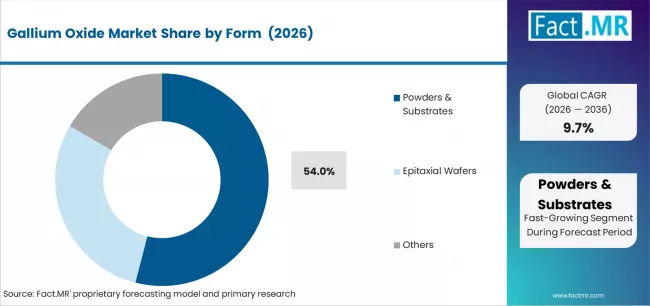
Gallium Oxide Market Analysis By Form | Source: Fact.MR
The powders & substrates form segment is projected to maintain its leading position in the gallium oxide market in 2025 with a 54.0% market share, reaffirming its role as the preferred material form for semiconductor manufacturing and comprehensive electronic device fabrication.
Semiconductor manufacturers and electronics developers increasingly utilize powders & substrates for their superior processing characteristics, excellent material quality, and proven performance in enabling advanced device fabrication while maintaining manufacturing efficiency and product reliability.
Powders & substrates technology's proven effectiveness and processing versatility directly address semiconductor requirements for material consistency and reliable device manufacturing across diverse electronic applications and fabrication processes.
This form segment forms the foundation of modern gallium oxide utilization, as it represents the material form with the greatest contribution to semiconductor manufacturing and established processing record across multiple electronic applications and device protocols. Electronics industry investments in advanced material processing technologies continue to strengthen adoption among manufacturers and device producers.
With increasing demand for high-quality semiconductor materials and proven manufacturing performance, powders & substrates align with both technical objectives and production requirements, making them the central component of comprehensive electronic device manufacturing strategies.
By Application, the Power Electronics Segment Dominates Market Demand
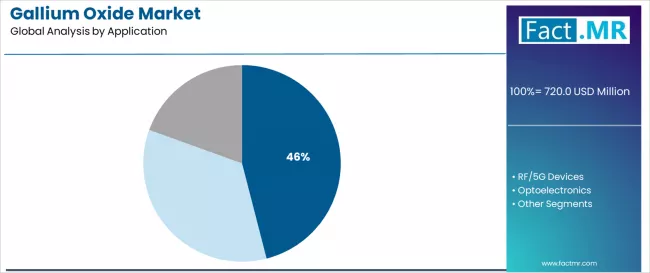
Gallium Oxide Market Analysis By Application | Source: Fact.MR
The power electronics application segment is projected to represent the largest share of gallium oxide demand in 2025 with a 46.0% market share, underscoring its critical role as the primary application for gallium oxide adoption across power conversion systems, electric vehicle chargers, and energy management devices.
Electronics engineers prefer gallium oxide for power electronics applications due to their exceptional electrical properties, comprehensive efficiency capabilities, and ability to support complex power conversion requirements while maintaining thermal stability and operational reliability objectives. Positioned as essential materials for modern power electronics systems, gallium oxide offers both performance advantages and efficiency benefits.
The segment is supported by continuous innovation in power electronics technology and the growing availability of advanced semiconductor devices that enable superior electrical performance with enhanced efficiency and improved thermal management coordination.
Additionally, power electronics systems are investing in comprehensive energy efficiency programs to support increasingly demanding performance standards and environmental requirements for effective and sustainable power conversion.
As power electronics standards advance and efficiency complexity requirements increase, the power electronics application will continue to dominate the market while supporting advanced gallium oxide utilization and energy optimization strategies.
By End User, the Semiconductor Fabs Segment Commands Market Leadership
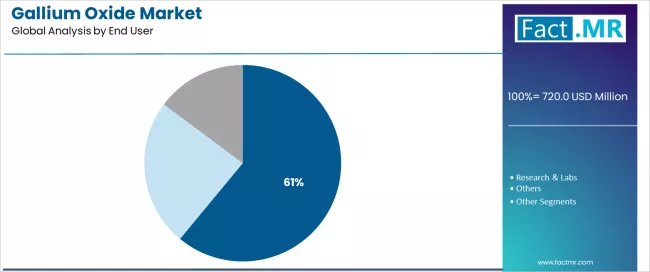
Gallium Oxide Market Analysis By End User | Source: Fact.MR
The semiconductor fabs end user segment is projected to maintain the largest share of gallium oxide consumption in 2025 with a 61.0% market share, highlighting its fundamental role in manufacturing-focused applications, device production, and electronics optimization.
Semiconductor manufacturers prefer semiconductor fabs for their comprehensive manufacturing benefits, advanced processing capabilities, and proven effectiveness in delivering high-performance electronic devices with superior material quality and consistent production performance. This segment represents the backbone of modern gallium oxide utilization across multiple semiconductor applications and manufacturing protocols.
The semiconductor fabs segment benefits from ongoing technological advancement in semiconductor manufacturing and the expanding adoption of advanced fabrication processes in electronic device applications.
Semiconductor fab demand continues to grow due to increasing preference for advanced electronic devices, rising performance requirements, and the need for manufacturing environments that can support complex production while maintaining material quality and device reliability.
As semiconductor applications become more sophisticated and manufacturing requirements increase, the semiconductor fabs end user segment will continue to drive market growth while supporting advanced gallium oxide manufacturing and electronics optimization strategies.
What are the Drivers, Restraints, and Key Trends of the Gallium Oxide Market?
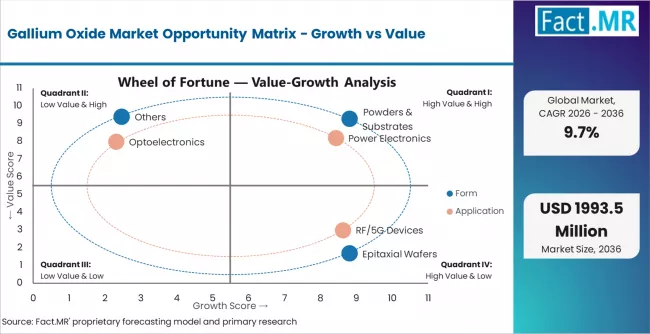
Gallium Oxide Market Opportunity Matrix Growth Vs Value | Source: Fact.MR
The gallium oxide market is advancing rapidly due to increasing electric vehicle adoption and renewable energy system deployment driven by environmental regulations and energy efficiency mandates, growing demand for 5G infrastructure and telecommunications advancement that require advanced semiconductor materials providing enhanced electrical performance and thermal management across diverse semiconductor fabrication facilities, power electronics systems, telecommunications infrastructure, and automotive applications.
However, the market faces challenges, including high material costs and production complexities, limited manufacturing capacity and supply chain constraints, and competition from alternative wide-bandgap materials and established semiconductor technologies. Innovation in crystal growth techniques and material processing continues to influence product development and market expansion patterns.
Expansion of Electric Vehicle Infrastructure and Power Electronics
The growing deployment of electric vehicle charging systems is driving demand for advanced power electronics that address high-efficiency requirements including rapid charging capabilities, improved energy conversion, and comprehensive thermal management support in automotive and infrastructure settings.
Electric vehicle applications require advanced gallium oxide materials that deliver superior electrical performance across multiple power parameters while maintaining reliability standards and operational efficiency.
Electronics manufacturers are increasingly recognizing the competitive advantages of gallium oxide integration for power conversion optimization and energy efficiency enhancement, creating opportunities for innovative materials specifically designed for next-generation electric vehicle applications.
Integration of 5G Infrastructure and RF Technologies
Modern telecommunications providers are incorporating 5G systems and RF technologies to enhance communication performance, address bandwidth requirements, and support comprehensive connectivity objectives through optimized signal processing and intelligent communication systems.
Leading companies are developing 5G-compatible devices, implementing RF enhancement systems, and advancing telecommunications technologies that maximize communication effectiveness while supporting high-frequency approaches. These technologies improve connectivity performance while enabling new market opportunities, including 5G applications, RF device systems, and telecommunications treatments.
Development of Advanced Crystal Growth and Manufacturing Technologies
The expansion of advanced crystal growth methods, manufacturing enhancement technologies, and precision material processing is driving demand for gallium oxide materials with enhanced crystal quality and specialized electronic capabilities.
These advanced applications require specialized material platforms with precise crystal control and exceptional electronic reliability that exceed traditional semiconductor requirements, creating premium market segments with differentiated electronic propositions.
Manufacturers are investing in advanced crystal growth capabilities and manufacturing system development to serve emerging high-performance applications while supporting innovation in advanced semiconductor materials and electronics optimization sectors.
Analysis of the Gallium Oxide Market by Key Countries
.webp "Top Country Growth Comparison Gallium Oxide Market Cagr (2026 2036)")
Top Country Growth Comparison Gallium Oxide Market Cagr (2026 2036) | Source: Fact.MR
| Country | CAGR (2026-2036) |
|---|---|
| USA | 11.2% |
| Mexico | 10.5% |
| Germany | 9.6% |
| France | 9.4% |
| UK | 9.3% |
| South Korea | 9.1% |
| Japan | 8.9% |
Source: Fact.MR analysis. Updated Mar 24, 2026
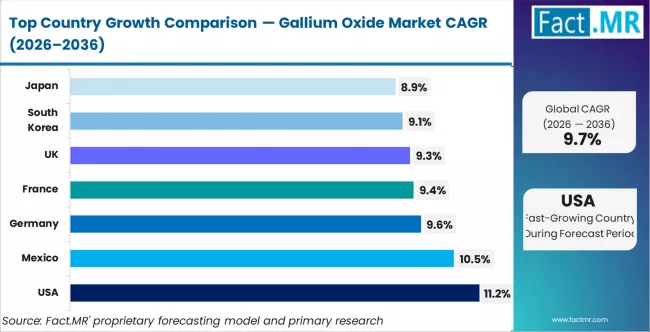
Gallium Oxide Market Cagr Analysis By Country | Source: Fact.MR
The gallium oxide market is experiencing robust growth globally, with the USA leading at an 11.2% CAGR through 2036, driven by expanding semiconductor infrastructure and growing electronics innovation, alongside increasing investment in advanced material technologies and power electronics development.
Mexico follows at 10.5%, supported by electronics manufacturing expansion, growing industrial infrastructure, and increasing demand for advanced semiconductor materials in domestic and regional markets.
Germany shows growth at 9.6%, emphasizing material technology innovation, semiconductor excellence, and advanced electronics development. France demonstrates 9.4% growth, supported by electronics advancement and material technology adoption. The UK records 9.3%, focusing on semiconductor innovation and electronics technology development.
South Korea exhibits 9.1% growth, emphasizing electronics modernization and semiconductor applications. Japan shows 8.9% growth, emphasizing quality standards and specialized semiconductor applications.
USA Leads Global Market Growth with Semiconductor Infrastructure and Innovation
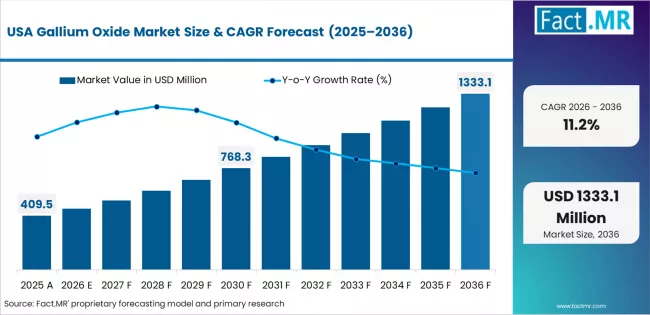
Gallium Oxide Market Country Value Analysis | Source: Fact.MR
Revenue from gallium oxide in the USA is projected to exhibit strong growth with a CAGR of 11.2% through 2036, driven by expanding semiconductor infrastructure and rapidly growing electronics sector supported by digital transformation initiatives and advanced material technology adoption.
The country's substantial semiconductor industry and increasing investment in power electronics technologies are creating substantial demand for advanced material solutions. Major semiconductor manufacturers and electronics companies are establishing comprehensive gallium oxide capabilities to serve both domestic markets and export opportunities.
- Strong semiconductor expansion and growing electronics innovation are driving demand for gallium oxide throughout major technology regions including Silicon Valley, Texas, and the Northeast technology corridors, supporting both semiconductor fabs and electronics manufacturers.
- Growing electric vehicle adoption and renewable energy deployment are supporting the rapid adoption of gallium oxide technologies among electronics providers seeking enhanced power efficiency capabilities and performance excellence in competitive technology markets.
Mexico Demonstrates Electronics Integration with Industrial Infrastructure Development
Revenue from gallium oxide in Mexico is expanding at a CAGR of 10.5%, supported by electronics manufacturing growth, expanding industrial infrastructure, and strategic position as an electronics hub for Latin American markets.
Mexico's industrial development and electronics technology advancement are driving sophisticated gallium oxide capabilities throughout manufacturing sectors. Leading electronics manufacturers and material companies are establishing extensive production facilities to address growing domestic electronics and regional market demand.
- Electronics modernization and expanding manufacturing infrastructure are creating opportunities for gallium oxide adoption across semiconductor systems, electronics facilities, and manufacturing centers in major industrial regions including Northern Mexico and electronics development zones.
- Growing electronics sector and material technology expansion are supporting the adoption of advanced semiconductor materials among manufacturers seeking to serve both domestic and international markets while maintaining electronics standards and material effectiveness.
Germany Demonstrates Material Excellence with Semiconductor Innovation
Revenue from gallium oxide in Germany is expanding at a CAGR of 9.6%, driven by the country's material technology leadership, semiconductor innovation capabilities, and precision manufacturing excellence supporting high-performance gallium oxide applications.
Germany's materials expertise and electronics technology innovation are driving demand for specialized gallium oxide solutions throughout semiconductor sectors. Leading material manufacturers and electronics providers are establishing comprehensive innovation programs for next-generation semiconductor technologies.
- Advanced material technology development and semiconductor innovation requirements are creating demand for specialized gallium oxide materials among manufacturers and electronics companies seeking enhanced electronic performance and material reliability in competitive European markets.
- Strong materials industry expertise and semiconductor technology leadership are supporting the adoption of advanced gallium oxide technologies and electronics optimization across semiconductor facilities throughout major technology regions including Bavaria and Baden-Württemberg.
France Shows Electronics Excellence and Material Innovation Leadership
Revenue from gallium oxide in France is expanding at a CAGR of 9.4%, supported by the country's electronics excellence, material innovation leadership, and pioneering semiconductor advancement initiatives including power electronics procedures and precision material development.
France's electronics heritage and material expertise are supporting investment in advanced gallium oxide technologies. Major electronics providers and material technology companies are establishing comprehensive semiconductor programs incorporating gallium oxide advancement and electronics innovation.
- Advanced electronics innovation and material technology capabilities are creating demand for premium gallium oxide products supporting electronics excellence, semiconductor advancement, and technology optimization throughout major electronics and material technology regions.
- Strong electronics focus and material technology leadership are driving the adoption of advanced semiconductor materials and electronics enhancement throughout manufacturing facilities across electronics excellence clusters and innovation zones.
UK Focuses on Electronics Innovation and Semiconductor Technology Development
Revenue from gallium oxide in the UK is growing at a CAGR of 9.3%, driven by the country's electronics innovation, semiconductor technology development initiatives, and emphasis on advanced material solutions for electronics and semiconductor applications.
The UK's electronics research excellence and technology commitments are supporting investment in advanced gallium oxide technologies. Major electronics providers and material technology companies are establishing comprehensive semiconductor programs incorporating advanced gallium oxide formulations.
- Electronics innovation and semiconductor development requirements are creating demand for high-performance gallium oxide materials supporting semiconductor advancement, electronics innovation, and technology optimization throughout major electronics and material technology regions.
- Strong research capabilities and technology mandates are driving the adoption of advanced semiconductor materials and electronics enhancement supporting superior electronic performance and technology leadership in competitive global markets.
South Korea Demonstrates Electronics Leadership with Semiconductor Technology Focus
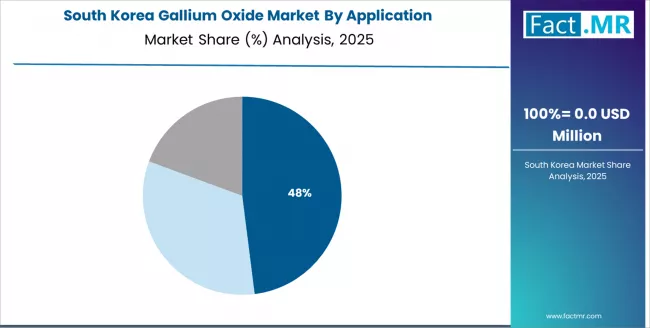
Gallium Oxide Market South Korea Market Share Analysis By Application | Source: Fact.MR
Revenue from gallium oxide in South Korea is expanding at a CAGR of 9.1%, supported by the country's electronics modernization, semiconductor technology expertise, and strong emphasis on advanced material solutions for comprehensive electronics and semiconductor applications.
South Korea's electronics sophistication and technology innovation focus are driving sophisticated gallium oxide capabilities throughout electronics sectors. Leading electronics providers and semiconductor technology companies are investing extensively in advanced material technologies.
- Advanced electronics development and semiconductor technology innovation are creating demand for specialized gallium oxide products throughout electronics applications, semiconductor systems, and manufacturing facilities in major technology regions including Seoul Capital Area and electronics innovation zones.
- Strong electronics industry and semiconductor expertise are supporting the adoption of innovative material technologies and electronics optimization for next-generation applications requiring superior electronic performance and technology excellence.
Japan Shows Quality Excellence Focus with Specialized Semiconductor Applications
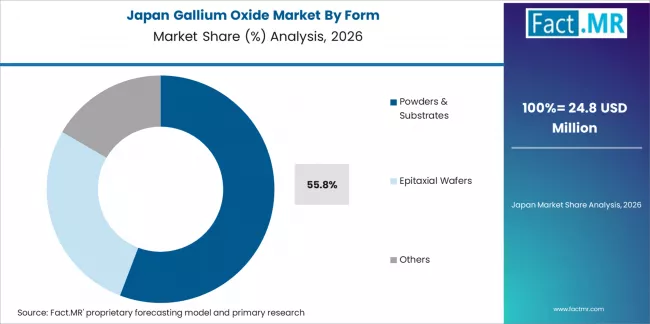
Gallium Oxide Market Japan Market Share Analysis By Form | Source: Fact.MR
Revenue from gallium oxide in Japan is expanding at a CAGR of 8.9%, supported by the country's quality excellence standards, specialized electronics capabilities, and strong emphasis on high-specification semiconductor materials for advanced electronics and semiconductor sectors.
Japan's quality sophistication and electronics excellence are driving demand for premium gallium oxide products. Leading electronics providers and semiconductor technology companies are investing in specialized capabilities for advanced electronics applications.
- Advanced electronics processing and quality manufacturing requirements are creating opportunities for high-quality gallium oxide products throughout specialized semiconductor production, electronics manufacturing, and technology applications meeting stringent quality and performance standards.
- Strong electronics industry and semiconductor sector are driving adoption of specialized gallium oxide technologies and advanced material systems supporting innovation in electronics advancement, semiconductor development, and technology sectors requiring superior electronic performance and consistency.
Europe Market Split by Country
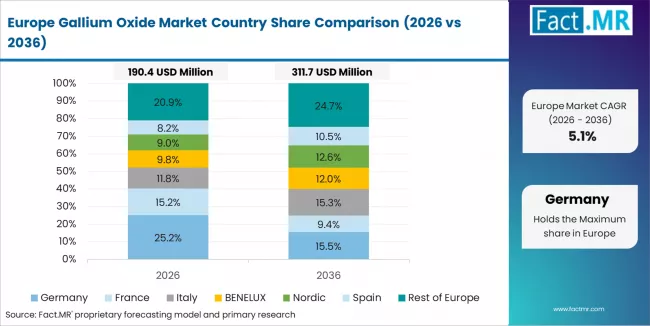
Gallium Oxide Market Europe Country Market Share Analysis, 2026 & 2036 | Source: Fact.MR
The gallium oxide market in Europe is projected to grow from USD 205.0 million in 2026 to USD 518.0 million by 2036, registering a CAGR of 9.7% over the forecast period. Germany is expected to maintain its leadership position with a 26.8% market share in 2026, declining slightly to 26.3% by 2036, supported by its advanced semiconductor industry and materials technology capabilities.
France follows with a 21.9% share in 2026, projected to reach 22.2% by 2036, driven by comprehensive electronics development and semiconductor technology industry applications. The United Kingdom holds a 19.1% share in 2026, expected to decrease to 18.7% by 2036 due to market diversification. Italy commands a 14.4% share, while Spain accounts for 11.3% in 2026.
The Rest of Europe region is anticipated to gain momentum, expanding its collective share from 6.5% to 7.0% by 2036, attributed to increasing semiconductor adoption in Nordic countries and emerging Eastern European electronics markets implementing advanced material technologies.
Powders & Substrates Applications Dominate Electronics Services in Japan
The Japanese gallium oxide market demonstrates a mature and precision-focused landscape, characterized by advanced integration of powders & substrates technologies with existing semiconductor infrastructure across manufacturing facilities, electronics networks, and technology operations.
Japan's emphasis on quality excellence and electronic precision drives demand for high-reliability gallium oxide solutions that support comprehensive semiconductor initiatives and regulatory requirements in electronics operations.
The market benefits from strong partnerships between international material providers like Sumitomo Metal Mining, Materion, and domestic electronics leaders, including established semiconductor companies and materials specialists, creating comprehensive service ecosystems that prioritize material quality and electronic precision programs.
Power Electronics Applications Lead Technology Services in South Korea
The South Korean gallium oxide market is characterized by strong international electronics application presence, with companies like II-VI, Kyma Technologies, and Kojundo Chemical maintaining dominant positions through comprehensive system integration and electronics services capabilities for technology modernization and semiconductor applications.
The market is demonstrating a growing emphasis on localized electronics support and rapid deployment capabilities, as Korean electronics providers increasingly demand customized solutions that integrate with domestic semiconductor infrastructure and advanced technology systems deployed across major manufacturing centers and electronics facilities.
Local materials companies and regional electronics integrators are gaining market share through strategic partnerships with global providers, offering specialized services including semiconductor training programs and certification services for electronics specialists.
Competitive Landscape of the Gallium Oxide Market
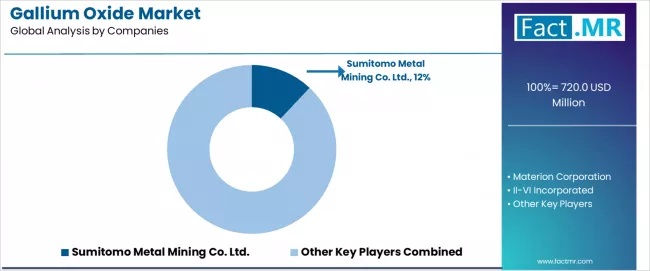
Gallium Oxide Market Analysis By Company | Source: Fact.MR
The gallium oxide market is characterized by competition among established material manufacturers, specialized semiconductor material producers, and diversified technology companies.
Companies are investing in advanced crystal growth technology development, material purity innovation, product portfolio expansion, and application-specific material development to deliver high-performance, reliable, and electronically effective gallium oxide solutions.
Innovation in crystal technology advancement, manufacturing process integration, and specialized material systems is central to strengthening market position and competitive advantage.
Sumitomo Metal Mining leads the market with a 12.0% share, offering comprehensive gallium oxide solutions with a focus on semiconductor applications, advanced material technologies, and integrated electronics platforms across diverse semiconductor and electronics distribution channels.
The company has announced major technology advancement initiatives and investments in crystal growth integration to support growing global demand for advanced semiconductor materials and precision electronics solutions.
Materion provides innovative material solutions with emphasis on electronic excellence and purity technologies, while II-VI delivers specialized semiconductor products with focus on power electronics and technology applications.
Kyma Technologies offers comprehensive semiconductor solutions with gallium oxide offerings for multiple electronics categories, and Kojundo Chemical provides advanced material technologies with emphasis on crystal systems and electronics optimization.
TAIYO NIPPON SANSO specializes in substrate solutions with advanced gallium oxide technologies, while other key players including PDI, Novel Crystal, US Crystal, and Sparkle Tech contribute to market competition through specialized material capabilities and semiconductor expertise.
Gallium Oxide Market - Stakeholder Contribution Framework
Gallium oxide represents a specialized semiconductor material segment within electronics and technology applications, projected to grow from USD 720.0 million in 2025 to USD 1,820.0 million by 2035 at a 9.7% CAGR.
These advanced material products—primarily powders & substrates, epitaxial wafers, and specialized configurations for multiple applications—serve as critical technology materials in semiconductor fabs, research facilities, electronics systems, and technology institutions where electronic precision, device performance, and material reliability are essential.
Market expansion is driven by increasing power electronics demand, growing 5G adoption, expanding electric vehicle deployment, and rising demand for advanced semiconductor solutions across diverse semiconductor, electronics, telecommunications, and automotive sectors.
How Technology Regulators Could Strengthen Material Standards and Device Safety?
- Material Standards: Establish comprehensive technical specifications for gallium oxide, including purity requirements, performance standards, quality validation protocols, and reliability guidelines that ensure consistent effectiveness across semiconductor fabs, research facilities, electronics systems, and technology institutions.
- Device Safety Integration: Develop regulatory frameworks that incentivize advanced material practices, requiring manufacturers to implement quality management systems, utilize performance validation protocols, incorporate device safety procedures, and achieve measurable reliability improvements in gallium oxide development.
- Quality Assurance Requirements: Implement mandatory quality control standards for gallium oxide manufacturing, including purity testing protocols, performance verification measures, and reliability validation systems that ensure material effectiveness and device safety across diverse semiconductor applications.
- Semiconductor Grade Guidelines: Create specialized regulations for semiconductor-grade gallium oxide used in critical electronics, addressing stringent purity specifications, performance requirements, and regulatory validation specific to semiconductor applications requiring enhanced reliability and device protection.
- Innovation Support Programs: Provide regulatory facilitation and research incentives for development of next-generation material technologies that improve electronic outcomes, enhance device safety, and enable emerging applications in advanced semiconductors and power electronics systems.
How Industry Associations Could Advance Material Technology Standards and Market Development?
- Technology Best Practices: Develop comprehensive technical guidelines for gallium oxide selection, electronic optimization, and performance validation techniques that maximize technology effectiveness, ensure device safety, and maintain cost-effectiveness across semiconductor fabs, research facilities, and electronics applications.
- Device Safety Benchmarking: Establish industry-wide metrics for electronic performance, including technology efficacy assessment, device safety measurement, electronic outcome evaluation, and semiconductor application documentation that enable comparative analysis and drive continuous improvement toward technology optimization objectives.
- Professional Training Programs: Create specialized education initiatives for semiconductor engineers, electronics technicians, and technology professionals covering gallium oxide characteristics, electronics applications, performance requirements, and technology techniques across diverse semiconductor applications.
- Technology Standardization: Develop standardized testing methodologies for gallium oxide evaluation, including performance assessment, purity analysis, reliability validation, and application-specific technology metrics that facilitate objective material comparison and electronic validation.
- Semiconductor Collaboration: Facilitate partnerships between gallium oxide suppliers, electronics providers, research institutions, and technology organizations to advance material technology development, address emerging electronic challenges, and accelerate innovation in semiconductor applications.
How Gallium Oxide Manufacturers Could Drive Innovation and Market Leadership?
- Advanced Material Technologies: Invest in crystal growth enhancement, purity optimization, manufacturing development, and device safety improvement initiatives that enhance electronic effectiveness while maintaining material reliability and regulatory compliance in global markets.
- Specialized Material Development: Develop specialized gallium oxide with enhanced electronic characteristics, including optimized purity properties, improved crystal quality, increased performance levels, and application-specific reliability attributes for emerging semiconductor segments.
- Quality Control Integration: Implement intelligent quality systems with real-time purity monitoring, predictive performance assessment, automated reliability verification, and data analytics that optimize material performance, ensure electronic reliability, and reduce manufacturing complexity.
- Technology Support Services: Establish comprehensive customer service capabilities providing electronics consultation, technical assistance, performance troubleshooting, and material expertise that strengthen customer relationships and enable successful semiconductor implementation.
- Global Technology Excellence: Develop regional service networks, specialized electronics support management, reliable technical support systems, and responsive customer service that ensure consistent material availability, maintain technology quality, and support customer semiconductor requirements worldwide.
How End-User Industries Could Optimize Electronic Performance and Technology Success?
- Strategic Material Selection: Conduct comprehensive assessments of electronic requirements, device needs, regulatory constraints, and operational considerations to optimize gallium oxide selection and achieve desired technology characteristics while managing total electronic costs and device outcomes.
- Technology Optimization: Implement advanced electronic methodologies utilizing performance validation, reliability evaluation, and systematic technology assessment to maximize gallium oxide electronic benefits, minimize technology complexity, and optimize overall electronic effectiveness and device satisfaction.
- Device Performance Management: Develop optimized technology protocols, performance control procedures, and reliability validation that ensure effective gallium oxide utilization, maximize electronic benefits, and maintain consistent technology performance throughout semiconductor operations.
- Quality Technology Integration: Incorporate technology best practices, device performance principles, and electronic quality considerations into technology planning and electronic processes that support comprehensive semiconductor objectives and device excellence.
- Strategic Technology Partnerships: Establish strategic partnerships with gallium oxide suppliers for joint electronics programs, technology optimization initiatives, and co-innovation projects that address specific semiconductor challenges and accelerate material technology commercialization.
How Research Institutions Could Enable Material Technology Advancement?
- Technology Research Programs: Conduct fundamental investigations into gallium oxide technology, electronic mechanisms, technology optimization, and semiconductor applications that advance material understanding and enable breakthrough innovations in material technology and electronic science.
- Material Technology Development: Develop novel electronic methods, including advanced crystal techniques, purity approaches, and technology enhancement systems that improve electronic performance while maintaining device safety and cost effectiveness.
- Semiconductor Application Innovation: Investigate emerging applications for gallium oxide in power electronics, 5G systems, electric vehicles, and specialized semiconductor applications that create new market opportunities and expand technology potential.
- Technology Validation Services: Provide advanced material research services utilizing electronic validation, performance testing, semiconductor assessment, and technology evaluation methodologies that enable detailed understanding of gallium oxide properties and semiconductor applications.
- Material Technology Transfer: Facilitate technology commercialization through licensing agreements, startup incubation programs, technology publications, and collaborative research projects that accelerate material technology innovation adoption and strengthen industry-academia partnerships.
How Investors and Financial Enablers Could Support Material Technology Market Growth?
- Semiconductor Infrastructure Investment: Provide capital for gallium oxide manufacturing facility construction, production capacity expansion, and technology upgrade projects that address growing electronic demand while improving operational efficiency and technology performance.
- Material Technology Financing: Fund research and development of breakthrough gallium oxide technologies, including advanced crystal methods, manufacturing systems, and novel semiconductor applications that address current market limitations and create competitive advantages.
- Technology Development Support: Finance material technology innovation initiatives, performance validation programs, regulatory development, and technology advancement that enhance electronic capabilities and position manufacturers for long-term market acceptance and growth.
- Semiconductor Market Expansion: Support strategic acquisitions, market entry initiatives, distribution network development, and technology service capabilities that accelerate geographic expansion and strengthen competitive positions in high-growth semiconductor markets.
- Global Technology Development: Provide financing and technical assistance for gallium oxide facilities in developing economies, creating new material technology supply capabilities, supporting local semiconductor development, and expanding global market access for technology solutions.
Key Players in the Gallium Oxide Market
- Sumitomo Metal Mining Co. Ltd.
- Materion Corporation
- II-VI Incorporated
- Kyma Technologies Inc.
- Kojundo Chemical Laboratory Co. Ltd.
- Taiyo Nippon Sanso Corporation
- PDI (Pacific Digital Imaging/PDI Chemicals)
- Novel Crystal Technology Inc.
- US Crystal Inc.
- Sparkle Tech Co. Ltd.
Bibliography
- Novel Crystal Technology, Inc. (2024). Beta-Ga2O3 substrate product specifications. NCT.
- U.S. DARPA. (2024). SWITCHES programme: Ultra-wide bandgap semiconductor device development. DARPA.
- Kyma Technologies, Inc. (2024). Gallium oxide substrates: Product catalogue and specifications. Kyma.
- Tamura Corporation. (2024). Ga2O3 crystal growth: EFG technology development report. Tamura.
- Sumitomo Metal Mining Co., Ltd. (2024). High-purity gallium oxide: Product specifications. SMM.
- U.S. Air Force Research Laboratory (AFRL). (2024). Wide bandgap semiconductor materials research. AFRL.
This bibliography is provided for reader reference. The full Fact.MR report contains the complete reference list with primary research documentation.
This Report Addresses
- Market sizing and quantitative forecast metrics detailing the precise expenditure dedicated to gallium oxide across major industrial sectors through 2036.
- Segmentation analysis mapping the adoption patterns of specific form categories and evaluating the technical and economic factors driving segment share distribution.
- Regional deployment intelligence comparing growth trajectories across Asia Pacific, North America, Europe, Latin America, and Middle East and Africa.
- Regulatory compliance assessment analyzing how evolving standards and policies affect product specifications and market access in key consuming regions.
- Competitive posture evaluation tracking the positioning of leading producers and the structural factors determining competitive advantage.
- Capital investment strategic guidance defining the procurement and capacity planning considerations for industry participants.
- Supply chain risk analysis identifying the specific feedstock, logistics, and regulatory variables that constrain market expansion.
- Custom data delivery formats encompassing interactive dashboards, raw Excel datasets, and PDF narrative reports.
Segmentation
Scope of the Report
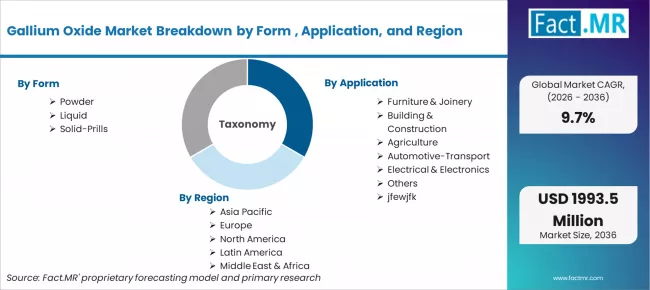
Gallium Oxide Market Breakdown By Form , Application, And Region | Source: Fact.MR
| Metric | Value |
|---|---|
| Quantitative Units | USD 789.84 million to USD 1993.45 million, at a CAGR of 9.7% |
| Market Definition | Gallium oxide (Ga2O3) is a ultra-wide-bandgap semiconductor material with five polymorphs, of which the beta phase (monoclinic) is thermodynamically stable and commercially relevant. Beta-Ga2O3 has a bandgap of 4.8 eV, the widest among commercially developed semiconductor materials, enabling high breakdown voltage, low on-resistance power devices. |
| Form Segmentation | Powders & Substrates, Epitaxial Wafers, Others |
| Application Segmentation | Power Electronics, RF/5G Devices, Optoelectronics |
| End User Segmentation | Semiconductor Fabs, Research & Labs, Others |
| Regions Covered | North America, Latin America, Europe, East Asia, South Asia, Oceania, Middle East & Africa |
| Countries Covered | USA, Mexico, Germany, France, UK, South Korea, Japan, and 40 plus countries |
| Key Companies Profiled | Sumitomo Metal Mining Co. Ltd., Materion Corporation, II-VI Incorporated, Kyma Technologies Inc., Kojundo Chemical Laboratory Co. Ltd., Taiyo Nippon Sanso Corporation, PDI (Pacific Digital Imaging/PDI Chemicals), Novel Crystal Technology Inc., US Crystal Inc., Sparkle Tech Co. Ltd. |
| Forecast Period | 2026 to 2036 |
| Approach | Hybrid top-down and bottom-up methodology reconciling production, trade, and consumption data with primary research validation. |
Source: Fact.MR analysis. Updated Mar 24, 2026
Gallium Oxide Market by Segments
-
Form :
- Powders & Substrates
- Epitaxial Wafers
- Others
-
Application :
- Power Electronics
- RF/5G Devices
- Optoelectronics
-
End User :
- Semiconductor Fabs
- Research & Labs
- Others
-
Region :
-
North America
- United States
- Canada
- Mexico
-
Europe
- Germany
- United Kingdom
- France
- Italy
- Spain
- Netherlands
- Nordic
- BENELUX
- Rest of Europe
-
Asia Pacific
- China
- Japan
- South Korea
- India
- Australia
- Rest of Asia Pacific
-
Latin America
- Brazil
- Argentina
- Chile
- Rest of Latin America
-
Middle East & Africa
- Kingdom of Saudi Arabia
- Other GCC Countries
- Turkey
- South Africa
- Other African Union
- Rest of Middle East & Africa
-
Frequently Asked Questions
How large is the demand for Gallium Oxide in the global market in 2026?
What will be the market size of Gallium Oxide in the global market by 2036?
What is the expected demand growth for Gallium Oxide in the global market between 2026 and 2036?
Which Form is poised to lead global sales by 2026?
How is the Application segment structured in this report?
What is the growth outlook for USA in this report?
What is Gallium Oxide and what is it mainly used for?
How does Fact.MR build and validate the Gallium Oxide forecast?
Who worked on this report


Preview the report firsthand - request a free sample
Free SampleGet the brochure for pricing and purchase details
Download PDF